
Best Commission-Only Sales Jobs for Recurring Income
Best Commission-Only Sales Jobs for Entrepreneurs Who Want Recurring Income
If you're already comfortable with commission-only sales jobs, the question probably isn't whether you can handle performance-based compensation.
You've already made that decision.
You may have spent years prospecting, handling rejection, running appointments, closing over the phone, sitting across from customers, presenting on Zoom, networking, or building relationships with business owners.
The bigger question is:
What are you getting in return for taking all of that risk?
A large commission?
Flexibility?
Control of your schedule?
Uncapped upside?
Those things matter.
But if you've spent years in commission sales, I think you should also be asking:
Does this opportunity build anything behind my production?
Because there is a major difference between making another commission and building a book of business.
A salesperson can make excellent money in a one-time commission industry and still wake up next month needing to recreate every dollar.
Another salesperson may work in a model where previous customers can continue generating renewal, recurring, or residual compensation while new customers are added.
Neither model is automatically better.
But they're economically very different.
For the experienced salesperson who is tired of constantly starting over, that distinction deserves serious attention.

Commission-Only Sales Isn't Automatically a Bad Deal
Commission-only sales gets criticized because the salesperson assumes a large amount of risk.
There may be no guaranteed base salary.
No hourly wage.
No promise that effort turns into a paycheck.
That's real.
But experienced commission salespeople already understand why the model can also be attractive.
You can have more control.
Compensation may be less restricted by a salary band.
Strong performers can potentially be rewarded disproportionately.
Independent roles may provide greater schedule flexibility.
And in the right industry, you may be able to build something that continues generating economics after the original sale.
Current job boards still show commission-only and independent sales opportunities across merchant services, SaaS, real estate, software, recurring B2B services, home services, and other industries. Some even advertise renewal or recurring commissions specifically rather than only one-time payouts.
So I don't think the question should be:
"Are commission-only sales jobs good or bad?"
The better question is:
"Which commission-only opportunity gives me the best return on the skills and risk I'm already bringing to the table?"
What I Would Compare Before Taking Any Commission-Only Role
If you're evaluating a commission-only opportunity, look beyond the headline commission.
A $10,000 commission can be fantastic.
But so can a smaller commission attached to a customer relationship that continues producing recurring income.
Before choosing an industry, I would compare:
Factor | What to Ask |
|---|---|
Upfront Compensation | How quickly can a productive salesperson create cash flow? |
Recurring Income | Can existing customers continue generating compensation? |
Book of Business | Does years of selling create something behind you? |
Startup Cost | How much money is required before you can reasonably begin? |
Licensing | Is industry licensing or certification required before selling? |
Lead Dependency | Can you create your own business or are you dependent on purchased leads? |
Remote Flexibility | Can prospecting, appointments, and closing happen remotely? |
Sales Skill Transfer | Can you use abilities you already have? |
Customer Demand | Are you selling something businesses or consumers already need? |
Long-Term Rights | What happens to recurring compensation if you leave? |
That's how I would evaluate the opportunities below.
Not:
"Who promises the biggest OTE?"
1. Merchant Services Sales
Merchant services is the industry I've spent more than 16 years building in, so naturally I know this model better than the others on this list.
The job is relatively straightforward conceptually.
Businesses need ways to accept payments.
A merchant-services salesperson helps those businesses obtain payment processing and related commerce technology through an established processing organization.
Depending on the partner, the salesperson can potentially receive upfront commissions, recurring residual income, or both.
The recurring component is what makes merchant services especially interesting to me.
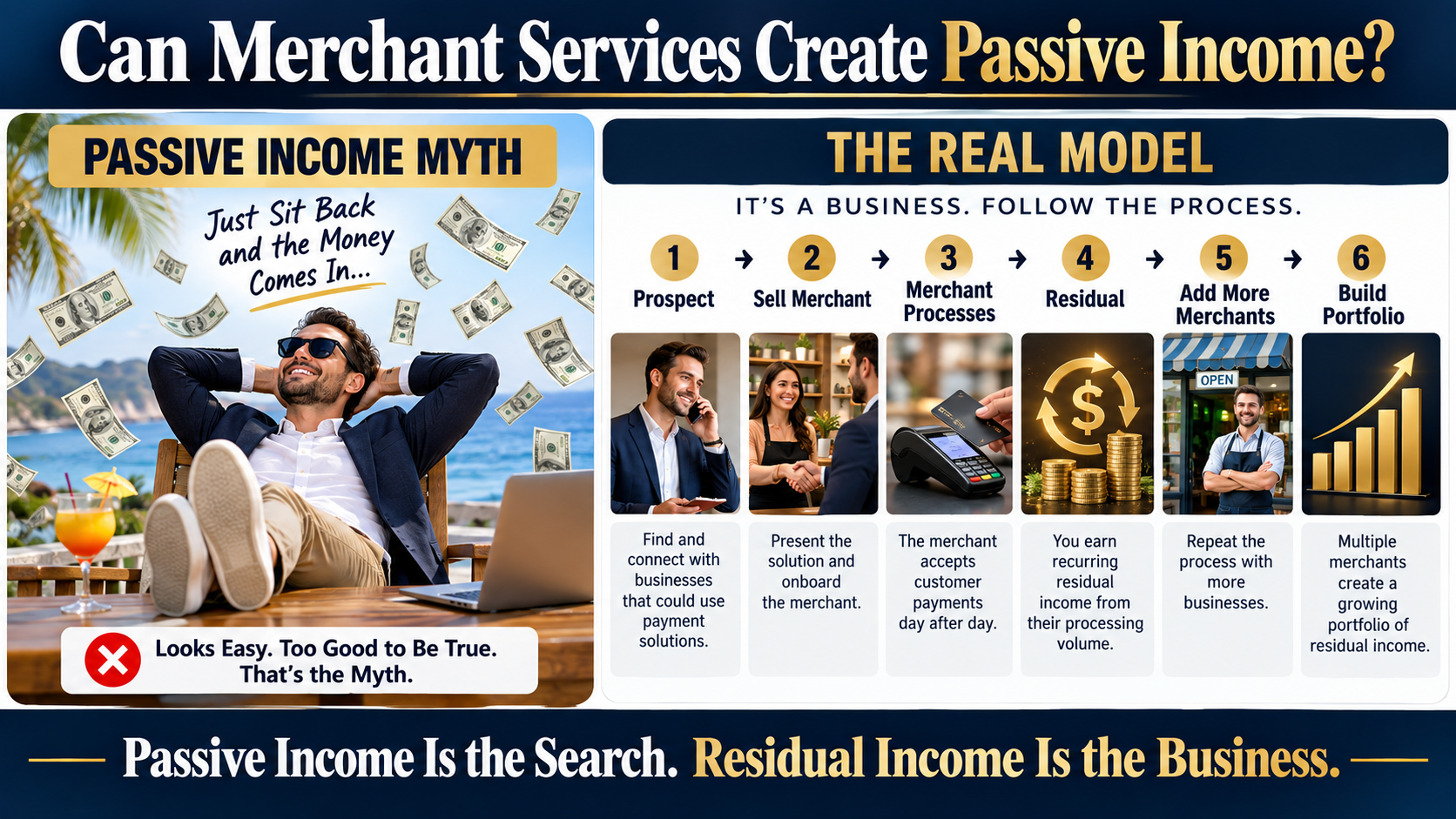
You can acquire Merchant A this month.
Merchant B next month.
Merchant C after that.
If those accounts remain active and your agreement protects your residual rights, previous merchants can potentially continue contributing to your compensation while you're adding new ones.
That's why I think in terms of a portfolio, not simply commissions.
Where Merchant Services Is Strong
For an experienced salesperson, merchant services can have a relatively low financial barrier to entry when working through an established partner.
You don't need to build the payment processor.
You don't need to manufacture the product.
You don't need to warehouse inventory.
You can prospect locally, over the phone, through referrals, networking, or existing business relationships.
And businesses already need payments.
Where Merchant Services Is Hard
You still have to prospect.
Merchants already receive payment-processing solicitations.
You need to learn the industry.
Merchant retention matters.
Your processing partner matters.
Your agent agreement matters.
And if you choose a poor partner, the residual opportunity can look very different from what the recruiting pitch promised.
That's why I tell people to learn merchant services before choosing a company.
If recurring income is what attracted you, also read Can Merchant Services Create Passive Income?
2. Insurance Sales
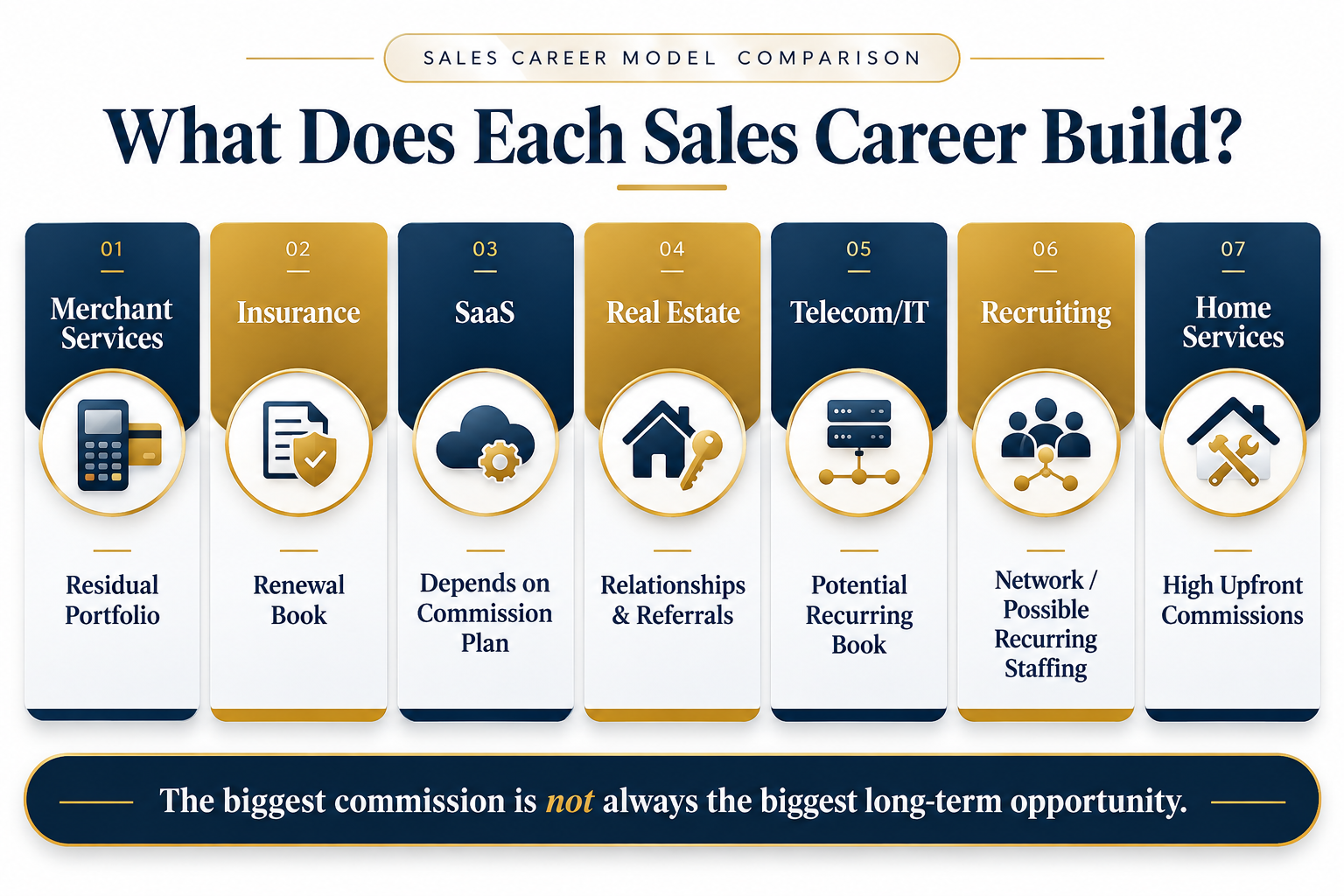
Insurance is one of the classic examples of a commission-driven career that can potentially build a book of business.
Depending on the line of insurance, compensation may include new-business commissions and renewal economics.
That makes insurance interesting for someone thinking long term.
A productive agent can potentially build customer relationships that remain valuable beyond the original policy sale.
Where Insurance Is Strong
There is real consumer and business demand.
Many lines create natural renewal cycles.
Relationship selling matters.
Referral networks can become powerful.
A salesperson who enjoys building trust and maintaining long-term client relationships can do very well with the model.
Where Insurance Can Be Harder to Enter
Licensing is a meaningful difference.
Insurance producers generally need the appropriate state licensing for the products they sell.
Different lines of insurance also require very different knowledge.
You may need to build deep expertise around products, underwriting, regulations, and policy structures.
That's not a negative.
It's simply part of the barrier to entry.
For someone saying:
"I want to be selling by next week without spending months preparing for a license,"
another industry may fit better.
For someone who loves insurance and wants to build a long-term book, licensing may be completely worth it.
3. SaaS and Recurring Software Sales
Software can be a fantastic sales industry.
Businesses increasingly rely on recurring software subscriptions, which means the underlying company benefits from monthly or annual recurring revenue.
Some commission-only or independent software opportunities also give salespeople recurring commissions while accounts remain active. Current listings include software and other subscription-based roles advertising recurring commission structures.
That can make SaaS attractive to a strong B2B salesperson.
Where SaaS Is Strong
Remote selling works extremely well.
Zoom closers can transition naturally.
Phone prospecting is common.
Recurring subscription economics create the possibility for recurring compensation when the pay plan supports it.
A strong product solving an obvious business problem can be compelling to sell.
Where SaaS Can Be Weaker for the Independent Entrepreneur
Not every SaaS company pays residual commissions to the salesperson.
A business may collect recurring revenue while the rep receives only a one-time commission.
That distinction matters.
You need to ask:
Does the company have recurring revenue, or do I have recurring compensation?
Those are not the same thing.
You should also understand what happens to your book if you leave.
Some programs may stop recurring commissions when the sales relationship ends.
That's why the agreement still matters even outside merchant services.
4. Real Estate Sales
Real estate is one of the most recognizable commission-only careers.
A strong agent can build an impressive income through transactions, referrals, reputation, and eventually a team.
The sales skills are extremely transferable.
Relationship building.
Networking.
Follow-up.
Negotiation.
Local prospecting.
Referral development.
Where Real Estate Is Strong
A successful transaction can create a meaningful commission.
Relationships can create repeat customers and referrals.
An experienced agent can eventually build a strong local brand.
The industry also rewards networking heavily.
Where It Differs From a Residual Model
The customer relationship can continue producing referrals and future transactions, but the typical commission is tied to another transaction occurring.
You generally don't sell a home once and receive a monthly commission while the buyer continues living there.
That's fundamentally different from a recurring-residual structure.
Real estate can create an excellent relationship asset.
It doesn't usually create the same type of monthly transactional residual that merchant services can.
And like insurance, real-estate sales typically requires state licensing.
5. Telecom, Managed IT, and Recurring B2B Services
This category deserves more attention.
Telecom.
Internet services.
Managed IT.
Cybersecurity.
Business communications.
Other recurring B2B services.
These industries can sometimes offer commission plans tied to recurring customer revenue.
Current managed-services recruiting offers, for example, include programs paying salespeople monthly recurring commissions while clients remain active.
That creates a legitimate book-of-business opportunity.
Where Recurring B2B Services Are Strong
Business customers can remain for years.
Products are often essential.
Relationship-based prospecting works.
Existing business-owner networks can be valuable.
Phone and Zoom selling can translate extremely well.
Where It Gets More Complicated
Products can become technical quickly.
You need to understand enough technology to speak credibly.
Some deals involve long sales cycles.
And again, compensation varies dramatically.
The service provider may have fantastic recurring revenue while offering the salesperson very little residual participation.
Always distinguish:
The company's recurring revenue
from
your recurring revenue.
6. Recruiting and Staffing
Recruiting can be an outstanding career for someone who knows how to prospect both clients and candidates.
A talented recruiter uses many of the same skills as a strong salesperson:
Cold outreach.
Discovery.
Relationship management.
Negotiation.
Follow-up.
Closing.
Networking.
Where Recruiting Is Strong
High-value placements can create substantial fees.
Certain staffing models create ongoing revenue while placed workers remain billing.
A talented recruiter can build an impressive network that compounds over time.
Where It Can Feel Like Starting Over
Traditional direct-hire recruiting is often still transactional.
You fill the position.
You receive your commission.
Then you need another opening and another candidate.
Staffing arrangements can create more recurring economics than one-time placement models, but compensation structure varies.
It can be a great business.
Just understand whether you're building recurring economics or simply a better pipeline.
7. Solar, Roofing, Home Improvement, and Other High-Ticket Field Sales
These industries attract aggressive closers for a reason.
A single sale can generate a substantial commission.
Door-to-door experience can be extremely valuable.
Experienced outside salespeople may be able to create significant cash flow much faster than in a residual model that needs time to accumulate.
Where High-Ticket Field Sales Is Strong
Large commissions.
Clear customer problems.
Strong fit for door-to-door prospectors.
A productive salesperson can create immediate income.
Where the Tradeoff Appears
The commission is typically concentrated around the transaction.
You install the roof.
Sell the solar system.
Complete the project.
Then go find another customer.
You may build referrals and reputation, but yesterday's closed project usually isn't producing a monthly residual check indefinitely.
This does not make these industries inferior.
In fact, a salesperson prioritizing cash flow today may prefer them.
But the economic model is different.
So Which Commission-Only Sales Job Is Best?
It depends on what you're optimizing for.
If your number-one goal is the largest possible commission this month, a high-ticket one-time sales environment may be more attractive than a business where recurring income takes time to build.
If you want licensing to create a barrier to entry and you enjoy long-term client relationships, insurance may be attractive.
If you love technology and remote B2B selling, SaaS may fit.
If you love networking, local branding, and large transactions, real estate may be an excellent career.
If you understand technology deeply, managed IT or telecom could be compelling.
If you love recruiting people and building professional networks, staffing may fit.
And if you're already a strong salesperson who wants relatively low startup overhead, existing B2B demand, upfront income potential, and the opportunity to build recurring portfolio economics, merchant services deserves serious consideration.
Not because it is universally the best sales career.
Because it aligns unusually well with the skill set many experienced salespeople already have.
The Best Opportunity Depends on Your Existing Skill Set
This is the part I think career articles often miss.
They tell everyone:
Here are the best jobs.
But the better question is:
Which opportunity makes your existing skills most valuable?
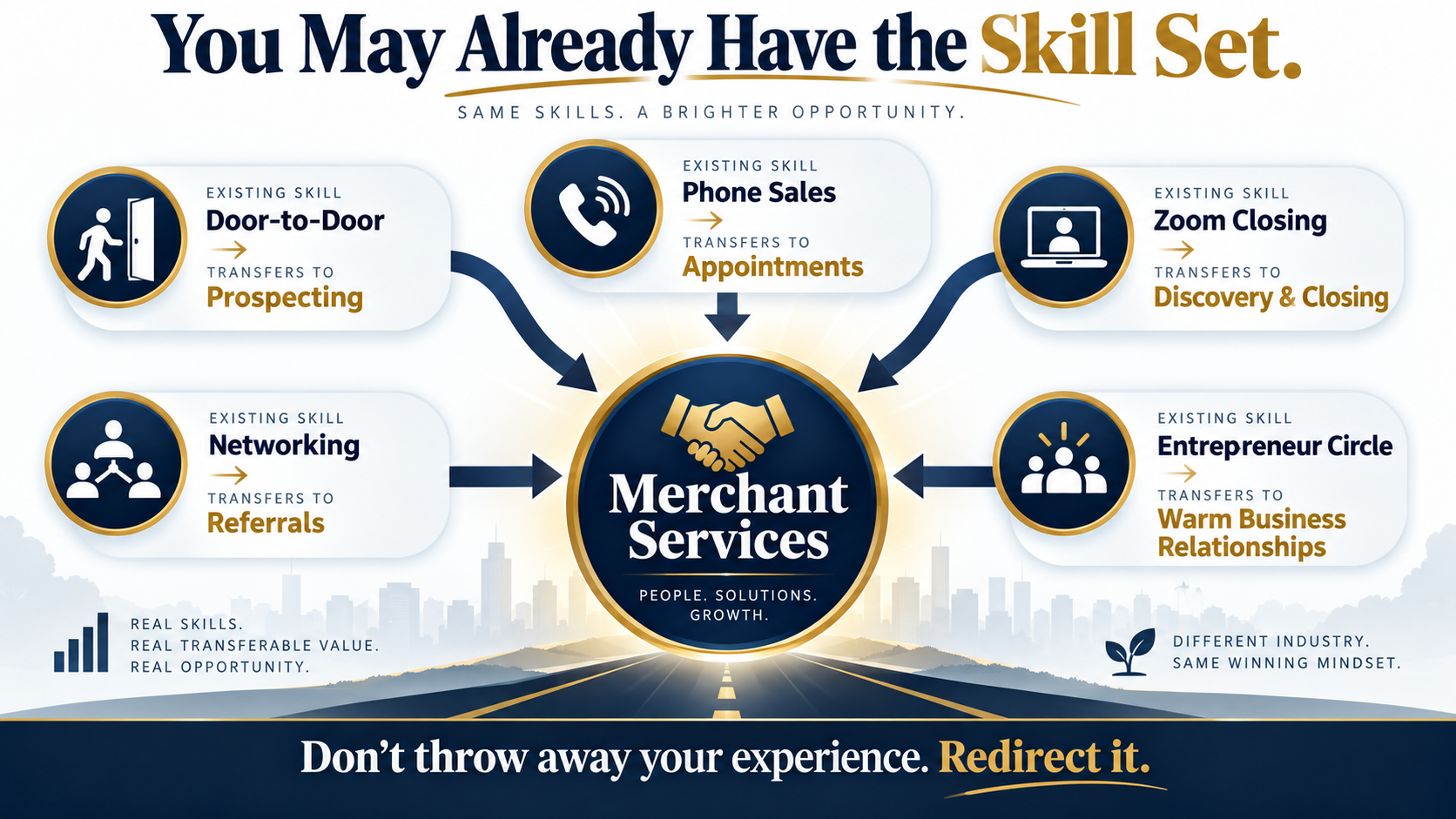
If You're Great Door to Door
You may be a natural fit for merchant services, roofing, solar, telecom, or other local B2B/field sales.
You already understand rejection and activity.
Don't underestimate how rare that skill is.
If You're a Phone Salesperson
Merchant services, SaaS, telecom, recruiting, and other B2B services can all leverage outbound calling.
If you've already made tens of thousands of cold calls, don't assume you need to completely change your business identity.
You may simply need a different offer.
If You're a Zoom Closer
SaaS is an obvious fit.
So are consulting and high-ticket services.
But merchant services can also be sold through phone-to-appointment and remote sales models.
You already understand discovery.
You already know how to present value.
You know how to ask for a decision.
Those are the difficult parts.
If You're a Networker
Insurance.
Real estate.
Merchant services.
Recruiting.
Financial services.
All can reward someone with strong relationships.
If your phone is already full of entrepreneurs and business owners, that network is an asset.
If You Already Sell B2B
Pay especially close attention to merchant services and recurring B2B service models.
You're already accustomed to decision-makers.
You understand business pain.
You can speak in terms of ROI rather than emotion alone.
You may already be most of the way toward the sales skill required.
The missing piece is learning the product.
Why Merchant Services Keeps Standing Out to Me
I obviously have a bias.
I've built my career in payments.
So I'm not going to pretend I'm an impartial career counselor.
But I can explain exactly why I've stayed.
First, businesses need payment processing.
We're not trying to convince businesses that accepting money is a new trend.
Second, an agent can work through established processing infrastructure rather than creating the technology themselves.
Third, the opportunity can support both immediate and recurring compensation depending on the program.
Fourth, the same skills that make someone successful in other sales industries transfer naturally.
Prospecting.
Discovery.
Closing.
Networking.
Follow-up.
Relationship management.
And fifth:
You can build a merchant portfolio.
That last point is the biggest one for me.
I don't want to spend my entire sales career restarting.
One-Time Commission vs. Recurring Commission
Imagine two jobs.
Job A pays $5,000 when you close a customer.
Job B pays $1,500 upfront and potentially provides recurring compensation from the customer relationship afterward.
Which should you take?
There isn't enough information.
You'd need to know:
How difficult is the sale?
How long does the customer stay?
What is the recurring payout?
What are your rights?
How much support is provided?
How many customers can you realistically acquire?
What happens if you leave?
This is why I don't like simplistic compensation comparisons.
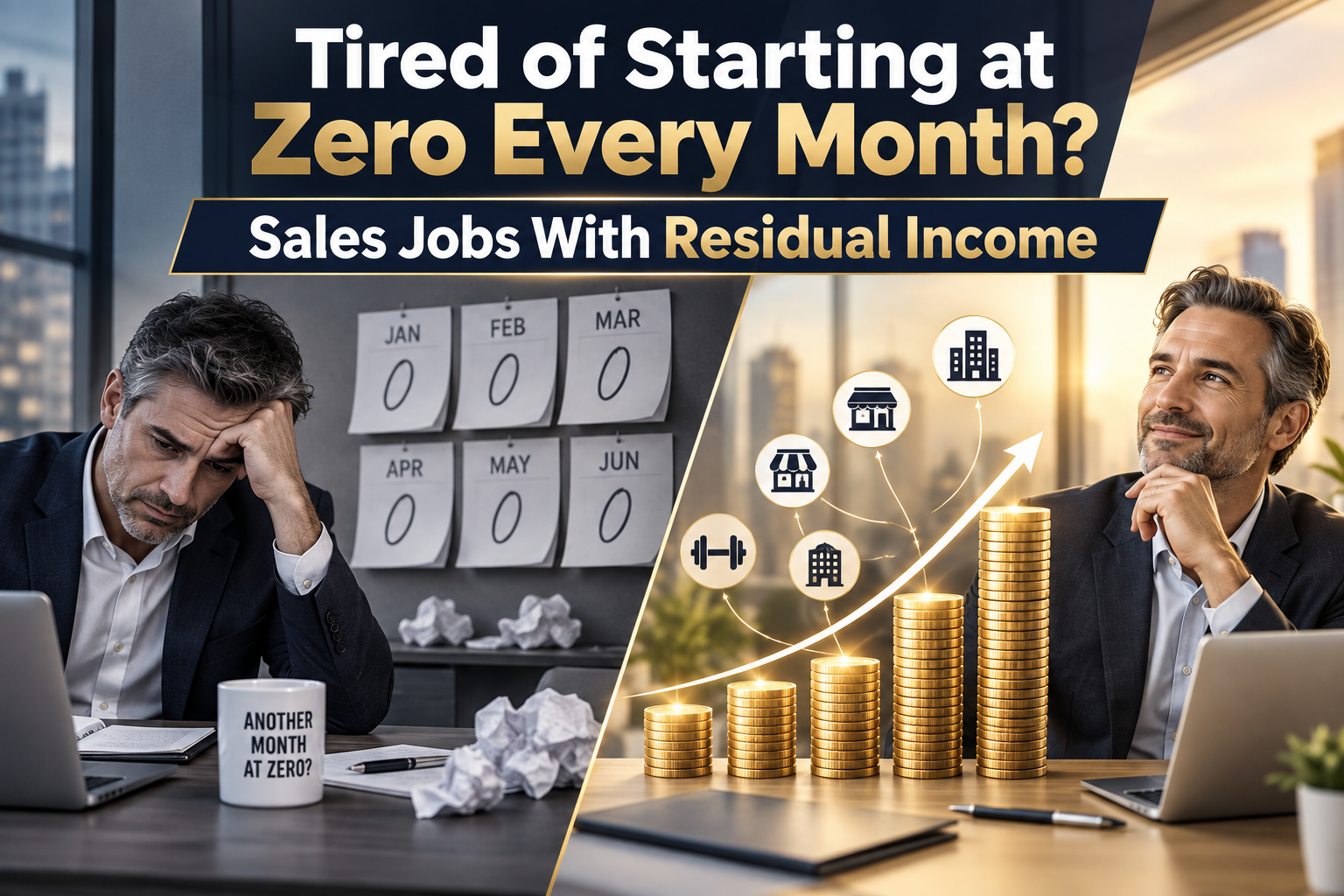
The larger concept is explained in Sales Jobs With Residual Income.
And our upcoming article How to Build Recurring Income as a Salesperson Without Starting Over Every Month will go deeper into how these economics can change over a career.
Residual Income Does Not Automatically Mean Better
This is important.
A terrible residual opportunity is still terrible.
Suppose you receive a small recurring commission, but:
The customers leave constantly.
You have no contractual rights.
The company can terminate the residual easily.
The product is bad.
Support is terrible.
The underlying economics are weak.
That is not automatically better than a large, clean, one-time commission.
If you're choosing a recurring-income opportunity, evaluate the quality of the recurring economics.
In merchant services, that means understanding things like residual splits, Schedule A costs, vesting, merchant retention, and the agent agreement.
Read Merchant Services Residual Splits Explained and What Lifetime Residuals Really Mean before believing that the word "residual" automatically means "great opportunity."
Commission-Only Means You Should Care More About the Agreement
Think about this.
You're taking the financial risk.
You receive no guaranteed salary.
You generate the customer.
You create the revenue.
So you should understand exactly what happens after you create it.
How are commissions calculated?
When are they paid?
Can they be clawed back?
What happens on cancellation?
Do residuals vest?
What happens if you leave?
Are there production requirements?
Who owns the customer relationship?
Every commission-only salesperson should ask those questions.
In merchant services, start with 11 Questions to Ask Before Signing a Merchant Services Agent Agreement.
The same philosophy applies in other industries:
Understand the contract governing the value you're creating.
Don't Overlook Startup Costs
Two opportunities may both call themselves commission-only but require radically different investments from the salesperson.
One may require licensing.
Another may require paid leads.
Another expects expensive software.
Another needs inventory.
Another may involve franchise or territory costs.
Another allows you to begin with a phone, basic business tools, training, and prospecting.
That's why our next article, Low-Cost Business Ideas for Salespeople Who Already Know How to Sell, matters.
If you're already bringing the sales ability, I'm not convinced you need to spend $25,000 simply to earn permission to use it.
Don't Buy Another Opportunity Before Understanding the Business
This is another pattern I've watched online.
A salesperson becomes frustrated.
They search for freedom.
They find someone marketing an opportunity.
The advertisement says:
Work from anywhere.
Unlimited income.
Build passive income.
Be your own boss.
Now they're paying thousands of dollars before they even understand the underlying business.
That's backwards.
I'm not saying all paid education is bad.
I'm saying you should understand what you're buying.
Our upcoming Online Business Ideas in 2026 article will go much deeper into how I evaluate a business model before buying into the dream.
Merchant Service University exists partly because I wanted people to have another path.

Take a Peek at Merchant Services Before Making a Career Decision
If you are already an experienced salesperson, I'm not asking you to sign up with a processing company because you read an article comparing sales careers.
Do something much simpler.
Learn the industry.
Go to MerchantServiceUniversity.com.
The core education is free.
Learn how payment processing works.
Understand how agents get paid.
Learn residuals.
Understand the Schedule A.
Learn what merchant agreements contain.
Learn modern commerce technology.
See how prospecting works.
Then decide whether the business fits your skill set.
You don't owe me a course payment.
You don't have to commit to one company.
Just take a peek.
Can You Combine Upfront Commissions With Residual Income?
In merchant services, potentially.
This is an important consideration for experienced commission-only salespeople.
A portfolio takes time to build.
You still need cash flow.
Some merchant-services partner programs offer both upfront compensation and ongoing residual economics.
One of the partners I work with can pay up to $10,000 upfront on certain qualified merchant accounts based on profitability and program requirements.
That is not what every merchant pays.
It is not guaranteed compensation.
Other partner relationships may offer different combinations of residuals, technology, underwriting, support, or upfront income.
That's why the goal isn't finding the company with the biggest number.
It's matching the compensation model to the business you're trying to build.
Read Upfront Commissions vs. Residual Income in Merchant Services for the full comparison.
What If You Want to Sell From Home?
This is another reason commission-only salespeople are increasingly looking at industries like SaaS and merchant services.
If you can prospect over the phone, run discovery remotely, conduct Zoom meetings, and manage follow-up digitally, much of the sales process can be built from a home office.
That doesn't mean you have to avoid in-person selling.
Some of the best merchant-services reps may combine both.
Phone prospecting Monday through Wednesday.
Appointments or local merchant visits later in the week.
Networking events.
Referral partnerships.
Video meetings when appropriate.
Your sales model can fit your strongest skills.
We're going deeper into this in Can You Sell Merchant Services From Home?.
What If You're Already Around Business Owners?
Then you have another advantage.
Think about your existing world.
Clients.
Friends.
Professional contacts.
Business networking groups.
Accountants.
Realtors.
Restaurant owners.
Contractors.
Consultants.
Retailers.
Gym owners.
Salon owners.
Entrepreneurs.
If you already know the people who own businesses, you may already have access to the customer merchant services serves.
Again, don't turn every relationship into an aggressive pitch.
Learn enough to recognize where you can actually help.
The relationship gets you a conversation.
The solution still needs to earn the business.
My Ranking Depends on What You're Trying to Build
If I had to summarize these industries for an experienced salesperson, I would think about them this way:
Want large transactional commissions?
Real estate and high-ticket home services can be compelling.
Want renewals and a traditional book?
Insurance deserves consideration.
Love technology and remote closing?
SaaS can be excellent.
Love recurring B2B relationships and technical services?
Telecom and managed IT can make sense.
Love talent, relationships, and deal-making?
Recruiting can be a strong career.
Want a low-overhead B2B sales model with existing business demand, flexible prospecting, potential upfront compensation, and recurring residual portfolio economics?
That's where merchant services becomes extremely interesting to me.
Not easiest.
Not guaranteed.
Interesting.
Especially for someone who already knows how to sell.
Frequently Asked Questions About Commission-Only Sales Jobs
What are the best commission-only sales jobs?
The best opportunity depends on the salesperson's goals and skills. Common commission-driven industries include merchant services, insurance, SaaS, real estate, telecom, recruiting, solar, roofing, and other high-ticket or recurring B2B services.
Which commission-only sales jobs offer residual income?
Residual or recurring compensation may be available in merchant services, insurance, certain SaaS programs, telecom, managed IT, and other subscription-based services. Compensation structures vary by company.
What is the difference between commission and residual commission?
A traditional commission is generally tied to a specific sale. A residual commission can potentially continue while the customer remains active or continues generating qualifying revenue according to the compensation agreement.
Are commission-only sales jobs worth it?
They can be for salespeople comfortable with income variability and performance-based compensation. The opportunity should be evaluated based on product demand, commission structure, recurring income, contract terms, support, startup costs, and the salesperson's ability to generate business.
Is merchant services a commission-only sales job?
Many independent merchant-services agent programs are commission-based. Compensation can include upfront payments, recurring residual income, or a combination depending on the program.
Is insurance better than merchant services?
Neither is universally better. Insurance can offer renewal economics and a strong book-of-business model but typically involves licensing. Merchant services can offer recurring residual economics through business accounts and may have a lower entry barrier for an independent sales agent through an established partner.
Is SaaS good for recurring commissions?
It can be, but not every SaaS company shares recurring subscription revenue with the salesperson. Salespeople should understand whether their commission continues after the original sale and what happens if they leave the company.
Does real estate offer residual income?
Traditional real-estate commissions are generally tied to transactions rather than monthly residual payments. Repeat customers, referrals, and a strong personal brand can still create significant long-term business value.
Which commission career is best for phone salespeople?
Merchant services, SaaS, telecom, recruiting, and other B2B services can all fit experienced outbound phone salespeople, depending on the products and sales process.
Which commission career is best for Zoom closers?
SaaS, consulting, high-ticket services, and merchant services can all leverage discovery, remote presentations, objection handling, and closing skills.
Can existing business relationships help in merchant services?
Yes. A network of entrepreneurs and business owners can provide a meaningful starting point for merchant-services prospecting and referrals, although relationships do not guarantee sales.
Can I learn merchant services without paying for a course?
Yes. The core Merchant Service University education is free and does not require students to join one specific processing company.
Where should I start if merchant services interests me?
Begin by learning the business at MerchantServiceUniversity.com. Then use How to Become a Merchant Services Agent in 2026 to understand the complete path.
Final Takeaway: If You're Already Betting on Yourself, Make Sure the Bet Can Build Something
Commission-only sales isn't for everybody.
But if you've already spent years working without a guaranteed paycheck, prospecting when nobody forces you to, handling rejection, and trusting your ability to produce, then you are already accepting a level of risk most people won't.
You should ask what you're receiving in exchange for that risk.
Another commission?
That's fine.
But what about the customer?
What about next month?
What about five years from now?
What did your previous sales build?
Maybe you're excellent at door-to-door.
Maybe your phone is your weapon.
Maybe you're a killer Zoom closer.
Maybe networking is your advantage.
Maybe you've spent ten years building relationships with entrepreneurs.
Don't throw those skills away because you're frustrated with your current industry.
Redirect them.
Find the business model where your strongest abilities create the most long-term value.
For some people, that will be insurance.
For others, SaaS.
Real estate.
Recruiting.
Telecom.
Home services.
And for the right salesperson, I think merchant services deserves a serious look.
Not because it's easy.
Because businesses already need the product, you can leverage an established company's backend infrastructure, experienced sales skills translate well, and the compensation model can potentially allow you to build a recurring merchant portfolio behind your new production.
If that interests you, don't make a career decision today.
Go to MerchantServiceUniversity.com.
Take a peek at the free core education.
Understand the industry.
Then decide whether your existing sales skills may have found a better vehicle.
You're already betting on yourself.
Make sure the business model is worth the bet.
About Joe Wagner
Joe Wagner has spent more than 16 years in merchant services and payment-processing sales, acquiring merchants, developing sales organizations, and building recurring merchant portfolios.
He created Merchant Service University to give new and experienced salespeople free foundational education before asking them to choose a processing partner.
Joe works with sales professionals from backgrounds including in-person sales, phone sales, high-ticket closing, networking, B2B relationship development, and entrepreneurial business development who want to understand whether their existing skills can transfer into merchant services.
After education and certification, Joe can also help qualified agents evaluate potential processing partners based on residual economics, upfront compensation, technology, underwriting, support, and long-term portfolio goals.
Continue with Sales Jobs With Residual Income, Merchant Services Passive Income, Low-Cost Business Ideas for Salespeople, Sales Careers That Build a Book of Business, or How to Become a Merchant Services Agent in 2026.