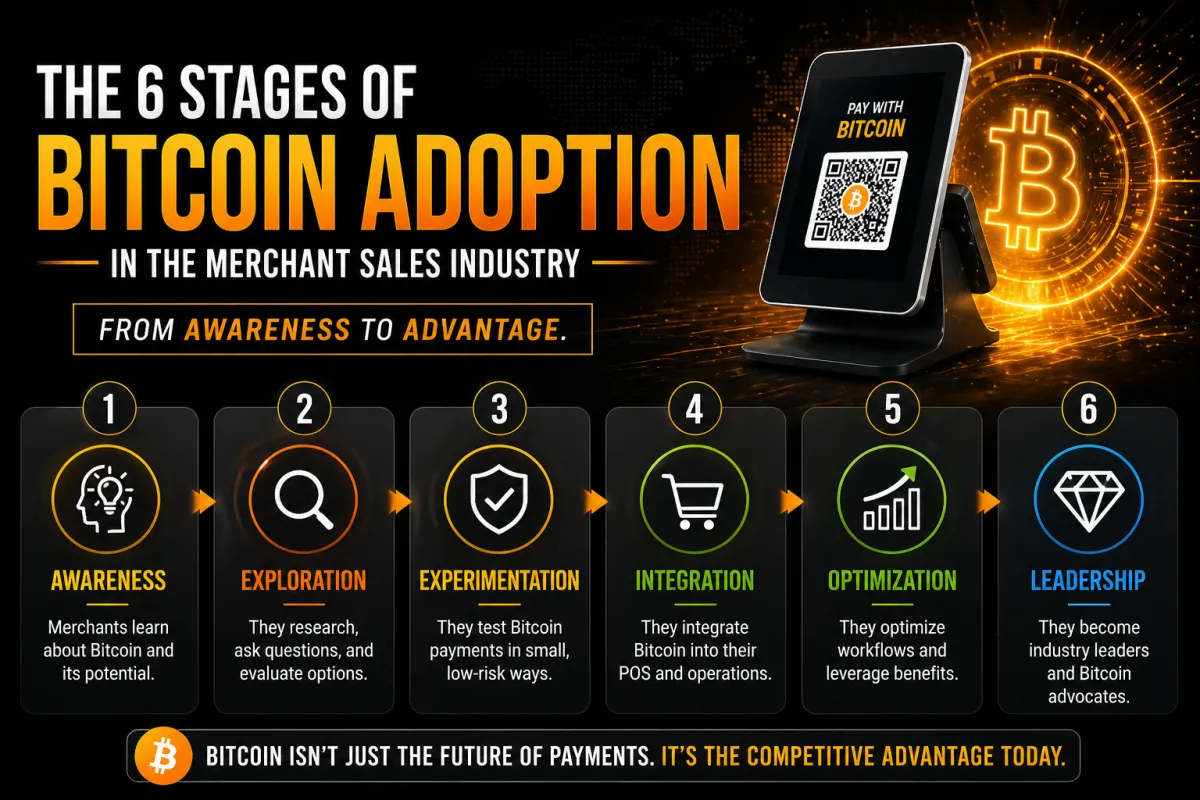
The 6 Stages of Bitcoin Adoption in the Merchant Sales Industry
The 6 Stages of Bitcoin Adoption: What Crypto Payments Mean for the Future of Merchant Services
When I originally started talking about Bitcoin and merchant services, I wasn't doing it because I believed every business owner needed to become a cryptocurrency expert. I was paying attention because Bitcoin provides a great example of something much bigger happening throughout the payments industry: new ways of moving money are continually being introduced, simplified, integrated, and eventually accepted by mainstream businesses.
That's the real lesson merchant sales professionals should understand.
The payment processing industry has never stopped evolving. We moved from predominantly cash transactions to widespread card acceptance. Then came ecommerce, mobile payments, contactless payments, digital wallets, integrated POS systems, faster funding options, and increasingly sophisticated business technology. Bitcoin and other cryptocurrency payment methods represent another potential payment rail within that continuing evolution.
Whether Bitcoin ultimately becomes a major form of everyday commerce or remains more important within certain industries and use cases isn't the most important point for a merchant sales professional. The lesson is understanding how payment technology gets adopted and why modern commerce systems increasingly need the flexibility to support the ways customers want to pay.
Why Bitcoin Adoption Matters to the Merchant Sales Industry
The merchant sales industry has historically been shaped by consumer behavior. When customers began carrying credit cards, businesses needed card terminals. When customers began shopping online, merchants needed ecommerce capabilities. When consumers became comfortable tapping phones and watches at checkout, contactless acceptance became increasingly important.
Bitcoin and crypto payments should be viewed through that same lens.
A good merchant sales professional doesn't need to convince every merchant to accept every payment method available. That's not our job. Our job is to understand what's changing, identify whether it matters to a particular business, and help that merchant choose technology capable of evolving with its customers.
I look at Bitcoin adoption as happening through six general stages. These aren't official industry classifications. They're simply a framework I've developed for understanding how new technologies move from something businesses barely understand to something that can eventually become integrated into everyday commerce.
Stage 1: Bitcoin Is Unknown to the Merchant
Every new technology begins here. During the earliest stage, most business owners either haven't heard about the technology or don't see any reason it should matter to their business.
Bitcoin spent years in this category for mainstream merchants. It was something discussed primarily by technology enthusiasts, investors, and people already involved with cryptocurrency. A local restaurant, retailer, salon, auto shop, or professional service company generally had little reason to think about accepting it.
That's normal. Businesses don't adopt technology simply because it exists. Adoption usually begins when the technology solves a problem or enough customers begin creating demand for it.
Stage 2: Businesses Become Skeptical
Awareness usually creates skepticism before it creates adoption. A business owner may have heard about Bitcoin but immediately think about volatility, complexity, regulation, accounting, security, or whether any of their customers would actually use it.
Those are reasonable questions.
This is also where sales professionals need to be careful. Our job isn't to become evangelists for a technology simply because it's new. If a payment method doesn't provide meaningful value to a merchant, there is no reason to force it into the conversation.
Good merchant sales is about solving problems, not creating features to sell.
Stage 3: Awareness Becomes Curiosity
Eventually, the conversation begins changing. A business owner hears about another company accepting Bitcoin. A customer asks whether they accept cryptocurrency. They read about crypto payment processing or see it becoming available through payment technology they already recognize.
They may not be ready to use it, but they're now asking a different question.
Instead of, "Why would anyone use this?" the question becomes, "How would this actually work?"
That change matters because curiosity is often the bridge between skepticism and adoption.
Suggested Image: Business owner reviewing traditional card payments, digital wallets, Bitcoin, and alternative payment methods through one modern payment system.
ALT Text: Bitcoin adoption in merchant services and modern commerce systems.
Stage 4: Bitcoin Becomes an Optional Payment Method
The next stage occurs when Bitcoin becomes something a business can reasonably offer without restructuring its entire operation.
This is an important distinction. New payment technology rarely becomes mainstream when accepting it requires complicated applications, separate hardware, additional systems, and extensive employee training.
Friction slows adoption.
When crypto payments can be offered as another payment option within a merchant's broader technology environment, the conversation becomes much easier. The merchant doesn't necessarily need Bitcoin to become its primary payment method. It simply becomes another way a customer may be able to pay.
This is where modern commerce systems become increasingly important.
Stage 5: Crypto Payments Become Integrated
Integration is where almost every new business technology becomes more interesting.
Think about how many technologies used to require separate providers and separate systems. Online ordering was separate. Loyalty was separate. Marketing was separate. Scheduling was separate. Ecommerce was separate. Even payments were frequently disconnected from the software actually running the business.
The entire industry is now moving toward integration.
A Modern Commerce System brings payments together with other important business functions such as POS technology, customer management, inventory, ecommerce, loyalty, marketing, reporting, payroll, financing, and automation.
Alternative payment methods can become another component of that ecosystem.
The important development isn't simply that a particular system accepts Bitcoin. It's that payment platforms are being designed to add and support new payment methods without requiring merchants to rebuild their entire operation every time technology changes.
Stage 6: The Payment Method Becomes Normal
The final stage isn't necessarily when every customer uses Bitcoin. It's when accepting a new payment method stops feeling unusual.
We've already watched this happen with other technologies.
There was a time when accepting a credit card seemed innovative. There was a time when ordering products online seemed risky. There was a time when tapping a phone against a payment terminal seemed futuristic.
Eventually, technology becomes ordinary.
Whether Bitcoin reaches that level across mainstream commerce remains something the market will determine. Different industries may also adopt cryptocurrency at dramatically different rates.
But the broader lesson for merchant sales professionals is already clear: the payment system of the future needs to be capable of evolving without forcing businesses to continually start over.
Bitcoin Is One Piece of the Modern Commerce System
This is where my thinking about the payments industry has evolved.
I don't believe the future of merchant services belongs to one payment processor, one POS company, one piece of hardware, or one payment method. There are multiple technology companies racing to build better Modern Commerce Systems, and different platforms will make sense for different businesses.
Bitcoin is simply one piece of that larger technology conversation.
A restaurant may care far more about online ordering, inventory, employee management, and loyalty than cryptocurrency. A high-ticket business may be more interested in alternative payment methods, financing options, and cash-flow tools. A service business may care about scheduling, recurring billing, CRM, and automated customer communication.
The job of the modern merchant sales professional is to understand those differences.
That's why I believe the future of this industry is less about becoming the "credit card guy" and more about becoming someone who understands business technology.
What This Means for Merchant Sales Agents
The opportunity in merchant services hasn't disappeared. I believe it's actually becoming larger, but the knowledge required to compete is changing.
If your entire value proposition is lowering a processing rate, you're competing in one of the most commoditized areas of the business. Someone can always offer another rate.
Understanding the merchant's operation creates a different conversation.
How are they accepting payments today? What technologies are they using? Where are they losing time? How are they bringing customers back? What systems aren't connected? What payment methods are their customers requesting? What could make running the business easier?
Those questions position you as someone helping the business solve problems instead of someone trying to replace a terminal.
That's where I believe merchant sales is headed.
Learn the Industry Before Choosing Your Partnership
One of the biggest mistakes new merchant sales agents make is choosing a company before they understand the industry.
They see a commission number, residual split, piece of hardware, or recruiting pitch and immediately sign an agreement without knowing what questions they should have asked.
I want people working with me to approach this differently.
That's why I created Merchant Service University (MSU).
Merchant Service University teaches the fundamentals of merchant services, statements, pricing, sales, prospecting, business technology, modern commerce systems, residual income, and how this industry actually works.
MSU is normally a paid online training program, but I'm providing it at no cost to qualified, serious candidates who are looking for the right place to build their merchant services business.
There's a reason I do that. The certification process educates you before you make major decisions, but it also allows me to see who's actually willing to show up, learn, communicate, and put effort into building something.
If you complete the training and earn your MSU certification, I can then help introduce you to partners I believe offer what agents should be looking for today: modern commerce technology, ethical sales agreements, lifetime residual opportunities, responsive support for agents and merchants, and a real opportunity to build a long-term portfolio.
If you're serious about learning the business and finding the right place to build, begin the process at ezdirectsales.com.
Final Thoughts: Don't Bet Your Career on One Technology
Bitcoin may become increasingly important to merchants. Other payment rails will emerge. Artificial intelligence will continue changing business software. POS systems will become more sophisticated. Banking, lending, loyalty, ecommerce, automation, and customer data will continue becoming more integrated.
Nobody knows exactly what every business will be using ten years from now.
That's precisely the point.
Don't build your career around predicting one winner.
Learn the industry.
Understand the merchant.
Understand modern technology.
Build relationships with ethical partners capable of evolving.
And position yourself to help businesses navigate whatever comes next.
That's a much stronger long-term strategy than betting your future on one product, one processor, or one payment method.
Continue Learning About Merchant Services
Learn more about merchant sales, payment processing, modern commerce systems, recurring revenue, sales strategy, and industry trends throughout my Merchant Sales Training Blog:
https://iamjoewagner.com/merchant-sales-training-blog
Download my free book, The New Rules of Merchant Sales, to learn more about how technology is changing the industry:
https://ebook.ezdirectsales.com
If you're serious about building your own merchant services business, applying for complimentary Merchant Service University access, and potentially being introduced to one of my trusted industry partners after certification, start here:
Frequently Asked Questions About Bitcoin Adoption and Merchant Services
What are the six stages of Bitcoin adoption?
The six-stage framework described in this article is Unknown, Skeptical, Awareness, Optional Use, Integrated, and Normalized. It is a framework for understanding how emerging payment technologies can move from unfamiliar concepts toward easier integration and broader adoption.
Why does Bitcoin matter to merchant services?
Bitcoin is relevant to merchant services because it demonstrates how new payment rails can enter the market. Merchant sales professionals should understand emerging payment methods so they can determine when those technologies provide legitimate value to a business.
Should every business accept Bitcoin?
No. The right payment methods depend on the business, its customers, transaction types, technology, and operational needs. A modern merchant sales professional should recommend technology based on the merchant's actual situation rather than promoting every available feature.
Is Bitcoin part of a Modern Commerce System?
Bitcoin and other cryptocurrency payment options can be components of a Modern Commerce System when supported by the provider. A broader Modern Commerce System can also include POS technology, card payments, ecommerce, customer management, loyalty, inventory, payroll, marketing, reporting, financing, and automation.
Do merchant sales agents need to understand cryptocurrency?
Agents don't need to become cryptocurrency traders or Bitcoin experts, but understanding emerging payment methods can help them have better conversations with businesses and recognize where alternative payment rails may be relevant.
What is Merchant Service University?
Merchant Service University is Joe Wagner's online training program for learning merchant services, including pricing, statements, sales, prospecting, payment technology, modern commerce systems, and recurring residual income.
Can new merchant sales agents get Merchant Service University for free?
Qualified candidates who are serious about building a merchant services business may receive complimentary access to Merchant Service University through Joe Wagner's recruiting process. Candidates who complete the program and become certified may then be introduced to trusted industry partners based on their needs and goals.
How do I apply?
Start at ezdirectsales.com to learn about the process and apply for the opportunity to receive Merchant Service University access and potentially work with one of Joe Wagner's referred merchant services partners.