
How to Build Recurring Income as a Salesperson Without Starting Over Every Month
How to Build Recurring Income as a Salesperson Without Starting Over Every Month
If you've spent years in sales, you probably know the feeling.
You have a great month. You hit your number, close several deals, make good money, and prove once again that you know how to sell. Then the calendar changes and your dashboard might as well say zero.
Now you need another prospect list, another month of calls, another group of appointments, another set of closes, and another round of commissions just to reproduce what you already accomplished.
There is nothing inherently wrong with that model. Great salespeople can make exceptional incomes in transactional sales careers. But eventually, some of us begin asking a different question:
What if the customers I acquired yesterday could continue contributing to what I earn tomorrow?
That question is what led me to think differently about sales.
I've spent more than 16 years in merchant services, and one of the most important changes in my career happened when I stopped thinking only about commissions and started thinking about recurring income and portfolio building.
The goal wasn't to stop selling. It was to make the selling I was already willing to do have a longer economic life.
That's what this article is about.
Not effortless passive income.
Not some magic business that requires no prospecting.
We're going to talk about how salespeople can deliberately choose compensation models where previous production may continue creating economic value while new production is added on top.
You Don't Necessarily Need to Leave Sales
This is where I think a lot of experienced salespeople make the wrong diagnosis.
They're frustrated with their career, so they conclude they're tired of sales. Then they start researching completely different businesses and industries because they assume entrepreneurship means escaping everything they've been doing.
But look more closely at what actually frustrates you.
Do you hate talking to customers, or do you hate the quota reset? Do you hate closing deals, or do you hate that the relationship you created becomes almost entirely the company's asset after you get paid? Do you hate commission income, or do you hate having very little income base underneath you when a new month begins?
Those are different problems.
You may still love prospecting, competing, closing, networking, and being rewarded for production. You may simply want a model where the value of previous production doesn't disappear quite so quickly.
That's why this new series began with Sales Jobs With Residual Income: Stop Starting at Zero Every Month.
The goal isn't to convince great salespeople to stop being great salespeople.
It's to get them thinking about what their ability is building.
There Are Several Ways Salespeople Can Build Recurring Income
"Recurring income" gets used as though it describes one specific compensation model, but there are several ways a salesperson can participate in the continuing value of a customer.
Understanding the differences helps you choose the right business.
Recurring Commissions
A customer pays repeatedly for a product or service, and the salesperson continues receiving some form of commission while the account remains active according to the compensation agreement.
Certain SaaS, telecom, business-service, and independent sales programs can work this way.
Renewal Commissions
The customer periodically renews a policy, contract, or service, and the salesperson may receive another commission at renewal.
Insurance is one of the classic examples.
Residual Income
The customer's continuing activity creates eligible economics that can generate recurring compensation for the salesperson.
Merchant services is the business I know best in this category.
Repeat and Referral Income
The first transaction doesn't create an automatic monthly payment, but the customer becomes a source of repeat transactions, future purchases, or referrals.
Real estate and many professional services often work more like this.
Retainer or Subscription Income
If you're building your own consulting, agency, or service business, customers might pay a monthly retainer or subscription rather than purchasing one project at a time.
All of these can reduce your dependence on continually finding a completely new customer for every dollar you earn.
But they're not economically identical.
The Most Important Question Is What Happens After the Sale
Salespeople are trained to obsess over the transaction.
What is the commission?
How quickly does it pay?
How much revenue is the customer worth?
What percentage of quota does the deal cover?
Those questions matter, but they can make you think too narrowly.
I want you to add one more:
What happens economically after the customer says yes?
Imagine closing a customer today who pays you $5,000 once. That could be an outstanding sale.
Now imagine another business where the upfront compensation is smaller, but the customer can continue generating eligible compensation each month while they remain active.
Which opportunity is better?
We don't have enough information yet.
The $5,000 transaction may be far more profitable. The recurring customer may leave after three months. The recurring contract may have terrible economics. Or the recurring relationship might remain active for years and eventually become significantly more valuable.
The point isn't that recurring always wins.
The point is that experienced salespeople should know enough to compare both timelines.
One-Time Commission Is Not a Bad Business Model
I want to make this clear because I don't like articles that pretend one compensation structure is automatically superior.
A high-ticket salesperson can make tremendous money through one-time commissions.
Real-estate professionals can make significant transaction fees.
Home-improvement reps can produce substantial commissions.
Recruiters can earn large placement fees.
A strong closer might intentionally choose a business that pays heavily upfront because immediate cash flow is their highest priority.
That's perfectly reasonable.
The problem comes when a salesperson spends twenty years inside a transactional model and never stops to ask whether they actually wanted something different.
If you're going to intentionally choose one-time commission sales, choose it because the economics work for you—not because you never considered an alternative.
Our comparison of Best Commission-Only Sales Jobs for Entrepreneurs Who Want Recurring Income goes deeper into several industries and the tradeoffs between them.
Recurring Revenue Is Not the Same Thing as Recurring Compensation
This is one of the most important distinctions in this article.
A company having recurring revenue doesn't mean you have recurring income.
Suppose you sell a software subscription that costs the customer $1,000 per month. The software company receives $12,000 a year if the customer remains active.
That's recurring revenue for the company.
But if your compensation plan pays you $1,500 once when the customer signs and nothing afterward, you don't personally have recurring compensation.
That's not necessarily a bad deal.
But understand it.
If your objective is to build recurring income, ask:
Does the company have recurring revenue, or does my compensation actually participate in that recurring revenue?
Those are two completely different questions.
Merchant Services Is Why I Started Thinking in Portfolios
This distinction is one of the reasons merchant services changed the way I thought about selling.
A business signs up to process payments.
That merchant continues accepting card payments as part of its normal operations.
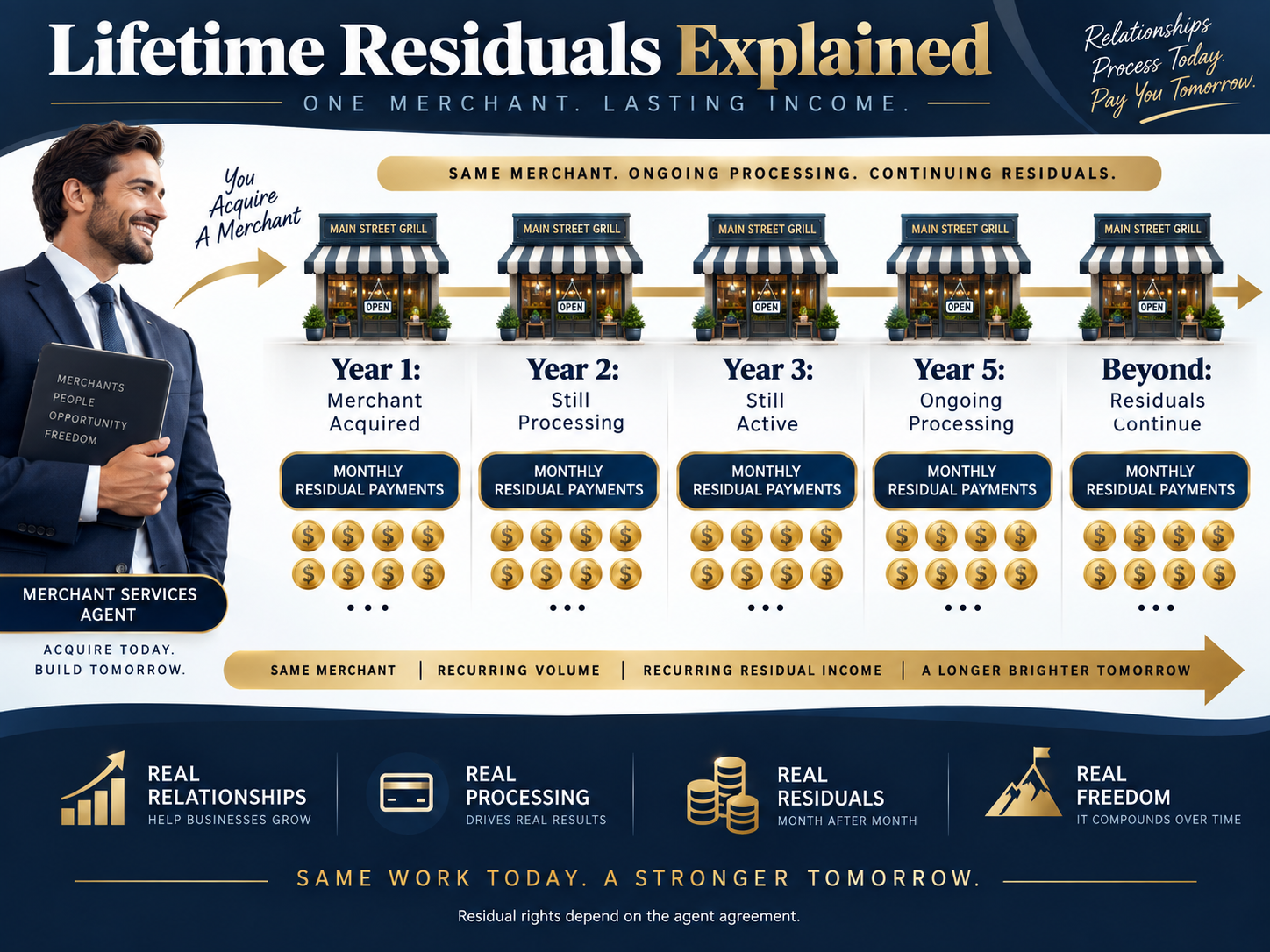
Depending on the economics of the account and the agent agreement, that continuing merchant activity can potentially generate recurring residual compensation for the agent who acquired the relationship.
Now think about that across many merchants.
One merchant isn't the entire strategy.
Neither are five.
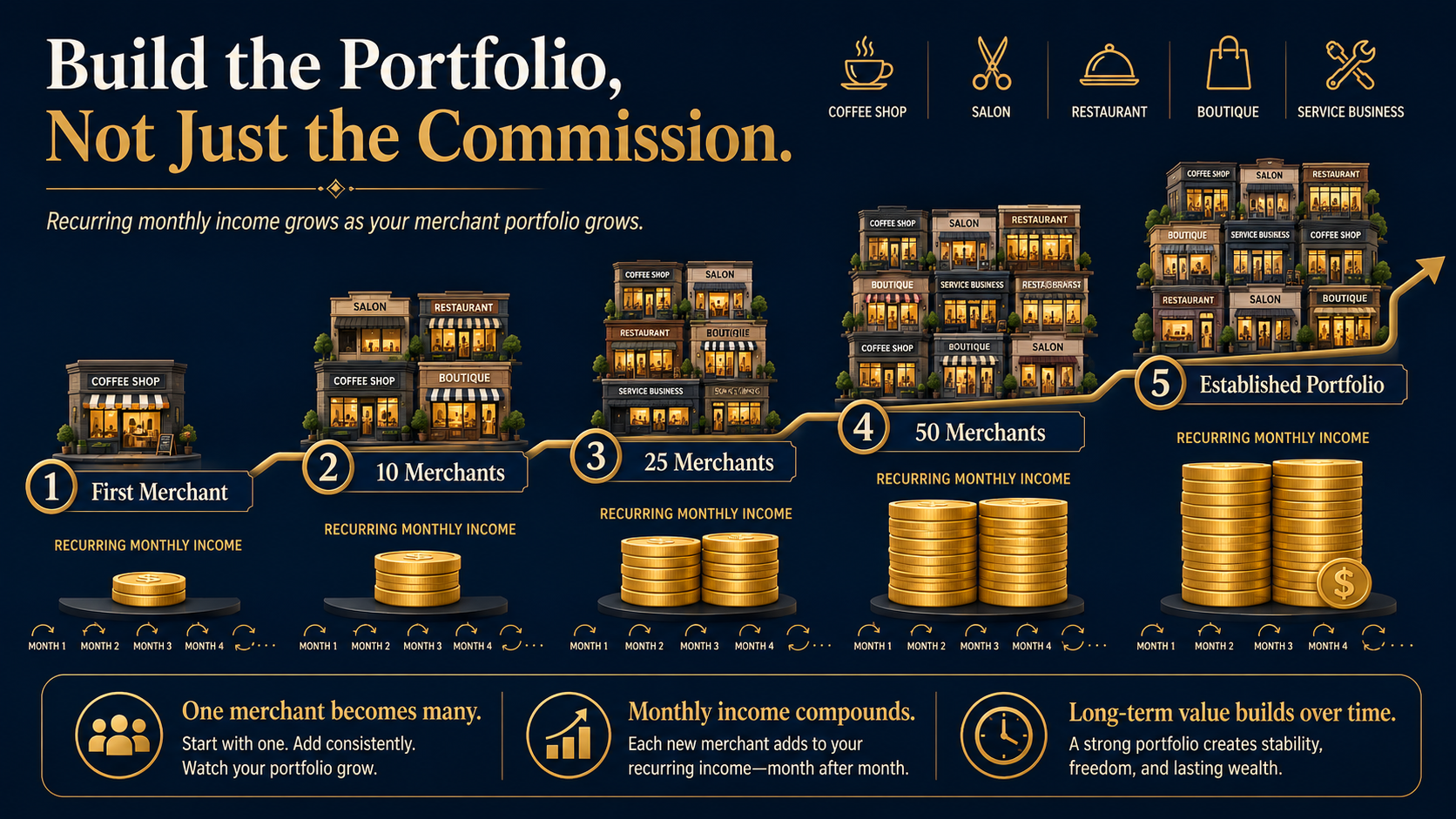
The bigger idea is that the salesperson can continue acquiring merchants while trying to retain the accounts already in the portfolio.
The model becomes:
Acquire → Retain → Add → Retain → Add
rather than:
Sell → Get Paid → Forget → Start Over
That's why I believe the phrase merchant-services passive income needs to be explained carefully. It's not passive when you're building it. There is real prospecting, closing, onboarding, relationship management, and retention involved.
Residual income is the more accurate description.
A Small Residual Isn't Impressive Until You Understand the Portfolio
This is where beginners sometimes dismiss the concept too quickly.
They look at what one merchant might contribute and compare it with a large one-time commission.
That misses the strategy.
The question isn't simply:
What does one merchant pay?
The question is:
What could consistent merchant acquisition build over time if those relationships remain active?
Your first account becomes part of the foundation. Then another merchant is added. Then another. Eventually, new production isn't replacing everything behind it; you're trying to add it to an existing recurring base.
That is the portfolio effect.
No portfolio grows perfectly. Merchants leave, businesses close, and processing volume changes. But the objective is very different from a model where the previous month's closed business has almost no direct relationship to this month's income.
Retention Becomes Part of Your Income Strategy
Once previous customers can continue producing economics, you start thinking differently about what happens after the close.
Retention isn't only a customer-service issue anymore.
It's part of your business model.
A customer who stays can potentially continue contributing value. A customer who leaves may remove that value.
That means the partner you represent, the product you sell, the onboarding process, support quality, merchant fit, and your own relationship with the customer become increasingly important.
This is why I've spent so much time teaching merchant-services agents that the sale isn't finished at approval.
Getting someone to sign is only part of building a portfolio.
You need merchants that activate, use the solution, receive support, and remain customers.
If You've Already Been Selling for Years, You May Have a Huge Advantage
This is where I want experienced salespeople to stop thinking of themselves as beginners.
You may be new to merchant services.
That doesn't mean you're new to sales.
If you've spent years cold calling, you already understand prospecting discipline. If you've worked door to door, you already understand rejection and face-to-face conversations. If you close over Zoom, you understand discovery, presentation, and objections. If networking is your strength, you've already learned how to create business through relationships.
And if your existing social and professional circle contains entrepreneurs, you've potentially spent years building a prospecting and referral network without even realizing it.
Those skills don't guarantee merchant-services success.
You still need to learn the payments business.
But you aren't starting with an empty toolbox.
This is why I believe experienced salespeople should consider home-based businesses that reward the abilities they've already developed rather than automatically abandoning sales for the latest online opportunity.
Phone Sales Can Become Portfolio Acquisition
Think about an experienced phone rep.
Maybe you've already made 50,000 or 100,000 calls during your career.
You've dealt with gatekeepers.
You've heard every version of "not interested."
You know how to stay disciplined when the first ten conversations go nowhere.
Those years weren't wasted simply because you want a different business now.
If you redirect that ability toward merchant acquisition, the same outbound discipline can potentially begin creating accounts that remain part of a recurring portfolio.
That's why selling merchant services from home through phone, Zoom, and remote sales can be such an interesting transition for experienced remote salespeople.
Your headset isn't new.
Your CRM isn't new.
Your sales discipline isn't new.
The product and economic model are.
Zoom Closers Should Think About What Their Closing Skill Is Building
The same is true for high-ticket closers.
You may already be great at forty-five-minute discovery conversations.
You know how to uncover pain, understand priorities, present a solution, handle concerns, and ask the prospect to make a decision.
Then you close the deal, receive your commission, and start searching for the next appointment.
There is nothing wrong with that.
But if you're already taking the risk and pressure associated with performance-based sales, it is reasonable to ask whether you want some of your future income tied to customers you've previously acquired.
Merchant services is one model that can potentially provide that.
You don't need to stop being a closer.
You can change what the close contributes to.
Networkers Can Create Recurring Income Through Relationships
Some salespeople don't build through enormous cold-call volume.
They build relationships.
They know accountants, lenders, insurance professionals, consultants, real-estate professionals, restaurant owners, gym owners, contractors, medical professionals, and entrepreneurs.
When they need something, people call them.
That network can become extremely valuable in a recurring-revenue business because a single relationship can produce more than one opportunity.
An accountant may introduce several businesses. One merchant may refer another. A business consultant may encounter payment problems repeatedly across their client base.
Your existing circle isn't guaranteed revenue.
But access is an asset.
The person who already knows entrepreneurs may have a dramatically different starting point than someone trying to build an audience from zero.
Recurring Income Still Requires New Production
One of the mistakes people make after discovering residual income is imagining they'll eventually stop needing to sell.
Maybe.
But I wouldn't build the strategy around that assumption.
Every recurring customer business experiences attrition.
Customers cancel.
Businesses close.
Needs change.
Competition shows up.
Economic conditions change.
The goal is to build a base that can help reduce your dependence on brand-new sales, not pretend new production becomes irrelevant forever.
Think about recurring income as building a bucket while water is slowly leaking out.
Retention reduces the leak.
New sales add water.
If new production consistently exceeds attrition, the portfolio can grow.
That is much more realistic than pretending recurring income moves upward forever in a straight line.
This Is Why "Lifetime Residuals" Needs Context
You will hear that phrase in merchant-services recruiting.
I like the concept.
But the words themselves don't create contractual rights.
You need to understand what the agreement actually says.
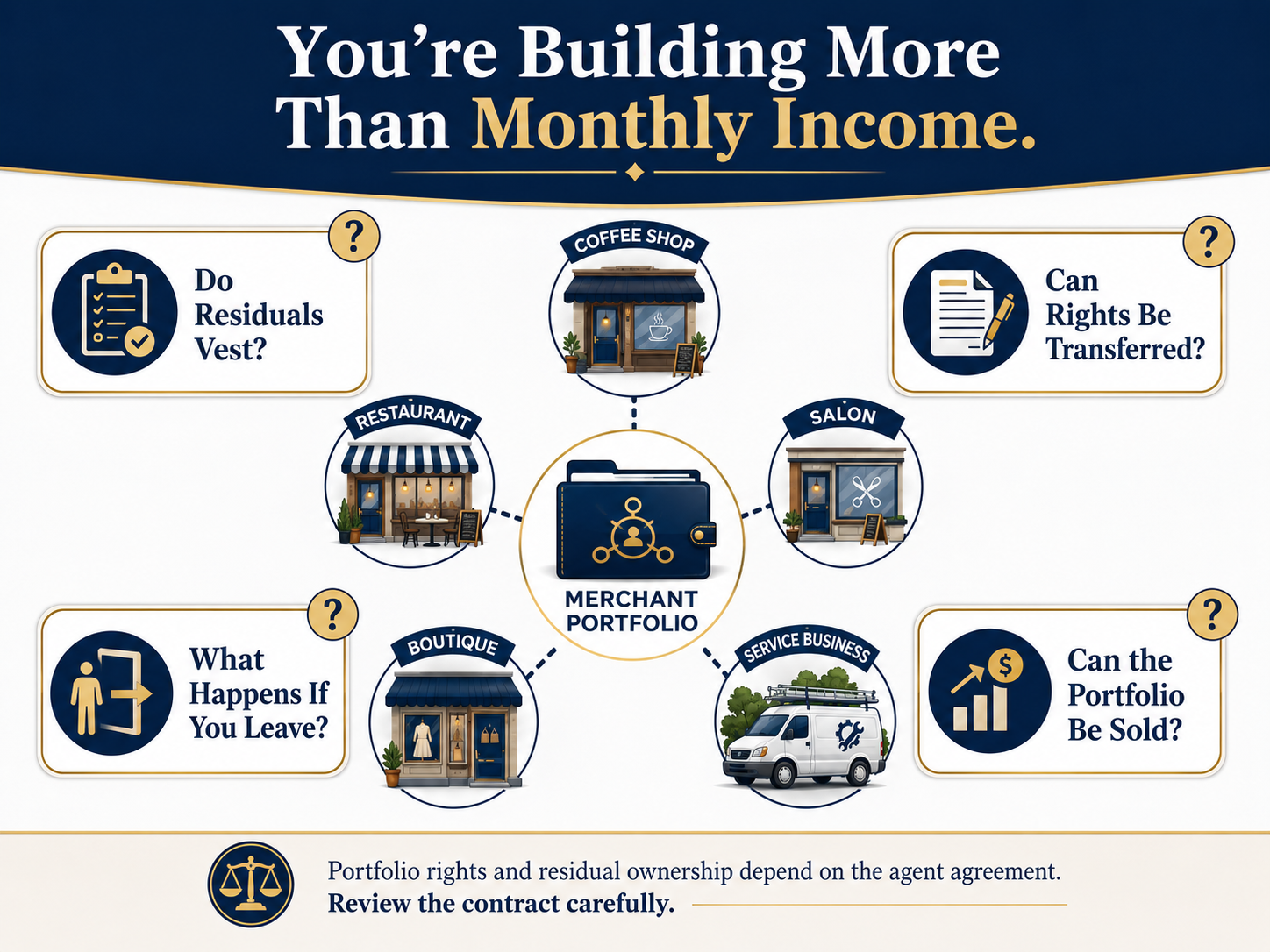
Do residuals continue if you stop producing? What happens if you leave? Are there vesting requirements? Can compensation be forfeited under certain circumstances? What happens if the upstream organization changes ownership? Can you transfer any rights? What happens to your residual stream if you die?
Those aren't negative questions.
They're the questions you ask when you're trying to build something valuable.
Read What Do Lifetime Residuals Really Mean in Merchant Services? before relying on the phrase alone.
The Residual Percentage Is Only Half the Math
The other mistake is chasing the biggest advertised split.
One company offers 50%.
Another says 60%.
A third advertises something even higher.
The obvious instinct is to choose the largest number.
But percentage of what?
The residual split is applied to underlying economics. Costs can affect the eligible amount being divided.
That means a clean 50% split can potentially create a larger actual payment than 60% applied to weaker underlying economics.
This is why you need to understand both merchant-services residual splits and the Merchant Services Schedule A.
If you're building one account, a small economic difference might not get your attention.
If you're building hundreds of accounts over years, those economics become much more important.
You Can Care About Upfront Income and Recurring Income
This does not have to become an ideological choice between getting paid now and getting paid later.
Cash flow matters.
Especially when you're new.
A salesperson can have a great long-term portfolio strategy and still need income this month.
Some merchant-services programs can combine upfront commissions with recurring residual compensation. Different partner relationships may emphasize different economics depending on merchant profitability, the product, the program, and the agreement.
One partner relationship I work with can pay up to $10,000 upfront on certain qualified merchant accounts based on profitability and program requirements. That doesn't mean every merchant pays $10,000, and no individual commission is guaranteed.
I mention it because the correct question isn't necessarily:
Upfront or residual?
It can be:
What combination fits what I'm trying to build?
I've covered that specifically in Upfront Commissions vs. Residual Income in Merchant Services.
Recurring Income Can Change Your Relationship With Time
This is where the model becomes more interesting than simple compensation math.
Suppose all of your income requires current production.
If you take two weeks off, revenue may suffer.
If family circumstances demand your attention, revenue may suffer.
If you're injured, sick, burned out, or simply need a break, the machine can slow down quickly.
A recurring customer base doesn't eliminate those risks, and no residual income should be assumed to continue forever.
But it can create another layer.
Some portion of income may come from relationships acquired previously while you continue adding new business.
That's one reason experienced salespeople eventually begin caring less about the biggest commission and more about the quality of the economic base underneath them.
This Is Not About Becoming Lazy
I want to emphasize this because the passive-income internet has distorted the conversation.
I didn't build my business because I was looking for a way to avoid work.
I liked sales.
I understood prospecting.
I knew how to close.
What interested me was using those abilities in a business where the work could compound.
Those are very different motivations.
If you aren't willing to sell, merchant services isn't suddenly going to solve that problem. If you won't prospect, no residual structure can rescue you. If you don't take care of merchants, retention suffers.
Recurring income is not a substitute for discipline.
It is a way of potentially getting more long-term value from disciplined work.

What Should You Look for in a Recurring-Income Opportunity?
Whether you're evaluating merchant services, insurance, SaaS, telecom, managed services, or another recurring model, I would look beyond the compensation headline.
First, identify what actually causes the customer to remain. Is the service valuable enough that people want to keep using it? Recurring compensation attached to a bad product isn't much of an opportunity if customers constantly leave.
Next, understand whether your compensation actually continues. As I explained earlier, the company having recurring revenue doesn't automatically mean you receive recurring compensation.
Then understand your rights. What happens if you stop producing, change companies, retire, or end the relationship?
Finally, understand the economics. What costs exist before your percentage is calculated? How often are you paid? Are there clawbacks? Are there minimums? Is the reporting transparent?
If you're going to spend years building a book, those questions matter more than the recruiting presentation.
A Book of Business Is the Bigger Goal
Recurring income becomes much more powerful when you stop thinking of it as individual payments and start thinking of the customers collectively.
That's a book of business.
I've already broken down sales careers that build a book of business instead of starting over, because the concept extends beyond merchant services.
Your book might be merchants.
Insurance policies.
Recurring software accounts.
Retained consulting clients.
Business-service contracts.
The specific customer changes.
The strategic principle is the same:
Your previous selling created something that still has economic relevance today.
That's what I want more commission salespeople thinking about.
Build Like It's an Asset, but Understand What You Actually Own
If you're building recurring income, you naturally begin thinking about the portfolio as an asset.
That's reasonable.
But don't get sloppy with the word ownership.
In merchant services, your agent agreement determines what rights you actually have. The processor or upstream organization may own certain merchant contracts while you have contractual rights to continuing compensation. Transfer, assignment, sale, inheritance, or solicitation rights can vary substantially by agreement.
So I like saying:
Build like it's an asset. Verify the rights like a business owner.
Don't spend ten years building something based entirely on what a recruiter said during your first phone call.
The Best Time to Think About Recurring Income Is Before You've Built the Book
A lot of people start asking about residual rights after they've already produced hundreds of accounts.
That's backwards.
The bigger the book becomes, the harder it is emotionally and financially to change poor economics or a weak contract.
Think about the agreement when the portfolio is still zero.
Understand the split.
Understand Schedule A.
Understand vesting.
Understand merchant support.
Understand what happens if you stop selling.
That's why How to Choose a Merchant Services Agent Program should come before putting serious production through a company.
Your first merchant may someday sit inside a much larger book.
Treat the relationship accordingly.
What if You Don't Have Money to Start Another Business?
Then I would be especially careful about buying another opportunity before you've proven the model.
This is part of the reason this entire cluster also includes Businesses You Can Start With Little Money and No Inventory.
Experienced salespeople are in an interesting position because customer acquisition is already one of the main things they bring to the business.
You don't necessarily need thousands of dollars of inventory to monetize the ability to sell.
In merchant services, you can operate through established infrastructure rather than building the payment-processing company yourself.
That doesn't mean there will never be normal business expenses.
It means you can potentially start much leaner than many traditional businesses.
Don't Buy Another Course Just Because the Phrase "Recurring Income" Sounds Good
This is another place people get into trouble.
Someone says residual income.
Recurring income.
Passive income.
Financial freedom.
Now the emotional side of the opportunity takes over.
Slow down.
Understand where the money comes from.
What does the end customer buy?
Why do they continue paying?
How do you acquire them?
What are the costs?
What controls your right to continuing compensation?
Those are the questions a business owner asks.
That's also why I built Merchant Service University the way I did.
I don't think you should have to pay thousands of dollars simply to understand whether merchant services is a business worth considering.
Take a Peek at Merchant Service University
If you're already in sales and the recurring-income model is catching your attention, your next step isn't choosing a merchant-services company.
Your next step should be understanding the business.
Go to MerchantServiceUniversity.com.
The core education is free.
You'll learn payment-processing fundamentals, pricing, merchant statements, agent compensation, residual income, Schedule A economics, agreements, merchant technology, prospecting, sales, retention, and portfolio building.
If you're experienced at phone sales, Zoom closing, outside selling, networking, or developing B2B relationships, go through the training with a specific question in mind:
How much of what I already know can transfer into this business?
I think many experienced salespeople will discover the answer is:
Quite a lot.
The industry knowledge is new.
Your ability to create customers doesn't have to be.

A Simple Framework for Moving From Commission to Recurring Income
If I were an experienced salesperson deliberately trying to change my income model, I would approach it in this order.
First, I would identify the sales abilities I've already developed. I would be very clear about whether my advantage is phone prospecting, closing, relationships, networking, field sales, referrals, or some combination.
Then I would study industries where those abilities can produce recurring, renewal, or book-of-business economics. I wouldn't assume merchant services is automatically the answer.
Next, I would compare the actual compensation structures. I would look beyond the headline commission and ask what the customer can potentially contribute after the first transaction.
After choosing a model, I would learn it properly before spending heavily. Then I would begin producing as leanly as possible, measure acquisition, track retention, and reinvest only after proving that I can consistently create customers.
Most importantly, I would stop measuring success solely by what I earned this month.
I'd begin measuring:
How many active customers have I built?
How much recurring base exists?
How much attrition am I experiencing?
How many referrals are being created?
How strong are my contractual rights?
How much am I adding to the book?
That's the transition from salesperson thinking to portfolio-builder thinking.
Frequently Asked Questions About Recurring Income for Salespeople
What is recurring income for salespeople?
Recurring income for salespeople is compensation that can continue from previously acquired customers through residuals, renewals, subscriptions, repeat revenue, retainers, or other ongoing customer economics. The exact structure depends on the industry and compensation agreement.
What sales jobs offer recurring income?
Merchant services, insurance, certain SaaS programs, telecom, managed services, recurring B2B services, and some subscription-based sales programs can potentially offer recurring or renewal compensation. Pay structures vary significantly.
What is the difference between commission and recurring commission?
A traditional commission is generally paid in connection with a particular transaction. A recurring commission can potentially continue while the customer remains active, renews, or generates qualifying revenue according to the compensation plan.
What is residual income in sales?
Residual income is recurring compensation connected to customers a salesperson previously acquired. In merchant services, active merchant accounts can potentially generate recurring residual compensation based on program economics and the agent agreement.
Is residual income passive income?
Not exactly. A salesperson must first acquire the customer, and continuing income can depend on retention, customer activity, program economics, and contractual rights. Residual income is generally a more accurate description than completely passive income.
Is recurring revenue the same as recurring commission?
No. A company can earn recurring revenue without paying recurring commissions to its salespeople. Salespeople need to understand their own compensation plan rather than assuming the company's subscription model creates continuing compensation for them.
Can phone salespeople build recurring income?
Yes. Strong outbound phone skills can be applied to recurring B2B models including merchant services, certain SaaS and telecom programs, recruiting relationships, and other recurring-service businesses.
Can Zoom closers build recurring income?
Potentially. Discovery, objection handling, presentation, and closing skills can transfer into businesses where customers create recurring, renewal, or residual economics.
Can merchant services create recurring income?
Merchant-services agents can potentially receive recurring residual compensation from qualifying active merchant accounts according to account economics and the terms of the agent agreement.
Does a merchant-services agent get paid forever?
Not automatically. Merchant retention, processing activity, vesting, termination provisions, production requirements, and other contractual conditions can affect continuing compensation.
Is a 60% merchant-services residual split always better than 50%?
No. The underlying costs and eligible economics affect the amount being divided. A higher percentage can still produce a lower actual payout if the underlying economics are weaker.
Can merchant-services agents earn upfront commissions too?
Depending on the program, compensation can include upfront commissions, recurring residual income, or a combination of both.
Do I need sales experience to build recurring income?
No, but previous sales experience can help. Experienced salespeople may already understand prospecting, follow-up, closing, networking, and self-management, which can provide transferable advantages when learning a new industry.
Can I start building recurring income without a large startup investment?
Some sales and service models can be started with relatively low traditional overhead, particularly when the product or infrastructure is provided by an established company. Expenses and requirements vary by business.
Is Merchant Service University free?
Yes. The core Merchant Service University education is free and does not require students to join one specific processing company.
Where should I start if I want to build recurring income through merchant services?
Start by learning the industry at Merchant Service University, then review How to Become a Merchant Services Agent in 2026 before choosing an agent program.
Final Takeaway: Don't Stop Selling. Make the Selling Build Something.
I don't believe most experienced salespeople need another speech about working harder.
You've worked hard.
You've made the calls.
You've driven to appointments.
You've stayed late for Zoom presentations.
You've chased prospects.
You've followed up when people ignored you.
You've had huge months and terrible months.
You've already proven you're willing to do what selling requires.
The question is whether you want to spend the next ten or twenty years doing that while continually rebuilding almost all of your income from scratch.
Maybe you do.
If you love large transactional commissions and the economics work, there is nothing wrong with that.
But if you're starting to think differently about your time, recurring income deserves serious consideration.
You may want the merchant you acquire today to continue mattering tomorrow. You may want previous customer relationships beneath the next month of prospecting. You may want to build a book rather than simply a history of commission checks.
That's what merchant services gave me the opportunity to think about.
It didn't remove sales.
It gave the sales another purpose.
For the right person, especially someone who already knows how to sell by phone, face to face, on Zoom, through networking, or through an existing circle of entrepreneurs, that can be an incredibly important distinction.
You may not need to become a different salesperson.
You may simply need to point the salesperson you've already become toward something designed to accumulate.
If you want to understand how that works in merchant services, go to MerchantServiceUniversity.com.
Take a peek at the free training.
Learn how residual income actually works.
Understand the economics and agreements.
Then decide whether the next sale you make should be just another commission—or another piece of something you're building for the long term.
About Joe Wagner
Joe Wagner has spent more than 16 years in merchant services and payment-processing sales, acquiring merchants, developing sales organizations, and building recurring residual portfolios.
He created Merchant Service University to help new and experienced salespeople learn the payments business before choosing a processing partner. His approach focuses on applying existing sales abilities to a longer-term portfolio model while understanding compensation, residual economics, contracts, merchant retention, technology, and the realities of building recurring income.
Joe works with sales professionals from phone, outside-sales, high-ticket closing, networking, and B2B backgrounds who want to evaluate whether merchant services can provide a stronger long-term vehicle for the skills they've already developed.
Continue with Sales Jobs With Residual Income, Merchant Services Passive Income, Sales Careers That Build a Book of Business, Home-Based Business Ideas for Salespeople, Businesses You Can Start With Little Money and No Inventory, or Merchant Services vs. Online Business Models.
Or take a peek inside Merchant Service University.