Businesses You Can Start With Little Money and No Inventory
Businesses You Can Start With Little Money and No Inventory
One of the biggest misconceptions about entrepreneurship is that starting a legitimate business requires a huge amount of capital.
Sometimes it does. If you're opening a restaurant, purchasing a franchise, manufacturing a physical product, leasing retail space, or carrying significant inventory, the financial barrier can be substantial before the first customer ever walks through the door.
But there is another category of business that works very differently.
Instead of using large amounts of capital to acquire inventory, equipment, or physical infrastructure, these businesses are built primarily around skills, relationships, customer acquisition, services, knowledge, or access to someone else's existing infrastructure.
For the right person, especially someone who already knows how to sell, that creates an entirely different way to approach entrepreneurship.
You may not need $50,000 sitting in the bank.
You may need a phone, a computer, a legitimate product or service, the ability to find customers, and the willingness to execute consistently.
That doesn't mean the business is free. It doesn't mean it's easy. And it definitely doesn't mean you're guaranteed to make money because your startup costs are low.
It simply means capital doesn't have to be the primary barrier between you and starting.
That's an important distinction.
Start by Separating Startup Capital From Business Ability
Having money makes some aspects of entrepreneurship easier. You can buy technology, hire people, advertise, create a more polished brand, or move faster operationally.
But money doesn't automatically create customers.
A person can spend $50,000 building a beautiful company and still have no idea how to sell anything. Another person can start with very little infrastructure but understand exactly who the customer is, what problem they have, how to get in front of them, and how to close the sale.
That second entrepreneur may have a much stronger foundation.
This is especially important for experienced salespeople because one of your most valuable startup assets may not appear on a balance sheet.
It's your ability to create revenue.
If you've spent years cold calling, walking into businesses, running appointments, networking, following up, or closing over Zoom, you've already developed a capability that many new entrepreneurs eventually have to spend significant money trying to replace with advertising.
That's why I believe experienced salespeople should evaluate entrepreneurship differently.
Low Startup Cost Does Not Mean No Startup Cost
I want to be careful with the language here because phrases like "start a business with no money" tend to attract unrealistic expectations.
A legitimate business may still have expenses.
You may need to form a business entity. You may need insurance. Certain industries require licenses. You may need software, a reliable computer, a phone, transportation, bookkeeping, marketing, professional advice, or other operating tools.
The objective is not to pretend expenses don't exist.
The objective is to avoid business models where massive capital has to be committed before you've proven that you can acquire customers.
That's why I prefer the phrase low overhead over "free business."
Low overhead gives you room to learn.
It gives you room to test.
It lets you put more of your energy into actual production rather than servicing debt or trying to cover enormous fixed expenses immediately.
Why No-Inventory Businesses Can Be Attractive
Inventory changes the economics of a startup.
When you purchase inventory, money leaves your account before the customer pays you. You now have capital tied up in products that may or may not sell. You need somewhere to store them. You may deal with shipping, damage, returns, spoilage, purchasing mistakes, or obsolete products.
Again, none of that means inventory businesses are bad. Some of the best businesses in the world are product companies.
But inventory creates another layer of risk.
A no-inventory business allows you to direct more attention toward the two things that ultimately matter most:
finding customers and delivering value to them.
That's particularly attractive for people whose competitive advantage is sales rather than product development or logistics.
The Best No-Inventory Business May Be the One That Matches Your Existing Skills
I don't believe the same business is right for everyone.
A talented software developer should evaluate entrepreneurship differently from a salesperson. A licensed accountant has different opportunities than a skilled recruiter. Someone with a large online audience has different distribution than somebody with a strong local business network.
Your starting point matters.
If you've already developed a valuable skill, the best low-cost business may be one where you can monetize that skill directly rather than spend another three years becoming a beginner at something unrelated.
That's exactly the argument behind Low-Cost Business Ideas for Salespeople Who Already Know How to Sell.
Don't automatically ask:
What's the cheapest business I can start?
Ask:
What's the lowest-overhead business where I already have an advantage?
Those are very different questions.
1. Merchant Services
Merchant services is the business I know best and one of the reasons I believe experienced salespeople should understand no-inventory business models.
Businesses already need ways to accept payments.
As an independent merchant-services agent, you can work through an established payments organization rather than building the entire processing infrastructure yourself.
The upstream company can handle many of the operational pieces such as underwriting, payment-processing infrastructure, reporting, hardware programs, technology, and merchant support.
Your primary role becomes business development.
You find merchants.
You understand their needs.
You present appropriate solutions.
You help get accounts established.
Then you continue building relationships and adding merchants to your portfolio.
Why This Can Be a Low-Overhead Business
You generally don't need to manufacture anything.
You don't need a warehouse.
You don't need to order thousands of terminals and hope somebody buys them.
You don't need to build a payment gateway from scratch.
And you do not need to become a registered ISO merely to begin selling merchant services through an established partner.
I explain that structure in Merchant Services Agent vs. ISO.
This allows a salesperson to leverage existing infrastructure rather than spending massive amounts of capital trying to recreate it.
Why It Can Be More Interesting Than a One-Time Commission Business
Depending on the program and agreement, merchant accounts can potentially generate ongoing residual compensation while they remain active.
That means you're not simply selling another service and starting over.
You're potentially building a portfolio.
If that's the part that caught your attention, read Can Merchant Services Create Passive Income? How Residual Income Really Works. I prefer residual income because it more accurately reflects the work required and the fact that merchant retention, account economics, and contractual rights matter.
2. Consulting
Consulting is one of the most straightforward businesses you can build without inventory because your expertise becomes the product.
If you've spent years solving a valuable problem, another company may pay you to help solve it for them.
That could include sales consulting, leadership, operations, CRM implementation, recruiting, marketing, financial processes, industry-specific expertise, or countless other specialized services.
The startup costs can be relatively modest because you don't need shelves of physical products before you start selling.
The larger challenge is credibility and customer acquisition.
You need to actually know something worth paying for, and you need to be able to find clients.
For an experienced salesperson who also possesses specialized expertise, that can be an excellent combination.
3. Recruiting
Recruiting can also be started without traditional inventory because your business is built around relationships, talent, and employer needs.
You identify organizations with hiring problems.
You find qualified candidates.
You manage conversations between both sides.
You create successful placements.
The salesperson who already understands outbound prospecting can have a meaningful advantage here because recruiting frequently requires consistent outreach to both companies and potential candidates.
The model can also be run substantially from a home office through calls, email, video meetings, databases, and professional networks.
Traditional direct-hire recruiting can be transactional, while staffing and other arrangements may introduce more recurring economics and more operational complexity.
Know which business you're choosing.
4. Outsourced Sales and Appointment Setting
If you know how to consistently create qualified appointments, you possess something businesses are willing to pay for.
Many companies have good products and poor outbound sales execution.
An experienced salesperson can potentially build a service around prospecting, appointment setting, lead qualification, pipeline development, or even closing.
The advantage is obvious: the core service is something you've already spent years doing.
The challenge appears when you scale.
If you personally make every call and run every sales conversation, your income remains closely tied to your time. To grow beyond that, you'll eventually need people, systems, training, quality control, and account management.
That's not a reason to avoid the business.
It's simply what happens when a service business grows.
5. Specialized B2B Agency
A B2B agency can also be built without inventory.
The actual service might be website development, video production, marketing, local SEO, appointment generation, bookkeeping, CRM implementation, automation, content, or another specialized business solution.
A strong salesperson has an immediate advantage because acquiring clients is one of the biggest challenges most agencies face.
But there is a major warning here.
Don't sell what you can't deliver.
Being able to close ten customers is only useful if the service is capable of keeping ten customers happy.
This is one of the reasons I believe experienced salespeople should think about both customer acquisition and fulfillment before choosing a business.
The easiest product to sell today isn't automatically the best business to build for five years.
6. Independent Sales Representation
There are manufacturers, technology companies, professional-service providers, and B2B organizations that want distribution without employing every salesperson internally.
That can create opportunities for independent representatives.
You sell someone else's existing product or service and receive compensation according to the agreement.
The startup advantage is that you don't have to manufacture the product yourself.
Your role is sales and distribution.
This can be an excellent model for somebody who already has industry relationships or a specialized customer network.
The question to ask is what happens after the first sale.
Does the customer reorder?
Do you receive recurring commissions?
Do you control a territory?
Do you retain rights to the customers?
Or are you simply receiving another one-time commission?
Understand the economics before you spend years building distribution for someone else.
7. Referral Partnerships
Some people are not traditional high-volume salespeople but are outstanding connectors.
They know people.
They know who needs what.
Business owners trust them.
A legitimate referral or strategic-partnership business can leverage those relationships by connecting people with quality providers in industries where referral compensation is allowed and structured appropriately.
Potential categories could include professional services, merchant services, recruiting, technology, payroll, certain financing relationships, or other B2B services.
The advantage is that you're monetizing access and trust rather than buying inventory.
The responsibility is protecting that trust.
A bad referral can cost far more than the commission it created.
8. Freelance or Professional Services
Writing, design, bookkeeping, video editing, programming, web development, virtual assistance, consulting, and countless other professional services can be launched without physical inventory.
The barrier is usually the skill.
If you're genuinely good at something, you can potentially sell that ability directly.
The larger question is whether the business remains completely dependent on your personal time.
A freelance service can create great income but still operate primarily as self-employment.
There's nothing wrong with that.
Just don't mistake low startup cost for automatic scalability.
9. Digital Education or Information Products
Education can also be a no-inventory business.
Courses, memberships, digital guides, and specialized training can be delivered without manufacturing physical products.
And I want to be clear: there is absolutely nothing inherently wrong with charging for real expertise.
Great education can save people years of mistakes.
The concern begins when someone sells the lifestyle of an opportunity much more aggressively than the practical skills required to succeed in it.
If you build education, teach something you actually understand.
If you buy education, evaluate whether the person genuinely possesses the expertise they're selling.
That's one of the main themes in Online Business Ideas in 2026: Stop Buying the Dream and Evaluate the Business Model.
10. Certain Software, Affiliate, and Partner-Based Businesses
Other low-inventory models include software reselling, affiliate relationships, referral partnerships, and digital products.
These businesses can have attractive economics because you don't have to warehouse physical goods.
But the customer-acquisition question never disappears.
Affiliate marketing requires traffic.
Software needs customers.
Referral businesses need relationships.
Digital products need distribution.
Removing inventory does not remove sales and marketing.
That's the theme I want repeated throughout this article.
No inventory is a financial advantage. It is not a substitute for a customer-acquisition strategy.
Why Salespeople Have Such an Advantage in Low-Cost Businesses
Notice how many of the businesses above depend heavily on customer acquisition.
That's why salespeople are positioned differently from many first-time entrepreneurs.
You may already know how to make a cold call.
You may know how to walk into a business.
You may be comfortable asking someone for an appointment.
You may know how to run discovery.
You understand objections.
You know how to follow up.
You know how to close.
You may also have years of relationships with business owners.
These skills can reduce the amount of money you need to spend buying attention.
Instead of immediately spending thousands on paid ads, you may be able to create your own prospecting activity.
Instead of purchasing leads before you understand the offer, you can begin testing direct outreach.
That is an enormous entrepreneurial advantage.
The Business Owners Already in Your Phone May Be Your First Advantage
If you're an experienced professional, stop assuming every new business requires you to build an audience from zero.
Look at your existing relationships.
How many business owners do you know?
How many accountants?
Consultants?
Commercial real-estate professionals?
Contractors?
Restaurant operators?
Retailers?
Medical professionals?
Gym owners?
Salon owners?
Other salespeople?
You don't necessarily need thousands of followers.
You need access to people who can either become customers or introduce you to customers.
That doesn't mean aggressively pitching every person you've ever met.
It means recognizing that years of networking and professional experience have already created distribution.
This becomes especially valuable in B2B businesses like merchant services.
If You Have Very Little Money, Don't Spend It Trying to Look Like a Big Company
This is another mistake I see.
Somebody has $5,000 available to start a business and spends almost all of it trying to make the company look established.
Expensive branding.
A complex website.
Premium software.
Automations.
Professional photos.
Business cards.
Subscriptions.
Then they have no money left and no customers.
Your first objective should not be convincing yourself you're an entrepreneur.
Your first objective should be proving that the market wants what you're selling.
You need enough infrastructure to operate professionally and legally.
After that, I would prioritize customer acquisition and fulfillment.
Revenue gives you the ability to upgrade the rest.
Don't Buy Inventory of Any Kind Before You Understand Demand
Inventory doesn't only mean physical products.
You can build digital inventory too.
A course you spend six months creating that nobody wants is inventory.
A complicated agency service you've built before speaking with a customer is inventory.
Twenty software subscriptions purchased before you have clients are effectively overhead inventory.
A huge marketing funnel built before you've proven the offer can create the same problem.
This is why I prefer starting lean.
Sell the solution.
Learn what customers care about.
Then build more infrastructure around what the market has already validated.
Why Merchant Services Fits the Low-Capital Entrepreneur
This is the part I believe deserves much more attention.
Merchant services lets the salesperson participate in an established industry without having to recreate every component of the industry.
Businesses already accept payments.
Payment processors already exist.
Commerce technology already exists.
Underwriting infrastructure already exists.
Merchant support already exists.
Payment hardware already exists.
The salesperson's opportunity is to connect businesses with the right solutions through the right partner.
That means your biggest investment may be learning, prospecting, and developing relationships, rather than purchasing massive quantities of inventory.
For a talented salesperson, that's a much better use of the asset you already have.
You Also Don't Need to Become a Registered ISO Immediately
This is part of the low-overhead philosophy.
A salesperson may hear "build a payments business" and assume they need to become a registered ISO before they can take the opportunity seriously.
I don't believe that's necessary for most people.
A strong upstream ISO or processor already has infrastructure, banking relationships, underwriting, risk management, support, deployment capabilities, reporting, and operational experience.
Why spend the beginning of your career recreating those systems if your strongest capability is sales?
I would rather see a great salesperson sell while great operators operate.
Learn more in Merchant Services Agent vs. ISO.
Don't Confuse "Low Cost" With "Low Value"
This is important because low startup cost can create a psychological trap.
People often take an opportunity less seriously when they didn't spend much to access it.
If you spend $25,000 on something, you feel pressure to use it.
If you receive training for free, it's easier to put it on a shelf and tell yourself you'll get to it later.
Don't make that mistake.
The financial barrier and the value of an opportunity are not the same thing.
A business can have a low financial barrier and still require enormous discipline to succeed.
Merchant services is a perfect example.
You can learn the business without paying me thousands of dollars.
That does not mean I can make the calls for you.
You still have to prospect.
You still need appointments.
You still need merchants.
You still need follow-up.
You still need retention.
Low startup cost does not mean low effort.
In many ways, sales ability becomes the capital.
This Is Why Merchant Service University Is Free
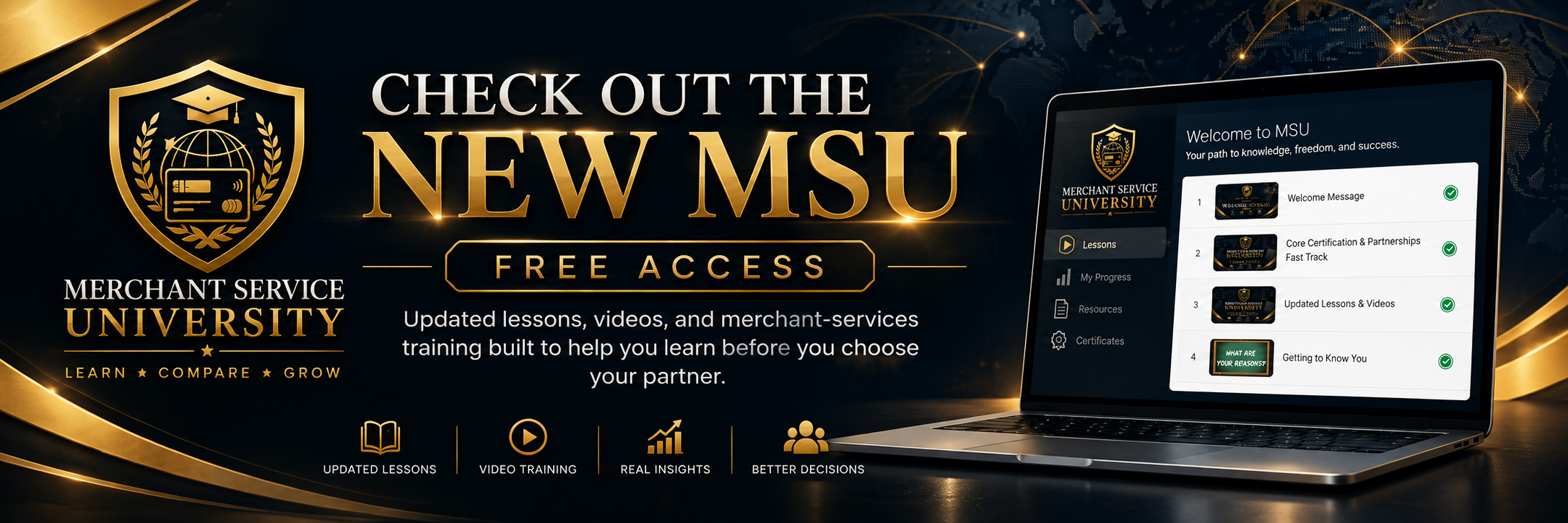
Merchant Service University exists partly because I became tired of watching people pay thousands of dollars simply to gain access to merchant-services education.
I've spent more than 16 years actually working in payments.
My livelihood is built in the industry itself.
I don't need to make my living selling you the dream of someday working in it.
So I invested my own time and resources into building the foundational education and made the core training free.
That's not me saying all paid education is bad. Specialized coaching, mentorship, and advanced education can absolutely be valuable.
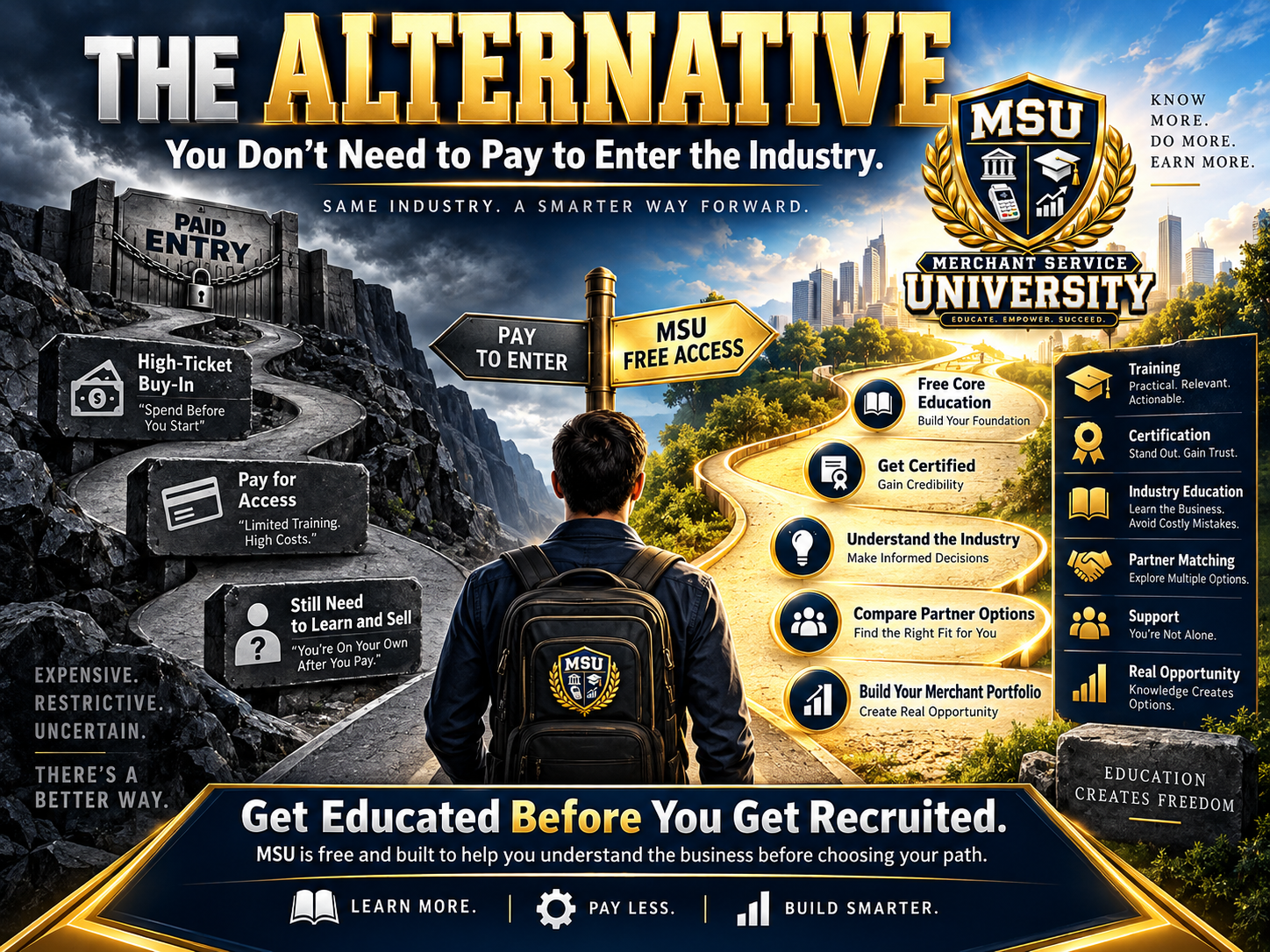
The difference is that I don't believe someone should have to make a huge upfront investment simply to understand the basics and decide whether the industry fits them.
That's the philosophy behind Can You Start Selling Merchant Services for Free?.
Get educated before you get recruited.
Take a Peek at Merchant Service University Before Spending Thousands Somewhere Else
If you're researching businesses you can start with little money because startup capital is one of the things holding you back, don't create another financial obstacle unnecessarily.
Go to MerchantServiceUniversity.com.
Take a look at the free foundational training.
Learn how payment processing works.
Learn how agents get paid.
Understand residual income.
Understand pricing.
Learn what a Schedule A is.
Understand agent agreements.
Learn the technology.
Learn how agents prospect.
Learn how the merchant portfolio is built.
There is no obligation to join one specific processing company.
You're allowed to learn first.
If merchant services doesn't fit you after you've gone through the education, you haven't lost thousands of dollars discovering that.
If it does fit you, you can move forward with a much stronger understanding of what you're actually building.
No Inventory Makes the Sales Partner More Important, Not Less
When you don't control fulfillment yourself, the organization behind you matters tremendously.
Suppose you sell a merchant.
If the partner handles underwriting poorly, that affects your customer.
If support is terrible, that affects your relationship.
If equipment takes forever, you're the person the merchant remembers.
If reporting is unclear, you suffer.
If residual calculations are poor or difficult to verify, your long-term economics suffer.
So don't hear "leveraged infrastructure" and assume all partners are interchangeable.
They're not.
Your partner is effectively part of the product you're selling.
That's why I recommend How to Compare Merchant Services Companies Without Getting Sold before committing serious production to one organization.
Low Startup Cost Should Let You Be More Selective
This is another benefit of not putting $20,000 into an opportunity upfront.
You don't need to defend a bad decision simply because you've already spent a fortune.
You can learn.
Compare.
Ask questions.
Read agreements.
Understand compensation.
Evaluate support.
Decide whether the fit makes sense.
That is a much healthier position than paying a huge buy-in and then feeling financially trapped into making the opportunity work regardless of what you discover.
The lower your sunk cost, the easier it is to make rational decisions.
No Inventory Does Not Mean No Risk
Every business has risk.
A consultant can fail to attract clients.
An agency can lose accounts.
A recruiter can struggle to make placements.
A merchant-services agent can fail to acquire merchants.
Residual accounts can attrit.
Business owners can close.
Sales cycles can take longer than expected.
Your time has value.
Your reputation has value.
Opportunity cost is real.
So don't confuse lower capital risk with no business risk.
The advantage is that you may be able to test the model without placing your financial life in danger just to begin.
That's very different.
Can You Start Part Time?
Many of these businesses can potentially begin alongside another career.
Consulting can start with a small number of clients.
Recruiting can begin through a specific niche.
Referral partnerships can develop through existing relationships.
Merchant services can potentially be learned and prospected part time.
We've addressed that directly in Is Merchant Services a Good Side Hustle in 2026?.
The key is not using "part time" as permission for inconsistency.
You still need dedicated activity.
A side business grows because you schedule time for it, not because time magically appears.
What Should You Do With the Money You Save by Not Buying Inventory?
Use it intelligently.
Build financial runway.
Invest in tools only when they improve a real process.
Buy better data when you understand how to prospect it.
Improve your website after you've proven the offer.
Pay for advanced education when you know exactly what skill gap you're trying to solve.
Hire help when fulfillment actually requires it.
Reinvest after the business earns the right to be reinvested in.
That's a much stronger model than beginning with maximum expense and hoping customers arrive quickly enough to support it.
Which No-Inventory Business Is Best?
There is no universal answer.
If you possess deep professional knowledge, consulting might make the most sense.
If you're an elite recruiter, build a search business.
If you can generate appointments, an outsourced sales model could fit.
If you understand digital fulfillment, an agency may work.
If you have a strong professional network, referral partnerships could make sense.
If you're great at sales and want a B2B business with relatively lean startup requirements, existing infrastructure, flexible prospecting options, and recurring portfolio potential, merchant services deserves serious consideration.
And our final article in this cluster, Merchant Services vs. Online Business Models: Which Makes Sense for a Salesperson?, will compare that decision directly.
What I'd Look for Before Choosing Any Low-Cost Business
I would want the answers to a handful of important questions before committing my time.
Who is the actual customer? What painful or useful problem am I solving? How will I reach that customer? Can my existing skills create an advantage? How difficult is fulfillment? What costs appear after I start growing? Does the customer generate repeat or recurring value? What am I building after five years? And what contractual or platform dependencies could affect the business?
Those questions are more important than whether the startup fee is $500 or $5,000.
Cheap is not the objective.
Strong economics with manageable risk is the objective.
Frequently Asked Questions About Businesses You Can Start With Little Money
What businesses can you start with little money?
Potential examples include consulting, recruiting, outsourced sales, merchant services through an established partner, professional services, appointment setting, specialized agencies, referral businesses, independent sales representation, and certain digital businesses.
What businesses can you start without inventory?
Service-based and sales-based businesses often do not require physical inventory. Examples include consulting, recruiting, merchant services, agencies, professional services, referral businesses, outsourced sales, and digital education.
Is a no-inventory business easier to start?
It can require less upfront capital and eliminate inventory risks, but the business still needs customers, delivery capability, operating systems, and consistent execution.
What is a good low-cost business for a salesperson?
Merchant services, recruiting, appointment setting, outsourced sales, consulting, independent B2B representation, and referral businesses can all leverage existing sales abilities.
Is merchant services a low-cost business to start?
Working as an independent agent through an established merchant-services company can reduce the infrastructure and inventory requirements compared with creating a payment-processing company from scratch. Normal business expenses can still exist.
Do I need to buy credit-card terminals to sell merchant services?
An independent agent generally does not need to purchase and warehouse large quantities of equipment simply to begin selling through an established merchant-services partner. Equipment programs vary by provider.
Do I need to become a registered ISO?
Not necessarily. Many agents can build merchant portfolios through established ISOs or processing partners that already provide operational infrastructure.
Can merchant services create recurring income?
Merchant-services agents can potentially receive recurring residual compensation from qualifying active merchant accounts according to the economics and terms of their agent agreement.
Can I start merchant services part time?
Potentially. Some people can learn and begin prospecting while maintaining another career, although consistent activity is still required.
Is Merchant Service University free?
Yes. The core Merchant Service University education is free and does not require students to join one particular processing company.
Is all paid business education a waste of money?
No. Specialized coaching, mentorship, and professional education can provide significant value. The important distinction is understanding exactly what expertise you're purchasing rather than paying solely for access to an opportunity or an income promise.
What should I spend money on first when starting a business?
Prioritize legitimate operational requirements and whatever is needed to responsibly acquire and serve customers. Avoid overbuilding technology, branding, inventory, or infrastructure before validating customer demand.
Are no-inventory businesses risk free?
No. They may reduce capital and inventory risk, but customer acquisition, operational performance, reputation, time, opportunity cost, customer retention, and other business risks still remain.
What if I already know a lot of business owners?
An existing network can be a meaningful advantage in B2B businesses because those relationships may create customer conversations, referral partnerships, or introductions. Relationships do not guarantee sales.
Where should I start if merchant services interests me?
Begin by learning the business through Merchant Service University, then review How to Become a Merchant Services Agent in 2026 before choosing a processing partner.
Final Takeaway: If You Don't Have a Lot of Money, Build Around What You Do Have
Maybe you don't have $50,000 to invest in a new business.
That doesn't mean you have nothing.
You may have ten years of sales experience.
You may have a phone full of business owners.
You may know how to cold call.
You may be great on Zoom.
You may have built an incredible professional network.
You may be excellent at solving a specific business problem.
You may have spent years learning how to get strangers to trust you and make decisions.
Those are assets.
Don't overlook them simply because they don't look like startup capital in a bank account.
The smartest business for you may be one that lets you trade those existing strengths for expensive infrastructure you don't need.
Consult.
Recruit.
Sell.
Represent.
Refer.
Build relationships.
Serve businesses.
And if the combination of B2B sales, relatively low traditional overhead, existing infrastructure, flexible prospecting, and recurring residual potential interests you, take a serious look at merchant services.
Not because it's effortless.
It isn't.
Not because success is guaranteed.
It isn't.
But because you can learn a real industry, leverage the backend of an established partner, use skills you may already have, and begin building merchants without first purchasing a warehouse full of products or paying thousands merely for permission to enter the business.
If you'd like to understand the model, start at MerchantServiceUniversity.com.
The core education is free.
Take a peek.
Learn how the business works.
Then decide whether the resources you've been waiting to acquire were never the real barrier in the first place.
Maybe you already had the most important one:
the ability to create customers.
About Joe Wagner
Joe Wagner has spent more than 16 years in merchant services and payment-processing sales, acquiring merchants, developing sales organizations, training sales professionals, and building recurring residual portfolios.
He created Merchant Service University to give new and experienced salespeople free foundational education before they choose a processing partner or commit significant money to accessing the industry. His approach focuses on understanding the business, leveraging existing sales skills, evaluating partner economics, and building a merchant portfolio rather than simply chasing the next commission.
Continue with Low-Cost Business Ideas for Salespeople, Merchant Services Side Hustle, Home-Based Business Ideas for Salespeople, How to Build Recurring Income as a Salesperson, or Merchant Services vs. Online Business Models.