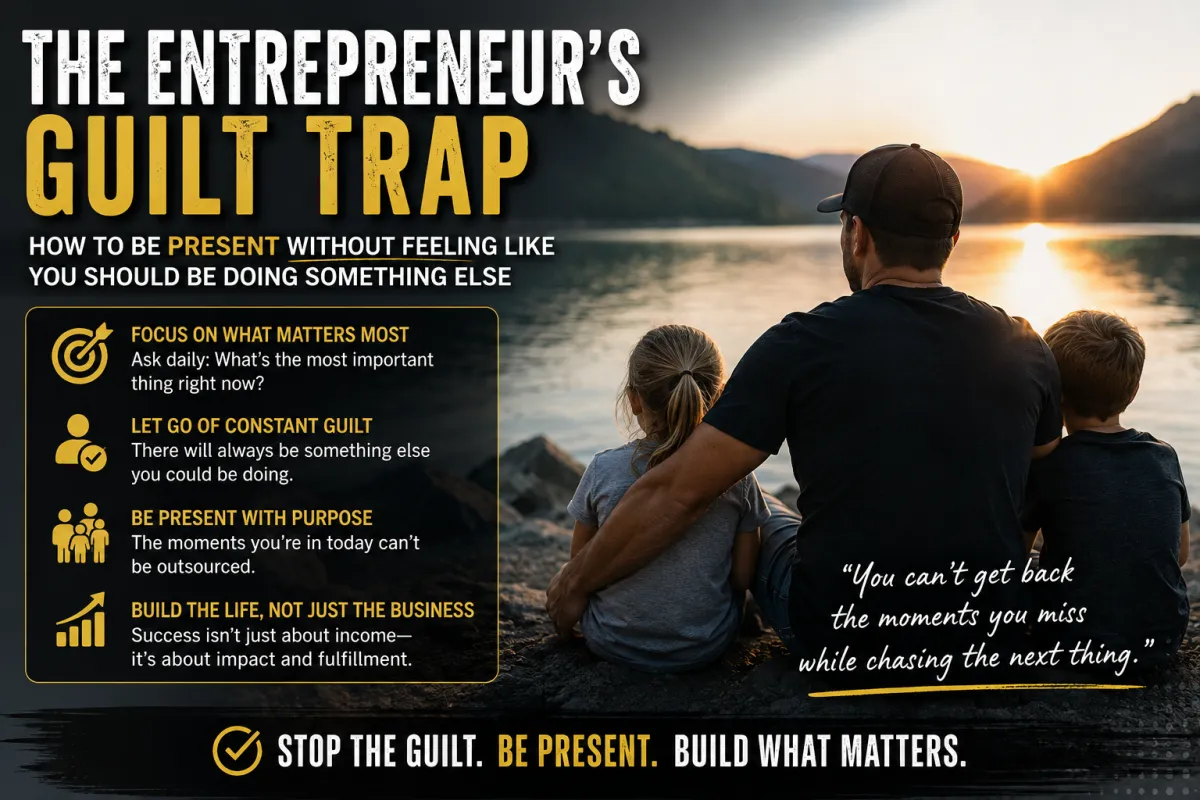
The Entrepreneur’s Guilt Trap: How to Be Present Without Feeling Like You Should Be Doing Something Else
The Entrepreneur’s Guilt Trap: How to Be Present Without Feeling Like You Should Be Doing Something Else
One of the strangest things about becoming an entrepreneur is that you can finally gain more control over your time and somehow feel guilty about almost every way you choose to spend it.
You sit down to work and think you should be spending more time with your family. You finally put the computer away to spend time with your family and start thinking about the emails you haven't answered. You take a morning to work out and wonder whether you should be prospecting. You go prospecting and remember the existing customers you haven't followed up with. You take care of those customers and start worrying because you didn't make enough new sales calls.
Then, God forbid, you actually take an afternoon off.
Now your entrepreneurial brain can find 47 different reasons why you're falling behind.
I've dealt with this for years, and I know I'm not alone. I think it's especially common among entrepreneurs, high achievers, parents, salespeople, and anyone who has built a life where nobody else is standing over them telling them exactly where their time should go.
The problem isn't necessarily that we're doing too little.
The problem is that entrepreneurship creates an environment where the work is never truly finished.
Once you understand that, you can start changing the question. Instead of constantly asking, "What else should I be doing?" you start asking a much healthier and more productive question:
"What deserves my full attention right now?"
That distinction has become incredibly important to me.
Watch: Feeling Guilt as an Entrepreneur
This article expands on a lesson I recently shared about something I've personally had to work through as an entrepreneur: learning to stop carrying guilt from one responsibility into another.
The goal isn't to care less about your responsibilities. It's actually the opposite. It's learning how to give the responsibility in front of you more of yourself instead of constantly dividing your attention between everything else.
Why Entrepreneurs Feel Guilty Even When They’re Working Hard
There's a psychological reason entrepreneurship can create this feeling so easily.
Most traditional jobs provide boundaries whether you like them or not. There is usually a workplace, schedule, boss, list of responsibilities, or some other external structure telling you when you're working and what you're supposed to accomplish.
Entrepreneurship destroys many of those boundaries.
Your business can always use another customer. There is always another idea worth exploring, another problem that could be fixed, another person you could contact, another process you could improve, another piece of content you could create, and another opportunity you might be missing.
There is no final email.
There is no final prospect.
There is no final improvement you could make to your business.
Your brain is therefore constantly dealing with what psychologists sometimes describe as unfinished tasks. Research on the Zeigarnik effect has historically explored our tendency to keep incomplete intentions mentally active. More recent research on attention has also examined how thoughts about unfinished work can interfere with our ability to fully disengage from it.
Entrepreneurs can experience this on steroids because our list of unfinished tasks is essentially infinite.
Even when you're doing something important, your mind can generate evidence that you should be doing something else.
That's where the guilt trap begins.
The Problem Isn't Your To-Do List. It's the Belief That You Should Be Completing All of It
I've had to accept something that sounds obvious but is incredibly difficult for ambitious people to actually live by:
I will never get everything done.
Neither will you.
Your goal cannot be reaching some magical point where every responsibility in your life is completely handled and you're finally allowed to relax without guilt. That day isn't coming.
If you're building something meaningful, there will always be competing priorities.
The solution isn't doing everything.
The solution is prioritizing intentionally and then accepting the cost of that priority without punishing yourself for it.
If your most important responsibility this morning is prospecting, then prospect. Give it everything you've got.
If your most important responsibility this afternoon is solving a serious customer problem, solve it.
If tonight you've decided belongs to your family, then be with your family.
The guilt usually comes from mentally standing in two places at once.
Your body is doing one thing while your brain is criticizing you for not doing another.
That's an exhausting way to live.
Your Business Priorities Will Change as You Grow
Merchant services is a perfect example because I've lived this progression myself.
When you're brand new in sales and have no customers, your priority is pretty obvious.
You need customers.
Prospecting should consume a significant portion of your productive time because there isn't much of a business to manage yet. You don't have a portfolio full of merchants calling with questions. You don't have dozens of activations in progress. You don't have existing relationships requiring your attention.
You need to sell.
But then something interesting happens when you become successful.
You create new responsibilities.
Now you've got merchants who trusted you enough to sign an agreement. You have installations to coordinate, accounts that need to activate, questions that need answers, relationships worth maintaining, and customers whose businesses depend on the systems you helped put in place.
Suddenly there are days when protecting what you've already built is more important than going out and adding something new.
That's where entrepreneurs can unnecessarily beat themselves up.
You finish a day handling important customer issues and think, Damn, I didn't prospect enough today.
Okay.
But what did you do instead?
If you wasted six hours scrolling your phone, that's a problem.
If you spent those six hours protecting customers, solving legitimate problems, and strengthening the portfolio you worked so hard to build, that's not failure.
That's prioritization.
Tomorrow you can prospect again.
Not Everything Important Can Be the Most Important Thing Right Now
This may be the distinction that has helped me the most.
Several things can be important simultaneously without all of them deserving your attention simultaneously.
Your business is important.
Your family is important.
Your health is important.
Your marriage is important.
Your faith is important.
Your customers are important.
Your financial future is important.
Your friendships are important.
Your personal growth is important.
The mistake is believing that because all of those things matter, you should somehow be actively serving all of them every minute of every day.
You can't.
And trying usually produces a watered-down version of you everywhere.
Instead of being a great entrepreneur, parent, spouse, friend, athlete, or leader at different times, you become partially present in every role.
You're working while feeling guilty about your family.
You're with your family while checking your phone.
You're working out while thinking about work.
You're on vacation responding to emails.
You're having dinner while mentally solving tomorrow's problems.
Technically, you're everywhere.
In reality, you're nowhere.
The Entrepreneur’s Real Problem Is Often Attention, Not Time
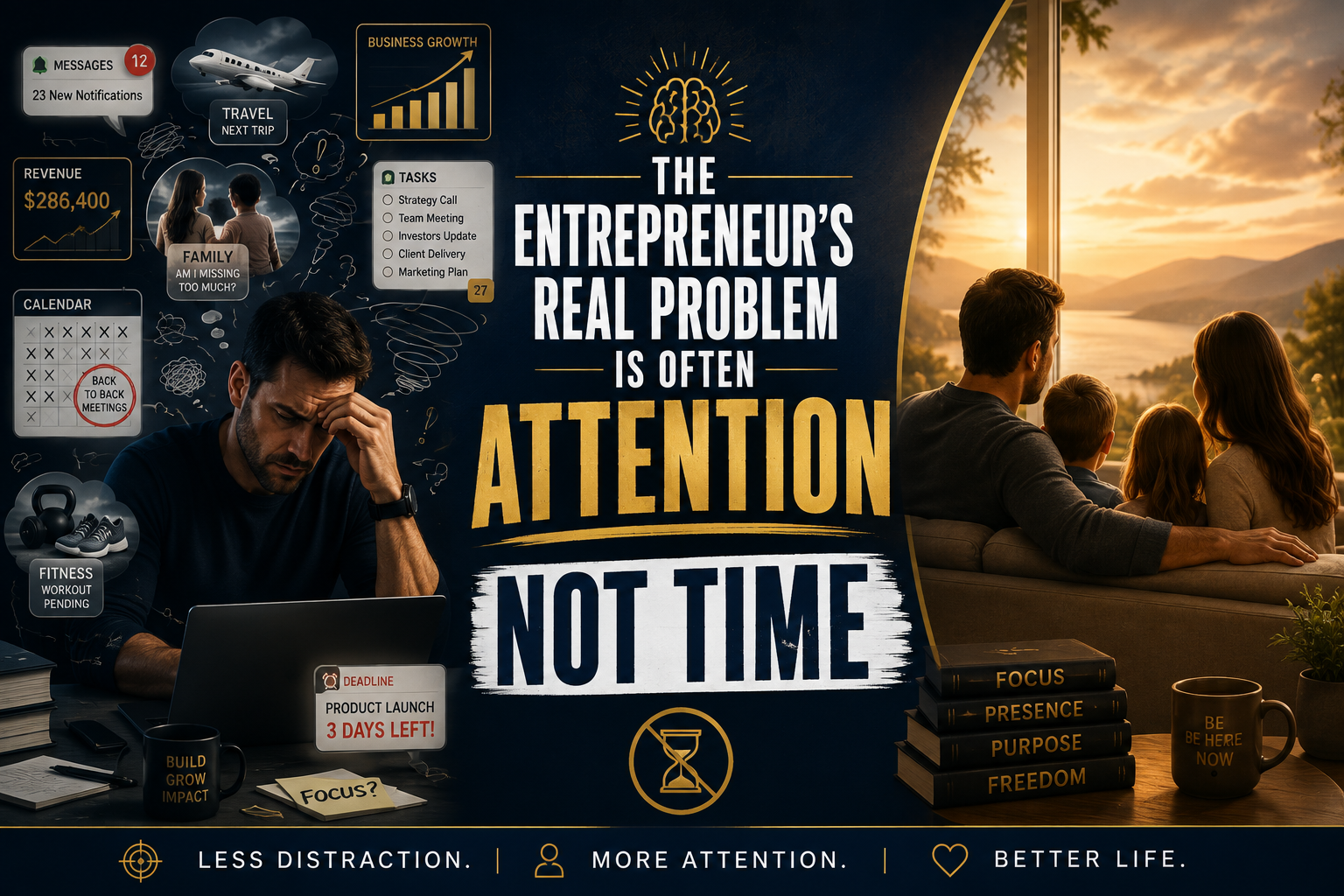
We talk constantly about time management, but I increasingly think attention management is the bigger issue.
You and I get the same 24 hours everybody else gets. What changes dramatically is the quality of attention we're capable of giving those hours.
An hour of completely focused work is different from an hour interrupted 15 times.
An hour playing with your kids while your phone is in another room is different from an hour sitting beside them while answering emails.
An hour-long conversation with your spouse where you're actually listening is different from physically sitting across the table while mentally running tomorrow's schedule.
Presence changes the value of time.
This is why I've become much more interested in asking myself where my attention is rather than simply where my body is.
Because you can give somebody three hours of your physical presence and almost none of your attention.
Stop Carrying Business Guilt Into Your Family Time
This one hits especially hard for entrepreneurs with families.
There are seasons when building something requires sacrifice. I'm not going to pretend otherwise.
Sometimes the business needs more of you.
Sometimes you're going to miss something.
Sometimes there's an opportunity that requires travel, long days, early mornings, or late nights.
I don't believe the answer is pretending business and family will always divide perfectly into some beautiful 50/50 balance. Real life doesn't work like that.
But there's another mistake we make.
We finally get the family time we've been telling ourselves we need, and then we refuse to actually experience it because our mind stays at work.
That's the worst of both worlds.
You're not working productively, and you're not really with your family either.
I've had to work on this myself.
If I've chosen that this time belongs to my family, then I want to get better at allowing it to actually belong to them.
Not the distracted version of me.
Not the guy holding his phone waiting for another notification.
Not the entrepreneur mentally working through tomorrow's problems.
Me.
That's one of the reasons I care so much about building financial and time freedom in the first place. What's the point of creating freedom if you never psychologically allow yourself to experience it?
And Stop Carrying Family Guilt Into the Hours You Need to Build
There's another side to this conversation that doesn't get discussed enough.
Sometimes entrepreneurs feel guilty for working hard because they're told they should always be spending more time at home.
But who is building the future you're trying to create for that family?
There are seasons when your responsibilities require you to work.
Providing matters.
Building assets matters.
Creating financial security matters.
Taking risks today that may create more choices tomorrow matters.
Your family doesn't only benefit from your physical presence. They can also benefit from the future you're working to build.
The key is intentionality.
If you're constantly using "I'm doing this for my family" as an excuse to avoid your family for 20 years, you've probably lost the plot.
But if you've intentionally decided that the next three hours are for building your business, you don't need to spend those three hours feeling guilty for working.
Work.
Give it everything you've got.
Then when the work block ends, honor the next priority with the same commitment.
Guilt Is Not the Same Thing as Accountability
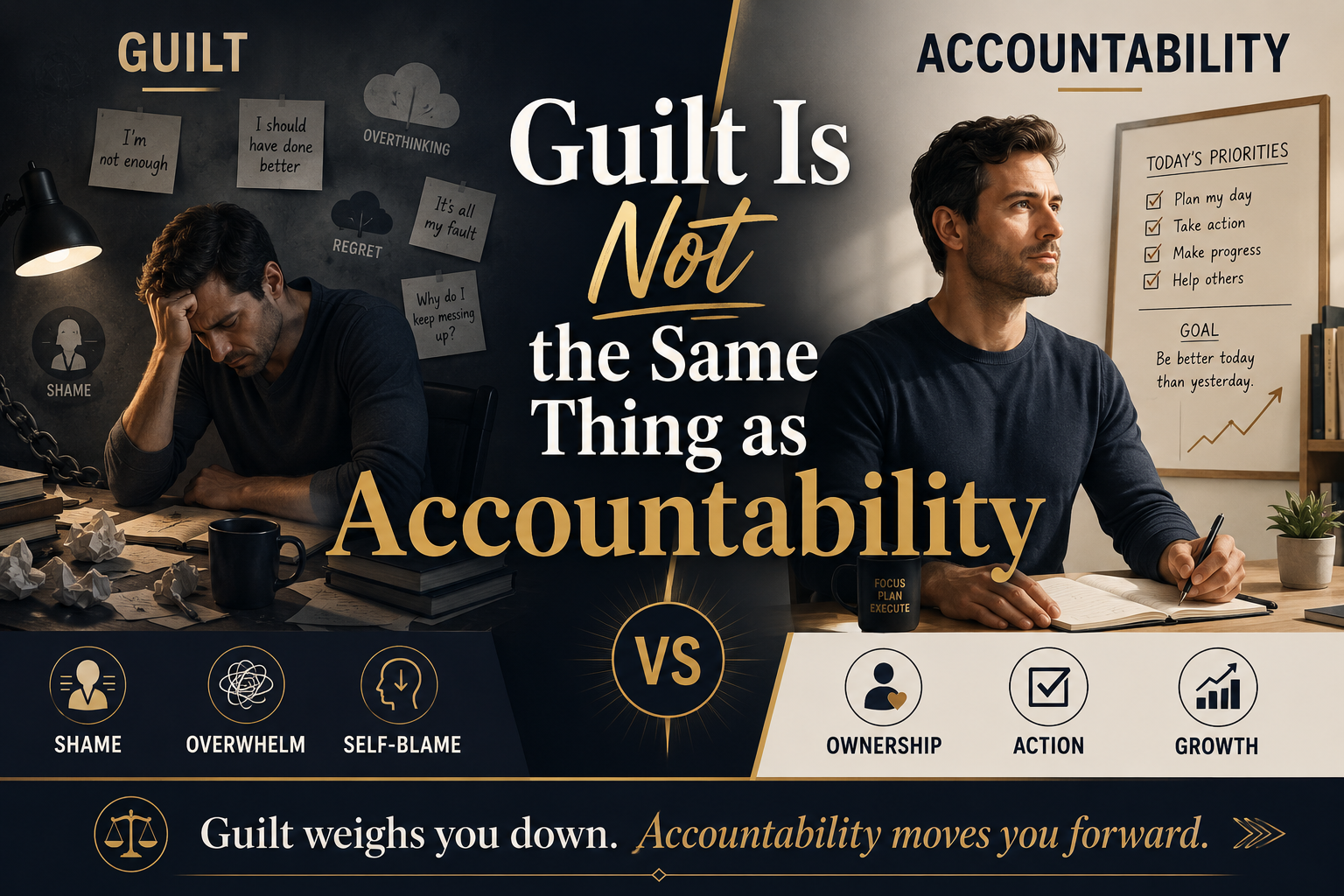
This is where I think ambitious people sometimes confuse themselves.
We believe feeling guilty proves we care.
It doesn't.
Accountability asks:
Did I give the right priority my best effort today?
Guilt asks:
Why wasn't I doing everything else too?
Those are completely different questions.
Accountability can create change. If you're neglecting your health, fix it. If you've barely seen your family for three months, fix it. If you've been avoiding prospecting because you're scared of rejection, fix it. If you're spending your supposedly productive hours wasting time online, fix it.
I'm a huge believer in personal responsibility.
But beating yourself up for responsibly choosing between competing priorities isn't accountability.
It's wasted emotional energy.
Use Priorities Instead of Guilt
One practical change I've made in my thinking is separating priorities from possibilities.
There may be 30 things I could do today.
That doesn't mean there are 30 things I should do today.
Ask yourself:
What genuinely needs my attention today?
What produces the greatest consequence if I neglect it?
What can wait without creating a meaningful problem?
What am I choosing to give my full attention to right now?
Then commit.
This doesn't require some complicated productivity system.
It requires making a decision and allowing yourself to live inside that decision for a while.
When it's time to sell, sell.
When it's time to lead, lead.
When it's time to train, train.
When it's time to recover, recover.
When it's time to be Dad, be Dad.
When it's time to be with the people you love, put the damn phone away and actually be there.
Be Where Your Feet Are
I've come to love this idea because it's incredibly simple:
Be where your feet are.
Look down.
Where are you?
That's where your attention should probably be.
If you're sitting across from your kid, be there.
If you're on a sales call, be there.
If you're standing on top of a mountain, stop checking emails and look at the damn mountain.
If you're at dinner with your wife, don't mentally be sitting at your desk.
If you're at your desk during the time you've intentionally committed to building your future, stop feeling guilty because you're not somewhere else.
Be where your feet are.
You will never eliminate every competing responsibility.
But you can stop allowing responsibilities that aren't currently in front of you to steal the experience that is.
Time Freedom Means Nothing If You Can't Enjoy Your Time
This is where this lesson connects to a much bigger philosophy for me.
I've spent a significant part of my career talking about recurring income, residual income, passive income, and building financial assets because I believe money should ultimately create choices.
The goal isn't simply accumulating more money.
It's being able to decide where your time goes.
But I've realized there's another level beyond financial freedom.
You also have to give yourself permission to use the freedom you've created.
You can build a successful company and remain mentally imprisoned by it.
You can create passive income and still check your phone every four minutes.
You can take your family around the world and spend the entire trip worried about what's happening back home.
You can technically own your schedule while psychologically feeling like you're never allowed to stop.
That's not the freedom I'm chasing.
I want the ability to work incredibly hard when work deserves me and then experience my life when life deserves me.
I want both.
And I think a lot of entrepreneurs do too.
You Don't Need Perfect Balance. You Need Intentional Seasons.
I've never loved the idea that life should always be perfectly balanced.
Some seasons aren't balanced.
When you're launching a company, business may temporarily demand more attention.
When you have a newborn, family may demand more.
When you're training for a major physical challenge, fitness may temporarily take additional time.
When a family member needs you, priorities can change overnight.
That's life.
The goal isn't making every day identical.
The goal is making sure the important areas of your life aren't being permanently sacrificed because one area has consumed everything.
Think in seasons.
Then periodically ask whether the season you're living intentionally became the life you're living accidentally.
That's an important distinction.
The Goal Is Not Doing Everything. It’s Being Fully Committed to What Matters Now.
There will always be another prospect.
Another email.
Another business idea.
Another project.
Another workout.
Another problem.
Another opportunity.
There will always be something else you could be doing.
There will not always be more time.
That's the part I think we forget.
You can spend your entire life optimizing your schedule and still miss your life because your brain was always somewhere else.
I'm still working on this myself. This isn't something I've mastered and now get to preach from the finish line.
I've carried the guilt.
I've been with my family thinking about business and been at work wondering whether I should be somewhere else. I've looked at productive days and focused on what I didn't accomplish instead of what I did.
That's exactly why I wanted to talk about it.
The answer I'm learning isn't caring less.
It's choosing more deliberately.
Decide what matters.
Give it your attention.
Do it well.
Then move to the next responsibility without dragging the guilt from the last one behind you.
Because an extraordinary life isn't built by trying to do everything at once.
It's built by knowing what matters most right now and having the discipline to actually be there for it.
Focus. Let go of the unnecessary guilt. Be where your feet are.
And enjoy some of the life you're working so damn hard to build.
Frequently Asked Questions About Entrepreneur Guilt
Why do entrepreneurs feel guilty when they aren't working?
Entrepreneurs often operate without clear boundaries between work and personal life. Because there is almost always another task, opportunity, customer, or improvement available, stopping work can feel like choosing not to make progress. Learning to define intentional priorities and boundaries can help separate legitimate responsibility from unnecessary guilt.
How can entrepreneurs stop thinking about work during family time?
Creating a clear transition between work and family time can help. Finish or document unfinished tasks, decide when you'll return to them, silence unnecessary notifications, and intentionally put your phone away when possible. The goal isn't pretending work doesn't exist; it's giving yourself permission to return to it later.
Is work-life balance realistic for entrepreneurs?
Perfect daily balance usually isn't realistic. A better approach for many entrepreneurs is intentional allocation across different seasons of life. Business may require more attention during certain periods, while family, health, or other responsibilities may become the priority during others.
How do I know whether I'm feeling unnecessary guilt or actually neglecting something important?
Look at your behavior rather than the emotion alone. If an important area of your life has been consistently neglected, guilt may be signaling a legitimate need for change. If you're responsibly handling your priorities but still feel bad whenever you're not doing everything simultaneously, the problem may be unrealistic expectations rather than lack of effort.
How can entrepreneurs become more present?
Choose the priority before entering the activity. Decide that a particular period belongs to work, family, exercise, recovery, or another responsibility, and remove unnecessary distractions during that time. Being present becomes easier when you've intentionally decided what deserves your attention instead of continuously renegotiating that decision.
Can building passive income improve work-life balance?
Recurring and passive income can create greater financial flexibility because some income may continue without being directly tied to every hour worked. However, financial freedom alone doesn't guarantee presence or happiness. Entrepreneurs still have to establish boundaries and intentionally use the choices their financial assets create.
About Joe Wagner
Joe Wagner is an entrepreneur, author, sales leader, and advocate for building a life around freedom, experiences, family, health, and personal responsibility. His philosophy is that success shouldn't only be measured by how much money you make, but by how much control you have over your time and the choices you're able to make with it.
A major part of Joe's entrepreneurial journey has been learning how to build income that isn't permanently tied to hours worked. Through more than 16 years in merchant services and payment processing, he built a substantial recurring residual portfolio and became passionate about the idea that passive and recurring income can create something more valuable than money: options. Those options can mean more time with family, the ability to travel, opportunities to pursue difficult physical challenges, and greater control over how you choose to live.
Today, Joe connects those lessons through his personal development content and merchant services education. He writes about mindset, discipline, fitness, faith, adventure, entrepreneurship, leadership, personal responsibility, and his Own Your Life philosophy while teaching entrepreneurs and sales professionals how recurring revenue and portfolio building can become vehicles for greater financial and time freedom.
For Joe, these subjects ultimately connect to the same goal: build the financial assets that create choices, then become the person capable of using those choices to build a meaningful life.
Explore Joe's articles about payment processing, merchant services, portfolio building, and recurring income through the Merchant Sales Training Blog.
Follow Joe's social channels and find his latest content, books, projects, and resources through Joe Wagner on LinkMe.