
Home-Based Business Ideas for Salespeople & Experienced Closers
Home-Based Business Ideas for Salespeople and Experienced Closers
If you're searching for home-based business ideas, I want you to start somewhere different than most lists on the internet.
Don't begin with whatever business happens to be trending this year. Start with the skills you've already spent years developing.
If you've made thousands of sales calls, closed deals over Zoom, walked into businesses cold, built referral networks, managed pipelines, negotiated contracts, or developed relationships with entrepreneurs, you are not starting entrepreneurship from zero. You already possess one of the most difficult skills every new business eventually has to develop: the ability to create customers.
That should completely change the type of home business you consider.
You don't necessarily need to learn how to build an e-commerce store, become a content creator, manufacture a product, master paid advertising, or chase whatever online opportunity somebody is promoting this month. Those can all be legitimate businesses, but they may require you to abandon the exact competitive advantage you've already spent years building.
For the experienced salesperson, I believe the better question is:
What home-based business lets me use what I already know while building something that belongs more to me over time?
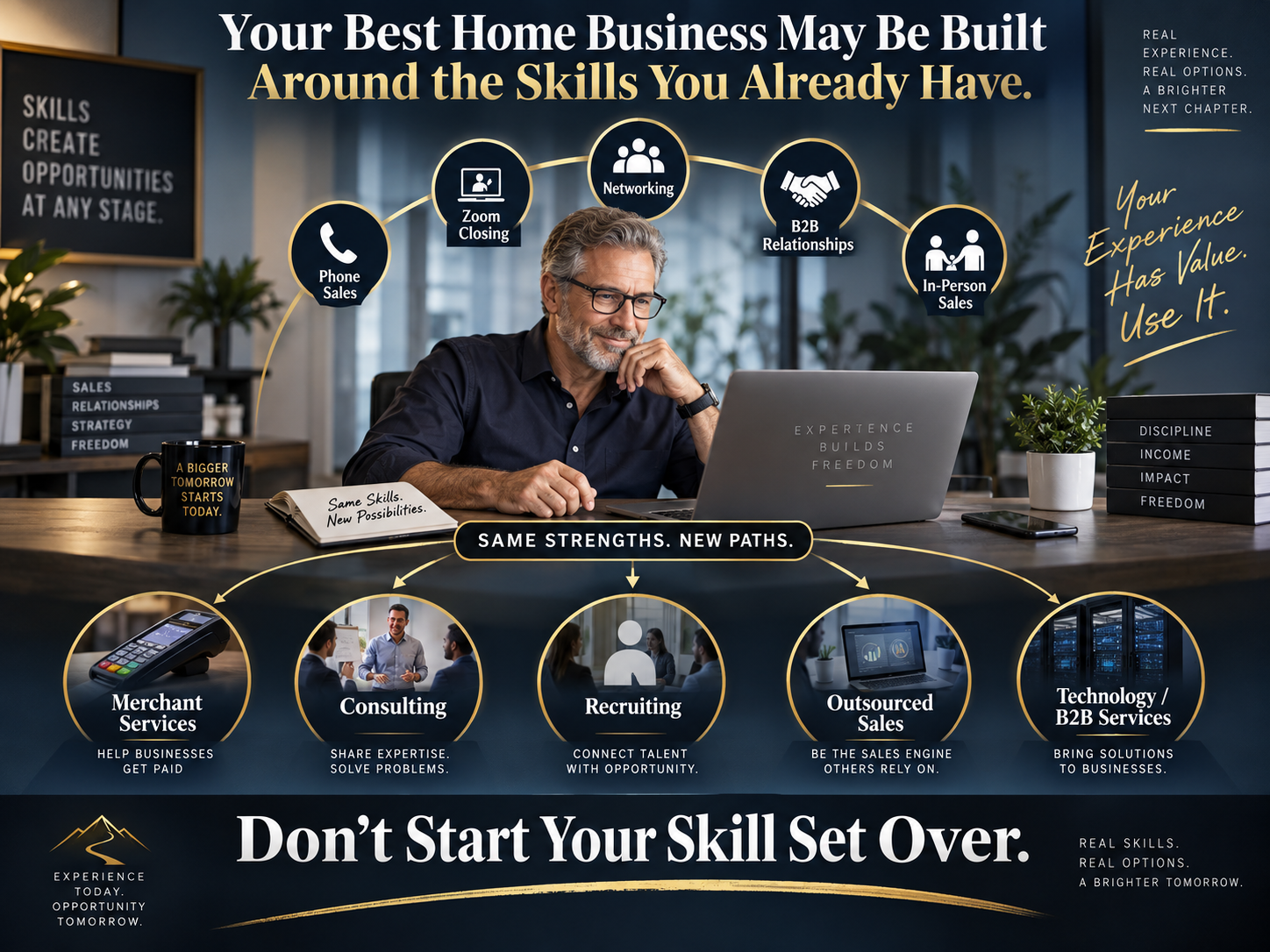
That could mean consulting. Recruiting. An outsourced sales business. Technology sales. Referral partnerships. Merchant services. Or another B2B model where relationships and customer acquisition matter.
The goal isn't simply to work from your house.
The goal is to build a business where your existing experience gives you a head start.
A Home-Based Business Is Not the Same Thing as an Easy Business
This distinction matters because the phrase work from home has become tied to a lot of unrealistic expectations.
A home-based business may eliminate the need for a traditional office, storefront, warehouse, or daily commute, but it doesn't eliminate the need for customers. You still need a product or service people will pay for, a reliable way to acquire those customers, a system for delivering what you sold, and economics that make the business sustainable.
Working from your kitchen table doesn't turn weak economics into strong economics.
A home-based entrepreneur still has to answer the same fundamental questions as any other business owner: Who is the customer? What problem am I solving? How do I reach them? Why should they choose me? What does fulfillment require? What does it cost to operate? What happens after the first sale?
That's why I would separate location freedom from business quality.
Where you work is one variable.
What you're building is the much bigger one.
The Biggest Advantage an Experienced Salesperson Has Is Customer Acquisition
One of the most common reasons new businesses fail to gain traction is that the owner learns how to create the product but never learns how to consistently sell it.
A technically talented consultant may struggle to find clients. A fantastic software developer may not know how to create business conversations. A talented marketer may be great at delivering campaigns but uncomfortable asking prospects to make a decision.
Experienced salespeople enter entrepreneurship with a different starting point.
You already understand activity.
You understand pipeline.
You know what follow-up means.
You understand that most people don't buy during the first conversation.
You've heard objections before.
You've lost deals.
You've recovered from bad weeks.
You know how to ask for money.
That's significant.
If you've been doing these things successfully for somebody else's company, don't underestimate what happens when you apply the same ability to something you're building for yourself.
This is exactly why I wrote Low-Cost Business Ideas for Salespeople Who Already Know How to Sell. Your strongest startup asset may already be the ability you use every day.
Before Choosing a Home Business, Identify How You Actually Sell
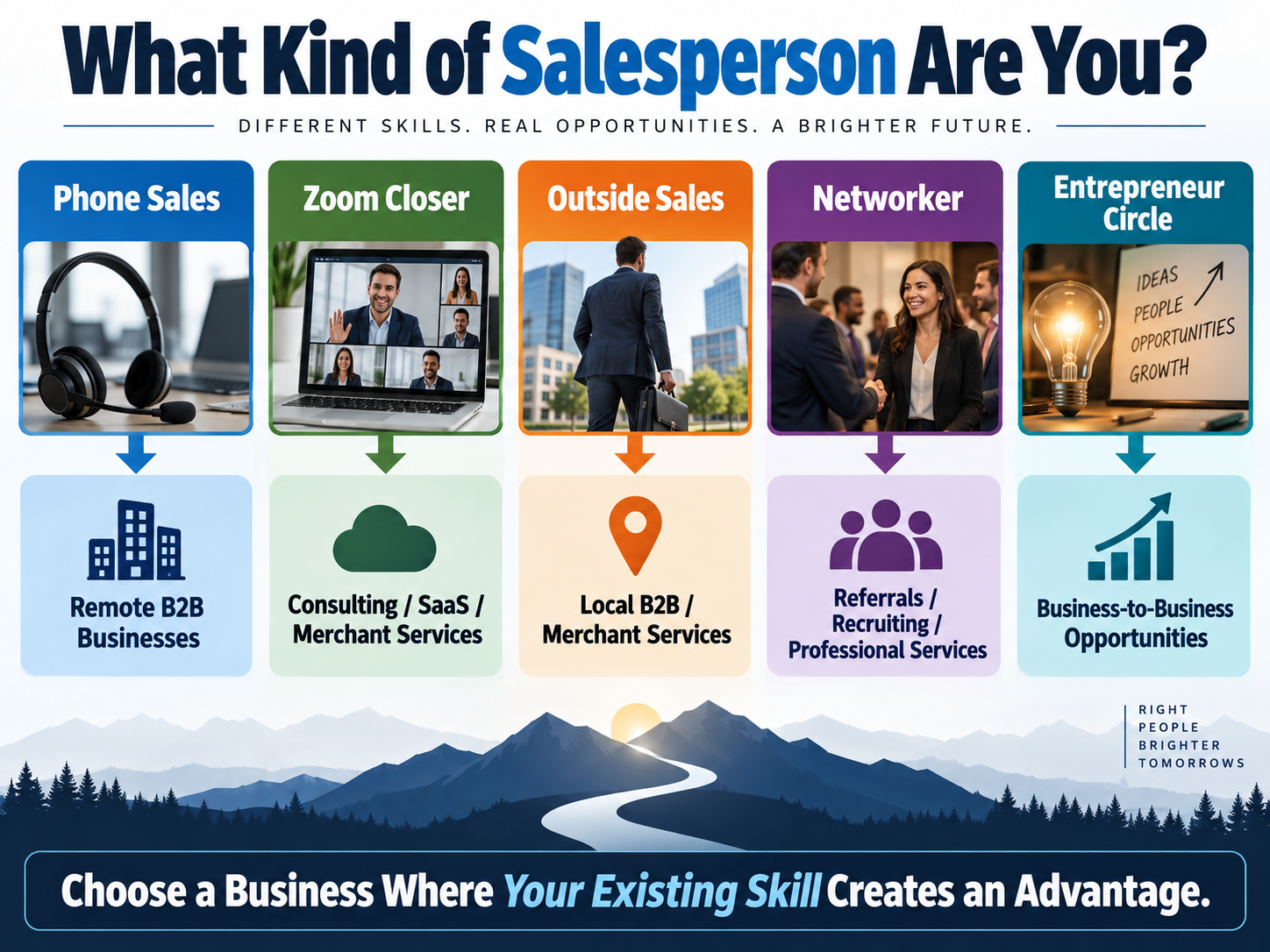
Not all salespeople sell the same way, and I don't think everybody should choose the same business model.
Some people are phenomenal cold callers. Give them a list, a headset, and a compelling offer and they will create opportunities all day.
Other people hate the phone but can walk into a room and immediately build trust.
Some people are excellent Zoom closers who understand discovery, pain, objections, and decision-making.
Others are natural networkers. They may not enjoy high-volume prospecting, but they know hundreds of business owners and are constantly making introductions.
Your style matters because the more your next business resembles what you're already good at, the less you're truly starting over.
If Your Strength Is Phone Sales
Look heavily at B2B models where outbound prospecting is still an advantage. Merchant services, recruiting, technology services, appointment setting, SaaS, outsourced sales, and certain consulting businesses can all benefit from a strong phone salesperson.
If You're a Zoom or High-Ticket Closer
You may be well suited for consulting, software, business services, remote B2B sales, or merchant services where discovery and presentation can happen remotely. You already understand how to guide a prospect through a business decision without sitting in the same room.
If You're Strong Face to Face
Don't assume a home-based business means you should stop meeting people. Your home can simply become your headquarters while your selling happens in the field. Merchant services, consulting, real estate-related businesses, and local B2B representation can all operate this way.
If Networking Is Your Superpower
Consider businesses where one relationship can create several more. Recruiting, merchant services, commercial business services, consulting, insurance, referral partnerships, and professional services can all reward someone with a strong network.
If You Already Know Entrepreneurs
Pay particular attention to B2B opportunities. If many of the people in your phone own businesses, you already have potential customers, referral partners, or introductions that a brand-new entrepreneur might spend years trying to develop.
1. Merchant Services: A Home-Based B2B Sales Business With Residual Potential
Merchant services is first because it is the business I know best and one I believe experienced salespeople often overlook.
Businesses need to accept payments. An independent merchant-services agent helps those businesses establish processing and commerce solutions through an established processing organization.
The agent does not need to manufacture the payment technology or build the entire processing backend. A strong upstream partner can provide underwriting, processing infrastructure, equipment programs, reporting, technology, and merchant support while the salesperson focuses heavily on acquiring and retaining merchant relationships.
That structure makes merchant services especially interesting as a home-based business because a large amount of the operation can be run from a phone and computer.
You can research businesses from home, prospect by phone, conduct Zoom meetings, manage follow-up through a CRM, communicate digitally, and organize your pipeline from a home office. You can then meet merchants in person whenever doing so improves the relationship or the sale.
I explain this model in detail in Can You Sell Merchant Services From Home? Phone, Zoom & Remote Sales Explained.
Why Experienced Salespeople May Have an Advantage
The payments knowledge can be learned.
The difficult sales habits may already exist.
If you've spent ten years prospecting, you understand activity. If you've closed high-ticket deals, you understand discovery and decision-making. If you've worked B2B, you're comfortable speaking with business owners. If you're a networker, you may already know potential merchants and referral partners.
You aren't necessarily learning how to sell.
You're learning what to sell and how the economics work.
Why the Long-Term Model Is Interesting
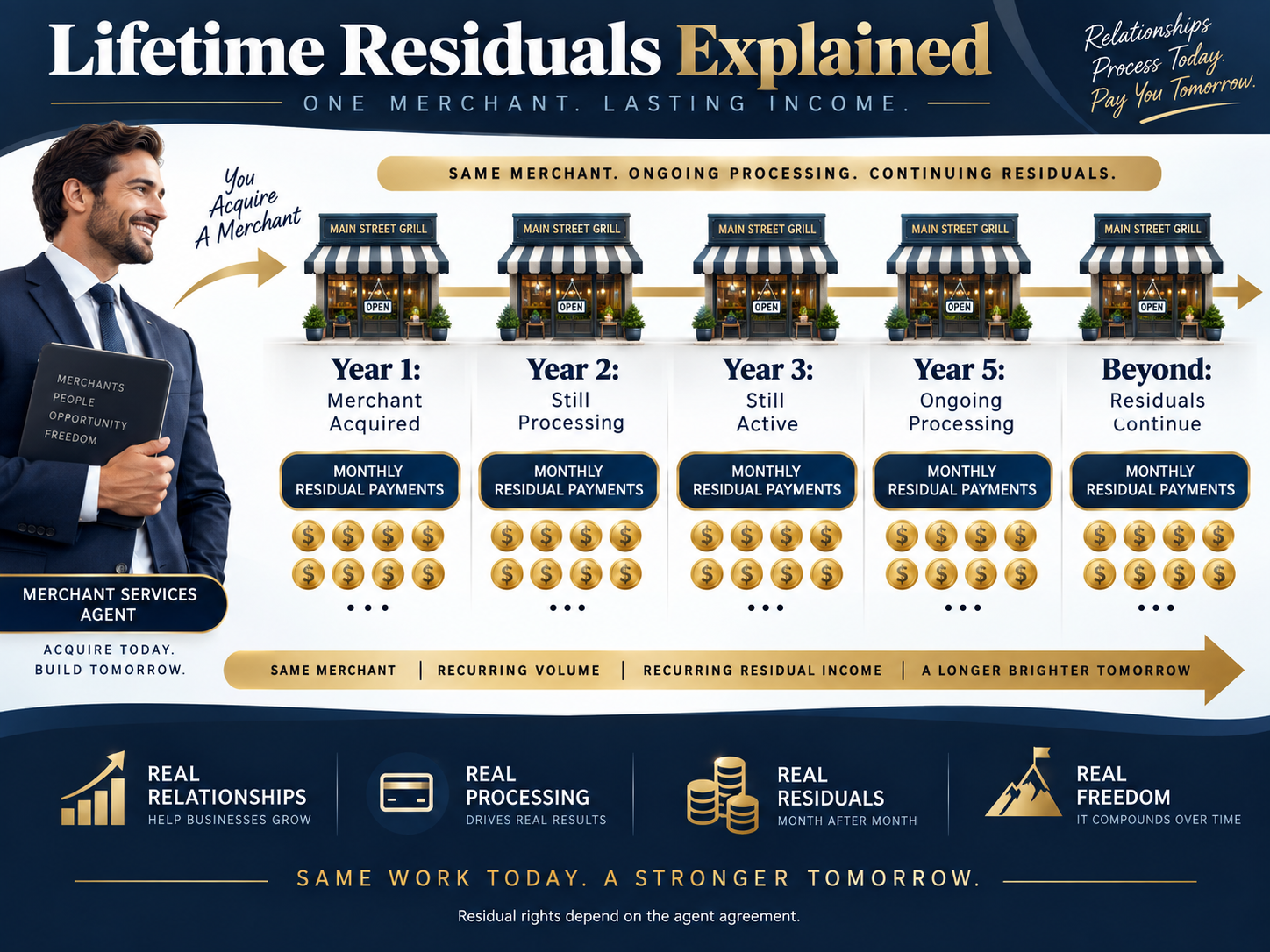
Depending on the agent program and agreement, merchant-services agents can potentially earn recurring residual compensation from active merchants they've previously acquired.
That means the goal isn't only:
Sign merchant → Get commission → Start over.
The merchant can potentially become part of a growing portfolio.
That's why I think merchant services deserves serious attention from people searching for sales careers that build a book of business.
2. Consulting: Sell Expertise Instead of Inventory
Consulting can be one of the most natural home-based businesses for an experienced professional because your knowledge becomes the product.
If you've spent fifteen years building sales teams, improving operations, managing projects, recruiting, marketing, working within a specialized industry, or solving a specific business problem, someone may be willing to pay you to help them solve that problem faster.
A salesperson has an important advantage because many knowledgeable professionals struggle with client acquisition. They know how to deliver the service but have difficulty creating enough conversations to sell it.
If you can both sell and deliver expertise, consulting can be a powerful model.
The challenge is leverage.
If your business requires you personally to spend another hour every time you earn another dollar, it can eventually become a very profitable job rather than a business that scales independently.
That may be perfectly fine.
Just understand the model you're choosing.
3. Independent Recruiting or Search
Recruiting is another business that can fit experienced salespeople exceptionally well because so many of the core activities overlap.
A recruiter prospects companies, uncovers hiring needs, identifies candidates, qualifies people, manages expectations, negotiates, follows up, and closes both sides of a transaction.
Those are sales skills.
A recruiter can operate substantially from a home office using phone calls, video meetings, databases, email, and professional networks.
The model can also reward specialization. Instead of trying to recruit every type of employee for every company, a recruiter can build credibility in one industry or job category.
The limitation is that traditional direct-hire recruiting can remain transactional. You make a placement, collect a fee, and then need another placement. Staffing or recurring recruitment arrangements can introduce ongoing economics, but they also introduce additional operational responsibilities.
As with every business in this article, understand what happens after the initial transaction.
4. Outsourced Sales or Appointment-Setting Agency
If you're truly good on the phone, you can potentially sell the ability to create sales conversations for other companies.
A home-based outbound sales company might offer prospecting, appointment setting, lead qualification, follow-up, or sales-development services to businesses that don't want to build the function internally.
This model can be attractive because you are monetizing a skill you already possess.
You know how to call.
You know how to work a list.
You know how to create appointments.
The challenge is that once you acquire multiple clients, you need fulfillment capacity. If you personally make every call, your income is constrained by your available hours. If you hire representatives, you become responsible for training, management, quality control, systems, and client retention.
That is not necessarily bad. It's simply the next stage of the business.
5. Specialized B2B Agency
A specialized agency can be a strong home-based business when you combine a clear service with strong client acquisition.
The word agency has become so broad online that it almost means nothing. The important part is what you actually do for the customer.
Perhaps you build websites for a specific industry. Maybe you manage local advertising, implement CRM systems, provide bookkeeping, create videos, automate appointment reminders, manage social media, or run outbound campaigns.
A salesperson's advantage is getting the client.
Your challenge is fulfillment.
If you sell ten businesses a service you cannot deliver well, your sales ability becomes a liability because you've acquired customers faster than you can help them.
The best agency businesses combine great sales with repeatable delivery.
6. Independent B2B Sales Representative or Broker
Many companies have products or services they need help distributing without building enormous internal sales teams.
An experienced salesperson may be able to represent a manufacturer, software company, business service, finance provider, telecom solution, equipment company, or other B2B provider on an independent basis.
This can create a relatively low-overhead home business because the salesperson isn't responsible for manufacturing the underlying product.
You focus on relationships and distribution.
That is very similar to one of the things I like about merchant services: leverage the established company's infrastructure while focusing on the thing you're best at—creating customers.
The important question is the compensation structure. Do you get paid once? On repeat orders? On renewals? On recurring customer revenue?
If long-term income matters to you, understand that before dedicating years to the product.
7. Referral and Strategic Partnership Business
Not every salesperson wants to directly close every deal.
Some people are extremely good at identifying opportunities and connecting the right people.
That ability can create a home-based business built around referral and strategic partnerships, depending on the industry and applicable rules.
A well-connected professional may already have relationships with business owners who need financing, payroll, merchant services, insurance, recruiting, technology, marketing, or other services. By developing legitimate partnerships with quality providers, that person may be able to create value by making appropriate introductions.
The key is becoming more than someone who simply throws leads around.
Trust matters.
The provider needs to take care of the person you introduced.
The solution should actually fit.
And any compensation arrangement needs to comply with the rules governing that industry.
For networkers, this type of business can be particularly powerful because the asset you've been building for years is the network itself.
Which Home-Based Businesses Have the Lowest Startup Costs?
This is one reason service and sales businesses tend to attract experienced professionals.
You may not need a storefront, manufacturing equipment, large inventory purchases, or a warehouse. You can often begin with communication tools, basic business infrastructure, appropriate licenses where required, software, and whatever is necessary to deliver the actual service.
But low cost does not mean no cost.
You may still have business registration expenses, software, marketing, insurance, professional services, telecommunications, travel, or other legitimate operating costs depending on what you choose.
That's why I think the better goal is low unnecessary overhead, not chasing a mythical business that costs nothing.
Our guide to Businesses You Can Start With Little Money and No Inventory goes much deeper into that distinction.
Avoid Building a Business Around Expenses Before You've Built It Around Customers
One of the strangest things about entrepreneurship is how easy it is to spend money before you've made any.
You buy the branding package.
Then the expensive CRM.
Then lead-generation software.
Then automation.
Then a course.
Then another tool.
Then a professional website.
Six months later you have a beautifully organized business with no customers.
For an experienced salesperson, this should feel backwards.
You know that the market ultimately decides whether the business works.
Learn enough to deliver responsibly. Build the infrastructure you legitimately need. Then begin testing whether you can create and close customers.
Once you prove the sales process, you can reinvest into things that genuinely improve production or fulfillment.
Home-Based Does Not Have to Mean Fully Online
This matters especially for people comparing merchant services with traditional internet businesses.
I consider merchant services a home-based business even though I don't believe every merchant needs to be sold through a computer screen.
Your home office can be the operational headquarters.
You build lists there.
Make calls there.
Run Zoom conversations there.
Manage CRM there.
Handle follow-up there.
Complete training there.
Then if a merchant is fifteen minutes away and meeting face to face increases your chance of earning a long-term relationship, go meet them.
That's still a home-based business.
Your home is the base, not a cage.
The same is true in consulting, recruiting, independent B2B sales, and many other businesses.
What if You're Looking for a Business Because You're Tired of Your Sales Job?
This is where I want you to be careful.
Maybe you're not actually tired of sales.
Maybe you're tired of quota resets.
Maybe you're tired of building customer relationships that ultimately belong entirely to the company.
Maybe you're tired of having a great year and then being told your new target is even higher.
Maybe you're tired of being laid off from a business you helped grow.
Maybe you're tired of making someone else's brand stronger without building enough behind yourself.
Those are different frustrations.
Don't interpret every career frustration as evidence that you need to abandon selling.
You may need to change what your selling is building.
That's why this entire new cluster began with Sales Jobs With Residual Income.
The experienced salesperson isn't necessarily looking for a way to stop working.
They're looking for a reason yesterday's work should continue mattering.
Why Recurring Revenue Deserves a Place in Your Decision
A high one-time commission can be extremely valuable.
There is nothing wrong with transactional sales.
But when evaluating a home-based business, I would still ask whether previous customers can continue contributing revenue.
A consulting client might pay a monthly retainer.
A staffing client might create recurring placements or billings.
A SaaS program might provide recurring commission depending on the agreement.
An agency may collect monthly retainers.
A merchant-services agent may potentially receive recurring residual compensation from active merchant accounts.
The exact model matters less than understanding whether something is accumulating.
This is why our next article, How to Build Recurring Income as a Salesperson Without Starting Over Every Month, is an important part of this cluster.
You don't need every dollar to be recurring.
But you should understand what percentage of your future depends entirely on creating another new sale.
What Happens if You Stop Selling for a Month?
This is one of my favorite questions when evaluating a business.
Suppose you're sick for a month.
You take a long trip.
Family needs your attention.
Or you simply have a bad sales month.
What happens?
In a purely transactional business, new revenue may drop sharply because there are no new sales.
In a consulting retainer model, some existing clients may continue paying.
In an agency, retained clients may continue.
In insurance, renewal economics may continue depending on the arrangement.
In merchant services, active merchant accounts may continue contributing residual compensation according to the underlying economics and agent agreement.
Nothing is guaranteed forever.
Customers cancel.
Businesses close.
Contracts change.
But a recurring customer base can create a fundamentally different business than one where every dollar depends on this week's prospecting.
The Long-Term Question: What Does Five Years of Selling Leave Behind?
Suppose you dedicate five years to your next home-based business.
What do you want to have at the end?
Just the money you earned during those five years?
Or would you also like to have customers, recurring contracts, renewal relationships, referral networks, systems, a team, intellectual property, or a portfolio that has some continuing economic value?
There is no universally correct answer.
Some people want to earn a lot of money and invest it elsewhere.
Others specifically want a book of business.
The mistake is never thinking about it.
If you're going to work hard either way, understand what the work is capable of creating.
Merchant Services Checks Several Boxes for the Person I'm Talking To
I do not believe merchant services is the best business for everybody.
But if I were creating a profile of someone who should seriously evaluate it, that person would probably have several of these characteristics.
They've sold before and don't need somebody teaching them that rejection exists. They're comfortable with commission-based compensation and have experience creating their own activity. They either know business owners already or are willing to prospect them. They want relatively low traditional overhead and would rather leverage an established company's infrastructure than manufacture or warehouse a product themselves.
Most importantly, they're interested in building recurring economics behind the sales they make.
If several of those things describe you, merchant services deserves more than a passing glance.
It may fit especially well if you've sold over the phone, run Zoom calls, worked B2B, managed a territory, generated referrals, or spent years developing an entrepreneurial network.
The product is different.
The skill set may not be.
Merchant Services Is Not Just "Selling Credit-Card Rates"
This is another misconception that can make the industry look outdated to someone evaluating businesses.
Modern merchant services goes far beyond walking into a company and saying, "I can save you ten basis points."
Businesses need payment acceptance, but many also need point-of-sale systems, invoicing, online payments, appointments, customer-management capabilities, loyalty, reporting, integrated software, funding solutions, e-commerce capabilities, and other commerce tools.
The job increasingly becomes understanding how the business operates and identifying whether the available technology solves something meaningful.
That creates a much more consultative sale.
For an experienced B2B closer, that's a good thing.
You aren't limited to competing on price.
You can actually sell value.
Don't Become a Payment Processor Just Because You Want Your Own Business
This is another area where salespeople make entrepreneurship unnecessarily complicated.
They think "build my own merchant-services business" means they need to become a registered ISO, establish sponsor-bank relationships, build technology, manage underwriting, hire support teams, and operate the entire backend themselves.
For most people starting out, I don't think that's necessary.
You can work as an independent agent through a strong upstream organization.
I explain why in Merchant Services Agent vs. ISO.
The idea is simple:
Let great operators operate. Let great salespeople sell.
Your business can be the portfolio and customer relationships you're developing without needing to reinvent the processing infrastructure.
That leverage is one of the biggest reasons merchant services fits this home-based-business conversation.
What About Startup Costs?
Entering merchant services as an agent is different from building an entire payment-processing company.
You generally don't need to warehouse equipment or finance the entire infrastructure yourself simply to start prospecting. Exact expenses vary by how you structure your business, but the model can be approached far more leanly than many product-heavy businesses.
This is one reason I wrote Can You Start Selling Merchant Services for Free? What You Should—and Shouldn't—Pay For.
The point isn't that no business expense will ever exist.
The point is that I do not believe somebody should assume they need to pay thousands of dollars merely for permission to access the merchant-services industry.
This Is Exactly Why I Built Merchant Service University
I had already been working in merchant services for years when I started seeing something bother me.
People were being charged thousands of dollars to learn how to enter an industry that I actually make my living in. Some of the people I spoke with afterward still didn't feel they had received the practical depth they expected from what they purchased.
That became part of the reason I built Merchant Service University.
I didn't need to turn MSU into another expensive business opportunity.
I invested my own time and resources into creating the foundational education and made the core training free.
My philosophy is straightforward:
Get educated before you get recruited.
If merchant services looks interesting, understand it first.
Then decide.
Take a Peek at Merchant Service University From Home
If you're already sitting at your computer researching home-based business ideas, you're in the perfect place to do the next step without buying anything.
Go to MerchantServiceUniversity.com.
Learn how payment processing works.
Learn how agents are compensated.
Understand residual income.
Understand pricing.
Learn what a Schedule A is.
Understand agent agreements.
Learn the basics of merchant technology.
Learn prospecting.
Learn portfolio building.
The core education is free, and there is no obligation to join one specific processing company.
If you've already spent years in sales, I especially want you to look at it through that lens.
You may realize you're not trying to learn how to become an entrepreneur from scratch.
You're learning how to apply a skill set you already possess to a different business.

Don't Choose the First Merchant Services Company That Finds You
Education should come before recruitment.
Once you begin researching merchant services online, you're going to encounter processing companies, ISOs, recruiters, agent programs, and promises about compensation.
Don't make the decision based solely on the biggest advertised percentage.
You need to understand residual economics.
Schedule A costs.
Vesting.
Portfolio rights.
Upfront commissions.
Merchant support.
Technology.
Underwriting.
The agent agreement.
And how all of those pieces match the type of business you're trying to build.
That's why I created How to Compare Merchant Services Companies Without Getting Sold and How to Choose a Merchant Services Agent Program.
If you're going to build from home for the next five or ten years, the partner behind the business matters.
Could You Start This as a Side Hustle First?
Potentially, and I think that can be a responsible way to approach it.
You can begin learning without leaving your current career. You can build prospect lists, schedule defined selling blocks, use your existing business network, run remote appointments, and learn what merchant onboarding actually feels like before deciding whether you want to allocate more of your professional life to it.
That doesn't mean five random calls every other weekend will build a serious portfolio.
A side business still needs disciplined activity.
But it can allow you to prove the model and your own ability before making a larger financial decision.
Read Is Merchant Services a Good Side Hustle in 2026? if that sounds more realistic for your current situation.
What if You've Already Tried Several Home-Based Businesses?
This may be the most important section for some readers.
If you've already tried dropshipping, affiliate marketing, an agency, Amazon, coaching, content creation, or several other online businesses, don't automatically conclude you're bad at entrepreneurship.
Ask why each one failed.
Did you actually understand the customer?
Did you know how to acquire them?
Did you stay with the model long enough to become competent?
Did you enjoy the work?
Was fulfillment too complicated?
Was the startup cost too high?
Were you dependent on advertising you didn't understand?
Did the business require a completely different skill set from the one you had?
Or did you buy an opportunity based on how easy it looked?
If that's been your cycle, read Online Business Ideas in 2026: Stop Buying the Dream and Evaluate the Business Model.
The answer may not be finding another business.
It may be choosing more intelligently.
The Right Home Business Should Fit Your Life and Your Strengths
There isn't one universal winner.
A consultant with deep expertise may be able to create an excellent business from a laptop.
A natural recruiter may build something through relationships and phone calls.
A technically skilled operator may build a specialized agency.
A strong content creator may build distribution online.
An elite closer may build a high-value B2B sales business.
A highly connected entrepreneur may build around referrals and strategic partnerships.
And someone with strong sales ability who wants low overhead, B2B customers, flexible prospecting, and recurring portfolio potential should seriously evaluate merchant services.
That's the point of this article.
I'm not trying to find the best home-based business for the average person.
I'm trying to help you identify the one that best rewards what you've already spent years becoming good at.
Frequently Asked Questions About Home-Based Business Ideas for Salespeople
What are the best home-based business ideas for salespeople?
Potential options include merchant services, consulting, recruiting, outsourced sales, appointment setting, specialized B2B agencies, independent sales representation, and referral-based businesses. The best choice depends on the salesperson's experience, network, startup capital, preferred selling method, and long-term income goals.
What home business is best for someone who is good at phone sales?
Merchant services, recruiting, appointment setting, outsourced sales, SaaS, telecom, consulting sales, and other B2B services can all benefit from strong outbound phone-sales ability.
What home business is good for a high-ticket closer?
High-ticket closers may be well suited to consulting, SaaS, specialized business services, merchant services, remote B2B sales, and other models that rely heavily on discovery, value presentation, objection handling, and closing.
Can merchant services be run from home?
A significant portion of merchant-services prospecting, appointment setting, Zoom meetings, CRM management, training, applications, and follow-up can potentially be handled from a home office. Some merchants or sales approaches may still benefit from in-person meetings.
Is merchant services a low-cost home business?
Working as an independent agent through an established merchant-services organization can reduce the infrastructure required compared with building an entire processing company. Normal business expenses can still exist.
Do I have to buy payment terminals to start merchant services?
An independent agent generally does not need to warehouse equipment simply to begin prospecting and selling through an established provider. Equipment and deployment programs vary by partner.
What home businesses can create recurring income?
Potential examples include subscription services, retainer-based consulting or agencies, certain SaaS and telecom programs, insurance renewals, managed services, and merchant-services residual portfolios. Compensation structures vary.
Is a home-based business the same as an online business?
No. A home-based business simply uses the home as its operating base. Selling, networking, service delivery, or customer meetings may still take place in person.
Can I use my existing professional network to start a business?
Yes. Relationships with business owners, former customers, professional contacts, and referral partners can provide an important starting point for B2B businesses, although relationships should never be treated as guaranteed sales.
What if I've already tried several online businesses and failed?
Review why each model failed before choosing another. Consider customer acquisition, skill fit, fulfillment, startup cost, recurring economics, execution consistency, and whether you stayed with the business long enough to develop competence.
Do experienced salespeople have an advantage in entrepreneurship?
They can. Customer acquisition, discovery, closing, follow-up, networking, and self-management are valuable entrepreneurial skills. Experience does not guarantee success, but it can reduce the number of completely new skills a salesperson must learn.
Can I build merchant services part time?
Potentially. Some people can learn and begin prospecting while keeping another career, although consistent selling activity and access to business owners are still necessary.
Can merchant services create recurring residual income?
Merchant-services agents can potentially receive recurring residual compensation from qualifying active merchant accounts based on the program economics and agent agreement.
Is Merchant Service University free?
Yes. The core Merchant Service University education is free and does not require students to commit to one specific processing company.
Where should I start if merchant services interests me?
Begin with the foundational training at Merchant Service University, then use How to Become a Merchant Services Agent in 2026 to understand the larger path from education through partner selection and portfolio building.
Final Takeaway: Don't Search for a Business That Lets You Start Over. Build Around What You've Already Earned.
If you're an experienced salesperson searching for home-based business ideas, I don't think you should automatically assume your next chapter requires becoming a completely different person.
You may already know how to create revenue.
You've made the calls. You've run the appointments. You've handled objections. You've built relationships. You've learned how to manage yourself through inconsistent months. You may have spent years developing an entire network of entrepreneurs and business owners.
Those years weren't wasted because you want something of your own now.
They are the foundation.
The question is where you're going to point them next.
Maybe consulting fits your expertise. Recruiting may fit your ability to connect people. An outsourced sales business may fit your outbound ability. An agency may fit if you also understand fulfillment. An independent B2B opportunity may allow you to leverage someone else's product while building your own customer base.
And for the right salesperson, merchant services deserves serious consideration.
You can operate with a relatively lean structure through an established partner. You can prospect by phone, Zoom, networking, referrals, and face-to-face meetings. Businesses already need payment solutions. Your existing B2B selling skills can transfer. And depending on your agreement and merchant retention, you can potentially build recurring residual compensation from the merchant portfolio you create.
That's very different from searching for another easy online business.
You aren't trying to escape work.
You're trying to make the work you've already proven you're willing to do build something longer term.
If that idea catches your attention, go to MerchantServiceUniversity.com.
Take a peek at the free core education.
Don't commit to a processing company yet.
Learn the business.
Then decide whether the sales skills you've already spent years developing may finally have a home-based business worth aiming them at.
About Joe Wagner
Joe Wagner has spent more than 16 years in merchant services and payment-processing sales, acquiring merchants, developing sales organizations, training sales professionals, and building recurring residual portfolios.
He created Merchant Service University to provide free foundational merchant-services education before asking prospective agents to choose a processing partner. Joe's approach is particularly focused on helping experienced sales professionals recognize how skills developed through phone sales, outside sales, Zoom closing, networking, referrals, and B2B relationship building can transfer into a longer-term merchant-services business.
Continue with Sales Jobs With Residual Income, Low-Cost Business Ideas for Salespeople, Online Business Ideas in 2026, Sales Careers That Build a Book of Business, Can You Sell Merchant Services From Home?, or Businesses You Can Start With Little Money and No Inventory.
Or take a peek inside Merchant Service University.