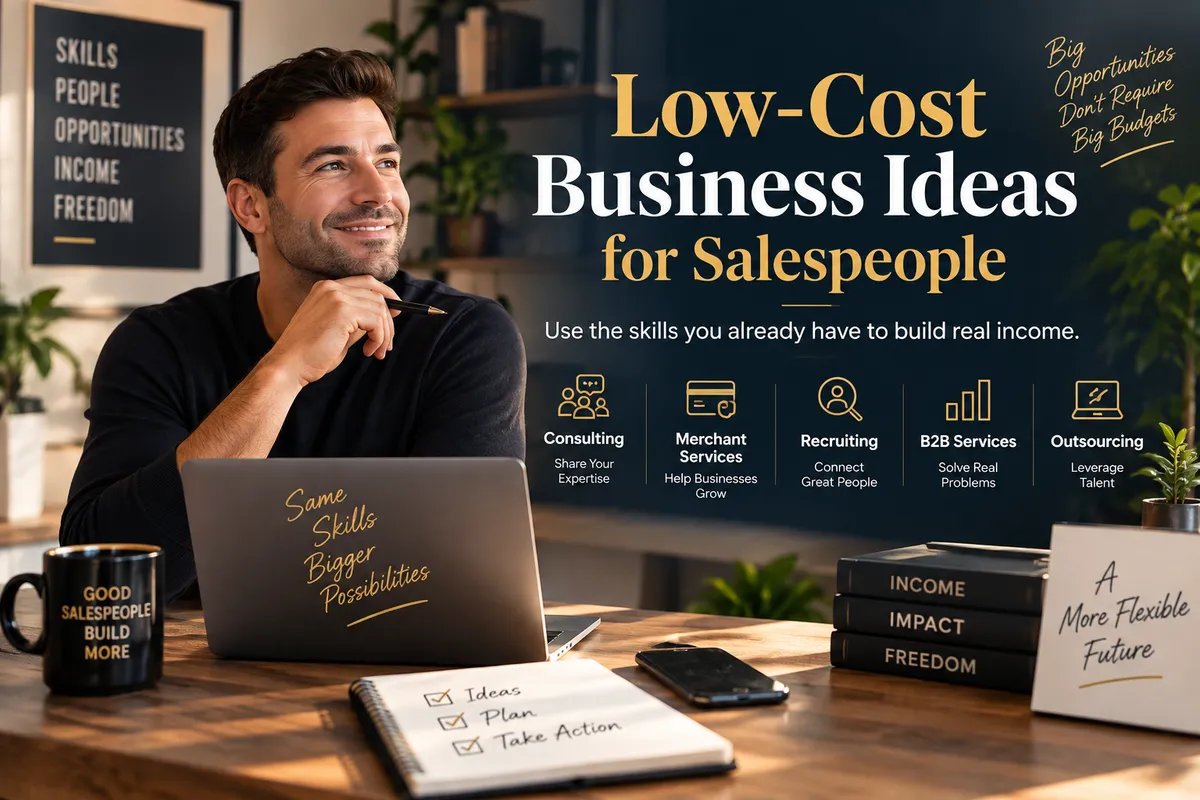
Low-Cost Business Ideas for Salespeople Who Know How to Sell
Low-Cost Business Ideas for Salespeople Who Already Know How to Sell
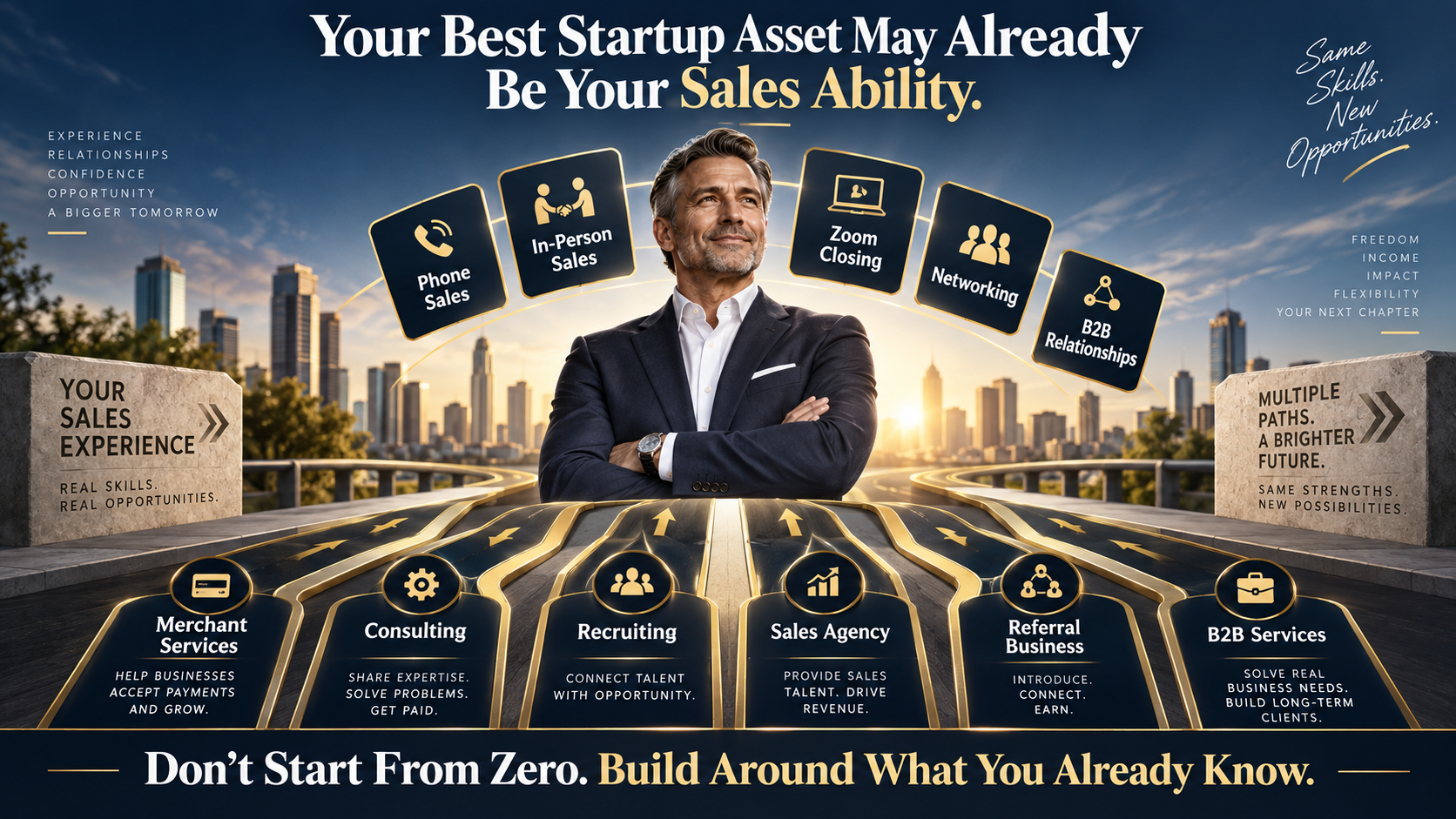
If you already know how to sell, I think you're starting the entrepreneurship conversation with one of the most valuable assets a new business owner can have.
You know how to get a stranger's attention.
You know how to create a conversation.
You know how to ask questions.
You know how to present value.
You know how to follow up.
You know how to ask somebody to make a decision.
Maybe you developed those skills knocking doors.
Maybe you've made thousands of outbound phone calls.
Maybe you've spent years closing deals over Zoom.
Maybe you're a natural networker with a phone full of entrepreneurs.
Or maybe you've spent a decade selling for somebody else's company and are finally asking:
What could I build if I aimed these same skills at something of my own?
That's the question I want to address.
Because when salespeople start looking for low-cost business ideas, I think many of them make a mistake.
They assume becoming an entrepreneur means abandoning everything they already know and learning an entirely new business model.
They start researching dropshipping.
E-commerce.
Amazon stores.
Content businesses.
Digital products.
Franchises.
Agencies.
Whatever opportunity is dominating social media that month.
Sometimes those businesses work.
But before spending thousands of dollars learning a completely new skill, I would ask a much simpler question:
What business can I build around the skill I've already spent years developing?
If you're already good at selling, your answer may look very different from somebody starting with no sales experience at all.
Low Startup Cost Does Not Mean No Business Expenses
Let's establish this immediately.
A low-cost business is not necessarily a business with absolutely zero expenses.
Every legitimate business can have costs.
The U.S. Small Business Administration recommends estimating both one-time and ongoing expenses before launching. Depending on the business, startup expenses can include licensing, permits, equipment, technology, professional services, marketing, rent, and other operating costs.
So I'm not interested in promising you:
"Start a business for $0 and make money tomorrow."
That's exactly the type of thinking I want salespeople to move away from.
Instead, we're looking for businesses where the capital requirement is not the primary barrier to entry.
Maybe you need a phone.
A computer.
Transportation.
Basic software.
A business entity.
Some marketing expenses.
Those are very different from needing:
$50,000 of inventory.
A retail lease.
Manufacturing equipment.
A large advertising budget.
A franchise fee.
A warehouse.
Or a $20,000 course before someone will even explain what you're supposed to sell.
The goal is not zero expense.
The goal is leverage.
How can you use the skills you already have without taking on massive fixed costs before you've proven you can acquire customers?
For a Salesperson, Customer Acquisition Is Already Your Advantage
This is the biggest difference between you and many aspiring entrepreneurs.
A new entrepreneur may have an excellent product but absolutely no idea how to find customers.
That becomes the entire problem.
You may have the opposite situation.
You already understand customer acquisition.
You've done it for years.
You've built pipelines.
You've cold called.
You've asked for referrals.
You've sat through sales meetings.
You've followed up with people who ignored the first six attempts.
You've learned how to hear "no" without shutting down.
That's why I don't necessarily think an experienced salesperson needs another business course teaching them how to become an entirely different person.
You need to understand the business model.
But your ability to create revenue may already be the strongest part.
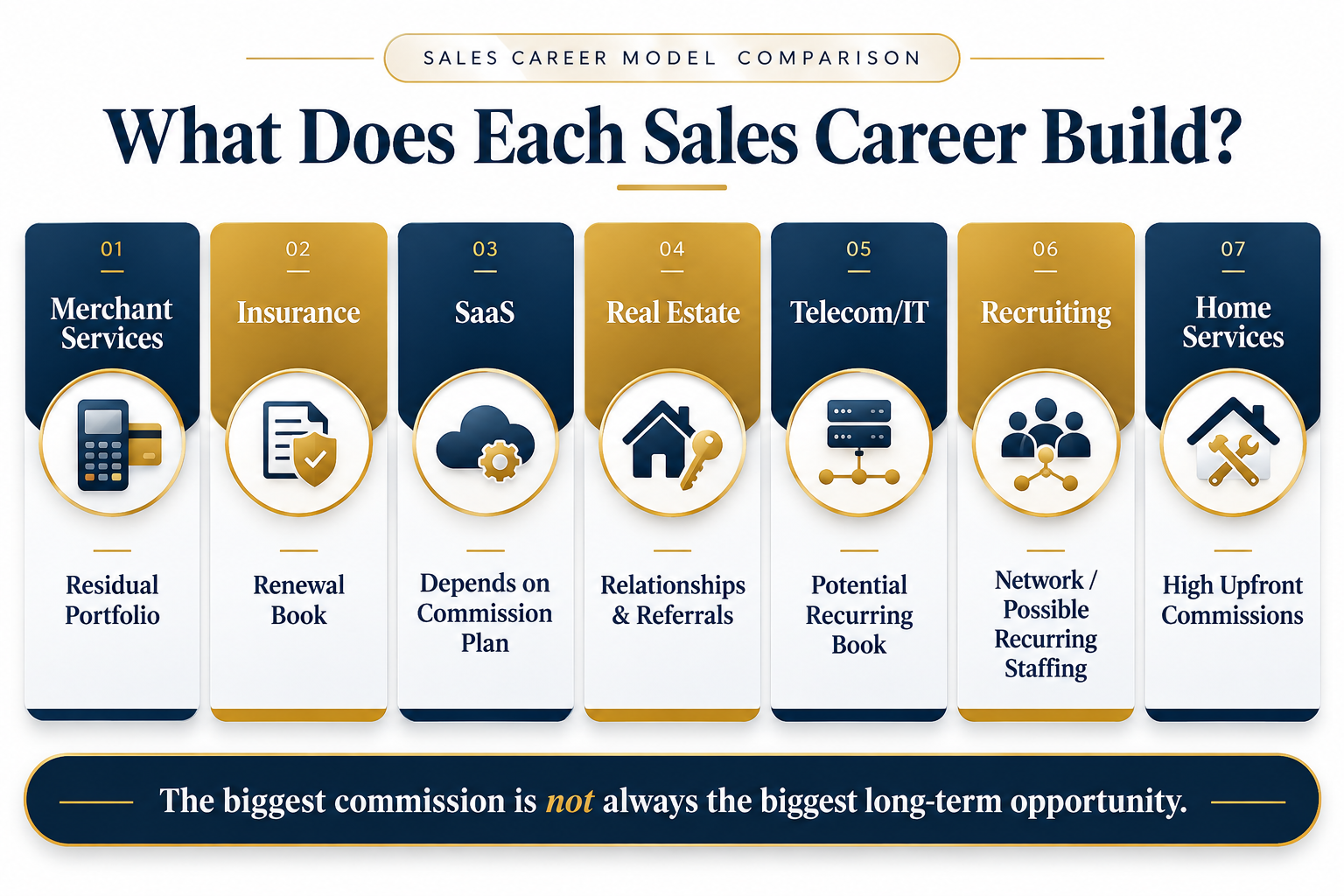
Our previous article on the best commission-only sales jobs for recurring income looked at this from the career side.
Now let's look at it from the ownership side.
What could you actually build?
1. Merchant Services Sales
Merchant services is first because it's the business I know best.
Businesses need ways to accept payments.
Rather than creating your own payment-processing technology, an independent agent can work through an established payments company that already has the backend infrastructure.
That can include processing relationships, underwriting, equipment deployment, reporting, merchant support, and technology.
The agent focuses heavily on what a strong salesperson should be focusing on:
Finding and acquiring merchants.
Why Merchant Services Can Be a Low-Cost Business Model
You don't need to manufacture a product.
You don't need a warehouse full of terminals.
You don't need to build banking infrastructure.
You don't need to become a registered ISO just to begin selling.
You can operate through an existing partner while building your own merchant portfolio.
I explain that structure in Merchant Services Agent vs. ISO: Do You Really Need to Become a Registered ISO?.
And you don't need to spend thousands of dollars simply learning the basics. My guide to starting merchant-services sales without a large buy-in explains the distinction between legitimate operating expenses and paying just for access to the industry.
Why Salespeople Have an Advantage
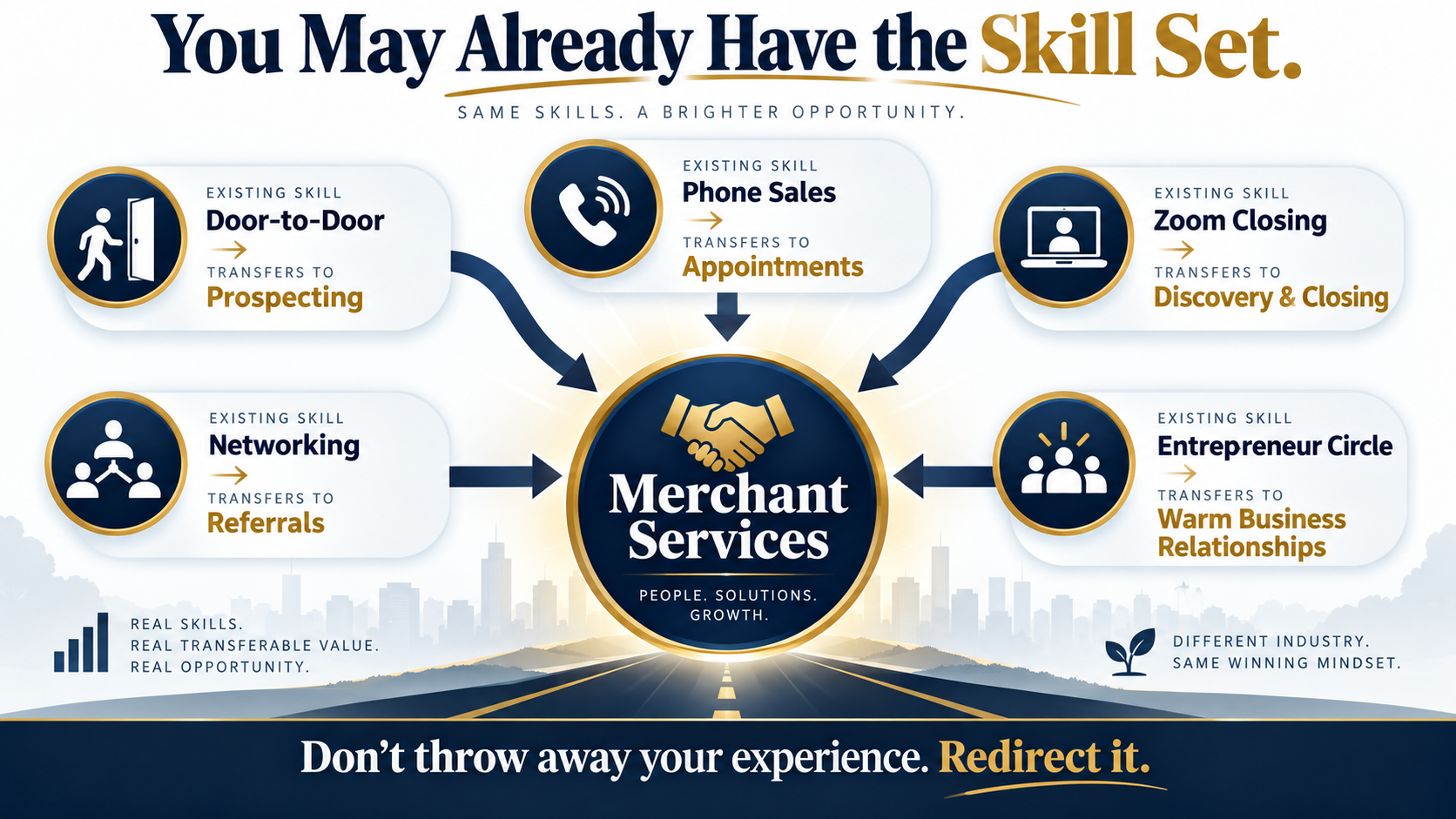
If you've sold door to door, you can walk into businesses.
If you're a phone salesperson, you can prospect business owners remotely.
If you're a Zoom closer, you can run discovery and presentations.
If you're a networker, you can build referral relationships.
If you already know entrepreneurs, you may already know prospective merchants.
You still need to learn payments.
But you may not need to learn how to sell.
What Makes the Model Especially Interesting
Merchant services can potentially combine upfront compensation with recurring residual income.
That means you're not only asking:
"What did this sale pay me?"
You're also asking:
"What did this merchant add to the portfolio I'm building?"
That's why I've spent so much time teaching the difference between traditional commissions and merchant-services residual income.
2. Consulting Based on Skills You Already Have
Consulting is one of the simplest businesses to understand.
You have knowledge.
Somebody has a problem.
They pay you to help solve it.
The attraction for experienced professionals is that you often don't need inventory or manufacturing.
Your expertise is the product.
A salesperson could potentially consult around:
Sales process development.
CRM implementation.
Sales-team training.
Appointment setting.
Pipeline management.
Business development.
Recruiting systems.
Sales scripts.
Negotiation.
Industry-specific knowledge.
The obvious advantage is startup cost.
You may already own most of what you need.
The Challenge With Consulting
You still have to answer an important question:
Why should anyone pay you?
A job title isn't enough.
You need real expertise, credibility, and a clear result you can help create.
And unless you structure retainers or ongoing engagements, consulting can become another version of:
Find client → Do project → Get paid → Find next client
That doesn't make it a bad business.
It simply means a salesperson looking for recurring economics should think carefully about how the offer is structured.
3. Independent Recruiting
Recruiting can be an excellent sales-driven business because the basic mechanics overlap heavily with sales.
You prospect companies.
You discover a hiring need.
You source candidates.
You qualify both sides.
You manage objections.
You facilitate a decision.
You close.
If you've spent years working phones and building relationships, the transition can be logical.
Why It Can Be Low Cost
You aren't manufacturing anything.
The primary assets can be your network, prospecting ability, systems, and knowledge of a specific market.
The Challenge
Direct-hire recruiting can be extremely transactional.
You place someone.
You get paid.
Then you need another opening.
Staffing models can create more recurring economics because workers may continue billing, but they also introduce more operational complexity.
Again, the point isn't that one is right or wrong.
The question is:
What does your work build after the original transaction?
4. Appointment-Setting or Outsourced Sales Business
If your strongest skill is outbound sales, you can potentially sell that ability itself.
Small businesses often need help creating qualified conversations.
A salesperson can build a service around:
Prospecting.
Appointment setting.
Outbound calling.
Follow-up.
Lead qualification.
Sales-development representation.
You can start narrow.
One industry.
One offer.
One type of appointment.
Why This Fits Phone Salespeople
If you've already spent years making cold calls, you aren't beginning from zero.
You understand the work.
You're monetizing a capability you've already proven.
The Potential Problem
You need clients before you have a business.
Then you need fulfillment.
If you're personally making every call, you've potentially created another job for yourself.
To build something larger, you may eventually need systems, people, technology, training, and client retention.
That doesn't make the model bad.
But a low-cost startup can become operationally complex as it grows.
5. A Specialized B2B Service Agency
"Start an agency" has become one of the most common online-business pitches.
The word agency doesn't really mean much by itself.
The question is:
What valuable service are you actually delivering?
A legitimate agency might provide:
Local marketing.
Paid advertising.
Website development.
Video production.
CRM implementation.
Email marketing.
Appointment generation.
Sales development.
Bookkeeping.
Automation.
A salesperson can have an advantage because many technically skilled operators struggle with acquiring clients.
If you know how to get business, that's meaningful.
But Don't Confuse Sales Ability With Delivery Ability
Closing ten clients is fantastic.
If you cannot deliver what you sold, you haven't created a sustainable business.
This is one reason I like business models where established infrastructure handles significant portions of fulfillment.
In merchant services, for example, I don't need to personally build the payment network every time I sign a merchant.
An established processing partner handles that infrastructure.
That's leverage.
6. Independent Manufacturer's Rep or B2B Sales Representative
There are companies with excellent products and terrible distribution.
That's an opportunity for experienced salespeople.
An independent manufacturer's representative or B2B rep can sell products for one or multiple companies without manufacturing the products themselves.
Depending on the industry, you might represent:
Commercial equipment.
Technology.
Business services.
Industrial products.
Restaurant equipment.
Medical products.
Professional services.
The model can allow you to build a territory or customer base using somebody else's existing product infrastructure.
The Advantage
You get to focus on distribution and relationships.
The Question to Ask
What happens after the sale?
Some independent rep structures create repeat-order commissions or territory economics.
Others are entirely transactional.
If your goal is to stop restarting your income, understand that before committing years to the product.
7. Referral and Strategic Partnership Businesses
Some people are exceptionally good connectors.
They aren't necessarily great cold callers.
They aren't traditional closers.
But they know everybody.
They know who needs what.
They make introductions.
And people trust their recommendations.
That can become a legitimate business-development model.
Professional referral relationships exist throughout industries such as:
Commercial finance.
Payroll.
Technology.
Insurance.
Staffing.
Merchant services.
Marketing.
Business lending.
Professional services.
Depending on the arrangement and applicable rules, a person may earn referral or sales compensation from qualified business they introduces.
Why This Can Fit Entrepreneurs With Existing Networks
If you've spent 15 years around business owners, your network itself has value.
You may know hundreds of entrepreneurs.
That's not a guarantee of revenue.
But it can be a significant head start.
The mistake is assuming entrepreneurship always requires going online and building an audience of 100,000 strangers.
Sometimes the first opportunity is already sitting in your contact list.
The Business I Would Avoid: One You Don't Understand but Were Sold Emotionally
This matters more than the list above.
There is a massive difference between:
Buying a business because you understand the economics
and
Buying an opportunity because somebody made the lifestyle look exciting.
The Federal Trade Commission specifically advises people evaluating business and coaching opportunities to ask basic questions before paying: What exactly will you be selling or doing? How does the business generate income? What are the expenses? When might it become profitable? The FTC also warns against claims suggesting that the buyer doesn't need to understand the details because a turnkey system or expert will supposedly handle everything.
That's great advice.
Because if you cannot explain:
Who is my customer?
What am I selling?
Why do they need it?
How do I reach them?
How does the company make money?
How do I make money?
What does it cost me to operate?
then you don't understand the business yet.
And I wouldn't invest heavily until you do.
The FTC has also warned about business-opportunity sellers using exaggerated earnings claims, pressure tactics, and vague promises of easy income.
This doesn't mean every course, coach, or online opportunity is illegitimate.
It means:
Stop buying the dream before understanding the machine.
We're going to address that directly in Online Business Ideas in 2026: Stop Buying the Dream and Evaluate the Business Model.
A Low-Cost Business Still Needs a Customer-Acquisition Plan
This is where salespeople have an enormous advantage.
A business can cost $100 to start and still fail.
It can cost $100,000 and succeed.
Startup cost is only one variable.
The much bigger question is:
Can you get customers profitably and repeatedly?
You already know this if you've spent time in sales.
A beautiful website isn't a customer.
A CRM isn't a customer.
A logo isn't a customer.
An LLC isn't a customer.
A certification isn't a customer.
A social-media page isn't a customer.
These things can support a business.
But eventually somebody has to buy something.
That's why I think the smartest low-cost business for a salesperson is often one where your ability to acquire customers is disproportionately valuable.
Don't Spend Thousands Building Infrastructure Before You've Proven You Can Sell
This is one of the biggest mistakes I see aspiring entrepreneurs make.
They build everything except the business.
They buy software.
Create branding.
Buy leads.
Hire designers.
Build automations.
Buy a massive course.
Order equipment.
Set up complicated funnels.
Then six months later they still haven't consistently sold anything.
The SBA's own startup guidance emphasizes calculating costs and understanding expenses before launch rather than simply spending first and hoping revenue catches up later.
For a salesperson, I'd reverse the order.
Learn enough to sell responsibly.
Get the minimum legitimate infrastructure you need.
Start creating conversations.
Get feedback.
Make sales.
Then reinvest intelligently.
That's one reason our upcoming article Businesses You Can Start With Little Money and No Inventory is important.
Low overhead gives you more room to prove the business before burying yourself in fixed costs.
The "Done for You" Trap
This deserves its own section because it's especially relevant to experienced salespeople who become frustrated and start looking for another opportunity.
You've spent years working hard.
You're tired.
So the offer that catches your attention says:
Done for you.
We'll generate the leads.
We'll build the store.
We'll create the campaigns.
We'll automate the business.
We'll close the sales.
We'll fulfill everything.
You'll collect the income.
Ask yourself:
What part of the business am I actually responsible for?
If the answer is essentially:
"You provide the credit card,"
I'd slow down.
The FTC has specifically warned about business-opportunity promotions that tell buyers they can make substantial money without needing to understand the underlying business because supposed experts will handle everything.
Maybe the offer is legitimate.
But understand it before you buy it.
I would rather build around something I can control.
For a salesperson, that means the ability to create customers.
You Don't Need an "Easy" Business if You're Already Willing to Work
This is where I think a lot of people get the entire entrepreneurship search wrong.
They type:
easiest online business
easy passive income
easy home business
business that runs itself
But the person I'm talking to in this article is different.
You've already sold commission-only.
You've already worked weekends.
You've already cold called.
You've already driven to appointments.
You've already run Zoom calls late at night.
You've already built relationships.
You've already demonstrated that you're willing to work.
Why are you looking for a business that removes the exact thing you're good at?
You don't need the easiest business.
You need a business where the hard work has better long-term economics.
That's different.
One-Time Income vs. Recurring Income
This should become part of your evaluation of every business idea.
Imagine two opportunities.
Business A
You sell a $5,000 service.
You earn $2,000.
The transaction ends.
You find another customer.
Business B
You sell a service.
You make less upfront.
But the customer pays every month and your compensation arrangement gives you ongoing participation while they remain active.
Business A may absolutely be better.
We don't have enough information to know.
But at least ask the question.
If you're already going to build the customer relationship, what happens economically after the initial sale?
This is exactly why we created Sales Jobs With Residual Income and Can Merchant Services Create Passive Income?.
The goal isn't passive income for the sake of a buzzword.
The goal is getting more economic life from the customers you've already worked to acquire.
Your Existing Network Can Change the Startup Equation
Suppose two people start the exact same business.
Person A knows nobody.
Person B has spent ten years selling to business owners.
They know accountants.
Realtors.
Restaurant owners.
Contractors.
Doctors.
Retailers.
Gym owners.
Salon owners.
Consultants.
Other salespeople.
Local entrepreneurs.
Those two people do not have the same starting point.
Person B already has distribution.
Maybe not guaranteed customers.
But access.
And access matters.
This is why I want experienced salespeople looking at their current network as an asset rather than assuming they're starting a completely new career from zero.
If you're already surrounded by entrepreneurs, you may want to choose a business that serves entrepreneurs.
Merchant services is a perfect example of that logic.
What if You Want to Work From Home?
Then choose a model that supports the way you already sell.
You don't necessarily need a storefront to build a real business.
Consulting can be sold remotely.
Recruiting can be remote.
Sales agencies can operate remotely.
Many B2B services can be sold by phone and video.
Merchant-services prospecting and follow-up can also be handled substantially through phone, Zoom, CRM systems, referrals, and digital applications, depending on the business model and partner.
We'll address the broader entrepreneurship angle in Home-Based Business Ideas for Salespeople and Experienced Closers.
And if payments specifically interest you, Can You Sell Merchant Services From Home? goes directly into how phone, Zoom, networking, and in-person approaches can work together.
What I Like About Merchant Services for This Particular Reader
Not everybody reading this should sell payment processing.
But if the person reading is:
Already good at sales.
Comfortable with variable income.
Interested in entrepreneurship.
Doesn't want a massive startup investment.
Doesn't want inventory.
Wants flexibility.
Already knows business owners.
And wants a business where previous customers can potentially continue contributing recurring compensation.
Then merchant services checks a lot of boxes.
That's a very specific person.
And if that's you, I think you should at least understand the industry.
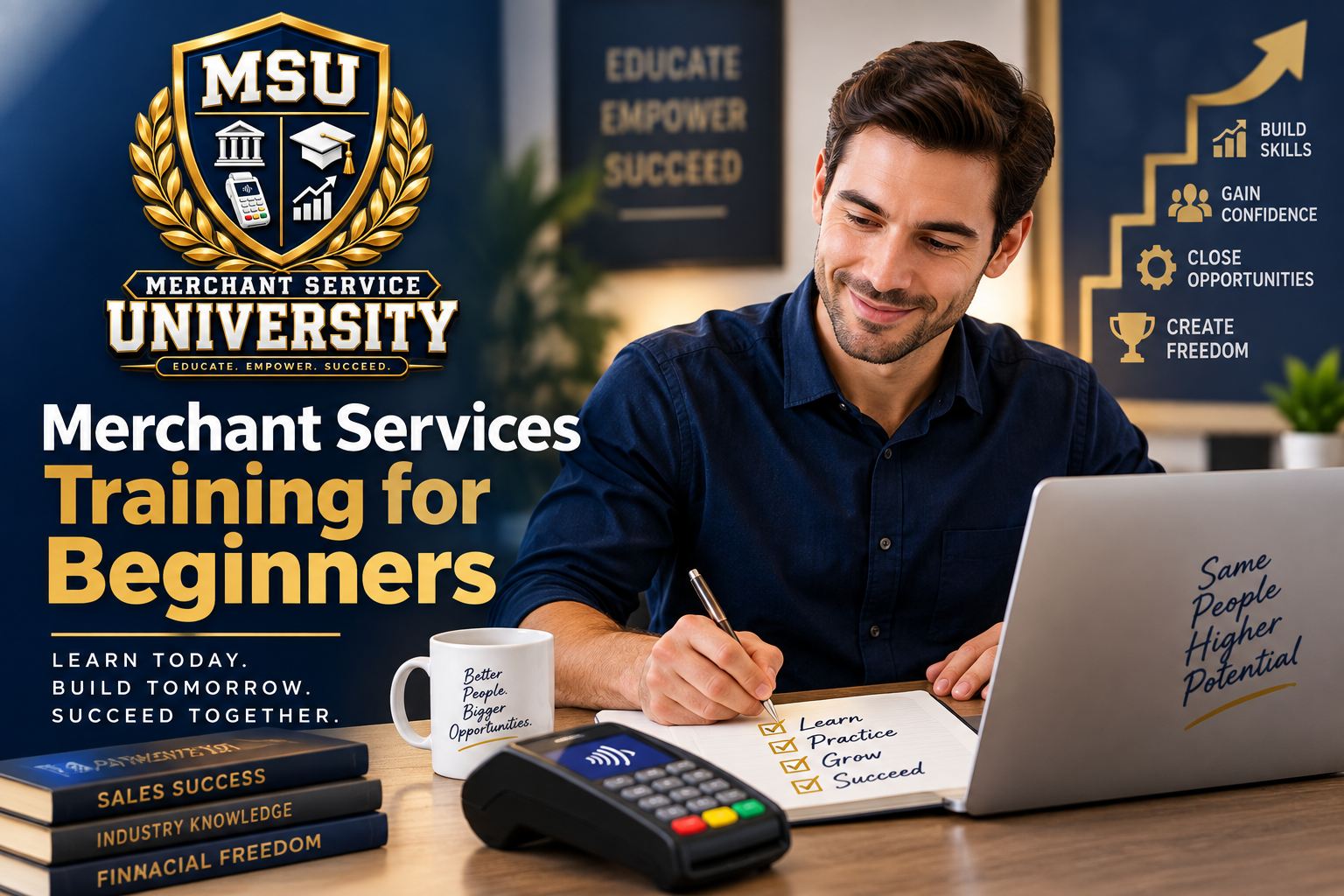
Take a Peek at Merchant Service University Before You Spend Money Anywhere
This is exactly why I built Merchant Service University.
I got tired of watching people pay thousands of dollars simply for access to merchant services and then hearing from some of them afterward who still didn't feel they had received the practical education they expected.
I don't think you should have to pay me thousands just to determine whether this industry makes sense for you.
My livelihood comes from merchant services.
I've spent more than 16 years actually building in the payments industry.
So I invested my own time and money into building a foundational education process and made the core training free.
If you've never considered payment processing as a business model, don't join anything yet.
Just take a peek.
Learn:
How card processing works.
How merchant-services agents get paid.
What residual income actually means.
How pricing works.
What a Schedule A is.
How agent agreements work.
What technology businesses use.
How prospecting works.
How portfolios are built.
Then decide whether the model fits the skills you already have.
There is no obligation to join one particular processing company.
Get educated before you get recruited.
What Would I Do if I Were an Experienced Salesperson Starting Over Today?
I would not begin by asking:
"What's the hottest business right now?"
I'd write down what I'm already good at.
Can I cold call?
Can I close?
Can I present?
Can I network?
Do business owners trust me?
Can I create referrals?
Can I recruit?
Can I teach?
Can I negotiate?
Do I understand a particular industry better than most people?
Then I'd find business models where those skills create disproportionate value.
Next I'd compare:
Startup cost.
Customer demand.
Compensation.
Recurring revenue.
Operational complexity.
How much fulfillment I personally have to provide.
What happens to my customers if I stop producing.
Whether I'm building an asset or only another paycheck.
Then I'd learn before spending heavily.
That's a much more rational approach than scrolling social media until somebody convinces you this month's business model is your last chance at financial freedom.
What Makes a Low-Cost Business Actually Good?
Low cost alone does not make a business attractive.
A terrible business that costs $500 is still a terrible business.
I'd rather evaluate five things.
1. There Is a Real Customer
Someone outside the opportunity itself needs to buy the product or service.
2. The Customer Has a Real Problem
The business should solve something people or companies actually care about.
3. You Have a Real Advantage
For the reader we're talking to, that advantage is likely sales, relationships, or business development.
4. The Economics Make Sense
Revenue needs to exceed the real cost of customer acquisition and fulfillment.
5. The Business Can Become More Valuable Over Time
That could mean recurring customers.
Renewals.
A residual portfolio.
A brand.
Intellectual property.
Systems.
Employees.
A network.
A sellable book of business.
Something should be getting stronger because you worked yesterday.
That's the part too many people miss.
Low Cost Should Give You Freedom to Execute, Not Permission to Be Casual
There is another mistake people make.
They hear that a business has low startup costs and conclude:
"I don't have much to lose."
So they don't take it seriously.
That's backwards.
The advantage of a low-overhead business is that more of your energy can go into execution rather than servicing debt and covering huge fixed expenses.
It doesn't mean the business deserves less effort.
In merchant services, for example, not having to buy inventory or build a processing platform doesn't mean merchants magically appear.
You still need prospecting.
Appointments.
Follow-up.
Sales.
Onboarding.
Retention.
The financial barrier may be low.
The execution barrier is still real.
And I actually like that.
Because execution is where an experienced salesperson should have an advantage.
Frequently Asked Questions About Low-Cost Business Ideas for Salespeople
What are the best low-cost business ideas for salespeople?
Potential options include merchant-services sales, consulting, recruiting, appointment setting, specialized B2B agencies, independent sales representation, and referral-based business development. The best model depends on the salesperson's skills, network, goals, and desired income structure.
What business can a salesperson start with little money?
Service and sales-based businesses often require less upfront capital than inventory-heavy businesses. Examples can include consulting, recruiting, outsourced sales, merchant services through an established partner, referral businesses, and specialized service agencies.
Is merchant services expensive to start?
An independent sales agent can work through an established merchant-services organization rather than building an entire payment processor. Startup and normal business expenses can vary, but entering as an agent does not inherently require the infrastructure costs associated with starting a processing company.
Do I need to buy payment terminals to start selling merchant services?
Generally, an independent salesperson working through a merchant-services partner does not need to warehouse processing equipment simply to begin prospecting and selling. Equipment programs vary by provider.
Can experienced phone salespeople start a business?
Yes. Outbound sales experience can translate into businesses such as appointment setting, recruiting, consulting sales, SaaS or B2B representation, merchant services, telecom, and other services where customer acquisition is important.
What business is good for someone who is good at networking?
Businesses built around B2B referrals, consulting, recruiting, insurance, real estate, merchant services, professional services, and strategic partnerships can benefit from strong networking ability.
Should I pay thousands for a business opportunity?
Price alone does not determine whether an opportunity is legitimate or worthwhile. Understand exactly what you are buying, how customers are acquired, how the business makes money, all costs involved, and any earnings claims before investing. The FTC recommends careful due diligence when evaluating business and coaching opportunities.
Is a low-cost business the same as a free business?
No. Legitimate businesses can still have one-time and recurring expenses such as software, licensing, professional services, technology, marketing, transportation, and other operational costs.
What businesses do not require inventory?
Many service and relationship-based businesses do not require physical inventory, including consulting, recruiting, outsourced sales, certain agencies, referral businesses, and independent service sales such as merchant services.
Can merchant services create recurring income?
Merchant-services agents can potentially earn recurring residual compensation from qualifying active merchant accounts depending on account economics and their agent agreement.
Do my current sales skills transfer to merchant services?
Many do. Door-to-door prospecting, outbound calling, Zoom presentations, discovery, objection handling, closing, networking, referrals, and B2B relationship skills can all be useful. You still need to learn payments and execute consistently.
Can I learn merchant services before committing to a company?
Yes. The core training at Merchant Service University is free and designed to help people learn the industry before selecting a processing partner.
Where should I start if I want to explore merchant services?
Take a look at Merchant Service University, then read How to Become a Merchant Services Agent in 2026 for the complete path from education through partner selection and portfolio building.
Final Takeaway: Build Around the Advantage You Already Have
If you're an experienced salesperson looking for low-cost business ideas, I don't think your first step should be learning how to become someone completely different.
You've already spent years building an asset.
Maybe it's your ability to cold call.
Maybe it's your confidence walking into a business.
Maybe you can close on Zoom.
Maybe you can build trust faster than most people.
Maybe you know how to network.
Maybe you have 300 entrepreneurs in your phone.
Maybe you've spent a decade selling somebody else's product and you're finally ready to build something around yourself.
Don't dismiss all of that experience because the internet says you need to start an e-commerce brand this year.
Use what you have.
Then choose the vehicle carefully.
Look for a real customer.
A real problem.
Reasonable startup economics.
A sales process you understand.
And ideally, something that becomes more valuable as you keep doing the work.
That's one reason I believe experienced salespeople should take a serious look at merchant services.
It is not easy money.
It is not guaranteed income.
And I'm not asking you to buy access to the opportunity.
It's a real B2B sales business serving companies that already need to accept payments.
You can leverage an established partner's infrastructure.
You can apply skills you've already developed.
And depending on your agreement and merchant retention, you can potentially build recurring residual economics behind your production.
If that catches your attention, go to MerchantServiceUniversity.com.
Don't sign up for a company yet.
Don't buy another expensive course.
Take a peek.
Learn the business for free.
Then decide whether the skills you've already spent years developing might finally have a better vehicle.
About Joe Wagner
Joe Wagner has spent more than 16 years in merchant services and payment-processing sales, acquiring merchants, building recurring residual portfolios, and developing sales organizations.
He created Merchant Service University to give people a way to learn the payments industry before paying for access or committing their production to one processing company.
Joe's work focuses heavily on helping experienced salespeople recognize how existing skills in phone sales, door-to-door selling, Zoom closing, networking, referrals, and B2B relationship development can transfer into merchant services and potentially be used to build a longer-term merchant portfolio.
Continue with Sales Jobs With Residual Income, Merchant Services Passive Income, Best Commission-Only Sales Jobs for Recurring Income, Home-Based Business Ideas for Salespeople, or Businesses You Can Start With Little Money and No Inventory.
Or take a peek inside Merchant Service University.