
Should You Pay for a Merchant Services Business Opportunity?
Should You Pay $10,000–$25,000 for a Merchant Services Business Opportunity?
If someone offered you a merchant services business opportunity for $10,000, $20,000, or $25,000, would you know how to determine whether it was actually worth the money?
That's the question I want to answer in this article.
I'm not going to tell you that every expensive merchant-services program is automatically a scam. Price alone doesn't tell me whether education, coaching, technology, leads, accounts, mentoring, or another service is valuable. There are legitimate consultants and coaches whose time and expertise are worth substantial amounts of money, and there are circumstances where paying for specialized knowledge can save years of trial and error.
But I have a serious problem with the idea that someone needs to pay tens of thousands of dollars simply to gain access to the merchant-services industry, particularly when the offer is wrapped in promises of passive income, a prebuilt portfolio, turnkey systems, or a "done-for-you" business.
I've spent more than 16 years making my living in merchant services. The foundational business is not mysterious. Businesses need payment solutions. Salespeople acquire those businesses as merchants. Strong processing partners provide the backend infrastructure. Depending on the economics and agreement, agents can potentially receive upfront compensation, recurring residual compensation, or a combination of both.
The difficult part isn't unlocking a secret industry.
The difficult part is learning it, prospecting, acquiring merchants, and building a portfolio that stays together.
So before you spend $25,000 because someone tells you they've packaged the shortcut, I want you to do something much less exciting and much more useful:
Break the offer apart and figure out exactly what you're paying for.
That's the standard I would use before writing a check of any size.
The Price Isn't the First Question. The Deliverables Are.
When someone hears that a business opportunity costs $25,000, the natural reaction is usually to decide whether $25,000 sounds expensive.
I don't think that's the best place to start.
A $25,000 investment can be incredibly inexpensive if you're purchasing something that legitimately creates far more value. The same $25,000 can be extraordinarily expensive if what you're receiving is information, access, or infrastructure that could have been obtained elsewhere for little or no cost.
The first question should therefore be:
What are the specific deliverables?
If the package costs $25,000, I should be able to break that $25,000 into components that I understand. Maybe there is advanced one-on-one coaching. Perhaps there are qualified appointments. Maybe you're purchasing contractual rights to existing merchant accounts. There could be proprietary technology, specialized business development, licensing, personalized consulting, or another legitimate deliverable.
Fine.
Put it on paper.
The bigger the purchase, the less comfortable I become with vague language such as "our system," "turnkey business," "proven model," "business in a box," or "everything you need."
Tell me what everything actually means.
Start With the Simplest Financial Reality: You Begin $25,000 Behind
This is basic business math, but it's easy to ignore when someone is selling potential future income.
If you pay $25,000 upfront, the first $25,000 of net economic benefit you eventually receive is required simply to recover the original purchase price on a cash basis. That is before considering your time, taxes, financing costs, software, travel, additional lead purchases, advertising, or any other operating expense.
If you finance that purchase on a credit card or another high-interest source of capital, your actual economic hurdle becomes even greater.
That doesn't automatically make the purchase wrong. Businesses invest capital every day with the expectation that the investment will eventually produce a return.
But the investment needs to be judged like a business investment.
Not like a lottery ticket.
The question shouldn't be:
“Could somebody make $25,000 doing this?”
The question should be:
“What would need to happen for this particular $25,000 purchase to create an acceptable return for me?”
Those are very different standards.
Don't Compare the Purchase Price With the Biggest Success Story
This is one of the easiest ways to rationalize a large business-opportunity purchase.
The presentation shows someone earning $10,000 per month in residual income. Another person reportedly built a six-figure business. Someone else supposedly replaced their career income.
Now $25,000 starts looking small.
But you're comparing a guaranteed expense with somebody else's possible outcome.
Those are not equivalent.
Your $25,000 leaves your account if you make the purchase. The success story does not automatically transfer to you.
The person being showcased may have started with substantial sales experience, an existing network, more working capital, additional lead-generation expenses, unusually high activity, years of industry experience, or circumstances you don't share. Their result may also be real while still being uncommon.
This is why the FTC advises people evaluating business coaching and money-making opportunities to be skeptical of promises involving guaranteed earnings, large returns with little effort, urgency, and supposedly proven money-making systems. The agency also specifically recommends treating testimonials and success stories cautiously rather than assuming that highlighted results represent what a typical buyer will experience.
The success story may answer:
“What happened to this person?”
You need to answer:
“What am I actually buying?”
Ask the Seller to Break the $25,000 Package Into Pieces
If I were sitting across from someone selling me an expensive merchant-services package, this is exactly how I would evaluate it.
Let's assume the program includes several of these components:
Training.
Coaching.
Lead generation.
Appointments.
Existing merchant accounts.
Software.
CRM.
Business setup.
Processing-company access.
Sales scripts.
Weekly calls.
Marketing materials.
Partner support.
I would assign a question to each one.
Training: What Am I Learning That I Cannot Learn Without the Package?
Does the education cover payment-processing fundamentals, pricing models, statements, residuals, Schedule A, agent agreements, merchant technology, prospecting, closing, retention, and portfolio building?
Great.
Now ask whether that education itself justifies a substantial portion of the price.
This question is particularly relevant because foundational education is available without a high-ticket buy-in through Merchant Service University. I provide this online training & advanced course FOR FREE.
That doesn't make advanced paid coaching worthless.
It changes what you should be willing to pay merely for the foundation.
Coaching: How Much Actual Personal Access Am I Receiving?
There is a significant difference between buying fifty prerecorded videos and receiving ongoing individual access to someone with real expertise.
If a successful industry professional is personally spending significant time reviewing your deals, training you, coaching your sales process, helping you analyze contracts, solving advanced problems, or guiding strategy, that time can legitimately have substantial value.
But understand what you're getting.
Is it one-on-one?
Group coaching?
Once per week?
Once per month?
For how long?
Who actually conducts the coaching?
The person featured in the advertising—or somebody you've never met?
Those details matter.
Leads: What Does the Word “Lead” Actually Mean?
A spreadsheet containing business names is technically a list of prospects.
That isn't the same thing as a lead who requested information.
And neither is the same thing as a qualified appointment with a decision-maker.
If leads are part of the package, understand where they come from, whether they're exclusive, how recently they were generated, what qualifies them, how many other representatives receive the same data, and whether the merchant actually expressed interest in changing anything.
Don't allow one word to hide several very different levels of value.
Appointments: Who Qualifies Them and What Was the Merchant Told?
A scheduled appointment can be valuable.
But I want to know what expectation was created before I entered the conversation.
Does the merchant know they're meeting about payment processing?
Do they know why they're speaking with you?
Is the decision-maker attending?
Was there a legitimate discovery process?
Or was an appointment setter simply paid to put something on your calendar?
Great salespeople know that appointment quantity and appointment quality are not the same thing.
Existing Merchant Accounts: What Exactly Is Being Transferred?
This is a huge one.
If existing merchants are part of the package, ask about account history, residual profitability, merchant tenure, processing volume, attrition, contractual rights, and the reason those accounts are available for transfer.
We're dedicating the next article in this cluster entirely to this question: Buying Existing Merchant Accounts: 11 Questions to Ask Before You Pay for a Portfolio.
Existing residual income can make an offer look incredibly attractive.
But this is not an area where I would accept screenshots and verbal assurances.
I would want documentation.

Be Very Careful Paying Thousands Simply for “Access”
This is one of the areas where my opinion is strongest.
Merchant services is a real industry with processors, ISOs, banks, technology providers, independent sales organizations, software platforms, and sales-agent programs.
You do not inherently need to pay somebody $25,000 just for the privilege of becoming an independent merchant-services salesperson.
That's one of the reasons I wrote Can You Start Selling Merchant Services for Free? What You Should—and Shouldn't—Pay For.
An established merchant-services partner already has an economic reason to want productive agents.
If you acquire profitable merchants who remain active, the upstream organization can benefit from that production.
That underlying incentive is one reason the industry can support sales-agent relationships without requiring every new agent to buy a franchise-style opportunity merely to participate.
There can still be normal expenses involved in building your business.
That's different from paying a large entry fee simply for access to the opportunity itself.
Ask a Question Most Buyers Never Ask: Could I Get This Partner Relationship Without Buying the Course?
This can expose a lot of the package value very quickly.
Suppose part of the sales presentation is:
“We're going to connect you with a payment processor.”
Okay.
Would that processor accept qualified independent sales agents without the $25,000 program?
Suppose another benefit is:
“We'll give you access to payment technology.”
Would the upstream partner already provide that technology to approved agents?
What about underwriting?
Equipment?
Applications?
Reporting?
Merchant support?
These can all be extremely valuable pieces of infrastructure.
The question is whether you're purchasing them from the program or whether they're already provided by the processing relationship the program connects you to.
That's not a minor distinction.
You could unknowingly assign thousands of dollars of perceived package value to resources the actual payment company already provides because it wants merchants.
This Is Why “Done for You” Needs to Be Taken Apart Word by Word
Our previous article, There Is No “Done-for-You” Merchant Services Business, explains this in detail.
A company can do a tremendous amount for you.
They can provide training.
They can provide underwriting.
They can provide merchant support.
They can provide processing infrastructure.
They can provide technology.
They can potentially provide prospect data or appointments.
They can help with deployment.
All of that can make it much easier to build a business.
But if you're being sold the idea that the central merchant-acquisition work somehow disappears, ask who is actually doing it.
Somebody still has to create the customer.
A merchant portfolio isn't created because your LLC paperwork is finished and a website goes live.
It gets created when real businesses become active customers.
The Customer-Acquisition Question Is the Question That Exposes Everything
I would ask:
“After I've paid the fee and completed your program, where do my next 50 merchants come from?”
Listen very carefully to the answer.
If the answer is that you will prospect them, great.
Now the opportunity is becoming much clearer.
You need to learn how to sell merchant services.
If the answer is that the company provides leads, ask how many and what qualifies them.
If they provide appointments, ask how they're generated.
If they provide existing accounts, ask how long those accounts are expected to remain and what historical data exists.
If someone claims the entire merchant-acquisition system operates for you indefinitely, then ask another very reasonable question:
Why would they transfer the long-term economics from successfully acquired merchants to you rather than retaining those economics themselves?
There can be business models where outsourced acquisition makes economic sense.
But you should understand exactly how the math works.
Merchant Services Can Create Residual Income. It Does Not Eliminate Sales.
This distinction is important because the attraction of these opportunities is often completely legitimate.
Merchant-services residual income is powerful.
Depending on the account economics and your agreement, you can potentially acquire a merchant today and continue receiving residual compensation while that merchant remains active in the future.
That's very different from a sales job where the commission ends after every transaction.
It's one of the biggest reasons I've remained in this industry.
But the recurring nature of the compensation doesn't make customer acquisition passive.
You still have to build the portfolio.
This is why I prefer the distinction between passive income and passive effort.
The income can become increasingly residual after the customer has been acquired.
The effort required to create the customer is not passive.
That same distinction is central to the video that inspired this cluster: merchant-services residual income can be powerful, but the merchant portfolio itself still has to be acquired, protected, and grown.
For a deeper explanation, read Can Merchant Services Create Passive Income? How Residual Income Really Works.

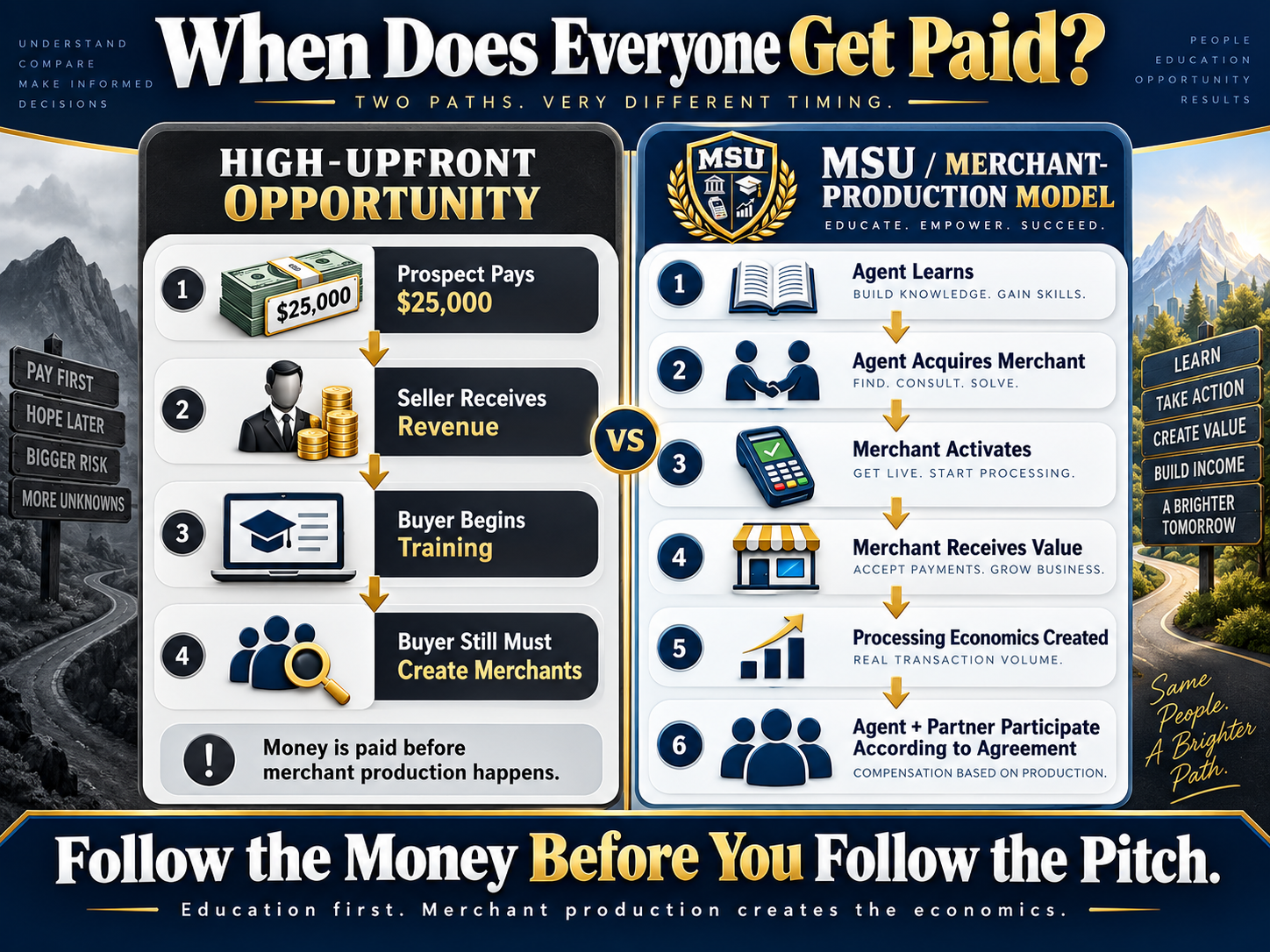
Follow the Money Before You Follow the Sales Presentation
This is one of the most useful due-diligence tests I know.
Ask:
When does everyone involved make money?
Imagine you pay $25,000 before you've signed one merchant.
The seller's major financial event has already happened.
You still need to build your business.
Again, that does not automatically make the program bad. Consultants and educators get paid upfront all the time.
But the incentive is worth understanding.
Now compare that with a processing relationship where the upstream company makes more money as you acquire good merchants that continue processing.
The agent needs productive merchants.
The processing partner needs productive merchants.
The merchant needs a solution worth keeping.
The economic relationship has the possibility of remaining aligned beyond the initial sale.
This is the subject of an entire upcoming article: Follow the Money: How to Evaluate the Incentives Behind a Merchant Services Agent Program.
I'm not suggesting one compensation structure automatically makes a company ethical and another automatically makes it unethical.
I'm suggesting you should know what behavior the economics naturally reward.
If the Opportunity Includes Existing Merchants, Don't Evaluate Them by One Monthly Statement
A merchant portfolio needs to be evaluated across time.
Imagine you're shown accounts currently generating $500 per month in residual compensation.
That sounds great.
But how long have those merchants been active?
What did the portfolio generate six months ago?
How much merchant concentration exists?
What happens if one large merchant leaves?
What's the historical attrition?
Are merchants month-to-month?
How satisfied are they?
What technology are they using?
Who currently owns the relationship?
Does the agreement actually permit the rights being represented to be transferred?
The monthly residual number is only one piece of the economic picture.
The larger question is:
How much durable value is actually being transferred?
In the video behind this cluster, I discuss one person's reported experience after purchasing an expensive package that included merchant accounts. According to what he told me, the initial residual amount was only a few hundred dollars per month and the included merchants eventually canceled within roughly six months. That is one individual's reported experience and should not be treated as evidence about every program, but it demonstrates why a beginning residual number alone doesn't establish the long-term value of the accounts.
If existing merchants are part of your purchase, investigate them like you're buying an economic asset.
Don't treat them like a free bonus.
Understand the Difference Between a Merchant Portfolio and Residual Rights
Another thing buyers need to understand is what they're actually entitled to.
People casually use language such as:
“These are your merchants.”
But what does the contract say?
You may have rights to a percentage of residual economics while the merchant remains active.
That doesn't necessarily mean you own the underlying merchant contract.
It doesn't automatically mean you can sell the account.
It doesn't mean you can transfer it.
It doesn't tell you what happens if your agent agreement terminates.
And it doesn't automatically tell you whether those residual rights are vested.
That's why Merchant Services Agent Agreement: 11 Questions to Ask Before You Sign, Merchant Services Contract Red Flags, and What Do Lifetime Residuals Really Mean in Merchant Services? should be part of your due diligence.
If you're spending $25,000 partly because you believe you're purchasing a book of business, you should know precisely what contractual rights are actually attached to it.
Ask What Happens if You Decide Merchant Services Isn't for You
This question is especially important because a large upfront fee creates a sunk-cost problem.
Suppose you buy the opportunity.
Then you learn merchant services.
You make prospecting calls.
You meet business owners.
And you discover you hate the business.
What happens?
Can you receive a refund?
Can you transfer what you've purchased?
Do you retain rights to any accounts?
Are recurring software fees still due?
What obligations continue?
Does a cancellation policy exist?
This is one reason I believe education should happen before the expensive commitment whenever possible.
You should understand whether you like the business before forcing yourself to stay in it because you spent too much money to walk away.
This Is Where Free Foundational Education Changes the Decision
Imagine the sequence is:
Pay $25,000 → Learn Merchant Services → Decide Whether You Like Merchant Services.
Now compare that with:
Learn Merchant Services for Free → Decide Whether You Like It → Evaluate What Advanced Help Is Worth Paying For.
I strongly prefer the second sequence.
That's one of the core reasons I built Merchant Service University.
I want prospective agents to learn processing, compensation, pricing, statements, residuals, Schedule A, agreements, merchant technology, prospecting, sales, retention, and portfolio building before somebody asks them to make a major financial commitment.
After you're educated, your ability to evaluate a paid program improves dramatically.
You might decide a specialized coach is worth every dollar.
You might decide a legitimate portfolio acquisition makes financial sense.
You might pay for a service that solves a very specific problem.
But you're buying from knowledge instead of desperation.
That's what get educated before you get recruited actually means.
Free Training Does Not Mean All Training Should Be Free
This deserves repeating because I don't want this cluster to become intellectually lazy.
There's a huge difference between:
Foundational industry education
and
specialized access to an expert's personal time and advanced knowledge.
If someone has built a major payments organization and you're paying that person to personally help you structure a large sales team, that's specialized consulting.
If you're purchasing advanced contract expertise, that's specialized value.
If you're paying an exceptional closer to personally analyze your sales calls, there can be real value there.
If you already run an ISO and hire somebody to help improve recruitment, management, retention, leadership, or portfolio economics, that's not the same thing as charging a complete beginner thousands merely to understand what interchange is.
Our article Free Merchant Services Training vs. Paid Courses: What Should You Actually Pay For? will deal with that distinction directly.
The point is not:
Never pay.
The point is:
Know why you're paying.
Current FTC Guidance Makes Due Diligence Even More Important
The FTC's current consumer guidance specifically warns people to be skeptical of business coaching and money-making opportunities that promise quick money, guaranteed income, large returns with little work, or a supposedly proven system. It recommends taking your time, researching the seller, getting another opinion, and viewing success stories skeptically.
There is also a federal Business Opportunity Rule that applies to certain covered business-opportunity transactions. The Rule can include some arrangements where a seller offers to help a buyer establish or operate a business by providing customers, accounts, or locations. Whether a specific merchant-services program is legally covered depends on how the transaction is structured, so I'm not saying every agent program falls under that Rule.
When the Rule does apply, the FTC says the seller generally must provide a prescribed disclosure document at least seven days before the buyer signs a contract or pays money. If the seller makes an earnings claim, additional written disclosure and substantiation requirements can apply, including information about the number and percentage of buyers who achieved at least the represented result.
This isn't legal advice, and I would not try to determine a particular program's regulatory status from an advertisement.
The practical takeaway is much simpler:
The more money somebody asks you to invest, the more comfortable they should be with you slowing down, reading documents, verifying claims, and asking difficult questions.
Pressure Is Not a Substitute for Value
I'm always cautious when a substantial purchase supposedly needs to happen today.
The price increases tonight.
The territory disappears.
The bonus merchant accounts vanish.
The exclusive opportunity closes.
You have ten minutes to decide.
Urgency can be legitimate in business, but artificial pressure is not a reason to stop doing due diligence.
The FTC specifically advises consumers considering business coaching offers to take their time and be wary of pressure to act immediately or risk losing an opportunity.
If the offer is worth $25,000 today, it should still be understandable after you've reviewed the agreement, calculated the economics, verified what you're receiving, and spoken with someone who isn't being paid to close you.
Ask for More Than Testimonials
Testimonials are marketing.
Due diligence is research.
I don't mean that dismissively. Testimonials can be completely legitimate and useful. I've shared student experiences myself.
But when you're considering a major purchase, I would want more than the three most successful buyers the seller chose to feature.
Ask how many people have purchased the program.
Ask what percentage are still actively operating in merchant services.
Ask whether there is documented performance information behind any specific earnings representations.
Ask about people who purchased but did not succeed.
Ask whether you can speak with actual buyers.
If a covered business opportunity falls under the FTC's Business Opportunity Rule, the required disclosure process can include reference information, and covered earnings claims have specific substantiation requirements.
Even when a particular offer isn't covered by those requirements, the principle is still useful:
Ask for information that helps you evaluate more than the highlight reel.
Calculate the Real Break-Even Point
Suppose the purchase price is $25,000.
That's not necessarily your total investment.
Add any recurring software.
Additional training.
Lead purchases.
Advertising.
Travel.
Professional services.
Equipment you're expected to purchase.
Financing interest.
Other business expenses.
Then consider your time.
You don't need to assign yourself an hourly wage for every minute, but you should understand that you're investing more than cash.
Now ask:
How much actual net compensation would I need before I consider this initial investment recovered?
Not gross merchant processing volume.
Not total revenue generated somewhere in the payments chain.
Not hypothetical lifetime value.
Your actual economics.
If the seller can't help you understand the difference, you're not ready to buy.
Don't Forget the Alternative Cost
Opportunity cost matters too.
If you have $25,000 available, what else could that money do?
It could remain in your financial runway while you build.
It could fund legitimate prospecting over time.
It could support travel to merchant appointments.
It could purchase advanced coaching later when you know your actual weaknesses.
It could remain invested elsewhere.
It could help you maintain your lifestyle while you transition from another career.
I'm not telling you what to do with $25,000.
I'm telling you not to pretend that spending it has no alternative.
The correct comparison is not:
“$25,000 program versus doing nothing.”
It may be:
“$25,000 program versus learning the fundamentals for free and deploying that capital only after I understand where it can produce the greatest value.”
That's a completely different decision.

15 Questions I Would Ask Before Paying $1–$25,000
If you're currently considering one of these offers, take this list into the sales call.
1. What exactly does the upfront price purchase?
Get specific deliverables rather than broad promises.
2. How much of the fee is for education?
Then compare that education with what can already be learned through legitimate lower-cost or free resources.
3. Who personally provides the coaching?
Determine whether you're purchasing access to the advertised expert or primarily prerecorded material and group support.
4. How much individual coaching do I receive?
Get the amount, frequency, and duration.
5. Are leads included?
If so, understand how they're generated, qualified, distributed, and replaced.
6. Are appointments included?
Ask what qualifies an appointment and what the merchant was told before the meeting.
7. Are existing merchant accounts included?
If yes, request historical processing, residual, retention, and contractual information. Many of these companies are selling old accounts that typically cancel within 180 days and only pay less than $100 per account.
8. What happens if the included merchants cancel?
Understand whether any replacement commitment exists and exactly how it works.
9. What portion of the merchant residual do I receive?
A dollar screenshot doesn't explain the underlying economics.
10. What does the Schedule A look like?
The split percentage is only meaningful when you understand the costs underneath it.
11. What happens to my residuals if I stop producing?
Understand vesting and termination before you build.
12. What ongoing expenses exist after the initial purchase?
The purchase price may only be the beginning.
13. What exactly does your company make money from?
Understand whether the primary economics come from merchants, program buyers, or some combination.
14. Can I review every agreement before paying?
A major business investment should be supported by documentation.
15. What would I still have to do myself after buying the package?
This may be the most important question of all.
If the answer to the last question is:
Prospect, sell, close, and build your portfolio,
then you've finally reached the real merchant-services business.
What I Would Pay For
Let me turn the argument around.
What would I personally consider paying meaningful money for?
Expertise that I cannot easily obtain elsewhere.
Individual access to someone whose experience is directly relevant to a specific problem I'm trying to solve.
Advanced strategy after I've already learned the fundamentals.
Professional services that save substantial time or reduce legitimate risk.
A quality business asset with verified economics and contractual rights.
Proven systems that genuinely improve something I'm already executing.
Great coaching.
Great legal advice.
Great accounting.
Great technology.
Great data.
Great people.
I believe in investing in business.
What I don't believe in is spending a large amount of money because somebody convinced you the price itself is what separates you from financial freedom.
What I Would Not Pay $25,000 for Just Because It Has a Nice Name
I wouldn't assign enormous value merely to business formation.
I wouldn't assign enormous value to a generic CRM setup.
I wouldn't pay a huge premium simply because someone introduces me to a merchant-services company willing to accept independent agents.
I wouldn't treat basic merchant-services education as proprietary knowledge worth tens of thousands merely because it was packaged professionally.
And I definitely wouldn't pay a major premium because someone used the words passive income, turnkey, automated, or done for you without explaining exactly what those claims mean operationally.
A professional package can still contain legitimate value.
But packaging is not value by itself.
Take a Peek at Merchant Service University Before You Spend the Money
This is where I think the decision becomes extremely simple.
Before paying me, them, or anybody else thousands of dollars to teach you how to build a merchant-services business, first understand the business.
Go to MerchantServiceUniversity.com.
The core training is free.
Learn how credit-card processing works.
Understand who the players are.
Learn merchant pricing.
Learn how statements work.
Understand how agents are compensated.
Learn residual income.
Learn Schedule A economics.
Understand the agent agreement.
Learn merchant technology.
Learn prospecting.
Learn closing.
Understand retention.
Understand portfolio building.
Get MSU Core Certified.
Then evaluate whatever business opportunity is sitting in front of you.
You will be much harder to sell.
And I consider that a feature, not a problem.
If somebody's $25,000 program genuinely delivers specialized value worth $25,000, your education shouldn't threaten that offer.
It should help you recognize why it's worth paying for.
If the offer only looks valuable when you don't understand the industry yet, that's information too.

Frequently Asked Questions About Merchant Services Business Opportunities
How much should a merchant services business opportunity cost?
There is no universal price because programs can include very different education, coaching, technology, leads, merchant accounts, services, or contractual rights. The more important question is whether the specific deliverables justify the price and whether the buyer understands all ongoing costs and responsibilities.
Do I need to pay $10,000 or $25,000 to get into merchant services?
No large course or business-opportunity fee is inherently required simply to learn merchant services or explore becoming an independent agent through an established processing organization. Individual programs may sell additional services or assets that should be evaluated separately.
Are expensive merchant-services business opportunities scams?
Price alone does not establish that a program is fraudulent. Buyers should evaluate deliverables, seller representations, agreements, earnings claims, ongoing costs, account quality, refunds, merchant-acquisition responsibilities, and seller incentives before making a decision.
What should be included in a high-priced merchant-services program?
If a program charges a substantial amount, a buyer should clearly understand the value of each component, including education, individual coaching, leads, appointments, technology, business services, existing merchant accounts, or other deliverables.
Is merchant-services training worth paying for?
Specialized coaching and advanced education can be valuable. Foundational merchant-services knowledge can also be learned through free resources such as Merchant Service University, so buyers should determine what additional expertise a paid program provides.
What is a done-for-you merchant-services business?
The phrase typically suggests that substantial parts of business setup, training, prospecting, lead generation, or other operations are provided. Buyers should identify exactly which responsibilities are handled and which ones—including merchant acquisition—still remain with them.
Can a company provide merchants as part of a business opportunity?
Some arrangements may involve existing accounts or contractual economic rights, but buyers should investigate how the accounts were acquired, their processing history, residual economics, attrition, transfer rights, and what happens if those merchants cancel.
How do I value existing merchant accounts?
Evaluation can include processing history, actual residual profitability, account age, merchant concentration, attrition, technology, contractual rights, merchant relationships, and transfer provisions. A current monthly residual number by itself does not establish long-term value.
What is the difference between merchant volume and agent income?
Merchant processing volume is the amount the business processes. It is not the salesperson's compensation. Agent income depends on the account economics, costs, residual split, compensation agreement, and other program terms.
What should I ask about leads included in a merchant-services package?
Ask where the leads come from, whether they're exclusive, how recently they were generated, what makes them qualified, whether the business owner requested information, and whether replacement terms exist.
What should I ask about merchant-services appointments?
Ask who schedules them, what the merchant was told, whether a decision-maker is confirmed, what qualifies the appointment, and whether the appointment is exclusive.
Can merchant services generate passive income?
Active merchant accounts can potentially generate recurring residual compensation. However, merchants must first be acquired and retained, making residual income a more precise description than effortless passive income.
What is the Merchant Services Schedule A?
The Schedule A generally describes underlying costs and economics relevant to an agent's compensation. A residual percentage cannot be properly evaluated without understanding the costs to which that percentage is applied.
What are vested residuals?
Vesting generally refers to contractual conditions governing an agent's continuing rights to residual compensation. Exact terms vary by agreement, so agents should review the actual contract rather than relying on recruiting language.
Should I review the agent agreement before paying for a business opportunity?
Yes. If your expected value depends on merchant accounts or future residual compensation, understanding the agent agreement, vesting, termination provisions, residual calculations, restrictions, and transfer rights is critical.
Does the FTC regulate business opportunities?
The FTC's Business Opportunity Rule applies to certain covered business-opportunity transactions. Whether a particular merchant-services arrangement is covered depends on its structure. Covered opportunities have disclosure requirements, and covered earnings claims can require additional substantiation and disclosures.
Is Merchant Service University free?
Yes. The core Merchant Service University education is free and does not require a student to select one specific processing partner simply to learn the industry.
Where should I start before purchasing a merchant-services opportunity?
Begin by learning the foundational business through Merchant Service University. Then evaluate the program's price, deliverables, partner economics, agreements, leads, merchant accounts, ongoing expenses, and seller incentives from an informed position.
Final Takeaway: Don't Ask Whether $25,000 Is Expensive. Ask What $25,000 Actually Buys.
I don't want you walking away from this article thinking the lesson is:
“Joe says expensive merchant-services programs are bad.”
That's too simplistic.
A $25,000 investment can be brilliant.
It can also be terrible.
The price doesn't answer the question.
The economics do.
If someone is asking you to pay $10,000, $20,000, or $25,000 to enter merchant services, slow the process down enough to understand what you're purchasing.
Put a value on the training.
Put a value on the personal coaching.
Investigate the leads.
Investigate the appointments.
Investigate the merchants.
Read the agreements.
Understand your residual rights.
Understand Schedule A.
Calculate the ongoing expenses.
Ask how the seller makes money.
Ask how you make money.
Ask when both of those things happen.
Most importantly, determine what you will still have to do after the purchase.
If the answer is that you will still need to learn how to prospect, acquire merchants, retain them, and build the portfolio, then recognize what that means.
You're still building the business.
And that's okay.
I think that's actually good news.
Because you don't need somebody to create an imaginary shortcut for you.
You need to understand the industry.
You need a strong processing partner.
You need real sales ability.
You need consistent activity.
And you need enough time for those individual merchants to become a portfolio.
That's the business I've spent more than 16 years in.
And I don't think you should have to spend $25,000 merely to understand whether you want to be part of it.
Go to MerchantServiceUniversity.com.
Learn the foundations for free.
Get educated.
Get certified.
Then go back and evaluate every opportunity being sold to you.
If it's truly worth $25,000, you'll be in a better position to understand why.
If it isn't, you may have just saved yourself $25,000.
About Joe Wagner
Joe Wagner has spent more than 16 years in merchant services and payment-processing sales, acquiring merchants, developing sales organizations, training sales professionals, and building recurring residual portfolios.
He created Merchant Service University to provide foundational merchant-services education without requiring prospective agents to make a large upfront financial commitment simply to understand the industry. MSU teaches payment processing, pricing, residuals, Schedule A economics, agreements, technology, prospecting, closing, merchant retention, and portfolio building before students evaluate potential processing partners.
Joe's philosophy is simple: learn the business first, then decide what additional services, coaching, partnerships, or investments are actually worth paying for.
Continue with There Is No “Done-for-You” Merchant Services Business, Buying Existing Merchant Accounts: 11 Questions to Ask Before You Pay for a Portfolio, Free Merchant Services Training vs. Paid Courses, or Follow the Money: How to Evaluate the Incentives Behind a Merchant Services Agent Program.
Or begin with free foundational education at Merchant Service University.