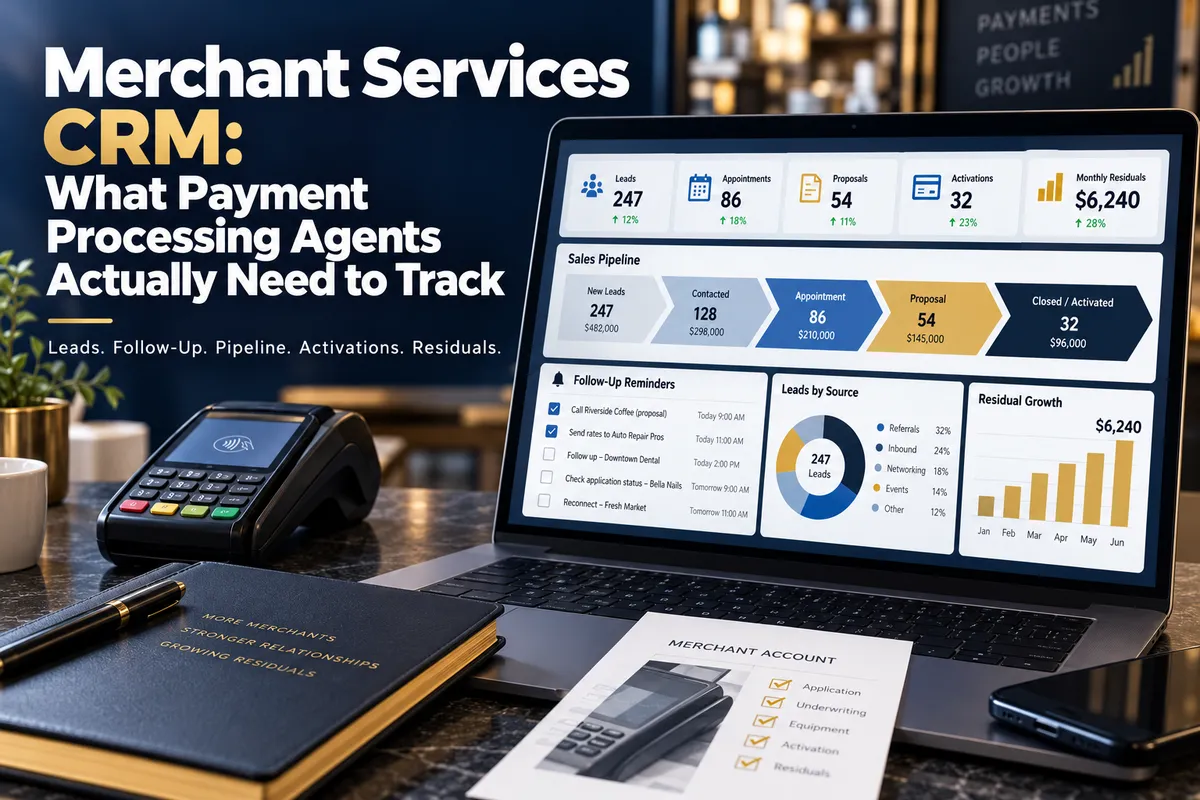
Merchant Services CRM: What Payment Processing Agents Actually Need to Track
Merchant Services CRM: What Payment Processing Agents Actually Need to Track
I've used a lot of systems throughout my career in merchant services.
Processors have systems.
ISOs have systems.
Sales organizations have CRMs.
Agents have spreadsheets, notes, calendars, phone contacts and sometimes three or four different places where they're trying to keep track of everything.
All of those tools can serve a purpose.
But after more than 16 years in merchant services, I kept seeing one problem:
The individual agent still couldn't tell me their numbers.
Ask an agent which merchants they're working with and they can probably give you a list.
Ask them exactly how much prospecting they've done this month, how many proposals that activity created, how many POS demos they completed, how many deals they signed, what their personal conversion ratios are, what their current pipeline may be worth, what commissions are still outstanding and how their production compares with previous months?
That's where things usually get fuzzy.
That's why I started building EZ MerchantTracker.
I didn't want another merchant database.
I wanted a merchant services CRM built around the salesperson.
A place where an agent can manage leads and pipeline, but also measure the actions that actually build a merchant portfolio.
Because storing information about your merchants is important.
Understanding your own business is important too.
What Is a Merchant Services CRM?
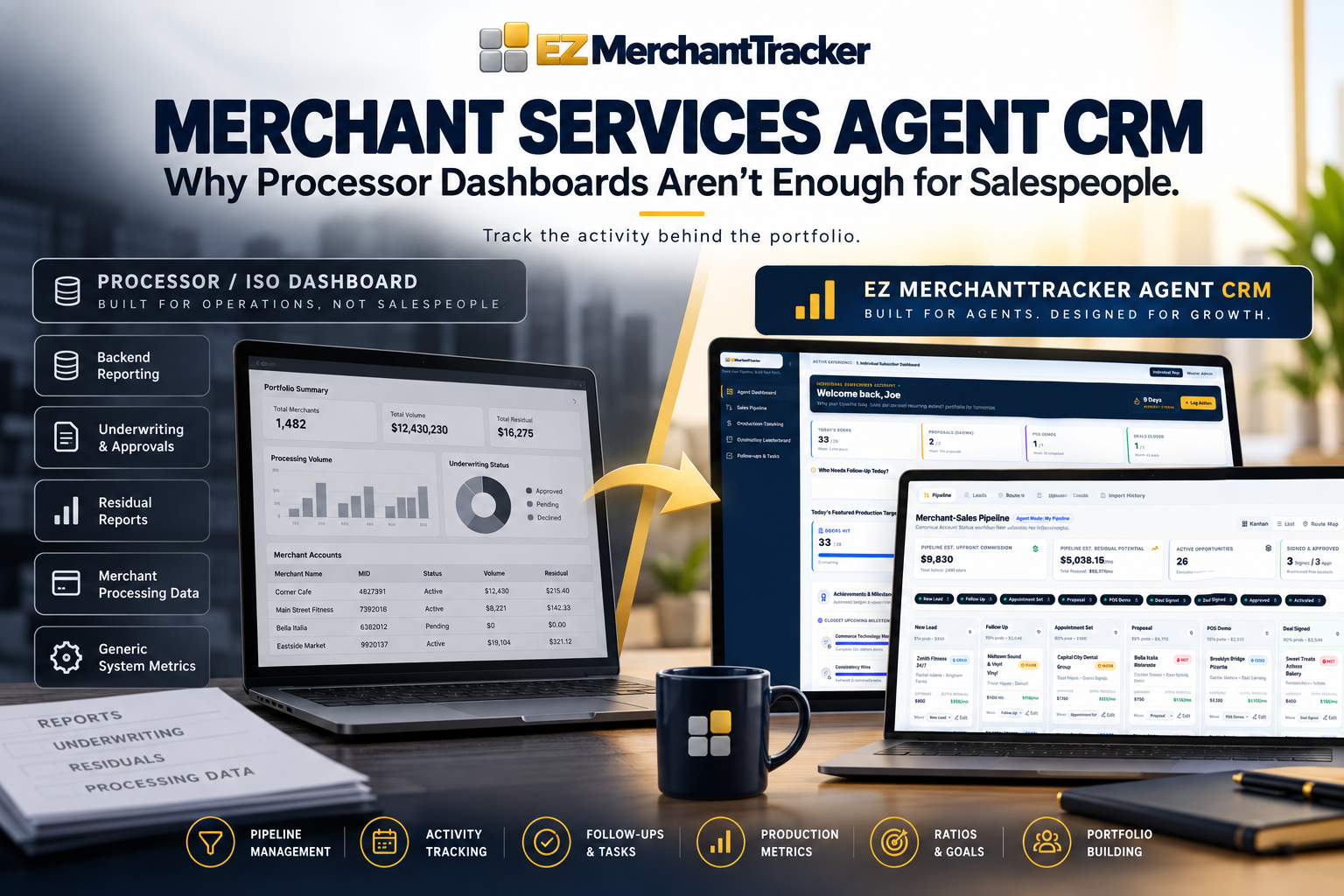
A merchant services CRM is a customer relationship management system used to organize prospects, merchants, follow-ups, opportunities and other information involved in selling payment-processing services.
But that definition is almost too broad to be useful.
Merchant services has multiple layers.
A processing company needs merchant information.
An ISO needs underwriting and operational information.
A sales organization may need to manage agents, applications, merchants and residuals.
Those systems matter.
EZ MerchantTracker isn't being built because I think all those systems should disappear.
It's being built because the individual merchant-sales agent has a different problem to solve.
The agent needs to know:
Who am I working?
What happens next?
Who needs follow-up?
What's moving through my pipeline?
What have I actually done this week?
What is that activity producing?
Where am I losing opportunities?
How much potential business is sitting in my pipeline?
What have I earned?
Am I improving?
Am I doing enough?
Those are sales questions.
And I wanted a system designed around answering them.
IF YOU'RE ALREADY SELLING, THIS IS THE PROBLEM EZ MERCHANTTRACKER WAS BUILT TO SOLVE
If you're already a merchant-services agent and your current system tells you plenty about your merchants but very little about your own production, take a look at EZ MerchantTracker.
It's being built specifically around merchant-sales agents, their leads, pipeline, activity, production, commissions, conversion ratios and accountability.
If you're brand new and aren't selling yet, don't start with software. Start by learning the business through Merchant Service University, then get connected with the right partnerships.
A CRM Full of Contacts Doesn't Mean You Have a Pipeline
This is one of the first distinctions I want agents to understand.
Having 300 businesses saved in a CRM doesn't mean you have 300 leads.
And having 50 leads doesn't mean you have 50 legitimate opportunities.
Where are they in the sales process?
Did you actually speak with the owner?
Is there a problem you can solve?
Did you complete a presentation?
Did you submit a proposal?
Does the merchant need a POS demo?
Did they commit?
Did they sign?
Were they approved?
Did they activate?
A merchant-services sales pipeline should tell you what's happening next—not simply remind you that a business exists.
That's why I want agents moving opportunities through clear stages.
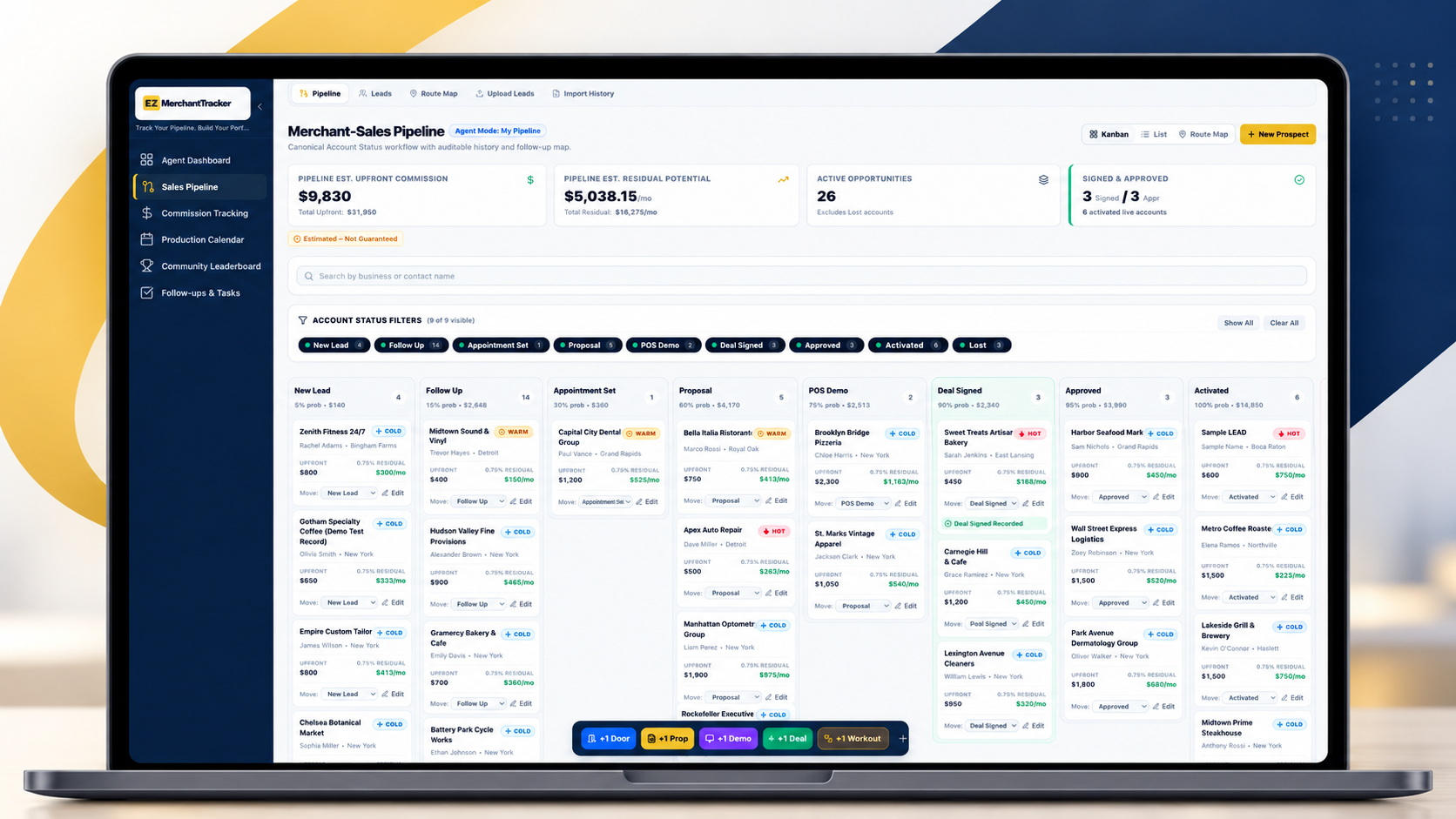
Inside EZ MerchantTracker, we're building the pipeline around statuses that reflect actual progress, such as:
New Lead → Warm → Hot → Proposal → POS Demo → Deal Signed → Approved → Activated
And yes, some opportunities are going to be lost.
Track those too.
Because your lost deals contain information.
Your Merchant Services CRM Should Track Activity, Not Just Opportunities
This is where I think traditional CRM thinking misses something important for independent salespeople.
Let's say your pipeline is empty.
Why?
A CRM might show you that there aren't many opportunities.
Great.
But what created the problem?
Did you spend the last two weeks prospecting and simply struggle to create targets?
Or did you barely prospect at all?
Those require completely different responses.
That's why activity belongs beside pipeline data.
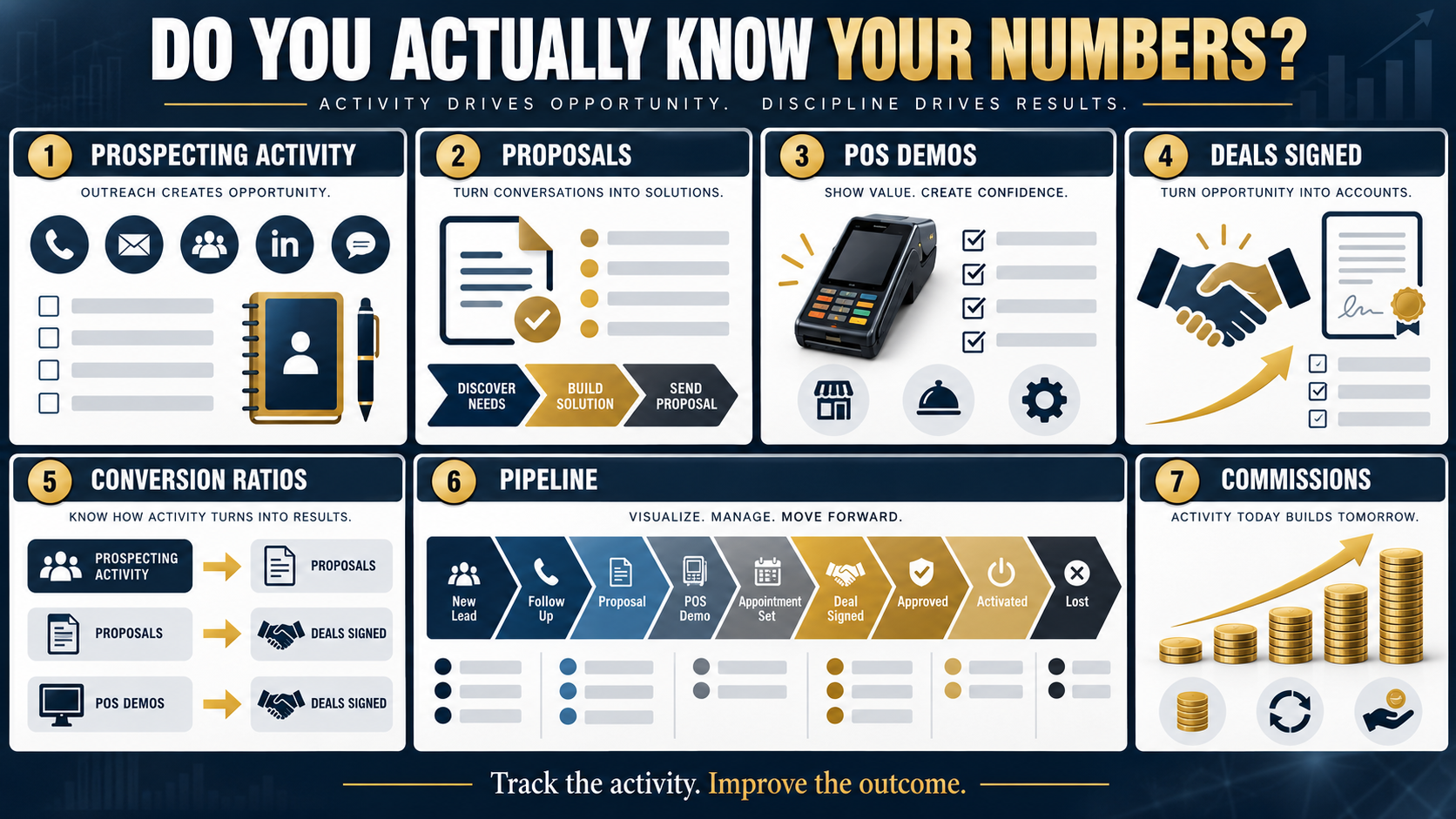
I'm interested in the actions that eventually produce business.
Prospecting.
Proposals.
POS demonstrations.
Deals signed.
Follow-up.
Over time, we can begin connecting those actions to results.
That's incredibly valuable.
Because the goal isn't merely to tell you:
“You only closed one deal.”
I want the data to eventually help us understand:
Why?
The Numbers You Think You Know Probably Aren't Your Real Numbers
I've had agents ask me for years:
“If I hit this many businesses, how many accounts should I close?”
The problem is that there isn't one answer that applies to everybody.
Your sales ability is different.
Your market is different.
Your experience is different.
Your approach is different.
Your ability to identify targets is different.
Your follow-up is different.
Your closing ability is different.
What I've wanted for years is enough data to answer a much better question:
What does YOUR activity normally produce?
That's why long-term tracking becomes so important.
Maybe Agent A requires significantly more initial prospecting to create a deal than Agent B.
Okay.
Now we know.
Maybe Agent A is improving dramatically over six months.
Now we know that too.
Maybe an agent thinks they're having a closing problem, but their historical data shows the real decline began when their prospecting activity dropped.
That's useful information.
You stop guessing.
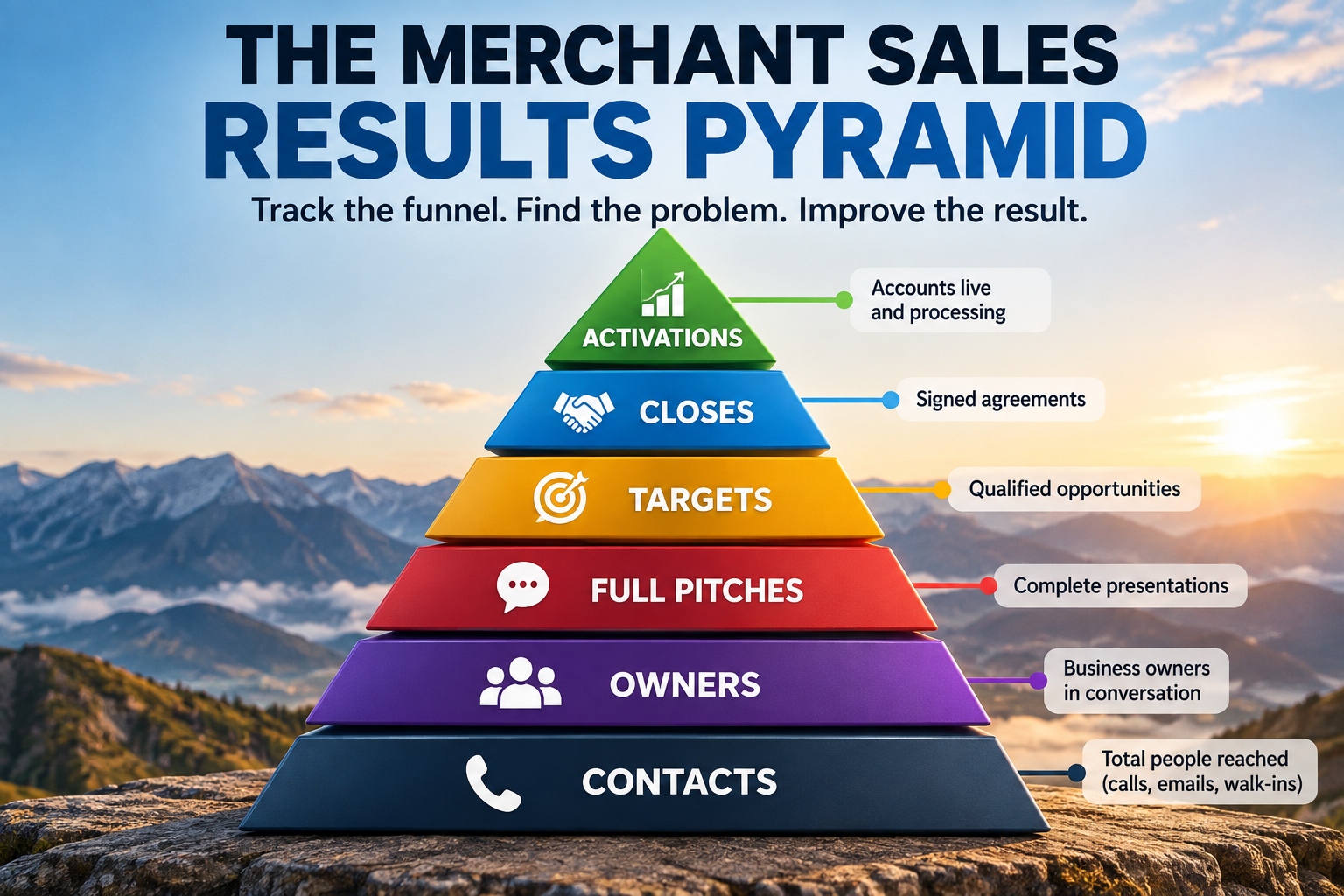
Track the Results Pyramid
I've taught the Results Pyramidfor years.
The concept is straightforward:
Contacts → Owners → Full Pitches → Targets → Closes → Activations
The reason this matters inside a merchant sales CRM is that the final result doesn't tell you the whole story.
Imagine two agents each close one account.
Same result.
Completely different story.
One agent may have barely worked but converted an unusually high percentage of the few opportunities they created.
Another may have done substantial activity but struggled converting legitimate targets.
If all we record is:
Deals Closed: 1
we don't know enough.
When you track the stages leading toward the result, you can begin diagnosing performance.
Track Your Personal Conversion Ratios
This may eventually become one of the most valuable parts of building your own historical merchant-sales data.
How does your activity convert?
For example:
How often do your proposals become signed deals?
How often do POS demos become signed deals?
How much prospecting does it typically take you to produce a signed account?
Again, I'm intentionally not giving you one magic industry number and pretending everybody should perform exactly the same way.
I have production standards I believe agents should work toward, and we can provide benchmarks inside the software and coaching.
But ultimately I want to know your numbers.
And I want to see them over time.
Are you improving?
Are you declining?
Did something change?
Does increasing one activity consistently increase another result?
Now your CRM starts becoming more than storage.
It becomes business intelligence about you.

Your CRM Should Show You Whether You're Actually Doing the Work
This is the accountability piece.
You can tell yourself you had a productive week.
Your calendar might tell a different story.
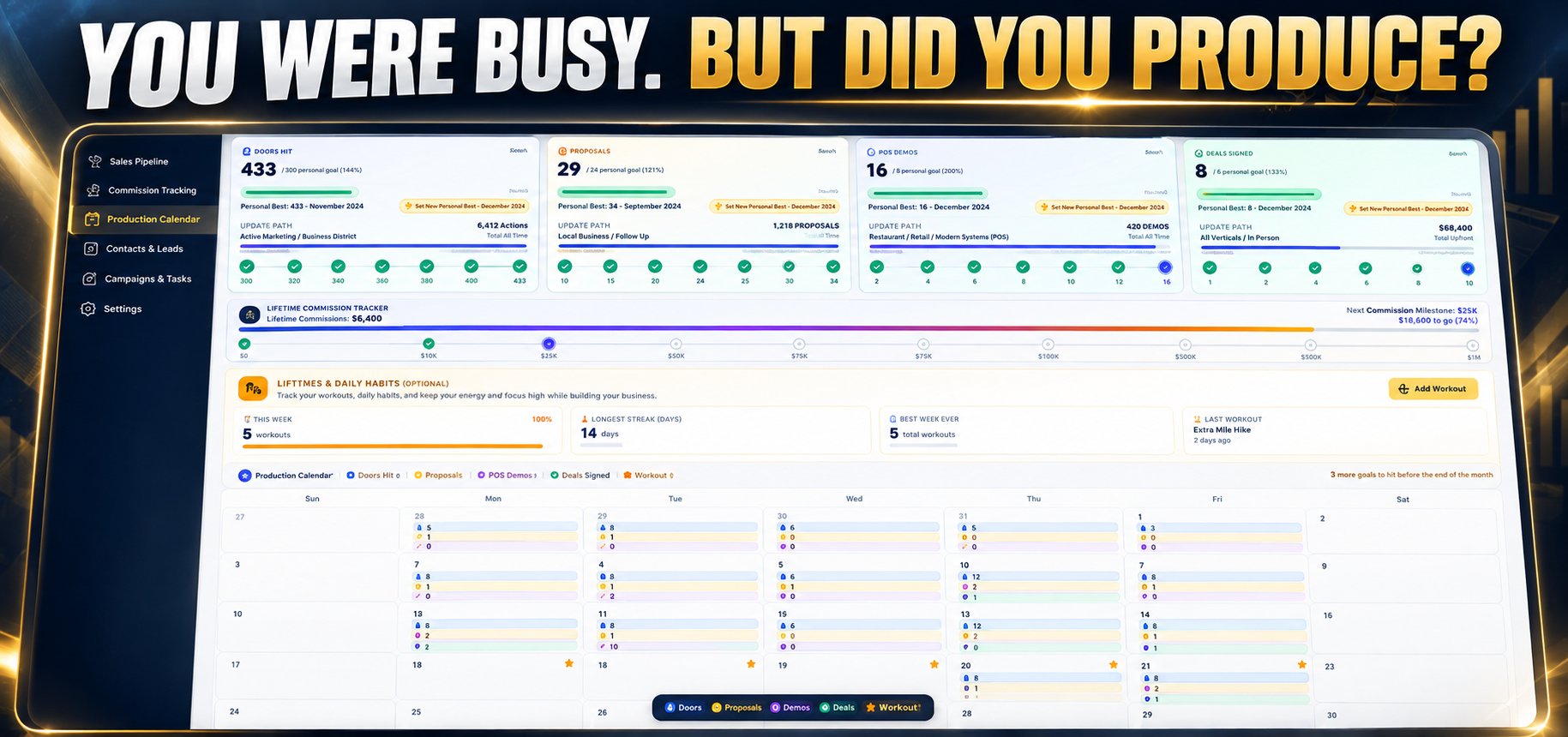
That's why I wanted production activity visualized over time.
Days.
Weeks.
Months.
Patterns start becoming visible.
You can see consistency.
You can see gaps.
You can see personal bests.
You can see progress toward production targets.
That's different from remembering that you “worked pretty hard last month.”
There should be nowhere to hide.
And I don't mean that negatively.
The truth is useful.
If you're crushing your activity and your results aren't following, good.
Now we know we need to work on skill.
If you're extremely talented but barely working, good.
Now we know that too.
The data isn't there to insult you.
It's there to make the problem visible.
Track Your Pipeline's Potential Value
Not every opportunity in your pipeline is going to close.
Obviously.
But that doesn't mean you shouldn't understand what you're working toward.
I wanted MerchantTracker to help agents visualize both potential upfront commissions and potential residual value sitting inside their active pipeline.
The word potentialmatters.
Pipeline isn't income.
A proposal isn't a deal.
A signed deal isn't always an activated merchant.
But understanding the potential value of the opportunities you're actively working can help you see the business you're building and prioritize follow-up.
The key is not confusing potentialwith earned.
Merchant Services Agents Should Track Commissions Too
Merchant sales doesn't always involve one simple commission payment.
Depending on the partnership and product, agents may have different upfront payouts, activation bonuses, profitability-related payments or other compensation.
Then there is recurring residual income.
I wanted the sales side of MerchantTracker to give agents a better picture of the commissions associated with the business they're producing.
What's expected?
What's unpaid?
What's been paid?
What doesn't apply?
That gives an agent another layer of visibility into their business.
It doesn't replace your processor's official residual or accounting reporting.
The processor's reporting remains the authority for what you're actually being paid.
MerchantTracker gives the salesperson a way to connect production with their own commission tracking and expectations.
That's an important distinction.
A Merchant Services CRM Should Make Follow-Up Harder to Forget
This sounds basic.
It is.
It's also where deals die.
Agents prospect.
They find somebody interested.
The merchant says:
“Call me next Tuesday.”
Tuesday comes.
Nothing.
Then Friday.
Then another week.
Eventually the agent can't even remember what the conversation was about.
A CRM doesn't close that merchant for you.
But it should make it much harder for legitimate opportunities to disappear because you forgot about them.
Tasks.
Reminders.
Notes.
Pipeline stages.
Next actions.
These aren't exciting features.
They produce something much more valuable:
Consistency.
Your CRM Should Help You Work Smarter in the Field
Merchant services is still a local business for a lot of agents.
If you've got warm and hot prospects spread across a territory, geography matters.
That's why route visibility is useful.
Instead of randomly driving around wondering who you should stop by and see, your lead data can help organize the day.
Who is nearby?
Who needs follow-up?
Which hot opportunities are in the area?
Can you build a more efficient route around legitimate targets?
Technology should reduce friction.
Not create more administrative work.
A Merchant Sales CRM Can Make Production More Competitive
I like competition.
I think sales should have some fun built into it.
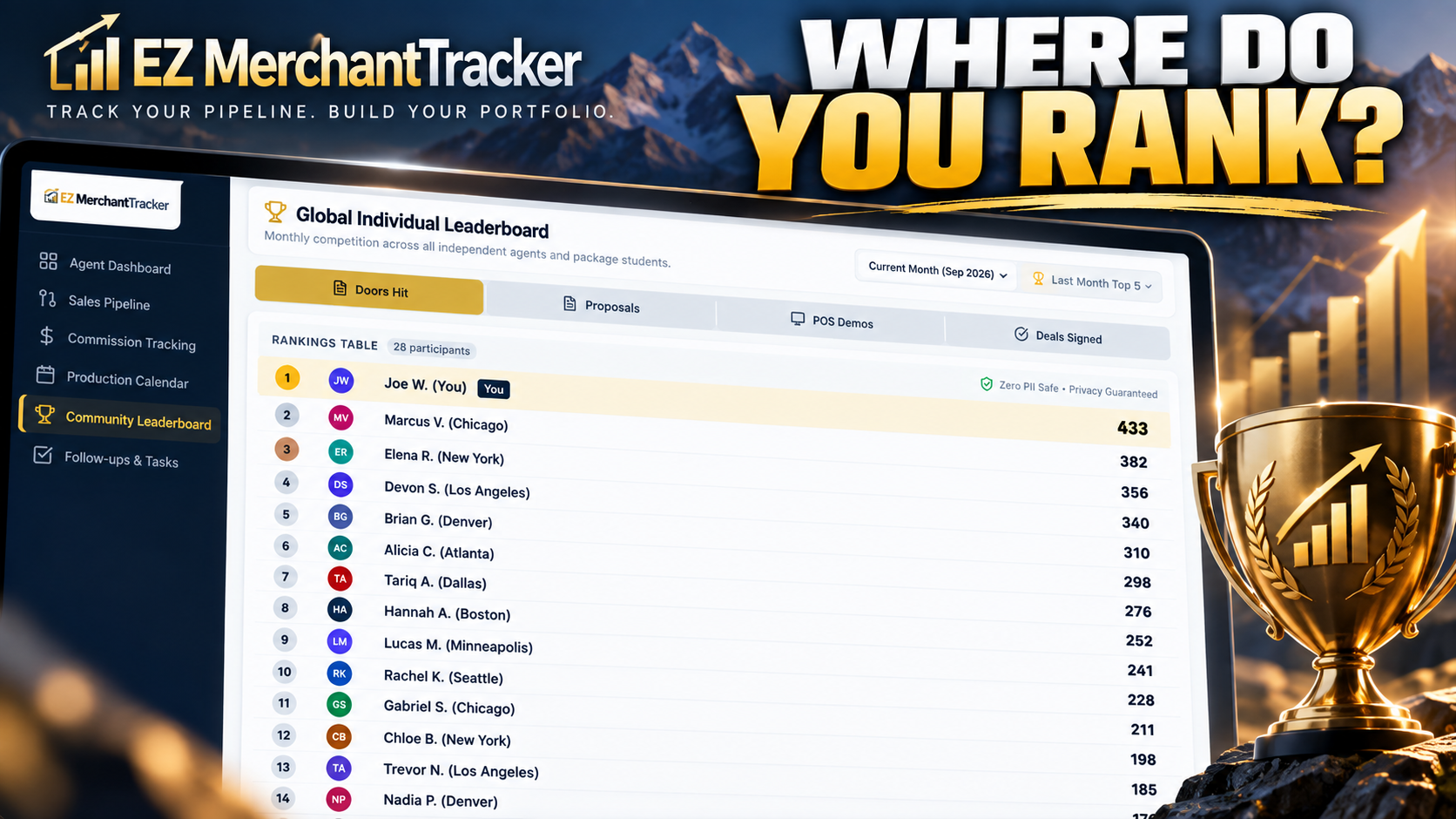
That's why MerchantTracker includes leaderboards.
Doors.
Proposals.
POS demos.
Deals signed.
Individual agents can compare production.
Organizations can create visibility around their teams.
And agents can chase personal bests and milestones.
Competition isn't going to motivate everybody.
It doesn't have to.
But for the right salesperson, seeing somebody else putting up numbers can be exactly the nudge they need.
If somebody else is working, maybe it's time to stop screwing around and get moving.
What About Organizations and Sales Teams?
The same concept becomes even more useful when you're managing people.
An organization shouldn't have to call every salesperson and ask:
“What did you do today?”
Managers need visibility.
Who's producing?
Who's prospecting?
Who's creating proposals?
Who's doing demos?
Who's signing business?
Who has a healthy pipeline?
Who's disappeared?
Where might somebody need coaching?
MerchantTracker is being built for both individual agents and merchant-services organizations, with different access levels for agents, managers and administrators.
An agent should be able to focus on their business.
A manager should be able to understand the team's production.
And an organization should be able to create accountability without exposing everyone's private data to everybody else.
What Makes EZ MerchantTracker Different?
I'm not interested in claiming that no merchant-services CRM existed before I built one.
That's obviously not true.
There are merchant-management platforms, processor systems, ISO CRMs and general-purpose sales CRMs already available.
Many of them solve important problems.
I'm building something much more specific.
EZ MerchantTracker is centered around the merchant-services salesperson and the actions required to build a portfolio.
That's the difference.
It's CRM.
It's activity tracking.
It's pipeline management.
It's commission tracking.
It's performance measurement.
It's competition.
It's accountability.
And eventually, it's coaching.
All centered around one question:
Are you doing enough of the right things to build the business you say you want?
WANT TO KNOW YOUR NUMBERS?
If you're already selling merchant services, stop relying on memory and guesses.
Start building actual historical data around your business.
See your pipeline.
Track your activity.
Measure your ratios.
Monitor commissions.
Compete.
Set goals.
And start learning what your actions actually produce.
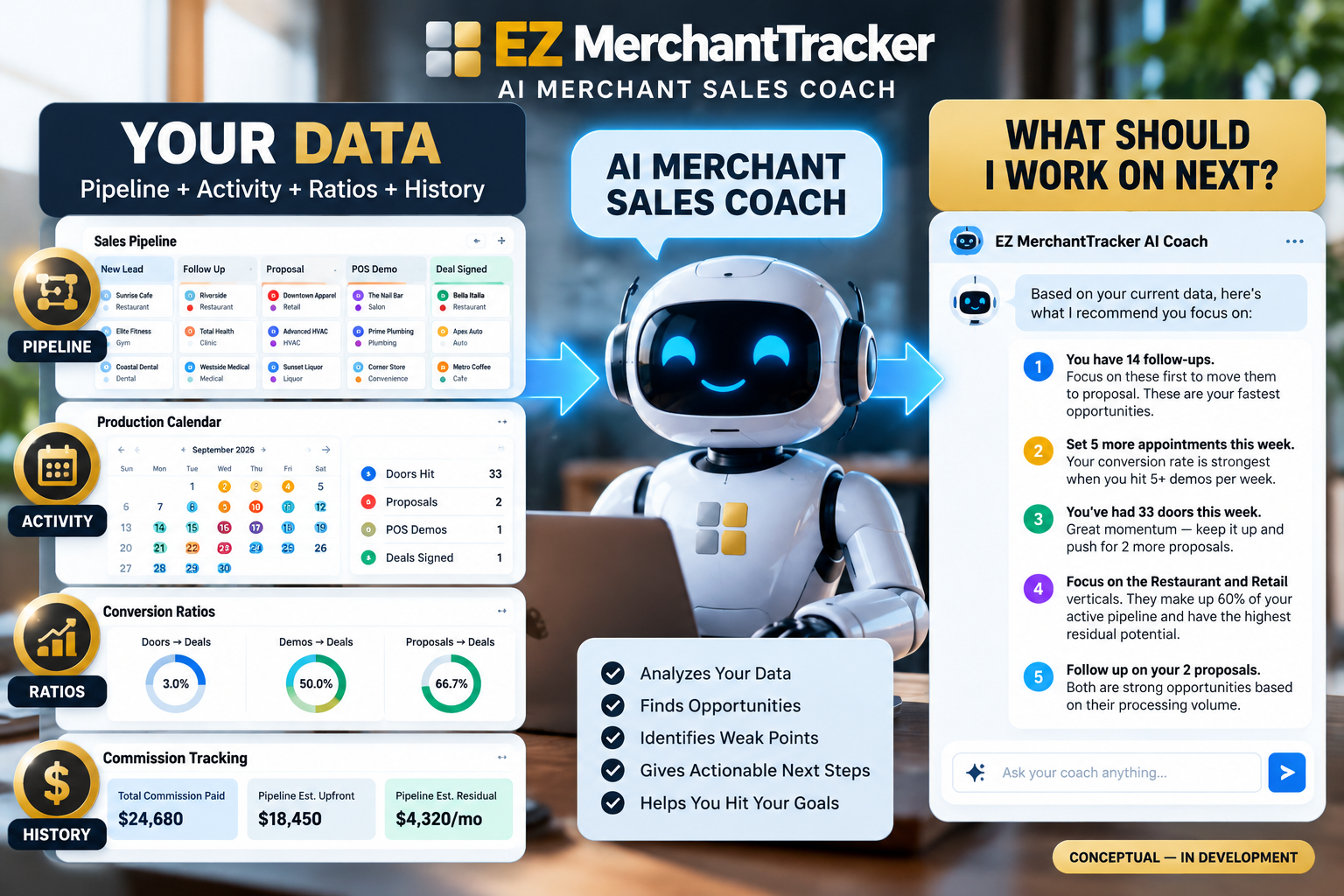
MerchantTracker Also Has an AI Sales Coach
Tracking tells you what's happening.
The next question is:
What should I do about it?
That's why we're building an AI Sales Tips & Suggestions Coachinto EZ MerchantTracker.
It's being programmed around my merchant-sales methodologies and Merchant Sales Guide so that the assistance isn't simply generic sales advice disconnected from this industry.
The goal is to give agents additional tips and guidance as they build their business.
But I want to make an important distinction.
AI assistance and direct human coaching aren't the same thing.
An AI coach can help surface information and suggestions.
The software can show you that you're behind.
The dashboard can make a pattern obvious.
But sometimes you need somebody who knows what you said you wanted and is willing to hold you to it.
That's where Portfolio Builders Coaching comes in.
When CRM Data Meets Actual Coaching
This is where I'm most excited about where we're going.
Historically, coaching often starts like this:
“How's everything going?”
“Pretty good.”
“How much are you working?”
“A lot.”
“How's your pipeline?”
“Pretty good.”
That's not enough for me.
I want to see it.
Show me the activity.
Show me the pipeline.
Show me the ratios.
Show me the follow-up.
Show me what's converting.
Show me what's not.
Now coaching gets interesting.
If your activity is low, let's stop pretending the closing script is the problem.
If your activity is strong but opportunities aren't developing, let's look at your approach.
If you have opportunities everywhere but aren't following up, let's fix that.
If everything is strong except closing, now let's work on closing.
Data gives coaching somewhere to look.
DATA + ACCOUNTABILITY
If you want the software, use MerchantTracker.
If you're highly self-accountable, that may be everything you need.
I respect the hell out of the person who sets their own standard, does the work and doesn't need anybody pushing them.
But if you want somebody in your corner helping you interpret what's happening, challenge you and hold you accountable to the actions you committed to taking, that's what Portfolio Builders Coaching is being built around.
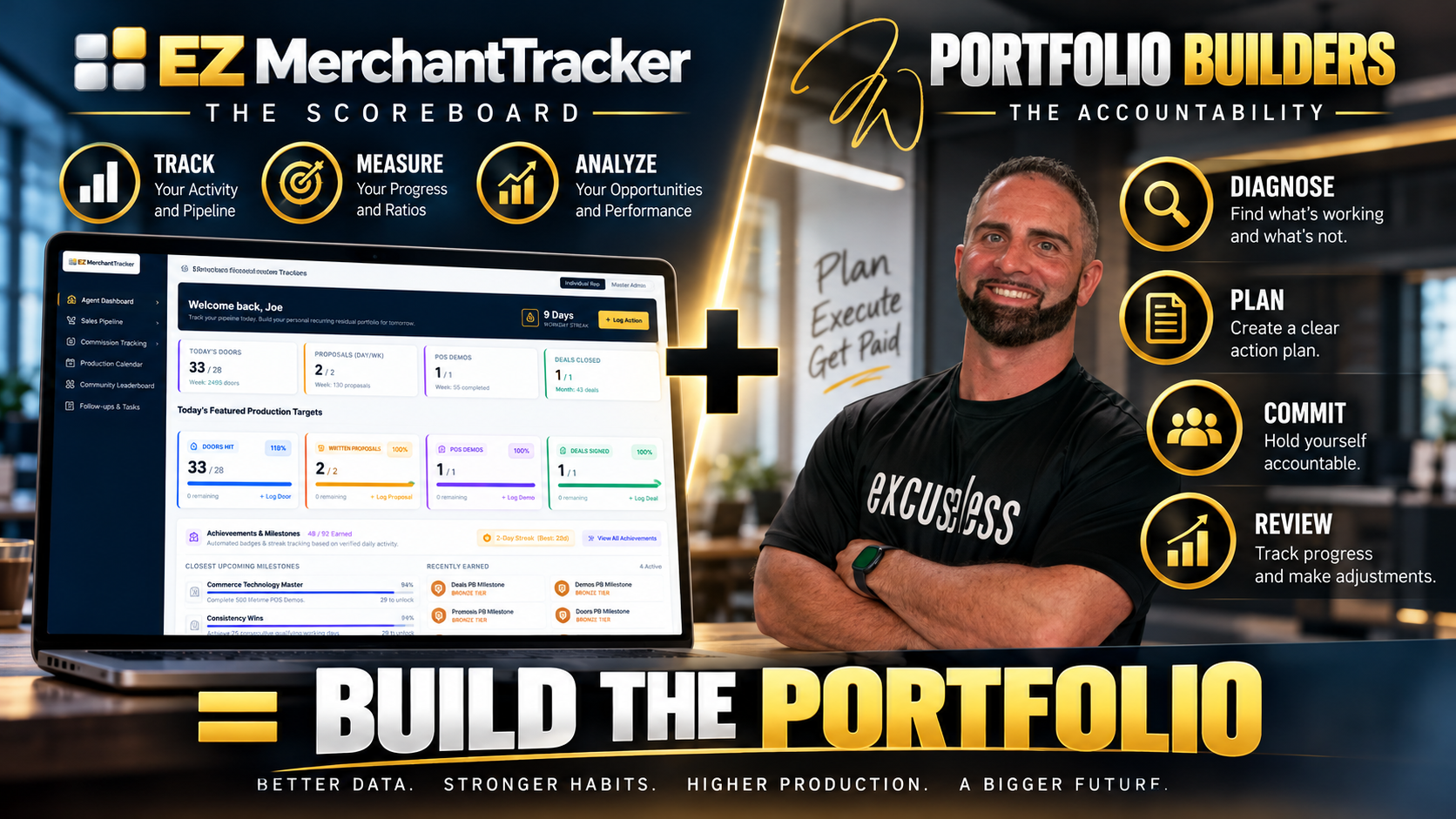
EZ MerchantTracker gives us the data.
Portfolio Builders gives us the accountability.
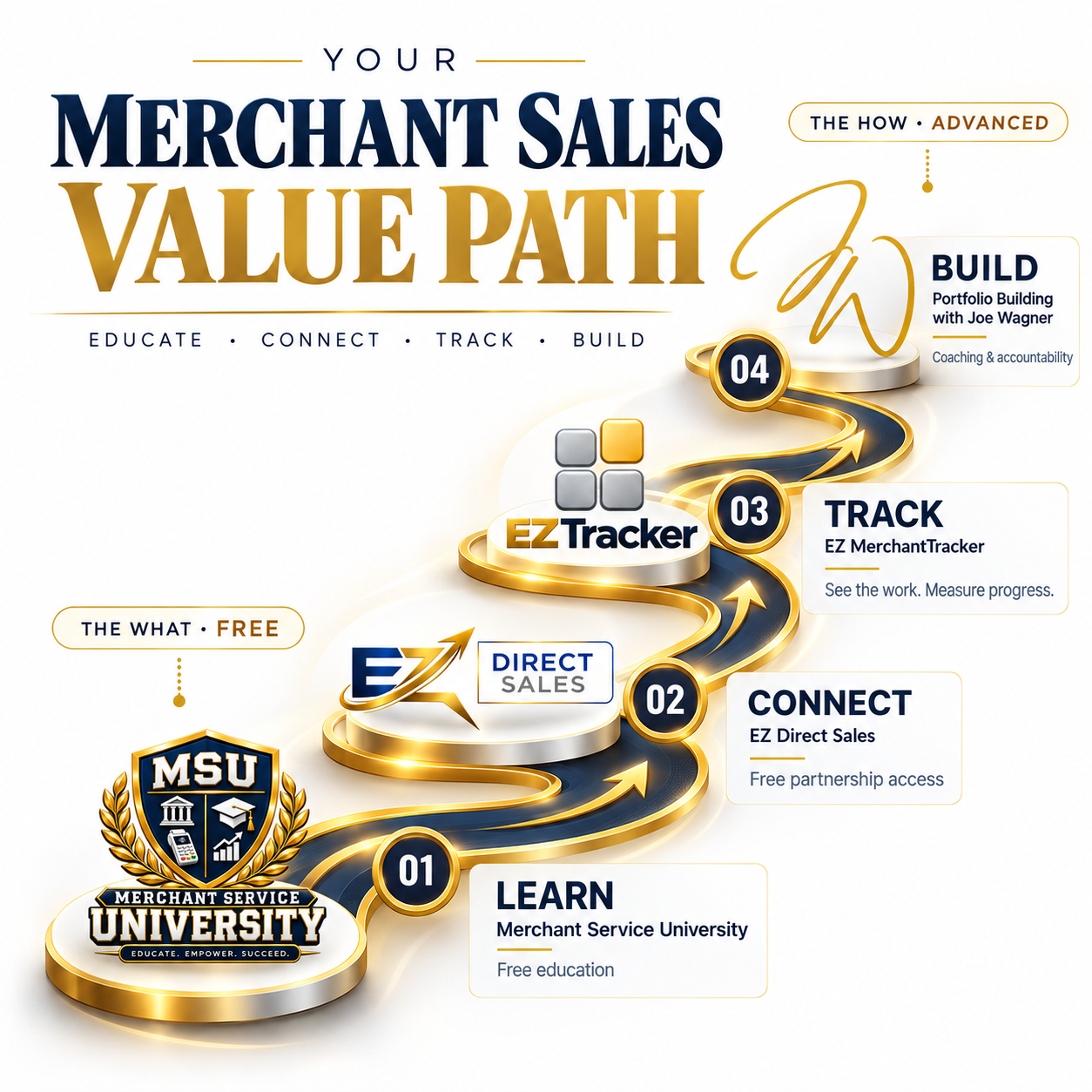
The Complete Path: Learn, Start, Execute and Build
This is the larger ecosystem I'm creating around merchant-services agents.
1. LEARN — Merchant Service University
If you're brand new, start here.
Learn merchant services.
Understand the business.
Understand the products.
Understand residuals.
Understand selling.
The core education is free.
2. START — EZ Direct Sales
Once you're educated, you need somewhere to actually submit business.
I help qualified agents connect with trusted merchant-services partnerships so they can start selling and building.
3. EXECUTE — EZ MerchantTracker
Now track the business.
Leads.
Pipeline.
Activity.
Production.
Ratios.
Commissions.
Goals.
AI sales tips.
Accountability.
4. BUILD — Portfolio Builders Coaching
For agents who want direct coaching and additional accountability, we take the data and work on execution.
Identify the constraint.
Commit to the action.
Do the work.
Review the result.
Improve.
Repeat.
Education → Opportunity → Execution → Accountability → Coaching → Production → Portfolio
A CRM Won't Build Your Portfolio for You
This needs to be said too.
Software doesn't build businesses.
People do.
Buying MerchantTracker isn't going to magically create activity.
A notification can't physically make you follow up.
A leaderboard can't force you to work.
An AI coach can't make you listen.
A human coach can't make you execute either.
You still have to do the work.
But the right system can make the work more organized.
It can make your performance visible.
It can show you trends you couldn't see before.
It can help prevent opportunities from disappearing.
It can give you a record of what you've actually done.
And most importantly:
It can make it a hell of a lot harder to lie to yourself.
That's what I wanted.
Not another place to store phone numbers.
A system that helps merchant-services agents track the actions that build the portfolio.
Frequently Asked Questions
What is a merchant services CRM?
A merchant services CRM is software used to manage merchant prospects, sales opportunities, follow-ups and other information related to selling payment-processing services. Depending on the platform, it may also include merchant onboarding, residual reporting, pipeline management, sales activity tracking or organizational features.
What should a merchant services agent track in a CRM?
Useful information can include leads, contact information, pipeline status, follow-ups, proposals, POS demonstrations, signed deals, approvals, activations, sales activity, commissions and personal conversion ratios. What matters most depends on how the agent sells and what they want to improve.
What is the difference between a merchant services CRM and a processor CRM?
A processor or ISO CRM may focus heavily on merchant onboarding, applications, account management, residuals and operational information. A sales-focused merchant services CRM can place greater emphasis on the individual agent's leads, prospecting activity, pipeline, production and performance.
What is EZ MerchantTracker?
EZ MerchantTracker is a merchant sales CRM and performance-tracking platform being built specifically around merchant-services agents and sales organizations. It combines lead and pipeline management with sales activity tracking, production data, conversion ratios, commission tracking, goals, leaderboards and AI sales tips and suggestions.
Does EZ MerchantTracker replace my processor's CRM?
It isn't designed to make every processor or ISO system unnecessary. Processor systems remain important for official merchant, underwriting, processing and residual information. EZ MerchantTracker focuses on the salesperson's own pipeline, production, activity and accountability.
Can a merchant services CRM track sales activity?
Yes. A sales-focused CRM can track activities associated with building the pipeline and producing merchant accounts. EZ MerchantTracker is specifically being designed to make agent production and activity visible over time.
Can merchant services agents track conversion ratios?
Yes. When activity and outcomes are consistently recorded, agents can calculate personal conversion ratios and observe how those ratios change over time. This can help identify where a sales process may need improvement.
Should merchant services agents track commissions?
Commission tracking can give agents greater visibility into the financial results associated with their production. However, processor or ISO reporting should remain the authoritative source for official commissions and residual payments.
Does EZ MerchantTracker include AI sales coaching?
EZ MerchantTracker includes an AI Sales Tips & Suggestions Coach programmed around Joe Wagner's Merchant Sales Guide, methodologies and merchant-services sales philosophy to provide additional tips and guidance inside the platform.
Can merchant services sales organizations use EZ MerchantTracker?
EZ MerchantTracker is being designed for both individual agents and organizations. Organization accounts can support different roles and visibility so managers can monitor relevant team production while agents focus on their own data.
Is a merchant services CRM useful for coaching?
Sales activity and pipeline data can give a coach more objective information about what an agent is actually doing. This can help distinguish between potential activity, prospecting, qualification, follow-up, presentation and closing problems.
Do I still need sales coaching if I use a CRM?
Not necessarily. Some agents are highly self-accountable and may primarily need better data and organization. Others benefit from having a coach help interpret performance, identify weaknesses and provide outside accountability.
Where should a new merchant-services agent start?
A brand-new agent should generally start with education rather than software. Merchant Service University provides core merchant-services education. Once an agent is ready to sell, they can explore partnerships, begin tracking their business and decide whether additional coaching would be useful.