
Merchant Services Passive Income: How Residuals Really Work
Can Merchant Services Create Passive Income? How Residual Income Really Works
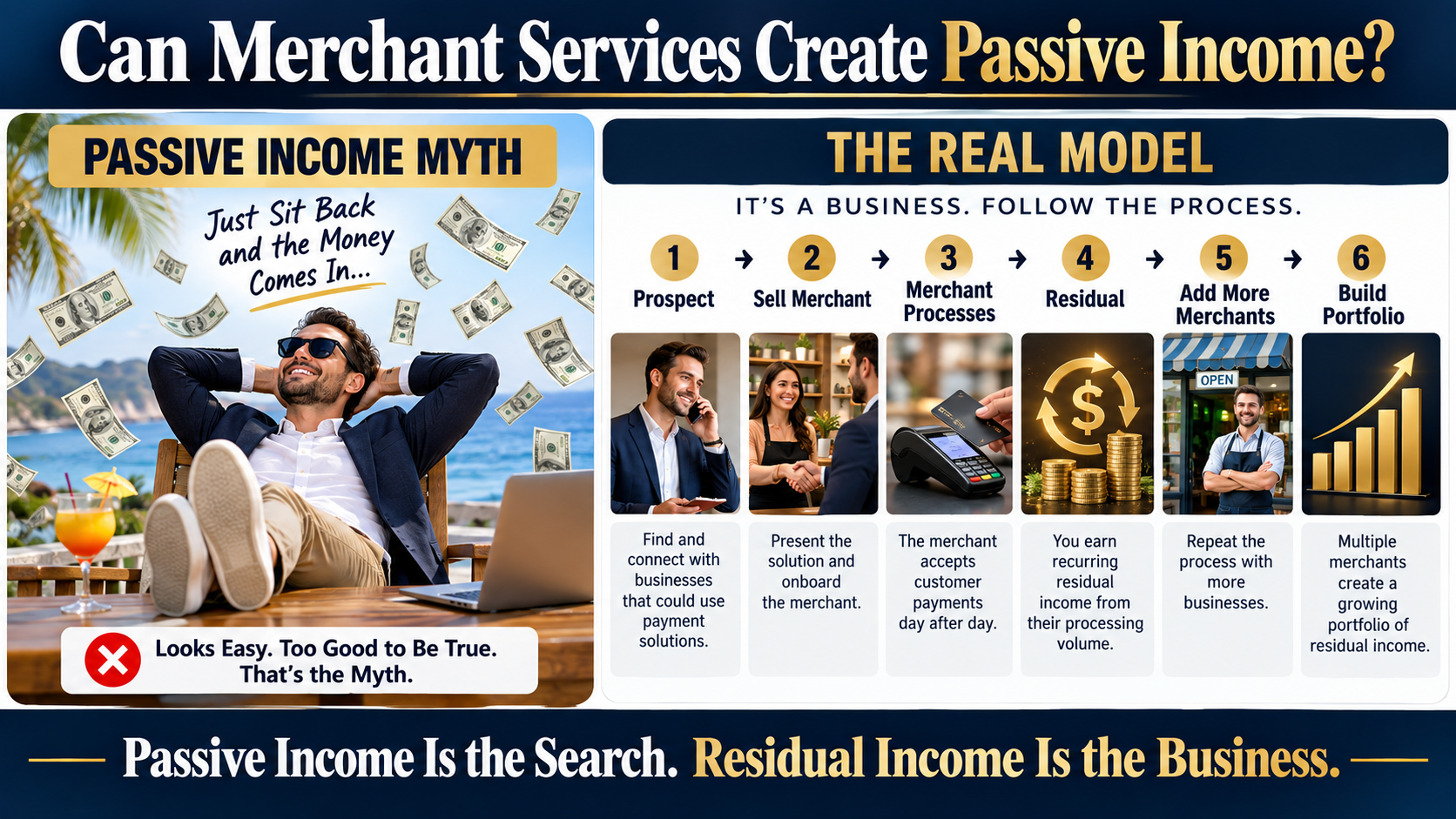
Can merchant services create passive income?
Potentially, but I think residual income is the more accurate phrase.
That distinction matters.
If you're searching for passive-income opportunities because you want to push a button, do nothing, and have money show up indefinitely, merchant services is probably going to disappoint you.
You have to sell.
You have to find merchants.
You have to create conversations.
You have to close accounts.
Those merchants need to activate.
They need to continue processing.
And the economics and contractual rights underneath your agent agreement matter.
But here's why merchant services caught my attention more than 16 years ago and why I've continued building in this industry:
You don't necessarily have to resell the same customer every month in order for a previous sale to continue contributing to your income.
That is the opportunity.
You acquire merchant number one.
Then merchant number two.
Then number ten.
Then twenty-five.
If those merchants remain active and your agreement provides continuing residual compensation, previous production can potentially continue generating income while you're adding new production.
That is not effortless passive income.
It is something I think is much more useful for a salesperson:
A recurring residual portfolio.
And if you're already good at selling, the bigger question may not be whether you need another passive-income idea.
It may be whether you're using your existing sales skills in a business model capable of building something behind them.
Why People Call Merchant Services Passive Income
The attraction is easy to understand.
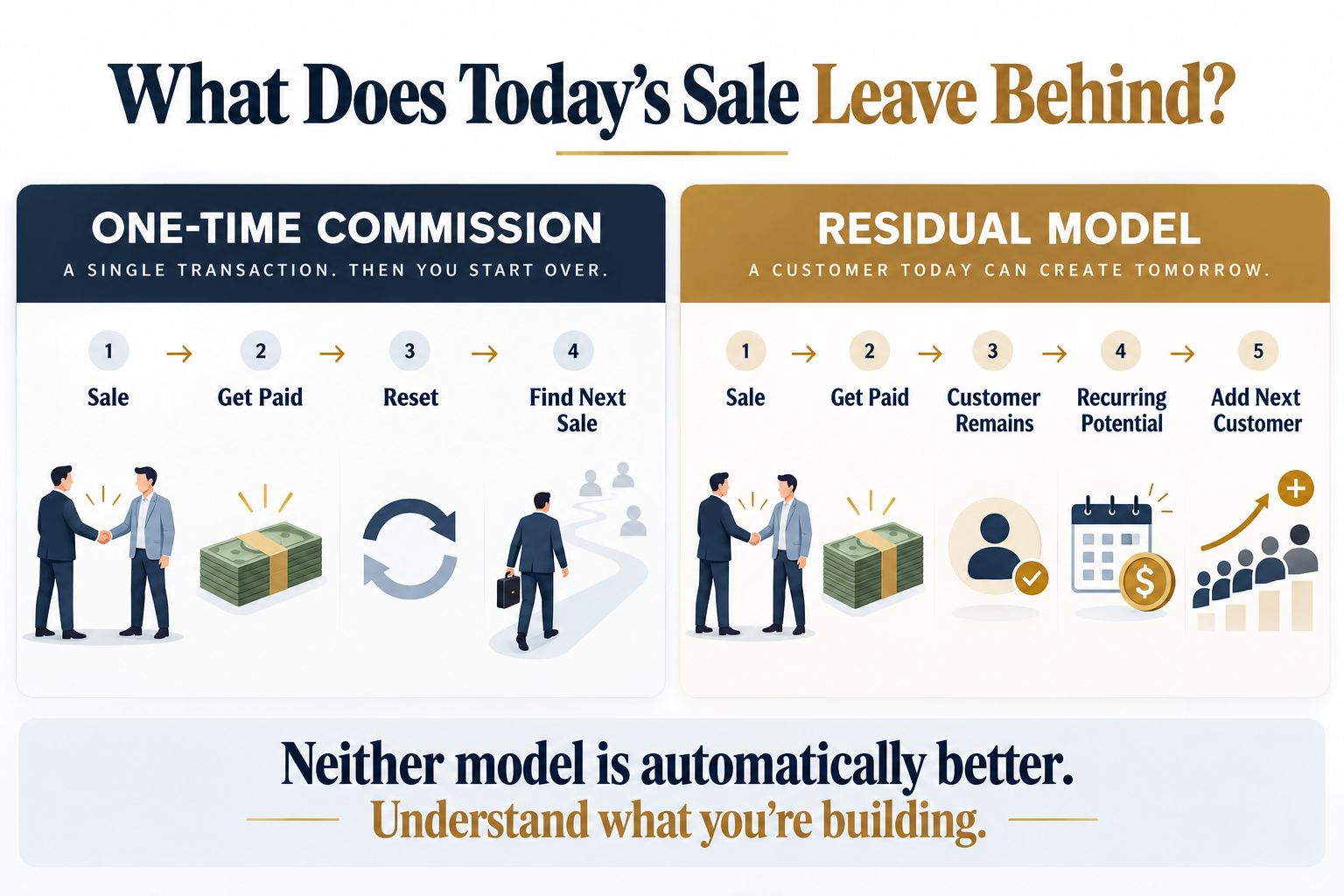
In a traditional one-time sales job, the economics may look like this:
You find a customer.
You close the customer.
You get paid.
Then you need another customer to create the next commission.
Merchant services can work differently.
An agent can potentially receive ongoing residual compensation associated with active merchant accounts they previously acquired, depending on the partner's economics and the agent agreement.
That means your existing book of merchants may continue contributing revenue while you continue selling.
That's why people use the word passive.
But the income didn't start passively.
You had to create the customer relationship first.
And the portfolio doesn't exist independently of merchant retention, processing activity and your contractual rights.
That's why throughout my own content I generally use residual income or recurring portfolio income.
Those terms better describe what you're actually building.
If you're coming from a traditional commission role, start with Tired of Starting at Zero Every Month? Sales Jobs With Residual Income. That's the bigger problem this model solves.
What Is Merchant Services Residual Income?
Think about a business that accepts card payments.
The business processes transactions throughout the month.
There are costs associated with moving and processing those payments.
Depending on the pricing arrangement, there may also be revenue or eligible margin above those underlying costs.
An independent sales agent may be entitled to an agreed percentage of certain eligible economics generated by merchant accounts they acquired.
For example, imagine an account produces $400 in eligible monthly residual profit after the applicable costs defined by the program.
At a hypothetical 50% residual split:
$400 × 50% = $200 to the agent
If the merchant remains active and produces similar economics the following month, the account could potentially generate another residual payment.
Then imagine adding a second account.
And a third.
That is where the concept begins to change from selling individual deals to building a portfolio.
This example is purely illustrative. Merchant volume, pricing, costs, retention and compensation agreements vary, and residual income is never guaranteed.
For a deeper explanation, read How Merchant Services Agents Get Paid.
The Portfolio Is What Makes This Different
This is the part I wish more experienced salespeople understood.
If you sell one merchant, the residual may not feel impressive.
That's normal.
You're looking at merchant number one.
The bigger idea appears when you start asking what happens if you keep producing.
Imagine, only for illustration:
Month 1: several active merchants.
Month 6: more active merchants.
Year 1: a larger merchant base.
Year 3: an established portfolio.
You aren't supposed to be starting over from merchant number zero every January.
You're trying to protect what you've already acquired while adding more.
That's where recurring-income sales becomes fundamentally different from constantly restarting commissions.
Our upcoming guide, How to Build Recurring Income as a Salesperson Without Starting Over Every Month, goes much deeper into that distinction.
Why This Appeals to Experienced Salespeople
This is where merchant services gets especially interesting to me.
You may already know how to do the hardest part.
You've Sold Door to Door
You already understand rejection.
You know how to walk into a business where nobody invited you.
You know how to create conversations.
You know how to manage territory and activity.
Merchant services gives you a reason to have conversations with businesses that already need payment acceptance.
You've Worked the Phones
You know outbound prospecting.
You understand lists.
Follow-up.
Appointment setting.
Pipeline.
You already know that making ten calls and receiving nine no's isn't a personal crisis.
You may simply need to learn what you're selling.
You've Been a Zoom Closer
You understand discovery.
You can identify pain.
You know how to present a business solution.
You know how to handle objections and ask for a decision.
Those are highly transferable skills.
You're a Networker
You already know business owners.
You're comfortable creating introductions.
People trust you.
You're used to connecting problems with solutions.
That can become a legitimate merchant-acquisition channel.
You Already Have an Entrepreneurial Circle
You may have spent years accumulating relationships without realizing how valuable those relationships can become in a B2B payments business.
The restaurant owner in your phone is a merchant.
So is the contractor.
The salon owner.
The gym.
The consultant.
The doctor.
The retailer.
The e-commerce entrepreneur.
I'm not telling you to turn every friendship into a sales pitch.
I'm telling you to recognize something important:
You may already possess both the selling skill and the beginning of a prospect network.
You aren't necessarily starting from zero just because the product is new.
Our upcoming article Can You Sell Merchant Services From Home? Phone, Zoom & Remote Sales Explained will show exactly how those different selling styles can translate into merchant acquisition.
You May Not Need Another Passive-Income Idea
This is where I think a lot of entrepreneurs get stuck.
They want recurring income.
So they begin looking for something supposedly passive.
They try an online business.
Then another.
Then another.
Eventually they've spent years learning completely unrelated skills but never built anything substantial in any one model.
Maybe they tried e-commerce.
Affiliate marketing.
Dropshipping.
A digital agency.
Trading.
Content creation.
A course.
Then another course.
There is nothing inherently wrong with those businesses.
But if your strongest skill is already selling, why are you constantly trying to escape the skill you know?
Maybe the goal shouldn't be finding a business where you don't have to sell.
Maybe the goal should be finding something worth selling.
That's one of the central ideas behind Online Business Ideas in 2026: Stop Buying the Dream and Evaluate the Business Model.
And it is why merchant services deserves consideration from experienced commission salespeople.
You may not need a new skill set.
You may need a better vehicle for the skill set you already have.
Why Merchant Services Is Different From Selling a Course About Merchant Services
This distinction is also personal for me.
Merchant Service University was created because I became tired of watching people online charge thousands of dollars for access to the payments industry and then hearing from people who had paid for some of these programs but still didn't feel properly prepared afterward.
I watched the dream become the product.
Passive income.
Financial freedom.
Residual income.
Build your own payment company.
Those are powerful phrases.
They are also easy to sell.
I wanted to build something different.
I make my money doing merchant services.
I've spent more than 16 years acquiring merchants, building recurring portfolios and developing sales organizations.
I don't need you to buy a $10,000 course for me to make my living.
So I invested my own time and money into creating a real educational process and made the core Merchant Service University training free.
Before buying another passive-income opportunity, I would rather have you learn this one and decide for yourself whether it makes sense.
Take a Peek at Merchant Service University
You don't have to quit your job.
You don't need to sign an agent agreement today.
You don't need to buy expensive software.
And you don't have to believe me because I wrote a blog about residual income.
Go learn the business.
Merchant Service University teaches the foundation of payment processing, merchant pricing, residual compensation, Schedule A economics, agreements, technology, prospecting, sales and portfolio building.
The core education is free.
There is no obligation to join one particular processing company.
If merchant-services passive income was the phrase that brought you here, that's okay.
Now learn how merchant-services residual income actually works.
Then decide whether it's a business model worth pursuing.
What Makes Merchant Services Income Recurring?
The recurring nature of merchant-services compensation comes from continued merchant activity.
A merchant does not typically process one transaction and disappear.
A healthy business may accept payments every day.
If the agent's compensation arrangement provides recurring residual participation from that active merchant relationship, the merchant can potentially continue generating agent compensation without requiring the agent to sell that same account again each month.
That's the powerful part.
You may still sell new merchants every month.
But you're adding them to something.
That's different from a sales career where every new period starts with an empty scoreboard.
What Can Cause Merchant Residual Income to Stop?
This is why calling it guaranteed passive income is irresponsible.
There are several reasons an account may stop producing residual compensation.
The merchant may close.
The merchant may switch processors.
The merchant may stop accepting cards.
Processing volume may fall.
The economics may change.
Your agreement may contain conditions affecting continuing compensation.
There may be contract provisions related to vesting, termination or production.
This is why I strongly recommend understanding what lifetime residuals actually mean instead of simply trusting the phrase.
If you're building a portfolio, your rights to that portfolio matter.
Residual Split Matters—but It Isn't Everything
A recruiting company might tell you:
"We pay 60%."
Another might offer:
50%.
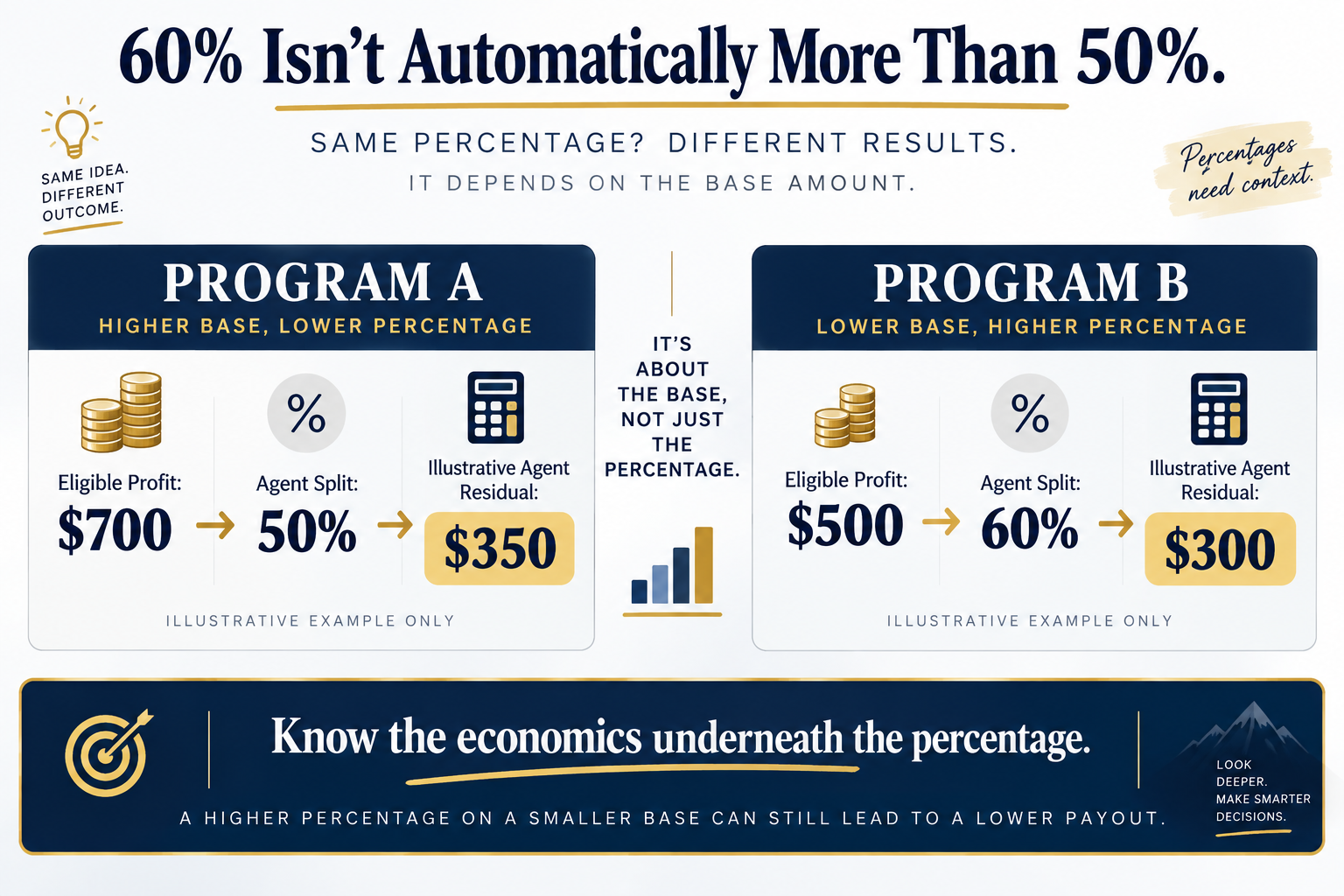
At first glance, 60% sounds automatically better.
But 60% of what?
Your residual percentage is applied to an underlying economic structure.
That's where the Schedule A becomes important.
Imagine Company A creates $700 of eligible monthly profit and pays you 50%:
$700 × 50% = $350
Company B creates $500 of eligible profit and pays you 60%:
$500 × 60% = $300
The larger percentage paid less.
That does not mean 50% is automatically better than 60%.
It means you cannot evaluate the percentage without understanding what it is applied to.
That's why I like a clean 50% arrangement when the underlying costs, support and residual rights are strong.
Learn the relationship between Merchant Services Residual Splits and your Merchant Services Schedule A before choosing a program.
Residual Rights May Matter More Than an Extra Few Percentage Points
Suppose you're going to spend ten years building merchants.
What matters more?
Receiving another five percentage points today?
Or knowing what happens to the portfolio if you eventually stop selling?
That's why vesting matters.
Termination matters.
Residual rights matter.
The agent agreement matters.
A 60% residual that disappears when you leave can potentially be much less valuable than a properly protected 50% residual relationship.
You should understand the questions to ask before signing a merchant-services agent agreement before committing significant production to any company.
The bigger the portfolio becomes, the more important the contract becomes.
Merchant Retention Is Part of Passive Income Too
This is one of the areas people don't think about when they hear the word passive.
Suppose a merchant is generating you recurring compensation.
Then they have a terrible support experience.
Nobody answers.
An equipment issue remains unresolved.
Funding becomes frustrating.
Eventually the merchant leaves.
Your future residual from that merchant can become zero.
That means support isn't just customer service.
For a residual-income salesperson, support protects the economic life of the account.
That's one reason I don't choose processing partners based entirely on who advertises the highest residual percentage.
A slightly lower percentage on merchants who stay can be more valuable than a larger percentage on merchants who constantly leave.
Can Merchant Services Produce Upfront Income Too?
Yes, depending on the program.
This is especially important for experienced salespeople because a residual portfolio can take time to develop.
You still need cash flow while you're building it.
Some merchant-services programs combine upfront compensation with continuing residual income.
One of the partners I work with can pay up to $10,000 upfront on certain qualified merchant accounts based on merchant profitability and program requirements.
That is not what every account pays.
It is not guaranteed income.
But it demonstrates an important point:
You don't necessarily have to choose between getting paid today and building for tomorrow.
Different programs can emphasize different combinations.
My article Upfront Commissions vs. Residual Income in Merchant Services explains how to think about that tradeoff.
Passive Income Sounds Better. Portfolio Income Is Better to Understand.
I could market this business by saying:
"Sell once and get paid forever."
That sounds fantastic.
It also leaves out most of the important details.
I would rather tell you:
Acquire merchants. Retain merchants. Understand your economics. Protect your contractual residual rights. Keep adding accounts. Build a portfolio.
That isn't as sexy as an Instagram passive-income ad.
But it is much closer to how the business actually works.
And if you're an experienced salesperson, it should actually be more attractive.
You don't need fantasy.
You already know how difficult customer acquisition is.
What you're looking for is a reason the difficult work might have a longer economic life.
The Difference Between a Job and a Book of Business
This is where I want experienced salespeople thinking longer term.
A job pays you for current production.
A book of business can potentially continue producing economics from relationships you've already developed.
That's why insurance professionals care about renewals.
Why advisors care about assets.
Why account-based recurring businesses care about retention.
And why merchant-services agents care about their portfolio.
Our upcoming article Sales Careers That Build a Book of Business Instead of Starting Over will compare this concept across industries.
The question isn't only:
How much can I earn this year?
Ask:
If I do this for ten years, what has my work built?
That's a much more interesting career question.
What if You Want to Start Part Time?
That's another advantage worth examining realistically.
You don't necessarily have to quit everything you're currently doing just to learn merchant services.
Some people may choose to learn the business and begin prospecting around an existing career.
A salesperson might dedicate specific hours to outbound calls.
A networker might begin through existing business relationships and referrals.
An entrepreneur may already be around potential merchants every week.
Someone may simply use part-time production to decide whether they actually like the industry before making a larger commitment.
That is the focus of Is Merchant Services a Good Side Hustle in 2026?.
The key is not confusing part-time with effort-free.
You still need activity.
You Can Build From Home Without Making It an "Easy Online Business"
Another reason people search for passive income is that they want location flexibility.
Merchant services can include a significant remote component.
Prospecting can happen over the phone.
Discovery can happen on Zoom.
Applications and documents can often be handled digitally.
Follow-up can be run from a CRM.
But that doesn't turn it into some magical "make money from your laptop" scheme.
You're still selling to real business owners.
You are simply using modern sales tools to do it.
If remote selling is already your strength, that's worth exploring rather than discarding your experience and trying to learn an entirely unrelated online business.
What If Your Existing Network Becomes Your Starting Point?
This is one of the biggest advantages experienced professionals underestimate.
You may already know dozens or hundreds of people who own businesses.
Maybe through your current sales career.
Networking groups.
Your gym.
Your church.
Professional organizations.
Previous customers.
Social circles.
Family relationships.
Local community involvement.
You don't automatically have dozens of sales.
But you may already have access that a brand-new salesperson would spend years trying to create.
Merchant services gives you a legitimate B2B service to discuss with that network.
And because businesses already need to accept payments, you aren't inventing an entirely new problem that has to be explained before you can sell the solution.
Merchant Services Is Not Right for Everyone
This is another reason I made the education free.
You should be able to evaluate the business without being financially trapped into liking it.
If you hate prospecting, don't want commission-based income, dislike B2B conversations and want someone else to provide all of your customers, merchant services may not fit you.
If you're looking for guaranteed effortless passive income, it definitely isn't the model I would recommend.
But if you're thinking:
"I'm already willing to sell. I'm just tired of all my income depending entirely on this month's sales."
Now we're talking.
That is exactly the salesperson who should understand residual-income models.
Don't Join the First Merchant Services Company That Recruits You
If you decide the business is interesting, don't immediately sign with the first company you find.
Education first.
Learn how processing works.
Understand compensation.
Understand Schedule A economics.
Understand vesting.
Read the agreement.
Learn what technology merchants need.
Then compare potential partners based on your goals.
I created How to Compare Merchant Services Companies Without Getting Sold for exactly this step.
And if you want the entire path from zero through building a portfolio, read How to Become a Merchant Services Agent in 2026.
Take a Peek Before You Make a Decision
This is the CTA I want to leave you with.
Not:
Join my company.
Not:
Quit your job.
Not:
Buy my course.
Just:
Take a peek.
Go to MerchantServiceUniversity.com.
Learn how merchant services works.
Learn what a residual is.
Learn what a Schedule A is.
Learn what agent agreements contain.
Learn how merchants are sold and supported.
Learn how the portfolio model works.
The core education is free.
There is no obligation to join one specific processing company.
If you're already skilled at in-person sales, phone sales, Zoom closing, networking or connecting with business owners, pay particular attention.
You may discover that you don't need to become a completely different entrepreneur.
You may simply need to apply what you already know to a business with longer-term economics.

Frequently Asked Questions About Merchant Services Passive Income
Can merchant services really create passive income?
Merchant services can create recurring residual compensation from active merchant accounts, but describing it as completely passive can be misleading. Agents must first acquire merchants, and continuing income depends on factors such as merchant activity, retention, program economics and contractual rights.
What is merchant services residual income?
Merchant-services residual income is recurring agent compensation associated with qualifying merchant accounts the agent previously acquired. The exact calculation and continuing rights depend on the processing program and agent agreement.
Is residual income better than passive income?
They describe different concepts. "Passive income" usually suggests limited ongoing effort, while residual income describes compensation continuing from previously acquired business. Residual income is generally the more accurate term for merchant-services agents.
How do payment-processing residuals work?
A merchant processes payments, and the processing relationship can generate eligible residual economics after applicable costs. The agent may receive an agreed share based on the terms of the agent program.
How much residual income can one merchant generate?
There is no universal amount. Residual compensation depends on factors such as merchant processing volume, transaction count, pricing, underlying costs, residual split and the specific agreement.
Do merchant-services residuals continue forever?
Not automatically. Merchants may close or leave, processing activity can change, and agent agreements can contain vesting and termination provisions affecting continuing residual compensation.
Is a 60% residual split better than 50%?
Not necessarily. A higher percentage can still result in a lower actual payout when the underlying costs leave less eligible profit to divide.
Can merchant-services agents receive upfront commissions and residual income?
Yes, depending on the program. Some agent programs combine upfront compensation with continuing residual economics.
Do experienced sales skills transfer into merchant services?
Yes. Experience in phone sales, outside sales, Zoom closing, discovery, networking, referrals and B2B relationship building can provide useful transferable skills. The salesperson still needs to learn the payments industry and execute consistently.
Can I sell merchant services part time?
Potentially. Some agents can learn and prospect part time, although results still depend on consistent sales activity, ability and merchant acquisition.
Can merchant services be sold from home?
Much of the prospecting, follow-up and merchant communication can potentially be handled remotely by phone, video meetings and digital systems, depending on the salesperson's approach and partner.
Is Merchant Service University free?
Yes. The core Merchant Service University education is free and does not obligate students to join one particular processing company.
Where should I learn more about merchant-services residual income?
Start with Merchant Service University, then review How Merchant Services Agents Get Paid, Merchant Services Residual Splits Explained, and What Lifetime Residuals Really Mean.
Final Takeaway: Don't Chase Passive. Build Recurring.
If you searched for merchant services passive income, here's what I want you to leave understanding:
Merchant services is not a shortcut around sales.
It's a way of thinking differently about what sales can build.
You still have to create the merchant.
You still have to prospect.
You still need to close.
You need a legitimate processing partner.
The merchant needs to remain active.
Your economics and agreement matter.
But once you've acquired the merchant, you don't necessarily have to resell the same account every month for it to continue contributing to your residual portfolio.
That's the opportunity.
If you're already a salesperson, that should get your attention.
Because maybe you're not actually trying to escape work.
Maybe you're trying to escape starting over.
Maybe you're tired of becoming great at selling something and watching all of the long-term customer value belong to somebody else.
Maybe you're tired of January 1 meaning zero again.
If that's you, stop looking exclusively for the easiest business.
Look for a business where the skills you've already earned can build something behind you.
Merchant services might be that vehicle.
It might not.
That's why I don't want you buying anything to find out.
Start with the free core education at MerchantServiceUniversity.com.
Take a peek.
Learn the industry.
Understand the residual model.
Then decide.
Passive income is the search phrase.
Residual income is the business model.
Portfolio building is the strategy.
About Joe Wagner
Joe Wagner has spent more than 16 years in merchant services and payment-processing sales, acquiring merchants, building recurring residual portfolios and developing sales organizations.
He created Merchant Service University after becoming frustrated with seeing people pay significant amounts for access to merchant-services opportunities without always receiving the depth of education they expected.
Joe invested his own time and resources into building a free core educational process because his business is centered on actually working within merchant services rather than relying on high-ticket course sales.
Joe also helps new and experienced salespeople understand how skills such as phone prospecting, in-person sales, Zoom closing, networking and existing business-owner relationships can transfer into the merchant-services industry.
Continue with Sales Jobs With Residual Income, Best Commission-Only Sales Jobs for Entrepreneurs, How to Build Recurring Income as a Salesperson, and How to Become a Merchant Services Agent in 2026.
Or take a peek at Merchant Service University.