Merchant Services Sales: 2026 Complete Beginner Guide
Merchant Services Sales: The Complete 2026 Beginner’s Guide to the Payments Industry
If you're researching merchant services sales, the industry can feel unnecessarily complicated at first.
You hear terms like ISO, processor, acquiring bank, merchant account, interchange, residuals, basis points, gateways and POS systems before anyone stops to explain what business you're actually getting into.
So let's start there.
Merchant services sales is the business of helping companies accept payments and use the technology connected to those payments. A merchant services agent may help a business choose payment processing, point-of-sale technology, online payment tools, invoicing, customer-management systems, financing tools and other commerce solutions.
Depending on the agent agreement, that salesperson may earn upfront commissions, recurring residual income or a combination of both.
That's the simple version.
The bigger opportunity is understanding what happens after the first account.
I've spent more than 16 years in this industry, and one of the biggest lessons I've learned is that people often get recruited before they understand the business they're being recruited into.
I think that order should be reversed.
You should understand the merchant services industry first.
Then understand how agents are compensated.
Then understand the companies, agreements and technology available to you.
Only then should you decide where and how you want to build.
This beginner's guide is designed to give you that foundation.
What Is Merchant Services Sales?
Merchant services sales is the process of helping businesses implement the systems they use to accept and manage customer payments.
Historically, that often meant selling a merchant account and a countertop credit card terminal.
Today, it can mean considerably more.
A business might need:
In-person credit and debit card acceptance
Mobile payments
Ecommerce processing
Invoicing
Recurring billing
Point-of-sale software
Inventory management
Appointment scheduling
Customer profiles
Loyalty programs
Marketing automation
Reporting and analytics
Employee-management tools
Faster access to funds
Business financing or capital
Integrations between online and physical locations
This is why I increasingly think of the industry as commerce technology, not simply credit card processing.
Payment processing remains at the center of the relationship, but many business owners now expect the payment system to interact with other parts of their operation.
That change matters for anyone considering merchant services sales.
The agent who only knows how to discuss rates is competing in a commodity business.
The agent who can understand the merchant's operation, identify problems and recommend useful technology can have a completely different conversation.
What Are Merchant Services?
"Merchant services" is a broad industry term for the products, financial relationships and technology businesses use to accept electronic payments.
When someone taps a card at a restaurant, enters a card online or pays through a digital wallet, there is considerably more happening behind the scenes than most consumers realize.
Modern card processing generally involves three major stages:
Authorization.
The customer's financial institution determines whether the transaction should be approved.
Clearing.
Transaction information is exchanged and reconciled between the parties involved.
Settlement.
Funds ultimately move through the system and are deposited according to the merchant's processing arrangement.
You don't need to become a payment engineer to sell merchant services.
You do need to understand the basic ecosystem well enough that you can explain it to a business owner.
How Does Credit Card Processing Actually Work?
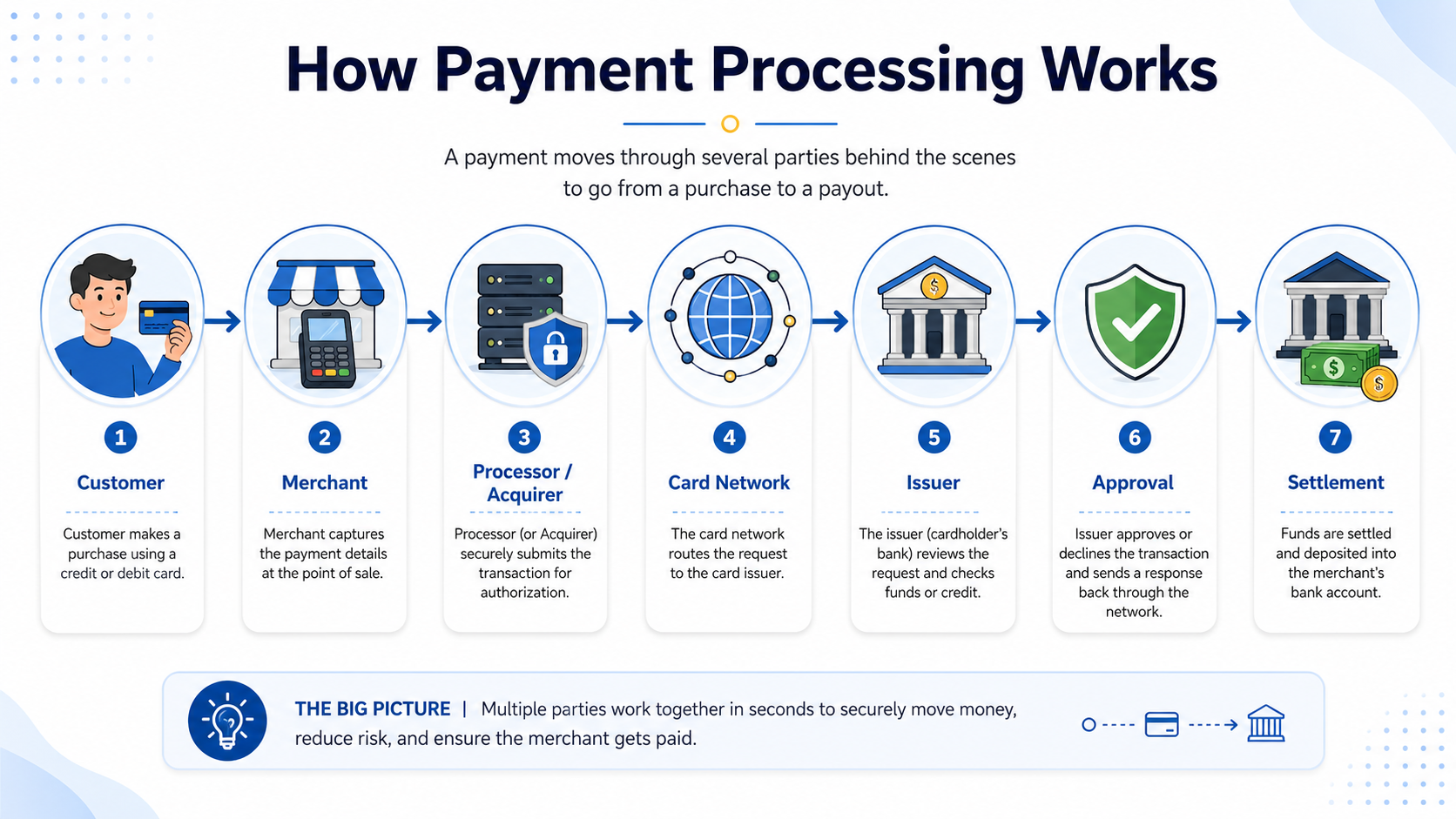
Let's use a simple example.
A customer walks into a local business and spends $100 using a credit card.
To the customer, the transaction appears almost instantaneous.
Behind the scenes, several parties may be involved.
1. The Customer
The customer, or cardholder, presents the payment method.
That might be a physical card, contactless card, digital wallet or payment credential entered online.
2. The Merchant
The merchant is the business accepting the payment.
3. The POS System or Payment Gateway
The payment information must first be captured.
In a physical business, that may happen through a terminal or POS system.
Online, a payment gateway can securely transmit transaction information from the checkout environment into the processing system.
4. The Payment Processor
The processor helps move transaction information through the payment ecosystem.
It communicates transaction information so authorization can occur and helps facilitate the eventual settlement process.
5. The Acquirer
The acquiring bank or merchant acquirer operates on the merchant side of the transaction.
Its role is different from the bank that issued the customer's card, although modern payment companies sometimes combine several functions.
6. The Card Network
The card network helps route the transaction between the acquiring side and the bank that issued the customer's card.
7. The Issuing Bank
The issuing bank is the financial institution that issued the customer's card.
It evaluates the authorization request and returns an approval or decline.
8. Authorization Comes Back
That response travels back through the system.
The merchant sees an approval or decline, often within seconds.
9. Clearing and Settlement Follow
Authorization is not the same thing as final settlement.
After authorized transactions are cleared and reconciled, funds ultimately move through the payment system and are deposited according to the merchant's settlement arrangement.
The specific flow can vary depending on the provider, payment type and technology being used, but this is the basic ecosystem.
Understanding this alone puts a new merchant services agent ahead of someone who only memorizes a pitch.
Where Does a Merchant Services Sales Agent Fit In?
This is the part that matters if you're considering the business.
A merchant services sales agent operates on the merchant-facing side of the industry.
You're the person helping the business determine what it actually needs.
That might involve reviewing an existing payment statement.
It could involve replacing an outdated terminal.
It could mean demonstrating a POS system.
It might mean helping a restaurant connect payments with ordering and inventory.
For a salon, it could involve appointments and customer management.
For a contractor, it might be mobile payments and invoicing.
For an ecommerce company, the conversation may center around online checkout.
The best merchant services sales agents don't begin with:
"What's your rate?"
They begin with:
"How does your business operate today, and where are the problems?"
That's a very different profession.
It moves you away from being someone selling credit card processing and toward becoming someone who understands business technology and payment infrastructure.
Merchant Services Sales Has Changed
When I entered the industry, much of merchant services sales revolved around three things:
Rates.
Contracts.
Terminals.
Those things still matter.
But they no longer represent the entire opportunity.
Business owners have become more dependent on technology.
Payments are increasingly connected to software.
The POS may now interact with the website, customer database, inventory, loyalty program, appointments, employee management, reporting and marketing.
That means the sales conversation has to evolve too.
I believe this is one of the biggest opportunities for new agents entering the industry today.
You don't have to unlearn 15 years of rate-based selling.
You can start by learning the modern version of the business.
What Does a Merchant Services Agent Actually Sell?
There isn't one universal product.
That's important to understand.
One merchant might need nothing more than a reliable standalone terminal.
And that's perfectly fine.
If you're talking with a small business that simply needs to accept cards, trying to force that merchant into a complicated POS platform may be terrible consulting.
Another business may have 15 employees, multiple locations, online ordering, inventory, loyalty customers and several disconnected software subscriptions.
That merchant has a completely different problem.
Your job is not to convince every business to buy the most advanced product available.
Your job is to understand the merchant well enough to determine the right solution.
That might include payment processing.
It might include a payment terminal.
It might include a full POS.
It might include business software.
It might include an integrated commerce platform.
The solution should follow the problem.
Not the other way around.
What Is an ISO in Merchant Services?
You'll encounter the term ISO constantly in this industry.
ISO stands for Independent Sales Organization.
In practical terms, an ISO often operates between payment infrastructure and the sales distribution network serving merchants.
Depending on the organization, an ISO may be responsible for areas such as:
Merchant acquisition
Sales
Support
Pricing
Risk coordination
Equipment
Software relationships
Agent management
A new salesperson will often work with an ISO or another payment-sales organization rather than trying to build payment infrastructure independently.
That's one reason choosing the right organization matters so much.
You're not simply choosing which product you can sell.
You may also be choosing:
Your compensation structure.
Your support.
Your technology.
Your training.
Your agreement.
Your residual rights.
Your pricing flexibility.
Your merchant-service experience.
And potentially the long-term value of the portfolio you build.
We'll break these issues down individually throughout this 21-day series.
Merchant Services Agent vs. ISO: What's the Difference?
At the beginner level, think of it this way:
The merchant services agent acquires and supports business relationships.
The ISO or payment organization provides the larger infrastructure through which those merchant relationships are boarded, processed, supported and compensated.
That is an oversimplification because organizations differ dramatically, but it's enough to begin understanding the structure.
An independent agent can sometimes build a significant book of business without becoming a registered ISO.
Other entrepreneurs eventually decide to build teams, negotiate more sophisticated relationships or move further up the payment-distribution structure.
Neither path is automatically better.
They're simply different business models.
How Do Merchant Services Sales Agents Make Money?
This is one of the biggest reasons people research merchant services sales.
Compensation varies significantly by company and agreement, but it commonly falls into several categories.
Upfront Compensation
Some programs pay agents when a new merchant account activates or reaches certain requirements.
These payments can help new agents create immediate cash flow while building their book.
Residual Income
Residual income is one of the primary reasons merchant services sales attracts entrepreneurs.
Instead of receiving only a one-time commission, an agent may receive an ongoing share of revenue generated by the accounts in their portfolio.
The exact calculation can vary dramatically.
That's why the phrase "70% residual split," for example, means very little until you understand:
70% of what?
We'll cover that later in this series.
Equipment or Software Compensation
Some programs may include compensation related to hardware, software subscriptions, implementation or other services.
Bonuses
Organizations may offer activation bonuses, production incentives or other temporary compensation programs.
The important thing for a beginner to understand is this:
Never evaluate a merchant services opportunity by one compensation number.
A large upfront bonus can come with a weaker residual structure.
A high advertised residual percentage can be based on an unattractive underlying Schedule A.
A great compensation plan can be paired with weak technology or poor support.
You have to evaluate the complete business model.
For a deeper breakdown of the income model, link here to your existing article on How Much Can You Earn in Merchant Services?
What Is Merchant Services Residual Income?
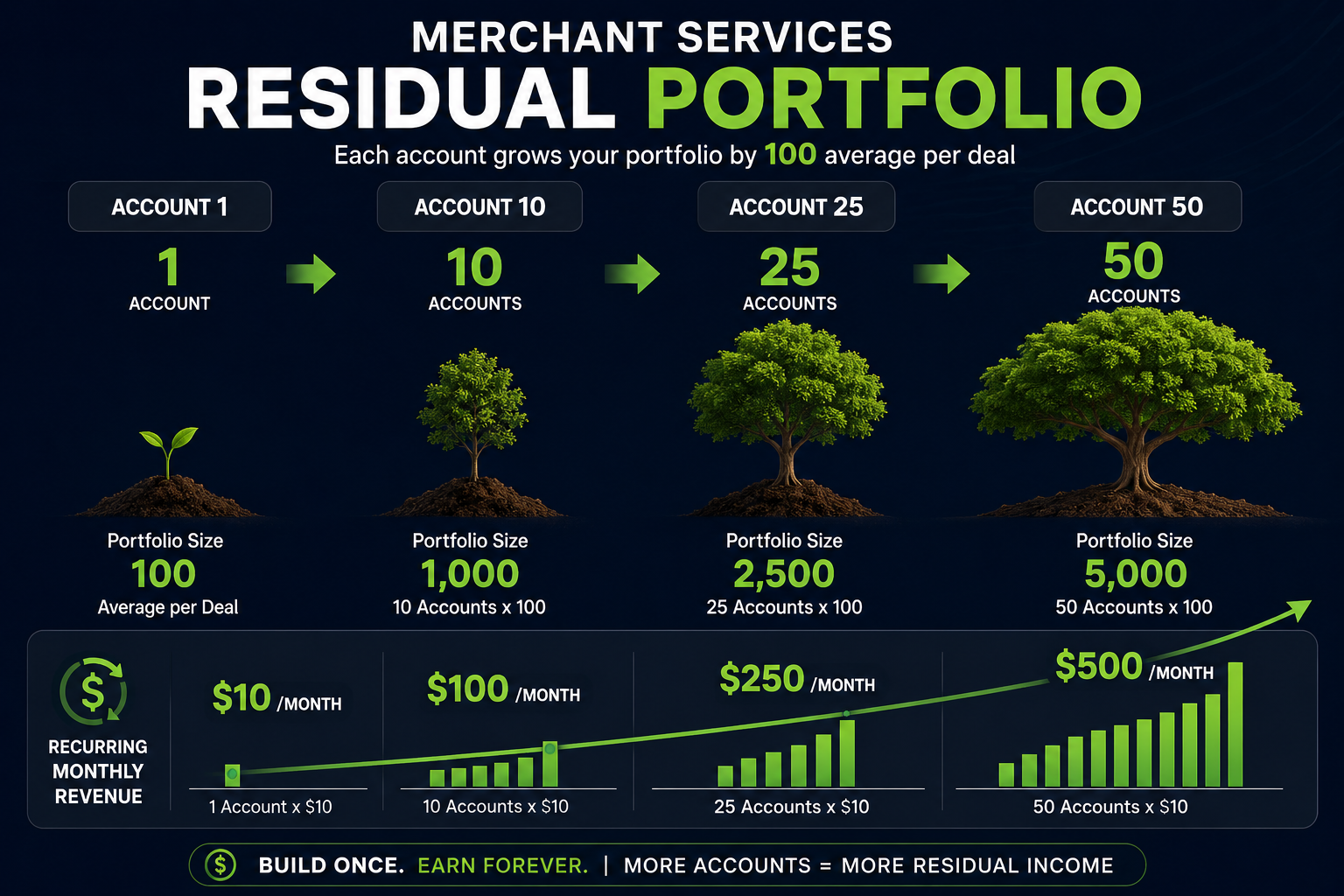
Residual income is recurring compensation generated by merchants that continue processing.
Imagine building a portfolio of 50 active businesses.
Those merchants continue accepting payments each month.
If your agent agreement entitles you to residual compensation from those accounts, the portfolio can continue producing income as long as the applicable accounts remain active and your contractual rights continue.
This creates a fundamentally different economic model than a traditional sales job.
In a traditional commission role:
Sell.
Get paid.
Start at zero again.
With residual-based merchant services sales:
Sell.
Get paid according to your compensation agreement.
Retain the merchant.
Add another merchant.
Repeat.
Over time, you can create a portfolio instead of simply creating individual commissions.
This does not make the income automatic.
Merchants close.
Accounts leave.
Processing volume changes.
Contracts matter.
Residual rights matter.
Service matters.
Retention matters.
But when built correctly, the underlying principle is extremely powerful:
Yesterday's sale can continue contributing to tomorrow's income.
Is Merchant Services Residual Income Really Passive Income?
I use the term passive income often, but it's important to define it correctly.
Merchant services residual income can eventually become relatively passive recurring income.
It is not magic money.
You have to acquire the accounts first.
You may need to support merchants.
You need partners capable of servicing them.
You have to manage attrition.
And if you're actively growing the portfolio, you're still working.
The passive component comes from the fact that an existing merchant can continue generating residual revenue without requiring you to resell that same account every month.
That's the leverage.
When I started, the early residual checks weren't impressive.
The point wasn't the first check.
The point was understanding what happened when you kept adding businesses month after month.
That's how a small residual becomes a portfolio.
What Skills Do You Need to Succeed in Merchant Services Sales?
You do not need to know everything about payments before speaking to your first merchant.
You do need to become competent.
The agents who last generally develop several important abilities.
Understanding the Industry
You should know the terminology, players, payment flow, common pricing models and basic economics.
Prospecting
This business requires conversations.
That might mean:
Walking into businesses
Calling businesses
Networking
Generating referrals
Working a specific vertical
Prospecting through digital channels
Combining several methods
Discovery
This is one of the most underrated skills in merchant sales.
Don't show up determined to sell a product before you've discovered whether the merchant has a problem that product solves.
Ask questions first.
What system do they use?
What do they like about it?
What frustrates them?
Where do they waste time?
What does their current technology not do?
What would make running the business easier?
Product Knowledge
You don't need to memorize every feature.
You should understand what problems your solutions solve.
Statement and Pricing Knowledge
Agents should eventually understand how to read merchant statements, recognize common pricing structures and explain costs accurately.
Follow-Up
A large percentage of merchants will not make a decision during the first conversation.
You need a system for staying in contact without becoming annoying.
Retention
The goal isn't merely to sign the account.
The goal is to keep good merchants.
If you're building a residual portfolio, retention is part of the sales strategy.
Why Payment Security Matters in Merchant Services Training
A beginner merchant services agent doesn't need to become a cybersecurity professional.
But payment security cannot be ignored.
PCI DSS establishes technical and operational requirements designed to protect payment account data.
That's another reason real merchant services training should go beyond teaching an opening pitch.
If you're advising businesses about payment systems, you should understand that security, equipment, compliance and implementation matter.
You're working around financial infrastructure.
Treat it accordingly.
Do You Need Experience to Start in Merchant Services Sales?
No.
You need education, coaching and activity.
Some excellent merchant-services professionals came from other sales industries.
Others began with no sales experience at all.
The advantage of starting today is that much more education is available than when many of us entered the business.
The disadvantage is that there is also considerably more noise.
That's why I recommend learning the fundamentals before choosing a company solely because someone recruited you first.
Start by understanding:
What the industry is
How merchants process payments
How agents get paid
What an ISO does
How residuals work
What an agent agreement controls
What a Schedule A is
What vesting means
What technologies different companies provide
Then evaluate the companies available to you.
That sequence gives you leverage.
Should You Pay Thousands of Dollars to Enter Merchant Services?
You should distinguish between paying for valuable education and paying simply to gain access to a payment-sales opportunity.
Those are not the same thing.
Good education can absolutely have value.
Coaching has value.
Sales training has value.
Specialized consulting has value.
But legitimate merchant-services companies have historically recruited independent salespeople because those companies make money when agents acquire productive merchant accounts.
You should not assume that paying thousands of dollars is a prerequisite for getting a processor to let you sell payment services.
Before paying anyone simply for "access" to the industry, ask exactly what you're purchasing.
Education?
Software?
Coaching?
Licensing?
Lead generation?
A franchise?
Or merely an introduction to a processor that already recruits agents?
Know the difference.
How Should a Beginner Start Learning Merchant Services?
Start in layers.
Don't try to learn the entire payment ecosystem in one weekend.
Step 1: Understand the Industry
Learn the major players and basic payment flow.
Step 2: Learn the Terminology
Understand processor, ISO, acquirer, issuer, gateway, POS, residual and Schedule A.
Step 3: Understand Merchant Problems
Learn why businesses actually change payment systems.
Step 4: Learn the Products
Understand terminals, POS systems, ecommerce, mobile payments, invoicing and integrated commerce technology.
Step 5: Learn Merchant Sales
Develop prospecting, discovery, presentation, objection-handling and closing skills.
Step 6: Learn Compensation
Understand upfront commissions, residuals, splits, Schedule A economics and bonuses.
Step 7: Understand Agreements
Learn vesting, ownership, minimums, clawbacks and termination provisions.
Step 8: Compare Potential Partners
Only after you understand what you're comparing should you choose where you want to build.
That's the education-first approach I'm going to spend the next several weeks teaching on this website.
If you're new, use the Merchant Sales Resources section and the Merchant Sales Training Blog as your starting library.
10 Merchant Services Terms Every Beginner Should Know
1. Merchant
The business accepting customer payments.
2. Processor
A company or service involved in facilitating electronic transactions through the necessary payment infrastructure.
3. Acquirer
The financial institution or acquiring entity operating on the merchant side of a card transaction.
4. Issuer
The financial institution that issued the customer's payment card.
5. Card Network
The network connecting the acquiring and issuing sides of a card transaction.
6. POS
Point of sale. The system through which a business records sales and, in many cases, accepts payments and manages additional business functions.
7. Gateway
Technology used to securely pass payment information, particularly in online and card-not-present environments.
8. ISO
Independent Sales Organization.
9. Residual
Recurring agent compensation tied to applicable merchant activity under an agent agreement.
10. Schedule A
The compensation or pricing schedule attached to many merchant-services agreements.
Understanding it is critical because an advertised residual percentage by itself does not tell you the complete economics of the relationship.
The Biggest Beginner Mistake: Choosing a Company Before Understanding the Industry
This is the mistake I want this entire content series to solve.
Someone hears about merchant services.
They're excited about residual income.
They talk to the first recruiter.
The recruiter explains one company.
They sign the agreement.
Only afterward do they begin learning what questions they should have asked.
That's backwards.
You should know the questions before you sign.
What are the residual terms?
Do residuals vest?
What happens if you leave?
What does the Schedule A look like?
Are there minimum production requirements?
Who owns the merchant relationship?
Are there clawbacks?
What products can you sell?
What support do merchants receive?
What support do agents receive?
What technology is available?
Can you build a team?
What happens to your portfolio if the relationship ends?
Those aren't advanced questions.
Those are questions everyone should learn to ask.
We'll address them throughout this series.
Where can I learn merchant services for free?
You can access the core education inside Merchant Service University at https://merchantserviceuniversity.com. The training is designed to help people understand merchant services, payment processing, residual income, sales and company evaluation before deciding where they want to build.
Merchant Services Sales in 2026: What Is the Opportunity?
I don't believe the future of merchant services sales is convincing every business owner to switch processors for a slightly lower rate.
That business will always exist.
There are plenty of merchants who only need simple payment acceptance and competitive pricing.
But the larger opportunity is evolving.
Payments are becoming one part of a broader business-technology ecosystem.
That means tomorrow's strong merchant-services professional needs to understand more than processing.
They need to understand businesses.
How do customers buy?
How does the business get paid?
Where does the business lose time?
What software is disconnected?
How do they market to existing customers?
How do employees interact with the system?
How does the owner access data?
What is happening online versus in-store?
What can be automated?
What can be simplified?
The better you become at diagnosing those problems, the less your career depends on being the cheapest processor in town.
That's a much better business to build.
Where Should You Go From Here?
If you're brand new to merchant services sales, don't rush to choose a company today.
Keep learning.
Read your existing How to Start a Payment Processing Business guide to understand the basic business model.
Then read How Much Can You Earn in Merchant Services? for a deeper explanation of compensation and recurring income.
Use the Merchant Sales Resources section to continue building your foundation.
And follow the Merchant Sales Training Blog as this series continues.
We're going to cover the subjects I believe every person should understand before choosing who they work with.
Education first.
Decision second.
Execution third.
Frequently Asked Questions About Merchant Services Sales
What is merchant services sales?
Merchant services sales is the business of helping companies accept electronic payments and implement related commerce technology. Agents may sell payment processing, POS systems, terminals, online payment tools, invoicing, software and other business solutions.
How do merchant services agents make money?
Merchant services agents may earn upfront commissions, activation bonuses, hardware or software compensation and recurring residual income. Exact compensation depends on the company, products and agent agreement.
What is residual income in merchant services?
Residual income is recurring compensation an agent may receive from active merchant accounts in their portfolio. The exact amount and duration depend on transaction activity, profitability and the terms of the agent agreement.
Do you need experience to sell merchant services?
No. Beginners can enter merchant services, but they should learn payment fundamentals, prospecting, discovery, pricing, statements, compliance basics, products and how agent agreements work.
What is an ISO in merchant services?
ISO stands for Independent Sales Organization. ISOs can perform merchant-acquisition, sales, support and payment-related functions and commonly work with independent sales agents.
Is merchant services sales the same as credit card processing sales?
Credit card processing sales is part of merchant services sales, but modern merchant services can include much more than card processing. Agents may also provide POS technology, ecommerce tools, invoicing, customer management, business software and other commerce solutions.
Is merchant services sales still a good opportunity in 2026?
There is still opportunity for skilled agents because businesses continue to require payment acceptance and increasingly rely on commerce technology. Success depends on sales ability, compensation, partner quality, merchant retention and consistent activity.
Should I choose a merchant services company before learning the industry?
I recommend learning the payment ecosystem, compensation structures, residual rights, agent agreements and technology first. Then compare companies using a consistent set of criteria.
Final Takeaway
Merchant services sales is much bigger than walking into businesses and asking to see a processing statement.
At its best, this is a business where you learn how commerce works, help companies solve real operational problems and build long-term relationships that can create recurring income.
But education needs to come before recruitment.
Understand the industry.
Understand the economics.
Understand the agreement.
Understand the technology.
Then choose where you want to build.
That's what this series is going to help you do.
About Joe Wagner
Joe Wagner has spent more than 16 years in the merchant services and payments industry, selling merchant accounts, building recurring-revenue portfolios and training sales professionals across the United States.
His focus today is helping entrepreneurs and sales professionals understand how the merchant-services industry actually works, how recurring payment portfolios are built, and how to evaluate the companies, technology and compensation structures available to them before making long-term partnership decisions.