
Is Merchant Services a Good Side Hustle?
Is Merchant Services a Good Side Hustle?
Yes, merchant services can be a good side hustle in 2026, especially for someone who already knows how to sell, network, prospect, or build relationships with business owners.
But I'm going to put an important condition on that answer.
If you're looking for something you can spend 30 minutes a week doing while money magically appears in your bank account, merchant services is probably not the side hustle you're looking for.
This is a real sales business.
You have to learn the industry.
You have to talk to business owners.
You have to create opportunities.
You have to follow up.
You have to close merchants.
And you need those merchants to activate and remain customers if you want to build recurring residual income.
What makes merchant services interesting as a part-time business is not that it eliminates the work.
It's that you may be able to start doing the work without immediately quitting your current job, spending tens of thousands of dollars on an opportunity, manufacturing a product, or building an entire company from scratch.
And if you already have experience in phone sales, outside sales, Zoom closing, networking, referrals, or B2B business development, you may already possess many of the skills that are hardest to teach.
The opportunity is to take those skills and begin aiming them at something that can potentially build behind you.
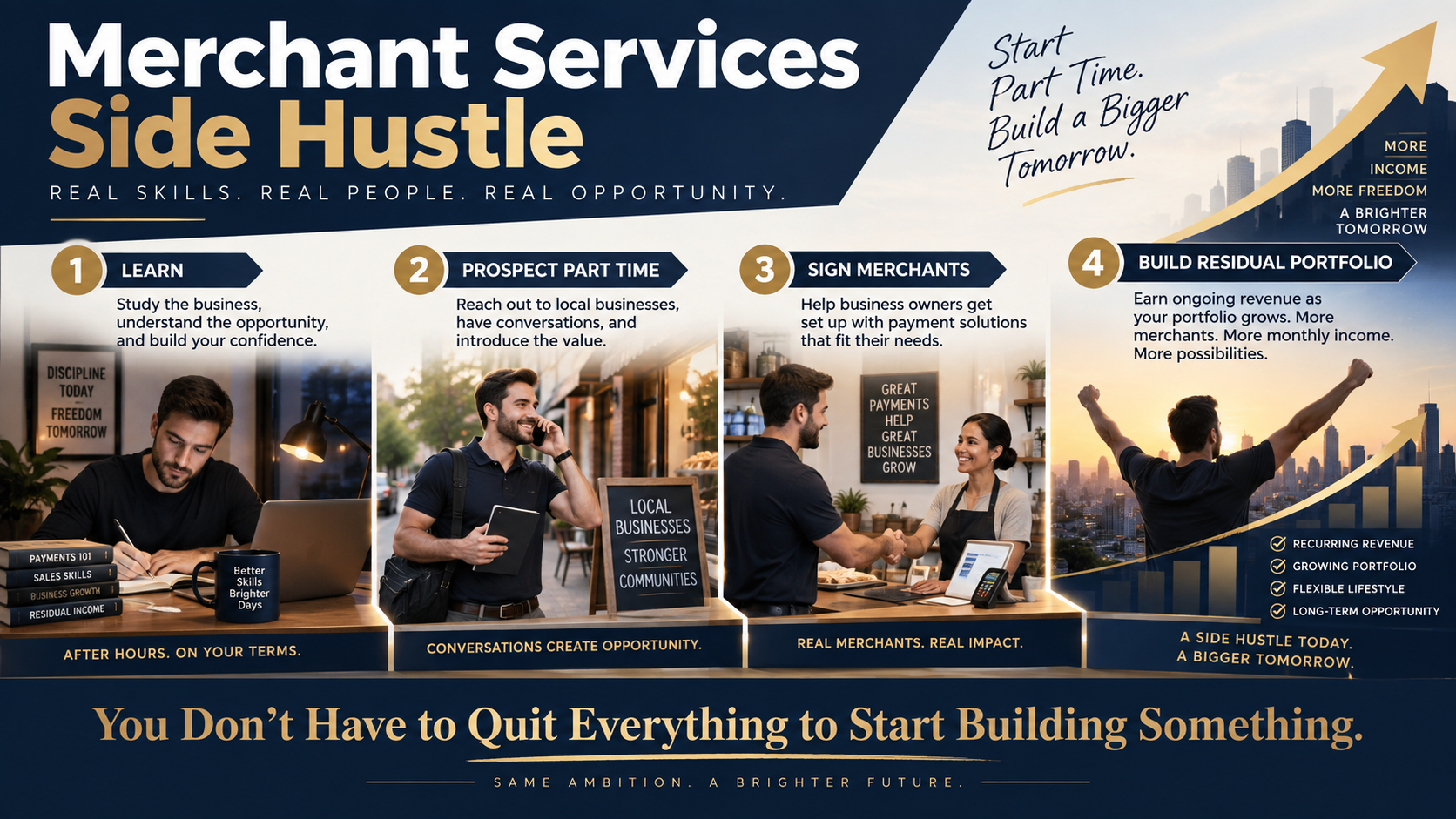
Why Merchant Services Can Work as a Side Hustle
A good side business needs to fit around the life you already have.
That doesn't necessarily mean every part of the work happens at night.
Merchant services is B2B sales, so many of the people you need to speak with are operating during normal business hours. You may occasionally need daytime appointments, calls, or merchant follow-up.
But a significant amount of the business can still be organized around an existing schedule.
You can build prospect lists after work.
You can prepare call lists early in the morning.
You can follow up digitally.
You can run certain appointments remotely.
You can attend business networking events.
You can build referral relationships.
You can talk to business owners already within your existing circle.
You can organize your CRM and pipeline at night.
And depending on your schedule, you can block specific windows during the week for actual prospecting and appointments.
That makes merchant services different from starting a business that immediately requires a storefront, employees, inventory, or full-time physical presence.
You can begin by learning the business and proving to yourself that you can generate merchant activity before making a larger career decision.
That's an important distinction.
Starting part time doesn't mean treating it casually.
It means starting intelligently.
Merchant Services May Be Especially Attractive if You're Already in Sales
This is the person I particularly want to reach with this article.
You're already working.
Maybe you're making decent money.
Maybe you're even making very good money.
But you're frustrated with the economics of what you're doing.
You have another great month.
Then the next month starts at zero.
Another quarter.
Reset.
Another year.
Reset.
You've built the sales ability, but you aren't necessarily building an asset behind the sales.
If that's your frustration, read Sales Jobs With Residual Income: Stop Starting at Zero Every Month.
Merchant services gives you another way to think about those same skills.
Instead of asking:
How do I find an entirely new career?
Ask:
How could I use the sales skills I already have to begin building something alongside my current career?
That's a much smaller leap.
Your Current Sales Experience Can Determine How You Start

There isn't one universal way to sell merchant services.
That's one of the reasons I think experienced salespeople should look at their current skill set before trying to copy somebody else's approach.
If You're Good on the Phone
Start there.
You've already learned one of the hardest sales disciplines: creating conversations with people who didn't ask to speak with you.
You understand lists.
Activity.
Voicemail.
Follow-up.
Appointment setting.
Rejection.
Pipeline.
You could build prospect lists outside your working hours and establish focused prospecting blocks when you're available to reach businesses.
You don't have to become a door-to-door salesperson just because somebody else built their merchant portfolio that way.
Use what you're already good at.
If You're an Outside or Door-to-Door Salesperson
You may have an even more direct transition.
Every local business becomes a potential conversation.
You already understand how to walk through a door.
You know how to read somebody quickly.
You know when to push forward and when to leave.
You understand territory.
And you already know rejection isn't fatal.
Learning the payments side gives those existing abilities a new product to represent.
If You Close Deals on Zoom
You already understand remote discovery and presentation.
You know how to ask questions.
Identify pain.
Present a solution.
Handle objections.
And ask for a decision.
Those skills don't disappear because the product changes.
You need to learn merchant services, pricing, processing, and technology, but you don't need to relearn the psychology of a sales conversation.
I'll go much deeper into this model in Can You Sell Merchant Services From Home? Phone, Zoom & Remote Sales Explained.
If Networking Is Your Strength
Then don't ignore your network and immediately start buying cold leads.
Who do you already know?
Which business groups are you part of?
Which entrepreneurs already trust you?
Which accountants, insurance agents, consultants, lenders, realtors, commercial professionals, or other business service providers are in your circle?
Those relationships can become referral channels.
If You Already Know Business Owners
Your first prospecting list may already be sitting in your phone.
Restaurant owners.
Contractors.
Salons.
Gyms.
Retailers.
Professional practices.
Consultants.
E-commerce businesses.
Local entrepreneurs.
You shouldn't spam every business owner you've ever met with a generic processing pitch.
But you should recognize that you've already spent years building access.
Learn enough about payments to become useful, then begin having legitimate business conversations.

You May Not Need to Quit Your Job to Find Out if You're Good at This
One of the worst pieces of entrepreneurial advice is that you have to immediately burn every bridge behind you to prove you're serious.
There are situations where going full time makes sense.
There are also situations where that's irresponsible.
If you have a career, family obligations, or financial commitments, why not first determine whether you actually enjoy the business and can generate merchant activity?
You can learn.
Get certified.
Choose a partner carefully.
Begin prospecting.
Create appointments.
Sign your first merchants.
Learn how onboarding works.
Experience the merchant-support process.
See whether you're willing to continue doing the work.
Then make a larger decision from experience instead of emotion.
That's very different from paying a huge upfront fee, quitting your job, and hoping the business-opportunity presentation was accurate.
What a Realistic Part-Time Merchant Services Schedule Can Look Like
The mistake would be approaching this with:
"I'll work on it whenever I get a chance."
That usually means you never get a chance.
A side business still needs scheduled activity.
For example, someone with a full-time job might use early mornings or evenings for prospect research, list building, CRM work, training, and follow-up preparation. They could block several concentrated prospecting windows during the week when business owners are reachable, schedule Zoom calls or local appointments around available time, and reserve another weekly block for follow-up and pipeline review.
Someone with more control over their daytime schedule could use a hybrid model: prospect by phone during specific days, schedule appointments into defined windows, and use networking or referral conversations around their existing professional schedule.
The exact calendar matters less than one principle:
Your side hustle needs dedicated selling time, not leftover time.
If you give merchant services whatever minutes remain after everything else in your life, don't be surprised when it produces leftover results.
Treat it like a business before expecting it to become one.
How Much Time Do You Need?
There isn't a magic number of hours that guarantees success.
I'd be suspicious of anybody telling you:
"Work exactly five hours a week and earn X dollars."
Sales doesn't work that way.
Someone with a strong business-owner network may create opportunities with fewer cold contacts than a person starting without relationships.
A highly experienced phone salesperson may create conversations faster than a beginner.
Someone who has never prospected before may need substantially more activity while learning.
The better question is:
Can you consistently create enough activity to generate merchant conversations?
Five disciplined hours can be more useful than fifteen distracted hours.
But one random hour every third Saturday is not a business model.
Consistency matters.
Is Merchant Services Really a Side Hustle if You Have to Sell?
Absolutely.
The phrase side hustle doesn't mean effortless.
A side hustle is simply income-generating work or business activity pursued alongside your primary occupation.
In fact, the IRS specifically includes people operating a business part time or doing gig work within its general description of self-employment. It also notes that self-employed individuals may have income-tax and self-employment-tax obligations, including estimated-tax requirements depending on their circumstances.
So if your merchant-services activity begins generating income, treat it like legitimate business income.
Keep records.
Understand your expenses.
Talk with a qualified tax professional about your particular situation.
Being part time doesn't make the money pretend.
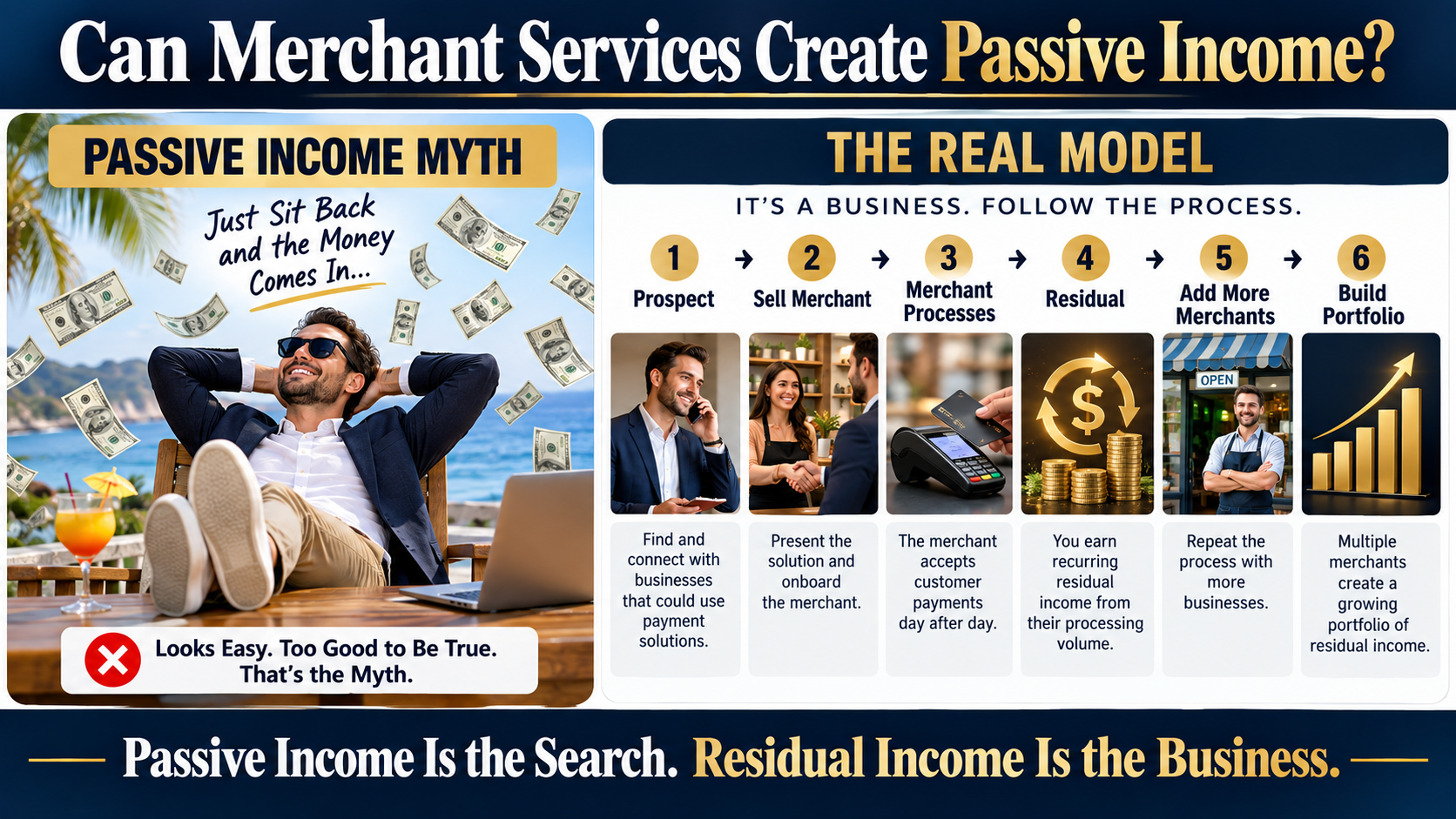
What Merchant Services Can Offer That Many Side Hustles Don't
There are thousands of ways to generate extra income.
Driving.
Freelancing.
Reselling.
Consulting.
Affiliate marketing.
Content creation.
E-commerce.
Local services.
There's nothing inherently wrong with any of them.
But the question I care about is:
What happens to the work after you've done it?
If you drive for four hours tonight, you get paid for those four hours.
Then tomorrow begins.
If you complete a one-time freelance project, you get paid.
Then you need another project.
Merchant services can potentially create different economics.
A merchant acquired this month can continue processing next month.
If your compensation arrangement includes residual participation and the merchant remains active, that previous sale may continue contributing to your portfolio while you acquire another.
That's why I don't think the biggest appeal is simply:
"Make some extra money on the side."
The stronger idea is:
Start building something on the side that may eventually become meaningful enough to change your options.
Read Can Merchant Services Create Passive Income? How Residual Income Really Works for the full explanation of why I prefer the phrase residual income over effortless passive income.
The Goal Doesn't Have to Be Quitting Your Job
This is important.
Not everybody needs to build merchant services into a full-time career.
Maybe you love your primary career.
Maybe you have benefits you want to keep.
Maybe you simply want another income stream.
Maybe you want to build a portfolio slowly.
Maybe you want an entrepreneurial outlet.
Maybe you want to eventually create options but have no interest in forcing a timeline.
That's fine.
Your business should serve your goals.
Not mine.
But there is also another possibility.
Maybe merchant services begins as a side hustle.
You sign a few merchants.
Then more.
You learn the business.
Your residual base grows.
Your confidence grows.
Your network expands.
At some point, you may decide the economics justify allocating more time to it.
That's a much healthier transition than pretending you know on Day 1 what the business will become.
Why Merchant Services Can Be Different From the "Easy Online Business" Cycle
This is where many side-hustle seekers get stuck.
They're not actually looking for a business.
They're looking for a promise.
This year it's one model.
Next year it's another.
The pitch usually sounds familiar:
Minimal work.
Work anywhere.
No experience.
No selling.
Automated.
Passive.
Done for you.
And then they discover that real customer acquisition somehow still has to happen.
I've never wanted Merchant Service University positioned that way.
Merchant services isn't exciting because it removes work.
It's exciting because the work can potentially build recurring economics.
If you've already failed at several supposedly easy businesses, maybe the answer isn't finding an even easier one.
Maybe it's choosing a business where you understand exactly what your job is.
In merchant services, your job as an agent is not mysterious.
Learn the product.
Find merchants.
Understand their needs.
Present appropriate solutions.
Close accounts.
Help get them activated.
Support the relationship.
Build the portfolio.
That's a real business.
Our Online Business Ideas in 2026: Stop Buying the Dream and Evaluate the Business Model article will go much further into this issue.
Startup Costs Are Another Reason It Can Work Part Time
One major hurdle with a side business is having to invest significant capital before knowing whether you'll succeed.
Merchant-services sales can be structured differently.
As an agent working through an established partner, you don't need to build a payment processor.
You don't need to manufacture terminals.
You don't need to create underwriting departments.
You don't need to build banking relationships from scratch.
You don't need to immediately become a registered ISO.
The upstream organization provides the infrastructure.
You focus heavily on sales and relationships.
Normal business expenses can still exist, but entering as an agent is fundamentally different from financing an entire processing company.
That's why I included merchant services prominently in Low-Cost Business Ideas for Salespeople Who Already Know How to Sell.
You can also read Can You Start Selling Merchant Services for Free? for a more detailed explanation of what "low cost" should and should not mean.
Take a Peek at Merchant Service University Before You Build Your Schedule Around It
Before you decide how many hours you're going to work, first understand what you'd actually be doing.
That's why I recommend starting with Merchant Service University.
The core training is free.
You can begin learning without quitting your job and without committing to one processing company.
You'll learn the payment-processing basics, pricing, statements, agent compensation, residuals, agreements, merchant technology, prospecting, sales, retention, and portfolio building.
The goal isn't to hype you into starting.
The goal is the opposite.
Get educated before you get recruited.
If you take a peek at MSU and decide merchant services isn't for you, you learned something without buying an expensive dream.
If it does make sense, then you can take the next step from an informed position.
Your Network Can Be the Best Part-Time Prospecting Strategy
For somebody balancing another career, warm relationships can be especially valuable because prospecting time is limited.
Look at the entrepreneurs already around you.
Not only as potential merchants, but as potential referral partners.
An accountant knows businesses.
A commercial insurance agent knows businesses.
A payroll representative knows businesses.
A realtor may know investors and business owners.
A business consultant knows businesses.
Existing merchants know other merchants.
A strong network can multiply your reach.
One of the most useful principles in merchant sales is that referrals become increasingly important as your portfolio grows.
The point isn't to eliminate prospecting.
It's to build multiple prospecting channels.
You Should Still Learn How to Prospect Cold
Don't use your network as an excuse to avoid sales activity.
Your circle eventually runs out.
And you don't want your business completely dependent on friends doing you favors.
A legitimate merchant-services business should eventually be able to create opportunities beyond your personal contacts.
That might happen through:
Phone prospecting.
Local merchant visits.
Networking.
Referral partnerships.
Previous merchant referrals.
Digital outreach.
Industry specialization.
Or a combination.
Your goal is to create a repeatable process.
That's what turns a few side deals into a business.
Can You Build Merchant Services Completely From Home?
A substantial amount of the business can potentially be conducted remotely.
Prospect research.
Calling.
Follow-up.
CRM management.
Video appointments.
Documents.
Applications.
Training.
Pipeline management.
Referral conversations.
But I wouldn't promise that you'll never leave your house.
Some merchants prefer in-person meetings.
Certain local opportunities are easier to win face to face.
Some salespeople are simply much better in person.
That's why I prefer thinking about this as a flexible sales business rather than forcing it into the phrase "100% remote."
Our dedicated guide, Can You Sell Merchant Services From Home?, will compare phone, Zoom, local, networking, and hybrid models in detail.
And Home-Based Business Ideas for Salespeople and Experienced Closers will compare merchant services with other businesses that can be operated substantially from a home office.
Do You Need Experience?
No.
But experience can help.
Someone completely new to sales can learn.
Merchant Service University is built to teach foundational concepts to beginners.
But if you've already spent years selling, don't ignore the advantage you've earned.
You may already understand:
How activity creates pipeline.
Why follow-up matters.
How objections work.
How to qualify.
How to ask questions.
How to present.
How to close.
How to lose a deal and keep moving.
How to manage yourself without somebody looking over your shoulder.
Those are huge advantages in an independent sales business.
You may still be a beginner in payments.
You aren't necessarily a beginner in sales.
That's a very different starting point.
Can a Side Hustle Build Residual Income?
Potentially, yes.
The number of hours you work doesn't inherently determine whether an acquired merchant can produce residual compensation.
What matters is the merchant relationship, processing activity, program economics, retention, and your agreement.
If you sign a qualifying merchant while working part time and that account remains active under a compensation program that pays you residuals, the account can potentially contribute recurring compensation just like an account acquired by someone working full time.
The difference is pace.
A full-time producer with significant prospecting activity may build a portfolio faster than someone dedicating only a few weekly hours.
That's common sense.
Part time isn't a shortcut.
It's a lower-risk way to begin.
Don't Confuse Residual Income With Guaranteed Lifetime Income
If somebody recruits you into merchant services and tells you:
"You'll get paid forever."
Ask to see the agreement.
Merchants leave.
Businesses close.
Volume changes.
Pricing changes.
Contracts matter.
Vesting matters.
Termination provisions matter.
This is why What Do Lifetime Residuals Really Mean in Merchant Services? is required reading before you build a business around that phrase.
The larger your eventual portfolio becomes, the more important those contractual rights become.
Choose Your Partner Carefully Even if This Is "Just a Side Hustle"
Don't make a bad long-term agreement because you're only testing the industry.
The first ten merchants you sign part time could someday be part of a much larger portfolio.
Treat those accounts like they matter from the beginning.
Understand:
The residual economics.
The Schedule A.
Vesting.
Merchant support.
Technology.
Upfront commissions.
Clawbacks.
Portfolio rights.
What happens if you stop producing.
What happens if you leave.
Use How to Choose a Merchant Services Agent Program before signing with a company, and review Merchant Services Contract Red Flags before assuming all agent agreements are interchangeable.
What About Upfront Commissions?
This is especially relevant for someone starting part time.
Residuals take time to accumulate.
Depending on the agent program, merchant-services compensation can also include upfront commissions.
Some partners emphasize upfront cash more heavily.
Others emphasize residual economics.
Some may offer a combination.
One partner relationship I work with can pay up to $10,000 upfront on certain qualified merchant deals based on profitability and program requirements.
That does not mean every merchant pays $10,000.
It is not a guaranteed commission.
I mention it because part-time salespeople should understand that merchant-services compensation isn't necessarily one-dimensional.
You can learn more in Upfront Commissions vs. Residual Income in Merchant Services.
The right model depends on what you need.
If you're keeping your primary income while building, perhaps you're comfortable prioritizing residuals more heavily.
Someone leaving a current sales career may care more about immediate cash flow.
There isn't one answer for everyone.
Should You Tell Your Employer?
That's something you need to evaluate based on your particular employment relationship.
Before starting any outside business, review your existing employment agreement and company policies.
Some employers have policies concerning outside employment, conflicts of interest, use of company resources, customer solicitation, confidential information, or competing businesses.
Don't assume because you're doing the work at night that your existing contractual obligations disappear.
And never use an employer's confidential customer information or company resources as your personal prospecting system.
Build your business cleanly.
If you have questions about contractual restrictions, get appropriate legal advice for your situation.
Treat the Tax Side Like a Business Too
If you generate self-employment income, don't wait until tax season to discover that side-business income has tax consequences.
The IRS states that someone can be considered self-employed even when the business is part time, and self-employed individuals generally have filing and tax obligations based on their circumstances. Estimated taxes can also apply because this income typically isn't subject to employer withholding.
Keep clean records from the beginning.
Track legitimate business income and expenses.
Separate business finances where appropriate.
Talk with a tax professional when you need personalized advice.
The fact that something began as a side hustle doesn't mean you should run it like a hobby.
What Would the First 90 Days Actually Be About?
Not getting rich.
Building competence.
The first phase should be education.
Understand payment processing.
Understand the major industry players.
Learn pricing.
Learn residuals.
Learn your partner's products.
Understand the agreement.
The second phase should be activity.
Build your first prospect list.
Start calling.
Start networking.
Have merchant conversations.
Practice discovery.
Learn what business owners actually care about.
Then begin signing and onboarding accounts.
Your early merchants teach you things no course can fully replicate.
What underwriting asks for.
Where installations get delayed.
What merchants misunderstand.
What objections are real.
Why support matters.
How your compensation actually shows up.
That experience is what turns theoretical knowledge into a business.
When Should You Consider Going Full Time?
There is no universal merchant count or residual amount that tells everybody when to leave a job.
Your personal finances matter.
Your obligations matter.
Your current salary matters.
Your risk tolerance matters.
Your merchant pipeline matters.
Your savings matter.
And your performance matters.
I'd rather see someone make that decision based on evidence.
You've shown you can consistently create opportunities.
You've signed merchants.
You understand the business.
You've built a pipeline.
You've seen your residual reports.
You have financial runway.
Now you're deciding whether more time would create significantly more opportunity.
That's a business decision.
Not a motivational speech.
What if You Never Want to Go Full Time?
Then don't.
There is nothing wrong with building a supplemental merchant portfolio.
The goal isn't for everybody to quit their job.
The goal is to create choices.
Maybe your portfolio pays for travel.
Maybe it accelerates debt repayment.
Maybe you invest the residual income.
Maybe it becomes another retirement-income component.
Maybe it eventually grows much larger.
Maybe you simply enjoy having another business.
Actual outcomes will depend on your production, merchant economics, retention, agreement terms, expenses, and many other variables.
The point is that you decide what you're trying to build.
Is Merchant Services Better Than Other Side Hustles?
Not universally.
If you hate selling, probably not.
If you want immediate guaranteed hourly income, gig work may fit you better.
If you possess a highly monetizable technical skill, freelancing may make more sense.
If you already have a consulting audience, consulting may be easier to launch.
If you've built an e-commerce skill set, another model may fit you better.
Merchant services becomes especially interesting when you combine several characteristics:
You're good at sales.
You're comfortable with performance-based income.
You know business owners.
You want relatively low startup overhead.
You're interested in B2B.
You want recurring-income potential.
And you'd rather build a portfolio than repeatedly restart from zero.
If that's you, the fit becomes much stronger.
Our guide to Best Commission-Only Sales Jobs for Entrepreneurs Who Want Recurring Income compares merchant services with several other sales-driven careers.
Don't Build Another Side Hustle That You Secretly Hate
This is something people overlook.
They choose an opportunity based solely on potential money.
Then discover they hate the actual daily work.
Don't do that.
If you despise talking to business owners, you're probably not going to enjoy merchant services.
If you hate prospecting, an independent sales business is going to become frustrating.
If rejection ruins your week, you're going to have to develop that skill.
But if you're already a salesperson?
This is exactly why your existing experience matters.
You aren't evaluating whether you like selling.
You've already answered that.
You're evaluating whether this product, this customer, and this compensation model are a better fit for the skills you already possess.
That's a much easier question to answer.
Take a Peek Before Calling It Your Next Side Hustle
If this sounds interesting, I don't want your next move to be:
"Where do I sign?"
Your next move should be:
"Let me understand the business."
Go to MerchantServiceUniversity.com.
The core education is free.
Learn the industry.
Learn processing.
Learn pricing.
Understand residual income.
Understand agreements.
Learn the technologies merchants use.
Learn prospecting.
Learn how the portfolio model works.
Get foundationally certified.
Then decide whether you want to take the next step.
If you do, I can help you understand different partner options based on what you're trying to build rather than automatically pushing everybody toward the same company.
Learn first. Get certified. Then decide what you want to build.

Frequently Asked Questions About Merchant Services as a Side Hustle
Is merchant services a good side hustle?
Merchant services can be a good side business for someone comfortable with selling, prospecting, networking, or developing business relationships. It is not guaranteed or effortless income, and results depend on sales activity, merchant acquisition, retention, partner economics, and agreement terms.
Can you sell merchant services part time?
Yes, merchant-services sales can potentially be pursued part time depending on the agent program and the salesperson's schedule. Prospecting, networking, remote meetings, follow-up, and administrative work can be organized around an existing career, although access to business owners may sometimes require daytime availability.
Can merchant services generate residual income if I only work part time?
A qualifying active merchant can potentially generate residual compensation based on the program economics and agent agreement regardless of whether the salesperson works full or part time. Working fewer hours may affect how quickly the salesperson acquires merchants and grows the portfolio.
Can I sell merchant services from home?
A substantial amount of prospecting, follow-up, CRM work, video meetings, training, and paperwork can potentially be performed remotely. Some merchants and sales strategies may still benefit from in-person meetings.
Do I need merchant-services experience?
No previous payments experience is necessarily required to begin learning. However, prospective agents should understand payment processing, pricing, compensation, technology, agreements, and merchant needs before attempting to represent the industry professionally.
Does previous sales experience help?
Yes. Experience in outbound phone sales, door-to-door selling, Zoom closing, networking, referrals, B2B sales, and relationship development can provide valuable transferable skills. Sales experience does not guarantee merchant-services success.
Can I start by selling to business owners I already know?
Existing business relationships can provide an initial source of conversations and referrals. The goal should be to identify legitimate merchant needs rather than aggressively pitching every person in your network.
Do I have to quit my job to become a merchant-services agent?
No. Some people may choose to learn and begin prospecting while maintaining other employment. Review your current employment agreement and company policies for outside-employment or conflict-of-interest restrictions.
Is merchant-services income passive?
Residual income is a more accurate description. Agents must first acquire merchants, and continued compensation depends on merchant activity, retention, program economics, and contractual rights.
How much does it cost to start selling merchant services?
Costs vary, but working as an independent agent through an established merchant-services company is different from building an entire payment processor. Large infrastructure or inventory investments are not inherently required simply to begin as an agent.
Do I need to pay thousands for merchant-services training?
No. The core Merchant Service University training is free and is designed to help students understand the industry before committing to a processing partner.
Can I receive upfront commissions while building residual income?
Depending on the merchant-services program, compensation can include upfront commissions, recurring residual income, or a combination of both.
Do part-time merchant-services agents have tax obligations?
Part-time business activity can still constitute self-employment for federal tax purposes. Tax obligations depend on individual circumstances, and self-employed people may need to account for income tax, self-employment tax, and estimated tax payments.
Where should I start?
Begin with the free education at Merchant Service University. From there, learn the business, complete the foundational certification, define your goals, and evaluate potential processing partners before committing your production.
Final Takeaway: Start Part Time. Think Long Term.
I like merchant services as a potential side hustle for one primary reason.
You can start small without being forced to think small.
You can keep your current career.
Learn the business.
Build your first prospect list.
Make calls.
Attend networking events.
Talk to people already in your circle.
Run a Zoom appointment.
Walk into a local business.
Sign your first merchant.
Then another.
Learn how the business actually works.
You're not required to wake up tomorrow and declare yourself a full-time payments entrepreneur.
But you should think long term from the first merchant you sign.
Because that first account might be insignificant by itself.
So might the second.
The third.
The tenth.
But the entire premise of portfolio building is that you don't evaluate every merchant only by what it produces today.
You evaluate what consistent production can build over time.
That's very different from the traditional side-hustle mindset of:
Work an extra hour. Get paid for an extra hour. Start over tomorrow.
If you're already willing to work, sell, call, network, close, and build relationships, I don't think you necessarily need another easy side hustle.
You may need a business where those existing abilities can begin creating something behind you.
Maybe merchant services becomes a small additional income stream.
Maybe it eventually becomes much more.
You don't need to know that today.
You just need to decide whether it's worth understanding.
Go to MerchantServiceUniversity.com.
Take a peek at the free core training.
Learn how the business works.
Then decide whether the sales skills you've already spent years building deserve another vehicle.
About Joe Wagner
Joe Wagner has spent more than 16 years in merchant services and payment-processing sales, acquiring merchants, developing sales organizations, and building recurring residual portfolios.
He created Merchant Service University to give both beginners and experienced salespeople a way to learn the payments industry before paying for access or committing their production to one processing company.
Joe's educational approach emphasizes learning the business first, understanding compensation and contractual rights, applying existing sales skills, and building a long-term merchant portfolio rather than chasing one commission at a time.
Continue with Sales Jobs With Residual Income, Merchant Services Passive Income, Low-Cost Business Ideas for Salespeople, Can You Sell Merchant Services From Home?, How to Build Recurring Income as a Salesperson, or How to Become a Merchant Services Agent in 2026.
Or start with the free education at Merchant Service University.