Merchant Services vs. Online Business Models: Which Is Best for Salespeople?
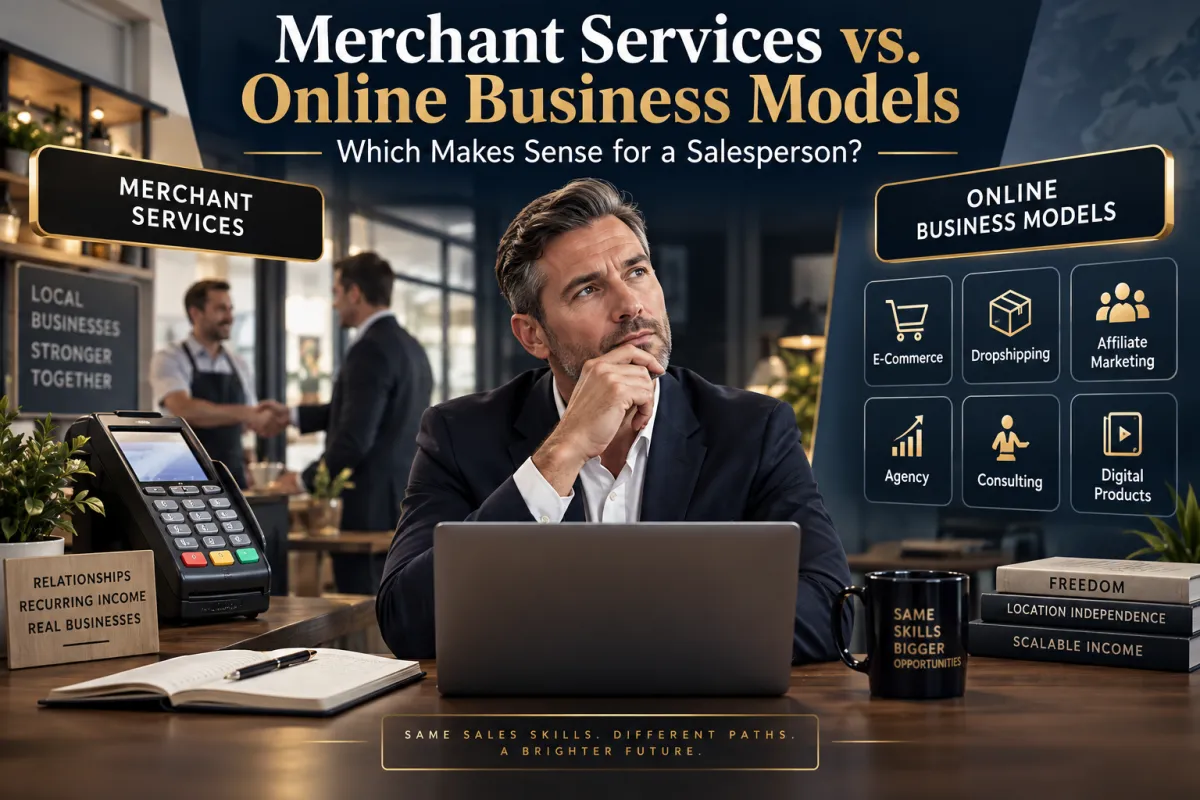
Merchant Services vs. Online Business Models: Which Makes Sense for a Salesperson?
If you're trying to find the best online business model, I think one of the first things you should stop doing is asking which business is easiest.
That's the question that gets people into trouble.
A business can look incredibly easy from the outside because you haven't yet experienced the part that makes it difficult. Dropshipping looks simple until you have to acquire customers profitably. Affiliate marketing looks simple until you realize you need traffic. A digital product looks attractive until you have to build an audience that trusts you enough to buy it. An agency seems straightforward until ten clients expect you to produce results every month.
Merchant services has its own challenges. You need to learn the payments industry, prospect businesses, handle rejection, close merchants, choose a strong processing partner, and retain the relationships you acquire. It isn't a shortcut around selling.
But for someone who already knows how to sell, that's exactly why merchant services becomes interesting.
You may not need another business model that requires you to spend several years learning an entirely new competitive advantage. You may need a business where the advantage you've already spent years building becomes immediately useful.
I've spent more than 16 years in merchant services, so I'm obviously closer to this business than the other models we're going to compare. I'm not going to pretend otherwise. My goal here isn't to declare merchant services the universal winner.
I want to compare the models based on what actually matters to an experienced salesperson: startup capital, customer acquisition, technical complexity, fulfillment, recurring revenue, platform dependency, sales-skill transfer, and what years of work can potentially build.
Then you can decide for yourself.
The Best Business Model Depends on Who Is Starting It
This is the biggest problem with generic lists of the "best businesses to start."
They treat every entrepreneur as though they're beginning with the same skills, relationships, experience, and resources.
They aren't.
A software engineer may have a huge advantage building a SaaS product. Someone with a million social-media followers may have an obvious advantage in affiliate marketing or digital products. A person with strong supply-chain knowledge may understand e-commerce in a way that I don't.
An experienced salesperson has a different advantage.
You know how to create customers.
That's not a small advantage. Customer acquisition is one of the core problems almost every business eventually has to solve. If you already know how to prospect, run discovery, follow up, build relationships, handle objections, and close, your business decision should reflect that.
This is why I keep coming back to a simple question throughout this cluster:
Why would you intentionally choose a business where the skills you've spent years developing matter less?
Maybe there is a good reason.
But you should at least ask.
How I'm Comparing These Business Models
Instead of comparing lifestyle photos or theoretical income ceilings, I want to use practical categories.
Startup Capital
How much financial commitment is typically needed before you can meaningfully test whether you can acquire a customer?
Sales-Skill Transfer
Does previous experience in phone sales, door-to-door selling, Zoom closing, networking, referrals, or B2B sales provide an obvious advantage?
Customer Acquisition
What is required to consistently generate buyers? Direct prospecting, content, advertising, search traffic, referrals, marketplaces, or some combination?
Inventory and Fulfillment
Do you need to purchase, manufacture, store, ship, or personally deliver something?
Recurring-Revenue Potential
Can existing customers continue creating revenue or compensation after the original transaction?
Platform Dependency
How dependent is the business on search engines, social-media platforms, marketplaces, ad networks, or another company's algorithm?
Technical and Operational Complexity
How much do you need to learn outside the core act of selling?
Long-Term Value
After five or ten years of successful execution, what might you actually have built?
Those are much more useful questions than:
"Which business can make me the most money?"
Almost every legitimate model has people who make a lot of money and people who make very little.
The business model matters.
So does the person operating it.
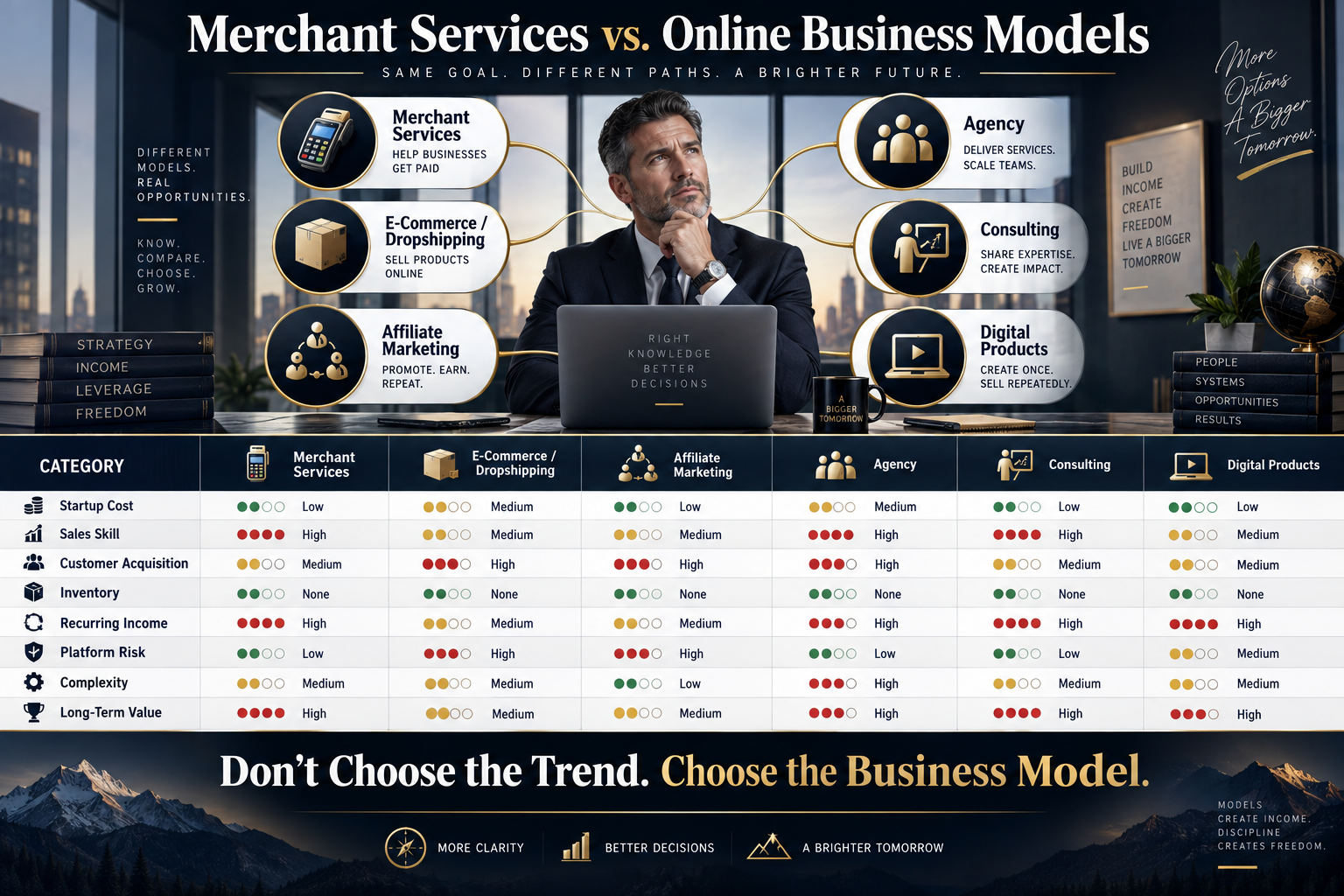
Quick Comparison: Merchant Services vs. Popular Online Business Models
Here is the high-level comparison before we break each model down.
Business Model | Startup Capital | Existing Sales Skills | Inventory | Recurring Revenue Potential | Platform Dependency | Fulfillment Complexity | Book/Asset Potential |
|---|---|---|---|---|---|---|---|
Merchant Services | Generally low through established partner | High | No traditional inventory required | Strong potential through residuals | Relatively low | Moderate; partner handles major backend functions | Merchant portfolio |
Dropshipping / E-Commerce | Low to potentially substantial | Moderate | Supplier/product dependent | Usually purchase-driven unless subscription/repeat model | Often high | Moderate to high | Brand, customer list, store |
Affiliate Marketing | Potentially low | Moderate | None | Can repeat, but usually depends on ongoing traffic/conversions | Often high | Low product fulfillment | Audience, content, traffic assets |
Agency | Often low to moderate | High | None | Strong potential through retainers | Moderate | High if you deliver service | Client base, systems, team |
Consulting | Often low | High | None | Possible through retainers | Low to moderate | Usually tied to expertise/time | Reputation, client book, IP |
Digital Products / Courses | Often low to moderate | Moderate to high | No physical inventory | Potentially strong | Often moderate to high | Front-loaded creation + marketing | Audience, IP, product library |
SaaS | Can be substantial unless reselling | High for sales side | None | Strong underlying recurring revenue | Usually lower than marketplace models | Potentially very high if building product | Software, subscribers, enterprise value |
This table isn't intended to rank the models from best to worst.
It shows why fit matters.
For a strong salesperson who doesn't want to manufacture a product or become a technical founder, certain models immediately begin looking different.
Merchant Services: Use Sales Skill to Build a Merchant Portfolio
Let's start with merchant services because it's the model I know firsthand.
Businesses need ways to accept payments. As a merchant-services agent, you can work through an established processing organization that already provides much of the infrastructure required to deliver that service.
Depending on the partner, that infrastructure can include processing relationships, underwriting, merchant applications, hardware programs, software, reporting, deployment, and support.
Your focus is heavily concentrated on customer acquisition and merchant relationships.
That is one reason I believe merchant services fits experienced salespeople so well.
You don't need to become a payment-network engineer before you can sell.
You need to understand the industry well enough to represent it professionally, then use the sales abilities you've already developed.
Startup Capital
Merchant services can generally be entered much more leanly as an independent agent than by trying to create an entire payment-processing company yourself.
You do not need a warehouse full of products simply to begin prospecting.
You can learn more in Can You Start Selling Merchant Services for Free? and Businesses You Can Start With Little Money and No Inventory.
Customer Acquisition
This is a sales business.
Phone.
Door to door.
Zoom.
Networking.
Referrals.
Existing business relationships.
You need to create conversations with business owners.
For someone who already knows how to do that, this is an advantage rather than a downside.
Recurring Income
Depending on the agent agreement and account economics, active merchant accounts can potentially create recurring residual compensation.
This is where merchant services differs significantly from many transactional businesses.
You're potentially building a merchant portfolio rather than relying only on the next transaction.
Platform Dependency
You aren't completely free of third-party dependencies because your processing relationships and partner infrastructure obviously matter. But your entire customer-acquisition system doesn't necessarily have to depend on one social platform, marketplace, or advertising account.
You can build direct business relationships.
That matters to me.
Long-Term Value
The potential long-term value is the portfolio of merchant relationships and associated contractual residual rights you've built.
Those rights depend on your agreement, which is why I repeatedly tell agents to understand lifetime residuals, Schedule A economics, and their agent agreement before committing serious production.
Dropshipping and E-Commerce: A Real Business With Real Operational Demands
Dropshipping became attractive because it appeared to solve one of the traditional problems of e-commerce: carrying inventory.
Instead of warehousing products yourself, a supplier can fulfill orders after customers purchase.
That can reduce the capital required for inventory.
But it doesn't eliminate the other parts of e-commerce.
You still need products people want.
You still need traffic.
You still need acceptable margins.
You need suppliers you can trust.
You need customer service.
Returns still happen.
Advertising can become expensive.
Competition can drive prices down.
And the customer experience still reflects on your brand even when someone else ships the product.
Does Sales Experience Help?
Yes, but perhaps not as directly as it does in a B2B outbound model.
Traditional closing skills can help with offer development, persuasion, landing pages, partnerships, and certain higher-ticket e-commerce models, but many consumer e-commerce businesses rely more heavily on advertising, creative, merchandising, conversion rates, and traffic acquisition than direct one-to-one sales conversations.
If your greatest skill is talking to business owners, you may have to develop an entirely new customer-acquisition discipline.
Can It Build an Asset?
Absolutely.
A successful e-commerce company can build a brand, customer database, repeat buyers, intellectual property, supplier relationships, and potentially substantial enterprise value.
I would never dismiss e-commerce as a legitimate business.
I simply wouldn't tell an experienced salesperson it's automatically the best use of their strongest skill.
Affiliate Marketing: Low Inventory, but Distribution Is Everything
Affiliate marketing is one of the simplest business models to explain.
You promote another company's product or service and receive compensation when qualifying customers purchase through your referral.
You don't need to manufacture the product.
You don't fulfill the product.
You may not handle customer support.
That can make it extremely attractive from an operational standpoint.
But something still has to create the customer.
Traffic becomes the business.
SEO.
YouTube.
Social media.
Email.
Paid ads.
Content.
Communities.
Partnerships.
If you have no audience and no distribution, you have very little affiliate business.
Where an Experienced Salesperson May Struggle
A great one-on-one salesperson may assume persuasion is persuasion.
It isn't always that simple.
Selling through content at scale can require a very different skill set from speaking directly with a decision-maker.
You may need to learn content creation, search optimization, analytics, audience development, copywriting, or paid media.
Some salespeople become fantastic at these things.
But again, you're adding new competencies.
Long-Term Value
The asset is often the distribution engine: website traffic, email subscribers, content, search rankings, social audience, or a trusted brand.
That can become extremely valuable.
It can also create platform exposure if a large portion of the business depends on one search algorithm, social platform, or affiliate program.
Agency Business: Great Fit for Salespeople, but Fulfillment Matters
I think agencies can be one of the strongest businesses for salespeople because acquiring clients is usually one of the most difficult parts of building an agency.
If you're great at prospecting and closing, you've already solved a major problem.
A specialized agency might provide websites, paid advertising, content, lead generation, CRM implementation, automation, video, bookkeeping, SEO, or another business service.
You can often start from home.
You don't need physical inventory.
You can potentially structure recurring monthly retainers.
There is a lot to like.
Where Agencies Become Difficult
Fulfillment.
It's easy for a strong salesperson to sell faster than the company can deliver.
If you sign fifteen businesses but the service isn't producing results, you haven't created recurring revenue.
You've created fifteen potential cancellations.
So the salesperson who chooses an agency business needs either genuine fulfillment expertise or a partner/team capable of consistently delivering the promised service.
This is one of the places merchant services can be attractive by comparison: an established payment partner handles a substantial portion of the backend product delivery while the agent focuses heavily on acquisition and relationships.
Consulting: Very Low Overhead if Your Expertise Is Valuable
Consulting can be an outstanding business for experienced professionals.
You take something you understand deeply and help another person or company solve the problem faster.
There may be very little physical overhead.
A laptop, phone, video meetings, professional systems, and the appropriate business structure may be enough to begin.
Sales ability helps tremendously because expertise doesn't automatically create customers.
The Limitation
Consulting can become highly dependent on your personal time.
If every dollar requires another hour of your direct involvement, you've built valuable self-employment but not necessarily recurring leverage.
You can create retainers, group programs, intellectual property, training, or a team to change those economics.
But that becomes another layer of business building.
Again, not bad.
Just different.
Digital Products and Courses: Excellent Margins if You Have Distribution
Digital products solve many problems associated with physical products.
There is no warehouse.
No shipping.
No physical inventory.
You can build something once and potentially sell it repeatedly.
That is an attractive model.
But the phrase "build once, sell forever" leaves out the hardest part.
Who is buying it?
If you already have an audience, email list, authority in a niche, strong search traffic, or a reliable paid-acquisition system, digital products can be incredibly powerful.
If nobody knows you exist, the product can sit online forever without generating meaningful sales.
Why I Don't Attack Paid Education
There are excellent coaches, trainers, educators, and consultants who have earned the right to charge for their expertise.
I believe specialized education can be extremely valuable.
My concern is when the primary product becomes selling people the dream of the underlying business rather than giving them useful skills from someone who genuinely knows how to execute that business.
That's one reason I built Merchant Service University differently.
My livelihood already comes from working in merchant services.
I don't need somebody to pay thousands of dollars simply to find out what merchant services is.
SaaS: Powerful Economics, but Building Software Is a Different Business
Software-as-a-service can be one of the most attractive recurring-revenue business models because customers pay monthly or annually to continue using the product.
But there's an important distinction between selling SaaS and building SaaS.
If you're joining an existing software company as a salesperson, your sales skills can transfer extremely well.
If you're trying to create the SaaS company yourself, the challenge becomes much larger.
Now you may need product development.
Engineering.
Security.
Hosting.
Customer support.
Product management.
Integrations.
Ongoing development.
Technical talent.
That can become capital and operationally intensive even though there is no traditional physical inventory.
Another Important Question
The software company may have recurring revenue.
Do you receive recurring compensation?
Not always.
This is the same distinction we covered in How to Build Recurring Income as a Salesperson Without Starting Over Every Month.
If recurring income is your goal, you need to understand your compensation rather than simply admiring the company's subscription economics.
Why Merchant Services Can Be a Strong Middle Ground
This is one of the reasons merchant services continues to stand out to me.
You can sell a technology-driven business service without becoming the person responsible for building all of the technology.
You can participate in a recurring-revenue industry without necessarily creating the subscription infrastructure yourself.
You can build from a home office without your entire customer-acquisition strategy depending on an audience or social platform.
You can potentially begin with relatively low traditional overhead.
You can use direct-response sales abilities you've already developed.
And you can potentially build residual compensation through a portfolio of active merchant relationships.
That combination is unusually well suited to certain salespeople.
Notice I said certain salespeople.
If you hate prospecting, it may not be you.
If you don't enjoy B2B conversations, it may not be you.
If you'd rather build products than relationships, another model may fit better.
But if you already know how to sell, merchant services can allow you to start with your strongest ability rather than developing an entirely new one first.
What About Platform Dependency?
This is an area people don't think about enough when choosing an online business.
Suppose nearly all your revenue comes from one marketplace.
What happens if your account is suspended?
Suppose nearly all your traffic comes from one search engine.
What happens if rankings fall?
Suppose you're completely dependent on one advertising account.
What happens if advertising costs rise or your account becomes restricted?
Suppose your entire audience exists on one social platform.
What happens when reach changes?
This doesn't mean you should avoid platforms.
Platforms are incredibly powerful.
I use them too.
The better lesson is to understand where your business is vulnerable.
One thing I like about direct B2B selling is that a merchant relationship is a direct relationship.
You can acquire businesses through your phone, in-person prospecting, referrals, professional networks, content, email, or multiple channels instead of allowing one algorithm to become your entire business.
That diversification has value.
Merchant Services Has Dependencies Too
I don't want to make the comparison unfair.
Merchant-services agents are also dependent on other organizations.
Your processor matters.
Your ISO matters.
Your sponsor and backend infrastructure matter.
Your technology matters.
Underwriting matters.
Merchant support matters.
Your agent agreement matters.
That's why partner selection becomes so important.
The difference is that you can consciously evaluate those dependencies rather than pretending they don't exist.
Before choosing an organization, read How to Compare Merchant Services Companies Without Getting Sold and How to Choose a Merchant Services Agent Program.
Fulfillment Is One of the Biggest Differences Between These Models
This is another area experienced salespeople should think about carefully.
You may be great at acquiring customers.
But what happens after they buy?
If you own an agency, you or your team needs to perform the work.
If you're consulting, you probably deliver much of the expertise.
If you're selling digital products, you created the product and may be responsible for support and updates.
If you're running e-commerce, fulfillment, shipping, product quality, and customer service still exist somewhere in the chain.
With merchant services, a large portion of the ongoing infrastructure is handled by the processing partner.
That doesn't mean the agent gets to disappear.
Your relationship still matters.
Merchant retention matters.
You may need to help navigate issues.
But you aren't personally moving every payment transaction through the card networks.
That leverage matters to someone whose highest-value activity is acquiring business.
What if You Want to Work From Home?
Several models in this article can operate from home.
Affiliate marketing.
Consulting.
Digital products.
Agencies.
Software.
And merchant services.
The difference is what you actually do from the home office.
In merchant services, you can research businesses, make calls, run Zoom meetings, manage a CRM, handle follow-up, build referral relationships, and complete large portions of the sales process remotely.
You can also meet merchants face to face whenever doing so adds value.
That's why I describe it as a flexible B2B business rather than forcing it into a "100% remote" promise.
Read Can You Sell Merchant Services From Home? for the complete remote and hybrid model.
What if You Can Only Start Part Time?
Then merchant services can potentially be explored alongside another career, depending on your schedule and contractual obligations.
You can begin learning before making a career decision. You can build prospect lists, work your existing network, use defined prospecting windows, attend networking events, and run remote or local appointments around your existing responsibilities.
That doesn't make it effortless.
Businesses still operate during business hours. You still need consistent activity. Merchant onboarding and follow-up still need attention.
But you don't necessarily have to quit your job tomorrow to discover whether you're good at it.
That's why I wrote Is Merchant Services a Good Side Hustle in 2026?.
What if You Have Very Little Startup Capital?
This is another area where merchant services can compare favorably with product-heavy businesses.
Operating as an agent through an established provider is fundamentally different from trying to create the payment processor yourself.
You can leverage the existing infrastructure.
That doesn't mean no business expenses will ever exist, but it can significantly reduce the capital required simply to test whether you can acquire merchants.
This is exactly why our previous article focused on Businesses You Can Start With Little Money and No Inventory.
Low startup cost isn't valuable because it makes the work easier.
It is valuable because it lets you put more attention toward proving customer demand before taking on major expenses.
Which Model Is Best for Phone Salespeople?
If you've spent years working a headset, I would pay particular attention to models where direct outbound activity is valuable.
Merchant services can fit extremely well.
So can recruiting.
Certain SaaS roles.
Telecom.
Appointment-setting businesses.
Outsourced sales.
Some consulting services.
Affiliate marketing and e-commerce can certainly be successful, but your existing skill may provide less immediate advantage because customer acquisition is often driven more heavily through media, search, content, or advertising.
The more direct the customer-acquisition process, the more immediately valuable your phone-sales experience may become.
Which Model Is Best for Zoom Closers?
A strong Zoom closer has several good options.
Consulting is an obvious fit.
High-ticket services.
SaaS.
Agencies.
Remote B2B sales.
And merchant services.
You've already developed discovery skills.
You can identify pain.
You understand decision-making.
You know how to present.
You understand objections.
You know how to ask for the sale.
Don't throw those years away just because another business claims you can make money without speaking to customers.
Which Model Is Best for Networkers?
If relationships are your greatest strength, I would favor businesses where business owners and professional relationships are directly valuable.
Merchant services.
Insurance.
Consulting.
Recruiting.
Business finance.
Professional services.
Referral partnerships.
Real estate.
These models reward access and trust.
Your network may be much less valuable to a random e-commerce product than it is to a B2B service where the people you already know are the actual target customer.
Which Model Is Best for Someone Who Wants Recurring Income?
Now we're getting closer to the economic question.
Several models can create recurring revenue.
A subscription software business can.
An agency can.
Consulting retainers can.
Certain affiliate programs can.
Memberships can.
Insurance renewals can.
Merchant services can.
But you need to distinguish between the business receiving recurring revenue and you personally participating in recurring compensation.
Merchant services can potentially allow the independent agent to receive residual compensation tied to active merchant accounts according to the program's economics and agreement.
That's what creates the portfolio model.
If that is your specific priority, read How to Build Recurring Income as a Salesperson and Sales Careers That Build a Book of Business.
What About Immediate Income?
Recurring income is powerful, but you still need cash flow.
This is why I don't automatically favor residual compensation over upfront commissions.
Depending on the merchant-services program, compensation can include upfront commissions, residuals, or a combination.
One partner relationship I work with can pay up to $10,000 upfront on certain qualified merchant accounts based on profitability and program requirements. That doesn't mean every merchant generates that amount, and no individual commission is guaranteed.
I mention it because salespeople comparing merchant services with high-ticket businesses should understand that merchant-services economics do not necessarily consist of waiting years for residuals to matter.
Different programs emphasize different combinations.
I've covered that more fully in Upfront Commissions vs. Residual Income in Merchant Services.
Merchant Services Doesn't Automatically Win on Every Category
I want this article to be useful, so let's be clear about where other models can be better.
If you already have a massive audience, digital products or affiliate marketing may offer substantially more leverage than starting a local B2B sales operation.
If you're a gifted developer with an original software idea, building SaaS could have much greater enterprise-value potential.
If you're a world-class consultant with highly specialized expertise, consulting may allow you to command far higher revenue per customer than a typical merchant account.
If you love branding, products, and consumer marketing, e-commerce might be much more enjoyable.
If your dream is building a media brand, merchant services may simply not be the right vehicle.
There is no reason to force yourself into the payments industry because the business checks certain boxes.
Fit matters.
Where I Think Merchant Services Wins for the Right Salesperson
The profile becomes very specific.
You already know how to sell.
You'd rather speak with real decision-makers than spend years hoping content generates traffic.
You understand B2B.
You're comfortable with variable income.
You want relatively low traditional startup overhead.
You don't want to manufacture or warehouse a product.
You want the flexibility to work by phone, Zoom, referrals, networking, and in person.
You want access to recurring-income potential.
You like the idea of building a book of business.
You already know business owners.
And you're willing to learn a real industry rather than looking for a push-button opportunity.
If several of those things describe you, I think merchant services becomes one of the strongest business models worth evaluating.
Not because it's easier than everything else.
Because it may be better aligned with the person you've already spent years becoming.

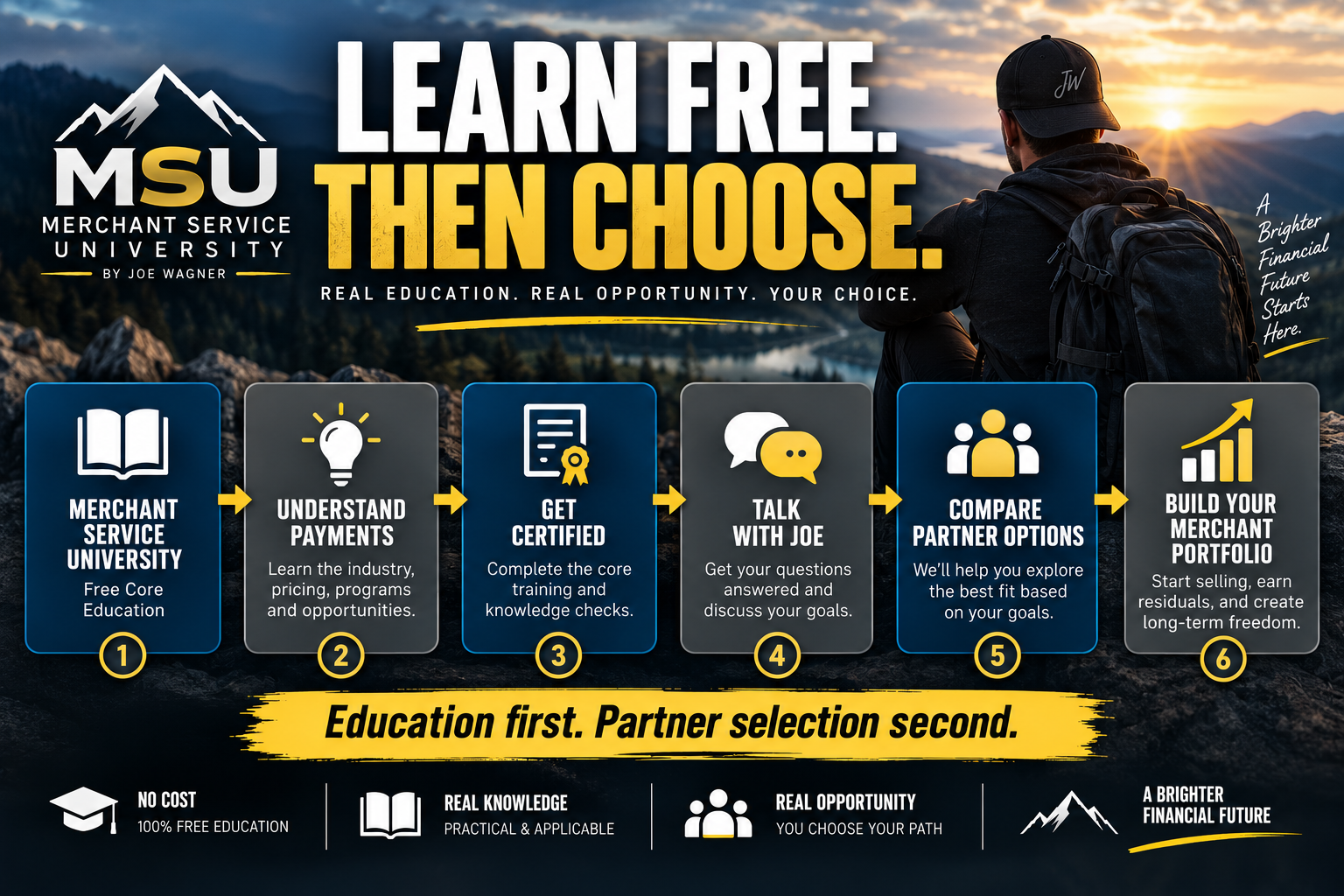
This Is Why I Don't Want You Choosing a Merchant Services Company Yet
If merchant services looks attractive after reading this comparison, don't immediately search for the company promising the highest residual split or biggest commission.
First understand the business.
You need to know how payment processing works.
Understand merchant pricing.
Understand residuals.
Understand Schedule A economics.
Understand vesting and agreements.
Learn what merchant technology actually does.
Understand the difference between promises and contractual rights.
Then compare companies.
That's the philosophy behind How to Learn Merchant Services Before You Choose a Company.
Get educated before you get recruited.
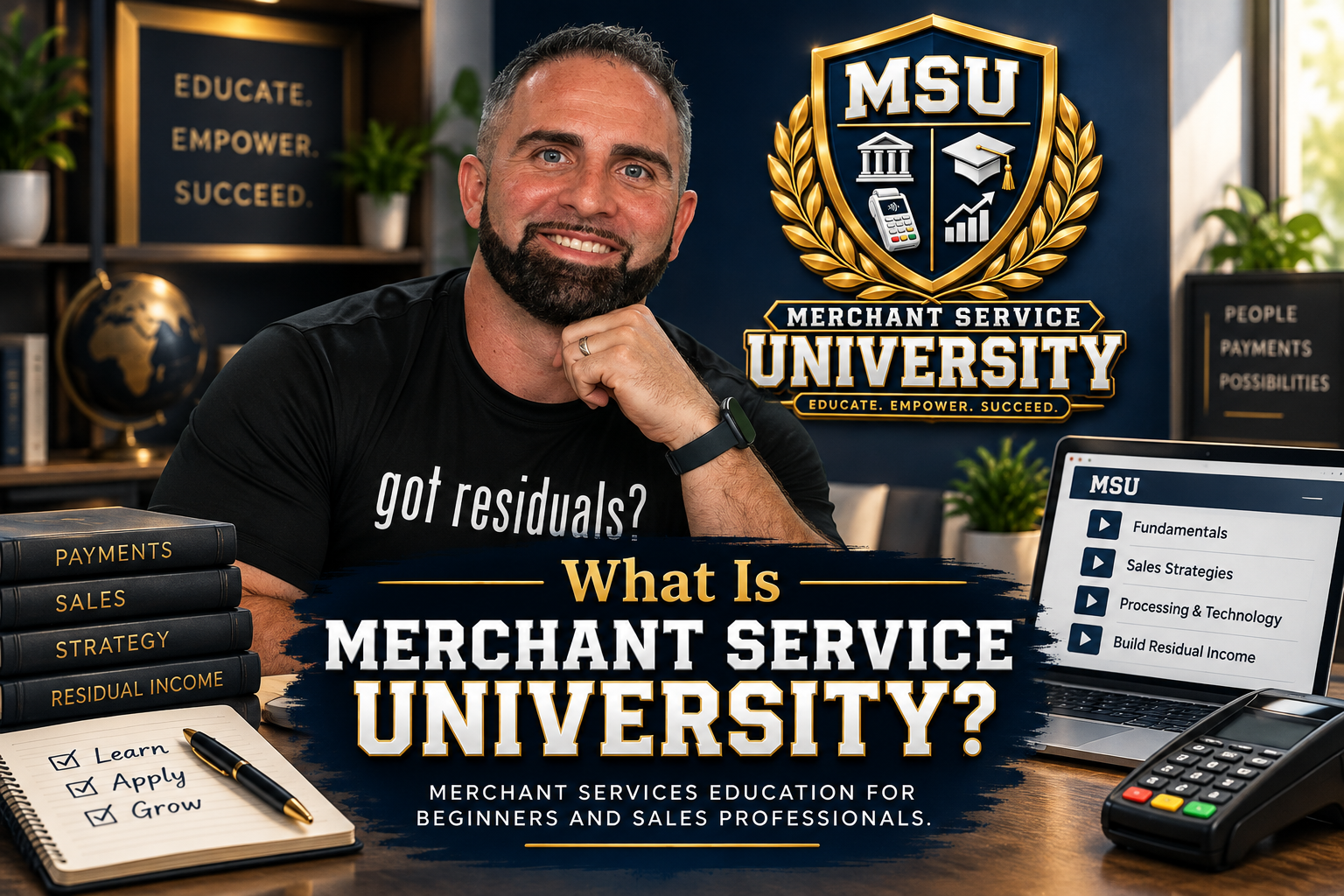
Why Merchant Service University Exists
Merchant Service University grew out of my frustration with the way this industry was being marketed online.
I've spent more than 16 years actually making my living in merchant services. During that time, I started seeing people pay thousands of dollars simply to get access to an industry that doesn't inherently require a huge course buy-in just to understand the fundamentals.
Some of the people I spoke with afterward still didn't feel they had received the practical depth they expected.
That doesn't mean all paid coaching or education is bad. It's not.
I've invested in education throughout my own life, and specialized mentorship can absolutely shorten a learning curve.
My issue was with selling the dream of access.
I didn't need to make Merchant Service University another high-ticket course because my livelihood was already coming from the business itself.
So I invested my own time and resources into building the foundational education and made the core training free.
The objective is simple:
Learn the business first.
Then decide whether it's the right business.
Take a Peek at Merchant Service University and Compare It Yourself
If you've spent the last year researching the best online business model, I'm not asking you to stop researching and blindly choose merchant services instead.
Do the opposite.
Go to MerchantServiceUniversity.com.
Take a look at the free core training.
Learn how the industry works.
Understand who the customer is.
Understand what businesses buy.
Learn how agents get paid.
Understand residual income.
Learn how merchant pricing works.
Understand the Schedule A.
Learn what an agent agreement means.
Understand merchant technology.
See what prospecting actually requires.
Learn how a portfolio is built.
Then return to the same framework from this article.
How much capital does it require?
Does it fit your skills?
How will you acquire customers?
What does fulfillment require?
Does revenue potentially repeat?
What dependencies exist?
What does five years of work potentially build?
Compare it with the other business models you're considering.
That's exactly what I want you to do.
A Better Decision Framework for Experienced Salespeople
If I were an experienced salesperson choosing a business today, I would put every opportunity through the same filter.
First, I would identify my unfair advantages. If I've spent ten years phone prospecting, that should influence the decision. If I'm an elite Zoom closer, that matters. If my network is full of entrepreneurs, that matters.
Then I would determine how customers are acquired. I would be very cautious about entering a business where I have no distribution advantage and need to immediately spend heavily just to create traffic.
Next, I would look at fulfillment. If I sell faster than I can deliver, I haven't created a scalable business.
Then I would compare startup capital and ongoing operating expenses.
After that, I'd examine recurring economics. Do customers pay once, buy repeatedly, renew, subscribe, or create residual value?
Finally, I'd ask the long-term question:
What could five or ten years of successful execution leave behind?
A customer base?
A portfolio?
An audience?
Intellectual property?
A team?
A software product?
A brand?
A referral network?
Nothing?
That last question should carry more weight than most people give it.
The Best Business Model Is Not the One With the Best Marketing
The internet makes it incredibly easy to confuse a great marketing funnel with a great business opportunity.
The opportunity with the best advertisements gets your attention.
The person with the most impressive lifestyle convinces you they must have discovered something special.
The income screenshots become the proof.
Then you buy access before you've ever considered whether the underlying work fits you.
I think the process should be reversed.
Start with your skills.
Then the customer.
Then the product.
Then customer acquisition.
Then fulfillment.
Then economics.
Then long-term value.
Marketing comes after understanding the business.
This is the philosophy we developed in Online Business Ideas in 2026: Stop Buying the Dream and Evaluate the Business Model.
If you haven't read that one yet, it is the perfect companion to this article.
Don't Try to Escape the Hard Part if the Hard Part Is Your Competitive Advantage
This may be the biggest takeaway from this entire cluster.
A lot of experienced salespeople start researching entrepreneurship because they're tired.
They've been prospecting for years.
They've dealt with quotas.
They've faced rejection.
So naturally, a business that promises:
No calls. No selling. No customers. Automated income.
sounds attractive.
But think about what you're doing.
You're intentionally trying to remove the exact ability you've spent ten or twenty years becoming excellent at.
What if the better move isn't eliminating sales?
What if the better move is aiming those sales skills at something with stronger long-term economics?
That's what initially attracted me to the portfolio model.
I'm still selling.
But I'm not thinking only about today's commission.
I'm thinking about what today's merchant might contribute to what I'm building.
That's a different relationship with the work.
Frequently Asked Questions About Merchant Services vs. Online Business Models
What is the best online business model for a salesperson?
There is no universal best model, but experienced salespeople may have an advantage in businesses where direct customer acquisition matters, including merchant services, consulting, agencies, recruiting, SaaS sales, outsourced sales, and other B2B services.
Is merchant services better than dropshipping?
Neither is universally better. Dropshipping can suit someone skilled in e-commerce, digital marketing, product selection, and online customer acquisition. Merchant services may be a stronger fit for someone with direct B2B sales skills who wants recurring residual potential without carrying traditional product inventory.
Is merchant services better than affiliate marketing?
Affiliate marketing can be attractive for people with strong content, SEO, email, social-media, or audience-building skills. Merchant services may better suit someone whose advantage is direct prospecting, networking, B2B sales, or closing.
Is merchant services better than starting an agency?
An agency can be an excellent business if you can both acquire clients and deliver the service consistently. Merchant services allows the agent to leverage more of an established partner's backend infrastructure while focusing heavily on merchant acquisition and relationships.
Is merchant services better than consulting?
Consulting can be extremely attractive for someone with specialized expertise and a strong client network. Merchant services differs because the agent can potentially build recurring residual economics from a portfolio of active merchant accounts instead of relying solely on personal consulting hours.
Is merchant services an online business?
Merchant services is better described as a flexible B2B sales business that can use digital tools extensively. Agents can prospect by phone, conduct video meetings, manage CRM follow-up, use digital applications, and work from a home office while still meeting merchants in person when useful.
Is merchant services a low-cost business?
Entering as an independent agent through an established processing partner can require far less infrastructure than building a payment-processing company from scratch. Normal business expenses can still exist.
Do merchant-services agents need inventory?
Agents generally do not need to purchase and warehouse large quantities of equipment simply to begin selling through an established processing organization. Equipment programs vary by partner.
Can merchant services create recurring income?
Merchant-services agents can potentially receive recurring residual compensation from qualifying active merchants according to account economics and the terms of their agent agreement.
Is merchant-services residual income passive?
Residual income is the more accurate term. The salesperson must first acquire merchants, and continued compensation can depend on merchant activity, retention, economics, and contractual rights.
Can I sell merchant services from home?
A significant portion of prospecting, phone outreach, Zoom appointments, CRM management, follow-up, training, and applications can potentially be handled remotely. Some merchants or sales strategies may benefit from face-to-face meetings.
Can I start merchant services part time?
Potentially. Some people can learn and begin prospecting while maintaining another career, although consistent sales activity and access to business owners are still required.
Do previous sales skills transfer to merchant services?
Yes. Phone prospecting, outside sales, Zoom closing, discovery, objection handling, networking, referrals, and B2B relationship development can all be useful transferable skills. Experience does not guarantee success.
Do I need to become a registered ISO?
Not necessarily. Many agents can build merchant portfolios through established processing organizations that already provide underwriting, processing, support, technology, and operational infrastructure.
How is merchant services different from a SaaS business?
Both can involve recurring customer economics. Building SaaS typically requires creating and maintaining the software product, while an independent merchant-services agent can leverage an established processing partner's infrastructure. Sales compensation in SaaS also does not automatically include continuing commissions.
Is Merchant Service University free?
Yes. The core Merchant Service University education is free and does not require students to choose one specific processing partner.
Where should I start if merchant services looks like the best fit?
Start by learning the industry through Merchant Service University, then use How to Become a Merchant Services Agent in 2026 to understand the complete process from education through partner selection and portfolio building.
Final Takeaway: The Best Business Model Is the One That Gives Your Existing Ability the Best Vehicle
I don't think merchant services is universally better than e-commerce, affiliate marketing, consulting, agencies, SaaS, or digital products.
That would be an easy claim to make and a bad argument.
Every one of those models has legitimate entrepreneurs building outstanding businesses.
The better question is which model makes sense for you.
If you're a brilliant product marketer, build around that.
If you already have a massive audience, use the distribution you've built.
If you're a developer, software may be your obvious advantage.
If you have deep professional expertise, consulting may be the cleanest path.
But if you've spent years selling, I want you to stop undervaluing what you've built.
You know how to prospect.
You know how to talk to strangers.
You know how to ask questions.
You know how to identify pain.
You know how to follow up.
You know how to close.
Maybe you know hundreds of entrepreneurs already.
That is a serious entrepreneurial foundation.
You may not need to abandon it and spend the next three years learning how to run Facebook ads for a product you've never cared about.
You may not need another business model that promises you won't have to sell.
You may need a business where being willing and able to sell gives you an enormous advantage.
For the right person, that's why I believe merchant services deserves serious consideration.
Businesses already need the service. You can leverage established processing infrastructure. You can work from a home office, over the phone, on Zoom, through networking, through referrals, or face to face. You don't need traditional product inventory, and depending on your agreement and merchant retention, you can potentially build recurring residual economics through the merchant portfolio you acquire.
It isn't the easiest business model.
For someone who already knows how to sell, that may be exactly why it deserves consideration.
You already have the difficult skill.
The question is what vehicle you're going to put it in.
If you want to evaluate merchant services yourself, go to MerchantServiceUniversity.com.
The core education is free.
Learn the business.
Compare it to everything else you're considering.
Then decide what you actually want to build.
About Joe Wagner
Joe Wagner has spent more than 16 years in merchant services and payment-processing sales, acquiring merchants, developing sales organizations, training sales professionals, and building recurring residual portfolios.
He created Merchant Service University to give new and experienced salespeople free foundational education before asking them to choose a processing partner. His approach emphasizes understanding the real business model, applying existing sales abilities, comparing compensation and contractual economics, and building a long-term merchant portfolio rather than simply chasing the next commission.
This article completes Joe's second educational cluster designed specifically for experienced salespeople, commission professionals, and aspiring entrepreneurs who want to evaluate whether their existing sales skills can be redirected into a lower-overhead business with recurring-income potential.
Continue with Sales Jobs With Residual Income, Best Commission-Only Sales Jobs for Recurring Income, Low-Cost Business Ideas for Salespeople, Online Business Ideas in 2026, Sales Careers That Build a Book of Business, Home-Based Business Ideas for Salespeople, How to Build Recurring Income as a Salesperson, or Businesses You Can Start With Little Money and No Inventory.
Or begin with the free core education at Merchant Service University.