
Passive Income vs. Portfolio Income: Which Should You Build First?
Passive Income vs. Portfolio Income: Why I Believe Cash Flow Should Come First
Would you rather spend the next 20 or 30 years trying to accumulate a multimillion-dollar investment portfolio, or spend the next several years building a recurring-income business that could potentially pay for your lifestyle while you build that portfolio?
It's a question I believe more people should ask themselves.
Most of us were taught a fairly traditional approach to financial success.
Get a good job. Work hard. Save money. Invest consistently. Build a retirement portfolio. And hopefully, after decades of working, you'll have accumulated enough money to retire and enjoy your life.
There's nothing wrong with that strategy. In fact, I believe investing is an essential part of creating long-term financial security.
But I've always had a different perspective on the order in which people should approach financial freedom.
I believe the average person should seriously consider building recurring passive income first, then using the excess income to build an investment portfolio.
Why?
Because growing an investment portfolio can make you wealthier over time, but recurring income can potentially give you something equally valuable much earlier in life.
Control over your time.
And after spending more than 16 years in merchant services building a portfolio of business relationships that generate residual income, I've experienced how powerful that distinction can become.
My philosophy is simple:
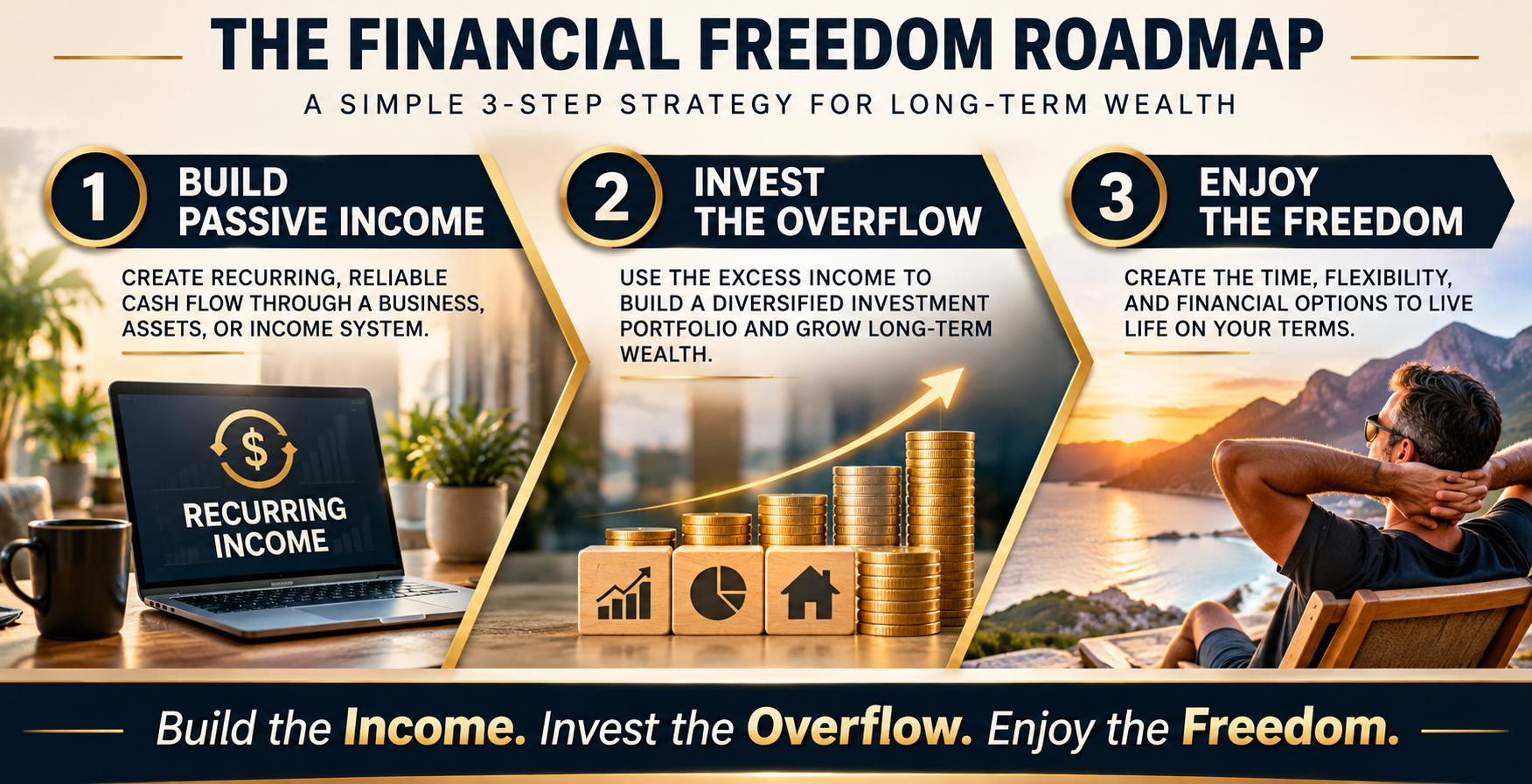
Build the income. Invest the overflow. Enjoy the freedom.
Let's break down what that actually means.
What Is the Difference Between Passive Income and Portfolio Income?
Before comparing the two, we need to understand what each represents.
What Is Passive Income?
In everyday financial discussions, passive income generally refers to money that continues coming in from an asset, business, or system you previously created or acquired, without requiring you to perform the same amount of active work for every payment.
Examples can include:
Residual income from merchant services accounts
Royalties from books, music, or intellectual property
Revenue from subscription-based businesses
Certain rental property arrangements
Income from businesses operated by employees or management teams
Recurring licensing agreements
Not all of these income sources are passive under IRS tax rules, and some require substantial ongoing work.
That's an important distinction.
When I talk about passive income, I'm primarily referring to recurring business income that is no longer directly tied to trading another hour of work for another dollar.
It doesn't mean the income was effortless to create.
It doesn't mean there are no responsibilities.
And it certainly doesn't mean the income is guaranteed.
It means you've developed something that can continue producing income from work performed previously.
What Is Portfolio Income?
Portfolio income generally refers to income and gains generated from financial investments.
Examples include:
Stock dividends
Bond interest
Interest from certain savings and investment products
Realized capital gains from selling investments
Investments can also appreciate in value without immediately producing spendable income.
For example, if your investment account increases from $200,000 to $250,000, you've experienced a $50,000 increase in account value.
That's meaningful financial progress.
But unless you receive distributions or sell some of those investments, the additional value isn't necessarily paying your mortgage, covering your car payment, or funding your next vacation.
Of course, you can sell investments or receive dividends before retirement. Some investors deliberately build portfolios to provide current income.
My point isn't that portfolio income must remain inaccessible until retirement.
It's that many people spend decades accumulating investments without building a separate recurring-income source capable of supporting their everyday lifestyle.
And I believe there's another path worth considering.
The Fundamental Difference
Portfolio income generally depends on having investment capital.
Recurring business income can sometimes be developed primarily through your time, skills, effort, and customer relationships.
Both require resources. Both involve risk.
But for someone who doesn't have hundreds of thousands of dollars available to invest, building a recurring-income business may offer a more accessible starting point.
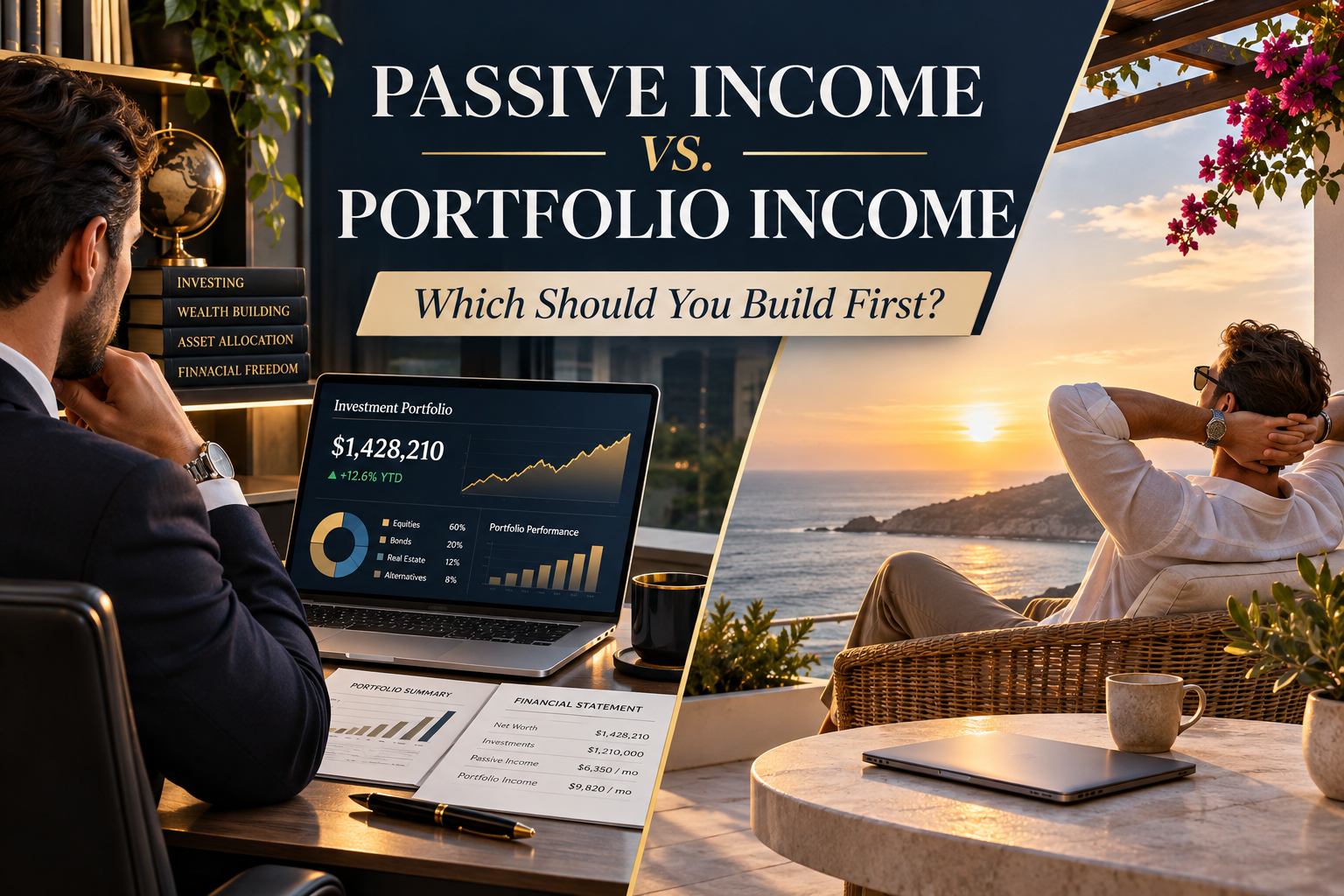
The Problem With Waiting Until Retirement to Enjoy Your Money
Think about the traditional retirement strategy.
You spend decades working, contributing to retirement accounts, and hopefully watching your investments compound.
Over time, your net worth grows.
But for many people, the expectation is that they won't meaningfully rely on those investments until much later in life.
That raises a question I've thought about for years.
What if you could build enough recurring income to enjoy greater financial freedom long before retirement?
What if you could take vacations without worrying about missing a paycheck?
What if you could spend more time with your children while they're still young?
What if you could leave a job you no longer enjoy, start another business, or take a few months to travel?
What if you could continue working simply because you wanted to?
That's the type of freedom I'm talking about.
Financial freedom doesn't necessarily mean you stop working.
It means work becomes more of a choice.
And I believe building recurring income is one of the most practical ways to work toward that outcome.
Let's Talk About the Real Cost of a Comfortable Lifestyle
I don't want to build this discussion around someone surviving on $2,000 or $3,000 per month.
The cost of living has increased significantly, and I believe we should use a realistic example of a very comfortable lifestyle.
Not everyone needs or wants the same things.
Some people are perfectly happy living on considerably less. Others have families, healthcare expenses, or housing costs that require much more.
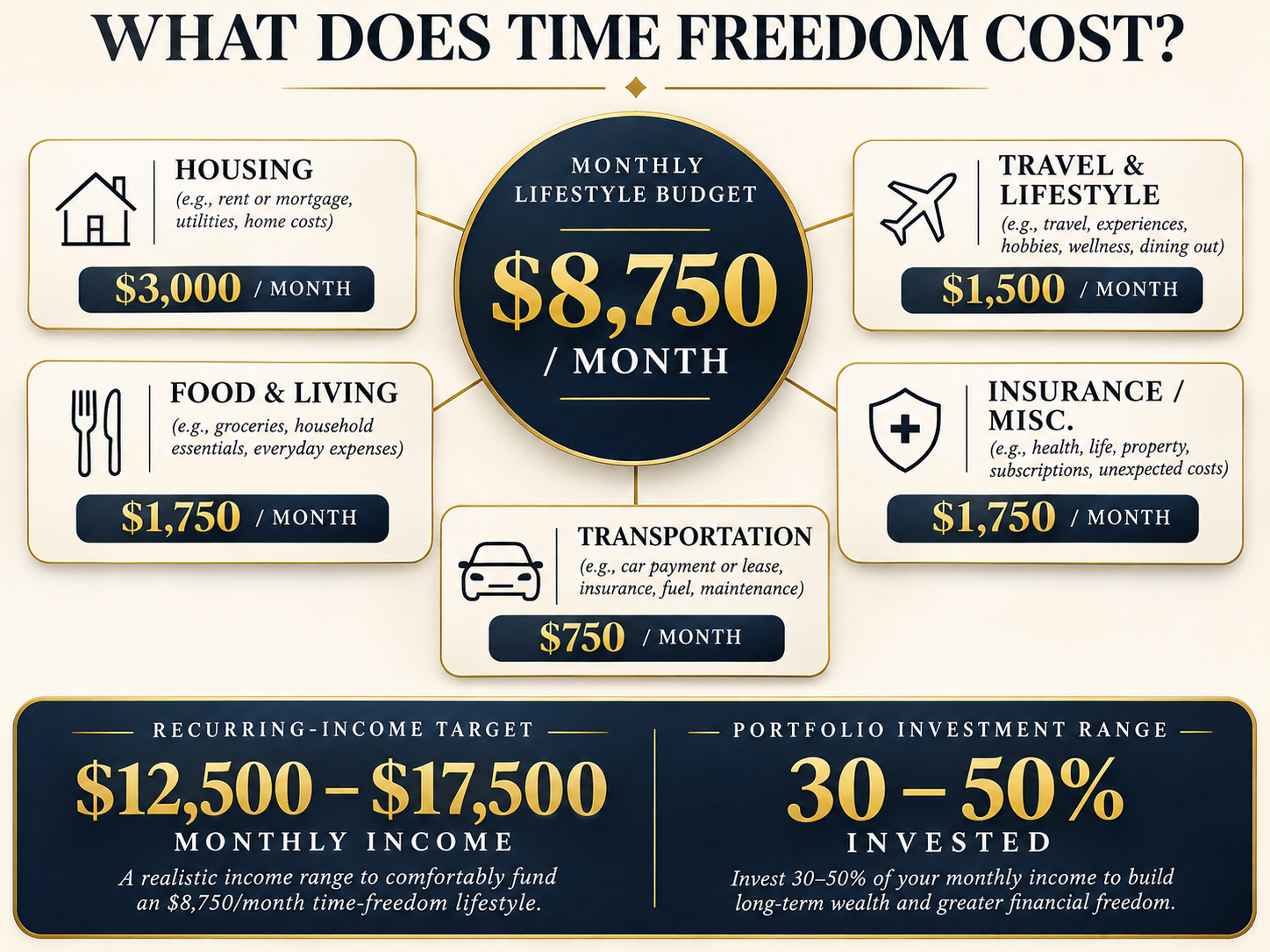
But let's imagine the following monthly budget.
Lifestyle Expense | Monthly Cost |
|---|---|
Housing | $3,500 |
Car payment | $750 |
Dining out and nights out | $500 |
Vacation fund — $3,000 every three months | $1,000 |
Additional life expenses | $2,000 |
Total Monthly Lifestyle | $8,750 |
That's $105,000 per year in lifestyle expenses.
You have a comfortable place to live.
You drive a vehicle you enjoy.
You can go out to dinner.
You take four $3,000 vacations per year.
And you have $2,000 per month for additional living expenses.
For many people, that would represent a very good lifestyle.
But here's where my philosophy becomes even more interesting.
I don't want to stop at covering the lifestyle. I want to invest another 30% to 50% of available income on top of it.
That means we need recurring income sufficient to support both today's lifestyle and tomorrow's investment portfolio.
How Much Income Would That Require?
If $8,750 represents your lifestyle expenses, here's how much monthly income you would need after taxes and business expenses to invest different percentages of that income.
Percentage Invested | Monthly Income Needed | Monthly Investment |
|---|---|---|
30% | $12,500 | $3,750 |
40% | $14,583 | $5,833 |
50% | $17,500 | $8,750 |
Now we're talking about a meaningful financial goal.
You're not just earning enough to pay your bills.
You're potentially earning enough to enjoy life while investing tens of thousands of dollars per year.
And the investment portfolio can continue growing alongside your recurring-income business.
These figures are planning illustrations, not earnings projections. Personal taxes, healthcare, dependents, business expenses, and other costs must be accounted for when determining the actual income required.
How Much Money Would You Need Invested to Generate $8,750 Per Month in Dividends?
Now let's look at the portfolio-income side of the equation.
Suppose your goal was to generate $8,750 per month purely from dividends.
That's $105,000 per year.
How large would your investment portfolio need to be?
The answer depends on the dividend yield.
Hypothetical Annual Dividend Yield | Investment Portfolio Required |
|---|---|
2% | $5,250,000 |
3% | $3,500,000 |
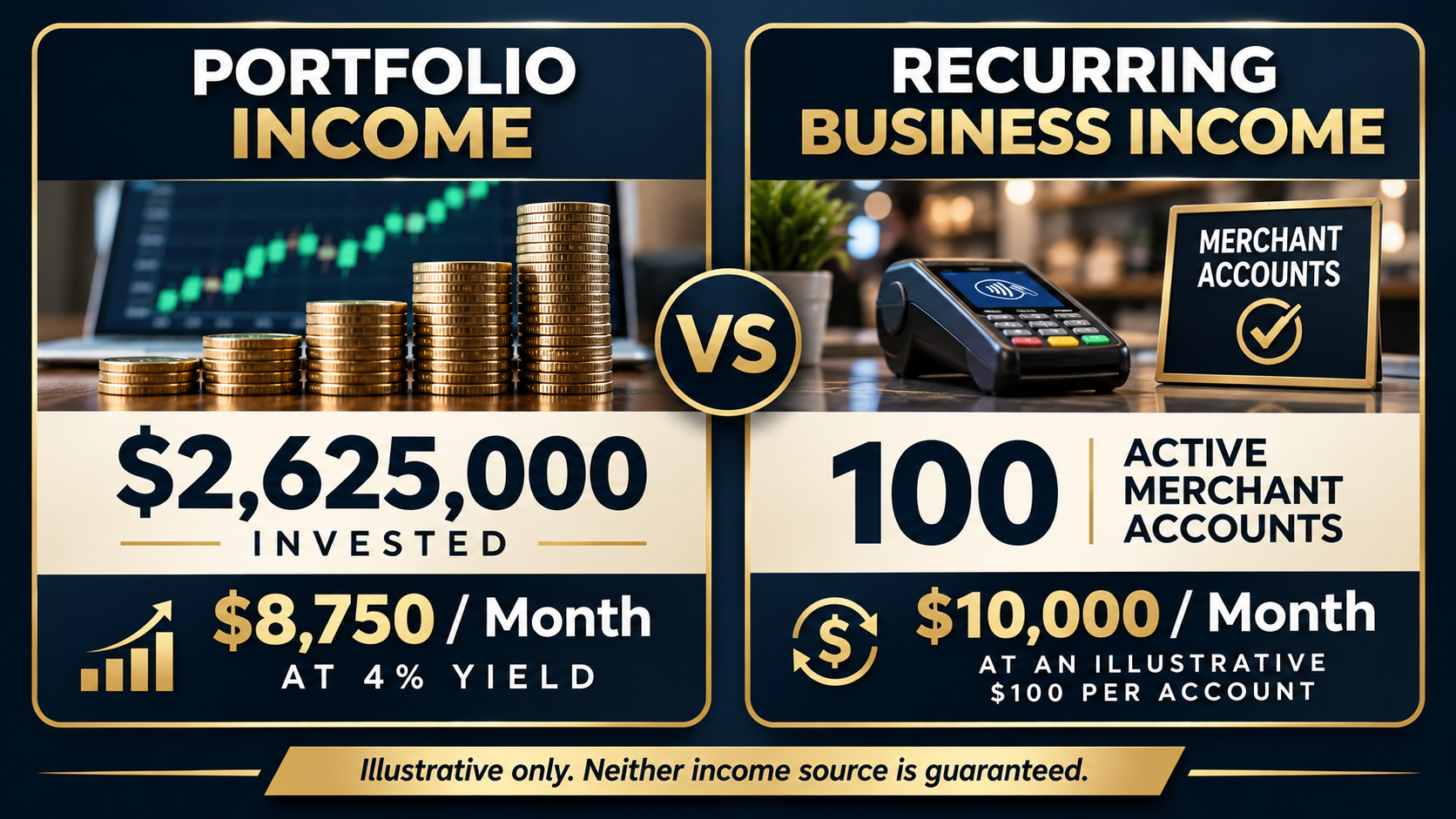
4% | $2,625,000 |
5% | $2,100,000 |
Let's focus on the 4% example.
You would need approximately $2.625 million invested to generate $105,000 annually at a sustained 4% dividend yield, before taxes and fees.
That's a tremendous amount of investment capital.
And remember, $8,750 per month only covers our hypothetical lifestyle.
It doesn't include the additional 30% to 50% we want to invest.
If we wanted $15,000 per month from dividends at the same hypothetical 4% yield, we'd need approximately $4.5 million invested.
Now ask yourself:
How long would it take the average working person to accumulate $2.6 million, let alone $4.5 million?
For many people, the answer is decades.
And that's assuming they're consistently saving and investing, their investments perform sufficiently well, and they don't experience major financial setbacks along the way.
To be clear, dividend yields fluctuate, dividends can be reduced or eliminated, and investment principal can decline. Higher dividend yields may also involve greater risk. These examples are mathematical illustrations, not assumptions about achievable or guaranteed investment returns.
But the comparison reveals something important.
If you begin with very little investment capital, generating a comfortable lifestyle entirely from portfolio income can require a very large amount of accumulated money.
That's one reason I believe building recurring business income first deserves serious consideration.
What If You Built the Income Instead of Trying to Accumulate Millions First?
Here's the alternative I want people to understand.
Instead of asking:
"How do I accumulate $2.625 million so I can potentially generate $8,750 per month in dividends?"
What if you asked:
"How do I build a business that can eventually produce $8,750 per month in recurring income?"
Those are two very different questions.
The first primarily involves accumulating investment capital.
The second involves building an income-producing business.
And while both require discipline, the resources needed to begin can be dramatically different.
You might not have $100,000 to invest today.
You might not even have $10,000.
But you may have time.
You may have the ability to learn a skill.
You may have the willingness to talk to people, build relationships, solve problems, and sell a valuable service.
That's where entrepreneurship and direct sales can create opportunities.
And that's exactly what attracted me to merchant services.
How Merchant Services Changed My Perspective on Passive Income
I entered the merchant services industry in 2009.
What fascinated me wasn't simply the ability to earn a commission from acquiring a new customer.
It was the opportunity to build a portfolio of business relationships that could continue generating residual compensation.
Here's how the concept works.
Businesses accept credit and debit card payments.
They need payment processing services, technology, support, and solutions that help them operate.
A merchant services sales professional can acquire a business as a customer through an authorized provider.
Depending on the compensation agreement, the agent may receive a share of the ongoing profitability generated by that merchant account.
As long as the account remains active, generates eligible processing activity, and the applicable agreement continues to provide compensation, the agent may continue earning residual income.
One merchant relationship can potentially create recurring income.
Then you acquire another.
And another.
Over time, those relationships can form an income-producing portfolio.
The beauty of the model, in my opinion, is that you're offering something businesses already need.
You're not trying to convince business owners they should suddenly start accepting payments.
They're already doing it.
Your job is to earn their business by helping them find a better solution, better service, more useful technology, or a more appropriate processing arrangement.
That doesn't make selling easy.
But it gives you an established market with an ongoing business need.
What Could a Merchant Services Residual Portfolio Look Like?
Let's use a simple illustration.
Suppose an agent averages $100 in net monthly residual compensation per active merchant.
Active Merchant Accounts | Illustrative Monthly Residual Income |
|---|---|
25 | $2,500 |
50 | $5,000 |
75 | $7,500 |
100 | $10,000 |
150 | $15,000 |
200 | $20,000 |
Now imagine building a portfolio of 100 active merchants that collectively generates $10,000 per month in residual compensation.
That's $120,000 per year before applicable business expenses and personal taxes.
You haven't accumulated a $3 million stock portfolio.
You've built a portfolio of customer relationships.
And if those relationships remain active and profitable under your compensation agreement, they may continue generating recurring income.
The $100 per merchant is strictly illustrative. Actual compensation varies substantially based on merchant size, processing volume, pricing, profitability, agent splits, provider agreements, and account retention. Many agents earn substantially less per merchant, and individual accounts may generate little or no residual compensation.
The First Year Is Where Most People Have to Prove They're Serious
Now, I want to be very clear about something.
Building recurring income through merchant services is not easy money.
It's a business.
And like any legitimate business, it requires commitment.
In the beginning, you're learning an entirely new industry.
You're learning how credit card processing works.
You're learning how to read merchant statements.
You're learning different pricing models.
You're learning how to approach business owners, ask better questions, handle objections, and close deals.
You're developing confidence.
And you're discovering that rejection is part of the process.
For many new sales professionals, that first year can be challenging.
You're putting in significant effort while your residual portfolio is still relatively small.
That's where consistency matters.
Treat It Like a Business, Not a Side Hustle You Try Occasionally
If you want to build something meaningful, you have to approach it seriously.
That means developing a prospecting schedule.
Tracking your activity.
Following up with business owners.
Improving your presentations.
Learning from unsuccessful conversations.
Taking care of existing merchants.
And showing up consistently, even when the results aren't coming as quickly as you'd like.
I've spent years teaching sales professionals that the daily activities they control eventually influence the results they produce.
You can't control whether every business owner says yes.
But you can control how many businesses you contact, how well you prepare, how professionally you present, and how consistently you follow up.
Over time, those activities can create momentum.
Why the Second Year and Beyond Can Look Different
Imagine someone who spends the first year learning the business and consistently acquiring customers.
They may begin the second year with existing merchant relationships already producing some residual income.
Now, as they continue acquiring new accounts, they're potentially adding new income on top of income generated from earlier relationships.
That's fundamentally different from starting at zero every month.
Of course, merchant accounts can close, processing volumes can decline, and residual compensation can change. A growing portfolio isn't automatic, and account retention matters just as much as acquisition.
But when the business is managed well, the accumulated relationships can become increasingly valuable.
The first year is about building the foundation. The years that follow are where consistency, experience, and a retained portfolio can begin to compound.
There is no guaranteed timeline for replacing a salary or reaching a specific residual-income target. Results vary widely, and some agents never achieve those levels.
But the business model gives you something worth working toward.
An income stream that may become less dependent on your daily sales activity as the portfolio matures.
My Three-Step Financial Freedom Philosophy
This brings us back to the central question.
Should you build passive income or portfolio income first?
My preferred approach is a three-stage strategy.
Step 1: Build Passive Income First
Focus on creating a recurring-income source that can eventually support your living expenses.
That might be a merchant services portfolio.
It could be another recurring-revenue business.
The specific model matters less than the underlying principle.
Build something that has the potential to keep producing income from the work you've already performed.
Initially, you may still need your job or active sales commissions to support yourself while building it.
That's normal.
The goal is to gradually reduce your dependence on income that requires you to show up and work another hour.
And before relying on recurring income to cover essential expenses, you should have sufficient reserves and account for the possibility that income declines.
Step 2: Invest the Overflow
Once your recurring income is established and your financial foundation is stable, begin directing more of the surplus into investments.
That might include diversified stock investments, retirement accounts, real estate, or other assets appropriate for your circumstances.
I believe investing 30% to 50% of available income can be an ambitious and worthwhile goal for people whose finances support it.
But it isn't a universal requirement.
The key is to develop a consistent investment strategy while protecting the recurring-income business that supports your lifestyle.
You don't have to choose between income and investments forever.
Your income-producing business can help finance the investment portfolio you're building.
And you shouldn't necessarily postpone all investing until your business reaches a particular income target. Employer retirement matches, emergency reserves, debt costs, taxes, and personal circumstances may justify investing and saving along the way.
Step 3: Enjoy Your Freedom While Your Portfolio Grows
This is my favorite part.
Imagine having recurring income that comfortably covers your lifestyle.
You're investing consistently.
Your investment portfolio is growing over time, although market performance will fluctuate.
And you're no longer relying entirely on your next paycheck or commission to pay the bills.
Now you have choices.
You can continue selling because you enjoy the business.
You can recruit and train others.
You can build another company.
You can travel.
You can spend more time with your family.
You can pursue something you've always wanted to do.
Or you can simply enjoy having less financial pressure in your everyday life.
That, to me, is the real purpose of building recurring income.
Not necessarily retiring early.
Not necessarily buying expensive things.
Having greater control over how you spend your time.
What About People Who Prefer Traditional Investing?
I want to make something clear.
I'm not against traditional investing.
Quite the opposite.
I believe building a diversified investment portfolio is important for long-term financial security.
Stocks, bonds, retirement accounts, and other investments can provide diversification and opportunities for growth.
And for some people, investing early and consistently while working a traditional career may be the most appropriate approach.
Not everyone wants to run a business.
Not everyone enjoys direct sales.
Not everyone is comfortable with the income variability and responsibilities of entrepreneurship.
That's perfectly reasonable.
My argument isn't that every person should abandon traditional financial planning.
It's that people who are willing to build a business should understand the opportunity to create recurring cash flow before they've accumulated millions in investment assets.
And even successful recurring-income businesses carry risks.
Customer concentration, merchant attrition, compensation changes, business expenses, and industry developments can affect income.
That's one more reason I believe converting surplus recurring income into diversified investments is so important.
You're not replacing portfolio income.
You're creating a potential way to help fund it.
The Goal Isn't to Stop Working. It's to Stop Having to Work.
One of the biggest misconceptions about passive income is that the ultimate goal is to sit around and do nothing.
That's never been my philosophy.
I enjoy building businesses.
I enjoy sales.
I enjoy teaching people.
I enjoy helping others develop skills that can change their financial circumstances.
And I don't believe financial freedom should require someone to abandon work they find meaningful.
But there's a difference between working because you want to and working because you have no other choice.
When your income depends entirely on showing up every day, your financial security can feel tied to your next paycheck.
When you've built recurring income, you may eventually have more flexibility.
You can make decisions based on what matters to you rather than exclusively on what you need to earn next week.
That's the opportunity I want more people to understand.
You don't necessarily need to wait until you're 65 to start enjoying the life you've worked to build.
You can begin working toward that freedom now.
And if you're willing to learn a business, develop your skills, build relationships, and remain consistent, recurring income may be one of the ways to get there.
Watch: Passive Income vs. Portfolio Income
I explain the philosophy behind this article in a short video.
Watch the video:Passive Income vs. Portfolio Income — Joe Wagner
The message is simple.
Build income that can support your lifestyle.
Use the surplus to invest.
And create the freedom to enjoy your life while your investments have time to grow.
Frequently Asked Questions About Passive Income vs. Portfolio Income
Is passive income better than portfolio income?
Neither is universally better. They serve different purposes and involve different risks. My preference is to build recurring business income first when practical, then invest surplus cash flow into a diversified portfolio. That approach can potentially support current living expenses while building long-term financial security.
Can you build passive income without a lot of money?
Some recurring-income businesses can be started with relatively little investment capital compared with purchasing income-producing financial assets. However, they typically require substantial time, effort, skills, and sometimes operating expenses. Merchant services sales is one example of a business model where relationships and sales performance can be more important initially than large amounts of investment capital.
How much money would I need invested to earn $10,000 per month in dividends?
At a hypothetical 4% annual dividend yield, generating $120,000 per year would require approximately $3 million invested before taxes and fees. At 3%, the required portfolio would be approximately $4 million. These are simplified illustrations, not guaranteed investment returns.
Can merchant services really create residual income?
Yes. Depending on the provider and compensation agreement, merchant services sales professionals may receive ongoing residual compensation from eligible merchant accounts. The amounts vary based on account profitability, processing activity, merchant retention, agent splits, and contractual terms. Residual income is not guaranteed.
How long does it take to build meaningful merchant services residual income?
There is no universal timeline. It depends on sales activity, skills, merchant size, retention, compensation agreements, and other factors. The first year often involves a significant learning curve. Consistent agents who acquire and retain profitable merchants may build increasing recurring income over multiple years, but outcomes vary substantially.
Should I stop investing while building passive income?
Not necessarily. Maintaining emergency savings, managing debt, and taking advantage of appropriate retirement benefits may be important while building a business. My philosophy is about prioritizing the creation of recurring cash flow, not abandoning prudent financial planning.
What is the ultimate goal of passive income?
For me, it's time freedom. The ability to make decisions about work, family, travel, business, and lifestyle with less dependence on your next paycheck. Recurring income can be one tool for working toward that goal.
Want to Learn How I Built Recurring Income Through Merchant Services?
I've spent more than 16 years in the merchant services industry building merchant relationships, developing sales teams, and teaching people how this business works.
I created Merchant Service University to make the education accessible to people who want to understand the industry and learn how to build their own merchant services business.
The training is free.
You'll learn the fundamentals of merchant services, how to approach business owners, how to understand processing, and how residual compensation works.
Start your free training:Merchant Service University
You can also download my free eBook, The New Rules of Merchant Sales, to learn more about the industry and the opportunities available to sales professionals.
Download the free eBook:The New Rules of Merchant Sales
And remember:
Build the income. Invest the overflow. Enjoy the freedom.
Continue Reading the Passive Income vs. Portfolio Income Series
This is Lesson 1 of 5 in my Passive Income vs. Portfolio Income educational series.
The next four lessons explore the philosophy in greater detail.
Lesson 2: Why Passive Income Can Give You Financial Freedom Before Retirement
Lesson 3: How to Build Passive Income From Scratch: Start With Cash Flow, Not Capital
Lesson 4: Passive Income First, Portfolio Income Second: How to Make Your Money Work Twice
Lesson 5: The Real Goal of Passive Income: Time Freedom, Financial Security, and Living Life Now
Explore more educational articles on my Merchant Sales Training Blog.
About Joe Wagner
Joe Wagner is a merchant services entrepreneur, sales trainer, author, and founder of Merchant Service University.
Since entering the merchant services industry in 2009, Joe has focused on building recurring residual income through merchant relationships and helping other sales professionals learn the business.
His work emphasizes financial independence, disciplined sales activity, ethical customer relationships, and the opportunity to build businesses that provide greater control over time.
Learn more at iamjoewagner.com.
Disclaimer: This article is educational and reflects the author's personal business philosophy. It is not individualized financial, investment, tax, or legal advice. Passive income, merchant services residuals, dividend payments, and investment returns are not guaranteed. Business income can decline or cease, and investments can lose value. All financial figures are illustrative and do not represent typical or promised results.