
Sales Careers That Build a Book of Business Instead of Starting Over
Sales Careers That Build a Book of Business Instead of Starting Over
If you've spent ten years in sales, I want you to ask yourself a question that has nothing to do with this month's commission check.
What do you have today because of the customers you acquired five or ten years ago?
For some salespeople, the answer is a tremendous network, valuable experience, and a strong résumé. Those things matter, but economically, many of those previous sales are finished. The commission was paid, the company kept the customer, and the salesperson moved on to the next opportunity.
Then another month begins and the scoreboard resets.
If you're a successful salesperson who is starting to get tired of that cycle, the problem may not be that you're tired of sales. You may simply be ready to look at sales careers with residual income, renewals, repeat business, or other structures that allow years of customer acquisition to build something behind you.
That's the concept of building a book of business.
I've spent more than 16 years in merchant services, and this shift in thinking changed the way I looked at my career. I stopped evaluating every merchant only by the upfront commission attached to the sale and started asking what that merchant could contribute to the portfolio I was building over time.
The sale still matters today. The difference is that today's sale may also matter tomorrow.
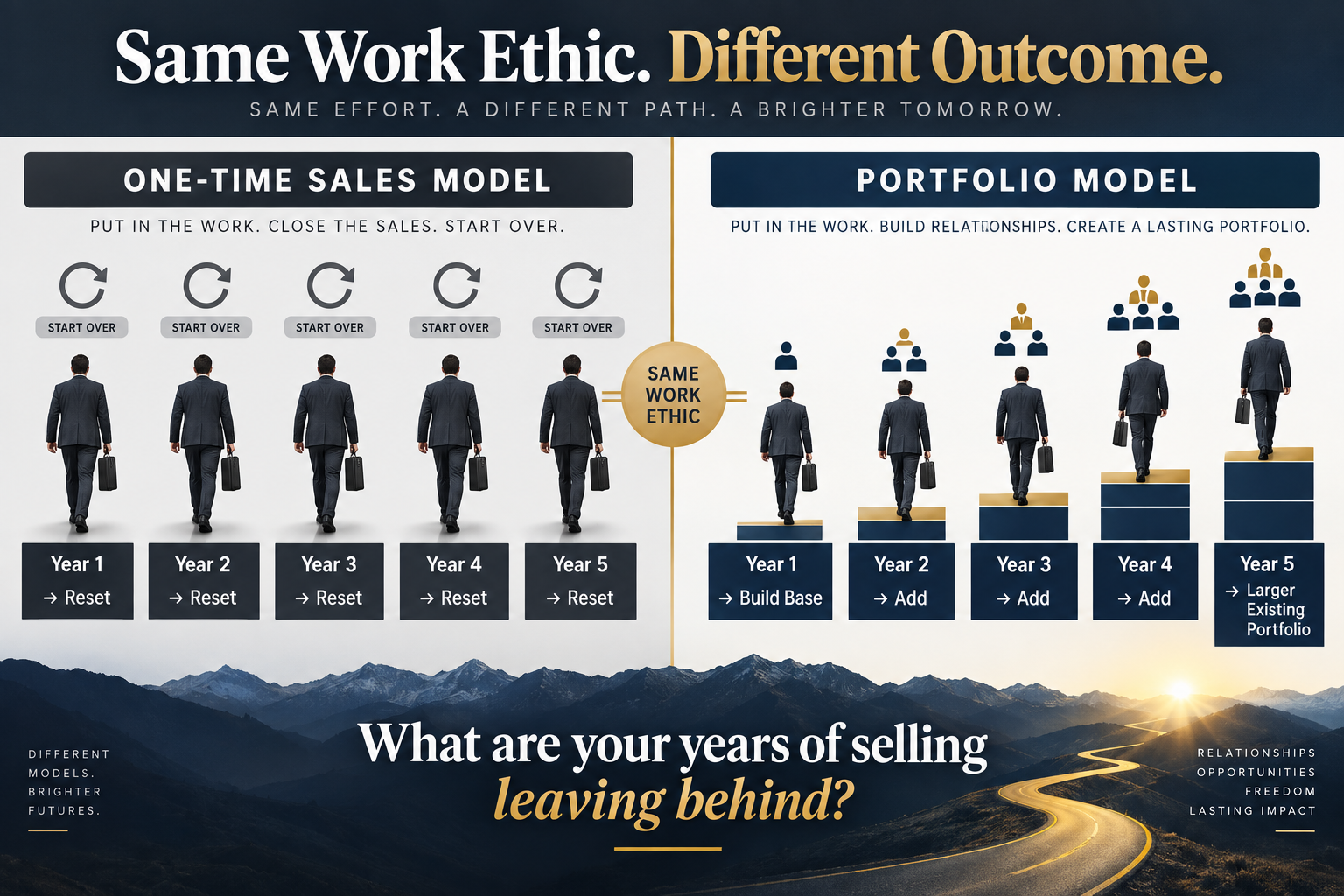
What Does It Mean to Build a Book of Business?
A book of business is the collection of customers, accounts, policies, relationships, or contracts a salesperson or business has developed over time. The economic value of that book depends entirely on the industry and compensation structure.
In some industries, the book can produce direct recurring income. In others, customers renew periodically and generate renewal commissions. Some careers don't create recurring commissions at all, but a well-maintained customer base can produce repeat transactions and referrals for years.
That distinction is important because people often use the phrase book of business as though every book works the same way.
It doesn't.
An insurance producer's renewal book is different from a REALTOR's past-client database. A merchant-services agent's residual portfolio is different from a SaaS salesperson's account list. Even within the same industry, two companies can give salespeople radically different rights to the customers they acquire.
What matters is understanding exactly what your previous sales can continue creating for you.
A Pipeline and a Book of Business Are Not the Same Thing
Salespeople are taught to build pipeline, and they should be. Without future opportunities, sales activity eventually dries up.
But pipeline represents business you haven't closed yet.
A book represents relationships you already acquired.
That's a major difference.
A strong pipeline tells you what might happen next. A strong book of business tells you what you've already built that may continue creating renewals, referrals, recurring revenue, repeat purchases, or residual compensation.
The ideal long-term sales career may allow you to build both.
You continue creating new opportunities while previous customers remain economically relevant.
That's how the career can start feeling less like an endless restart.
Why the Monthly Reset Eventually Frustrates Good Salespeople
A beginning salesperson is usually focused on one thing: learning how to make money.
That's reasonable.
The experienced salesperson eventually starts asking a different question.
They've proven they can prospect. They've proven they can close. They've produced for companies for years. The problem is that every new month, quarter, or year still requires them to recreate nearly everything.
If that's where you are, read Sales Jobs With Residual Income: Stop Starting at Zero Every Month. That article focuses specifically on the emotional and financial frustration of the reset.
This article goes one step further.
Instead of asking only how to create recurring income, we're asking:
What kind of sales career allows years of effort to accumulate into something?
That's the bigger career question.
Not Every Book of Business Produces the Same Kind of Value
I would divide book-of-business careers into several broad categories.
Residual Books
These can potentially generate recurring compensation tied to ongoing customer activity.
Merchant services is an example.
Renewal Books
The customer periodically renews a product or contract, potentially generating another commission.
Insurance is a classic example.
Recurring Contract Books
The customer continues paying for a subscription or recurring business service, and the salesperson may receive some continuing participation depending on the compensation plan.
Certain software, telecom, managed-services, and recurring B2B programs can operate this way.
Relationship Books
The customer doesn't necessarily create automatic monthly compensation, but the relationship can produce future transactions and referrals.
Real estate is a good example.
All four can be valuable.
But if your specific goal is to create income that continues from previous production, you need to know which type you're actually building.
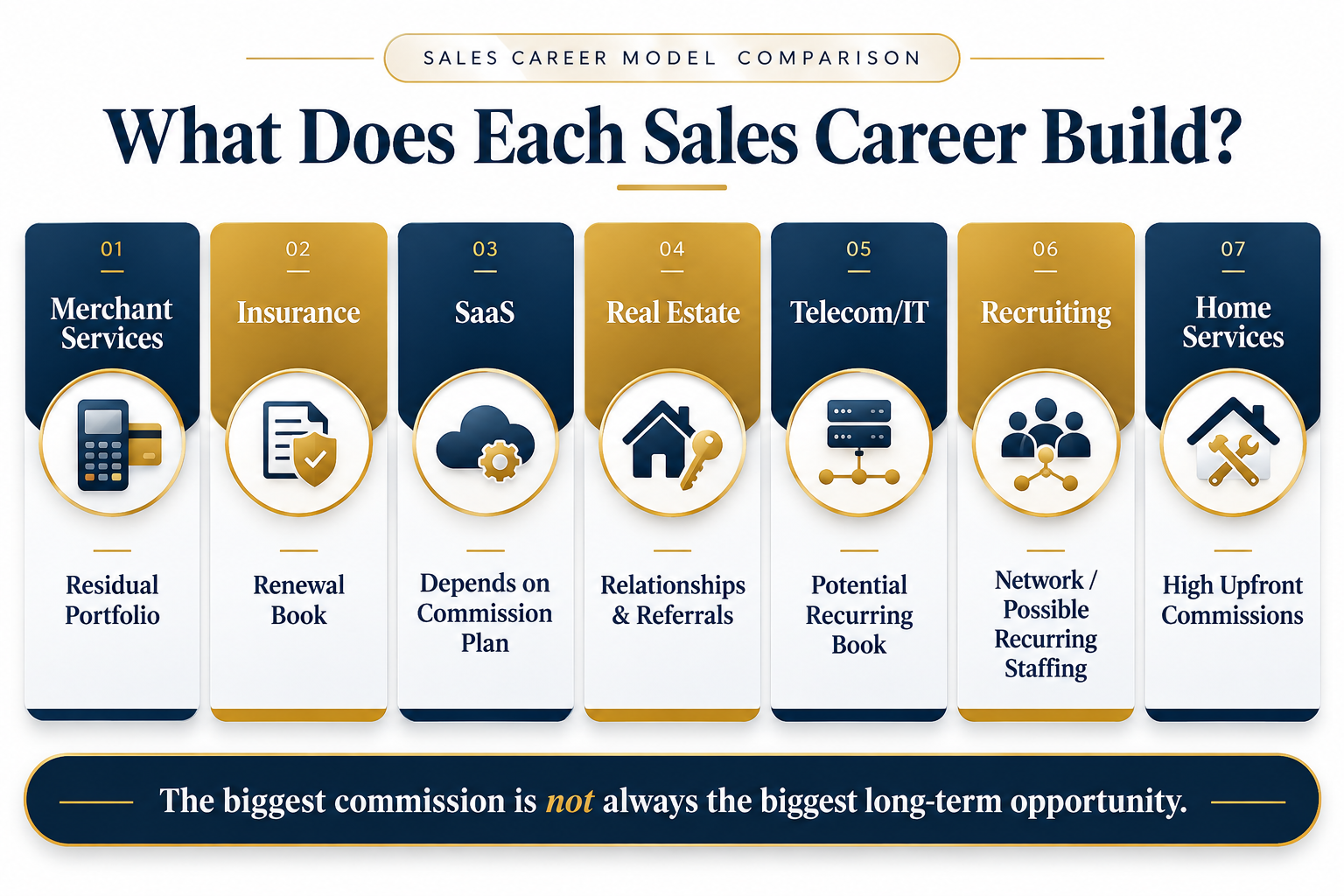
1. Merchant Services: Building a Residual Merchant Portfolio
Merchant services is the model I know best because it's where I've spent the majority of my career.
A merchant-services agent helps businesses establish payment-processing and commerce solutions through a processing partner. Depending on the agent agreement, the merchant's ongoing processing activity can potentially generate recurring residual compensation for the salesperson who acquired the account.
That changes the way you evaluate the customer.
Merchant number one may produce a relatively modest residual. Merchant number ten adds to the first nine. Merchant number fifty can potentially sit on top of an existing base of active accounts rather than replacing everything that came before it.
The goal is not merely to close another merchant.
It's to build and retain the portfolio.
That's why I believe merchant-services passive income is better understood as residual income. The portfolio requires work to create, merchants need to remain active, and your contractual rights matter, but previous production can potentially continue contributing while you add new business.
2. Insurance: Building a Renewal Book
Insurance is probably one of the best-known book-of-business careers.
A producer can write new policies and, depending on the carrier and compensation arrangement, potentially participate in renewal commissions as existing clients renew their coverage. Current insurance recruiting listings still explicitly advertise the ability to build a book that can produce recurring renewal commissions, illustrating how central the book-of-business model remains to insurance sales.
The tradeoff is that insurance generally has licensing requirements and can require substantial product and regulatory knowledge. That's not necessarily a disadvantage. A barrier to entry can actually be valuable for professionals who are willing to master the field.
For the right salesperson, insurance can create a powerful long-term career because the customer relationship doesn't necessarily end after the first policy is written.
3. SaaS, Telecom, and Recurring B2B Services
Recurring-service companies can also create book-of-business opportunities, but salespeople need to examine the compensation plan carefully.
The company may collect monthly subscription revenue from a customer for years. That does not automatically mean the salesperson receives recurring commissions for years.
Those are two completely different things.
A SaaS company can have incredible recurring revenue while paying its salesperson entirely through a one-time commission or quota-based compensation plan. Another independent program may give a rep continuing participation while the account remains active.
If recurring income is important to you, don't ask only:
Does the company have recurring revenue?
Ask:
Do I participate in the recurring revenue, for how long, and under what conditions?
That question can save you years of misunderstanding.
4. Real Estate: Building a Relationship and Referral Book
Real estate illustrates another type of long-term sales value.
A typical real-estate transaction does not create an automatic monthly residual merely because the buyer continues living in the house. The agent generally needs another transaction to create another commission.
But that doesn't mean previous customers stop mattering.
The National Association of REALTORS' 2026 Member Profile reported that the typical REALTOR received 28% of business from repeat clients and customers and another 22% from referrals from past clients and customers in 2025.
That's a powerful reminder that even a transaction-driven career can become less dependent on strangers when relationships are maintained well.
NAR also emphasizes the importance of post-transaction follow-up because repeat and referral relationships can continue feeding an agent's future pipeline long after closing.
Real estate isn't therefore the same residual model as merchant services.
But it demonstrates the larger principle:
A customer shouldn't automatically disappear from your business just because the original transaction is complete.
Which Type of Book Is Best?
There isn't one answer.
A renewal model may fit someone who loves maintaining long-term advisory relationships.
A relationship-and-referral model may work beautifully for someone who is highly networked.
A recurring contract model may be attractive to a technology salesperson.
A residual model may appeal strongly to someone who wants active customer accounts to continue contributing to compensation while they build additional business.
The more important question is whether the model matches the career you want.
Career Model | Typical Long-Term Value | Does Previous Business Potentially Pay Again? | What Drives Future Value? |
|---|---|---|---|
Merchant Services | Residual portfolio | Potentially recurring | Merchant activity + retention + agreement |
Insurance | Renewal book | Potentially at renewal | Policy retention + renewal terms |
SaaS / Recurring B2B | Account book | Depends on comp plan | Subscription retention + agreement |
Real Estate | Relationship book | Usually through future transaction | Repeat clients + referrals |
High-Ticket Transaction Sales | Network / reputation | Usually another sale required | New transactions + referrals |
The purpose of this comparison isn't to announce a winner.
It's to make you stop comparing careers by the first commission alone.
What Happens if You Spend Ten Years in Each Model?
This is the question I wish more salespeople would ask before choosing a career.
Suppose you're going to prospect hard for the next decade either way.
You're going to make the calls.
Run the appointments.
Attend networking events.
Follow up.
Deal with rejection.
Close customers.
If you're going to put in ten years of work, what could exist at the end of those ten years because of the customers you acquired along the way?
In one career, you may have an excellent résumé and years of great commission checks.
In another, you may also have a book producing renewal income.
In another, you may have recurring contracts.
In another, a referral network.
And in merchant services, depending on your agreement and merchant retention, you may have an active residual portfolio.
That's why this isn't really a conversation about finding an easier sales career.
It's about choosing where you want the difficult work to lead.
This Is Especially Important for Commission-Only Salespeople
If you're already accepting the risk of commission-only sales, I think you should be particularly demanding about the economics.
You're taking the risk of not having a guaranteed salary.
You're responsible for creating production.
You're generating the customers.
You're dealing with the highs and lows of variable income.
So what do you receive in exchange?
Only the immediate commission?
Or can the customer create something more?
That's why we compared multiple industries in Best Commission-Only Sales Jobs for Entrepreneurs Who Want Recurring Income.
A large one-time commission can absolutely be worth taking.
But don't assume the highest immediate check automatically creates the strongest career.
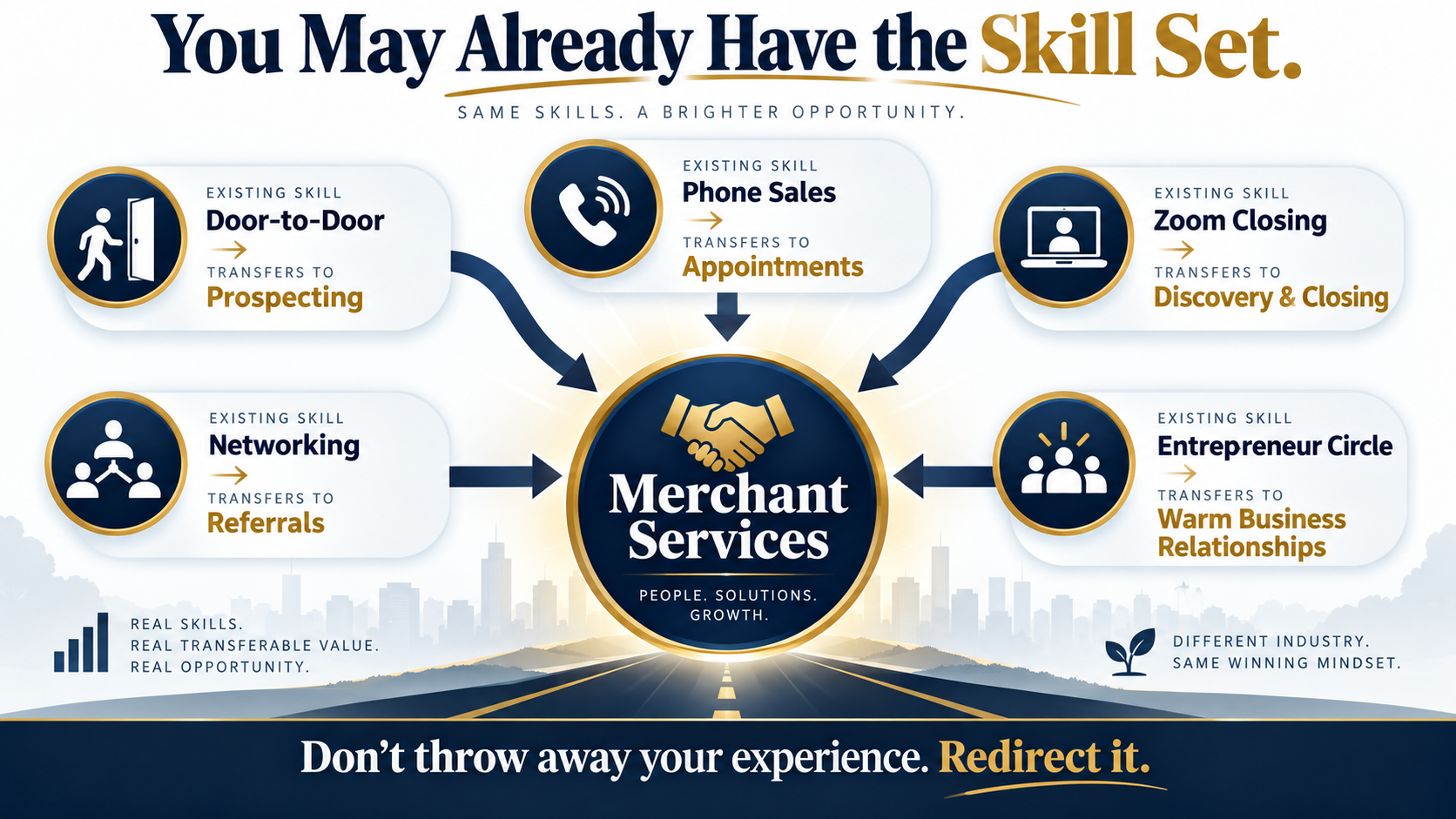
You May Already Have the Skills Needed to Build a Book
This is the part I especially want experienced salespeople to understand.
A book of business doesn't build itself.
Someone has to acquire the customers.
If you've already spent years selling, you may already have the most difficult part of the skill set.
If You Have Outside-Sales Experience
You've learned how to approach people who aren't waiting for you. You understand territory management, rejection, face-to-face discovery, and relationship development. Those skills can transfer extremely well into merchant services, insurance, real estate, and other relationship-driven businesses.
If You've Sold by Phone
You know how to create activity deliberately instead of waiting for leads. You understand list building, outreach, appointment setting, follow-up, and pipeline management. Those skills can translate directly into recurring B2B models.
If You're a Zoom or High-Ticket Closer
You understand discovery, presentations, objections, and asking someone to make a decision. The product may change, but the mechanics of consultative selling don't suddenly disappear.
If Networking Is Your Strength
A book-of-business career can become especially powerful because relationships create additional relationships. One merchant can introduce another merchant. One insurance client can introduce another business owner. One real-estate customer can produce future referrals.
If You Already Know Entrepreneurs
You may already possess a valuable starting network. Business owners you've met through work, friends, professional groups, prior customers, community involvement, and existing ventures can become potential conversations or referral relationships.
This is one reason I keep telling experienced salespeople:
You may not need a new skill set. You may need a better vehicle for the skill set you've already built.
Building a Book Changes How You Think About Retention
One of the biggest differences between transaction thinking and portfolio thinking is what happens after the close.
If your entire commission has already been paid and the customer leaving has no effect on you financially, it's easy for your attention to move immediately to the next sale.
When recurring compensation depends on customers remaining active, retention becomes economically personal.
That doesn't mean you personally solve every service issue.
It means you care deeply about whether the organization you're partnering with takes care of your customers.
This is one reason merchant support matters so much in merchant services.
Poor support isn't only inconvenient.
It can shorten the economic life of the portfolio you're trying to build.
The Company You Choose Becomes More Important When You're Building Long Term
If you're taking a temporary sales job, you might care primarily about what the next six months look like.
If you're planning to spend years building a customer book, the relationship deserves much more scrutiny.
In merchant services, I want to understand:
How residuals are calculated.
What the Schedule A looks like.
Whether residuals vest.
What happens if I stop producing.
What happens if I leave.
What happens if the company is acquired.
What happens to my residual rights.
What merchant support looks like.
What technology is available.
How transparent reporting is.
And whether important promises are actually written into the agreement.
That's why How to Choose a Merchant Services Agent Program and 11 Questions to Ask Before Signing a Merchant Services Agent Agreement matter so much more when you begin thinking in decades instead of commission periods.
A Higher Percentage Doesn't Automatically Create a Better Book
This is another trap in merchant services.
Company A says 60%.
Company B says 50%.
So the salesperson concludes that Company A obviously has the better residual opportunity.
Not necessarily.
Your split applies to underlying economics.
You need to understand the costs before the remaining eligible profit is divided.
A clean 50% arrangement with favorable underlying economics can potentially produce more than a 60% arrangement where the Schedule A contains materially higher costs.
That's why I wrote Merchant Services Residual Splits Explained and Merchant Services Schedule A Explained.
When you think in terms of one merchant, small cost differences can look insignificant.
When you think in terms of hundreds of merchants over many years, those same differences can become much more important.
Residual Income and Residual Rights Are Different Things
This may be even more important.
You can have a great residual percentage today and weak rights to the residual tomorrow.
Suppose you build for five years and then stop producing.
Do you continue receiving residuals?
What if you change companies?
What if you retire?
What if the upstream company gets acquired?
What if you die?
What if you eventually want to transfer or sell whatever rights you have in the portfolio?
The answer depends on the agreement.
Don't assume the phrase lifetime residuals solves all of those questions.
Read What Do Lifetime Residuals Really Mean in Merchant Services?.
If you're deliberately choosing a career because you want to build a book, you should understand what rights you actually have to the book.
Is a Book of Business Actually an Asset?
Potentially, but you need to be careful with that language.
Some books of business can have meaningful economic or transferable value. Insurance books can be bought and sold under appropriate arrangements. Professional practices can have client-book value. Recurring service contracts can create enterprise value.
In merchant services, however, you should never simply assume your residual portfolio can be sold, transferred, inherited, or assigned.
Your contract determines those rights.
That's why I prefer telling agents:
Build like it's an asset, but verify what you actually own.
You don't want to discover after years of production that your interpretation of "my portfolio" and the company's contractual definition were completely different.
A Book of Business Does Not Mean You Stop Prospecting
This also needs to be clear.
Portfolio building isn't an excuse to become lazy.
A book can shrink.
Customers leave.
Businesses close.
Policies don't renew.
Software accounts cancel.
Merchants switch providers.
Real-estate clients move away.
Attrition exists in every customer business.
The goal isn't to build ten customers and retire.
The goal is to create a growing base that gives new production something to stack on top of.
That can change your career psychologically as much as financially.
Instead of waking up thinking:
I need enough new sales to create all of this month's income again,
you can begin thinking:
I have a base. Now what am I adding to it?
That's the model we'll explore more deeply in How to Build Recurring Income as a Salesperson Without Starting Over Every Month.
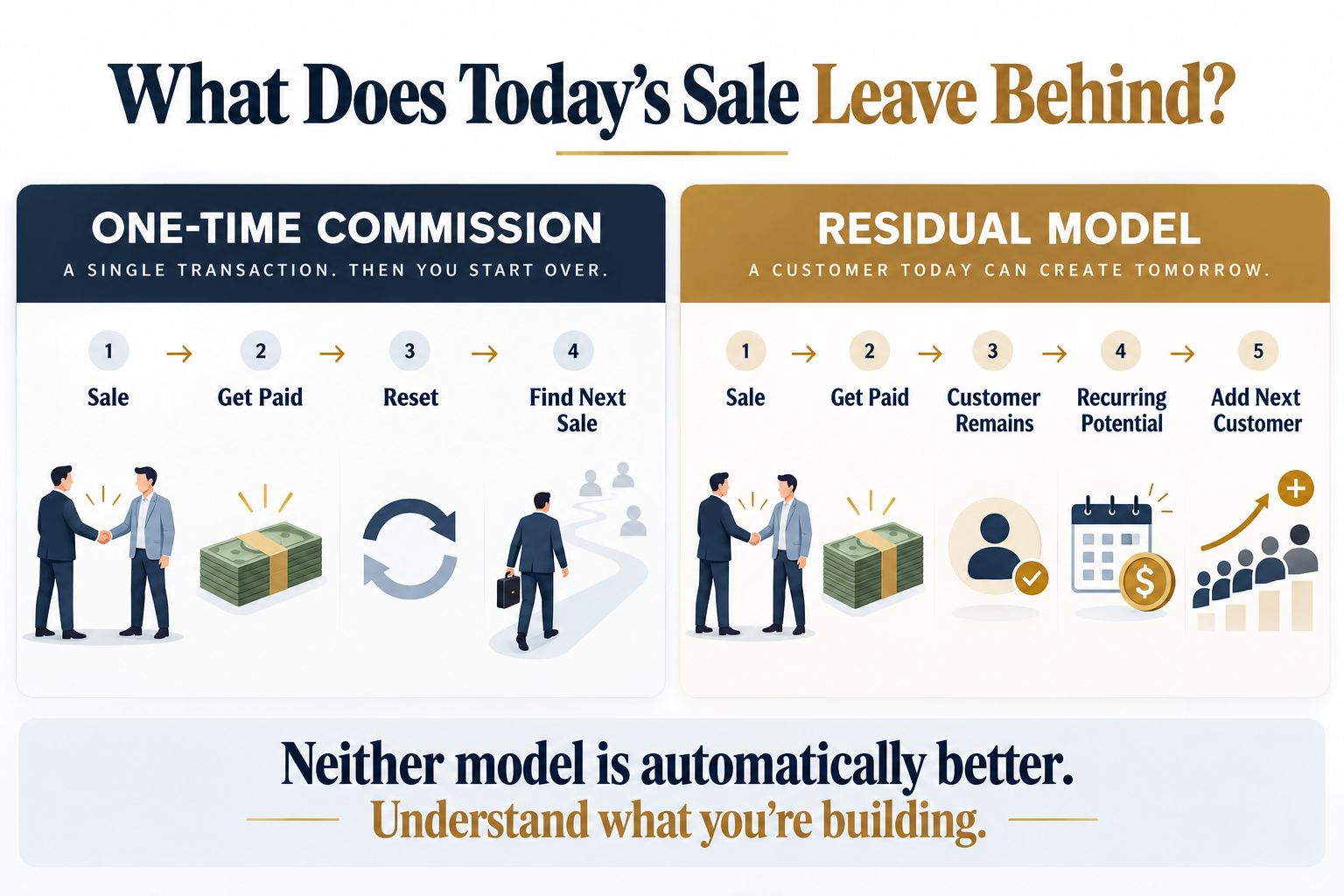
What if You Prefer Big Upfront Commissions?
Then don't force yourself into a residual model simply because recurring income sounds sophisticated.
There are salespeople who are extremely good at high-ticket transactional sales and love the economics.
They close.
They get paid well.
They invest the money.
They don't care whether the customer creates a residual.
That's a completely legitimate strategy.
Some merchant-services agents also care heavily about upfront compensation, particularly while they're building the portfolio.
One partner I work with can pay up to $10,000 upfront on certain qualified merchant accounts based on merchant profitability and program requirements. That does not mean every deal pays $10,000, and no particular commission is guaranteed, but it shows why the conversation doesn't always need to be upfront or recurring.
Depending on the partner, there may be opportunities to balance both.
Read Upfront Commissions vs. Residual Income in Merchant Services if that's important to your decision.
Your Goal Should Determine the Career
This is where I want you to stop listening to generic career lists and think about your actual life.
If your goal is maximizing cash over the next twelve months, your ideal sales career may look one way.
If you're trying to build a five- or ten-year book, it may look completely different.
If you want to work primarily from home, certain recurring B2B models become more attractive. We'll cover that specifically in Home-Based Business Ideas for Salespeople and Experienced Closers and Can You Sell Merchant Services From Home?.
If you want relatively low startup overhead, that's another consideration.
If you want licensing to create a professional barrier to entry, insurance or other regulated professions may appeal to you.
If you already know hundreds of business owners, B2B relationship businesses deserve special consideration.
There is no universal best career.
There is a best fit for what you're trying to build.
Why Merchant Services Fits the Experienced Salesperson So Well
This is where I think merchant services deserves more attention outside the payments industry.
A good salesperson doesn't need to suddenly become a software developer, inventory expert, content creator, media buyer, or manufacturer to participate in the business.
You can work through an established payments organization that already provides the underlying processing infrastructure.
You learn the industry.
You learn the solutions.
Then you apply the skills you already have.
Phone sales.
In-person sales.
Zoom.
Networking.
Referrals.
B2B relationships.
And unlike many transactional sales models, the merchant you acquire today can potentially remain economically relevant next month.
That's a strong combination.
Not easy.
Not guaranteed.
But strategically interesting.
Don't Buy Another Business Opportunity Just Because You're Tired of Your Career
This is another trap.
You become frustrated with starting over, so you search for passive income.
Then an advertisement finds you.
Now you're buying a $10,000 or $20,000 business opportunity because the seller says you can replace your income without the work you currently hate.
Slow down.
The problem may not be that you need a completely different skill set or some secret online business model.
You may simply need a career where your existing sales abilities create longer-term economics.
That's why I wrote Online Business Ideas in 2026: Stop Buying the Dream and Evaluate the Business Model.
And if startup cost is part of your concern, read Low-Cost Business Ideas for Salespeople Who Already Know How to Sell.
Use the experience you already have before paying someone to teach you how to become somebody entirely different.
How I Would Evaluate a Book-of-Business Opportunity
Before choosing one, I would answer eight questions.
1. What does the initial sale pay me? You still need cash flow, so upfront economics matter.
2. Does the customer create future compensation? Understand whether that means residuals, renewals, subscriptions, repeat transactions, or referrals.
3. What determines whether the compensation continues? Customer activity, contract renewal, retention, or another condition may control it.
4. What happens if I stop producing? This matters enormously if you're building for years.
5. Do I have contractual rights to the book? Don't assume ownership from recruiting language.
6. How difficult is customer retention? A recurring model with terrible churn is not automatically attractive.
7. Does my existing sales experience transfer? The more transferable your skills are, the less you're truly starting over.
8. What does ten years of successful production potentially leave behind? This is the question most career comparisons ignore.
If an opportunity looks great only when you avoid these questions, I wouldn't build my future around it.
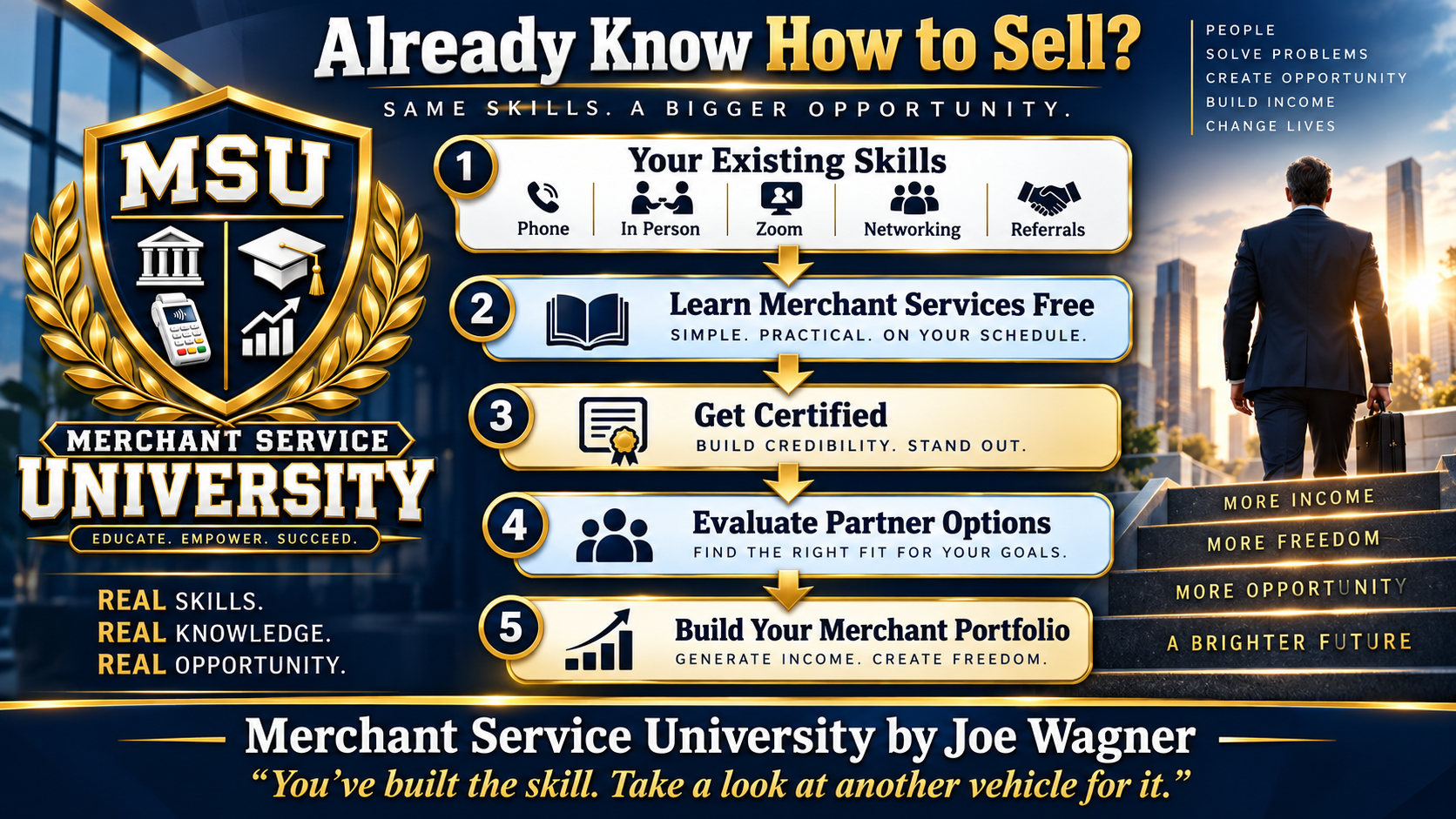
Take a Peek at Merchant Service University
If you're reading this because you're an experienced salesperson wondering whether merchant services could be your next book-of-business career, don't start by choosing a processing company.
Start with education.
I created Merchant Service University so people can understand this business before committing to one company or paying thousands of dollars simply to access the industry.
The core education is free.
You'll learn how payment processing works, how agents get paid, how residuals are calculated, what a Schedule A is, why agent agreements matter, how modern merchant technology works, how prospecting is done, and how a merchant portfolio is built.
If you've already sold door to door, over the phone, on Zoom, through networking, or through existing entrepreneur relationships, don't overlook how much experience you're bringing with you.
You're not necessarily starting your career over.
You're learning how to point that experience at a different business model.
Take a peek at Merchant Service University. Learn the industry first. Then decide whether you want to build in it.
Frequently Asked Questions About Sales Careers That Build a Book of Business
What is a book of business in sales?
A book of business is the collection of customers, accounts, policies, contracts, or client relationships a salesperson or business has developed. Depending on the industry, the book may generate residual income, renewals, subscriptions, repeat transactions, referrals, or other long-term economic value.
What sales careers build a book of business?
Examples can include merchant services, insurance, financial services, certain recurring SaaS or telecom programs, staffing, real estate, and other relationship-based or recurring-revenue businesses. The type of long-term value differs by industry.
What sales careers offer residual income?
Merchant services and certain recurring B2B sales programs can potentially provide ongoing residual or recurring commissions from active customer relationships. Compensation varies substantially by company and agreement.
Is insurance a book-of-business career?
Yes. Insurance producers can build books of policies that may generate renewal commissions depending on the carrier and compensation arrangement.
Does real estate create a book of business?
Yes, although it generally operates differently from a direct residual model. Past clients and relationships can generate repeat transactions and referrals rather than an automatic monthly commission.
Does SaaS create recurring commissions for salespeople?
Sometimes. A SaaS company having recurring subscription revenue does not automatically mean the salesperson receives recurring commissions. The compensation plan determines whether the rep participates after the initial sale.
What is the difference between a pipeline and a book of business?
A pipeline contains potential future sales that have not yet closed. A book of business contains customers or relationships already acquired that may create future revenue, renewals, repeat business, referrals, or residual compensation.
Can merchant services build a book of business?
Yes. Merchant-services agents can potentially build portfolios of active merchant accounts that generate recurring residual compensation according to the program economics and agent agreement.
Do merchant-services agents own their book of business?
Not automatically. Ownership, transfer rights, residual rights, vesting, and what happens after termination depend on the specific agent agreement.
Can a book of business be sold?
Some books of business can have transferable economic value, but sale or assignment rights depend on the industry, agreements, licenses, and specific contractual terms. Merchant-services agents should never assume their portfolio can be sold without reviewing their agreement.
Are lifetime residuals guaranteed?
No. Merchant activity, retention, contract provisions, vesting, and other conditions can affect continuing compensation. The actual agreement matters more than the phrase "lifetime residuals."
Do experienced sales skills transfer to book-of-business careers?
Yes. Phone prospecting, outside sales, Zoom closing, discovery, networking, referrals, relationship development, and B2B experience can transfer well into many book-of-business careers, although industry-specific education may still be required.
Should I choose recurring income over a larger upfront commission?
Not automatically. The right decision depends on your cash-flow needs, recurring economics, customer retention, contractual rights, sales cycle, and long-term goals.
Is Merchant Service University free?
Yes. The core Merchant Service University education is free and does not require students to commit to one processing company.
Where should I start if I want to build a merchant-services portfolio?
Start with Merchant Service University to learn the industry, then use How to Become a Merchant Services Agent in 2026 to understand the path from education through partner selection and portfolio building.
Final Takeaway: After Ten Years of Selling, What Do You Want to Be Left With?
There is nothing wrong with making great commissions.
I've made plenty of them.
The question is whether commission alone is the only thing you want your career to produce.
If you are going to spend the next ten years making calls, walking into businesses, running Zoom appointments, networking, following up, overcoming objections, and closing customers, I think you should understand what those years can potentially leave behind.
Maybe you want an insurance renewal book.
Maybe you want a real-estate relationship network.
Maybe you want recurring SaaS or business-service accounts.
Maybe you love large transactional commissions and have no interest in residuals at all.
That's okay.
But if you're an experienced salesperson who is tired of repeatedly rebuilding the same income, merchant services deserves consideration because it allows you to think differently about what happens after the sale.
The merchant can become part of a portfolio.
The portfolio can potentially create recurring residual compensation.
New production can be added to existing production rather than replacing it.
And the skills required to acquire those merchants may be skills you've already spent years developing.
That is the part I want experienced salespeople to understand.
You may not be starting over professionally.
You may simply be redirecting everything you've learned toward something designed to accumulate.
If that idea catches your attention, don't choose a company yet.
Go to MerchantServiceUniversity.com.
Take a peek at the free core training.
Learn how merchant services actually works.
Then decide whether the next ten years of your sales ability should build more than the next ten years of commission checks.
About Joe Wagner
Joe Wagner has spent more than 16 years in merchant services and payment-processing sales, acquiring merchants, developing sales organizations, and building recurring residual portfolios.
He created Merchant Service University to help new and experienced salespeople understand the payments industry before committing their production to one processing partner. His education emphasizes compensation, contracts, residual rights, prospecting, merchant retention, and long-term portfolio building rather than focusing only on the next commission.
Joe also works with experienced professionals from phone sales, outside sales, Zoom closing, networking, referral, and B2B backgrounds who want to evaluate whether their existing skill set can be redirected toward a longer-term merchant-services business.
Continue with Sales Jobs With Residual Income, Merchant Services Passive Income, Best Commission-Only Sales Jobs for Recurring Income, How to Build Recurring Income as a Salesperson, or Merchant Services vs. Online Business Models.
Or begin with the free core education at Merchant Service University.