Sales Jobs With Residual Income: Stop Starting at Zero
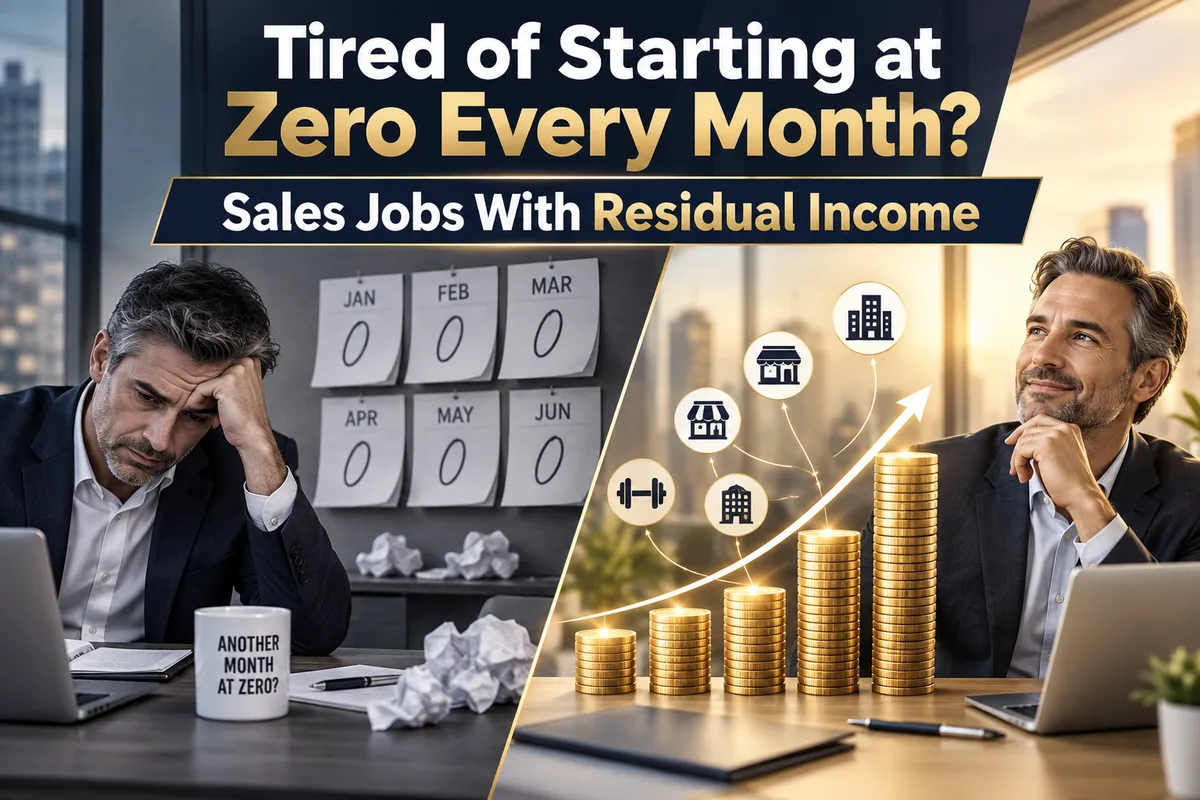
Tired of Starting at Zero Every Month? Sales Jobs With Residual Income
You can be great at sales and still be trapped in a compensation model you eventually hate.
You close the deal.
You get paid.
The month ends.
Then the scoreboard resets.
You wake up on the first of the next month and have to create the income all over again.
For some salespeople, that reset happens every month. For others, it happens every quarter or every January when a new quota year begins. You may have produced millions of dollars in revenue throughout your career, built relationships with hundreds of customers, and become exceptionally good at prospecting and closing, yet very little of yesterday's production continues paying you today.
If that frustration sounds familiar, you may not need to leave sales.
You may need to change what your sales are building.
That's why sales jobs with residual income deserve serious consideration, especially for people who are already willing to prospect, handle rejection, build relationships and close business.
I've spent more than 16 years in merchant services, and one of the biggest reasons I've stayed in this industry is that I stopped looking at sales as a series of disconnected commissions.
I started looking at merchants as a portfolio.
A merchant I acquire today can potentially continue contributing recurring residual compensation while that account remains active and my contractual rights remain intact.
Then I can add another merchant.
And another.
Instead of every month beginning at zero, the objective becomes building on what I've already done.
That is a very different way to think about a sales career.

Maybe You're Not Tired of Sales. You're Tired of the Reset.
There is a big difference.
A talented salesperson may actually enjoy selling.
You may like competing.
You may enjoy talking to people.
You may be comfortable asking for the business.
You may love the independence of commission compensation.
You may even prefer knowing that your production can directly affect your income.
The frustration comes when years of that effort leave very little behind.
Imagine selling successfully for ten years.
How many prospects did you contact?
How many presentations did you run?
How many objections did you overcome?
How many customers did you acquire?
How much revenue did those customers generate for the companies you represented?
Now ask a different question:
How much of that customer base are you still economically participating in today?
For a lot of salespeople, the answer is very little.
That's the problem this cluster of articles is going to explore.
You don't necessarily need an easier career.
You may need a sales model that gives your previous production a chance to continue mattering.
What Is Residual Income in Sales?
Residual income in sales generally refers to compensation that can continue after the original sale because the customer continues generating qualifying revenue.
The exact structure varies enormously by industry and agreement.
An insurance professional may receive renewal commissions.
A salesperson selling certain subscription services might participate in recurring account revenue.
Some telecom and business-services programs pay ongoing commissions while customers remain active.
Merchant-services agents can earn residual compensation from merchants they have previously acquired, depending on the economics of those accounts and the terms of the agent agreement.
The important difference is simple.
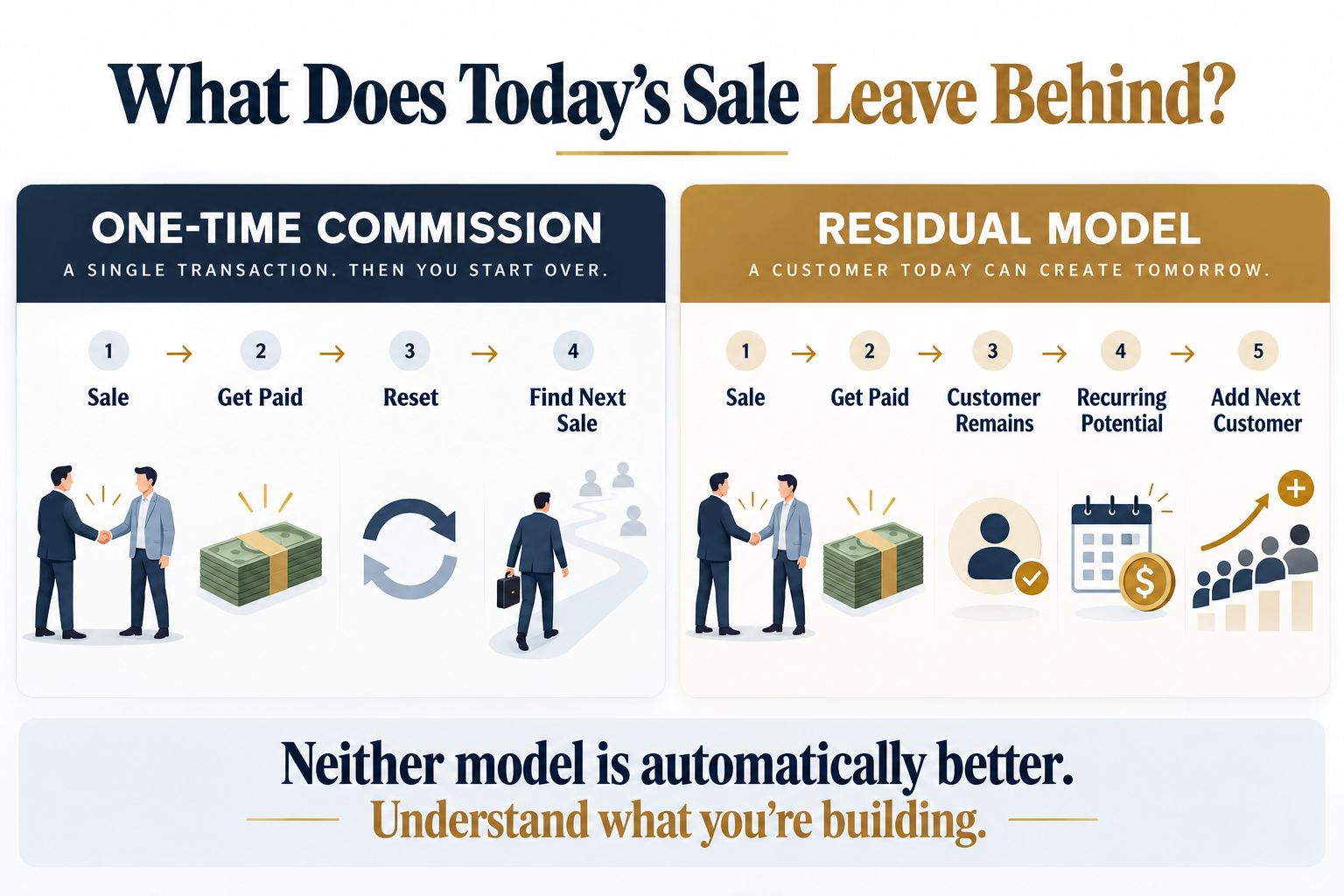
In a purely one-time commission model:
Sale → Commission → Finished
In a residual model:
Sale → Customer Remains Active → Potential Recurring Compensation
You still need new sales.
The business does not suddenly become effortless.
But your previous production may begin creating a base underneath your future production.
That's the concept.
Residual Income Is Not the Same Thing as Effortless Passive Income
This distinction matters.
People searching for recurring income frequently use the phrase passive income, and we're going to address that directly in Can Merchant Services Create Passive Income? How Residual Income Really Works.
For merchant services, I prefer residual income because it's more accurate.
You must acquire the merchant first.
The merchant needs to remain active.
Merchant processing can change.
Businesses close.
Merchants can switch providers.
Your agent agreement matters.
Support and retention matter.
So I would never tell someone:
"Make one sale and get guaranteed money forever."
That's not the business.
The advantage is that you don't necessarily need to resell the same merchant every month for an active account to continue contributing to your residual portfolio.
That's what makes the model interesting.
The Question Salespeople Should Be Asking
Most salespeople compare opportunities using questions like:
How big is the commission?
How high is the OTE?
How fast do I get paid?
Are leads provided?
Is there a base salary?
Can I work remotely?
Those are legitimate questions.
But an experienced salesperson should add another:
What does today's sale leave behind for me?
Suppose you sell something that pays you $5,000 once.
That can be a fantastic commission.
Now suppose another business model pays less upfront but creates recurring economics from the customer relationship.
Which is better?
There is no universal answer.
It depends on the compensation, retention, opportunity cost, contractual rights and your personal goals.
This is why we've also created Best Commission-Only Sales Jobs for Entrepreneurs Who Want Recurring Income. The point isn't to pretend every salesperson should make the same choice.
The point is to begin comparing business models, not merely commission checks.
You May Already Have the Hardest Skill
This is where I want experienced salespeople to pay attention.
If you've spent years in sales, you may already possess many of the hardest skills required to become productive in merchant services.
You still need to learn the payments industry.
You still need to understand the products.
You need to understand pricing, residuals, agreements and merchant technology.
But you may not need to reinvent yourself as a salesperson.
If You've Done Door-to-Door or Outside Sales
You already understand something many people never develop:
How to create a conversation when nobody invited you.
You know rejection.
You know territory management.
You know how to walk into a business cold.
You know how to recover when someone tells you no.
You know how to create activity without waiting for an inbound lead.
Those skills translate extremely well into local merchant acquisition.
The product changes.
The psychology of creating a conversation doesn't.
If You've Sold Over the Phone
You already understand outbound activity.
You know how to work a list.
You know how to get past the first few seconds of a cold call.
You know how to ask for an appointment.
You know how to follow up.
You understand that one hundred conversations don't produce one hundred deals.
Merchant services can be prospected heavily by phone, which means the skill you've already developed can have direct application.
We will go much deeper into this in Can You Sell Merchant Services From Home? Phone, Zoom & Remote Sales Explained.
If You've Closed High-Ticket Offers on Zoom
You probably understand discovery.
You know how to ask questions.
You know how to identify pain.
You know how to present value.
You understand objection handling.
You're comfortable asking someone to make a business decision.
Those skills matter in merchant services too.
The difference is that instead of selling another one-time high-ticket offer and moving on forever, you can potentially use those closing skills to acquire merchant relationships that contribute to a longer-term portfolio.
If You're Good at Networking
Maybe you've never been a stereotypical salesperson.
But everybody seems to know you.
You connect people.
Business owners trust you.
You attend events.
You generate introductions.
People ask you who they should use.
That is a sales asset.
Merchant services is ultimately a relationship business.
You may not need thousands of cold leads if you already have access to a community of business owners.
If You Already Know Entrepreneurs
Look through your phone.
How many business owners do you know?
Restaurant owners?
Contractors?
Salon owners?
Gym owners?
Consultants?
Doctors?
Dentists?
Retailers?
E-commerce entrepreneurs?
Professional-service companies?
Those relationships may already represent the beginning of a merchant prospecting network.
I'm not suggesting you spam everybody you know.
I'm saying recognize the business development asset you've already built.
You may have spent years creating the network and sales skills.
Now ask whether there is another business model you could apply them to.

You May Not Need a New Skill Set. You May Need a Better Vehicle.
This is one of the most important ideas in this entire cluster.
A salesperson gets frustrated with their career.
So they decide they need to become something completely different.
They buy a course on e-commerce.
Then affiliate marketing.
Then an agency model.
Then trading.
Then whatever online business happens to be popular that year.
Now they're trying to become a media buyer, programmer, content creator, product designer or supply-chain expert when their strongest existing competitive advantage was sales.
There is nothing wrong with those businesses.
But why discard a skill you've spent ten years developing?
Our upcoming guide to low-cost business ideas for salespeople will explore this much more deeply.
For an experienced salesperson, I believe the better question is:
What business model makes my existing skills more valuable?
That's a very different question from:
What is the easiest business to start online this year?
Why Merchant Services Fits This Conversation
Merchant services isn't the only residual-income sales industry.
I'm not going to pretend it is.
Insurance can create renewals.
Certain financial-services businesses can build books.
Some SaaS, telecom and recurring B2B services have recurring commissions.
There are other models.
But merchant services deserves to be in that conversation because of several characteristics.
Businesses already need ways to accept payments.
You do not have to manufacture the underlying product.
You can operate through an established payments organization rather than building the entire processing infrastructure yourself.
Depending on the partner, compensation can include both upfront money and recurring residual income.
And the merchant relationships you acquire can potentially accumulate into a portfolio over time.
For me, that's the important part.
The sale can become more than the commission.
You Don't Need to Build a Payment Processor
A lot of entrepreneurial salespeople hear "build your own payments business" and assume they need to create payment technology, register their own ISO immediately, manage risk and underwriting, and build a customer-support department.
You don't.
An independent sales agent can work through an established organization that already provides the backend infrastructure.
I've explained the difference in Merchant Services Agent vs. ISO.
A strong processing partner can handle much of the operations.
You focus on the part you're already good at:
Creating business.
This matters because it allows experienced salespeople to leverage their existing skill set without first becoming experts in every backend function of the payment industry.
You Also Don't Need a Huge Buy-In Just to Learn the Business
This was one of the reasons I created Merchant Service University.
I became tired of watching people online sell expensive access to the merchant-services industry and then hearing from people who had paid for some of those programs but still felt unprepared afterward.
I make my living in merchant services.
I don't need to make my living selling you a high-ticket course about merchant services.
So I invested my own time and money into building a real educational process and made the core training free.
If you're curious about the business but aren't ready to make a career decision, that is exactly what MSU is for.
You can also read Can You Start Selling Merchant Services for Free? for a realistic breakdown of what you should and should not expect to pay for.
Take a Peek at Merchant Service University
If you've spent years selling, I'm not asking you to throw away everything you know and start over.
I'm asking you to look at another vehicle for those skills.
Merchant Service University will teach you how payment processing works, how merchant-services agents are compensated, how residuals work, what a Schedule A is, what to look for in an agreement, how merchant technology works, and how agents prospect and build portfolios.
The core education is free.
There is no obligation to join one specific processing company.
Take a peek. Learn how the model works. Decide for yourself whether it deserves more of your attention.
How Merchant Services Residual Income Actually Works
The basic concept is straightforward.
You acquire a merchant.
The merchant processes payments through the relationship you've helped establish.
The economics of that account generate eligible residual profit according to the program.
Your agreement determines your share and your rights.
As long as the merchant remains active and the applicable contractual conditions remain satisfied, the account can potentially continue contributing residual compensation.
That's why you need to understand more than the phrase residual income.
You need to understand:
Your residual split.
The Schedule A.
Vesting.
Termination provisions.
Merchant retention.
Support.
Pricing.
If you're new to those concepts, start with How Merchant Services Agents Get Paid, then read Merchant Services Residual Splits Explained and What Lifetime Residuals Really Mean.
A Residual Portfolio Changes the Math of a Sales Career
Imagine two salespeople.
Both can close.
Both prospect consistently.
Both work hard.
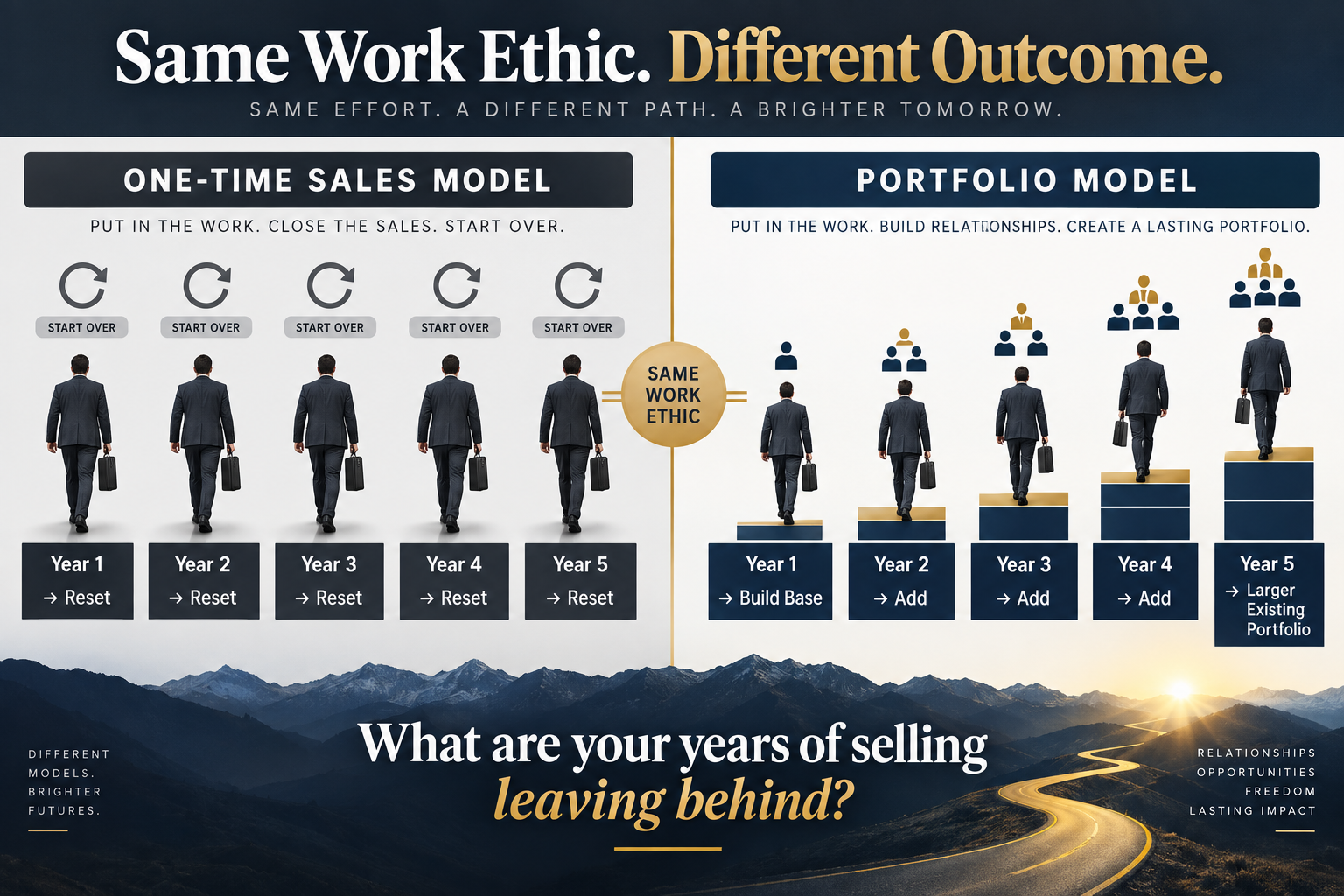
Salesperson A gets paid a one-time commission every time they make a sale.
Salesperson B sells within a model where previous active customers can continue contributing recurring compensation.
At the beginning, Salesperson A may even make more money.
That's important to acknowledge.
Recurring-income models don't automatically win in Month 1.
The difference can emerge over time.
If Salesperson B keeps acquiring customers and retaining the previous ones, the salesperson may begin each new month with an existing portfolio underneath the new production.
That changes the equation.
Instead of:
How much can I sell this month?
the question becomes:
How much have I already built, and what am I adding to it this month?
Our article How to Build Recurring Income as a Salesperson Without Starting Over Every Month will explore that model beyond merchant services.
This Is Why I Think Experienced Salespeople Can Have an Advantage
Notice I said advantage, not guaranteed success.
Someone who has never sold anything can absolutely learn merchant services.
But an experienced salesperson may arrive with years of transferable skills already built.
You understand rejection.
You understand pipeline.
You understand activity.
You know why follow-up matters.
You know that one good week doesn't make a career.
You know how to speak with decision-makers.
You know how to keep moving after losing a deal.
Those are difficult things to teach.
The payments knowledge can be learned.
That's why the person I'm most interested in reaching with this new content isn't necessarily someone looking for an easy side hustle.
It's the person who says:
"I'm already doing the work. I just want the work to build something more permanent."
That person should at least understand merchant services before dismissing it.
What Should You Look for in Any Residual-Income Sales Opportunity?
Residual compensation alone doesn't make an opportunity good.
Before joining any program, understand what creates the recurring revenue and what conditions govern your right to participate in it.
In merchant services, I would want to understand the residual split, underlying economics, vesting, what happens if I stop producing, what happens if I leave, merchant support, attrition and the overall agent agreement.
A company saying "lifetime residuals" is not enough.
The contract matters.
This is why I created How to Choose a Merchant Services Agent Program and 11 Questions to Ask Before Signing a Merchant Services Agent Agreement.
The more valuable you expect the portfolio to become, the more important these questions become.
Don't Chase Residual Income at the Expense of Cash Flow
There is another side to this.
You still have bills.
A residual portfolio may take time to develop.
That is why some experienced salespeople care heavily about upfront commissions while they're building recurring income.
The two models don't always have to be mutually exclusive.
Some merchant-services programs can include meaningful upfront compensation alongside residual economics.
One of the partners I work with can pay up to $10,000 upfront on certain qualified merchant accounts based on profitability and program requirements.
That does not mean every deal pays $10,000.
It is not guaranteed compensation.
But it demonstrates why an experienced closer should evaluate the full compensation model rather than assuming merchant services means waiting years to get paid.
I break that tradeoff down in Upfront Commissions vs. Residual Income in Merchant Services.
Your Existing Circle May Be More Valuable Than You Think
This is another reason sales veterans and entrepreneurs should consider the opportunity differently from a complete beginner.
You may already know your first prospects.
Think about the relationships you've built throughout your career.
Past customers.
Business owners.
Vendors.
Accountants.
Consultants.
Commercial real-estate professionals.
Insurance professionals.
Restaurant owners.
Contractors.
Gym owners.
Salon owners.
Local retailers.
Entrepreneurs you meet socially.
Again, the answer isn't to blast all of them with a generic sales pitch.
The opportunity is to recognize that you're not necessarily starting with zero relationships just because you're entering a new industry.
You have accumulated social capital.
If you learn merchant services properly, you may be able to use that network to begin having relevant business conversations.
That's very different from buying an online business course and then wondering where your first customer is supposed to come from.
What If You're Tired of Commission Sales Altogether?
Then merchant services may not be the answer.
That's worth saying clearly.
If what you really want is a guaranteed salary, predictable hours and no pressure to prospect, a commission-driven merchant-services business probably isn't what you're looking for.
But if what you're tired of is commission sales that never builds anything behind you, that's a different problem.
You may still enjoy performance-based work.
You may still want uncapped upside.
You may still want control.
You may simply want your effort to have a longer economic life.
That's the person this article is for.
From Salesperson to Portfolio Builder
The biggest mindset shift is moving from:
"How much did I make on this sale?"
to:
"What did this customer add to the business I'm building?"
That's portfolio thinking.
A merchant relationship can produce an upfront commission.
It may also produce recurring residual income.
It can create referrals.
It can deepen your business network.
It can become part of a book of merchants that may have value far beyond the first transaction.
That doesn't happen automatically.
You have to acquire and retain the merchants.
But you're finally playing a game where keeping the customer matters economically to you too.
Want a Sales Career That Builds a Book of Business?
That's exactly what we're going to explore in Sales Careers That Build a Book of Business Instead of Starting Over.
Because this issue goes beyond merchant services.
Experienced salespeople should be thinking about what happens after the transaction.
Are you building:
A customer base?
Renewals?
Recurring revenue?
Equity?
A transferable book?
A portfolio?
Or are you simply earning another commission?
There is nothing inherently wrong with a one-time commission.
But understand the trade.
If Merchant Services Caught Your Attention, Don't Join a Company Yet
Learn first.
That's the entire purpose of Merchant Service University.
Don't take this article as a recruiting presentation.
Don't take my word for the opportunity.
Go learn how payment processing works.
Learn how agents get paid.
Learn residuals.
Understand the Schedule A.
Learn what vesting means.
Understand merchant agreements.
Learn the technology.
Learn how the sales process works.
Then decide whether the industry fits you.
If it does, you can use my complete guide on How to Become a Merchant Services Agent in 2026 to understand the entire process from education through partner selection and portfolio building.

Frequently Asked Questions About Sales Jobs With Residual Income
What are sales jobs with residual income?
Sales jobs with residual income allow a salesperson to potentially continue receiving compensation from previously acquired customers while those accounts remain active and meet the requirements of the compensation plan. The structure varies by industry and company.
What industries offer residual commissions?
Residual or recurring commissions can exist in industries such as merchant services, insurance, telecom, financial services, SaaS and other subscription or recurring B2B service models. The specific compensation and continuing rights vary substantially.
Is residual income the same as passive income?
Not exactly. Residual income can continue from previous sales, but customer retention, account activity and contractual terms still matter. In merchant services, residual income is generally a more accurate term than completely passive income.
Why would an experienced salesperson consider residual-income sales?
An experienced salesperson may already have prospecting, discovery, closing, networking and relationship-building skills. A residual-income model can potentially allow those skills to build recurring economics behind new production rather than relying entirely on one-time commissions.
Do phone-sales skills transfer to merchant services?
Yes. Outbound calling, list building, appointment setting, follow-up and conversations with decision-makers can all transfer well to merchant-services prospecting, although the salesperson still needs to learn the payments industry and products.
Can high-ticket Zoom closers sell merchant services?
Many of the core skills can transfer, including discovery, objection handling, presenting value and closing. The salesperson must still learn payment processing, merchant economics, technology and the specific requirements of the partner they represent.
Can networking help me build a merchant-services portfolio?
Yes. Existing relationships with business owners and professional referral partners can create opportunities for merchant conversations. Relationships do not guarantee sales, but an established network can be a meaningful prospecting advantage.
Can merchant services generate residual income?
Merchant-services agents can potentially receive recurring residual compensation from active merchant accounts based on the economics and contractual terms of their agent program.
Do I need merchant-services experience if I already know how to sell?
You still need merchant-services education. Sales experience can provide a significant transferable foundation, but agents should understand processing, pricing, statements, compensation, agreements, technology and merchant needs before representing the industry professionally.
Is merchant services a commission-only opportunity?
Many independent merchant-services agent programs are commission-based, but compensation structures vary. Depending on the program, compensation may include upfront commissions, residual income or a combination of both.
Do merchant-services residuals last forever?
Not automatically. Merchant activity, retention, vesting and the agent agreement all affect continuing residual compensation. The phrase "lifetime residuals" should always be evaluated against the actual contract.
Can I start merchant services without spending thousands on a course?
Yes. The core Merchant Service University education is free, and it is possible to pursue merchant-services sales through established partners without paying a large fee simply for access to the industry. Normal business expenses can still vary.
Where should an experienced salesperson start?
Start by learning the merchant-services business at MerchantServiceUniversity.com. Then decide whether the compensation model, sales process and portfolio-building opportunity fit your goals.
Final Takeaway: Stop Changing Your Work Ethic. Change What the Work Is Building.
If you've spent years in sales, I don't think your first assumption should be that you need to reinvent yourself.
You may already know how to prospect.
You may already know how to close.
You may already be excellent on the phone.
You may already know how to run Zoom presentations.
You may already be comfortable walking into businesses.
You may already have a strong network of entrepreneurs.
You've spent years developing those abilities.
The question is:
What are those skills building for you?
If every month starts at zero, maybe the problem isn't your sales ability.
Maybe it's the compensation model you've attached that ability to.
Merchant services is not effortless.
It isn't guaranteed income.
And it isn't some easy online business where you press a button and wake up financially free.
It's a real sales business.
You need to learn it.
You need to prospect.
You need to acquire merchants.
You need to take care of those relationships.
But that's exactly why I believe experienced salespeople should look at it.
You already know how to do hard things.
Now consider whether those hard things could build a longer-term business behind you.
If you're curious, don't sign up for anything yet.
Go to MerchantServiceUniversity.com.
Take a peek at the free core training.
Learn how the business works.
Then decide for yourself.
You may not need a new skill set.
You may need a better vehicle for the one you've already built.
About Joe Wagner
Joe Wagner has spent more than 16 years in merchant services and payment-processing sales, acquiring merchants, building recurring-revenue portfolios and developing sales organizations.
He created Merchant Service University to provide free foundational merchant-services education before asking salespeople to choose a processing partner.
Joe works with both new agents and experienced sales professionals who want to understand how their existing abilities in phone sales, in-person selling, Zoom closing, networking, referrals and business development may transfer into the merchant-services industry.
After education and certification, Joe can also help qualified salespeople evaluate potential merchant-services partner relationships based on factors such as residual economics, upfront compensation, technology, underwriting and merchant support.
Continue with Can Merchant Services Create Passive Income?, Best Commission-Only Sales Jobs for Entrepreneurs Who Want Recurring Income, How to Build Recurring Income as a Salesperson, or the complete How to Become a Merchant Services Agent in 2026 guide.
Or take a peek inside Merchant Service University.