Can You Sell Merchant Services From Home? Phone, Zoom & Remote Sales Explained
Can You Sell Merchant Services From Home? Phone, Zoom & Remote Sales Explained
Yes, you can sell merchant services from home, and for the right salesperson, a large part of the business can be built from a phone, computer, CRM, and a disciplined sales process.
That does not mean you have to sell merchant services completely remotely. It also doesn't mean this is another "work from your laptop for two hours a day" business opportunity. Merchant services is still a real B2B sales business, and successful agents still need to prospect, create conversations, run appointments, follow up, close merchants, and help those relationships get properly established.
What has changed is how many different ways you can accomplish that work.
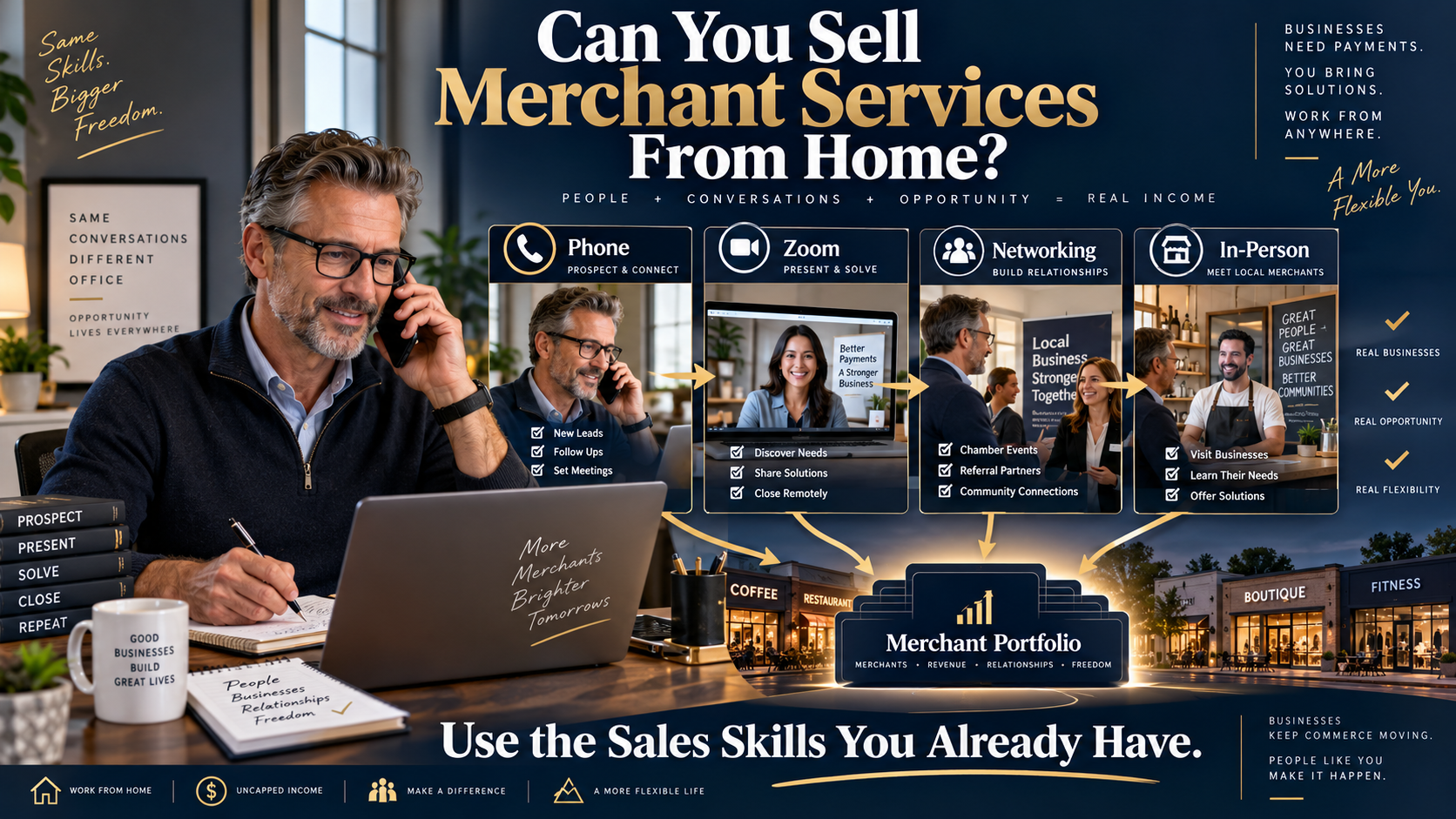
You can prospect businesses over the phone, run discovery conversations on Zoom, communicate by email and text, organize your pipeline through a CRM, complete much of the application process digitally, develop referral relationships remotely, and work an enormous amount of the business from a home office. At the same time, you can still meet merchants face to face whenever the opportunity or your personal selling style makes that the better choice.
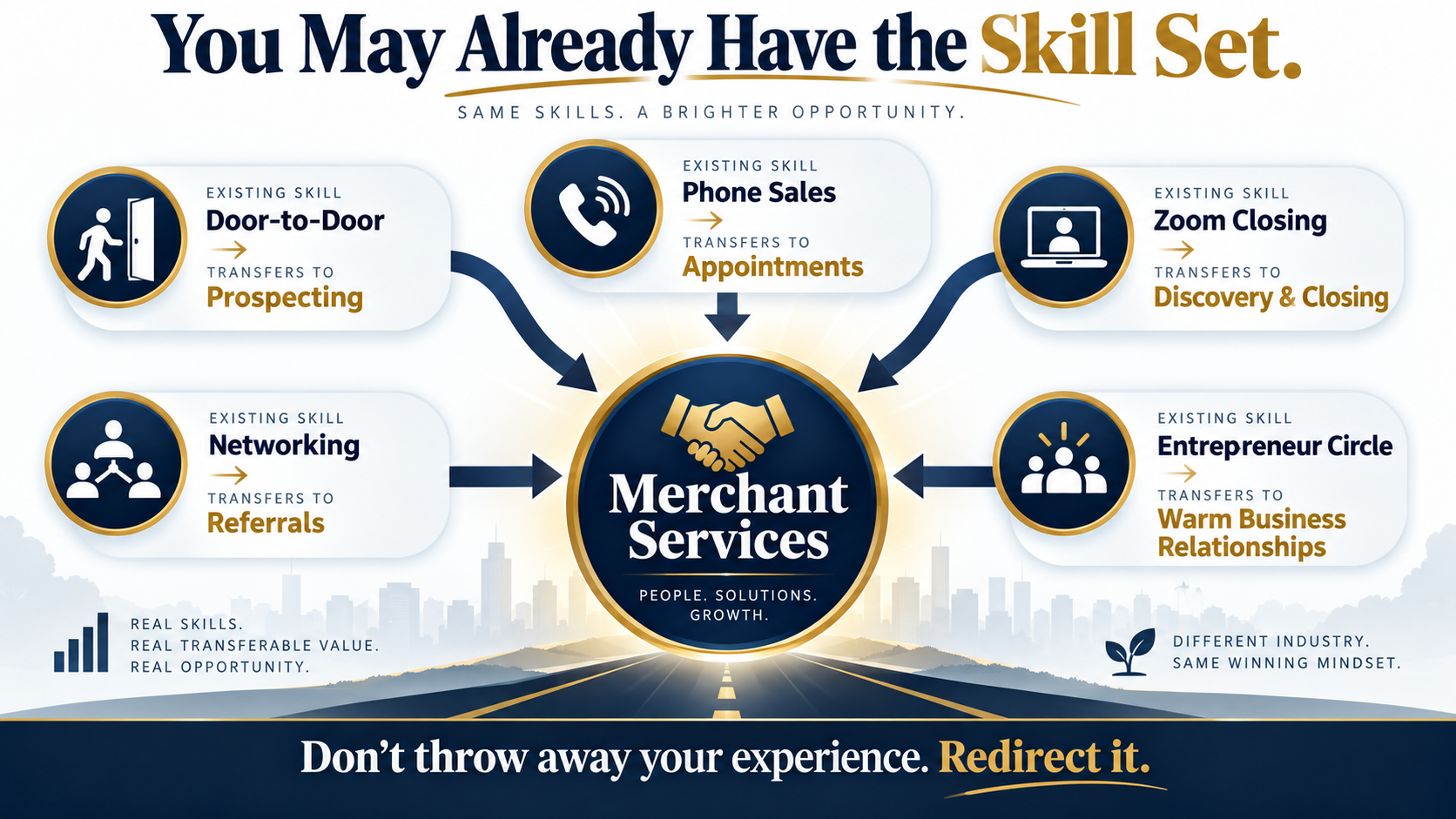
For someone who already has experience in phone sales, remote closing, Zoom presentations, networking, appointment setting, or B2B sales, that creates an important opportunity. You may not need to learn an entirely new way to sell. You may simply need to learn the payments industry and redirect the sales skills you've already spent years developing toward a business that can potentially build recurring residual income behind your production.
That's the distinction I want to make throughout this article.
You don't need to become the type of salesperson I am.
You need to figure out how to use the type of salesperson you already are.
Merchant Services Does Not Have to Be a Door-to-Door-Only Business
One of the misconceptions people have about merchant-services sales is that the only way to build a portfolio is to spend every day walking from business to business asking owners to look at their processing statements.
That approach absolutely works. Outside sales has been part of merchant services for decades, and I still believe an agent who is comfortable walking into businesses possesses a valuable advantage. Face-to-face selling can create trust quickly, gives you access to local merchants, and allows you to physically see how the business operates.
But it is not the only model.
I've trained salespeople on both door-to-door prospecting and phone-to-appointment sales because different people have different strengths. A salesperson who has spent ten years closing over the phone shouldn't automatically throw that experience away because somebody told them merchant services must be sold one way.
The goal isn't to force yourself into somebody else's prospecting personality.
The goal is to consistently get in front of qualified business owners.
If your phone can do that, use the phone. If Zoom helps you run strong discovery meetings, use Zoom. If networking is your strength, build referral relationships. If walking into a business is where you're most confident, get out into the market.
A strong merchant-sales business can combine all of them.
The Remote Merchant Services Model Is Really a Sales System
When people hear "work from home," they sometimes picture a location. I think it's more useful to picture a system.
Your home office becomes the operating base for prospecting, research, appointment setting, follow-up, training, pipeline management, and merchant communication. From there, the individual opportunity determines what happens next.
A local prospect may prefer to meet face to face. Another business owner may happily discuss their needs by phone. A multi-location operator might prefer a scheduled Zoom presentation. A referral partner may introduce you through email and allow you to take the conversation from there.
The important part is that the system consistently moves prospects through a process.
Build the list → Create contact → Reach decision-maker → Discover needs → Present solution → Follow up → Close → Onboard → Retain
That process can be managed from almost anywhere.
The location matters less than whether you actually execute it.
If You've Already Sold Over the Phone, Pay Attention
Phone sales experience can translate extremely well into merchant services.
You already understand something most aspiring entrepreneurs underestimate: getting a decision-maker to talk to you is a skill.
You know how to work a prospect list instead of staring at it. You know how to hear five no's without assuming the sixth person will also say no. You know that the opening seconds of a call matter, that getting past gatekeepers matters, and that asking for the next step is different from trying to explain an entire offer in the first thirty seconds.
Those are valuable abilities.
The merchant-services part is learning what conversation you're trying to create.
You are not necessarily calling to give somebody a ten-minute dissertation on interchange.
You're trying to determine whether there is enough reason to continue the conversation.
Perhaps they're frustrated with support. Maybe their current technology isn't doing what the business needs. Perhaps they're expanding. Maybe their pricing deserves review. Maybe they need better invoicing, online payments, appointments, reporting, integrations, funding capabilities, or a more modern commerce setup.
The phone creates the opportunity.
Your discovery process determines whether there is actually something worth solving.
Don't Try to Close Every Merchant on the First Cold Call
This is where experienced telephone salespeople can have an advantage, but only if they understand the objective of the initial contact.
Your first call doesn't always need to close the account.
Sometimes its job is simply to get access to the decision-maker and establish enough relevance for another conversation.
If I'm working a phone-to-appointment model, I want the call creating movement. That could mean a scheduled discovery call, a statement review, a technology discussion, a Zoom meeting, or an in-person appointment.
Trying to explain every possible merchant-services feature during an unsolicited cold call can make the conversation unnecessarily difficult.
You're selling the next appropriate step.
Once you have permission for a real conversation, you can actually discover what the merchant needs.
That's a sales principle that transfers far beyond merchant services.
Research Can Make Remote Prospecting Much Better
One advantage of operating from a home office is the ability to prepare before you call.
You can research businesses.
Find the owner's name.
Understand the vertical.
Look at the company's website.
See whether they sell online.
Determine whether they schedule appointments.
Understand whether they operate multiple locations.
Look at what technologies they're already using.
The goal isn't to spend twenty minutes researching every cold call. That destroys activity. But there is a meaningful difference between intelligently preparing your list and blindly dialing businesses without knowing anything about them.
If you know the decision-maker's name before calling, for example, you're having a very different opening conversation than:
"Hi, can I speak with whoever handles your credit-card processing?"
Remote sales works best when you use the information available to you intelligently.
Zoom Can Turn a Phone Appointment Into a Real Business Meeting
A phone call is great for creating a conversation.
Zoom can be great for expanding it.
If you've spent years selling high-ticket products or services remotely, you probably already understand how powerful video meetings can be. You can share information, walk through statements, demonstrate software, compare options, answer questions, and have a much richer discussion than you could through a quick cold call.
You already know how to run discovery.
What is the merchant currently doing?
What's working?
What's frustrating them?
What systems are they using?
Where are they wasting time?
What does their current payment setup fail to do?
What matters most to them?
Those questions matter far more than dumping every feature available to you onto the merchant.
Experienced Zoom closers understand this naturally. The skill isn't talking for forty-five minutes. The skill is uncovering enough information to make the forty-five minutes relevant.
That ability transfers directly.
The Product Changes. The Sales Psychology Doesn't Completely Change.
This is the larger point I want experienced closers to understand.
You need to learn merchant services.
You need to understand payment processing.
You need to understand pricing.
You need to understand statements.
You need to know what your partner can and cannot offer.
You need to understand the technology you're recommending.
But you are not starting your entire professional development over from zero.
If you have already conducted thousands of sales conversations, you understand human behavior, hesitation, urgency, trust, risk, questions, and decisions.
That experience matters.
It's one reason I keep telling experienced salespeople:
You may not need a new skill set. You may need a better vehicle for the skill set you've already built.
If that idea resonates with you, read Sales Careers That Build a Book of Business Instead of Starting Over. The real question isn't simply whether you can sell remotely. It's what years of remote selling are ultimately building for you.
Networking Can Be Part of a Work-From-Home Sales Model Too
Remote doesn't have to mean isolated.
A salesperson can build a substantial amount of business through relationships without spending every day driving from door to door.
Think about the professionals who are already talking to business owners.
Accountants.
Bookkeepers.
Payroll representatives.
Commercial insurance professionals.
Business consultants.
Bankers.
Commercial lenders.
Real-estate professionals.
IT companies.
Marketing agencies.
Web developers.
Other entrepreneurs.
A strong referral relationship can create repeated introductions without requiring you to personally cold prospect every opportunity.
You still need to know how to sell when the introduction happens, but you're building another distribution channel alongside your outbound activity.
For somebody with a strong existing professional network, this can be especially powerful because they may already know the people who can open the right doors.
Your Existing Circle of Entrepreneurs Can Be a Starting Point
I would also take a serious inventory of who you already know.
Many experienced salespeople underestimate their existing network because those people were never previously viewed as merchant prospects.
Maybe your friend owns a restaurant.
Your previous client owns a landscaping company.
Someone at the gym owns a retail store.
Your accountant works with hundreds of local businesses.
Your neighbor operates a medical practice.
A family friend owns three salons.
You've spent years around entrepreneurs.
These relationships don't guarantee sales, and I would never recommend turning every friendship into an aggressive processing pitch. But they can create access, conversations, referrals, and introductions.
That matters because one of the hardest problems for every new entrepreneur is:
Where do my first customers come from?
You may already have a much better answer to that question than you realize.
A Hybrid Model May Be Better Than Going 100% Remote
I wouldn't force "remote" into an ideology.
The objective isn't to prove you never need to leave your house.
The objective is to build the most efficient sales process for your strengths and market.
For many agents, I like a hybrid model.
Use your home office for prospect research, phone outreach, scheduling, follow-up, Zoom calls, and pipeline management. Then reserve specific days or blocks for appointments and merchant visits when face-to-face selling gives you an advantage.
A salesperson might spend early parts of the week heavily prospecting by phone and build scheduled appointments for later in the week. Instead of driving randomly between businesses hoping somebody is available, you've used remote prospecting to create a reason for those meetings.
That can make your time in the field much more efficient.
[IMAGE 3 — PLACE DIRECTLY AFTER THE HYBRID-MODEL SECTION ABOVE]
Concept: Create a weekly workflow titled "The Hybrid Merchant Sales Model."
Show:
HOME OFFICE
Prospect Research → Phone Outreach → Follow-Up → Zoom
leading to:
SCHEDULED OPPORTUNITIES
Merchant Appointments → Local Visits → Networking
then returning to:
HOME OFFICE
Applications → Pipeline → Follow-Up → Referrals
Bottom:
"Remote Where It Saves Time. In Person Where It Adds Value."
File Name: hybrid-merchant-services-sales-model.webp
Alt Text: hybrid remote and in person merchant services sales model
Could You Build Merchant Services Entirely Over the Phone?
It is possible to conduct a significant amount of merchant-services sales by phone and remote communication, especially depending on the business type, solution, partner, and salesperson.
I would still hesitate to tell someone that every merchant can or should be sold entirely over the phone.
Some merchants want to meet you.
Some solutions benefit from physical demonstrations.
Some local owners build trust faster face to face.
Certain operational environments are easier to understand when you actually see them.
And some salespeople are simply better sitting across from someone.
Don't sacrifice conversion just to maintain the label remote.
Use the channel that gives the merchant the best buying experience and gives you the strongest chance to build a relationship worth retaining.
Can You Start This While You Still Have Another Job?
Potentially, yes, which is why we've already explored whether merchant services can work as a side hustle.
A person can use evenings for training, prospect-list preparation, CRM organization, and follow-up planning. Depending on their work schedule, they can establish specific daytime windows for reaching businesses, run certain appointments remotely, attend networking events, and begin learning the real-world side of merchant onboarding without immediately abandoning their primary income.
However, don't confuse part time with whenever I feel like it.
Business owners are usually reachable during business hours. Prospecting requires consistency. Follow-up needs structure. A part-time salesperson still needs real blocks of productive activity.
You can start smaller.
You cannot eliminate execution.
What Tools Do You Actually Need to Begin?
This is another area where people overcomplicate entrepreneurship.
They think they need the perfect technology stack before making the first call.
You don't.
At a basic level, a remote merchant-services salesperson needs reliable communication, an organized way to track prospects, access to their partner's sales and application systems, and enough knowledge to represent the available solutions responsibly.
You can improve the operation as you grow.
More sophisticated CRM automation may eventually help.
Better lead-data tools may help.
Email sequences may help.
Scheduling tools may help.
Call-tracking systems may help.
But software should support production, not become a substitute for it.
A $500-per-month technology stack with zero merchant conversations is not a sales business.
This is one reason Businesses You Can Start With Little Money and No Inventory is an important part of this cluster. The goal should be getting operational without burying yourself in unnecessary startup expenses before you've proven you can sell.
You Don't Need to Buy Merchant Equipment and Keep It in Your Garage
This is another misconception that makes the business sound much more capital intensive than it has to be.
An independent merchant-services agent working through an established partner generally isn't building the entire processing company themselves. You aren't creating card-network connectivity, underwriting departments, merchant-support infrastructure, and hardware logistics from your home office.
The upstream organization handles much of that backend.
Your role is business development.
This is why I've written extensively about the difference between being a merchant-services agent and trying to become a registered ISO.
I believe many talented salespeople are better served focusing their energy on selling while experienced operations teams handle the parts of the industry they're designed to handle.
Let great operators operate.
Let great salespeople sell.
Working From Home Doesn't Mean You Don't Need Training
Remote flexibility can actually make poor preparation more dangerous.
When you're sitting in front of a merchant by yourself, there isn't necessarily a manager standing beside you to correct a bad explanation.
You need to know what you're talking about.
You should understand how payment processing works.
How agents get paid.
Merchant pricing.
Statements.
Residuals.
Agreements.
Basic security and PCI concepts.
The technology you're recommending.
Underwriting expectations.
Onboarding.
Retention.
You don't need to know everything before making your first prospecting call, but you should develop a legitimate foundation before presenting yourself as somebody who can advise a business owner on their payment environment.
That's exactly why Merchant Service University exists.
Take a Peek at Merchant Service University From the Same Home Office
If the appeal of merchant services is that you can potentially build much of the business remotely, you can begin learning it the same way.
Go to MerchantServiceUniversity.com.
The core education is free.
You can learn how payment processing works, understand merchant pricing, learn how compensation and residuals work, understand the Schedule A and agent agreements, study prospecting and sales, and begin understanding how a merchant portfolio is built before committing yourself to one processing company.
I created MSU because I don't believe someone should have to pay thousands of dollars simply to understand whether this industry makes sense for them.
If you're already a good phone salesperson or Zoom closer, I especially want you to take a look.
You already know how to sell.
Let me teach you enough about what you'd be selling so you can decide whether the business deserves your skill set.
[IMAGE 4 — PLACE DIRECTLY AFTER THE MSU CTA ABOVE]
Concept: Create a branded graphic titled "Your Home Office Can Be the Starting Point."
Show a clean progression:
Learn MSU From Home
↓
Build Prospect Lists
↓
Call Business Owners
↓
Run Phone / Zoom Discovery
↓
Sign + Onboard Merchants
↓
Build Residual Portfolio
Bottom:
Merchant Service University by Joe Wagner
"You've Built the Sales Skill. Now Learn the Industry."
File Name: merchant-services-work-from-home-msu.webp
Alt Text: Merchant Service University training for selling merchant services from home
Remote Sales Does Not Mean You Should Buy Thousands of Leads
Once someone decides they can sell from home, one of the first temptations is buying a massive lead list.
Be careful.
More leads do not automatically create more opportunities.
You need accurate prospect information.
You need organization.
You need a consistent calling process.
You need follow-up.
You need to know what you're saying when somebody answers.
And you need a reason the business owner should continue the conversation.
There are also many ways to build your own prospecting database without immediately spending heavily on leads.
Existing contacts.
Local business databases.
Directories.
Networking.
Referrals.
Vertical research.
Professional relationships.
Previous business contacts.
I've created training specifically around generating and organizing sales leads because I would rather teach an agent how to create opportunity than make them dependent on constantly buying it.
Follow-Up Is Even More Important When You're Selling Remotely
In-person interaction can create a memorable connection quickly.
Remote sales sometimes requires more deliberate follow-up because the prospect may have spoken with you for only a few minutes.
That's why your CRM matters.
Who did you speak with?
What did they say?
What pain point mattered?
When did they ask you to call back?
Did they send a statement?
Did you schedule a Zoom?
Did they postpone the decision?
Did they ask you to reach back out after their current contract?
A strong remote salesperson isn't simply good at making calls.
They're good at managing future conversations.
The prospect who isn't ready today may become the easiest sale sixty or ninety days from now if you're the salesperson who actually remembers the conversation.
Remote Sales Can Make Your Numbers Easier to Measure
Another advantage of building a structured phone-based system is that activity becomes easy to track.
How many prospects did you contact?
How many decision-makers did you reach?
How many meaningful conversations occurred?
How many appointments were scheduled?
How many appointments happened?
How many proposals were made?
How many merchants signed?
How many activated?
Those numbers tell you where your problem is.
If you make very few calls, you have an activity problem.
If you make plenty of calls but reach no decision-makers, you may have a data or opening problem.
If appointments are being set but nobody shows, you have an appointment-quality or confirmation problem.
If meetings happen but nobody closes, you may have a discovery, product-fit, or closing problem.
You can't improve what you refuse to measure.
Remote selling gives you a very clean environment for tracking those conversion points.
Your Real Goal Is Not Remote Sales. It's a Repeatable Acquisition System.
This distinction matters.
Working from home isn't the business model.
Customer acquisition is the business model.
Remote selling is simply one method of executing it.
The person who creates a repeatable system for finding merchants, starting conversations, scheduling appointments, closing appropriate accounts, and generating referrals has something that can be repeated.
That's where scale begins.
You can do more activity.
Improve conversion.
Add referral partners.
Specialize in a vertical.
Train additional people.
Create better follow-up systems.
The objective is moving away from luck and toward a repeatable process.
Remote Sales Becomes More Interesting When the Income Can Accumulate
This is where merchant services separates itself from many work-from-home sales jobs.
Imagine spending ten years working remotely for a company where every month starts with another new quota.
You could become incredibly good.
Make excellent money.
And still need to recreate almost all of the income every month or year.
Now consider using similar phone, Zoom, follow-up, and closing skills in a business where active customers can potentially continue contributing recurring residual compensation.
That's a different economic model.
You still need to sell.
You still need to retain merchants.
Your agreement still controls your rights.
But you're potentially stacking new production on top of existing production.
That's why I created How to Build Recurring Income as a Salesperson Without Starting Over Every Month.
The exciting part isn't really that you can sell merchant services from your house.
It's what those sales may build after you make them.
A Merchant Portfolio Still Has Attrition
Remote or not, you need to understand this part.
Merchants leave.
Businesses close.
Competitors call them.
Technology changes.
Owners sell businesses.
Support problems happen.
No residual portfolio grows forever in a perfectly straight line.
That's why retention matters.
The salesperson who is obsessed only with acquisition may build faster at first, but the person who also understands merchant experience and partner support may build something much more durable.
You can learn more in What Do Lifetime Residuals Really Mean in Merchant Services?.
Recurring income isn't simply about adding accounts.
It's about adding and retaining them.
Choosing the Right Partner Matters Even More When You're Remote
If you're working from home, you're relying heavily on the organization behind you.
You don't personally underwrite the merchant.
You don't personally maintain the payment infrastructure.
You don't personally manufacture every device.
You don't personally handle every technical support issue.
That means your upstream partner becomes part of the experience you're selling.
You need to understand:
What happens after the application is submitted?
How fast does underwriting respond?
Who helps with merchant questions?
How is equipment deployed?
How does technical support work?
What technology is available?
How clear is reporting?
How are residuals calculated?
What does the agreement say?
The right backend lets you stay focused on business development.
A bad backend can destroy relationships you worked hard to acquire.
Use How to Compare Merchant Services Companies Without Getting Sold before choosing a partner based merely on a recruiting pitch.
Remote Doesn't Mean Anonymous
This may be one of the most important principles in remote merchant sales.
Businesses don't want another random processor.
They want confidence in the person helping them.
You can build that confidence remotely, but you need to act like a real professional.
Use your real identity.
Understand the business.
Know your products.
Show up when meetings are scheduled.
Return calls.
Do what you said you would do.
Stay involved after the sale.
Remote selling does not mean transactional selling.
In fact, your ability to build genuine relationships without standing physically in the merchant's business can become one of your biggest competitive advantages.
What if You're Better in Person?
Then sell in person.
Nothing about this article should convince you to abandon something that already works.
If you're a phenomenal outside salesperson and terrible on Zoom, don't spend six months trying to become a remote influencer because somebody told you working from home is better.
Use the home office for what it does well.
Research.
Scheduling.
Follow-up.
CRM.
Administration.
Training.
Then go meet people.
Your business doesn't need to match a social-media image of entrepreneurship.
It needs to produce.
That's why the larger cluster we're building includes Home-Based Business Ideas for Salespeople and Experienced Closers. A home-based business doesn't mean you're chained to your home; it means you don't necessarily need expensive traditional infrastructure to operate it.
What I Would Do if I Were an Experienced Remote Salesperson Starting Merchant Services
First, I'd learn the industry before trying to sell it. I'd complete the foundational Merchant Service University education so I understood processing, pricing, compensation, agreements, technology, and the overall merchant journey.
Next, I'd choose the right partner based on my goals, not whichever company recruited me first.
Then I'd build a defined prospect market. I'd decide whether I'm targeting a geographic region, certain business verticals, my existing professional network, or some combination.
I'd create a prospecting system and give it dedicated blocks of time. I'd track decision-maker conversations, appointments, follow-ups, proposals, signed merchants, and activations.
I'd use the phone heavily if that were already my strength, Zoom when a visual presentation improved the process, and in-person meetings whenever they increased my chance of earning or retaining the relationship.
Then I'd keep doing it.
That's less exciting than announcing a secret work-from-home business.
It's also how real sales businesses get built.
[IMAGE 5 — PLACE DIRECTLY AFTER THE SECTION ABOVE]
Concept: Create a roadmap titled "Build Merchant Services From Your Existing Sales Strength."
Show:
1. Learn the Industry
2. Choose the Right Partner
3. Define Your Market
4. Build Prospect Lists
5. Phone / Network / Outreach
6. Run Zoom or In-Person Discovery
7. Close + Activate Merchants
8. Retain + Get Referrals
9. Repeat + Build Portfolio
Bottom:
"Remote Is the Method. Portfolio Building Is the Goal."
File Name: remote-merchant-services-sales-roadmap.webp
Alt Text: roadmap for selling merchant services from home and building a residual portfolio
Frequently Asked Questions About Selling Merchant Services From Home
Can you sell merchant services from home?
Yes. A significant portion of merchant-services prospecting, phone outreach, video appointments, follow-up, CRM management, training, and administrative work can be conducted from a home office. Some merchants or sales strategies may still benefit from in-person interaction.
Can merchant services be sold entirely over the phone?
Some merchant relationships can be developed and closed remotely, depending on the merchant, solution, partner, and sales process. Other opportunities may convert better through Zoom or an in-person appointment.
Can you sell payment processing over Zoom?
Yes. Video meetings can be useful for discovery, reviewing merchant needs, demonstrating software or technology, discussing processing statements, and presenting solutions remotely.
Do phone-sales skills transfer to merchant services?
Yes. Experience with cold calling, appointment setting, list management, follow-up, decision-maker conversations, and pipeline development can transfer well into merchant-services sales. The salesperson still needs to learn payments and the products being represented.
Do high-ticket Zoom-closing skills transfer to merchant services?
Many do. Discovery, value presentation, objection handling, decision-making, and closing are transferable sales skills. Industry-specific product and payments knowledge still needs to be developed.
Do I have to sell merchant services door to door?
No. Door-to-door and outside selling can be effective, but agents can also use phone prospecting, networking, referrals, Zoom meetings, existing business relationships, or a hybrid approach.
Is merchant services a work-from-home job?
Independent merchant-services sales is better viewed as a flexible B2B sales business rather than a traditional guaranteed work-from-home job. Compensation structures and agent relationships vary by company.
Can merchant services be started part time?
Potentially. Some people learn and begin prospecting alongside another career. Part-time agents still need consistent activity and may need availability when business owners can actually be reached.
Do I need expensive software to sell merchant services remotely?
Not necessarily. Basic prospect tracking, communication, partner systems, and reliable sales tools may be enough to begin. Additional CRM and automation tools can be added as the business develops.
Do I need to buy credit-card terminals before I start selling?
Independent agents working through an established merchant-services partner generally do not need to build inventory simply to begin prospecting. Equipment programs and deployment arrangements vary by provider.
Can I use my current network to find merchants?
Yes. Existing relationships with entrepreneurs, business owners, and professional referral partners can provide conversations and introductions. Relationships should be approached professionally rather than treated as guaranteed sales.
Does remote merchant-services sales create residual income?
Qualifying active merchant accounts can potentially generate recurring residual compensation according to the economics and contractual terms of the agent program. Selling remotely does not change the underlying need for merchant retention and contractual residual rights.
Do I need merchant-services training if I already know how to sell?
Yes. Previous sales experience can create a significant advantage, but a professional agent should still understand payment processing, pricing, statements, technology, agent compensation, agreements, underwriting, and merchant needs.
Is Merchant Service University free?
Yes. The core Merchant Service University education is free and does not require a student to commit to one processing company.
Where should I start if I want to sell merchant services from home?
Start by learning the industry through Merchant Service University, then define your sales model, evaluate potential partners, build a prospecting system, and begin creating merchant conversations consistently.
Final Takeaway: Your House Isn't the Opportunity. Your Sales Ability Is.
The fact that you can sell merchant services from home is useful.
But that's not the reason I think experienced salespeople should be paying attention.
The bigger opportunity is that many of the skills required to build the business may already be sitting inside you.
If you've made thousands of phone calls, use that.
If you're great at setting appointments, use that.
If you can close on Zoom, use that.
If you know how to walk into businesses, use that.
If networking is your strength, use that.
If your phone is already full of entrepreneurs, start recognizing how valuable those relationships may be.
You don't have to copy one salesperson's exact system.
Build around what you already know how to do.
Then learn the payments industry well enough to apply those abilities professionally.
Merchant services isn't attractive because you can sit in your house and avoid work. It's attractive because you can operate with relatively little traditional infrastructure, leverage an established processing partner's backend, use multiple modern sales channels, and potentially build recurring residual economics from merchants you've acquired.
That last part matters most.
The phone call is the method.
The Zoom meeting is the method.
The networking event is the method.
The merchant appointment is the method.
The portfolio is what you're building.
If you're already willing to do the selling, ask whether you'd rather direct that effort toward another quota that resets or toward a business where previous active customers can potentially remain economically relevant.
If you want to see how that business works, go to MerchantServiceUniversity.com.
Take a peek at the free core training.
Don't join a processing company because an article sounded exciting.
Learn first.
Understand the business.
Then decide whether your existing remote sales skills deserve a different long-term vehicle.
About Joe Wagner
Joe Wagner has spent more than 16 years in merchant services and payment-processing sales, acquiring merchants, developing sales organizations, training phone and outside salespeople, and building recurring residual portfolios.
He created Merchant Service University to give both new and experienced sales professionals a way to learn the payments business before choosing a processing partner. His approach emphasizes applying proven sales skills—phone prospecting, in-person selling, Zoom closing, networking, referrals, and B2B relationship development—to a long-term merchant portfolio rather than constantly restarting income from zero.
Continue with Merchant Services Side Hustle, Sales Jobs With Residual Income, Home-Based Business Ideas for Salespeople, How to Build Recurring Income as a Salesperson, or How to Become a Merchant Services Agent in 2026.
Or start with the free core education at Merchant Service University.