Why Traditional Payment Processing Is Being Replaced by Modern Commerce Systems
Why Traditional Payment Processing Is Being Replaced by Modern Commerce Systems
If you've spent any time in the merchant services industry over the last few years, you've probably noticed something changing.
Deals that used to be relatively straightforward suddenly aren't.
Business owners aren't nearly as interested in conversations centered around processing rates, equipment upgrades, or comparing merchant statements. The traditional "let me save you money" approach simply doesn't generate the same excitement it once did.
That isn't because payment processing has become less important.
It's because business owners have started asking different questions.
Instead of asking, "What's your rate?" they're asking:
Can this system help me operate more efficiently?
Will it save my employees time?
Can it improve customer retention?
Does it help me market my business?
Will it simplify payroll and scheduling?
Can everything work together in one place?
Those aren't payment processing questions.
They're business questions.
And that's why I believe the merchant services industry is experiencing one of its biggest transformations in decades.
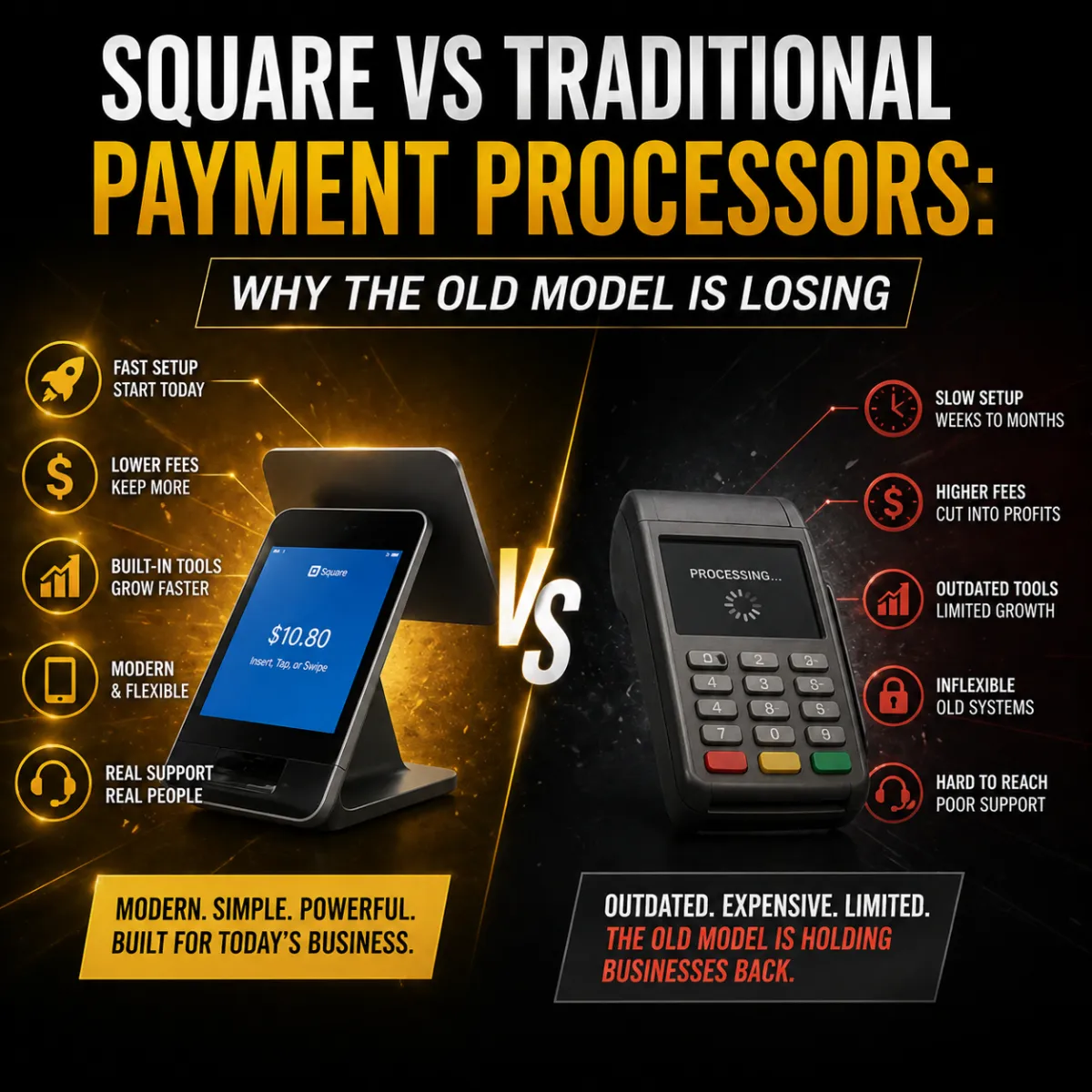
We're moving from traditional payment processing to modern commerce systems.
Traditional Payment Processing Was Built Around Transactions
For years, payment processors focused on doing one thing exceptionally well.
Moving money.
Their value proposition revolved around:
Credit card processing
Payment terminals
Merchant accounts
Competitive pricing
Contracts
Transaction settlement
For many years, that was exactly what businesses needed.
A business owner needed a way to accept credit cards, deposit funds into their bank account, and reconcile transactions at the end of the day.
The industry was built around processing payments.
There was nothing wrong with that model.
The problem is that business owners eventually needed much more than payment processing.
Businesses Didn't Stop Needing Payments
They Started Needing Solutions
Today's businesses are dealing with challenges that have very little to do with processing rates.
They're trying to:
Retain customers.
Hire and manage employees.
Reduce manual work.
Improve inventory accuracy.
Increase repeat business.
Understand customer buying habits.
Sell online and in-store.
Simplify reporting.
Automate repetitive tasks.
Payment processing alone doesn't solve those problems.
Modern commerce systems do.
That's the biggest shift happening in merchant services today.
The Three Eras of Merchant Services
One way I explain this evolution is by looking at the three major eras of merchant services.
Era One: Payment Processing
The primary objective was accepting credit cards.
Sales conversations focused on:
Rates
Fees
Equipment
Contracts
The processor moved money.
Mission accomplished.
Era Two: Point-of-Sale Systems
Technology became more sophisticated.
Businesses wanted inventory management.
Employee management.
Reporting.
Scheduling.
Online ordering.
Customer management.
The conversation expanded beyond payments.
Era Three: Modern Commerce Systems
Today, businesses expect one connected ecosystem.
A modern commerce system combines:
Payment processing
POS software
Customer relationship management
Loyalty programs
Marketing automation
Payroll
Scheduling
Inventory
Ecommerce
Reporting
AI-powered insights
Business financing
Banking tools
Instead of purchasing separate software for each function, businesses increasingly want one platform that keeps everything connected.
That's where the industry is heading.
Why Integration Matters
One of the biggest frustrations small business owners face isn't necessarily bad software.
It's disconnected software.
One system handles payments.
Another manages appointments.
Another tracks inventory.
Another sends marketing emails.
Another runs payroll.
Each requires:
Another login.
Another monthly subscription.
Another support number.
Another integration.
Another opportunity for something to break.
Modern commerce systems eliminate much of that friction by connecting business operations into one ecosystem.
That simplicity saves time.
It also reduces mistakes.
Customer Data Has Become More Valuable Than Processing Rates
Years ago, the merchant statement was the center of every sales conversation.
Today, customer data often matters far more.
Business owners want answers to questions like:
Who are my best customers?
Who hasn't visited recently?
Which products sell together?
Which marketing campaigns generate repeat business?
What is my average customer worth over time?
Processing payments generates transactions.
Modern commerce systems generate business intelligence.
That's a significant difference.
Merchant Sales Has Changed Too
This shift has changed the role of the merchant sales professional.
For decades, many sales representatives primarily sold payment processing.
Today's successful advisors help businesses evaluate technology.
Instead of focusing only on rates, they discuss:
Operational efficiency
Customer retention
Employee productivity
Automation
Reporting
Business growth
The conversation has become much more consultative.
Business owners appreciate sales professionals who solve problems rather than simply quote prices.
Technology Alone Isn't Enough
As modern commerce systems continue evolving, one lesson has become increasingly clear.
Technology matters.
But technology by itself isn't enough.
Business owners also need:
Reliable support.
Ongoing training.
Fast problem resolution.
People they can trust.
Partners who help them succeed after implementation.
The strongest technology in the world loses value if merchants can't receive the support they need when challenges arise.
That's why evaluating the entire ecosystem—not just the software—is becoming increasingly important.
What This Means for Business Owners
If you're evaluating payment solutions today, don't limit your comparison to processing fees.
Ask bigger questions.
Can this platform help me operate more efficiently?
Will it improve customer retention?
Will it simplify daily operations?
Does it provide the support my business needs?
Will it continue growing alongside my business over the next five years?
Those questions often matter far more than saving a few basis points on processing.
What This Means for Merchant Sales Professionals
If you're building a career in merchant services, this industry shift creates tremendous opportunity.
Businesses still need payment processing.
But increasingly, they need advisors who understand business technology, automation, customer retention, reporting, and operational efficiency.
The sales professionals who continue focusing only on processing rates will find themselves competing in a shrinking conversation.
Those who understand modern commerce systems will be positioned to help businesses solve much larger problems.
And those larger conversations often lead to stronger client relationships, higher retention, and larger long-term portfolios.
Continue Learning
If you're interested in understanding where the merchant services industry is heading, these resources may also help:
The Biggest Lesson I Learned After Helping Businesses Implement Modern Commerce Systems
Technology Gets the Sale. Support Keeps the Customer
The Merchant Services Industry Doesn't Have a Technology Problem. It Has a Support Problem
Merchant Sales Training Blog
https://iamjoewagner.com/merchant-sales-training-blog
Final Thoughts
The merchant services industry isn't disappearing.
It's evolving.
Payment processing will always be essential.
But processing alone is no longer enough.
Business owners want connected technology.
They want automation.
They want customer insights.
They want operational efficiency.
Most importantly, they want trusted advisors who understand how all of those pieces work together.
That's why I believe the future belongs to modern commerce systems—and to the professionals who learn how to help businesses implement them successfully.
Frequently Asked Questions
What is a modern commerce system?
A modern commerce system combines payment processing with business tools like POS software, customer management, inventory, payroll, marketing, reporting, and automation into one connected platform.
How are modern commerce systems different from traditional payment processors?
Traditional payment processors primarily focus on moving money. Modern commerce systems help businesses manage daily operations, customer relationships, employee management, reporting, and business growth in addition to accepting payments.
Are traditional payment processors becoming obsolete?
Traditional payment processing remains essential, but businesses increasingly expect integrated technology that does much more than simply process transactions.
Why are business owners moving toward integrated business systems?
Integrated systems reduce complexity by connecting payments, inventory, customer data, marketing, payroll, scheduling, and reporting into one ecosystem, saving time and improving efficiency.
What should merchant sales professionals focus on today?
Sales professionals should focus on understanding business operations, technology, automation, and customer growth instead of relying solely on processing rates and equipment comparisons.
Why are modern commerce systems becoming more popular?
Businesses want fewer disconnected software platforms and more integrated solutions that simplify operations, improve customer experiences, and support long-term growth.