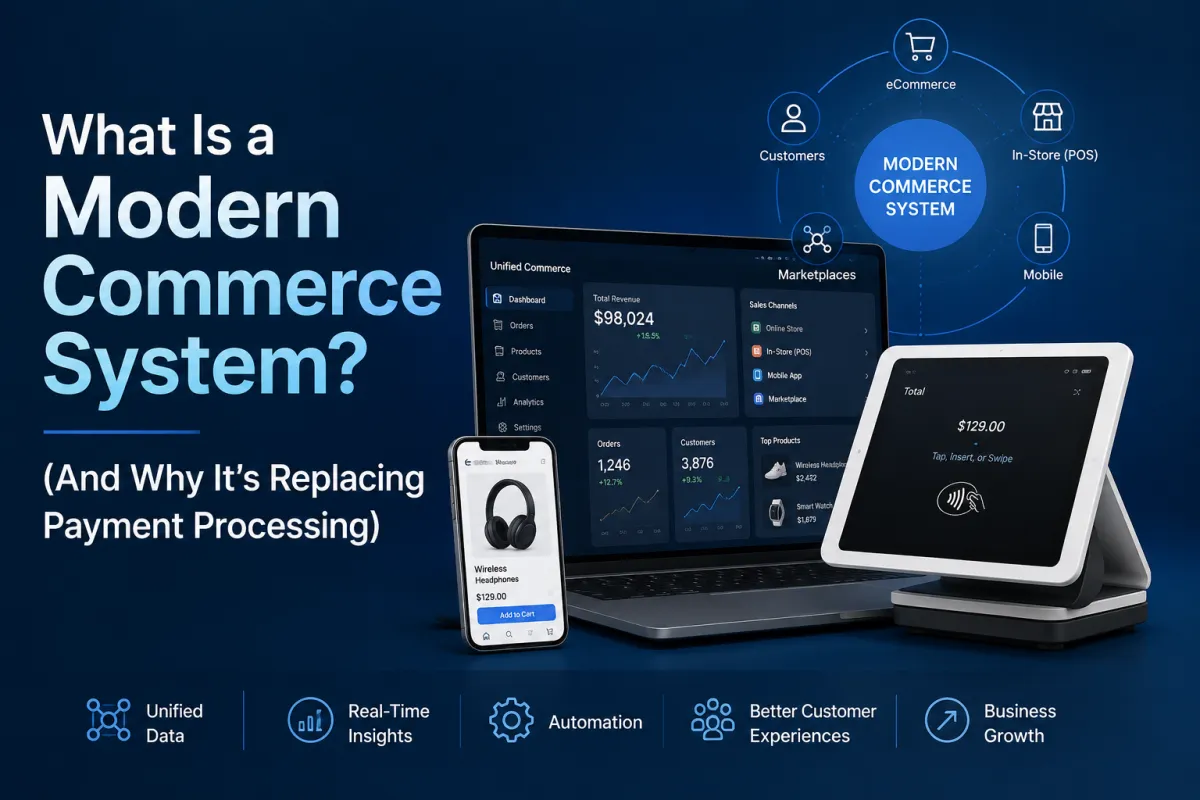
What Is a Modern Commerce System? (And Why It’s Replacing Payment Processing)
What Is a Modern Commerce System? Why It’s Replacing Traditional Payment Processing
One of the biggest changes I've watched happen in merchant services is that payment processing is becoming less and less of a standalone product.
For years, the industry was built around a pretty simple conversation. A business needed to accept credit cards, a processor provided the equipment and merchant account, and salespeople competed over rates, fees, contracts, and terminals.
That business still exists, but it's no longer where I believe the future of merchant services is headed.
Today's business owner expects technology to do more. They want payments connected to customer information. They want inventory connected to sales. They want their website connected to their physical location. They want better reporting, faster access to information, automation, loyalty, marketing, financing, scheduling, payroll, and other tools that help them actually operate their business.
This larger ecosystem is what I call the Modern Commerce System.
And if you're building a career in merchant sales, understanding this concept may be far more important than memorizing another processing rate.
What Is a Modern Commerce System?
A Modern Commerce System is an integrated collection of payment and business technologies designed to help a company accept money, manage operations, understand customers, and run more efficiently.
The important word is integrated.
A business can have great software and still have a terrible technology environment if none of its systems communicate with each other. I've seen businesses with one provider for payments, another for ecommerce, another for scheduling, another for customer management, another for loyalty, another for payroll, and spreadsheets filling the gaps between all of them.
Every additional platform can mean another login, another bill, another integration, another place where information lives, and another system someone has to learn.
Modern commerce is about reducing that fragmentation.
The perfect solution won't always mean literally having every feature from one company. Different businesses have different requirements. The goal is creating a technology environment where the important parts of the business work together instead of creating more work for the owner.
Businesses Don't Want More Technology. They Want Less Complexity.
This distinction is important.
I don't believe most business owners wake up thinking, "I need more software."
They want the opposite.
They want fewer headaches.
They want employees trained faster. They want customers checked out easier. They want reports they can understand. They want inventory updated automatically. They want customer information accessible. They want money deposited quickly. They want to stop entering the same information into multiple systems.
Technology only creates value when it simplifies something.
That's why I believe the merchant sales industry has to evolve beyond simply selling payment processing. The conversation should start with understanding how the merchant operates and then identifying where better systems can remove friction.
That's a very different sales conversation than, "Can I see your processing statement?"
Why Traditional Payment Processing Is No Longer Enough
Traditional payment processing solved an important problem: helping businesses accept electronic payments.
But accepting a card is now the minimum expectation.
The merchant doesn't necessarily care which backend processor moved the transaction. They care about what the overall system does for their business.
Can they sell online and in-store without managing separate inventories? Can they identify their best customers? Can they create recurring memberships? Can they manage employees? Can they send invoices? Can they track sales from their phone? Can they automate marketing? Can they access capital? Can they understand what is happening in the business without spending three hours building a spreadsheet?
Those are modern business problems.
And that's why the future of merchant services is increasingly connected to business technology.
The 10 Pillars of a Modern Commerce System
I've broken the Modern Commerce System into ten major pillars. Not every merchant needs every pillar, and different technology providers will approach each category differently.
The framework matters because it gives sales professionals a better way to evaluate what a business actually needs.
1. Faster Access to Money
Cash flow is oxygen for a business. The faster a merchant can access legitimate sales revenue, the easier it becomes to purchase inventory, cover payroll, pay vendors, manage expenses, and reinvest into growth.
Funding speed has improved tremendously across merchant services, and many providers now offer next-day or faster funding options depending on the merchant, platform, bank, transaction type, and program.
The important lesson for sales professionals isn't to promise every merchant instant access to every transaction. It's to understand that cash-flow speed is now part of the technology conversation.
2. Transparent Pricing and Flexible Payment Programs
Business owners are tired of statements they can't understand.
That doesn't mean one pricing model is right for every merchant. Interchange-plus, flat-rate pricing, tiered programs, cash discounting, dual pricing, and other structures all have different applications.
What matters is transparency.
A merchant should understand how they're being charged, what the program costs, and how the pricing structure works.
Trust begins when the salesperson can explain the economics clearly rather than hiding behind confusing terminology.
3. AI and Automation
Artificial intelligence will continue becoming a larger part of business technology, but I believe the real value will come from practical applications rather than simply putting "AI" on a product.
Business owners generate enormous amounts of data. The problem is that most of them don't have time to analyze it.
Modern systems can increasingly use automation and intelligent tools to help businesses understand sales patterns, employee performance, customer behavior, inventory, marketing, scheduling, and other operational information.
The goal should be simple: give the business owner better information while requiring less manual work.
4. Omnichannel Commerce
The line between an online business and a physical business continues disappearing.
A customer may discover a company through social media, browse its website, purchase online, pick up in-store, return through another location, and buy again through a text or email promotion.
The merchant sees one customer.
Their technology should too.
A Modern Commerce System should help connect in-person, online, mobile, invoicing, and other selling channels so the business isn't operating several completely separate companies behind the scenes.
5. Embedded Finance
Payments create valuable information about the financial health of a business.
That creates opportunities for financial products to become integrated directly into commerce platforms. Depending on the provider, this may include business financing, banking tools, cash-flow products, or other financial services.
This can eliminate some of the friction associated with traditional financing processes because the technology provider may already have access to transaction history and business performance data.
Again, products and eligibility vary by provider. But the broader trend is clear: payments and financial services are becoming increasingly connected.
6. Better Data and Decision-Making
I've met plenty of business owners who can tell you their monthly sales but can't tell you what actually produced those sales.
Which products have the highest margins? Which employees perform best? Which customers spend the most? What time of day is most profitable? Which marketing campaigns generate repeat customers?
A good Modern Commerce System helps turn transaction data into useful business information.
That matters because better information creates better decisions.
A business owner shouldn't have to guess what's happening inside their company when the data already exists.
7. Customer Experience, Loyalty, and Marketing
Getting a customer once is expensive.
Keeping them is where a tremendous amount of business value is created.
Modern commerce technology can help businesses build customer profiles, track purchase behavior, create loyalty programs, send targeted promotions, manage digital receipts, collect feedback, and communicate with customers after the original transaction.
This is one of the biggest differences between simply processing a transaction and helping a merchant grow.
The old system asked, "Did the payment go through?"
The modern system should also ask, "How do we get this customer to come back?"
8. Recurring Revenue and Memberships
Recurring revenue isn't valuable only to merchant sales professionals. It's valuable to merchants too.
Gyms figured this out decades ago, but the model has expanded into salons, spas, automotive businesses, home services, professional services, restaurants, retailers, subscription businesses, and countless other industries.
Memberships, subscriptions, packages, service plans, and recurring billing can create more predictable cash flow for businesses.
A Modern Commerce System should make these models easier to implement and manage when they're appropriate for the merchant.
9. Software Consolidation and Integration
This may be the most important pillar of all.
Businesses don't need fifteen pieces of software simply because fifteen pieces of software exist.
They need the right technology working together.
Payments, customer information, ecommerce, inventory, scheduling, marketing, reporting, loyalty, and other functions should communicate wherever possible.
Sometimes that means choosing an all-in-one platform. Other times it means choosing a strong core POS system with reliable integrations to specialized software.
The goal isn't one company controlling everything.
The goal is less friction and better integration.
10. Future Payment Rails
Payments will continue evolving.
Cards aren't disappearing tomorrow, but consumers now use contactless payments, digital wallets, ACH, account-to-account payments, buy now pay later programs, cryptocurrency, and other emerging payment methods.
We don't need to predict which payment rail will dominate ten years from now.
We need systems capable of adapting.
That's why I believe flexibility is one of the most important characteristics of a modern commerce platform. Businesses shouldn't need to rebuild their entire operation every time customer payment behavior changes.
There Is No Single Modern Commerce System
This may be one of the most important changes in how I look at the industry.
There isn't one company that owns the Modern Commerce System.
There shouldn't be.
Restaurants have different needs than retail stores. A salon has different requirements than an auto repair shop. A contractor operates differently than a medical practice. A multi-location business may need technology that would be unnecessary for a single-location merchant.
Multiple POS and fintech companies are racing to solve these problems, and that competition is good for the industry.
It creates better technology.
It creates more choices for merchants.
And it creates an opportunity for knowledgeable merchant sales professionals who understand how to evaluate those systems.
Your value shouldn't come from telling every business that the platform you happen to sell is automatically the best.
Your value should come from understanding which system is best for that merchant.
The Modern Commerce System Is Only as Good as the Support Behind It
Technology gets most of the attention, but I've learned that support can matter just as much as the feature list.
A POS system can look incredible during a demonstration. The real test happens after the merchant signs.
Who helps with onboarding?
Who handles installation?
Who trains the merchant?
Who answers questions when something stops working?
Who helps the business understand a feature six months later?
Who does the agent call when they need help?
If the answer to every question is "the salesperson," there's a problem.
Salespeople should understand the products they sell, but expecting one person to prospect, close, install, train, troubleshoot, handle customer service, manage retention, and continue building a portfolio is not a scalable model.
Modern technology needs modern support.
That is one of the criteria I now consider essential when evaluating merchant services partnerships.
Why Modern Commerce Creates a Better Merchant Sales Opportunity
For a sales professional, the transition from payment processing to Modern Commerce Systems changes the entire value proposition.
Traditional processing is highly commoditized. If your only advantage is a lower rate, eventually someone else can offer another rate.
Business systems are different.
When you help a merchant implement technology that becomes connected to inventory, employees, customers, ecommerce, marketing, reporting, and everyday operations, you're providing something much more valuable than transaction processing.
That can also create stronger merchant relationships and better retention when the system genuinely works for the business.
But retention shouldn't come from making it painful for a merchant to leave.
It should come from making the technology valuable enough that they don't want to leave.
That's a much healthier way to build a long-term residual portfolio.
Learn the Industry Before Choosing the System You Sell
This evolution is also why I believe education has become critical for new merchant sales agents.
If you don't understand merchant statements, pricing, payments, POS technology, residual agreements, prospecting, customer needs, and the different categories of business software, how can you possibly recommend the right system?
That's exactly why I created Merchant Service University (MSU).
MSU teaches the fundamentals of merchant services and modern merchant sales before someone commits years of their career to a particular company or product.
Merchant Service University is normally a paid online training program. However, I'm providing free access to qualified, serious candidates who are looking for the right place to build in merchant services.
The certification process serves two purposes.
First, it educates you so you can make smarter decisions about the industry.
Second, it helps me identify who is actually serious enough to show up, complete the training, communicate, and put effort into building a business.
Candidates who become MSU certified can then be introduced to partners I believe offer the combination that matters today: Modern Commerce Systems, ethical agent agreements, lifetime residual opportunities, responsive merchant support, strong agent support, and a legitimate opportunity to build a long-term portfolio.
If you're serious about learning merchant services and finding the right place to build, begin at ezdirectsales.com.
Final Thoughts: The Future Is Bigger Than Payment Processing
Payment processing isn't disappearing.
It's becoming part of something bigger.
Businesses still need to accept money, but they increasingly expect the same technology to help them understand customers, manage employees, sell online, automate tasks, access information, create recurring revenue, manage cash flow, and make better decisions.
That's the Modern Commerce System.
And I believe that's where the biggest opportunity exists for the next generation of merchant sales professionals.
Don't become an expert in one terminal.
Don't build your entire identity around one POS company.
Become an expert in business problems, merchant services, and the technologies capable of solving those problems.
Companies will change.
Products will change.
Payment methods will change.
But business owners will always need knowledgeable people who can help them make sense of those changes.
That's the position worth building.
Continue Learning Merchant Services
Download my free book, The New Rules of Merchant Sales, to learn more about where I believe the industry is headed:
https://ebook.ezdirectsales.com
Continue learning through the Merchant Sales Training Blog:
https://iamjoewagner.com/merchant-sales-training-blog
Access additional merchant sales resources:
https://iamjoewagner.com/merchant-sales-resources
If you're serious about building a merchant services business and want to apply for complimentary Merchant Service University access:
Frequently Asked Questions About Modern Commerce Systems
What is a Modern Commerce System?
A Modern Commerce System is an integrated collection of payment and business technologies that can combine payment processing, POS software, customer management, inventory, ecommerce, marketing, loyalty, reporting, financing, automation, and other operational tools.
Is a Modern Commerce System the same as a POS system?
Not necessarily. A POS system may be the central component, but a complete Modern Commerce System extends beyond checkout to other areas of business operations, customer management, financial services, data, and automation.
Why are Modern Commerce Systems changing merchant services?
Businesses increasingly expect their payment technology to connect with the rest of their operation. This changes merchant sales from a conversation primarily about processing rates into a broader discussion about technology, efficiency, growth, and business problems.
Does every business need the same Modern Commerce System?
No. Restaurants, retailers, salons, contractors, medical offices, professional services, and other businesses have different operational needs. The right technology should be based on the merchant rather than the salesperson's preferred platform.
What are the 10 pillars of a Modern Commerce System?
The framework includes faster access to money, transparent pricing, AI and automation, omnichannel commerce, embedded finance, business data, customer loyalty, recurring revenue, software consolidation, and future payment rails.
Why is support important when choosing a POS system?
Technology problems can directly affect a merchant's ability to operate. Strong onboarding, training, merchant support, technical assistance, and agent support help businesses use the technology successfully and can improve long-term retention.
What is Merchant Service University?
Merchant Service University is Joe Wagner's online training program covering merchant services fundamentals, statements, pricing, sales, prospecting, modern business technology, residual income, and other areas important to building a merchant services career.
How can I get Merchant Service University access for free?
Qualified candidates who are serious about building a merchant services business may receive complimentary MSU access through Joe Wagner's recruiting process. Begin at ezdirectsales.com to learn more and apply.