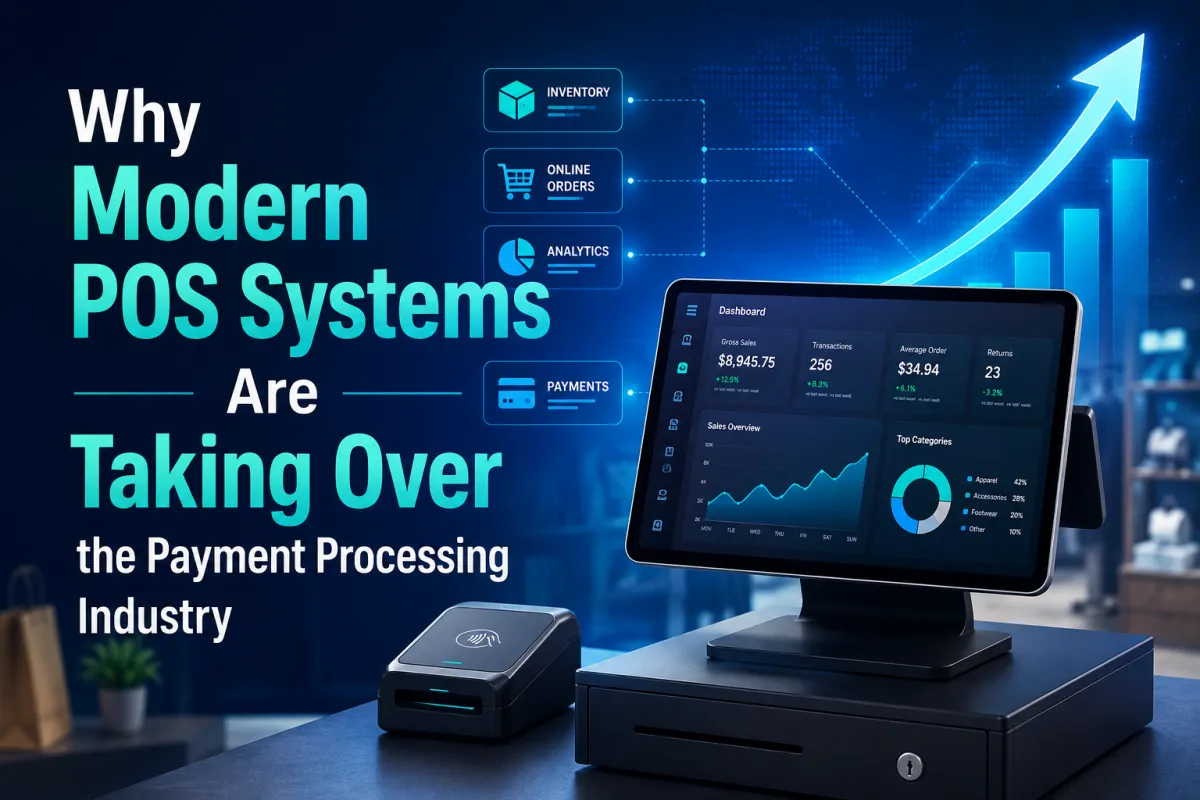
Why Modern POS Systems Are Taking Over the Payment Processing Industry
Why Modern POS Systems Are Taking Over the Payment Processing Industry
For most of my career, the merchant services industry was primarily built around one thing: processing payments. A business needed to accept credit cards, and our job was to provide the merchant account, equipment, pricing, and backend processing required to make that happen.
That industry still exists, but the conversation around it has changed dramatically.
Today's business owners don't simply ask whether a system can accept a Visa card. They want to know what else the technology can do for their business. Can it help manage inventory? Can it connect online and in-person sales? Can it help bring customers back? Can it simplify employee management? Can it provide better reporting? Can it reduce the number of separate software products they're paying for?
Those expectations are one of the biggest reasons modern POS systems are becoming so important to the payment processing industry.
The POS system is no longer simply the place where the customer pays. Increasingly, it's becoming the technology hub around which the business operates.
Payment Processing Is Becoming Part of a Larger System
Years ago, a typical merchant services sales presentation could revolve almost entirely around rates and equipment. We reviewed the merchant statement, compared costs, offered a new terminal, and explained why switching processors might save the business money.
That model worked because payment acceptance itself was the product.
Today, payment acceptance has largely become an expectation. A business assumes the system can process cards. What differentiates one solution from another is increasingly everything surrounding that transaction.
Modern POS systems can connect payments with customer profiles, inventory, loyalty, ecommerce, scheduling, payroll, marketing, reporting, invoicing, financing, and other operational tools. The exact capabilities vary by provider and industry, but the direction of the market is obvious.
Businesses want technology that does more work for them.
That's also why the merchant services sales conversation has to evolve. When the salesperson understands the merchant's entire operation instead of only the processing statement, there are far more meaningful problems to solve.
How Modern POS Systems Connect to the Modern Commerce System
I use the term Modern Commerce System to describe the larger ecosystem businesses are beginning to expect from their technology.
A POS system may be the center of that ecosystem, but the Modern Commerce System extends beyond the checkout counter. It connects payments with the systems that help a business acquire customers, manage operations, understand data, communicate with employees, sell through multiple channels, and make better financial decisions.
You can read my complete breakdown of the Modern Commerce System here:
https://iamjoewagner.com/post/what-is-a-modern-commerce-system
This distinction matters because I don't believe the future is simply "better POS equipment." The future is better-connected businesses.
A merchant may have excellent individual software products and still operate inefficiently if none of them work together. One company handles payments, another manages the website, another runs loyalty, another handles scheduling, and another maintains customer data. The owner ends up becoming the person responsible for connecting everything manually.
Modern commerce technology is designed to reduce that fragmentation.
Why Businesses Are Moving Toward Integrated POS Systems
Most business owners don't actually want more technology. They want fewer problems.
That's one of the most important things a merchant sales professional can understand.
A business owner doesn't necessarily care how impressive the software sounds during a demo. They care whether employees can learn it, whether customers can use it, whether information is easy to find, and whether it makes the business easier to run.
When technology forces an owner to log into five different dashboards and manually move information between systems, the technology becomes part of the problem.
Integrated POS systems can simplify those workflows by bringing more information and functionality into one environment.
For a restaurant, that could mean connecting payments, online ordering, menus, employee management, customer loyalty, and reporting. For a salon, it may mean payments, appointments, memberships, customer profiles, automated reminders, and employee scheduling. A retailer may care more about inventory, ecommerce, customer data, multi-location reporting, and loyalty.
Different businesses require different systems.
That's why I don't believe one POS company automatically wins every merchant.
The technology should fit the business, not the other way around.
Modern POS Systems Are Becoming Business Operating Systems
One of the biggest misconceptions about POS technology is that it's still essentially a cash register with a screen attached.
That's outdated thinking.
A strong modern POS environment can touch nearly every part of a company's operation. Payments generate customer and sales data. That data feeds reporting. Reporting helps owners make better decisions. Customer data can support loyalty and marketing. Sales information can affect inventory. Employee activity can connect to scheduling and payroll.
Suddenly, the POS system isn't just recording what happened at checkout.
It's helping the business understand what happened throughout the operation.
That has dramatically increased the strategic value of these systems.
Customer Retention Has Become Part of the Payment Conversation
This is another area where the merchant services industry has changed significantly.
Traditional processing primarily answered one question: did the payment go through?
Modern commerce technology can help answer a much more valuable question: how do we get that customer to come back?
A business that collects useful customer information can potentially identify repeat buyers, create loyalty programs, send relevant promotions, track purchase behavior, and measure customer engagement.
That moves the conversation beyond transaction processing and into revenue growth.
I think that's one of the reasons merchant sales professionals who understand customer retention can have far stronger conversations than someone competing only on basis points.
Saving a merchant a small amount on a transaction may have value.
Helping that merchant generate another visit from hundreds of customers can have significantly more value.
Business Data Is Becoming More Useful
Businesses generate enormous amounts of information through everyday transactions, but historically much of that data wasn't easy for small business owners to use.
Modern POS systems are changing that.
Owners increasingly have access to dashboards showing sales patterns, products, employees, customers, locations, inventory, and other operating information. AI and automation are likely to make that information even easier to understand over time.
The goal isn't giving owners more reports.
It's helping them make better decisions.
A useful system should allow an owner to understand what's working, identify problems sooner, and spend less time digging through spreadsheets trying to make sense of the business.
Payment Flexibility Is Growing Too
Modern POS technology also needs to adapt to how customers want to pay.
Credit and debit cards remain foundational, but the payments environment continues expanding through digital wallets, contactless payments, ACH, account-to-account payments, buy now pay later services, recurring billing, cryptocurrency, and other emerging options.
Nobody needs to predict exactly which payment rail will dominate twenty years from now.
The more important question is whether the technology is flexible enough to evolve.
A business shouldn't need to replace its entire operating system every time customer payment behavior changes.
That adaptability is becoming another major advantage of modern commerce technology.
Why Support Matters Just as Much as POS Technology
The more powerful POS systems become, the more important support becomes too.
I've learned this firsthand.
A feature list looks great during the sales presentation. The real test happens when the merchant is busy, something isn't working correctly, and they need an answer immediately.
Who handles implementation? Who trains the merchant? Who replaces hardware? Who helps configure features? Who answers technical questions months after the sale?
The salesperson can't realistically be expected to do all of it.
A merchant sales professional should understand the technology being sold, but their primary role should still be selling, building relationships, and growing a portfolio. If the agent becomes the installer, trainer, technical support desk, customer service representative, and retention department, eventually there isn't enough time left to prospect.
That's why I now evaluate merchant services partnerships based on much more than the POS system itself.
Modern technology matters.
So does responsive merchant support, agent support, training, ethical agreements, and long-term residual protection.
A Modern Commerce System is only as good as the organization standing behind it.
Why Selling POS Systems Is a Bigger Opportunity Than It Used to Be
For merchant sales professionals, this shift has expanded the opportunity.
Instead of selling a commodity, you're increasingly helping businesses make decisions about technology they may rely on every day.
That creates opportunities for deeper relationships and, when structured through the right agreement, long-term recurring residual income.
I don't believe the goal should be making it difficult for merchants to switch systems. If the only reason they stay is because leaving is painful, you've created the wrong relationship.
The goal should be providing technology and support valuable enough that they don't want to leave.
That's what creates healthy retention.
And healthy merchant retention is what helps create strong residual portfolios.
If you want to learn more about how to approach these conversations, read:
https://iamjoewagner.com/post/how-to-sell-pos-systems
Don't Build Your Career Around One POS Company
This is an important change in how I teach merchant services today.
I don't believe agents should build their entire identity around one POS brand.
Companies change.
Products change.
Compensation programs change.
Partnerships change.
Technology changes.
Your knowledge stays with you.
Learn merchant services. Learn how businesses operate. Understand modern commerce technology. Understand statements, pricing, customer retention, payment methods, POS software, automation, and the questions that uncover actual business problems.
Then work with ethical partners that give you access to the right solutions.
That puts you in a much stronger position than becoming known simply as the representative of one product.
Learn the Business Before Choosing Where to Build
One of the biggest mistakes people make when entering merchant services is selecting a company before they understand what they should be evaluating.
A compensation plan sounds exciting, so they sign.
Someone promotes a high residual split, so they join.
They like the hardware, so they commit.
Years later, they discover details about support, vesting, ownership, technology, or the agreement they wish they had understood from the beginning.
That's exactly why I created Merchant Service University (MSU).
MSU teaches merchant services fundamentals including pricing, statements, fees, sales, prospecting, POS technology, Modern Commerce Systems, residual income, and how the industry works.
Merchant Service University is normally a paid online course. However, I'm providing it at no cost to qualified, serious candidates who are looking for the right place to build their merchant services business.
I use MSU certification to educate people before introducing them to partners, but it's also a filter. If you're willing to complete the training, learn the material, communicate, and earn your certification, you've already demonstrated you're more serious than someone simply looking for the next quick opportunity.
Once you're certified, I can help qualified candidates connect with partners I believe provide what matters: modern commerce systems, ethical agent agreements, lifetime residual opportunities, responsive merchant support, strong agent support, and the opportunity to build a long-term portfolio.
If you're serious about learning merchant services and finding the right place to build, start the process at:
Final Thoughts: POS Systems Aren't Taking Over Because of Hardware
Modern POS systems aren't reshaping payment processing because somebody designed a better screen or a nicer terminal.
They're taking a larger role because the definition of merchant services itself is expanding.
Payments are becoming connected to operations, customers, marketing, inventory, data, ecommerce, financing, automation, and the broader technology businesses use every day.
That's where the future is headed.
For business owners, the opportunity is choosing systems that reduce complexity and genuinely help the business operate better.
For merchant sales professionals, the opportunity is becoming knowledgeable enough to help merchants make those decisions.
Don't simply sell the POS.
Understand the business behind it.
That's where your real value begins.
Frequently Asked Questions About Modern POS Systems
Why are modern POS systems changing the payment processing industry?
Modern POS systems combine payment processing with broader business tools such as customer management, ecommerce, inventory, reporting, marketing, loyalty, employee tools, and automation. This gives businesses more value than standalone payment acceptance.
What makes a modern POS system different from traditional payment processing?
Traditional payment processing primarily focuses on accepting and settling transactions. Modern POS systems can connect payments with other parts of the business, creating a broader technology ecosystem.
Are POS systems becoming business operating systems?
For many businesses, yes. Modern POS platforms increasingly serve as central hubs connecting payments, customer data, sales reporting, inventory, ecommerce, employees, and other operational functions.
Is selling POS systems a good merchant services opportunity?
It can be. Sales professionals who understand merchant needs and work through agreements providing recurring residual compensation may be able to build long-term portfolios by selling valuable business technology.
Should merchant sales agents represent only one POS system?
Not necessarily. Different merchants have different needs. Learning multiple types of technology and understanding the business first can help agents recommend better solutions rather than forcing every merchant into one platform.
Why is merchant support important with modern POS systems?
Businesses can depend on their POS technology for critical daily operations. Responsive onboarding, training, technical support, hardware assistance, and customer service help merchants successfully use the system and can improve retention.
What is Merchant Service University?
Merchant Service University is Joe Wagner's online merchant services training program covering pricing, statements, fees, POS technology, Modern Commerce Systems, sales, prospecting, and building recurring residual income.
How can I receive Merchant Service University for free?
Qualified candidates who are serious about building a merchant services business may receive complimentary Merchant Service University access through Joe Wagner's recruiting process. Begin at ezdirectsales.com to learn more and apply.