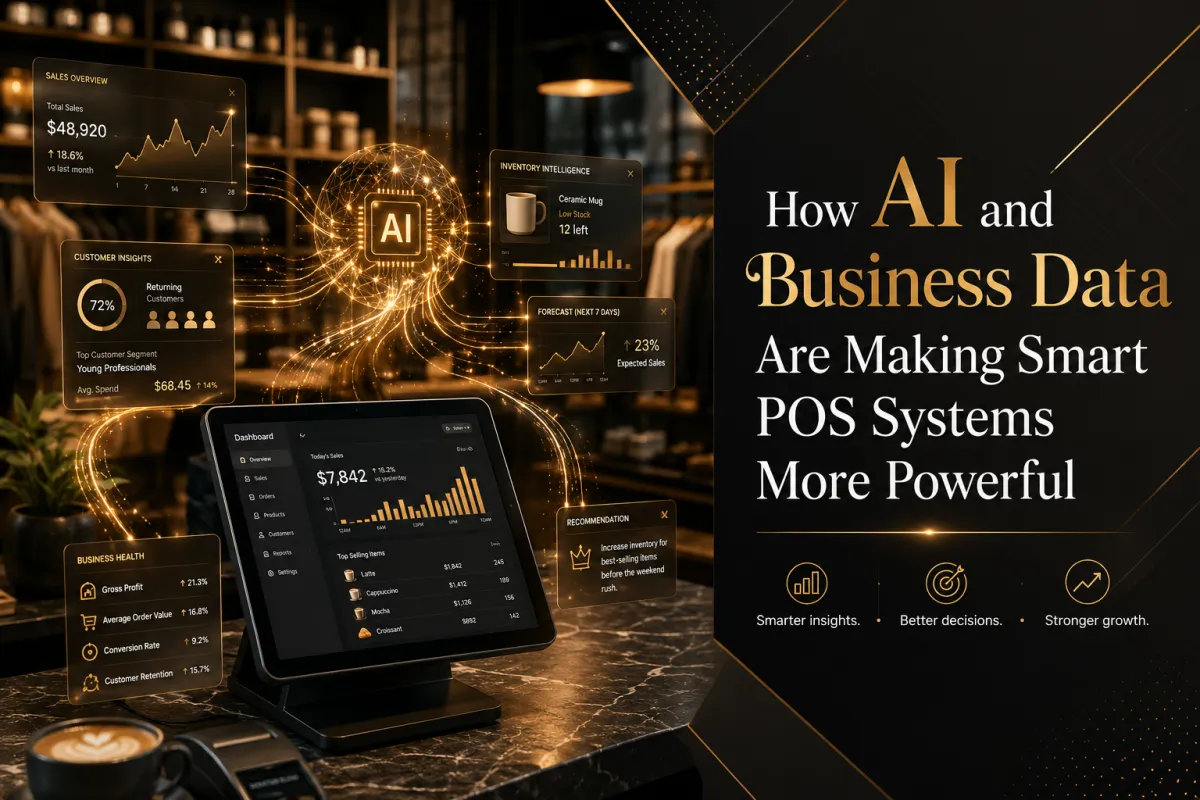
How AI and Business Data Are Making Smart POS Systems More Powerful
How AI and Business Data Are Making Smart POS Systems More Powerful
For years, a POS system was basically a place to record transactions. It accepted a payment, printed a receipt, tracked the sale, and maybe produced a basic report at the end of the day. That worked when the role of the point-of-sale system was limited to checkout.
Today, that role is getting much bigger.
Modern POS systems are collecting enormous amounts of operational information every day, and AI is making that information much more useful. Instead of simply telling a business owner what happened, smart POS systems are increasingly being built to help explain why it happened, where the opportunities are, and what deserves attention next.
That is an important shift for the merchant services industry because the value proposition is moving well beyond payment processing. The best systems are becoming tools that help owners understand and operate their businesses more intelligently.
This is one of the reasons I consider AI and business data important pillars inside what I call the Modern Commerce System.
If you have not read the full framework yet, start here:
https://iamjoewagner.com/post/what-is-modern-commerce-system
Businesses Already Have the Data. The Problem Is Using It.
One of the biggest misconceptions in small business is that owners need more information.
Most of them do not.
They already have more information than they know what to do with.
Every transaction creates useful data. A business can track what sold, when it sold, who sold it, which customer purchased it, what the average ticket was, which location performed best, and how frequently certain customers return. Add inventory, scheduling, loyalty, ecommerce, and employee data, and the amount of information becomes enormous.
The problem is that most business owners do not have time to sit down and analyze all of it.
Traditionally, that meant logging into dashboards, pulling reports, exporting spreadsheets, and manually looking for patterns. Even if the information was valuable, the process of getting to the answer was often too time-consuming.
AI has the potential to change that.
The real value is not collecting more data. The value is helping business owners use the information they already have.
Smart POS Systems Are Becoming Business Intelligence Tools
This is where smart POS systems start to become much more powerful than traditional payment technology.
Instead of only recording sales, the system can increasingly help organize information around actual business questions.
Which products are performing best?
Which customers have stopped returning?
Which employees consistently produce higher average tickets?
Which dayparts are most profitable?
Which promotions actually drove repeat business?
Those are the kinds of questions owners care about.
A traditional report may contain the answer somewhere inside hundreds of rows of data. An intelligent system can make that answer easier to find and understand.
That does not mean AI is running the business.
It means the owner can spend less time searching for information and more time making decisions.
Restaurant Operations Are a Good Example
Restaurants are one of the easiest places to understand how useful this can become.
Imagine an owner wants to know which menu items produced the highest margins over the last month. Traditionally, they may need to compare sales data, food costs, employee activity, and several reports before reaching a useful conclusion.
A smarter system can help surface those relationships much faster.
It may identify that certain items sell especially well during particular shifts, that one employee is consistently better at upselling specific products, or that one location has a much stronger average ticket than another.
Those insights allow the owner to act.
They can adjust the menu.
They can change training.
They can improve staffing.
They can promote higher-margin products.
They can identify what one successful employee is doing and teach it to the rest of the team.
That is where business data becomes valuable.
The insight leads to an action.
AI Can Help Businesses Understand Customer Behavior
Customer data is another area where modern POS systems can create significant value.
Most businesses spend heavily to attract new customers but do relatively little with the customers they already have.
A smart system can help a business understand customer frequency, purchase history, average spend, favorite products, and whether a previously active customer has stopped returning.
That creates an opportunity for much more relevant follow-up.
Imagine a customer who has visited a coffee shop every Tuesday morning for six months and then disappears for four weeks. A traditional POS system simply records fewer transactions.
A modern system connected to customer profiles, loyalty, and marketing can potentially identify that change and help the business respond.
Maybe the customer receives a targeted offer.
Maybe they get a loyalty incentive.
Maybe the business includes them in a re-engagement campaign.
The important part is that the owner did not have to manually watch thousands of customer profiles to notice the change.
The system helped surface the opportunity.
Business Data Can Improve Customer Retention
This is why customer retention should become a much larger part of the merchant services conversation.
Processing a payment is valuable.
Helping the merchant create another payment is even more valuable.
A business that understands its customers can communicate more intelligently. Instead of sending the same promotion to everyone, it can begin tailoring marketing based on actual purchasing behavior.
A customer who buys lunch three times per week should not necessarily receive the same message as someone who has not visited in six months.
A customer who regularly buys one category of products may respond differently than a customer who purchases something completely different.
The more relevant the communication becomes, the more useful the system becomes to the merchant.
And that is exactly how POS technology starts evolving from a transaction tool into a growth tool.
Smart Systems Can Reduce Operational Stress
Most small business owners are overloaded.
They manage employees, inventory, customers, vendors, scheduling, payroll, reporting, marketing, customer service, and countless other responsibilities.
They do not need another dashboard simply because someone built one.
They need better systems.
AI and automation can help reduce some of that operational load by summarizing information, identifying exceptions, triggering routine follow-up, automating reminders, and helping owners focus on what actually needs human attention.
The goal should not be more technology.
The goal should be less chaos.
That is one of the reasons integrated modern commerce systems are becoming more valuable. When payments, customer data, reporting, loyalty, inventory, and other tools work together, the owner has fewer disconnected systems to manage.
AI Is More Useful When the Data Is Connected
Artificial intelligence is only as useful as the information available to it.
If a business uses one platform for payments, another for customer data, another for ecommerce, and another for inventory, it becomes much harder to create a complete operational picture.
This is where integration becomes extremely important.
A Modern Commerce System can bring together more of the information generated across the business. Payments create transaction data. Customer profiles add behavioral information. Inventory shows product movement. Marketing reveals engagement. Employee activity adds another layer.
When those systems communicate, the technology has more context.
That context is what makes intelligent reporting and automation more useful.
The long-term opportunity is not simply AI.
It is AI connected to meaningful business data.
The Merchant Services Value Proposition Is Changing
For decades, merchant services conversations were heavily focused on rates, fees, equipment, and processing.
Those things still matter.
But modern POS technology gives sales professionals an opportunity to discuss much bigger business problems.
How much time does the owner spend creating reports?
How well does the business understand its customers?
How does the company bring inactive customers back?
Which systems are disconnected?
How much administrative work could be automated?
Where is the owner making decisions without enough information?
These questions create a completely different conversation.
The salesperson is no longer simply comparing payment costs.
They are helping the merchant think about the business itself.
That is where I believe merchant sales is becoming far more valuable.
Smart Technology Still Needs Strong Support
As systems become more capable, I believe the support behind them becomes even more important.
A merchant does not care how advanced the software is when something stops working during a busy day.
They need help.
They need onboarding.
They need training.
They need technical support.
They need someone who understands the system and can help them use it correctly.
The same applies to merchant sales professionals. If the agent is expected to sell the system, install everything, train the employees, answer every technical question, handle customer service, manage retention, and continue prospecting, the model eventually becomes unsustainable.
That is why I believe the best modern merchant services partnerships will combine two things:
strong technology and strong people.
One without the other is incomplete.
What This Means for Merchant Sales Professionals
The rise of AI POS systems creates an opportunity for salespeople who are willing to learn how businesses actually operate.
You do not need to become an AI developer.
You need to understand business problems.
A restaurant owner does not care about the technical model behind an AI feature. They care whether it helps increase average ticket size, improve staffing, identify profitable menu items, or bring customers back.
A retailer cares whether the system helps manage inventory, understand customer behavior, and improve reporting.
A service business cares whether automation saves time and reduces administrative work.
That is the level where merchant sales professionals should operate.
The technology is the tool.
The business outcome is the value.
Learn the Industry Before Choosing the Technology You Sell
This is also why I believe new agents need education before they choose a company or platform.
Every POS provider is going to tell you its technology is great.
Every recruiting organization will tell you its opportunity is the best.
But if you do not understand merchant services, statements, pricing, residual income, business technology, POS systems, support structures, and agent agreements, it is difficult to evaluate those claims.
That is exactly why I created Merchant Service University (MSU).
MSU teaches the fundamentals of the industry, including payment processing, pricing, statements, fees, sales, prospecting, POS technology, Modern Commerce Systems, recurring revenue, and how to evaluate merchant services partnerships.
Merchant Service University is normally a paid online program. However, I provide access at no cost to qualified, serious candidates who are looking for the right place to build in merchant services.
I use certification as both education and a filter.
If someone completes the lessons, learns the industry, communicates, and earns certification, that tells me they are serious enough to invest time before expecting results.
From there, I can help qualified candidates connect with partners I believe provide the combination that matters: modern commerce systems, ethical agent agreements, lifetime residual opportunities, responsive merchant support, strong agent support, and a legitimate place to build a long-term portfolio.
If you are serious about learning merchant services and finding the right place to build, begin at:
Final Thoughts: Better Data Should Lead to Better Decisions
The future of smart POS technology is not about giving business owners more reports.
It is about making the information they already have more useful.
AI can help identify patterns.
Automation can reduce repetitive work.
Customer data can improve retention.
Connected systems can create better operational visibility.
But none of that matters unless it leads to better decisions and better business outcomes.
That is how I believe business owners should evaluate smart POS systems.
And that is how merchant sales professionals should sell them.
Do not lead with AI because it sounds exciting.
Lead with the problem.
Then show how better technology, better data, and better support can help solve it.
That is the future of merchant services.
Related Resources
What Is a Modern Commerce System?
https://iamjoewagner.com/post/what-is-modern-commerce-system
How Smart POS Systems Are Using AI to Improve Business Operations
https://iamjoewagner.com/post/smart-pos-systems-ai-business-operations
Why Modern POS Systems Are Taking Over the Payment Processing Industry
https://iamjoewagner.com/post/why-pos-systems-are-taking-over-payment-processing
Merchant Sales Training & Industry Insights
https://iamjoewagner.com/merchant-sales-training-blog
Merchant Sales Resources
https://iamjoewagner.com/merchant-sales-resources
Download The New Rules of Merchant Sales
https://ebook.ezdirectsales.com
Apply for Merchant Service University Access
https://ezdirectsales.com
Frequently Asked Questions About AI, Business Data, and Smart POS Systems
How do smart POS systems use AI and business data?
Smart POS systems can use transaction data, customer behavior, reporting, and automation to identify patterns, summarize information, improve operational visibility, and support faster decision-making.
Why is business data important for modern POS systems?
Businesses already generate large amounts of information through payments, customers, inventory, employees, ecommerce, and other operations. Connected systems can make that information easier to analyze and use.
How can smart POS systems improve customer retention?
Smart POS systems can connect customer profiles and transaction history to loyalty and marketing tools, helping businesses identify repeat customers, inactive customers, and opportunities for targeted follow-up.
Can AI help restaurants operate more efficiently?
Yes. AI-supported reporting can help restaurants analyze sales trends, menu performance, employee activity, customer behavior, and other operational information more efficiently.
Why are integrated systems important for AI?
AI becomes more useful when payments, customer information, inventory, reporting, marketing, ecommerce, and other data are connected because the system has a broader view of business activity.
Is AI replacing traditional merchant services?
AI is not replacing payment processing. It is expanding what modern merchant services technology can do by adding automation, operational intelligence, customer insights, and business tools around the payment transaction.
What is Merchant Service University?
Merchant Service University is Joe Wagner's online merchant services training program covering statements, pricing, payment processing, sales, prospecting, POS technology, Modern Commerce Systems, and recurring residual income.
How can I get Merchant Service University access for free?
Qualified candidates who are serious about building a merchant services business may receive complimentary MSU access through Joe Wagner's recruiting process. Begin at ezdirectsales.com to learn more and apply.