
There Is No “Done-for-You” Merchant Services Business
There Is No “Done-for-You” Merchant Services Business: What You’re Really Buying
The idea of a done-for-you merchant services business sounds incredible when you first hear it.
You pay someone a large upfront fee. They give you training, systems, perhaps some merchant accounts, maybe leads or appointments, and they position the package as a shortcut to building passive income through payment processing. Instead of spending years figuring everything out yourself, you're supposedly buying a business that has already been assembled for you.
I understand why that gets people's attention. Merchant services can create recurring residual income, and a well-built merchant portfolio can become extremely valuable to the person who built it. I've personally experienced what recurring income can do for your lifestyle and financial freedom over more than 16 years in the payments industry.
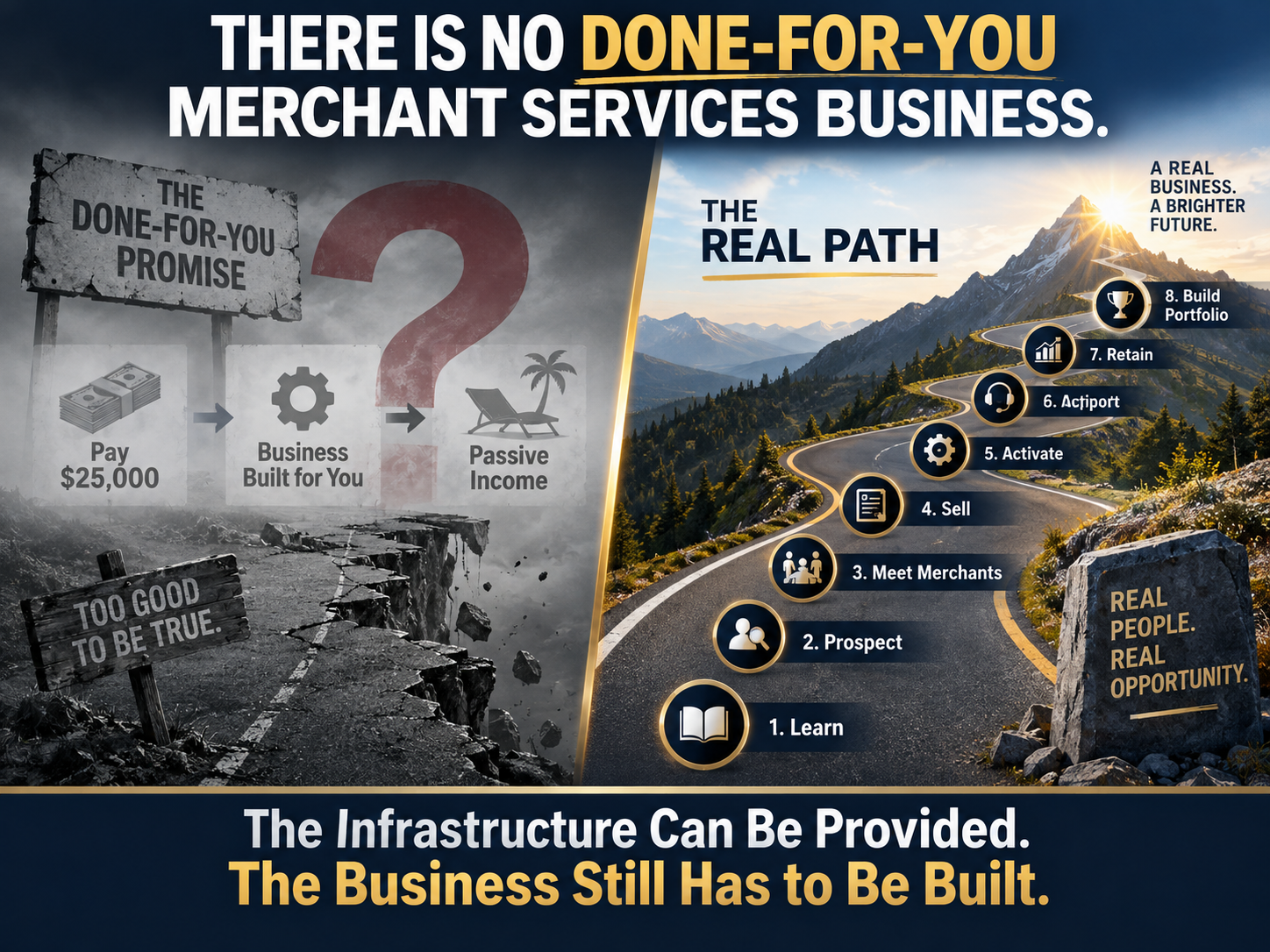
But there is a major difference between somebody providing you with infrastructure that helps you build a merchant-services business and somebody actually building the business for you.
The second promise is where I think prospective agents need to slow down.
Because if somebody is telling you that you can spend $10,000, $20,000, $25,000, or more and they'll essentially create the merchant-services business for you, I want you to understand exactly what would have to happen for that promise to be true.
Somebody would need to identify profitable businesses, prospect them, reach the decision-makers, set appointments, conduct discovery, overcome objections, close the merchants, get the accounts approved, activate them, build the relationships, and help keep those merchants processing - and after all that hand the account over to you. That would be done for you, and that process would have to be multiplied by hundreds of accounts for you to truly buy a done for you merchant sales business. That is NOT what you will get when buying a supposed DFY merchant sales business..
That should immediately lead to a very reasonable question:
If somebody can consistently acquire profitable merchants that create recurring income, why wouldn't they simply keep those accounts themselves?
That's the business.
There is no problem with purchasing training, technology, coaching, leads, infrastructure, or legitimate business support. But those things should not be confused with someone magically removing the central responsibility of entrepreneurship.
There is no done-for-you merchant-services business because nobody can do the ownership part of building a business for you.
That's exactly why I created Merchant Service University differently.
What Would “Done for You” Actually Have to Mean?
Let's remove the marketing language for a minute and look at the mechanics.
A merchant-services portfolio is a collection of real businesses that have been acquired as customers. Those merchants need payment processing, point-of-sale technology, invoicing, online payments, business software, or other commerce solutions. They don't become customers simply because somebody created a website for you, gave you a CRM, handed you a phone script, or added your name to a business entity.
Somebody has to sell them.
The restaurant owner has to say yes.
The contractor has to change processors.
The salon needs to trust the recommendation.
The retailer needs to see enough value to move forward.
The merchant may have questions about pricing, technology, support, contracts, implementation, deposits, integrations, equipment, or a dozen other things.
That relationship has to be won.
This is why I think the phrase done for you can become misleading when applied to merchant-services entrepreneurship. There are absolutely parts of the business somebody else can do for you. There are also parts they cannot eliminate without effectively becoming the salesperson and portfolio builder themselves.
If your goal is to understand the legitimate low-overhead version of the business, read Businesses You Can Start With Little Money and No Inventory. Merchant services can be attractive precisely because you can leverage existing infrastructure without having to manufacture the underlying product yourself.
But leveraging infrastructure is not the same thing as outsourcing entrepreneurship.
Done-for-You Infrastructure Is Real. Done-for-You Entrepreneurship Is Not.
This is the distinction I want people to understand before they dismiss all support as bad or, on the other extreme, assume support means they no longer need to do the work.
A strong merchant-services partner can provide tremendous value.
They can provide processing infrastructure, underwriting, equipment programs, merchant applications, reporting, technical support, product expertise, deployment assistance, modern commerce technology, and backend operations. A good organization can remove enormous amounts of friction from the salesperson's life.
That's exactly what I want a processing partner to do.
I don't want my sales agents underwriting merchants themselves. I don't want every salesperson trying to become a registered ISO before they understand the business. I don't want them building payment technology from scratch. I don't want an agent personally handling every technical support ticket.
I've written extensively about why I believe most salespeople are better served working through strong existing infrastructure in Merchant Services Agent vs. ISO.
Let great operators operate.
Let great salespeople sell.
That's leverage.
What isn't realistic is expecting the partner to also create the customers, build all the relationships, produce your portfolio, and somehow transfer the long-term value of all that work to you while you remain uninvolved.
The infrastructure can be done for you.
The production cannot.

What Are You Actually Buying for $10,000, $20,000, or $25,000?
This is the question I think every prospective buyer should write down before attending another business-opportunity presentation.
Forget the total price for a moment.
Break the package apart.
What exactly does your money purchase?
Is it education?
Personal coaching?
Weekly calls?
Software?
Lead-generation tools?
Appointments?
Merchant accounts?
A website?
A CRM?
Business formation?
A territory?
Equipment?
Access to a processing company?
A residual stream?
One-on-one mentorship?
If you're paying $25,000, you should be able to explain where the $25,000 of value is supposed to come from.
That doesn't mean a $25,000 program is automatically illegitimate. There are consulting engagements, executive coaching relationships, licenses, specialized education programs, franchises, and other legitimate business investments that can cost far more than that.
The amount alone isn't the issue.
The issue is whether you understand what you're buying and whether the product being sold actually solves the problem you think you're paying to solve.
That's why the next article in this cluster will be Should You Pay $10,000–$25,000 for a Merchant Services Business Opportunity?.
The answer shouldn't automatically be yes or no.
The answer should begin with:
Show me exactly what I'm purchasing.
If the Package Includes Merchant Accounts, Ask Where Those Accounts Came From
This deserves its own discussion because one way a high-ticket merchant-services opportunity can be made especially attractive is by telling the buyer they'll begin with existing accounts.
Now the offer sounds completely different.
You're not merely starting a business.
You're supposedly beginning with cash flow.
That gets people's attention because it appears to eliminate the slowest part of building a portfolio: acquiring the first merchants.
But existing merchant accounts create an entirely new list of due-diligence questions.
How long have those merchants been processing?
What is their average monthly volume?
What are the actual residual economics?
What percentage of the eligible residual do you receive?
How stable have the accounts historically been?
How long have those merchants been with the provider?
Why are these particular accounts being transferred?
What rights are actually being transferred?
Does the merchant have any relationship with you?
What happens if those businesses cancel thirty days later?
And perhaps most importantly:
Why is someone willing to sell or transfer an account that supposedly produces highly valuable recurring income?
There can be legitimate answers.
Portfolios and economic rights can be transferred under certain arrangements. Companies can restructure relationships. Books of business can change hands. I'm not suggesting the existence of transferred accounts automatically makes an offer questionable.
I'm saying you need to understand exactly what those accounts are worth rather than being hypnotized by the words instant residual income.
A Few Hundred Dollars in Residual Income Is Not the Same as Owning a Valuable Portfolio
In the companion video that inspired this article, I explain an experience reported to me by someone who said he paid roughly $25,000 for one of these types of opportunities. According to his account, the included merchants initially generated only a few hundred dollars per month, and within roughly six months those accounts had canceled. That is one individual's reported experience, not evidence that every business package operates the same way, but it illustrates why the quality and retention of transferred accounts deserve serious due diligence.
Think about what happens in that situation.
The buyer paid a large amount of money partly because existing accounts appeared to give them a head start.
Then those merchants disappeared.
Where is the buyer now?
They still need to prospect.
They still need to make calls.
They still need to set appointments.
They still need to close merchants.
They still need to build a portfolio.
In other words, they still need to learn the exact skill that could have been the foundation of the business from the beginning.
That's why our upcoming article Buying Existing Merchant Accounts: 11 Questions to Ask Before You Pay for a Portfolio is going to go much deeper into this issue.
If existing accounts are part of what you're purchasing, don't simply ask what they're paying this month.
Ask what you're actually buying.
The Most Important Question May Be: When Does the Seller Win?
This is the concept I think cuts through more marketing than almost anything else.
Follow the financial incentive.
Suppose you pay somebody $25,000 before you've signed your first merchant.
When did that company get paid?
Immediately.
When did you get paid?
You haven't yet.
That doesn't automatically make the arrangement bad. An educator can legitimately earn money before a student uses what they learned. A consultant can legitimately be paid before the client's implementation produces the result.
But it tells you something important about the incentive structure.
The seller may already have received its largest economic benefit from the relationship before you have successfully built anything.
Now compare that with a merchant-services relationship where an upstream organization earns more as you successfully acquire quality merchants that continue processing.
The economics begin to align differently.
You need productive merchants.
The processing organization needs productive merchants.
The merchant needs technology, pricing, service, and support worth keeping.
When the structure is healthy, the parties can benefit from keeping those merchant relationships active.
That doesn't make every traditional ISO perfect.
It doesn't make every referral relationship good.
It doesn't make every free program better than every paid program.
But it gives you a better question to ask:
What behavior does the compensation structure reward?
Our fifth article in this cluster, Follow the Money: How to Evaluate the Incentives Behind a Merchant Services Agent Program, will be dedicated entirely to this concept.

This Is Not an Argument Against Paid Coaching
I want to be very deliberate here.
I'm not arguing that nobody should ever pay for merchant-services coaching.
I'm not arguing that knowledge is worthless because information exists online.
I'm not arguing that someone's time shouldn't be expensive.
Great coaching can accelerate development tremendously.
If you want specialized one-on-one sales coaching, advanced portfolio consulting, help scaling a large ISO, contract consulting, vertical-specific expertise, leadership mentorship, or access to someone's limited personal time, there may be substantial legitimate value in paying for that expertise.
I've invested in education and mentorship myself.
The question is different:
Should someone need to pay $10,000, $20,000, or $25,000 simply to learn the foundational business and gain access to merchant services?
I don't believe they should.
That's why the distinction between foundational education and specialized coaching matters so much.
We'll break that issue down completely in Free Merchant Services Training vs. Paid Courses: What Should You Actually Pay For?.
Be Especially Careful With Guaranteed or Easy-Income Language
This is one place where my advice lines up closely with current FTC consumer guidance.
The FTC warns people considering business coaching or money-making opportunities to be skeptical of promises involving guaranteed income, large returns for little work, pressure to make a fast decision, or a supposedly proven system that will make the business easy. The agency recommends taking time, researching the seller, asking questions, and treating testimonials cautiously rather than assuming another buyer's stated result will become yours.
That doesn't mean every ambitious marketing claim establishes fraud.
It means you should not suspend normal business judgment because somebody attaches passive-income language to an opportunity.
You should become more analytical, not less.
Who is the end customer?
How does the customer get acquired?
Who performs the selling?
What are the margins?
What expenses continue after the initial fee?
How does the seller make money?
How do you make money?
How long do customers typically stay?
What happens if you stop producing?
What contractual rights are you actually receiving?
An opportunity that cannot survive those questions isn't something I'd be excited to purchase.
Some Business Opportunities May Also Carry Specific FTC Disclosure Requirements
There is another reason to understand exactly what type of opportunity you're being offered.
Depending on how a program is structured, certain business opportunities may fall within the FTC's Business Opportunity Rule. The FTC specifically notes that the Rule can apply in situations where a seller offers to help a buyer set up or operate a business, including some arrangements involving the provision of customers or accounts. Whether any particular merchant-services offer falls within the Rule depends on the actual structure, so this is not a statement that every agent program is covered.
When the Rule does apply, the FTC says covered sellers generally must provide a prescribed disclosure document at least seven days before the buyer signs a contract or pays money. If covered sellers make earnings claims, additional substantiation and an earnings-claim statement can also be required.
That isn't legal advice, and I wouldn't try to determine an offer's legal status from a marketing page alone.
The practical takeaway is simpler:
A serious business opportunity should become clearer when you ask for documentation, not more confusing.
Testimonials Are Not the Same Thing as Expected Results
This matters enormously in high-ticket opportunities.
A seller shows you someone earning $10,000 per month.
Another person says they left their job.
Someone else has built an enormous residual portfolio.
Those stories may be completely legitimate.
But they don't tell you what happens to the typical buyer.
Maybe that person had twenty years of sales experience.
Maybe they knew hundreds of business owners.
Maybe they worked sixty hours per week.
Maybe they bought additional advertising.
Maybe they were already in payments.
Maybe they had resources or relationships you don't have.
This is why I want you to learn how the business works rather than making a decision based primarily on somebody else's outcome.
I have built significant recurring income in merchant services.
That proves what I built.
It does not guarantee what you will build.
You still have to execute.
Passive Income and Passive Effort Are Two Completely Different Things
This is one of the core ideas from the video behind this cluster.
Merchant services can create recurring income that becomes increasingly detached from the exact hour in which the original sale was made.
That's powerful.
You can acquire a merchant in March and, depending on the account's activity, retention, economics, and your agreement, potentially continue receiving residual compensation later in the year without closing that same merchant again every month.
That is one of the things I've always loved about this industry.
But don't confuse that with passive effort.
You had to get the merchant first.
Someone needed to prospect.
Someone needed to create trust.
Someone needed to close.
Someone needed to get the account through underwriting and activation.
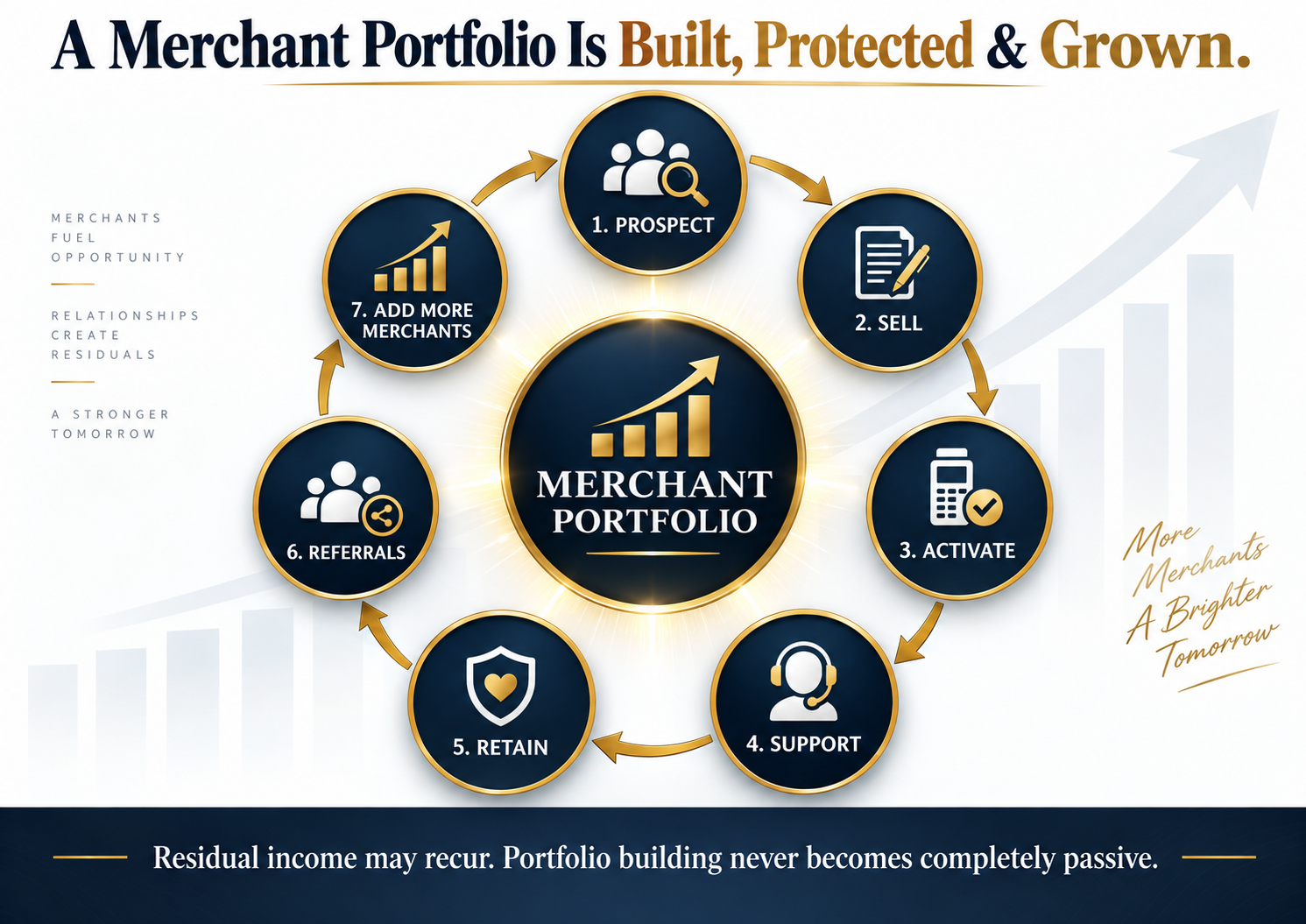
And if you're building a serious portfolio, you don't stop after one merchant.
You keep acquiring.
You keep protecting relationships.
You deal with attrition.
You add more accounts.
The income can become increasingly residual.
Building the source of that income is active work.
If you want the full breakdown of that distinction, read Can Merchant Services Create Passive Income? How Residual Income Really Works.
A Merchant Portfolio Is Never “Finished”
This is another reason I resist the done-for-you framing.
A website can be delivered to you.
A logo can be delivered.
A legal document can be completed.
A software installation can be finished.
A merchant portfolio is different.
Even after you've built one, merchants leave.
Businesses close.
Owners sell.
Technology changes.
Competitors call.
Processing volume moves up and down.
Support quality affects retention.
You continue adding merchants while trying to protect the relationships you've already acquired.
That's why How to Build Recurring Income as a Salesperson Without Starting Over Every Month focuses so heavily on both new production and retention.
A portfolio isn't a completed project someone drops into your account.
It's an operating customer base.
What a Good Merchant Services Program Should Actually Do for You
I don't want the takeaway from this article to be that you're supposed to do absolutely everything yourself.
That would defeat one of the biggest advantages of this industry.
A good partner should make it easier for you to focus on the part of the business where you create the most value.
They should provide legitimate processing infrastructure. They should have clear underwriting procedures. They should help merchants get properly boarded. They should offer products worth selling. They should provide reasonable merchant support. They should give you usable reporting. Your compensation should be understandable. Your agreement should explain your rights.
Training should also help you shorten the learning curve.
The point is that these resources should help you build the business rather than serve as theater designed to make it sound as though nobody needs to build it.
That's why How to Choose a Merchant Services Agent Program is such an important guide.
A strong program isn't one that promises you won't have to work.
It's one that makes your work more productive.
The Contract Still Matters Even if You Paid for the Opportunity
This is something I would never skip.
Paying a large fee doesn't automatically give you strong residual rights.
Your purchase agreement and agent agreement are separate issues that need to be understood carefully.
Who owns the merchant relationship contractually?
Are your residuals vested?
What happens if you stop producing?
Can residual compensation be terminated?
What are the clawback provisions?
Are there minimums?
What restrictions exist?
What happens if the upstream organization is sold?
Do you have any transfer or assignment rights?
The marketing language around "your business" may feel very different from the actual contractual language describing your rights.
Read Merchant Services Contract Red Flags and Merchant Services Agent Agreement: 11 Questions to Ask Before You Sign.
If you're paying thousands for a business opportunity, you should understand the documents at least as carefully as someone entering the industry for free.
Before You Pay for a Done-for-You Merchant Services Package, Ask These 12 Questions
You don't need to make the conversation confrontational. You simply need clear answers.
1. Exactly what am I receiving for the upfront fee? Break the package into specific deliverables and assign real value to them.
2. Does your company primarily make money from merchants or from selling business opportunities to prospective agents? The answer tells you something about the underlying incentives.
3. Who is responsible for acquiring my future merchants? Don't accept vague answers such as "the system does it."
4. If leads are included, what exactly is a lead? A data record, exclusive prospect, qualified appointment, or interested business owner are very different things.
5. If merchant accounts are included, where did they come from? Understand history, profitability, retention, and why they're being transferred.
6. What happens if the included merchants cancel? Is there any replacement policy? For how long? Under what conditions?
7. What exactly do I own? Ask specifically about residual rights, customer relationships, transfer rights, and termination.
8. What happens if I stop selling? Understand vesting and production requirements before building anything.
9. What ongoing expenses exist after the purchase? Software, lead costs, advertising, support, recurring fees, and other expenses matter.
10. What percentage of buyers actually achieve the income being discussed? Don't confuse a testimonial with a representative outcome.
11. Can I speak with buyers I choose rather than only selected success stories? The goal is to understand a range of experiences.
12. Can I review the agreements before paying? If you're making a serious business investment, you should understand the actual contractual structure.
If those questions make the opportunity stronger, great.
If they make it fall apart, you just saved yourself a very expensive lesson.
You Don't Need to Spend Thousands Just to Understand Merchant Services
This is the point where Merchant Service University enters the conversation.
I didn't build MSU because I think nobody should ever pay for coaching.
I built it because I don't believe basic access to this industry should require a huge buy-in.
You should be able to understand what payment processing is before paying thousands of dollars.
You should be able to learn how agents are compensated.
Understand pricing.
Understand residuals.
Understand Schedule A.
Understand agent agreements.
Understand merchant technology.
Understand prospecting.
Understand what portfolio building actually requires.
Then you can decide whether merchant services deserves your time.
That's a much more rational sequence than:
Pay $25,000 first → Learn what the business actually is afterward.
Why Merchant Service University Uses a Different Incentive Model
The core Merchant Service University education is free.
That's intentional.
I've spent more than 16 years making my living in merchant services. I don't need the foundational education itself to become a high-ticket product in order for me to participate economically in this industry.
I want you to learn.
I want you to get foundationally certified.
Then, if you decide merchant services fits what you're trying to build, you can unlock the next step and evaluate partner options.
Different partners can make sense for different people.
One salesperson may care more about technology.
Another may prioritize support.
Someone else may value strong upfront compensation.
Another may be focused heavily on long-term residual economics.
The objective isn't to recruit you first and educate you afterward.
It's:
Learn → Get Certified → Define Your Goals → Evaluate Partners → Build
That's why one of the core MSU phrases is:
Get educated before you get recruited.
Take a Peek at Merchant Service University Before You Write a $25,000 Check
If you're currently considering one of these expensive merchant-services opportunities, I'm not asking you to believe me instead of believing them.
I'm asking you to learn enough to evaluate the offer intelligently.
Go to MerchantServiceUniversity.com.
The core training is free.
Work through the fundamentals.
Understand how merchant services actually works.
Then go back and evaluate the $10,000, $20,000, or $25,000 package.
You may determine that the specialized coaching or deliverables justify the price.
Fine.
At least now you'll understand what you're buying.
Or you may realize that a large percentage of what you're being charged for is foundational information, industry access, and the promise that somebody can somehow remove the work of building your business.
If that's the case, you have another option.
Learn first.
Get certified.
Then decide what you want to build.

Frequently Asked Questions About Done-for-You Merchant Services Businesses
Is there really a done-for-you merchant services business?
A company can provide training, technology, processing infrastructure, underwriting, support, equipment programs, leads, appointments, or other resources. However, building a lasting merchant portfolio still requires acquiring and retaining real merchant relationships. Prospective buyers should understand exactly which parts are truly being provided and which responsibilities remain theirs.
Can someone build a merchant-services portfolio for me?
Someone else can potentially sell or transfer certain contractual economic rights or accounts under an appropriate arrangement, but that is different from continuously building your future merchant portfolio for you. Any transferred accounts should be carefully evaluated for profitability, retention, contractual rights, and transferability.
Are done-for-you merchant services programs scams?
Not automatically. The phrase can describe legitimate services and support, and a high purchase price alone does not establish fraud. Buyers should evaluate the actual deliverables, earnings representations, merchant-account quality, agreements, ongoing expenses, seller incentives, and responsibilities that remain after purchase.
Should I pay $10,000 or $25,000 for a merchant-services business opportunity?
The answer depends on what is actually included and whether those deliverables provide enough legitimate value to justify the price. Prospective buyers should understand the education, coaching, accounts, leads, technology, contractual rights, ongoing costs, and support they're purchasing before paying.
Can merchant services create passive income?
Merchant-services portfolios can potentially generate recurring residual compensation from active merchants. Residual income is generally a more precise term because acquiring merchants requires active sales work and continuing compensation depends on merchant activity, retention, account economics, and contractual rights.
What is the difference between passive income and passive effort?
Passive or recurring income describes compensation that may continue after the original sale. Passive effort implies little or no work is required to build the source of that income. Merchant-services portfolios generally require prospecting, selling, activation, relationship building, and retention before meaningful residual income can develop.
Is buying existing merchant accounts risky?
It can be. Buyers should evaluate account age, processing volume, actual residual economics, attrition history, customer relationships, contractual rights, reasons for transfer, and what happens if merchants cancel after the purchase.
What should I ask if merchant accounts are included in a business package?
Ask where the accounts came from, how long they've processed, their historical profitability and retention, why they're being transferred, what residual rights you're receiving, and what happens if the accounts cancel.
Do merchant-services agents need expensive training?
Foundational merchant-services education does not inherently require an expensive course. Specialized coaching or advanced mentorship can have legitimate value, but prospective agents should understand what additional expertise they're purchasing beyond basic industry education.
Is paid merchant-services coaching bad?
No. Specialized coaching, one-on-one mentorship, advanced sales training, portfolio consulting, leadership development, and other expertise can provide substantial legitimate value. The important question is whether the buyer understands exactly what they're paying for.
What should a merchant-services partner provide?
A strong partner may provide processing infrastructure, underwriting, merchant support, technology, equipment programs, applications, reporting, and operational assistance. The salesperson still needs to create merchant relationships and production.
Do I need to become a registered ISO to build a merchant-services business?
Not necessarily. Many independent agents can build substantial merchant portfolios through established processing partners that already provide the operational infrastructure needed to support merchants.
What should I check in a merchant-services agent agreement?
Review residual calculations, vesting, termination, production requirements, clawbacks, portfolio rights, transfer provisions, restrictions, and what happens to compensation if the relationship ends.
What is Merchant Service University?
Merchant Service University is Joe Wagner's foundational merchant-services education program designed to teach processing, pricing, residual compensation, agreements, merchant technology, prospecting, sales, and portfolio building before students choose a processing partner.
Is Merchant Service University free?
Yes. The core Merchant Service University education is free and does not require students to commit to one processing company.
What happens after Merchant Service University certification?
After completing the foundational education, qualified students can define what they're trying to build and evaluate potential partner options rather than choosing a processing company before understanding the industry.
Where should I start before buying a merchant-services business opportunity?
Start by learning how the industry works through Merchant Service University. Then evaluate the opportunity's price, deliverables, compensation structure, agreements, seller incentives, merchant-account quality, and ongoing responsibilities from an informed position.
Final Takeaway: You Don't Need Someone to Pretend They're Going to Build Your Business for You
Merchant services is a real business.
That's exactly why I like it.
There are real customers. There is a real product. Businesses genuinely need payment technology. The industry has real infrastructure behind it, and a salesperson can leverage that infrastructure without having to build an entire processor themselves.
There is also the potential for recurring residual income, which is one of the reasons I've remained passionate about this industry for more than 16 years.
But the portfolio still has to come from somewhere.
Real merchants need to be acquired.
If you're going to own the long-term benefit of those relationships, you should expect to participate in creating them.
That doesn't mean you need to do everything alone. In fact, I think the opposite is true. You need great education. You need a strong processing partner. You need good technology. You need underwriting. You need support. You need people around you who know the industry.
But all of those resources exist to help you build.
They aren't a substitute for building.
So when somebody says they'll create a done-for-you passive-income business in merchant services, don't immediately argue with them.
Ask questions.
What exactly is done?
Who acquires the merchants?
Where do included accounts come from?
What happens if they cancel?
What do you actually own?
What are the ongoing expenses?
When does the seller make its money?
When do you make yours?
And after spending all that money, what work will you still need to perform?
The answers will tell you far more than the sales presentation.
And before you pay thousands simply to discover how this industry works, go to MerchantServiceUniversity.com.
I'll teach you the foundations for free.
Learn the industry.
Learn residuals.
Learn pricing.
Understand the agreements.
Learn the technology.
Learn how merchants are acquired.
Get MSU Core Certified.
Then decide whether you want to build.
You don't need somebody to sell you the dream of merchant services.
You need education.
You need the right partnerships.
Then you need to do the work.
That's how this industry actually works.
About Joe Wagner
Joe Wagner has spent more than 16 years in merchant services and payment-processing sales, acquiring merchants, developing sales organizations, training sales professionals, and building recurring residual portfolios.
He created Merchant Service University after becoming frustrated with seeing people charged thousands of dollars simply for foundational access to the payments industry and hearing from prospective agents who did not always feel they received the practical value they expected.
Merchant Service University's core training is free and is designed around a different sequence: learn the business, get foundationally certified, understand your goals, evaluate partner options, and then begin building a real merchant portfolio.
Continue with Can Merchant Services Create Passive Income?, How to Choose a Merchant Services Agent Program, Merchant Services Contract Red Flags, How to Become a Merchant Services Agent in 2026, or the next article in this cluster, Should You Pay $10,000–$25,000 for a Merchant Services Business Opportunity?.
Or begin with the free core training at Merchant Service University.