Merchant Services Agent vs ISO: Do You Need to Become an ISO?
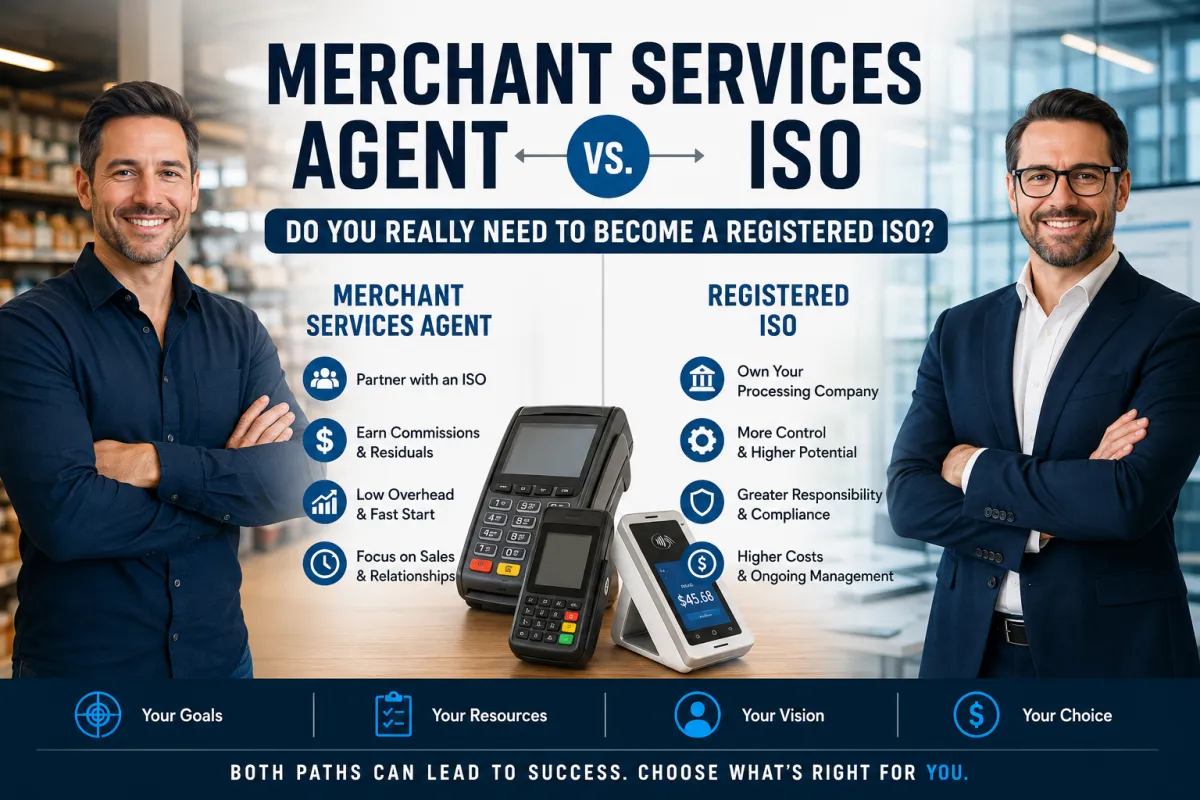
Merchant Services Agent vs. ISO: Do You Really Need to Become a Registered ISO?
If you're building a payments business, eventually you're probably going to hear someone say:
"You should become your own registered ISO."
I've heard it for years.
And after more than 16 years in merchant services, here's my opinion:
Becoming a registered ISO is overrated for most merchant services salespeople.
Notice that I said most.
There are legitimate reasons to become a registered ISO.
There are companies that should do it.
There are entrepreneurs building payment organizations where the additional control, infrastructure and direct relationships make complete sense.
But I don't believe becoming a registered ISO should automatically be viewed as the next level of success for every merchant services agent.
Personally, I always looked at it differently.
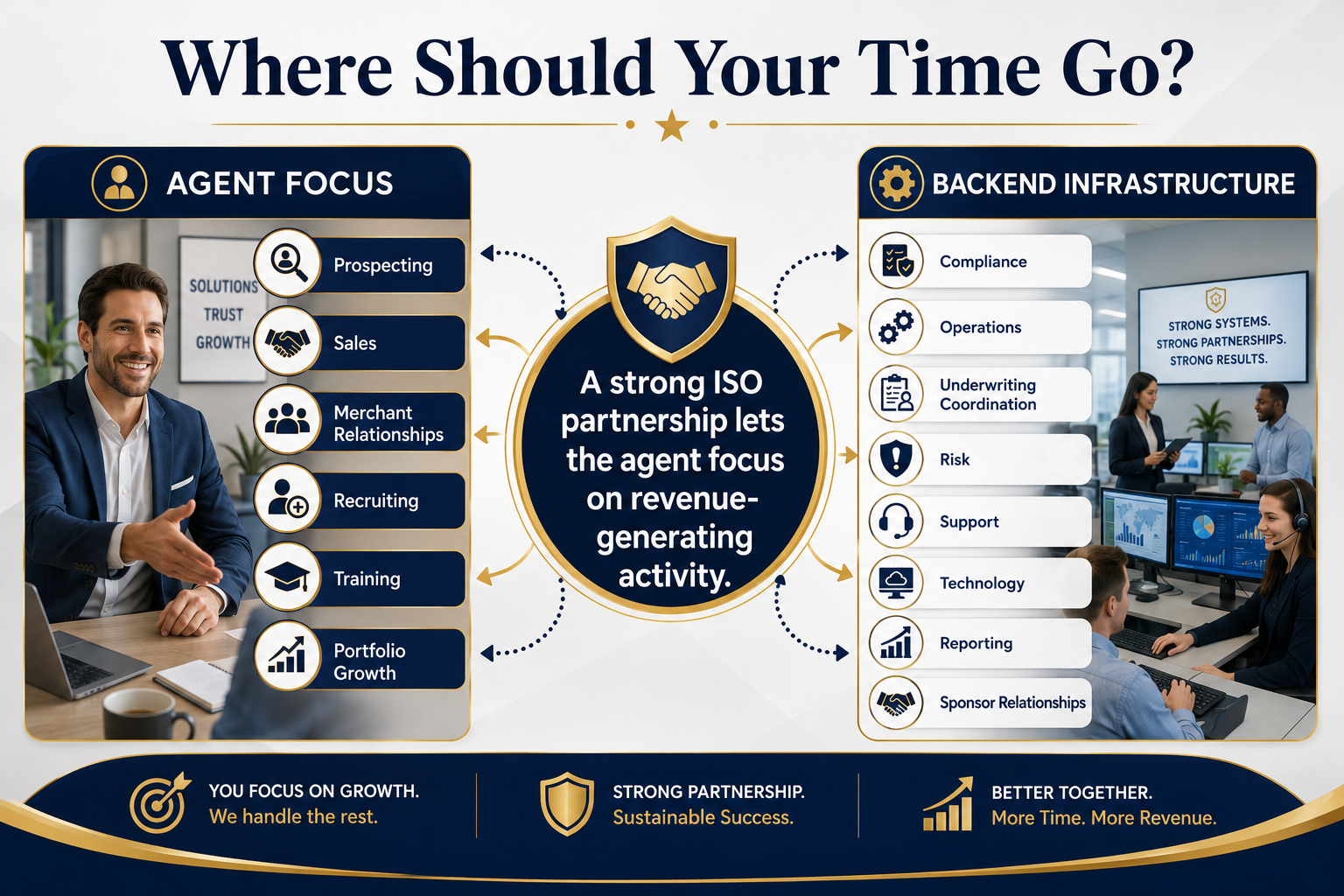
Why take on more operational responsibility, overhead, compliance obligations, backend infrastructure and risk if a strong ISO partner can handle that side of the business for me?
I'd rather sell.
I'd rather recruit.
I'd rather train.
I'd rather build merchant relationships.
I'd rather grow the portfolio.
If I can partner with a strong organization that handles the backend heavy lifting, I'm perfectly comfortable letting them do it.
Let the ISO be great at being the ISO.
Let me be great at creating revenue.
That's how I've approached this business.
This article will explain the actual difference between a merchant services agent vs. ISO, what becoming registered can involve, the advantages of each model and why I personally believe most sales professionals should think very carefully before deciding they need to become their own registered ISO.
If you're brand new to the payments industry, start with my Merchant Services Sales: Complete 2026 Beginner's Guide first.
What Is a Merchant Services Agent?
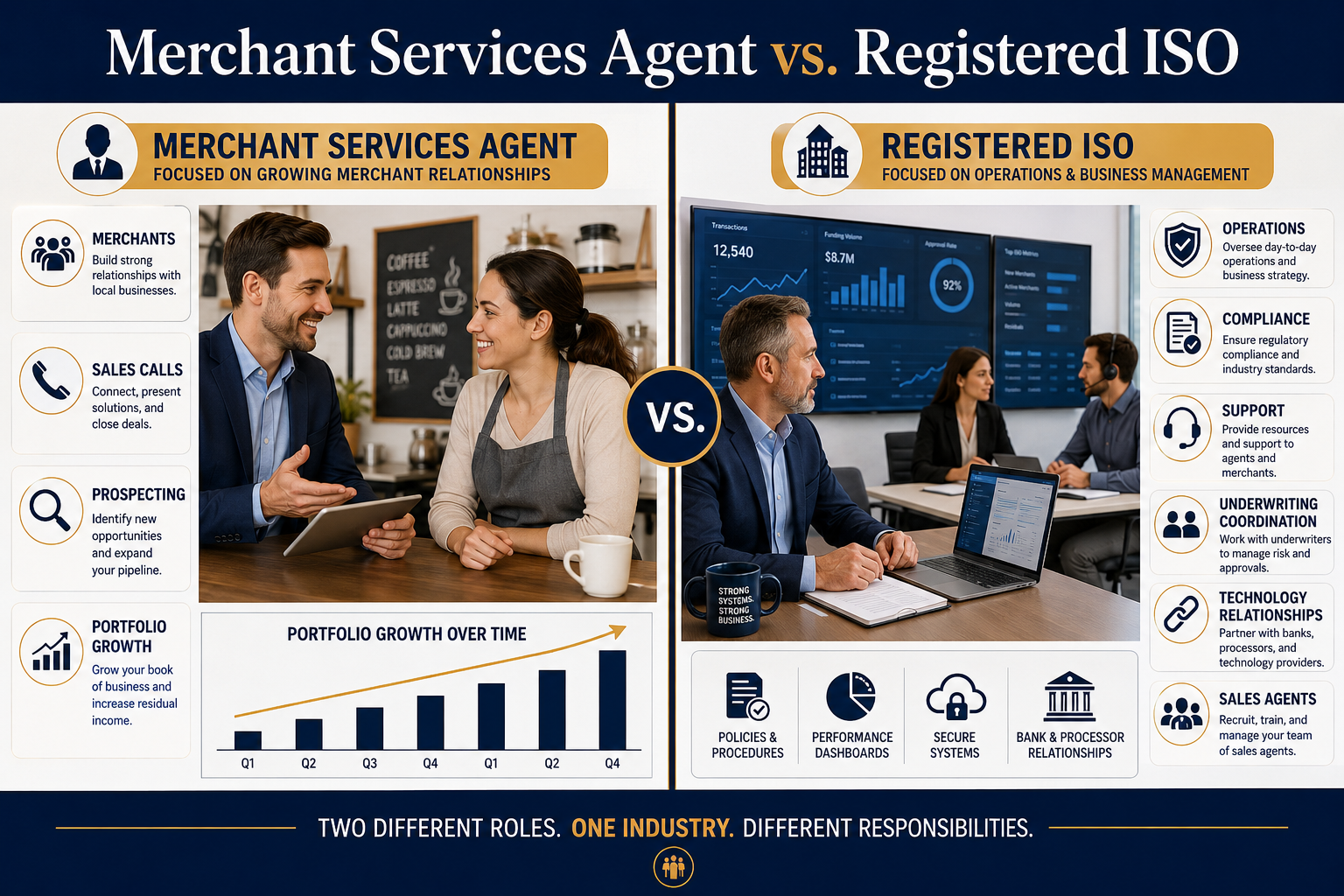
A merchant services agent is generally the person or organization responsible for developing merchant relationships and selling payment-processing or commerce solutions.
Depending on the company they're partnered with, an agent may:
Prospect businesses.
Explain payment products.
Review merchant statements.
Conduct demos.
Recommend POS systems.
Submit merchant applications.
Help coordinate installations.
Manage merchant relationships.
Build referrals.
Recruit or train additional agents.
And, depending on the agreement, earn merchant services agent commissions and residual income.
An independent agent doesn't necessarily need to operate all of the payment infrastructure behind the business.
That's one of the things I like about this model.
The agent can specialize in what they are best at:
Acquiring and retaining merchants.
The backend organization handles the larger operational structure required to get those merchants processed.
What Is an ISO in Merchant Services?
ISO stands for Independent Sales Organization.
The term can be used loosely in conversation, which sometimes creates confusion.
You'll hear people call themselves:
An ISO.
A sub-ISO.
An ISO agent.
An independent agent.
A registered ISO.
A merchant-services company.
Those aren't always identical arrangements.
At a high level, an ISO operates within the card-payment ecosystem to provide services related to merchant acquisition, sales and other payment functions through relationships with acquiring institutions and processors.
Mastercard's published service-provider categories specifically identify Independent Sales Organizations as service providers that can perform activities including merchant solicitation, application processing, merchant customer service, merchant education and terminal deployment. You can review Mastercard's official service-provider description here:
Visa similarly maintains a Third Party Agent Registration Program covering independent sales organizations and other payment-related third parties. Visa explains that entities providing merchant services may work through an existing Visa Client sponsor or establish a relationship with one for registration.
Visa's current program information is available here:
https://partner.visa.com/site/programs/third-party-agent-registration.html
The simplest way to understand the structure is this:
An agent focuses primarily on generating merchant business.
An ISO generally sits higher in the distribution and operational structure supporting that merchant business.
Exactly where responsibilities fall depends on the agreement, sponsor bank, processor and business model.
What Is a Registered ISO?
A registered ISO has gone beyond merely selling underneath another merchant-services organization.
The organization has established the relationships and registrations required for the role it performs within the payment ecosystem.
That generally involves relationships with an acquiring or sponsoring institution and registration within applicable card-network programs.
Visa's Global Registry, for example, exists so registered service providers and their compliance status can be identified within Visa's payment ecosystem.
Visa also states that applicable service providers must be registered before clients use their services.
You can see Visa's service-provider registry information here:
https://www.visa.com/splisting/
So becoming a registered ISO is not simply a marketing upgrade.
It's not like changing your business card from:
Merchant Services Agent
to:
Registered ISO
and suddenly becoming more legitimate.
You're stepping further into the operational payment infrastructure.
And with more control can come more responsibility.
That's the part I think gets overlooked.
Why Do Agents Want to Become Registered ISOs?
I understand the attraction.
There are legitimate advantages.
Depending on the relationship, becoming a registered ISO may provide greater control over things such as:
Pricing.
Agent compensation.
Processing relationships.
Product relationships.
Branding.
Merchant ownership.
Portfolio economics.
Sales organization structure.
Operational decisions.
Technology relationships.
There can also be prestige attached to it.
Instead of telling someone:
"I sell for a processing company,"
you can say:
"I own a registered ISO."
That sounds like progression.
And if you're building a large organization where that infrastructure supports the strategy, great.
But I've always asked a different question:
Does becoming a registered ISO actually make my life and business better?
Because adding responsibility for the sake of saying you moved "up" in an industry doesn't automatically make good business sense.
My Opinion: Becoming a Registered ISO Is Overrated for Most Agents
This is where my opinion gets stronger.
I think a lot of successful merchant services agents become fascinated with becoming their own ISO because it feels like the next logical step.
I don't automatically agree.
Here's why.
If I'm good at selling merchant services and building a portfolio, I want to spend my time doing the activities that create revenue.
Prospecting.
Meeting merchants.
Closing deals.
Recruiting.
Training.
Developing relationships.
Improving sales systems.
Growing the portfolio.
I don't personally get excited about taking on additional backend responsibility simply because I technically can.
If a strong ISO partner already has:
Processor relationships.
Sponsor relationships.
Underwriting systems.
Risk infrastructure.
Customer support.
Deployment processes.
Operations staff.
Residual reporting.
Compliance processes.
Technical support.
Product relationships.
Then why do I automatically need to recreate all of that?
I don't.
I'd rather use their infrastructure and continue doing what I do best.
That has been my approach for years.
Let Someone Else Do the Backend Heavy Lifting
This is probably the simplest way I can explain my philosophy.
Imagine two entrepreneurs.
Entrepreneur A
Spends the majority of their time:
Selling.
Prospecting.
Recruiting.
Training.
Building merchant relationships.
Growing recurring revenue.
Entrepreneur B
Does all of that while also trying to develop and oversee more of the backend infrastructure associated with operating their own registered payment organization.
Which one is better?
Neither universally.
Entrepreneur B may eventually build something larger.
They may gain greater control.
They may have a completely different exit strategy.
But Entrepreneur B also chose a different business.
And that's the key point.
Becoming an ISO isn't simply becoming a better merchant services agent.
You're increasingly becoming the operator of a payments organization.
Those require different skill sets.
I've always preferred to let someone else take on more of that responsibility.
Give me a great agreement.
Give me competitive economics.
Give me solid technology.
Give me strong merchant support.
Give me reliable operations.
Give me multiple solutions to sell.
Then let me go create revenue.
That's the business I enjoy.
More Control Usually Means More Responsibility
Entrepreneurs love control.
I understand that.
I do too.
But control has a cost.
The more of the payment relationship you bring under your own organization, the more likely you are to need people, systems, oversight and expertise to manage it properly.
Depending on your structure, that can include responsibilities around:
Compliance.
Merchant onboarding.
Risk coordination.
Underwriting relationships.
Customer support.
Equipment deployment.
Agent support.
Residual accounting.
Bank relationships.
Processor relationships.
Security requirements.
Technology.
Disputes and chargebacks.
Legal agreements.
Reporting.
Operations.
Card-network requirements.
Not every ISO performs every one of those functions directly.
That's important.
Different organizations outsource or allocate responsibilities differently.
But the general principle remains:
Moving further up the payments infrastructure usually means taking responsibility for more than simply selling accounts.
That's not necessarily bad.
But you should actually want that business before creating it.
Registration Also Brings Real Compliance Requirements
This isn't just my opinion.
The card networks themselves demonstrate that moving into registered service-provider roles involves actual oversight.
Visa's Global Registry explains that applicable service providers storing, processing or transmitting Visa cardholder data must maintain and revalidate PCI DSS compliance. Visa also maintains formal registration requirements around third-party agents.
Mastercard similarly identifies ISO as a defined service-provider category and maintains registration and compliance requirements for applicable service providers.
That's exactly what you would expect.
Payments involves financial data, merchants, banks, consumers and regulated infrastructure.
More involvement can mean more accountability.
So when someone says:
"Why don't you just become your own registered ISO?"
my response is:
Why?
What problem am I solving?
What economic advantage am I gaining?
What strategic control do I need?
And is that advantage worth the additional operational burden?
If I don't have compelling answers to those questions, I'm not interested in adding complexity just for the title.
Merchant Services Agents Can Still Build Serious Businesses
This is another misconception I want to eliminate.
You do not necessarily need to become a registered ISO to build a meaningful merchant-services business.
An agent can potentially build:
A large merchant portfolio.
Recurring residual income.
A team.
A personal brand.
A niche-specific sales organization.
A referral network.
A local market presence.
Training systems.
Lead-generation systems.
Recurring revenue.
Long-term merchant relationships.
You may be able to negotiate increasingly strong economics as your production increases.
What matters is your agreement.
What rights do you have?
What is your residual split?
What are the underlying costs?
Do your residuals vest?
Can you build a team?
Can you sell your portfolio?
What happens if you leave?
Those questions can matter far more to an entrepreneurial salesperson than whether their own company is technically the registered ISO.
That's why I keep telling agents to understand how merchant services commissions and residual income actually work before chasing titles.
Think About What Business You Actually Want to Own
This is the real question.
Do you want to own:
A Sales and Portfolio Business?
Your primary skills are:
Selling.
Marketing.
Recruiting.
Relationship building.
Training.
Portfolio development.
Your backend partner handles much of the operational infrastructure.
Or do you want to own:
A Payments Organization?
Now you're increasingly responsible for building an organization around the payment infrastructure itself.
Those can both be excellent businesses.
They're just not the same business.
I'm much more interested in building revenue-producing merchant relationships than proving I can take on every operational responsibility in the payments ecosystem.
That's personal preference.
Someone else may love the operational side.
They may want the control.
They may want to build an organization with hundreds of employees and direct payment relationships.
Great.
I don't think everyone needs to follow them there.
When Becoming a Registered ISO Might Make Sense
Despite my strong opinion, there absolutely are circumstances where becoming registered could make sense.
For example, you may have reached a point where:
You have significant processing volume.
You manage a large agent organization.
You need more pricing control.
You need different processor relationships.
You want direct control over certain merchant operations.
Your economics justify additional overhead.
You have experienced payments operations leadership.
You have the capital to build infrastructure properly.
You have compliance expertise.
You have a strategic reason for moving closer to the acquiring relationship.
You want to build a larger payments enterprise rather than primarily a sales organization.
Now the conversation changes.
At that point, becoming registered isn't simply about status.
It's part of a larger business strategy.
That's how I think it should be evaluated.
When I Would NOT Become a Registered ISO
I wouldn't do it simply because:
I had 20 merchants.
Someone told me it's the next level.
I wanted the words "registered ISO" on my website.
I assumed I'd automatically make more money.
I thought it would impress agents.
I didn't want to share revenue upstream.
Those reasons aren't enough for me.
Especially the last one.
People sometimes focus obsessively on what percentage they're giving up to their upstream partner.
But think about what you're receiving in return.
Infrastructure has value.
Support has value.
Risk management has value.
Compliance has value.
Technology has value.
Operations have value.
Underwriting relationships have value.
Merchant service has value.
If the organization above me provides all of that and leaves me free to sell, I'm perfectly willing for them to make money.
I want my partners to make money.
I just want an agreement where I also make excellent money.
That's business.
Don't Become an ISO Just to Keep 100% of Something Smaller
This is an entrepreneurial principle that goes far beyond merchant services.
People become obsessed with percentages.
They want:
100% ownership.
100% margin.
100% residual.
100% control.
But 100% of a smaller business isn't automatically better than a smaller percentage of a dramatically bigger business.
Suppose your strong ISO relationship allows you to focus almost entirely on sales.
Because of that, you build 300 merchants.
Now imagine becoming your own registered ISO forces you to spend substantially more time, money and attention on operations, staffing and backend responsibilities.
Maybe you build only 100 merchants.
Which model actually creates the better outcome?
I can't answer that universally.
But it's a question worth asking.
Optimization should focus on actual results—not ego percentages.
This is the same reason a larger residual percentage doesn't automatically mean you're earning more money, as I explained in Merchant Services Agent Commissions: How Agents Get Paid.
Your Most Valuable Skill May Still Be Acquiring Merchants
This is another reason I'm comfortable staying focused on sales.
Infrastructure is valuable.
But infrastructure without merchants doesn't create much revenue.
Merchant acquisition is difficult.
The person who can consistently walk into a market and create customers possesses an extremely valuable skill.
I would much rather spend years becoming exceptional at:
Finding merchants.
Starting conversations.
Understanding businesses.
Closing accounts.
Building teams.
Training producers.
Creating lead systems.
Building a brand.
Maintaining merchant relationships.
Than become mediocre at 40 different backend payment functions.
That's my lane.
Know yours.
The Better Goal: Build Leverage Without Unnecessary Complexity
I love leverage.
Residual income is leverage.
A team is leverage.
Technology is leverage.
Content is leverage.
Automation is leverage.
A good backend partner is also leverage.
If another organization has already invested millions of dollars and years of effort creating the payment infrastructure I need, why would I automatically recreate it?
I can plug into their infrastructure.
Negotiate strong economics.
Protect my contractual rights.
Then spend my time generating revenue.
That's leverage too.
Sometimes entrepreneurs create complexity because complexity makes the business feel bigger.
I would rather create a simple machine that produces results.
What Should You Look for in a Strong ISO Partner?
If I'm telling you not to automatically become registered yourself, the obvious next question is:
Then what should I look for in the ISO I'm working with?
A lot.
I would evaluate:
Strong Economics
Understand your upfront commissions, residual split and underlying costs.
Residual Rights
Understand vesting and what happens if the relationship ends.
Transparent Schedule A
Know what your compensation is calculated from.
Merchant Support
How well are your accounts treated after you sell them?
Agent Support
Can someone actually help you when a deal gets complicated?
Strong Technology
Does the organization give you competitive solutions to sell?
Underwriting
Can the organization get legitimate businesses approved efficiently without unnecessary friction?
Multiple Solutions
Not every merchant needs the same product.
Reliable Residual Reporting
You need transparency into what you're getting paid.
Fair Contract Terms
The relationship needs to make sense long term.
Operational Competence
This might be the most underrated one.
If I'm delegating the backend to you, you had better be good at the backend.
That's the deal.
You handle what you're great at.
I'll handle what I'm great at.
Then we both make money.
Agent vs. ISO: Which One Makes More Money?
There is no universal answer.
A registered ISO may potentially have more control over economics.
An agent may give up some margin to the organizations providing infrastructure.
But that doesn't tell you which entrepreneur ultimately earns more.
Income depends on:
Merchant volume.
Margins.
Residual splits.
Underlying costs.
Sales volume.
Merchant retention.
Staffing costs.
Operational expenses.
Technology costs.
Compliance costs.
Agent production.
Portfolio size.
Overhead.
A registered ISO generating weak sales can make less money than an elite independent agent with a huge merchant portfolio.
The title doesn't create the income.
Production creates the income.
That's why I continue to believe the biggest question should be:
Where can I generate the most value?
Is a Sub-ISO a Good Middle Ground?
For some entrepreneurs, yes.
A sub-ISO relationship may allow an organization to operate with greater independence than a basic individual sales-agent arrangement while still leveraging the registration and infrastructure of a larger ISO.
Again, terminology and structures vary significantly between companies.
Don't become obsessed with the title.
Look at the actual agreement.
What can you control?
What economics do you receive?
Can you recruit?
Can you build a team?
Can you negotiate pricing?
What systems are provided?
Who handles support?
Who handles operations?
What residual rights do you have?
Those contractual questions matter more than whether someone calls the relationship:
Agent.
Sub-agent.
Sub-ISO.
Sales office.
Dealer.
Partner.
Read the contract.
Understand the economics.
Understand the responsibilities.
My Preferred Model: Let the Experts Handle Their Lane
If I could simplify my personal philosophy into one paragraph, it would be this:
I want to work with a strong ISO that provides excellent technology, strong economics, reliable support and fair contractual terms. Then I want them to handle the backend payment infrastructure while I focus on sales, recruiting, training and portfolio growth.
That's the model I prefer.
It doesn't mean becoming registered is wrong.
It doesn't mean someone who builds their own ISO is making a mistake.
It means I don't personally believe additional complexity is automatically progress.
I want my time spent where I create the greatest return.
For me, that's the front end.
Sales.
People.
Growth.
Want to Understand the Industry Before Deciding What Structure You Need?
One of the reasons people become confused about terms like agent, ISO, registered ISO, processor, acquirer and payment facilitator is that they're often being taught by someone trying to recruit them into one specific structure.
That's why I created Merchant Service University.
The core education is free.
You can learn how this industry works before you decide:
Which company to join.
Which partner structure fits you.
Whether you want to remain an independent agent.
Whether you eventually want to build a team.
Or whether becoming a registered ISO someday actually makes sense.
Inside MSU, you'll learn:
How payment processing works.
Who the major industry players are.
How agents get compensated.
Residual income.
Merchant statements.
Pricing.
Modern commerce systems.
Merchant sales.
Partner evaluation.
Portfolio building.
Start Merchant Service University Free
https://merchantserviceuniversity.com
Free education. No obligation.
Understand the industry before choosing your place inside it.
Get educated before you get recruited.
What I Would Do If I Were Starting Again Today
If I were entering merchant services from zero today, here's my order.
Step 1: Learn the Industry
I'd start with the Merchant Services Sales Beginner's Guide.
Step 2: Decide Whether the Business Fits Me
I'd read Is Merchant Services Sales Worth It in 2026? and make sure I actually want the work required to build a portfolio.
Step 3: Understand Compensation
I'd learn how upfront commissions, residuals and underlying economics work through my guide to Merchant Services Agent Commissions.
Step 4: Find a Strong Partner
I'd look for the combination of:
Technology.
Economics.
Support.
Contracts.
Residual rights.
Operations.
Step 5: Sell
I'd spend my energy building a merchant portfolio.
Step 6: Reevaluate Later
If I eventually became large enough that becoming registered solved an actual business problem, I'd evaluate it then.
But I wouldn't begin my journey trying to create infrastructure I didn't yet need.
I'd build revenue first.
Frequently Asked Questions About Merchant Services Agents and ISOs
What is the difference between a merchant services agent and an ISO?
A merchant services agent primarily focuses on acquiring and supporting merchant relationships, while an Independent Sales Organization generally operates at a broader level within the payment distribution infrastructure. Exact responsibilities vary based on the processor, sponsor bank and contractual structure.
What does ISO stand for in merchant services?
ISO stands for Independent Sales Organization. ISOs can perform payment-industry functions including merchant solicitation, application processing, customer service, merchant education and terminal deployment depending on their registration and relationships.
Does a merchant services agent need to become a registered ISO?
No. An agent can potentially build a substantial merchant portfolio, earn residual income, recruit salespeople and create a merchant-services business while operating through an established ISO relationship. Whether registration makes sense depends on the business model and desired level of operational control.
Is becoming a registered ISO worth it?
It can be worthwhile for organizations that have sufficient processing volume, operational expertise, capital and a strategic reason for greater control. In my opinion, it is unnecessary for many sales-focused entrepreneurs who can achieve their goals through a strong ISO partnership.
Why would someone become a registered ISO?
Potential reasons include greater control over pricing, agent relationships, merchant programs, branding, processor relationships and business economics. Those benefits need to be weighed against the additional operational responsibilities and costs.
Can a merchant services agent build a team without becoming a registered ISO?
Often yes, depending on the agent agreement and upstream organization. Many merchant-services organizations allow qualified agents or sub-ISOs to recruit and manage sales teams without becoming independently registered themselves.
Can an agent earn residual income without becoming an ISO?
Yes. Independent merchant services agents commonly earn recurring residual compensation according to their agent agreements without becoming registered ISOs themselves.
What should I look for in an ISO partner?
Important considerations include compensation, underlying costs, residual rights, vesting, merchant support, agent support, technology, underwriting efficiency, available products, reporting, contractual terms and operational competence.
Is a sub-ISO the same as a registered ISO?
Not necessarily. A sub-ISO generally operates underneath another ISO's larger payment relationship, but specific terminology and contractual structures vary between organizations. Review the actual agreement rather than relying only on the title.
Where can I learn more about merchant services agents and ISOs?
You can access free foundational education through Merchant Service University, including merchant-services industry basics, payment processing, compensation, sales and partner evaluation.
Final Takeaway: Don't Take On Responsibility Just Because You Can
I'm an entrepreneur.
I like control.
I like ownership.
I like building things.
But I've never believed that owning every piece of the infrastructure automatically makes you a better entrepreneur.
Sometimes the smartest move is partnering.
Personally, I've always preferred having a strong ISO handle the backend heavy lifting so I can focus on what I believe creates the greatest value:
Sales.
Recruiting.
Training.
Relationships.
Portfolio growth.
Why voluntarily create more overhead, risk, operational complexity and responsibility if I don't actually need it to accomplish my goals?
That's my opinion.
Someone building a large payments enterprise may make a completely different decision.
And that's fine.
The important thing is understanding the difference between becoming a successful merchant services agent and becoming the operator of a registered ISO.
They aren't automatically the same career path.
You don't need the title to build a serious portfolio.
You don't need to control every backend function to build recurring income.
You need strong agreements.
Strong partners.
Strong technology.
Strong operations behind you.
And then you need to sell.
Let great operators operate.
Let great salespeople sell.
And build the business that actually fits what you're trying to accomplish.
About Joe Wagner
Joe Wagner has spent more than 16 years in merchant services and payment-processing sales, acquiring merchants, developing sales organizations and building recurring-revenue portfolios.
His focus today is helping people understand how the merchant-services industry actually works before making decisions about companies, contracts, compensation and partnerships.
If you're new to the industry, start with the Merchant Services Sales Beginner's Guide, read What I Wish I Knew Before Becoming a Merchant Services Agent, learn how merchant services agents get paid, and decide whether merchant services sales is worth it for you in 2026.
You can also continue through the Merchant Sales Training Blog, explore additional Merchant Sales Resources, or begin the free education inside Merchant Service University.
Free education. No obligation. Get educated before you get recruited.