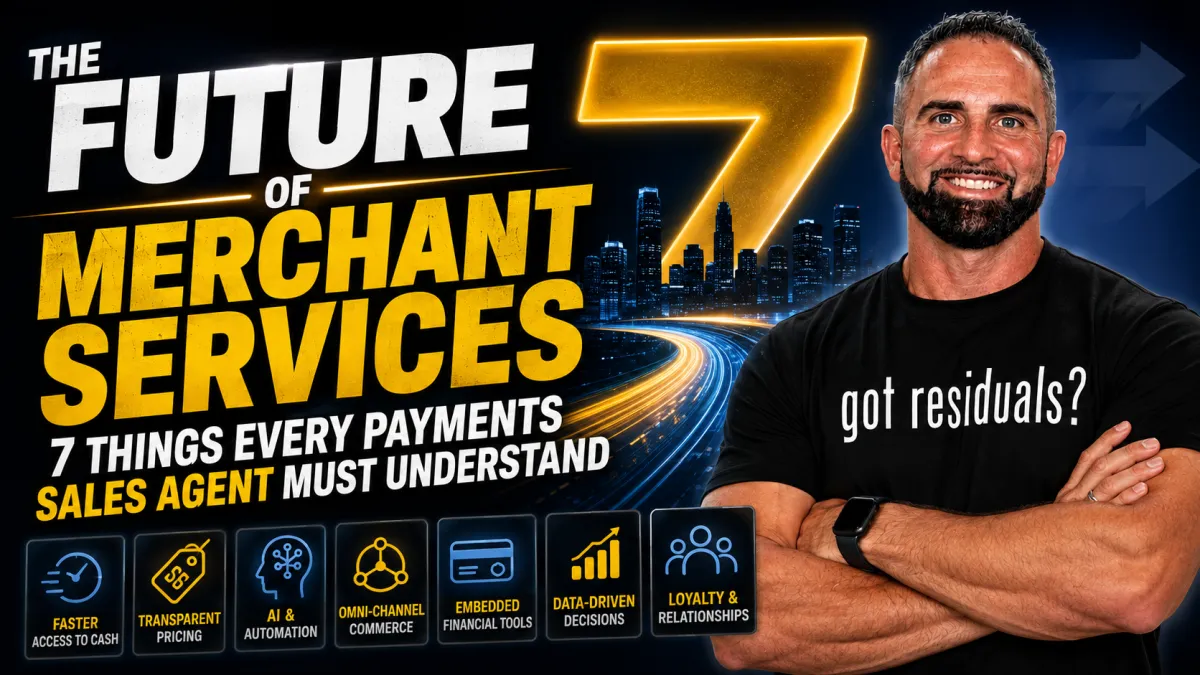
The Future of Merchant Services: 7 Things Every Payments Sales Agent Must Understand
The Future of Merchant Services: 7 Things Every Payments Sales Agent Must Understand
After more than 16 years in merchant services, I believe one thing has become very clear: if rates are still the primary thing you're selling to business owners, you're already behind where this industry is headed.
Payment processing isn't disappearing. Businesses will always need to accept money. What is changing is everything surrounding that transaction. Business owners now expect technology to help them operate more efficiently, understand their customers, automate repetitive work, access their money faster, sell through multiple channels, and make better decisions with the data they're already collecting.
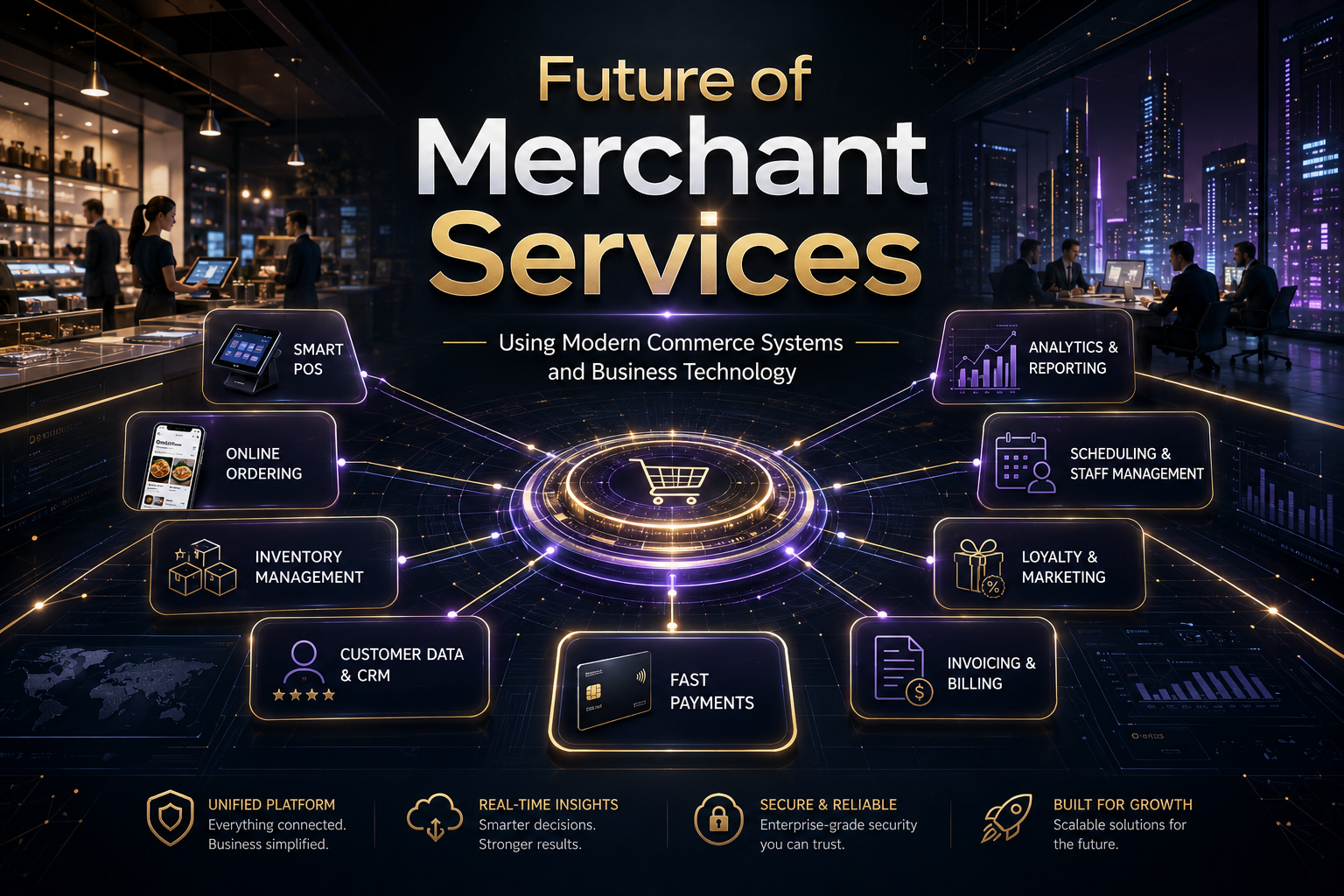
That is what I call the Modern Commerce System.
It isn't one product, and it definitely isn't one company. It's a way of thinking about how a modern business should operate using connected technology, better financial tools, customer data, automation, and strong support. Different businesses will require different technology stacks, which is exactly why I believe the future of merchant sales belongs to people who understand business problems instead of simply memorizing one company's product sheet.
In the video below, I break this down into seven pillars that I believe every payment sales agent needs to understand if they want to build a serious long-term career in merchant services.
Watch: The Future of Merchant Services
The Future of Merchant Services: 7 Things Every Payments Sales Agent Must Understand
These seven pillars aren't meant to tell you that every merchant needs every feature. They're a framework for understanding what businesses increasingly expect and what you should be looking for when evaluating merchant services partners.
Pillar 1: Faster Access to Cash
Every business runs on cash flow. Business owners have employees to pay, inventory to purchase, vendors to manage, and expenses that don't wait patiently for money to arrive.
That is why faster access to money has become a much bigger part of the merchant services conversation. Businesses increasingly expect faster funding options, flexible banking relationships, and working-capital solutions that give them more control over their cash flow.
For years, merchant sales professionals were trained to focus almost entirely on the cost of accepting a transaction. I think the better conversation today is broader: after the merchant makes the sale, how efficiently can they access and use that money?
Cash flow isn't just an accounting issue. It's the oxygen of the business.
Pillar 2: Modern Business Technology
The second pillar is technology that solves actual business problems.
This is where I think our industry has sometimes gone wrong. We became so excited about software that we forgot the purpose of software is supposed to be making things easier. A business owner shouldn't need to become a technology expert just to operate the systems they're paying for.
Today's businesses may need technology for payments, inventory, scheduling, online ordering, payroll, customer communication, ecommerce, reporting, appointments, subscriptions, and other operational needs. The right technology stack will look completely different for a restaurant than it will for a salon, contractor, retailer, or medical practice.
That's why I don't believe the goal is putting every merchant into the same POS system.
The goal is understanding how that business operates and helping them build the right technology stack around those needs.
The best merchant services partnerships give an agent options instead of forcing one answer onto every merchant.
Pillar 3: Customer Growth and Retention
A one-time customer can generate revenue.
A repeat customer can help build a great business.
Modern commerce systems are making customer retention a much bigger part of the merchant services value proposition because payments create valuable information about customer behavior. Businesses can increasingly understand how often customers buy, what they purchase, which customers are most valuable, and when previously active customers stop returning.
That data can then connect with loyalty programs, marketing automation, customer profiles, and retention campaigns.
I've talked about this extensively because I believe customer data is becoming one of the most valuable assets a business owns. The merchant already worked hard to acquire the customer. A strong system should help the business understand that relationship and create more opportunities to keep it.
You can read more about that here:
Customer Data: Why It May Be the Most Valuable Asset Your Business Already Owns
https://iamjoewagner.com/post/customer-data-most-valuable-business-asset
Pillar 4: AI and Automation
Business owners don't need another report simply because software can generate one.
They need better decisions.
Artificial intelligence and automation are beginning to change what businesses can do with all the information being generated throughout their operation. Instead of manually digging through reports trying to identify patterns, business owners can increasingly use intelligent tools to summarize information, uncover opportunities, and reduce repetitive work.
Imagine having years of customer, employee, inventory, and sales data but never having enough time to study it. The data technically exists, but it isn't helping you.
AI can make that information more useful.
It can assist with reporting, operational analysis, marketing ideas, customer segmentation, and other areas where owners traditionally spent large amounts of time trying to connect the dots manually.
I believe this will become dramatically more important over the next decade.
The question won't be whether your POS creates reports.
The question will increasingly become whether your technology helps you understand what those reports actually mean.
Pillar 5: Connected Commerce
Customers don't think about sales channels the way technology companies do.
They simply expect to buy however it's convenient.
That might mean purchasing in-store, online, through an invoice, through an appointment, using a subscription, through a mobile employee, or through another channel that fits the business.
The merchant shouldn't have to operate six disconnected businesses behind the scenes simply because customers interact with them in six different ways.
Connected commerce is about bringing those channels together.
A strong Modern Commerce System should allow the business to maintain a more complete picture of customers, sales, inventory, and operations regardless of where the transaction takes place.
This is another reason integration matters so much.
Businesses don't need more software.
They need technology that works together.
Pillar 6: Business Intelligence
Every transaction creates information.
Every sale tells the business something about customers, products, employees, locations, trends, timing, and performance. The businesses capable of understanding that information have an advantage over businesses operating primarily on instinct.
For years, data inside merchant services was mostly about reporting what happened.
Today, data is increasingly about helping determine what should happen next.
Which customers are most valuable?
Which products are growing?
Which employee behaviors are producing stronger results?
Which location is outperforming another?
Where is revenue slipping?
What should the business do differently next month?
Business intelligence turns transaction data into information that can influence those decisions.
That is a far bigger value proposition than simply giving a merchant another terminal.
Pillar 7: The Right Merchant Services Partnership
I believe this may be the most overlooked pillar of all, especially for someone new to merchant services.
Technology is only as good as the people standing behind it.
You can have an incredible POS system, great residual percentages, and an impressive product lineup, but if nobody answers the phone when the agent or merchant needs help, you have a serious problem.
The best partnerships should provide training, ongoing education, implementation help, knowledgeable merchant support, agent support, and enough flexibility to recommend the right solution instead of forcing one product onto every business.
Business owners aren't simply buying software.
They're buying confidence that somebody is going to help them succeed with that software after the sale.
The same should be true for the sales professional.
I've become increasingly focused on this because I don't believe an agent can realistically be expected to prospect, sell, install equipment, become technical support, handle merchant retention, troubleshoot every problem, and continue building a serious portfolio at the same time.
A great salesperson should understand the technology.
They shouldn't have to become the entire ISO.
The Future Merchant Sales Professional Is a Business Advisor
When these seven pillars come together, the role of the merchant sales professional changes.
You're no longer walking into a business simply asking, "Can I save you money on processing?"
You're asking how the business operates.
How quickly do they access their money? What technology are they using? Are the systems connected? How well do they understand their customers? What repetitive work could be automated? How are they using their business data? What kind of support are they currently receiving?
Those questions uncover much larger opportunities.
You stop sounding like another payment processor and start sounding like someone who understands business.
That is exactly where I believe the future of merchant services is headed.
Learn the Business Before Signing With a Merchant Services Company
One of the biggest mistakes I see new agents make is joining a company before they understand the industry well enough to evaluate the opportunity.
They hear a residual split.
They see a POS system.
They hear "lifetime residuals."
They get excited about an upfront commission.
Then they sign an agreement without understanding vesting, support, technology, ownership, portfolio protection, or what the business will actually require from them.
I want people who come through my network to do this differently.
That's exactly why I created Merchant Service University (MSU).
Merchant Service University teaches the fundamentals of merchant services, Modern Commerce Systems, pricing, statements, technology, portfolio building, contracts, residual income, sales, prospecting, and how to evaluate companies before committing years of your career to one.
MSU is normally a paid online training program. However, I'm providing Merchant Service University access for free to qualified, serious candidates who want to potentially partner with me.
The certification process is intentional.
I want to educate you first, but I also want to see who actually shows up.
If you're willing to complete the training, learn the material, communicate, and earn your certification, you've demonstrated something important before we ever discuss a partnership.
Get Certified, Then Let's Talk About Your Goals
Once you complete your Merchant Service University certification, I want to have a real conversation with you.
What are your goals?
What experience do you have?
Do you want to build locally or remotely?
Do you want to focus on a specific type of merchant?
Are you trying to build a long-term residual portfolio?
What kind of support do you need?
I don't believe everyone automatically belongs with the same company.
If the fit makes sense, I can help introduce qualified candidates to ethical companies within my network that I believe provide the fundamentals a serious agent should look for: fair agreements, strong support, ongoing training, modern commerce technology, and lifetime residual opportunities.
And I want to be available to help along the way as well.
My goal isn't to steer you toward one logo.
My goal is helping serious people build long-term careers with the right partners.
If that sounds like the kind of merchant services career you're looking for, begin the process here:
Get access to Merchant Service University, complete the certification, and then let's talk.
Final Thoughts: Don't Just Learn Payment Processing
Payment processing is still the foundation of merchant services, but I don't believe it's enough anymore.
Learn how businesses operate.
Learn modern POS technology.
Learn customer retention.
Learn AI and automation.
Learn connected commerce.
Learn business data.
And learn how to evaluate the companies you're trusting with your future portfolio.
The sales professionals who understand all seven of these pillars are going to have a much different conversation with merchants than the agents still competing entirely on rates.
That's where I believe this industry is going.
And that's exactly where I want the people I work with positioned.
I'll see you at the top.
Related Resources
What Is a Modern Commerce System?
https://iamjoewagner.com/post/what-is-a-modern-commerce-system
Why Modern POS Systems Are Taking Over the Payment Processing Industry
https://iamjoewagner.com/post/why-pos-systems-are-taking-over-payment-processing
How AI and Business Data Are Making Smart POS Systems More Powerful
https://iamjoewagner.com/post/ai-business-data-smart-pos-systems
Customer Data: Why It May Be the Most Valuable Asset Your Business Already Owns
https://iamjoewagner.com/post/customer-data-most-valuable-business-asset
Merchant Sales Training Blog
https://iamjoewagner.com/merchant-sales-training-blog
Download The New Rules of Merchant Sales
https://ebook.ezdirectsales.com
Apply for Free Merchant Service University Access
https://ezdirectsales.com
Frequently Asked Questions About the Future of Merchant Services
What is the future of merchant services?
The future of merchant services is expanding beyond standalone payment processing toward Modern Commerce Systems that connect payments with business technology, customer growth, AI, automation, connected commerce, business intelligence, and stronger merchant support.
What is a Modern Commerce System?
A Modern Commerce System is a framework for connecting payment processing with technology that helps businesses operate more efficiently, including POS systems, inventory, scheduling, customer management, ecommerce, payroll, reporting, automation, and other business tools.
What are the seven pillars of modern merchant services?
The seven pillars are faster access to cash, modern business technology, customer growth, AI and automation, connected commerce, business intelligence, and the right merchant services partnership.
Why is customer data important in merchant services?
Customer and transaction data can help businesses understand buying behavior, identify valuable customers, improve retention, create better marketing, and make stronger operational decisions.
How is AI changing merchant services?
AI can help businesses analyze information faster, automate repetitive work, improve reporting, identify customer and operational patterns, and turn business data into more useful insights.
Why does the merchant services partner matter?
Technology alone does not guarantee merchant success. Strong partners provide training, implementation assistance, merchant support, agent support, ongoing education, fair agreements, and technology options appropriate for different businesses.
What is Merchant Service University?
Merchant Service University is Joe Wagner's online training program covering merchant services fundamentals, Modern Commerce Systems, technology, pricing, statements, portfolio building, contracts, residual income, sales, and company evaluation.
How can I get Merchant Service University for free?
Qualified, serious candidates who are interested in potentially partnering with Joe Wagner can receive complimentary Merchant Service University access. Complete the training and certification, then begin a conversation about your goals and potential partner introductions through ezdirectsales.com.