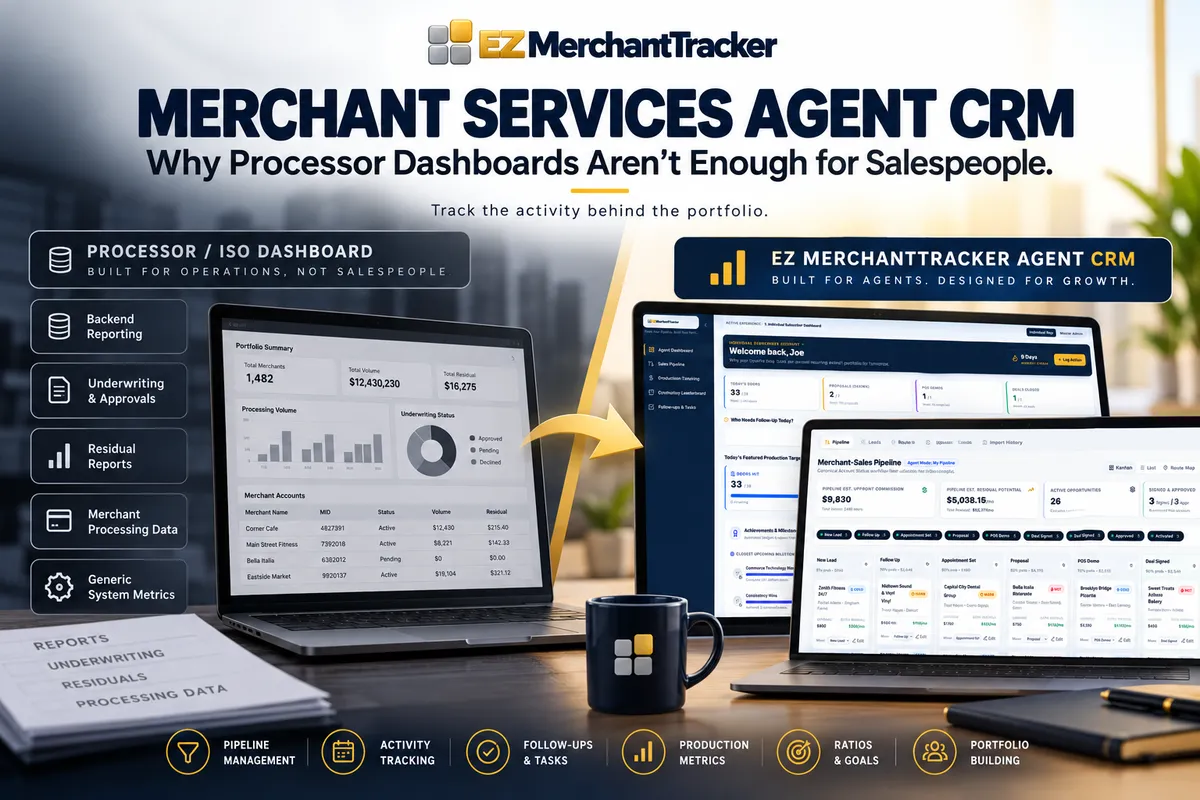
Merchant Services Agent CRM: Why Processor Dashboards Aren’t Enough for Salespeople
Merchant Services Agent CRM: Why Processor Dashboards Aren’t Enough for Salespeople
If you're a merchant-services agent, there's a good chance your processor or ISO already gives you access to some type of software.
You may be able to see submitted applications.
Check underwriting.
Review boarded merchants.
Access residual reports.
Track equipment.
View processing information.
Manage support issues.
Depending on the organization, the backend technology may be excellent.
Keep using it.
I want to make that clear from the beginning because when I started building EZ MerchantTracker, I wasn't trying to replace the systems processors and ISOs already provide.
They're necessary.
I'm trying to solve a different problem.
After more than 16 years in merchant services, I've realized that most of the software in our industry is understandably built around managing the merchant and processing relationship.
But what about the person creating those merchants?
Who is managing the salesperson?
Who is tracking your activity?
Who is measuring your personal sales ratios?
Who is showing you whether you're becoming more productive?
Who is keeping your pipeline organized before a merchant ever gets submitted?
Who is showing you what you did today—not just what accounts eventually boarded?
Who is helping you compare this month with last month?
Who is helping you identify where your sales process is breaking down?
That's the layer I believe has been missing.
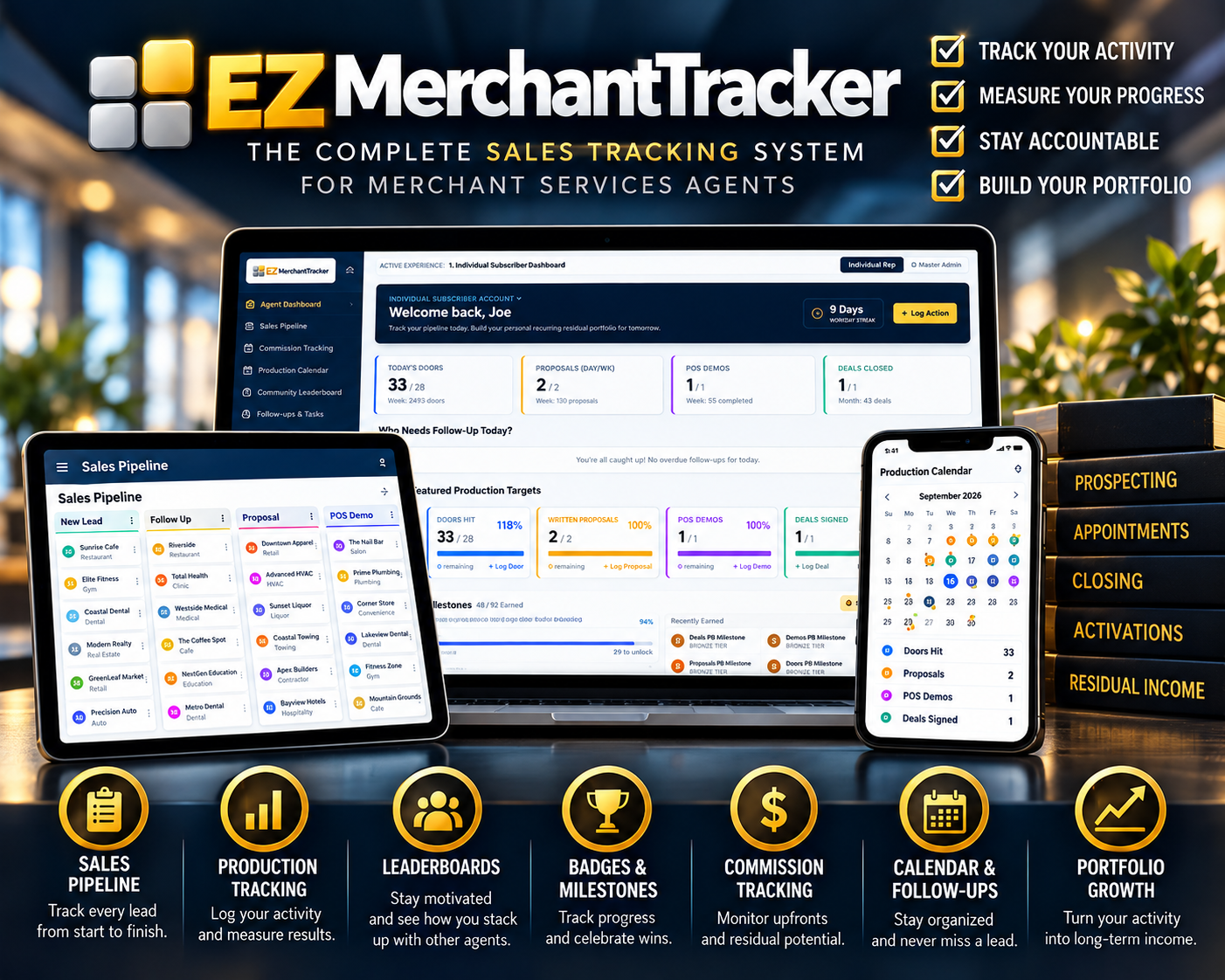
And that's why I'm building EZ MerchantTracker, a CRM and sales-performance platform designed specifically around the merchant-services agent.
As of September 2026, EZ MerchantTracker is still being developed and tested and is coming soon.
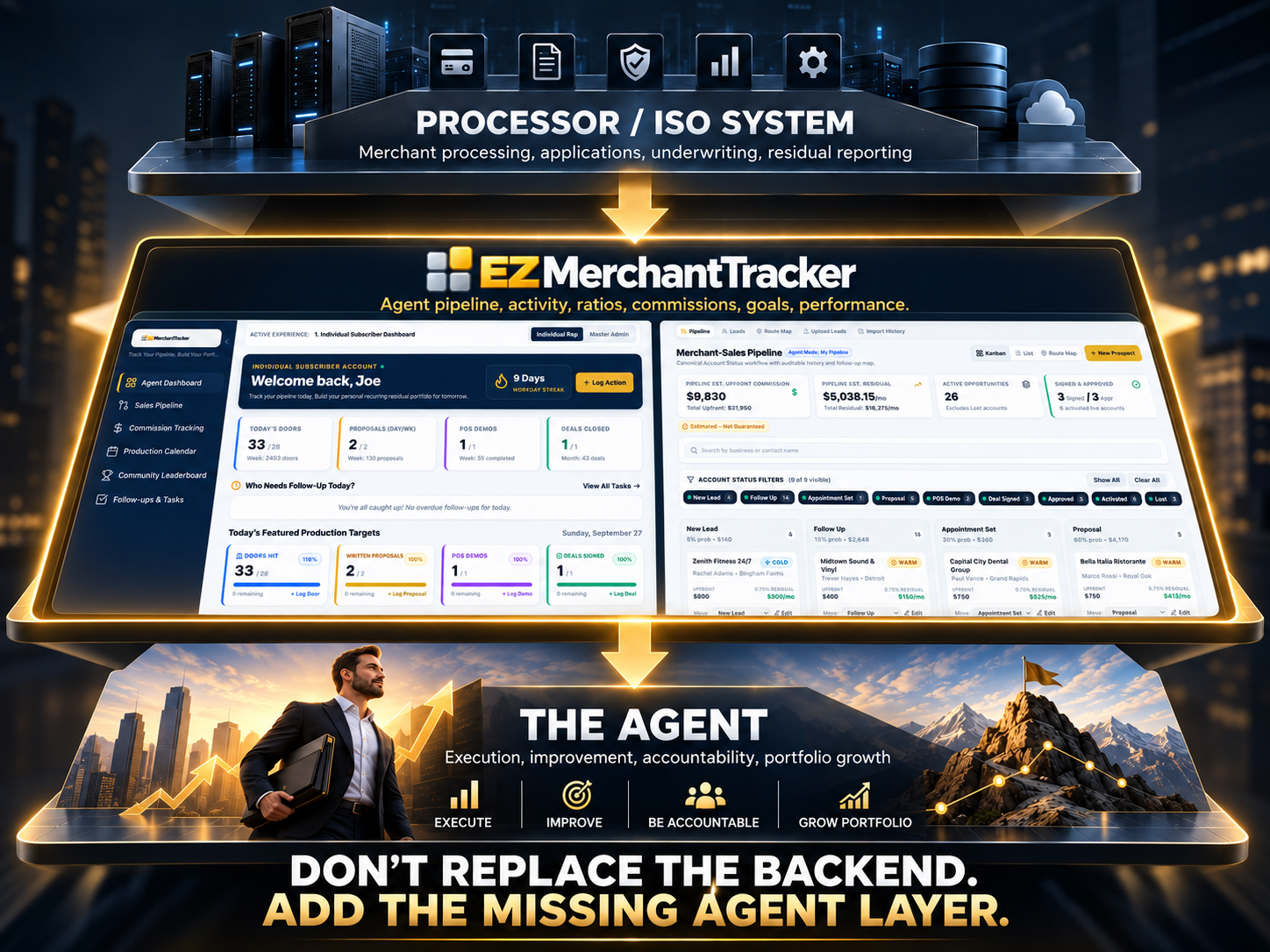
Your Processor Dashboard and Your Sales CRM Have Different Jobs
This distinction matters.
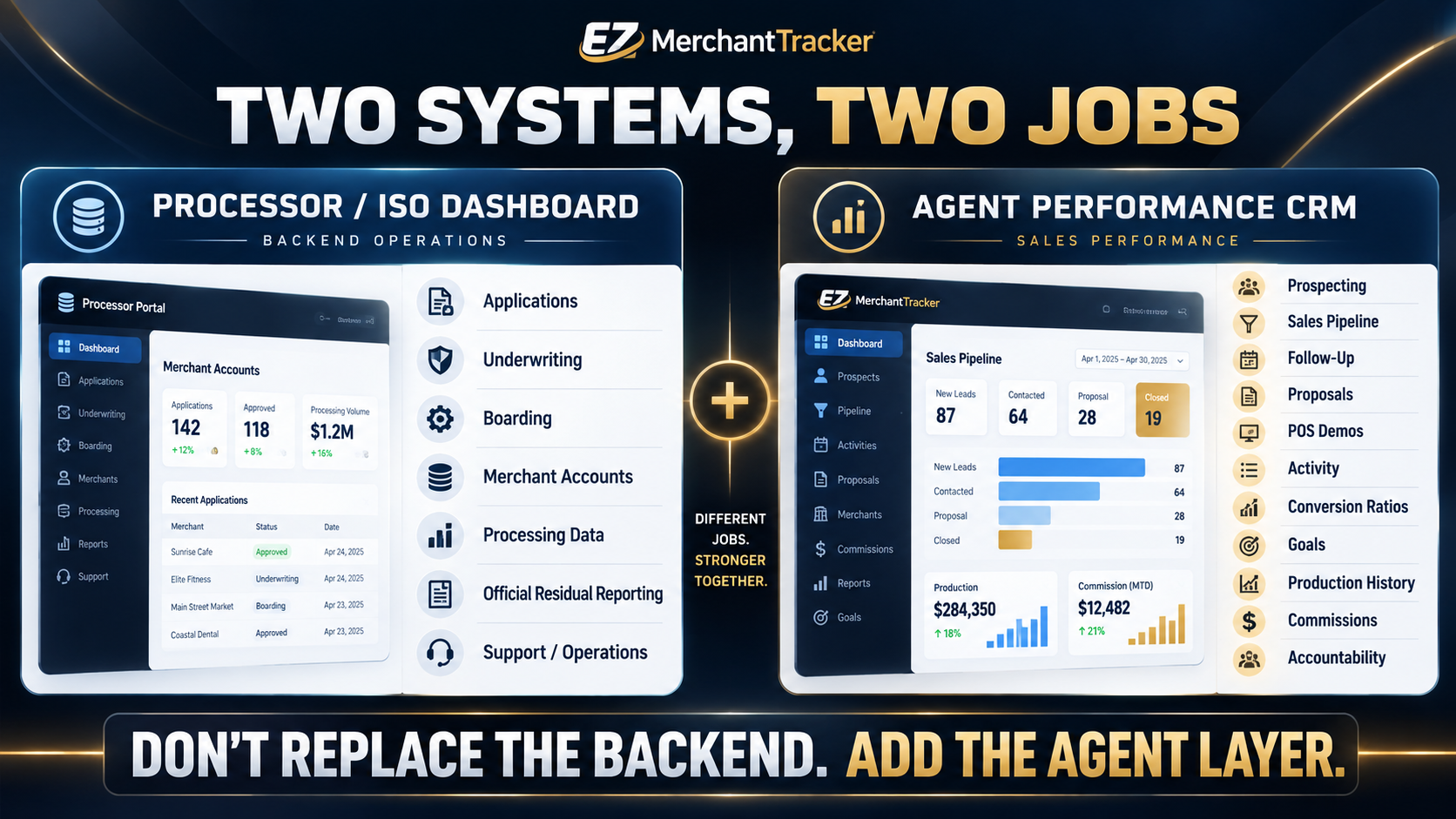
Your ISO or processor needs systems that help operate a payment-processing business.
That can include applications, underwriting, boarding, risk, merchant information, equipment, processing data, support, residual reporting and other operational functions.
That's infrastructure.
And I've argued for years that agents should take advantage of strong infrastructure rather than unnecessarily trying to recreate all of it themselves.
It's one of the reasons I personally prefer the agent model. In Merchant Services Agent vs. ISO: Do You Need to Become an ISO?, I explain why I would rather let a strong ISO handle the backend heavy lifting while I focus on selling, recruiting, training and building the portfolio. Joe Wagner
If I'm partnering with a great organization, I want them to be great at:
Underwriting.
Merchant support.
Processing infrastructure.
Equipment.
Risk.
Residual reporting.
Implementation.
Backend operations.
Let them do it.
But there's another side of the business.
My side.
The salesperson.
That's where an agent-specific CRM should live.
A Merchant Services Agent CRM Should Start Before the Application
Think about when most processor systems become most important.
Usually once the merchant is becoming an actual processing opportunity.
Maybe you're submitting an application.
Maybe underwriting is reviewing the account.
Maybe you're preparing equipment.
Maybe the merchant has boarded.
But your sales process started long before that.
You walked into the business.
You called the owner.
You got a referral.
You had a conversation.
You completed discovery.
You found a problem.
You identified a legitimate target.
You scheduled an appointment.
You collected a processing statement.
You prepared a proposal.
You scheduled a POS demo.
You followed up.
You followed up again.
Then you got the deal.
That entire journey matters.
If your CRM begins only when the merchant becomes an application, you're missing a huge part of the salesperson's business.
Your Pipeline Is the Business You're Trying to Create
Before a merchant becomes an active account, they're an opportunity.
Some opportunities are weak.
Some are strong.
Some need a proposal.
Some need a POS demo.
Some need another meeting.
Some are waiting on a decision-maker.
Some are ready to sign.
Some are dead and should be removed.
The salesperson needs to know where all of this stands.
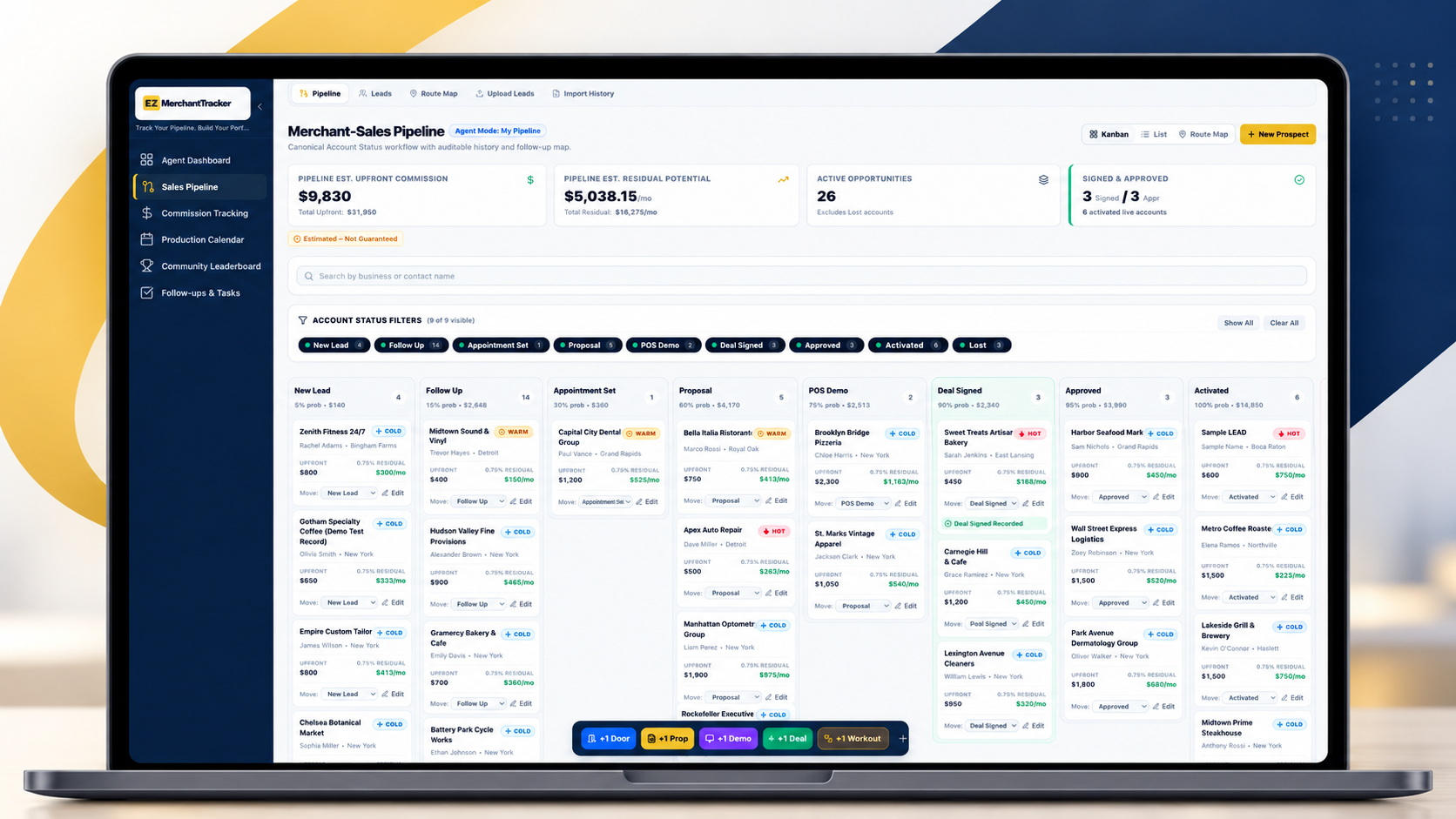
That's why EZ MerchantTracker is being built around a merchant-sales pipeline with practical stages such as:
New Lead → Follow Up → Proposal → POS Demo → Appointment Set → Deal Signed → Approved → Activated → Lost
I want an agent to open the system and immediately understand:
What am I working right now?
Not just:
What have I already sold?
But CRM Is Only Part of the Problem
Here's where I think traditional CRM falls short for salespeople.
Let's say you have 50 opportunities stored in a CRM.
Great.
Did you work?
That's a completely different question.
You can have hundreds of leads and still produce nothing.
You can meticulously update contacts and still avoid prospecting.
You can organize your pipeline for three hours and convince yourself you had a productive day.
That's why I've become much more interested in something beyond customer relationship management.
I want salesperson performance management.
The system shouldn't only answer:
“Where are my leads?”
It should help answer:
“What am I actually doing?”
Track the Agent's Activity, Not Just the Merchant's Status
This is one of the primary reasons I started building EZ MerchantTracker.
I want the agent to know what happened.
How much prospecting did you do?
How many legitimate proposals did you produce?
How many POS demonstrations did you complete?
How many deals did you sign?
How does this week compare with last week?
How does this month compare with your best month?
What does your historical activity actually look like?
This isn't about creating administrative work.
The software should be simple enough that tracking doesn't become the job.
Selling is the job.
The tracking exists to tell us whether you're doing it.
If you're still learning what productive activity should look like, I've built a growing library of free training on the Merchant Sales Training Blog, along with practical tools and additional education on my Merchant Sales Resources.
The purpose of MerchantTracker isn't to replace that education.
It's to help you measure whether you're putting it into practice.
Your CRM Should Make It Harder to Bullshit Yourself
That's direct, but I mean it.
Salespeople are incredibly good at remembering effort.
We remember driving around all day.
We remember the difficult merchant.
We remember answering emails.
We remember researching a product.
We remember watching training.
We remember talking to support.
We remember being tired.
Then Friday comes and we say:
“I worked hard this week.”
Okay.
What did you produce?
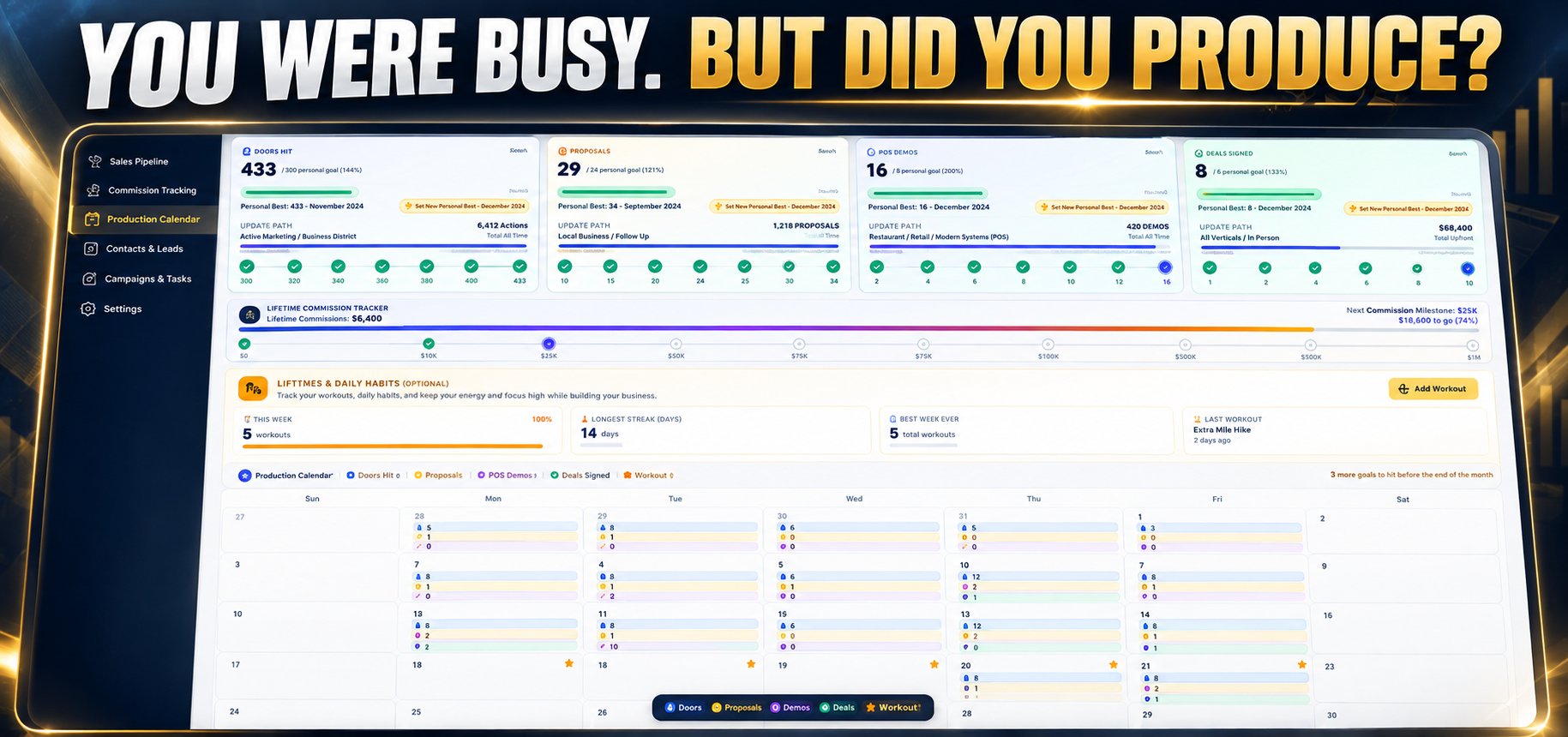
That's why I love the idea of a visual production calendar.
Don't tell me how the week felt.
Let's look at it.
Were you creating activity?
Were you producing proposals?
Were you conducting demos?
Were you signing accounts?
The data doesn't need to insult you.
It just needs to tell the truth.
Most Agents Don't Know Their Own Sales Ratios
This may be the biggest missed opportunity of all.
Agents have asked me for years:
“How many businesses do I need to contact to close a deal?”
They want a universal answer.
I can give standards.
I can tell you what I expect.
I can tell you what I've experienced.
But ultimately, I want to know something better.
What are YOUR numbers?
How much prospecting does it usually take you to create an opportunity?
How frequently do your proposals become signed deals?
How frequently do your POS demos convert?
How frequently do your signed accounts activate?
Are those ratios improving?
That's where tracking starts becoming incredibly powerful.
Two salespeople can complete the same amount of activity and produce completely different outcomes.
That doesn't necessarily mean one isn't working.
It may mean one is more effective at a specific stage of the process.
Now we have something to improve.
The Results Pyramid Gives the CRM a Diagnostic Framework
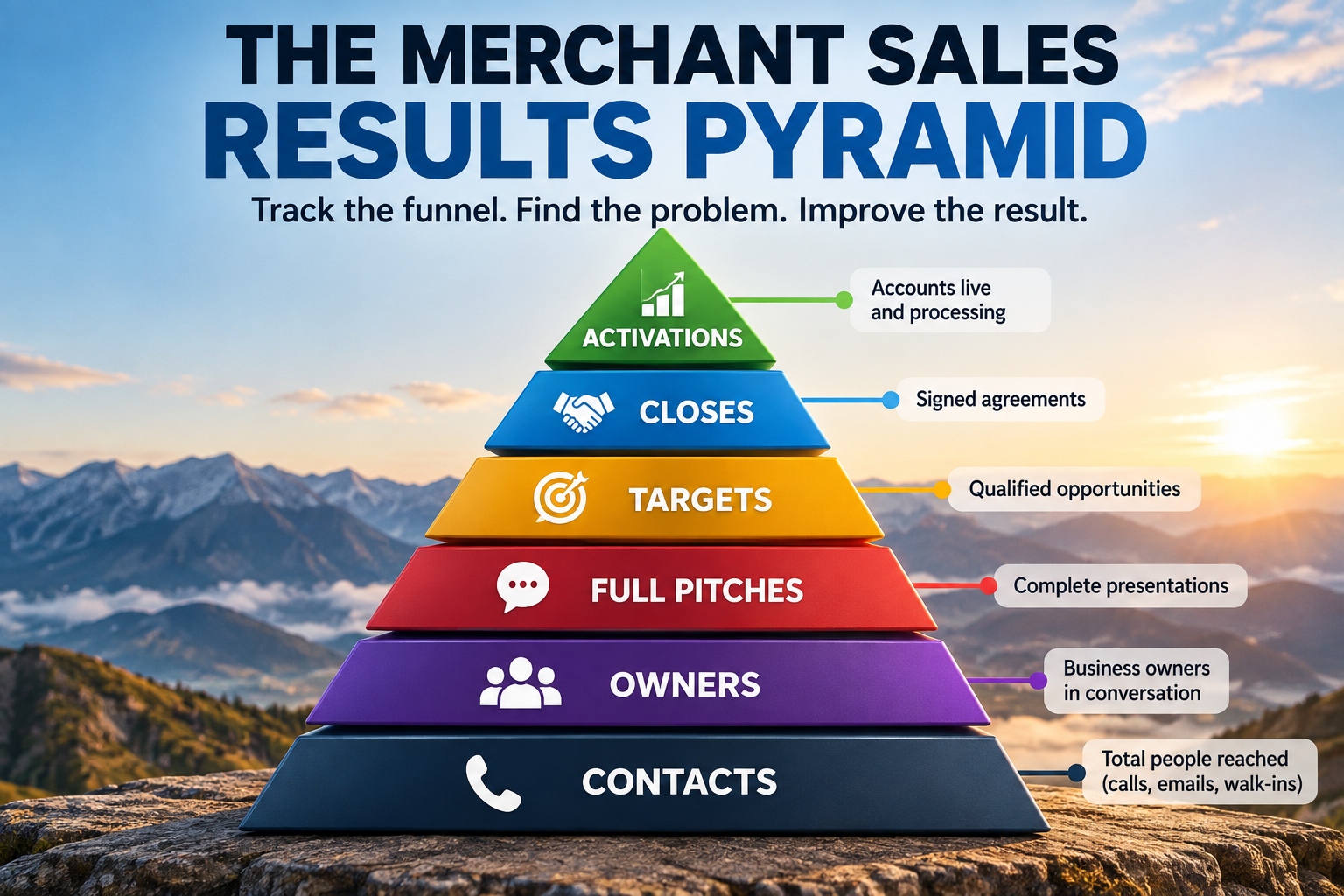
One framework I teach is the Merchant Sales Results Pyramid:
Contacts → Owners → Full Pitches → Targets → Closes → Activations
Instead of simply asking:
“Why am I not selling enough?”
we can work backward.
Not enough activations?
Look at closes.
Not enough closes?
Look at legitimate targets.
Not enough targets?
Look at full presentations.
Not enough presentations?
Are you getting to owners?
Not enough owners?
What does your contact activity look like?
Now imagine that framework being supported by actual historical data instead of memory.
That's when a CRM becomes more than a database.
It becomes a performance tool.
Your CRM Should Help You See Whether You're Improving
This is another feature I wish I'd had throughout my career.
I've been selling merchant services since 2009.
I know I've improved.
But imagine if I could pull up more than a decade of my own sales-performance data.
Imagine seeing:
My strongest production periods.
My weakest periods.
My personal conversion ratios.
My best month.
My longest production streak.
How my ratios changed as my sales skills improved.
What level of activity typically produced my strongest months.
Where I historically lost opportunities.
How many proposals I had to create to produce a certain number of activations.
That's information I would love to have today.
I don't.
And after building multiple portfolios and signing thousands of merchants, that's one of the reasons this product matters so much to me.
I think I could have been significantly more productive if I had been able to see the business this way while I was building it.
A Merchant Services Agent CRM Should Connect Production to Money
We're salespeople.
Eventually, the activity needs to create revenue.
Merchant services can involve multiple forms of compensation depending on the agent agreement, including upfront commissions, bonuses and recurring residual income. My Merchant Services Agent Commissions guide goes much deeper into how these compensation structures can work. Joe Wagner
EZ MerchantTracker isn't intended to replace your processor's official compensation reporting.
That's important.
Your processor or ISO remains the authority on what you're actually owed and paid.
What MerchantTracker can do is help the agent connect sales production with compensation.
Which opportunities have signed?
Which have activated?
Which commissions have been paid?
What remains outstanding?
What is the estimated upfront commission potential in your active pipeline?
What is the estimated residual potential?
Again, potential isn't income.
But if I'm working a serious pipeline, I want visibility into what I'm trying to build.
Your Residual Report Looks Backward. Your Pipeline Looks Forward.
This distinction is powerful.
Your residual report shows what the portfolio you've already built is producing.
Your pipeline represents what you're trying to add to it.
You need both.
If recurring income is part of your strategy, understanding how residual compensation actually works is essential. Before obsessing over percentages, learn the economics underneath them. My guide to Merchant Services Residual Splits explains why a larger advertised split doesn't automatically mean more actual income. Joe Wagner
Then use your CRM to focus on what actually creates that future portfolio:
Production.
MerchantTracker Should Make Sales More Competitive
This is one of the features I would have loved.
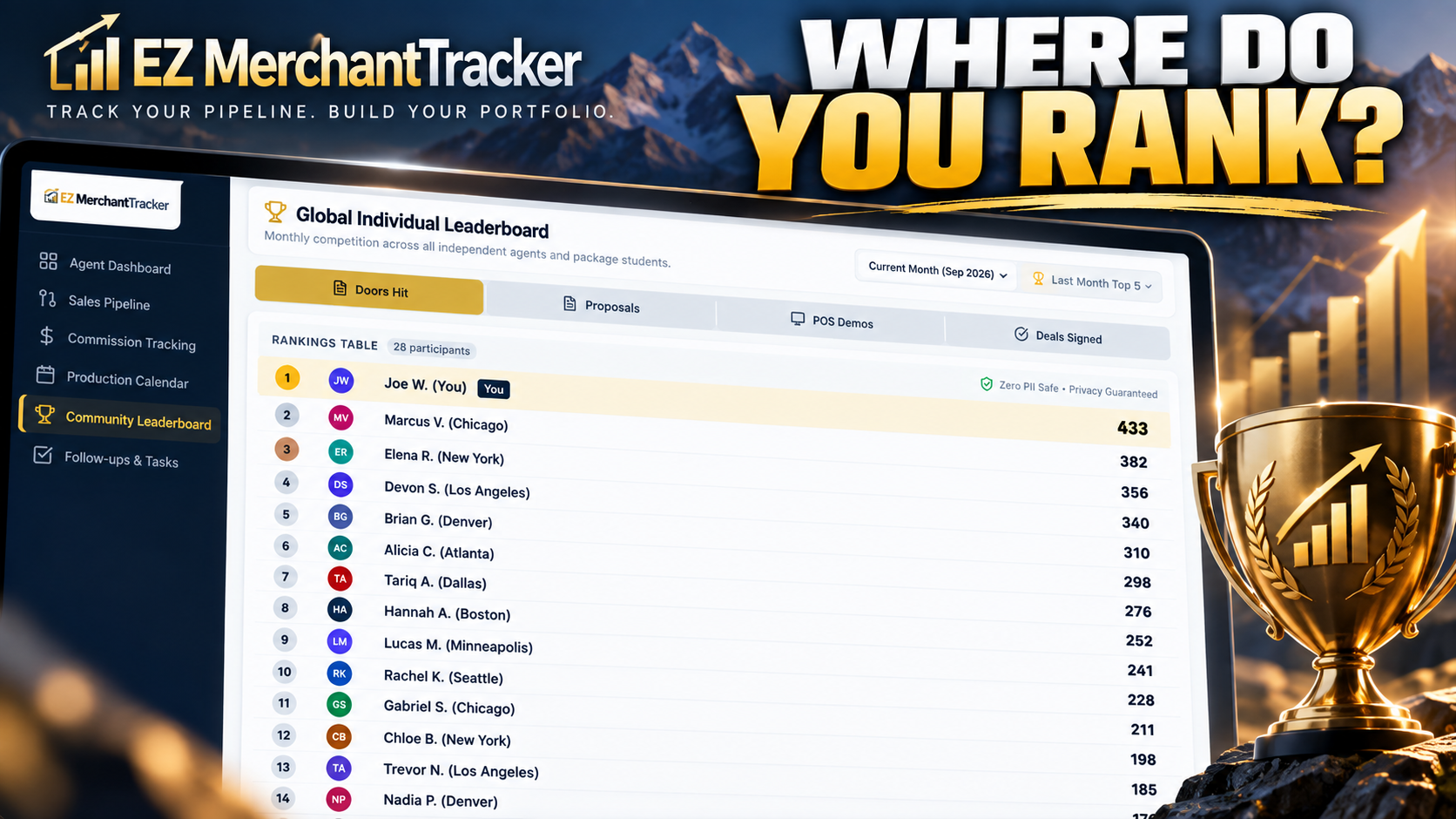
Leaderboards.
Personal records.
Streaks.
Milestones.
Competition.
I'm competitive.
If you show me that somebody else is producing more, I want to catch them.
If you show me my personal best, I want to beat it.
And I know I'm not the only salesperson wired that way.
That's why EZ MerchantTracker is being built with the ability to make production more visible and engaging.
How do you rank in prospecting?
Proposals?
POS demos?
Deals signed?
What's your personal best?
Are you ahead of last month's pace?
Did you hit a new milestone?
The purpose isn't to make merchant services childish.
It's the opposite.
Make the activities that actually build the business visible.
This Becomes Even More Valuable for Sales Organizations
Now imagine you're managing 20 agents.
You already know what eventually boards.
But what is happening before the application?
One agent isn't producing.
Why?
Do they need more training?
Maybe.
But first:
Are they working?
Maybe their activity is low.
Maybe activity is strong but they aren't getting to decision-makers.
Maybe they're reaching owners but rarely getting through a full presentation.
Maybe they're producing proposals but not converting them.
Maybe they sign deals but struggle to get them activated.
Those are completely different coaching problems.
A sales manager should not prescribe the same solution to all of them.
Data gives management somewhere to look.
That's why I see EZ MerchantTracker eventually becoming useful both for individual agents and organizations managing merchant-sales teams.
This Is Not About Replacing the ISO
In fact, I think this model works especially well when an agent has a great ISO relationship.
I've written extensively about choosing the right merchant-services organization because the backend matters enormously. Support, underwriting, compensation, technology, agreement terms and operational competence can all affect the business you build. My guide on How to Choose a Merchant Services Agent Program walks through those considerations in much greater detail. Joe Wagner
The better model isn't:
Agent software OR processor software.
It's:
Agent software + processor infrastructure.
Let the processor or ISO do what they're built to do.
Then give the salesperson a tool built around what they need to do.
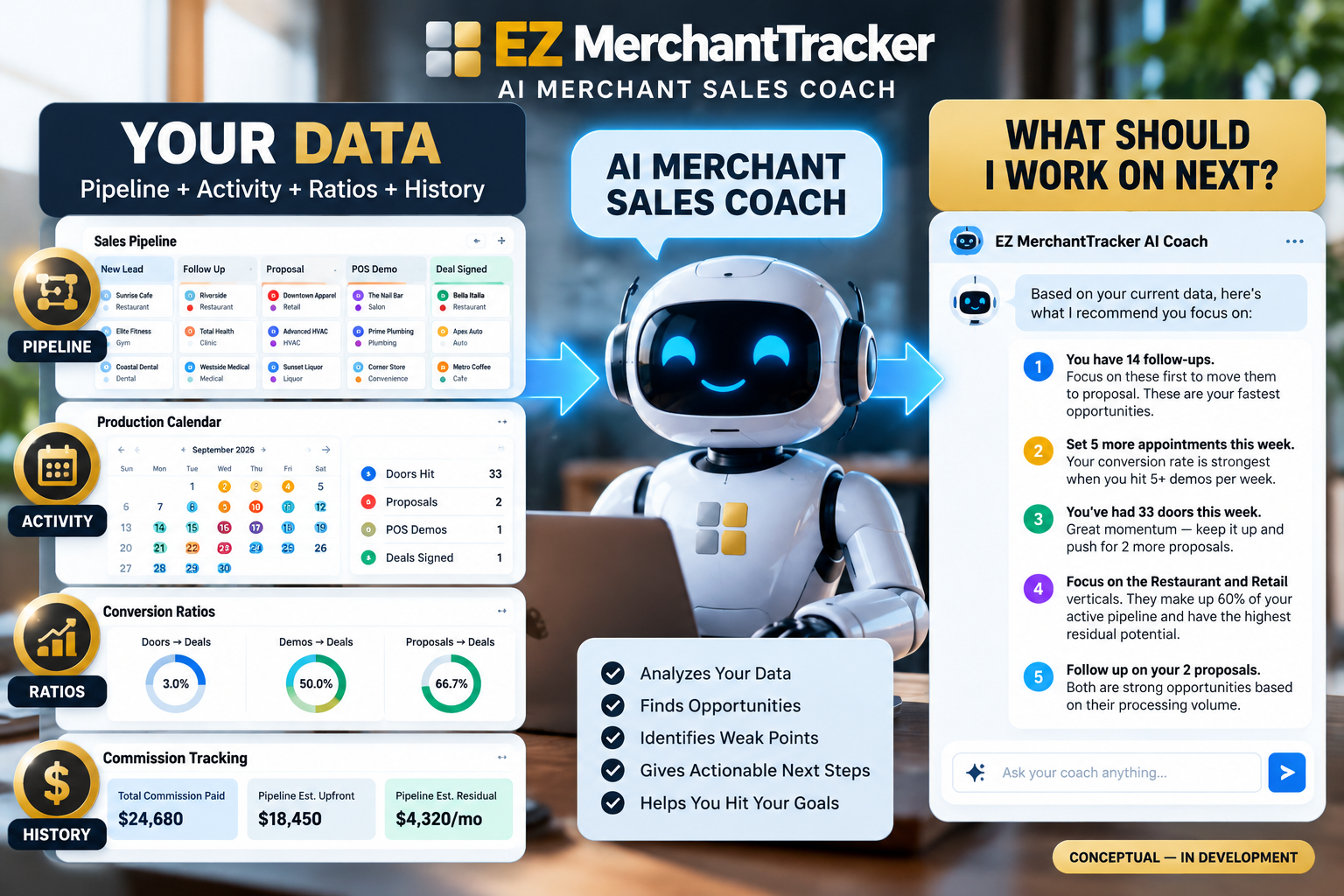
AI Can Eventually Turn CRM Data Into Coaching
This is where the long-term vision gets even more interesting.
A normal CRM stores information.
An AI-enabled performance system can potentially help interpret it.
Imagine MerchantTracker eventually recognizing:
Your prospecting is consistent, but owner conversations are low.
Your proposal volume increased, but proposal-to-close conversion declined.
Your POS demos convert well, but you're scheduling very few.
Your activity has dropped for three consecutive weeks.
You have several opportunities sitting in Follow Up without recent activity.
Now the AI isn't giving you generic sales advice.
It's looking at your business.
Then we can combine that with merchant-services-specific methodology.
Discovery.
Presentations.
Targeting.
Follow-up.
Objections.
Closing.
The Results Pyramid.
My five-step sales process:
Intro → Short Story → Presentation → Close → Rehash
That's the direction I'm building toward.
Not AI for the sake of saying the software has AI.
AI that helps the merchant-services agent understand what to work on next.
But AI Still Won't Hold Everyone Accountable
This is where software reaches its limit.
MerchantTracker can show you that you didn't work.
AI can potentially point it out.
Neither can force you to get out of bed tomorrow morning and do something about it.
That's why I'm also developing Portfolio Builders Coaching.
This is something agents have asked me for repeatedly.
Not more information.
Accountability.
A lot of people already know what they should do.
They know they should prospect.
They know they should follow up.
They know they should stop quitting early.
They know they should stay focused.
They know they should do the uncomfortable work.
The problem is execution.
Portfolio Builders Coaching is being developed around that gap.
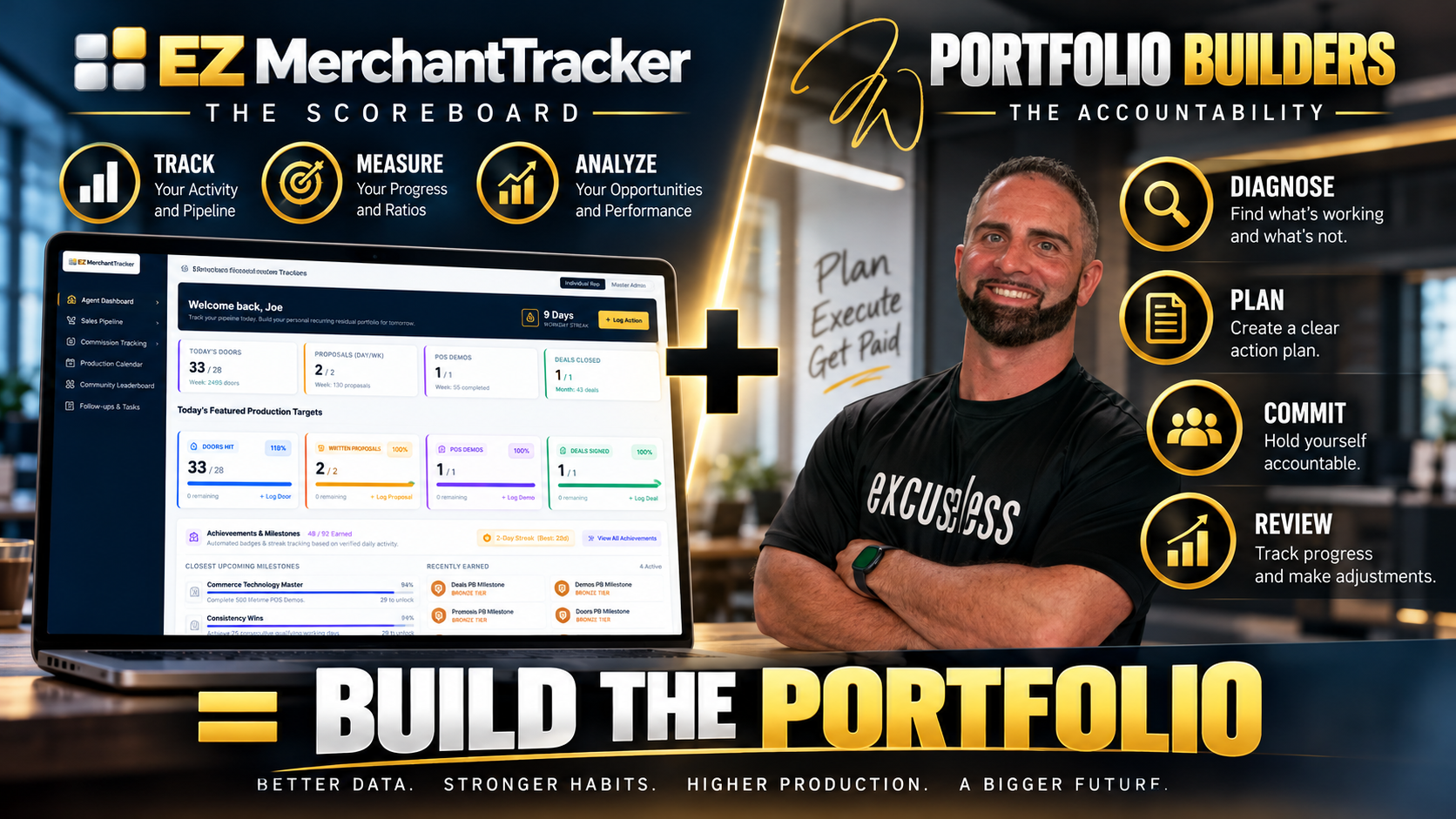
MerchantTracker Is the Scoreboard. Portfolio Builders Adds Accountability.
This is where the two become extremely powerful together.
Instead of starting a coaching conversation with:
“How do you think the week went?”
we can start with:
“Let's look.”
What did you say you were going to do?
What did you actually do?
What did it produce?
Where did the pipeline move?
What do the ratios show?
Where is the constraint?
What are we going to change?
What are you committing to doing next?
Then, the next time we meet:
Did you do it?
That's coaching I believe in.
Not endlessly consuming information.
Goal → Activity → Data → Constraint → Plan → Accountability → Review → Growth
What If You're Extremely Self-Accountable?
Then you may not need coaching.
Seriously.
There are people who don't need somebody checking on them.
They do the work when they don't feel like doing it.
They stay until the work is finished.
They follow up.
They don't constantly need motivation.
They don't need someone babysitting them.
Those people exist.
I've just found them to be rare.
If that's you, great.
Use the software.
Track your numbers.
Learn your ratios.
Compete.
Beat your own records.
Find your weaknesses.
Improve.
Build the portfolio.
Even highly self-accountable people benefit from a scoreboard.
New Agents Shouldn't Start With Software
There's another distinction I want to make.
If you're brand new to merchant services and you don't understand the industry yet, software is not your first problem.
Education is.
You need to understand what you're selling, how payment processing works, how agents get compensated, what an ISO does, how agreements work and how merchants actually use payment technology.
That's why I created Merchant Service University.
The core education is free.
You can also start with my Merchant Services Sales: Complete 2026 Beginner Guide, which lays out the basic structure of the business, including the roles agents and ISOs play. Joe Wagner
And before committing your production to any organization, I strongly recommend learning the industry first. That's the entire point behind How to Learn Merchant Services Before You Choose a Company. Joe Wagner
Get educated before you get recruited.
Then start producing.
That's when tracking becomes valuable.
Where EZ MerchantTracker Fits
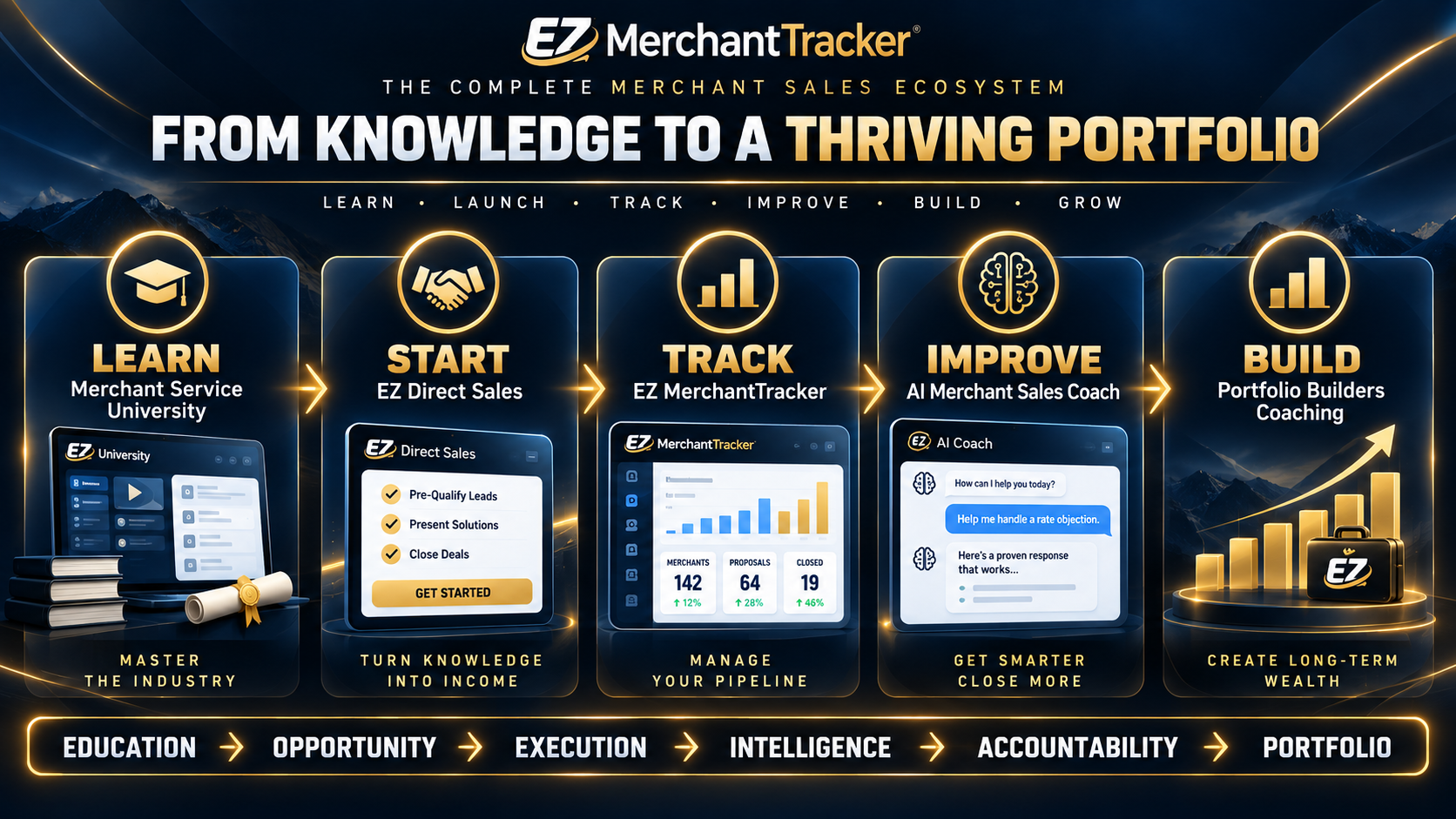
I see the merchant-agent journey becoming very simple.
LEARN — Merchant Service University
Understand the industry.
Start Merchant Service University Free
START — EZ Direct Sales
Get connected with trusted merchant-services partnerships and begin submitting real business.
TRACK — EZ MerchantTracker
Manage your sales pipeline, track production, learn your ratios, monitor commissions, compete and build your own performance history.
As of September 2026, EZ MerchantTracker is coming soon.
IMPROVE — AI Merchant Sales Coaching
Use merchant-specific methodology and your own performance data to make future coaching increasingly contextual.
BUILD — Portfolio Builders Coaching
Add human strategy, performance coaching and accountability around what you're trying to accomplish.
Portfolio Builders Coaching is also coming soon.
Your Processor Tracks the Merchant. Start Tracking the Agent.
That's the simplest way I can explain the opportunity I see.
Your processor's technology is important.
Your ISO's infrastructure is important.
Your merchant data is important.
Your residual reporting is important.
Keep it.
EZ MerchantTracker isn't being built to replace any of it.
It's being built because there's another side of the business that deserves its own system:
You.
Your activity.
Your pipeline.
Your ratios.
Your production.
Your commissions.
Your history.
Your goals.
Your improvement.
Your accountability.
And ultimately, the portfolio all of that work creates.
As of September 2026, EZ MerchantTracker is still being developed and tested.
If you're reading this while we're still in the coming-soon stage, visit ezmerchanttracker.com for the latest information.
In the meantime, continue learning through the Merchant Sales Training Blog, use the free tools and training on my Merchant Sales Resources, and watch additional merchant-sales training on my YouTube channel.
And most importantly:
Don't wait for another piece of software to start doing the work.
The software can help you track it.
The data can help you understand it.
AI can help you improve it.
A coach can help hold you accountable to it.
But you still have to execute.
This agent-performance gap is one of the primary reasons I created EZ MerchantTracker, a merchant-services CRM and performance platform being built specifically around the salesperson rather than replacing the processor or ISO backend. If you want to go deeper into the performance side, read Merchant Sales Tracking Software: How to Know Your Numbers and Build a Bigger Portfolio to see why tracking your activity, personal ratios and production history can become just as important as tracking the merchants in your pipeline.
Frequently Asked Questions
What is a merchant services agent CRM?
A merchant services agent CRM is software used to manage the sales side of building a merchant portfolio. Depending on the platform, that can include leads, merchant opportunities, pipeline stages, appointments, follow-up, proposals and other sales information.
How is a merchant services agent CRM different from processor software?
Processor and ISO software can include operational functions such as merchant applications, underwriting, processing information, merchant accounts, support and official residual reporting. An agent-focused CRM can complement those systems by concentrating on the salesperson's leads, pipeline, activity, follow-up and performance.
Does an agent need both a processor dashboard and a CRM?
They serve different purposes. A processor or ISO dashboard can provide important backend merchant and processing information, while a sales CRM can help the agent organize and measure the front end of acquiring those merchants.
What should a merchant services CRM track?
For an individual sales agent, useful areas can include merchant leads, pipeline status, follow-up, appointments, proposals, POS demonstrations, signed deals, approvals, activations, sales activity, commissions and historical performance.
Why should merchant-services agents track sales activity?
Final sales results don't always explain why production increased or decreased. Tracking the activities preceding the result can help an agent determine whether a potential constraint exists in prospecting, reaching owners, presentations, qualification, follow-up, closing or activation.
Should merchant-services agents track conversion ratios?
Conversion ratios can help agents understand their individual sales process. Examples can include proposal-to-signed-deal, POS-demo-to-signed-deal and signed-deal-to-activation ratios. Personal historical data can also help agents see whether their performance is changing over time.
Does EZ MerchantTracker replace my ISO or processor software?
No. EZ MerchantTracker is being designed as a complementary agent-performance layer rather than a replacement for processor or ISO infrastructure.
What is EZ MerchantTracker?
EZ MerchantTracker is a merchant-services CRM and sales-performance platform being developed specifically around individual agents and merchant-sales organizations. Its direction combines pipeline management with activity tracking, performance metrics, conversion ratios, commissions, historical trends, competition and developing AI coaching capabilities.
Is EZ MerchantTracker available now?
As of September 2026, EZ MerchantTracker is still being developed and tested and is coming soon. Product updates will be available through ezmerchanttracker.com.
Will EZ MerchantTracker include AI sales coaching?
AI merchant-sales coaching is part of the platform's developing direction. The goal is to combine merchant-specific sales methodology with agent pipeline, activity and performance information so coaching can become increasingly contextual. Features should not be considered final until released.
What is Portfolio Builders Coaching?
Portfolio Builders Coaching is a developing merchant-services performance and accountability program designed to complement the data tracked inside EZ MerchantTracker. Its focus is identifying constraints, establishing action plans, improving execution and holding agents accountable to the actions they commit to.
Where can a new merchant-services agent learn the industry?
New agents can begin with free education through Merchant Service University, browse the Merchant Sales Training Blog, or use the additional training available through Merchant Sales Resources.