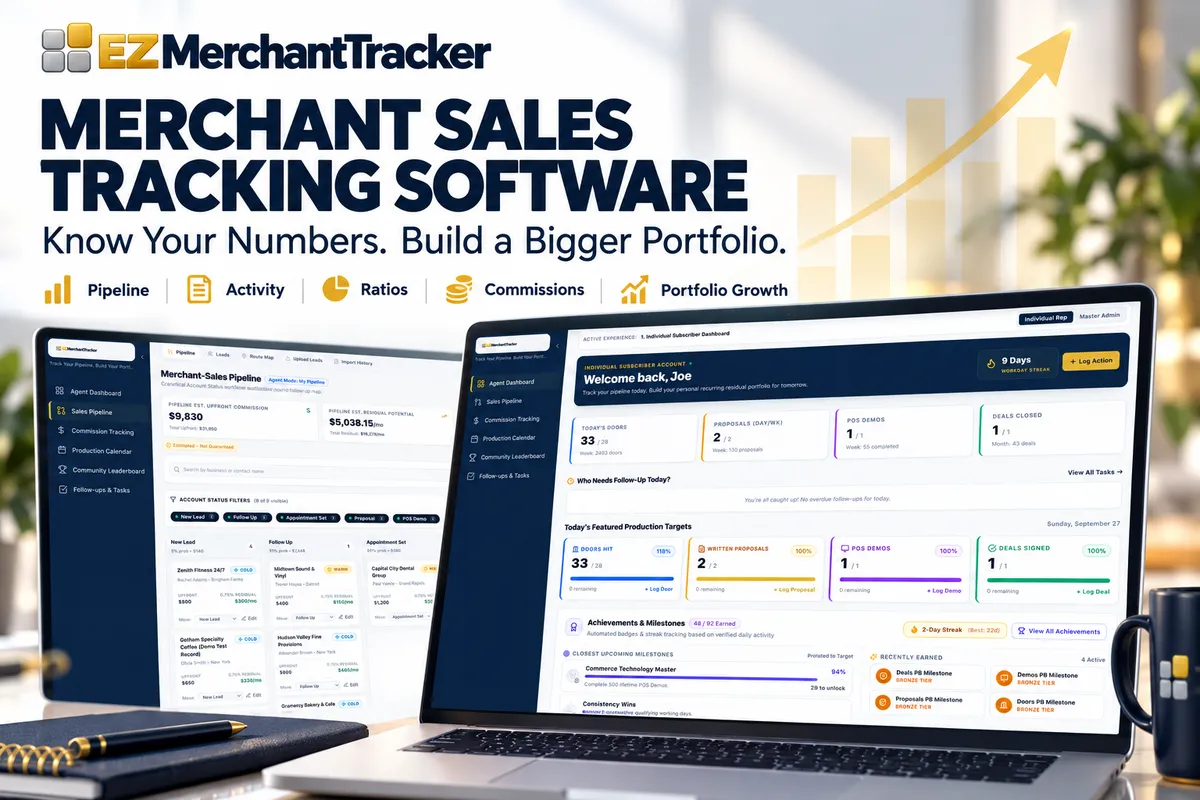
Merchant Sales Tracking Software: How to Know Your Numbers and Build a Bigger Portfolio
Merchant Sales Tracking Software: How to Know Your Numbers and Build a Bigger Portfolio
I've been selling merchant services since 2009.
I've signed thousands of merchants, built sales organizations and created multiple residual portfolios.
But here's something I can't tell you.
I don't know my lifetime prospecting-to-close ratio.
I don't know exactly how many businesses I had to contact throughout my career to produce one signed merchant.
I don't know my lifetime proposal-to-close ratio.
I don't know what percentage of my POS demonstrations became accounts.
I can't pull up a chart showing exactly how my sales performance changed from my first year in merchant services to my fifth, tenth or fifteenth.
I know I became better.
I know I produced.
I know the results.
But I don't have the data behind all of those results.
And I wish I did.
Because after more than 16 years in this industry, I believe there's an enormous difference between knowing what you produced and knowing how you produced it.
That's one of the biggest reasons I'm building EZ MerchantTracker.
I don't want the next generation of merchant-services agents building their businesses entirely on instinct.
I want them to know their numbers.
As of September 2026, EZ MerchantTracker is still being developed and tested and is coming soon.
The goal isn't simply to give agents another CRM.
It's to give them a scoreboard for the business they're building.
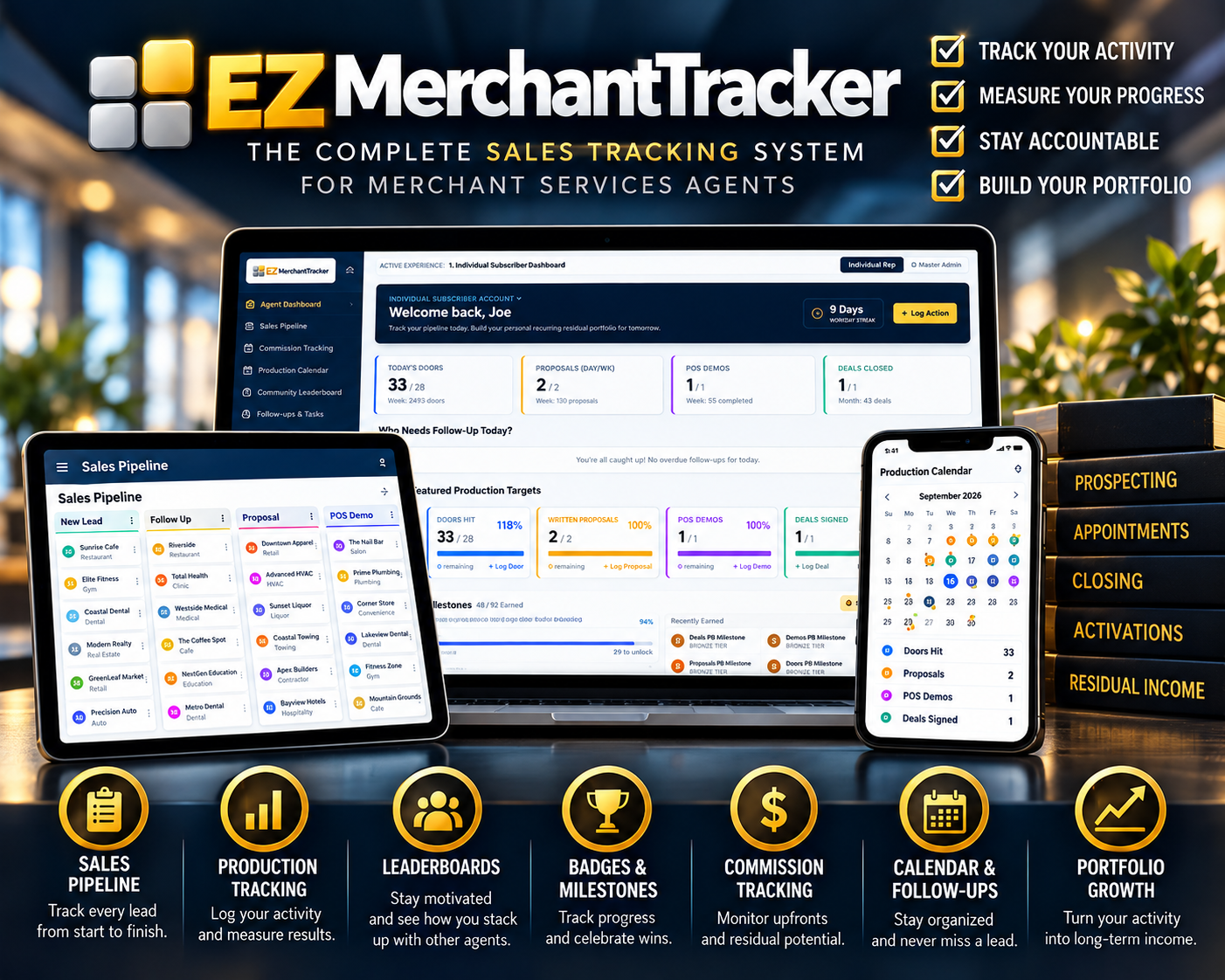
Most Merchant Services Agents Know the Result, Not What Created It
Ask an agent how much residual income they're making.
They probably have an answer.
Ask how many merchants they signed last month.
They may know that too.
Now ask:
How much prospecting created those accounts?
How many owners did you reach?
How many legitimate presentations did you complete?
How many targets did you identify?
How many proposals did you prepare?
How many POS demos did you conduct?
What percentage of those opportunities became signed accounts?
How many signed accounts activated?
How do those numbers compare with six months ago?
That's where things often become fuzzy.
And that's exactly where I think we're leaving valuable information on the table.
If you only track the final result, you know what happened.
If you track the process that created the result, you can begin understanding why it happened.
That gives you something to improve.
Stop Asking What Every Other Agent Should Produce
One of the most common questions I've heard throughout my career is some variation of:
“Joe, how many businesses do I need to contact to get a deal?”
Or:
“If I hit 100 doors, how many accounts should I close?”
I understand why people ask.
They want a benchmark.
They want to know whether they're doing enough.
And I absolutely believe agents should have production standards.
But there's another number that eventually becomes much more useful:
Your number.
Maybe one agent can generate a signed account from a certain amount of activity.
Another agent needs twice as much.
That doesn't necessarily mean the second agent is doomed.
Maybe they're new.
Maybe their presentation needs work.
Maybe they're targeting poorly.
Maybe they're struggling to reach owners.
Maybe their follow-up sucks.
Maybe the first agent has 10 years of experience.
The point is:
Your sales ratios are personal performance data.
And until you track them, you're guessing.
The Better Question Is: What Does YOUR Activity Produce?
Imagine being able to say:
“When I consistently produce this amount of prospecting activity, I normally create approximately this many legitimate opportunities.”
Then:
“When I create this many proposals, I typically produce this many signed accounts.”
Then:
“When I sign this many accounts, this percentage typically activates.”
Now we're no longer talking about somebody else's benchmark.
We're building a model of your business.
And once you understand that model, you can begin working backward from a goal.
If you want more production, you can ask:
At my current conversion rates, how much activity is likely required?
Or:
Instead of simply doing more activity, which conversion rate should I improve?
Those are much better questions.
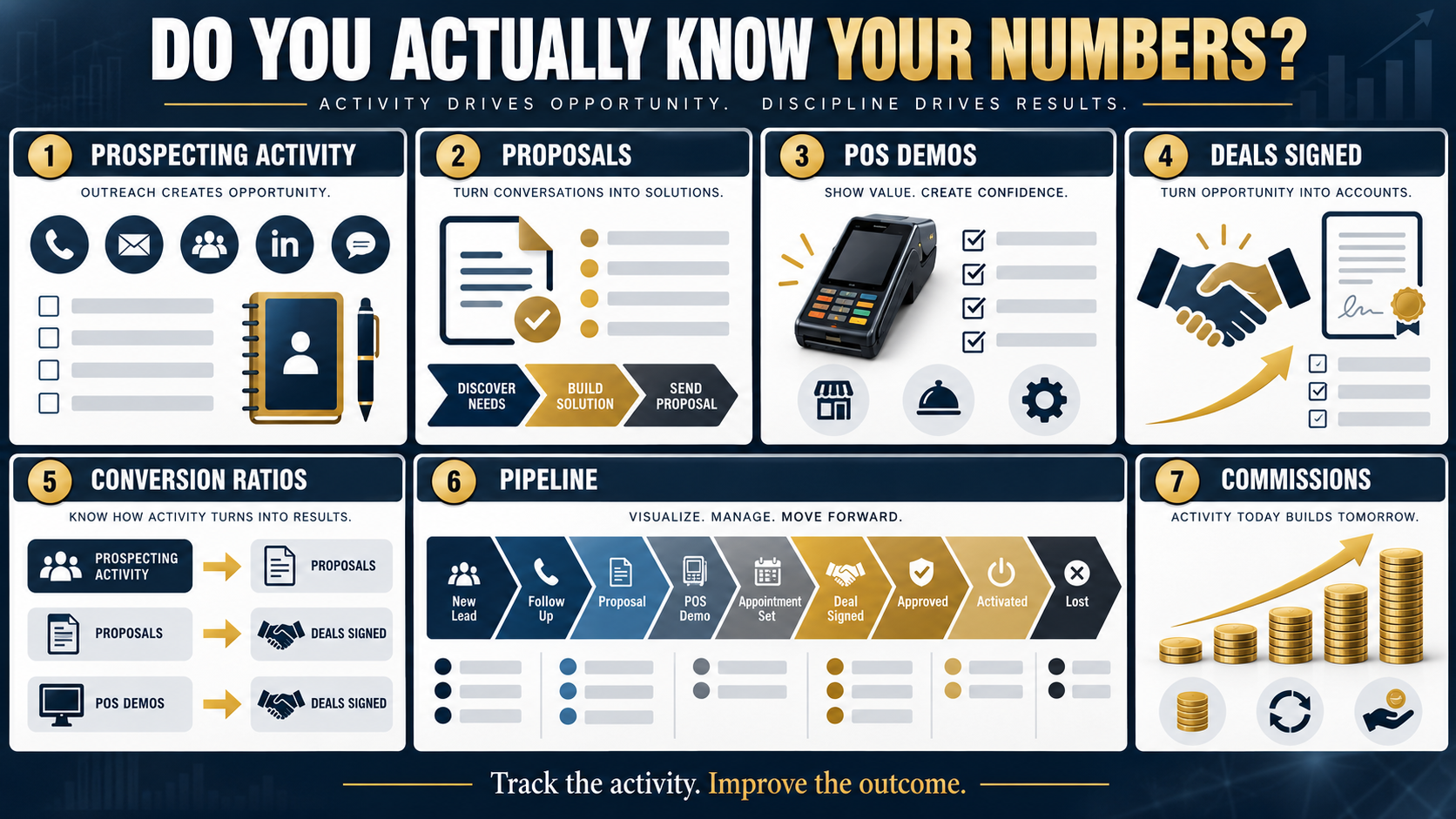
This Is Why Sales Tracking Has to Go Beyond a CRM
A CRM is essential.
You need to know who the merchant is.
You need contact information.
You need pipeline stages.
You need follow-up.
You need appointments.
You need notes.
You need to know where the opportunity stands.
But that doesn't automatically tell you how you're performing as a salesperson.
I broke down this distinction in Merchant Services Agent CRM: Why Processor Dashboards Aren't Enough for Salespeople.
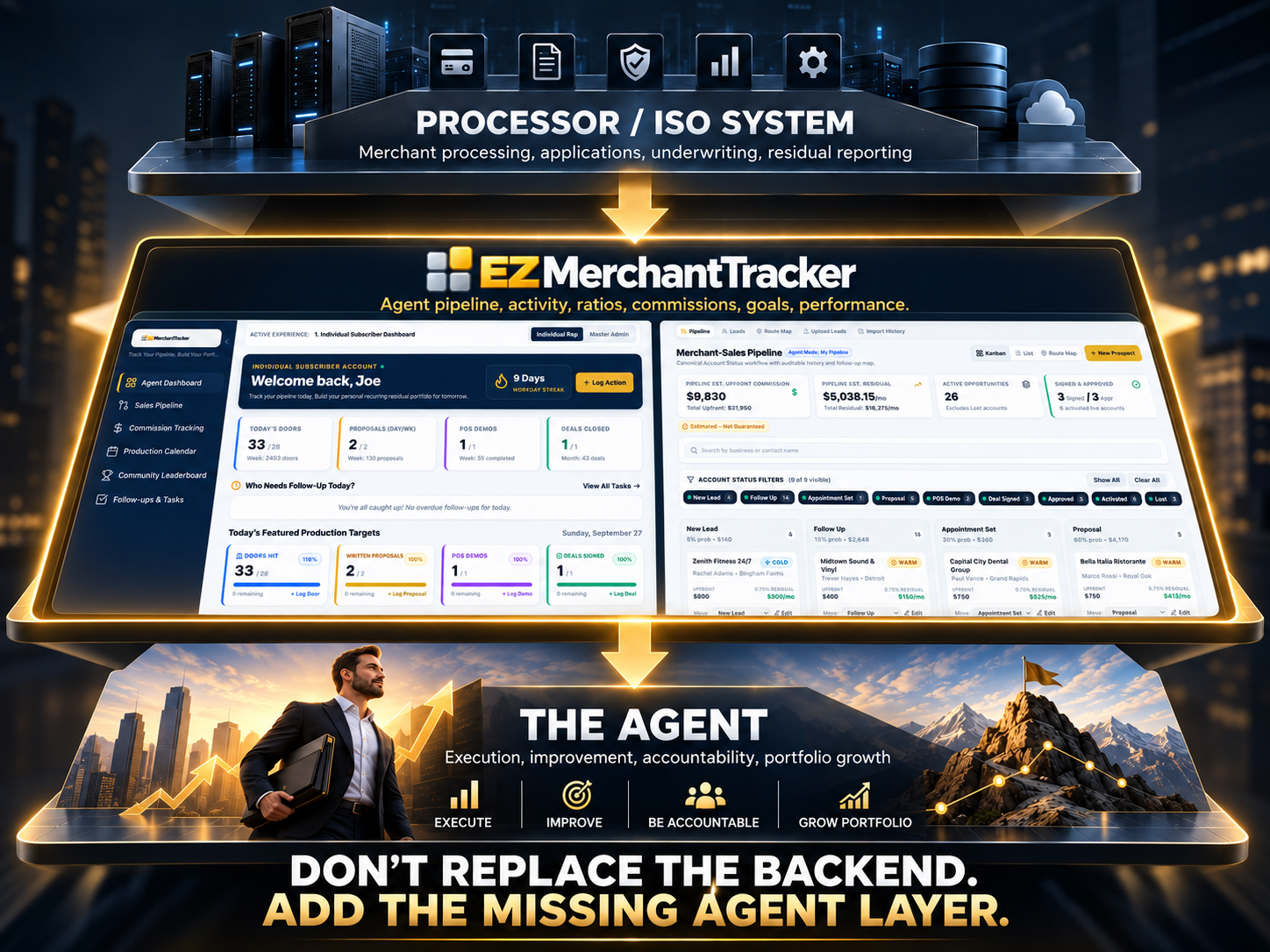
Your processor or ISO already has important backend systems.
Your CRM helps organize opportunities.
Performance tracking measures the person creating those opportunities.
That's the layer I'm especially interested in.
The Results Pyramid Shows What We Should Measure
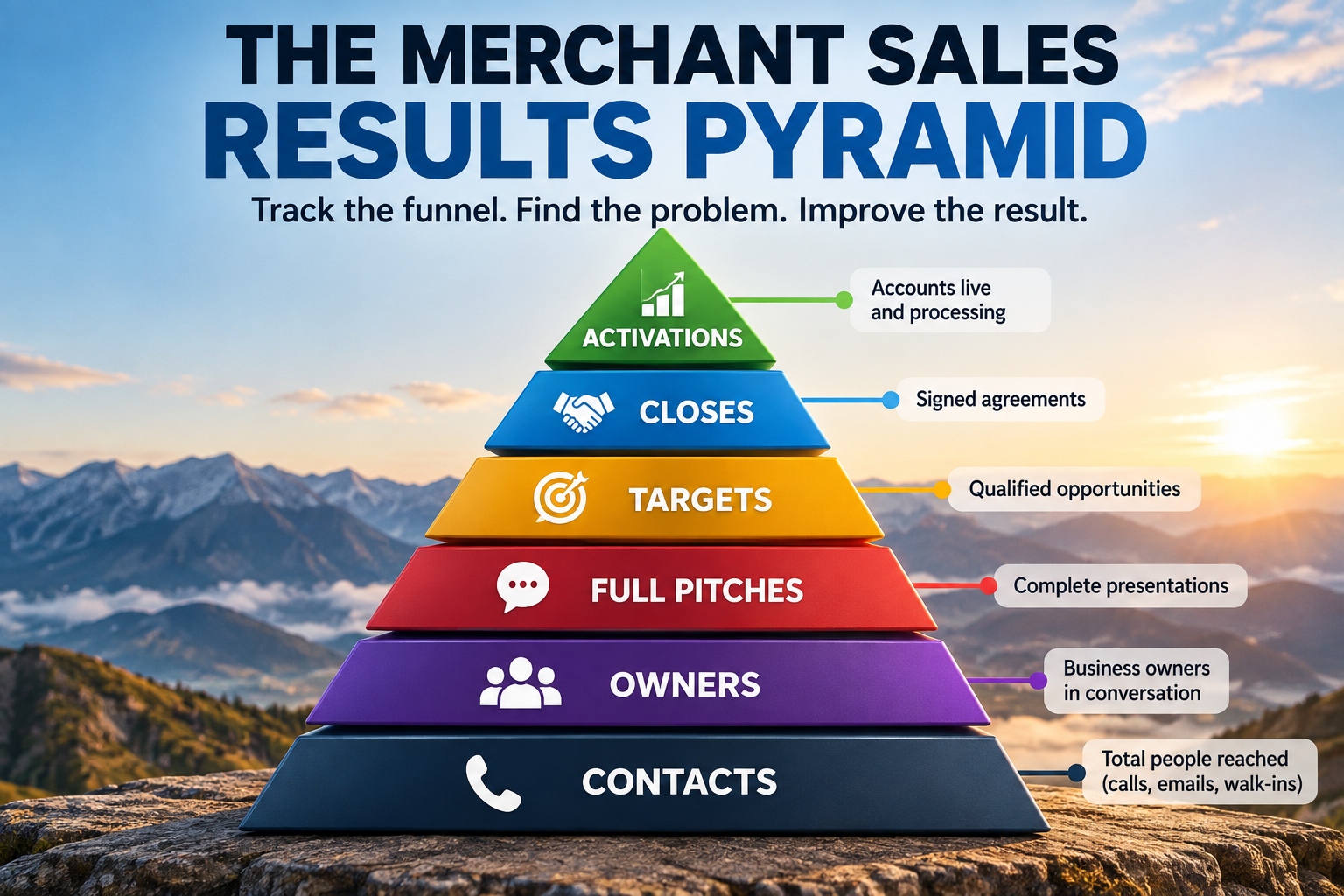
One of the frameworks I use when coaching merchant sales is the Results Pyramid:
Contacts → Owners → Full Pitches → Targets → Closes → Activations
The beauty of the pyramid is that it allows us to work backward from the result.
If you don't have enough activations, we look at closes.
If you aren't closing enough, we look at legitimate targets.
If you aren't producing enough targets, we look at full presentations.
If presentations are low, are you actually reaching owners?
If you're barely reaching owners, what does your initial activity look like?
Suddenly:
“I'm struggling with merchant sales”
becomes much more specific.
Maybe you aren't struggling with merchant sales.
Maybe you're struggling with one stage of merchant sales.
That's a very different problem.
Two Agents Can Work the Same Amount and Get Completely Different Results
Imagine two merchant-services agents each contact the same number of businesses.
Agent A signs six merchants.
Agent B signs two.
The easy conclusion is:
Agent B needs to work harder.
Maybe.
But if they completed the same amount of activity, that isn't enough of an explanation.
Let's go deeper.
Maybe Agent B isn't reaching enough owners.
Maybe they reach owners but struggle to get through discovery.
Maybe they're presenting to everybody instead of identifying legitimate targets.
Maybe they're creating proposals but not scheduling next steps.
Maybe they conduct plenty of POS demos but don't close.
Maybe they're actually signing merchants and losing them before activation.
Each problem requires a different solution.
Activity tells us whether you worked. Ratios help tell us how effectively that work moved through the sales process.
That's why I've written separately about merchant services KPIs and the sales numbers agents should track and the difference between merchant sales activity and sales results.
Those concepts are foundational to what we're building inside EZ MerchantTracker.
The Production Calendar Shows Consistency
Salespeople tend to remember their hardest days.
That's not always the same as remembering their most productive days.
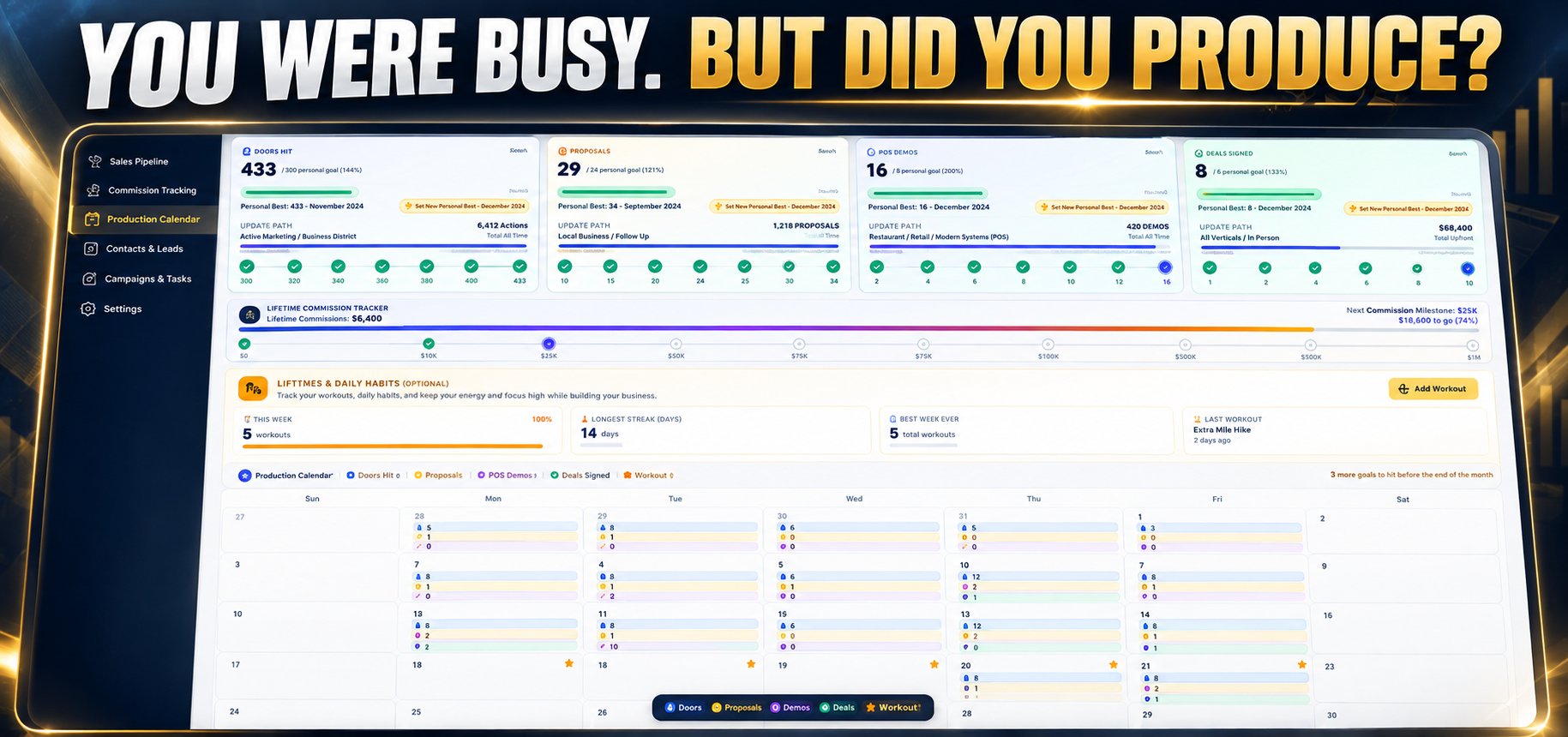
This is why I wanted a visual production calendar inside MerchantTracker.
I want to look across a month and see:
Where did you produce activity?
Where did you disappear?
When did proposals increase?
When did demos happen?
When were deals signed?
Where are the gaps?
Then, over time, we can begin comparing activity patterns with results.
That's much more useful than:
“I feel like I've been working pretty hard lately.”
What Gets Measured Becomes Harder to Ignore
This is where tracking begins creating accountability even before a coach gets involved.
Suppose you set a goal.
You say you want to build a certain amount of recurring income.
You say you want more accounts.
You say you want to replace your current income.
You say you want financial freedom.
Great.
What did you do today?
That's the uncomfortable bridge between the dream and the result.
I've watched people spend enormous amounts of time thinking about what they want while spending far less time measuring the actions required to get there.
A scoreboard changes that.
It doesn't guarantee you'll do the work.
But it makes the work—or lack of it—visible.
Your Sales History Should Become an Asset
This is one of the things I wish I had most.
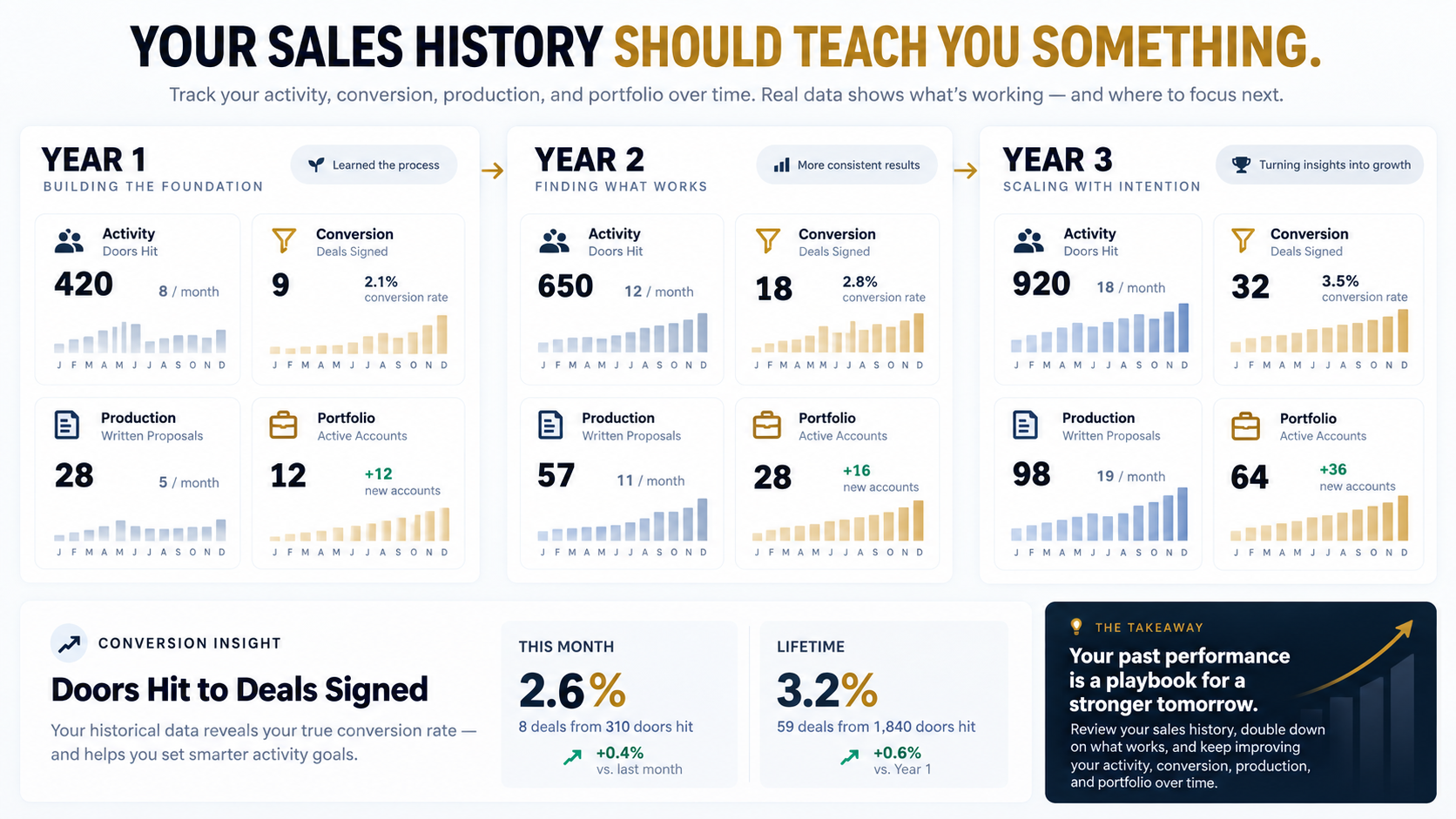
Imagine starting merchant sales today and tracking your performance consistently for five years.
Now imagine what you would know.
Your best month.
Your average month.
Your strongest prospecting periods.
Your personal records.
Your conversion ratios.
How those ratios changed as you gained experience.
Which activities consistently preceded strong production.
Where opportunities most commonly stalled.
How your current performance compares with your first year.
That data becomes valuable because it's your history.
Generic sales statistics can't replace that.
Neither can somebody else's results.
You now have a record of how you build business.
Competition Can Change Behavior
This is another part of EZ MerchantTracker I'm excited about.
Salespeople can be competitive.
I certainly am.
Show me somebody ahead of me and there's a good chance I'm going to want to catch them.
Show me my own personal record and I'm going to want to beat it.
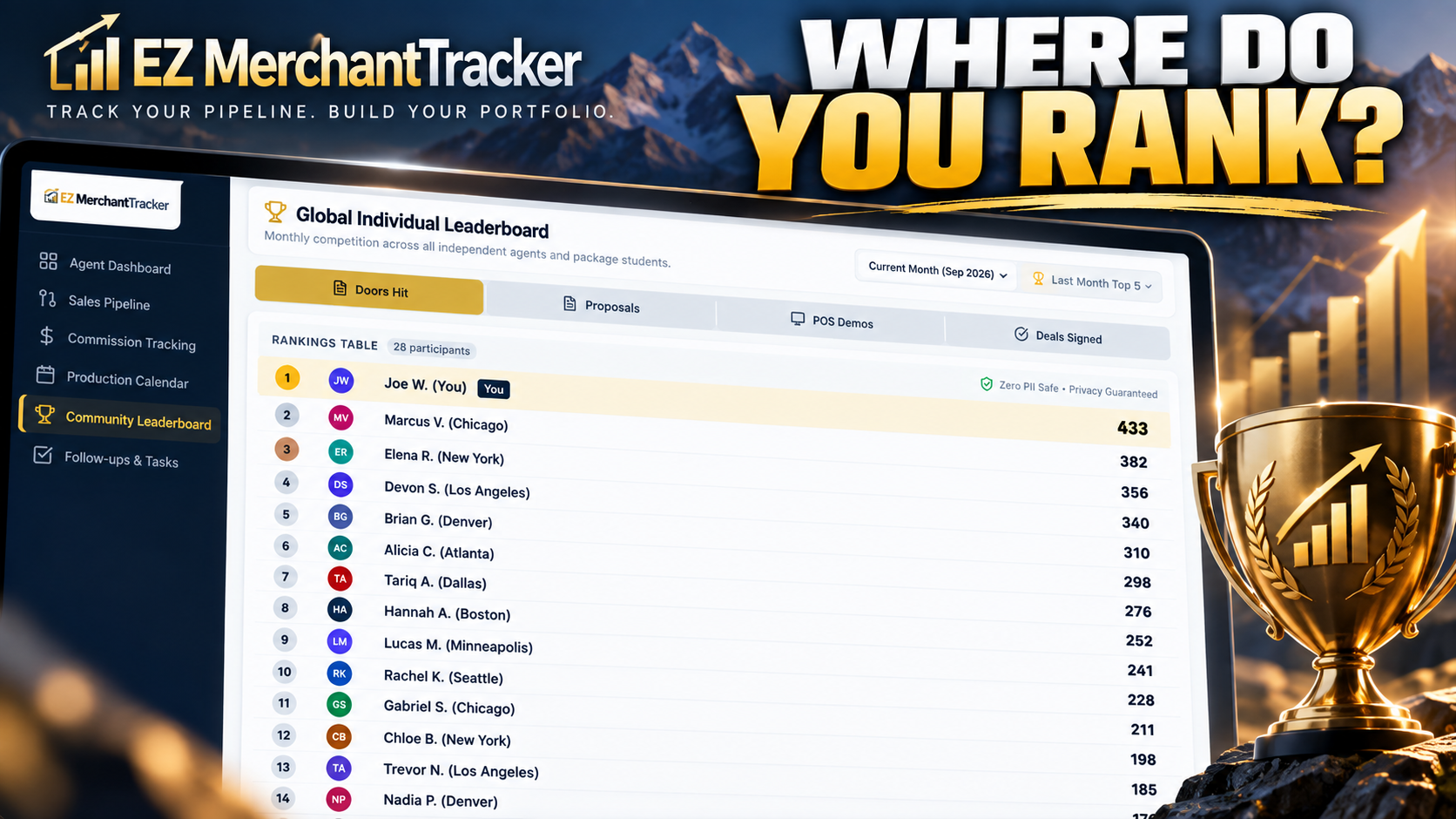
That's why leaderboards, milestones, streaks and personal bests aren't just decoration.
Used correctly, they can create another reason to execute.
Imagine seeing where you rank in:
Prospecting.
Proposals.
POS demos.
Deals signed.
Then imagine competing against your own history.
Can you beat last month?
Can you break your proposal record?
Can you create a longer production streak?
Can you move up the leaderboard?
Merchant sales can be lonely, especially when you're an independent agent.
A performance community makes the activity visible.
Tracking Commissions Connects Work to Reward
At some point, activity needs to become money.
Merchant services is especially powerful because compensation can include both upfront income and recurring residual income, depending on the agreement and program.
If you're still learning how compensation works, start with my Merchant Services Agent Commissions guide. I also explain the difference between upfront commissions and residual income in merchant services.
Those concepts matter because the economics of a merchant-services business are different from a job where you get paid once for every sale.
An account you acquire today may potentially contribute to your income well beyond the initial sale.
That's why I want agents connecting:
Activity → Opportunity → Account → Commission → Portfolio
EZ MerchantTracker isn't intended to replace your processor's official commission or residual reporting.
Your processor remains the authority on what you're actually owed and paid.
MerchantTracker is about connecting the salesperson's production with the economic business they're building.
Your Portfolio Is the Asset. Your Sales Process Is the Engine.
This may be the most important concept in this entire article.
If you're building merchant services around recurring residual income, your merchant portfolio becomes an asset.
But something has to create that asset.
That's your sales engine.
Think about the two sides.
THE PORTFOLIO
Active merchants.
Processing volume.
Residual income.
Long-term recurring revenue.
THE PRODUCTION ENGINE
Prospecting.
Conversations.
Presentations.
Targets.
Proposals.
POS demos.
Follow-up.
Signed accounts.
Activations.
A lot of technology becomes especially valuable once the merchant exists.
I want EZ MerchantTracker to help the salesperson understand the engine creating those merchants.
Because if we can improve the engine, we can potentially improve everything it produces.
This Is Why I'm Building EZ MerchantTracker
EZ MerchantTracker is being built around a simple question:
What would I have wanted as an agent?
I would have wanted one place to manage my pipeline.
Track activity.
See my production calendar.
Know my personal ratios.
Track commissions.
Estimate pipeline potential.
Set goals.
See historical trends.
Compete against other agents.
Beat my personal records.
Identify weaknesses.
And eventually have AI help interpret what all that data means.
That's the product.
Not another processor backend.
Not a replacement for your ISO.
Not software pretending it can sell merchants for you.
A performance system for the person building the portfolio.
As of September 2026, EZ MerchantTracker is still being developed and tested and is coming soon.
You can follow the launch at EZMerchantTracker.com.
AI Can Eventually Turn the Scoreboard Into a Coach
Tracking tells us what happened.
The next opportunity is helping the agent understand what to do about it.
This is where the AI direction becomes exciting.
Imagine an AI sales coach that understands both merchant-sales methodology and your actual performance.
Not:
“Give me five closing tips.”
Instead:
“My activity is up, but my production is down. Where should I look?”
And the system can examine the data.
Maybe activity isn't the problem.
Maybe you're creating plenty of proposals but not closing.
Maybe you're closing well whenever you conduct a POS demo, but demo volume has dropped.
Maybe your conversion rates are stable and the problem really is simply insufficient activity.
Maybe several legitimate opportunities have been sitting untouched in follow-up.
That's much more useful.
I've gone deeper into that vision in AI Merchant Services CRM: The Future of Sales Tracking and Agent Coaching.
The goal isn't to make salespeople dependent on AI.
It's to give them better information so they can make better decisions.
Data Without Action Still Produces Nothing
There's a trap here too.
You can become obsessed with analytics.
You can stare at dashboards.
You can study ratios.
You can admire charts.
You can spend an hour reviewing your leaderboard.
Then do absolutely nothing.
That's not the point.
The scoreboard isn't the game.
The purpose of the data is to help you decide what to do next.
Then you have to go do it.
That's also why software alone doesn't solve the accountability problem.
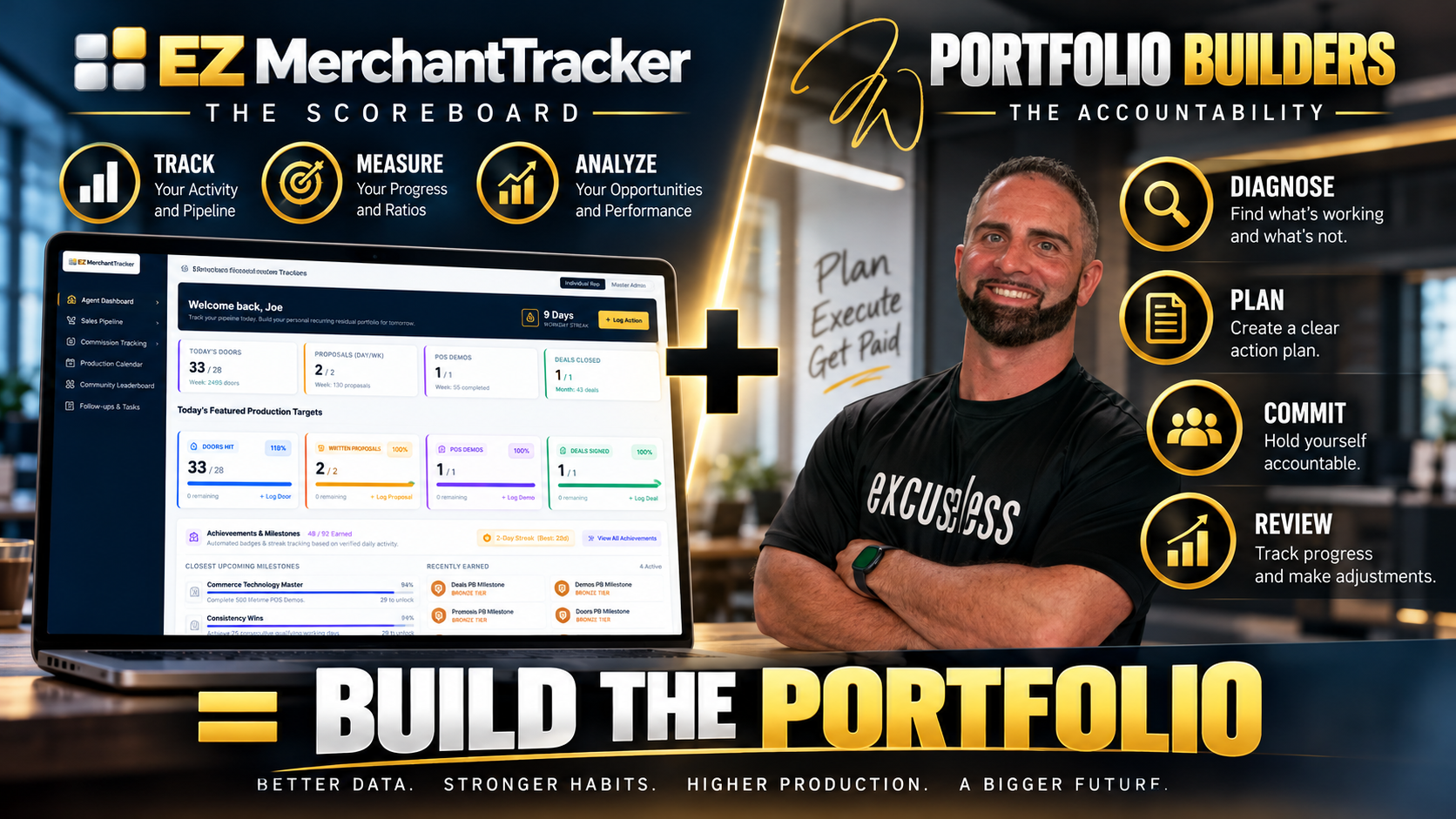
Portfolio Builders Coaching Adds the Human Accountability Layer
One of the most consistent requests I've received from agents isn't:
“Joe, can you give me more information?”
It's:
“I need accountability.”
That's what I'm building Portfolio Builders Coaching around.
Not another giant merchant-services course.
I've already made foundational merchant-services education free through Merchant Service University.
I've built a growing library through my Merchant Sales Training Blog.
I've organized additional tools through Merchant Sales Resources.
And I continue publishing free merchant-sales education through my YouTube channel.
Information isn't scarce.
Execution is.
Portfolio Builders Coaching is being designed to take the data and ask:
What do you want?
Where are you now?
What does your activity show?
What do your ratios show?
Where is the constraint?
What needs to improve?
What are you committing to doing?
And then:
Did you do it?
As of September 2026, Portfolio Builders Coaching is also coming soon.
You Don't Need Coaching to Benefit From Tracking
Some agents are incredibly self-accountable.
They don't need somebody calling them out.
They work.
They follow through.
They make adjustments.
They don't make excuses.
If that's you, great.
You may not need Portfolio Builders Coaching.
But I'd still want the data.
Because discipline and measurement solve different problems.
You can be extremely disciplined and still benefit from knowing:
Where you're strongest.
Where you're weakest.
What your personal ratios are.
Whether you're improving.
What activity creates your best results.
And how today's performance compares with your own history.
Self-accountability doesn't make data less valuable.
It may make you even more likely to use it.
If You're Brand New, Start With Education Before Analytics
There's another group reading this who doesn't need advanced tracking yet.
If you haven't learned merchant services, start there.
Don't build a beautiful dashboard for a business you don't understand.
My Merchant Services Sales: Complete 2026 Beginner Guide gives you a starting point for understanding the opportunity.
Then use the free training at Merchant Service University to build the foundation.
My philosophy remains:
Get educated before you get recruited.
Once you're ready to actually enter the business, EZ Direct Sales can help qualified people connect directly with merchant-services partnerships and begin producing.
Then the need changes.
Now you have activity.
Now you have leads.
Now you have opportunities.
Now you have data worth tracking.
That's where MerchantTracker begins making sense.
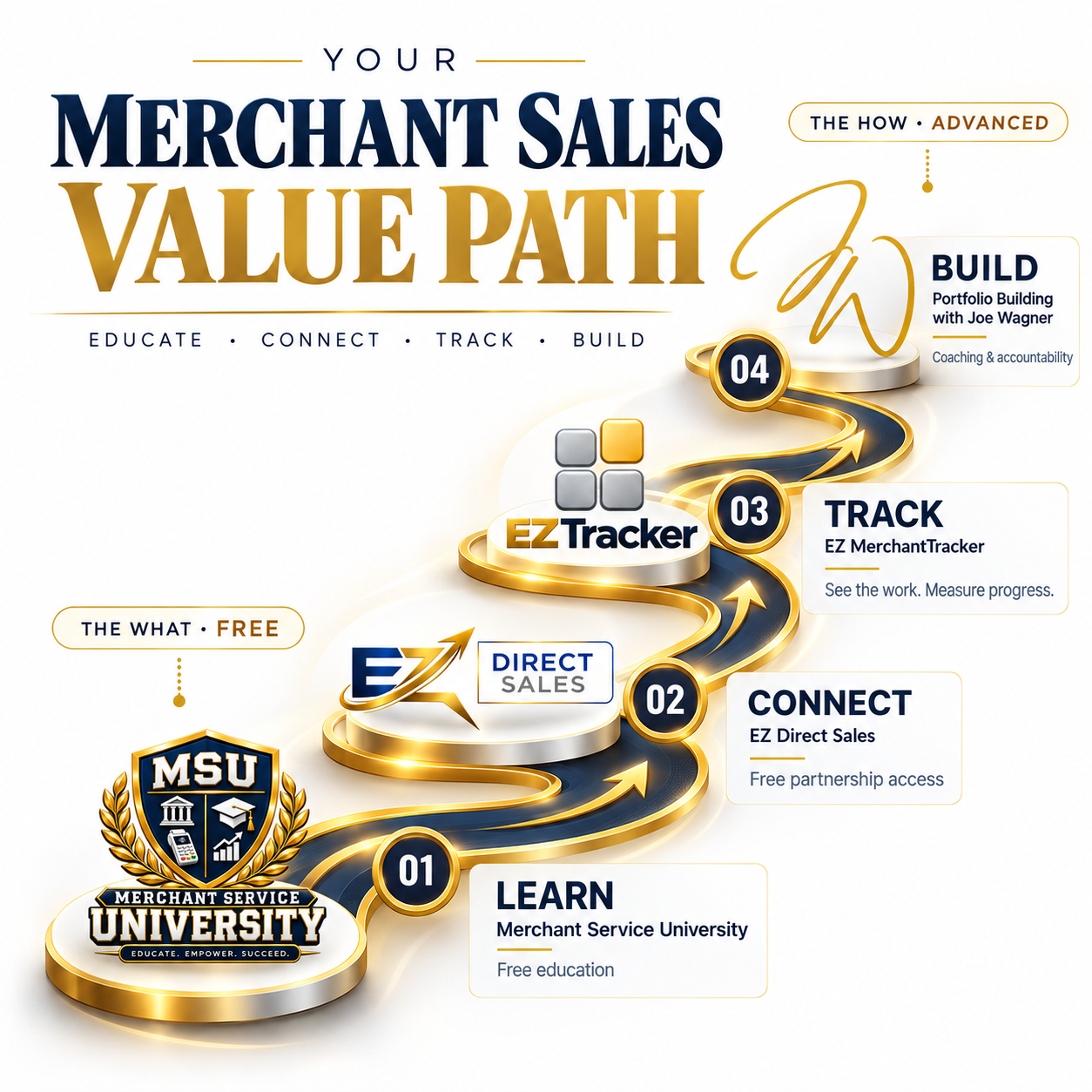
The Merchant Agent Growth System
I see these pieces becoming increasingly connected.
LEARN — MERCHANT SERVICE UNIVERSITY
Understand the industry.
Start Free at Merchant Service University
START — EZ DIRECT SALES
Get connected and begin submitting real business.
TRACK — EZ MERCHANTTRACKER
Manage your pipeline, track activity, learn your ratios, monitor performance and build your own sales history.
Follow the EZ MerchantTracker Launch
IMPROVE — AI MERCHANT SALES COACH
Use merchant-specific methodology combined with your performance data to make coaching increasingly contextual.
BUILD — PORTFOLIO BUILDERS COACHING
Add human strategy, accountability and performance coaching around the goals you're trying to accomplish.
Stop Guessing About Your Merchant Sales Business
If you're already selling merchant services, I want you to think about the questions we started with.
Do you know your numbers?
Not your residual check.
Not just your signed accounts.
Your performance numbers.
Do you know what your activity normally produces?
Do you know your conversion ratios?
Do you know whether you're improving?
Do you know where your opportunities typically fall apart?
Do you know how this month's execution compares with your strongest month?
Do you know exactly what your active pipeline looks like?
If you don't, you're not alone.
I spent a large portion of my own career without that information.
That's precisely why I'm building the system now.
As of September 2026, EZ MerchantTracker is coming soon.
Visit EZMerchantTracker.com as we move toward launch.
Until then, keep learning through the Merchant Sales Training Blog, use the tools available through Merchant Sales Resources, and continue learning with me on YouTube.
But don't confuse learning with execution.
Track the work.
Learn your numbers.
Find the constraint.
Improve the performance.
Build the portfolio.
Sales tracking is one part of the larger system I'm building with EZ MerchantTracker. The goal is to bring an agent's pipeline, activity, ratios, commissions, production history and performance into one place. For a deeper explanation of why this should complement—not replace—the technology provided by your processor or ISO, read Merchant Services Agent CRM: Why Processor Dashboards Aren’t Enough for Salespeople.
Frequently Asked Questions
What is merchant sales tracking software?
Merchant sales tracking software helps merchant-services agents record and analyze sales activities, opportunities and results. Depending on the platform, this can include prospecting, pipeline stages, proposals, POS demonstrations, signed accounts, activations, conversion ratios, commissions and historical performance.
Why should merchant-services agents track sales activity?
Tracking activity helps agents understand what occurs before the final sale. If production declines, activity data can help determine whether the potential problem begins with prospecting, opportunity creation, presentations, follow-up, closing or another stage of the process.
What merchant sales metrics should an agent track?
Useful metrics can include prospecting activity, owner conversations, presentations, qualified targets, proposals, POS demonstrations, signed deals, approvals and activations. Over time, agents can also measure conversion ratios between important stages.
What are merchant sales conversion ratios?
Merchant sales conversion ratios measure how frequently one stage of the sales process progresses to another. Examples include proposal-to-signed-deal, POS-demo-to-signed-deal and signed-deal-to-activation ratios.
Is there one ideal merchant-services conversion rate?
No single conversion rate should be assumed to apply equally to every agent. Experience, market, prospecting methods, merchant types, qualification, products, follow-up and sales skill can all affect results. Personal historical data can therefore be valuable alongside broader benchmarks.
How does merchant sales tracking help build a portfolio?
Tracking can help agents understand the activities and conversion patterns associated with acquiring merchants. This information can be used to identify potential constraints, improve consistency and make more informed decisions about the sales process used to build the portfolio.
What is the difference between merchant sales tracking software and a processor dashboard?
Processor and ISO systems can manage important backend functions such as applications, underwriting, merchant accounts, processing information and official residual reporting. Agent sales tracking focuses on the salesperson's pipeline, activity, conversion ratios, production and performance.
What is EZ MerchantTracker?
EZ MerchantTracker is a merchant-services CRM and sales-performance platform being developed specifically around individual agents and merchant-sales organizations. Its direction combines pipeline management with activity tracking, performance metrics, conversion ratios, commission tracking, historical trends, competition and developing AI sales-coaching capabilities.
Is EZ MerchantTracker available now?
As of September 2026, EZ MerchantTracker is still being developed and tested and is coming soon. Launch information will be available at EZMerchantTracker.com.
Does EZ MerchantTracker replace my processor's reporting?
No. EZ MerchantTracker is intended to complement processor and ISO systems rather than replace them. Official processing, residual and compensation information should continue to come from the appropriate processor or ISO.
Will EZ MerchantTracker include AI sales coaching?
AI merchant-sales coaching is part of the platform's developing direction. The goal is to combine merchant-specific sales methodology with an agent's own pipeline and performance information so future guidance can become increasingly contextual.
What is Portfolio Builders Coaching?
Portfolio Builders Coaching is a developing merchant-services performance and accountability program intended to complement the performance data tracked through EZ MerchantTracker. It will focus on goals, identifying constraints, execution, action commitments and accountability.