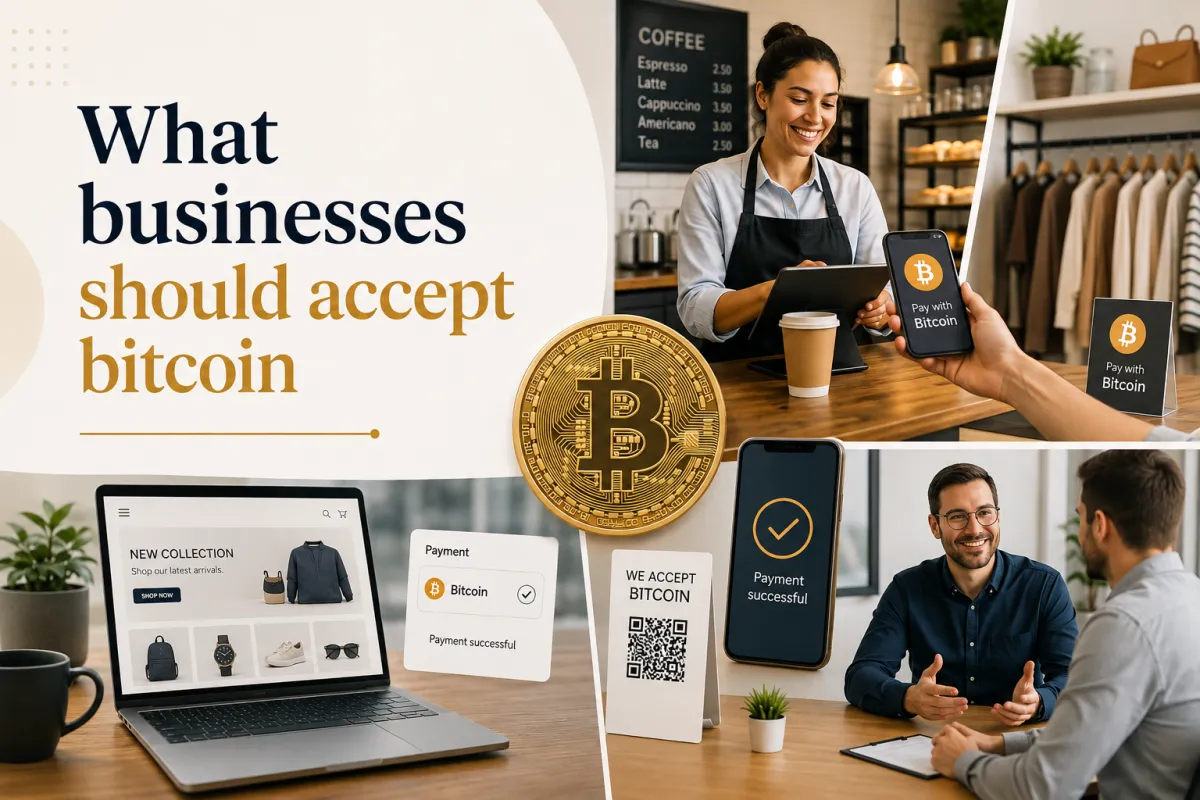
What Businesses Should Accept Bitcoin Payments First (And Why It Matters Now)
What Businesses Should Accept Bitcoin Payments First? Where Crypto Payments Actually Make Sense
One of the mistakes people make whenever a new payment technology starts getting attention is assuming every business suddenly needs it.
I don't think that's true with Bitcoin, and I don't think that's how good merchant sales professionals should approach emerging technology.
A coffee shop doesn't necessarily need customers paying for a $6 drink with Bitcoin. A small retailer probably isn't losing meaningful business because cryptocurrency isn't available at checkout. For most everyday purchases, credit cards, debit cards, cash, digital wallets, and other established payment methods already work extremely well.
That doesn't mean Bitcoin has no place in merchant services. It means we need to stop treating every payment solution as though it solves the same problem for every business.
The better question is: Where does Bitcoin actually solve payment friction today?
That's where the conversation gets much more interesting.
For certain businesses—particularly those accepting larger transactions—Bitcoin and other alternative payment rails may provide another way to complete purchases when traditional payment methods create limitations. That doesn't make cryptocurrency a replacement for cards. It makes it another option inside a broader Modern Commerce System.
Understanding that distinction is important for both business owners and merchant sales professionals.
Bitcoin Payments Make More Sense When Transaction Sizes Get Larger
Most everyday consumer transactions are already extremely convenient. If someone is buying lunch, filling their gas tank, purchasing groceries, or ordering something online, pulling out a credit card or tapping a digital wallet works just fine.
The situation becomes more complicated when transactions move into the thousands or tens of thousands of dollars.
High-ticket businesses routinely deal with larger payment amounts, financing requirements, card limits, fraud controls, declined transactions, bank transfer delays, and customers who may want alternative ways to move money. At that level, having additional payment options becomes much more meaningful.
I'm not suggesting Bitcoin eliminates every one of those challenges. It doesn't. Businesses still need to think about accounting, taxes, compliance, price volatility, customer demand, and how their payment provider handles cryptocurrency transactions.
But this is where alternative payment rails become worthy of a serious business conversation rather than simply being discussed because crypto happens to be popular.
Luxury Retail and High-End Purchases
Luxury businesses are one of the first categories where Bitcoin acceptance can make practical sense.
Jewelry stores, luxury watch dealers, art galleries, specialty retailers, and other businesses selling products that routinely cost thousands or tens of thousands of dollars operate in a completely different payment environment than the average retailer.
Imagine a customer purchasing a $25,000 watch or a $50,000 piece of jewelry. That's not the same payment decision as buying a shirt.
The merchant may deal with card limits, fraud concerns, payment authorization issues, bank wires, financing, or other methods of completing the purchase. If the buyer already owns cryptocurrency and the merchant has an established, compliant way to accept it, Bitcoin becomes another potential path for completing the transaction.
That's the important part.
It's another option.
Not a replacement for everything else.
Automotive, RV, Marine, and Specialty Vehicle Businesses
Large vehicle transactions are another category worth watching.
Traditional automobile dealerships, exotic car dealers, RV dealerships, marine businesses, powersports companies, and specialty vehicle sellers regularly handle large transactions. Financing will continue to play an enormous role in these industries, but not every customer wants or needs financing.
Some buyers pay significant down payments. Others purchase outright. International customers and affluent buyers may also hold significant assets outside traditional checking accounts.
For those customers, crypto may eventually become another useful payment rail.
Again, the goal isn't walking into every dealership claiming Bitcoin is going to replace automotive financing. That's not realistic.
The goal is understanding that as transaction values increase, the value of payment flexibility often increases with them.
That's the conversation modern merchant sales professionals should be having.
Construction and High-Ticket Home Services
Construction is another industry where payment friction becomes obvious very quickly.
Roofing projects, remodeling, windows, siding, pools, custom construction, HVAC installations, landscaping projects, and other major home services can easily generate invoices ranging from several thousand dollars to well into six figures.
These companies already rely on multiple ways of collecting money because no single payment method works perfectly for every customer.
They may accept checks, ACH, cards, financing, bank transfers, and staged payments throughout the project.
Bitcoin doesn't need to replace any of those options to have value. If enough customers want the ability to pay through cryptocurrency, it can simply become another payment choice available alongside the others.
That's what I believe the future of payments looks like.
Not one payment rail defeating all the others.
More options becoming available inside increasingly integrated business systems.
Medical, Dental, Cosmetic, and Elective Services
High-ticket healthcare and elective services are another area where payment flexibility matters.
Cosmetic dentistry, implants, orthodontics, elective procedures, med spas, plastic surgery, fertility services, and other privately paid treatments can involve significant out-of-pocket expenses.
These businesses already think differently about payment acceptance because the customer may need to combine several payment methods to complete treatment.
Credit cards.
Patient financing.
ACH.
Savings.
Installment plans.
Potentially alternative payment methods.
For the right patient and the right provider, cryptocurrency can become another tool.
Whether it's valuable depends entirely on the customers that particular business serves.
That's why I keep coming back to the same principle: understand the merchant before recommending the technology.
Real Estate and Other Large-Dollar Transactions Require More Caution
Real estate is often mentioned whenever people discuss Bitcoin and large transactions, but this is an area where I believe sales professionals need to be especially careful about oversimplifying the conversation.
Real estate transactions involve title companies, lenders, escrow requirements, attorneys, financial institutions, compliance rules, and significant documentation. Cryptocurrency may have a role in certain transactions, but accepting Bitcoin for a retail purchase and using digital assets within a real estate transaction are not the same thing.
This is exactly why merchant sales professionals shouldn't pretend to be experts in areas outside their lane.
Our role is to understand that new payment rails exist and know when to bring qualified technology and financial partners into the conversation.
Good consulting sometimes means knowing when not to pretend you have every answer.
The Bigger Story Is Payment Flexibility
The most important lesson here isn't really about Bitcoin.
It's about payment flexibility.
Customers increasingly expect businesses to meet them where they are. That may mean cards, digital wallets, ACH, financing, buy now pay later, recurring billing, bank transfers, cryptocurrency, or whatever payment methods become more relevant in the future.
The businesses that benefit most from alternative payment options will typically be those where the existing payment process creates the most friction.
That's why I would focus on the problem before focusing on the technology.
If a business routinely accepts $50 transactions and nobody has ever asked to pay with Bitcoin, cryptocurrency probably isn't going to transform that business.
If a company routinely accepts $20,000 transactions and customers regularly struggle with payment limits or ask for alternative ways to complete large purchases, the discussion becomes much more relevant.
That's how a merchant advisor should think.
Bitcoin Should Fit Inside the Modern Commerce System
One of the biggest changes happening throughout merchant services is that payment processing is becoming part of something much larger.
A Modern Commerce System can connect payments with POS technology, customer management, marketing, loyalty, ecommerce, inventory, payroll, reporting, financing, automation, and other operational tools.
Bitcoin and cryptocurrency payments are simply another possible component of that ecosystem.
Different technology providers will support different payment methods, and those capabilities will continue changing over time. That's why I don't believe merchant sales professionals should build their entire identity around one company, one payment rail, or one technology.
Understand the business.
Understand the available systems.
Then recommend the solution that actually fits.
That's a much stronger long-term strategy.
What This Means for Merchant Sales Professionals
If you're building a career in merchant services, Bitcoin is valuable to understand even if you rarely sell it.
Why?
Because it teaches you how to think differently about payments.
Instead of walking into a business and immediately asking for a merchant statement, start asking better questions.
How large are your average transactions? How do customers currently pay you? Do you have customers asking for payment methods you can't currently accept? Are large transactions difficult to complete? How important is financing? How quickly do you need access to funds? Are your payment systems connected to the rest of your operation?
Those questions teach you about the business.
Once you understand the business, you can start recommending technology.
That's the difference between being another payment salesperson and becoming a merchant services advisor.
Learn Merchant Services Before You Choose Where to Build
Emerging technologies like Bitcoin are also one reason I believe education matters so much for people entering merchant services.
If you don't understand processing, pricing, statements, sales, technology, residual income, agent agreements, and modern commerce systems, it's very easy to get distracted by whatever new product sounds exciting this month.
That's why I created Merchant Service University (MSU).
Merchant Service University teaches the foundations of the industry before I introduce serious candidates to the partners I work with.
MSU is normally a paid online program, but qualified candidates who are genuinely serious about finding their place in merchant services can receive access at no cost through my recruiting process.
I use the certification process for two reasons. First, I want people educated before they make decisions that could affect years of their career. Second, I want to know who's actually willing to show up, complete the work, communicate, and take building a business seriously.
Once you're certified, I can help introduce you to partners I believe offer the combination that matters: modern commerce systems, ethical agent agreements, lifetime residual opportunities, responsive support for merchants and agents, and long-term business potential.
If you're serious about learning this industry and finding the right place to build, begin at https://ezdirectsales.com.
Final Thoughts: Sell Solutions Where They Actually Matter
Bitcoin doesn't need to become the payment method everyone uses for it to matter in merchant services.
It simply needs to solve a legitimate problem for the right businesses.
Today, I believe the clearest opportunities are likely to appear first in higher-ticket environments where payment flexibility has greater value. Luxury goods, automotive, construction, high-end services, certain medical businesses, and other large-transaction industries are much more logical places to explore the conversation than trying to convince every neighborhood coffee shop that it needs cryptocurrency payments.
That's the bigger lesson.
Don't sell technology because it's exciting.
Don't sell features because they're new.
Understand the merchant's problem first.
Then determine whether the technology actually solves it.
That's how you build trust, and trust is still the most valuable asset you can build in merchant services.
Related Articles
The 6 Stages of Bitcoin Adoption: What Crypto Payments Mean for Merchant Services
https://iamjoewagner.com/post/bitcoin-adoption-merchant-sales-industry
The Future of Merchant Sales & Payment Processing
https://iamjoewagner.com/post/future-of-merchant-sales-payment-processing
Merchant Sales Training & Industry Insights
https://iamjoewagner.com/merchant-sales-training-blog
Download The New Rules of Merchant Sales
https://ebook.ezdirectsales.com
Ready to Learn Merchant Services the Right Way?
If you're serious about entering merchant services, building recurring residual income, and learning how to sell modern business technology instead of simply chasing processing rates, start at https://ezdirectsales.com.
Qualified, serious candidates can receive access to my normally paid Merchant Service University training at no cost. Complete the training, earn your certification, and demonstrate that you're serious about learning the business. From there, I can help introduce you to trusted partners that provide modern commerce systems, ethical sales agreements, lifetime residual opportunities, merchant and agent support, and a legitimate place to build a long-term portfolio.
Frequently Asked Questions About Businesses Accepting Bitcoin Payments
What types of businesses should consider accepting Bitcoin?
Bitcoin may be most relevant for businesses handling larger transactions, including luxury retailers, automotive and specialty vehicle businesses, construction companies, high-ticket home services, and certain elective medical or professional services.
Should every business accept Bitcoin payments?
No. Businesses should consider Bitcoin only when it provides meaningful value to their customers or solves an existing payment problem. For many businesses, traditional payment options already meet customer needs very effectively.
Why may high-ticket businesses benefit more from Bitcoin?
High-ticket businesses deal with larger transaction amounts and may experience more payment friction involving card limits, financing, bank transfers, authorization issues, and payment flexibility. Cryptocurrency may provide another option for some customers.
Is Bitcoin replacing credit cards?
No. Bitcoin should currently be viewed as an additional payment rail rather than a universal replacement for credit and debit cards.
Is Bitcoin part of a Modern Commerce System?
It can be. Some modern commerce providers support cryptocurrency or alternative payment methods alongside traditional payments, POS technology, ecommerce, customer management, reporting, and other business tools.
Should merchant sales agents sell Bitcoin payments to every merchant?
No. Sales agents should first understand the merchant's business, customers, transaction sizes, and existing payment challenges. Technology should be recommended because it solves a legitimate problem, not simply because it is available.
What is Merchant Service University?
Merchant Service University is Joe Wagner's online training program covering merchant services fundamentals, pricing, statements, sales, prospecting, payment technology, modern commerce systems, and building recurring residual income.
How can I get Merchant Service University access for free?
Qualified candidates who are serious about building a merchant services business may receive complimentary MSU access through Joe Wagner's recruiting process. Begin at ezdirectsales.com to learn more and apply.