
Merchant Services Agent: 11 Lessons I Wish I Knew
What I Wish I Knew Before Becoming a Merchant Services Agent: 11 Lessons From 16+ Years in Payments
Becoming a merchant services agent changed the direction of my life.
But if I could go back to the beginning, I would do a lot differently.
I entered the payments industry before I fully understood residuals, contracts, Schedule A pricing, vesting, merchant ownership, partner support or what actually makes one merchant services company better for an agent than another.
Like a lot of people, I learned many of those lessons the expensive way.
I sold.
I made mistakes.
I signed agreements I understood much better after the fact.
I worked with great companies and bad companies.
I watched merchants leave because of things outside my control.
I watched agents get recruited with promises that didn't always match the reality once they started selling.
And over time, I learned something I wish someone had explained to me on day one:
Choosing to enter merchant services and choosing the company you sell for are two completely different decisions.
You can love the industry and still choose the wrong partner.
You can be a great salesperson and still sign a bad agreement.
You can generate business and still build something that ultimately isn't as valuable as you thought it was.
That's why I believe anyone considering becoming a merchant services agent should get educated before they get recruited.
Here are the 11 lessons I wish I understood when I started.

1. Learn the Merchant Services Industry Before You Choose a Company
This is probably the biggest lesson of all.
Most people enter the industry in the wrong order.
They see a recruiting advertisement.
They talk to a recruiter.
The recruiter explains that company's products, compensation and opportunity.
Then the person decides whether they want to enter merchant services.
I think it should happen in reverse.
First decide whether the merchant services industry makes sense for you.
Understand what payment processing is.
Understand how merchants get boarded.
Understand how agents get compensated.
Understand recurring residual income.
Understand the difference between processors, ISOs, acquiring banks, gateways, POS platforms and sales organizations.
Then start comparing companies.
That puts you in a completely different position.
Instead of asking:
"Is this a good opportunity?"
you can ask:
"How does this opportunity compare with the other ways I could build inside this industry?"
That's a much smarter question.
If you're still learning the basics, start with my complete guide to merchant services sales.
That article explains the basic ecosystem this guide builds upon.
The goal should be simple:
Learn the industry first. Choose the company second.
2. Your Merchant Services Agreement Matters More Than the Recruiting Presentation
A recruiter can tell you almost anything during a conversation.
Your agreement is what actually matters.
When I was newer, I was much more focused on what I was going to sell and what I thought I could make.
Today, I would spend considerably more time understanding the contract.
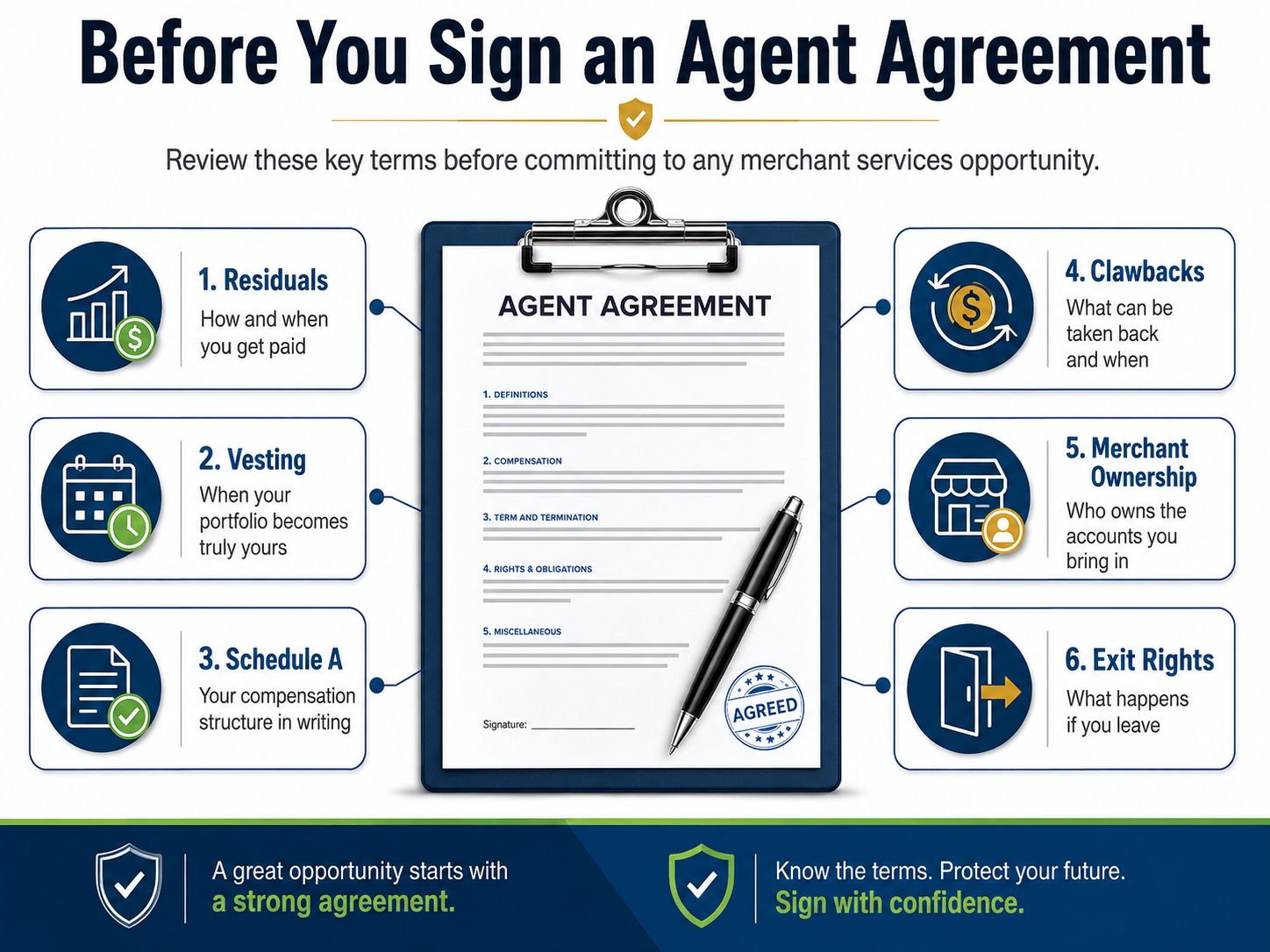
A merchant services agent should understand questions such as:
How are residuals calculated?
When do residuals vest?
Are residuals actually vested at all?
What happens if I stop producing?
What happens if I leave?
Can the company change my compensation?
Are there production minimums?
Are there clawbacks?
Who owns the merchant relationship?
Can I sell competing products?
Can I sell my portfolio?
What happens to my book if the company is acquired?
What happens upon death or disability?
Can my residual rights transfer?
Are there non-solicitation restrictions?
Are there non-compete restrictions?
What happens if the relationship terminates?
You do not have to become an attorney.
In fact, if you're signing something important enough to potentially control years of future residual income, having an attorney review it may be one of the smartest expenses you make.
But at minimum:
Read what you're signing.
If a company's verbal promises and written agreement tell two different stories, the written agreement is the one I would pay attention to.
A great recruiting presentation cannot fix a bad contract.
3. A High Residual Split Does Not Automatically Mean a Better Deal
This is one of the most important concepts a new merchant services agent can learn.
You may hear:
50% residuals.
70% residuals.
80% residuals.
90% residuals.
Naturally, the bigger number sounds better.
But the number doesn't mean much by itself.
The question is:
A percentage of what?
If one company gives you a higher percentage but calculates your profit from a much more expensive underlying cost structure, you could potentially earn less than an agent with a lower advertised split somewhere else.
This is where the Schedule A becomes important.
Consider two hypothetical offers.
Company A
You receive 80% of the remaining profit.
Sounds great.
Company B
You receive 60% of the remaining profit.
Sounds worse.
But what if Company B has significantly better underlying costs?
The 60% relationship could potentially produce more actual dollars.
That's why I would never evaluate a merchant services opportunity based on the residual percentage alone.
Ask:
What are the costs underneath the split?
What fees are deducted first?
What expenses are passed through?
What does the Schedule A say?
How transparent is the reporting?
What happens when pricing changes?
The advertised split gets your attention.
The economics underneath the split determine what you actually earn.
Later in this series, we'll break down merchant-services residual splits and Schedule A structures in much greater detail.
4. Residual Income Starts Small—The Portfolio Is What Makes It Powerful
One reason people quit merchant services too early is because they misunderstand the time horizon.
I didn't start with a giant residual check.
I saw small numbers before I saw meaningful numbers.
That's how recurring-income businesses work.
One account creates a little income.
Then another account gets added.
Then another.
Then another.
Eventually, you're no longer thinking about what one merchant pays you.
You're thinking about the portfolio.
That's the mental shift.
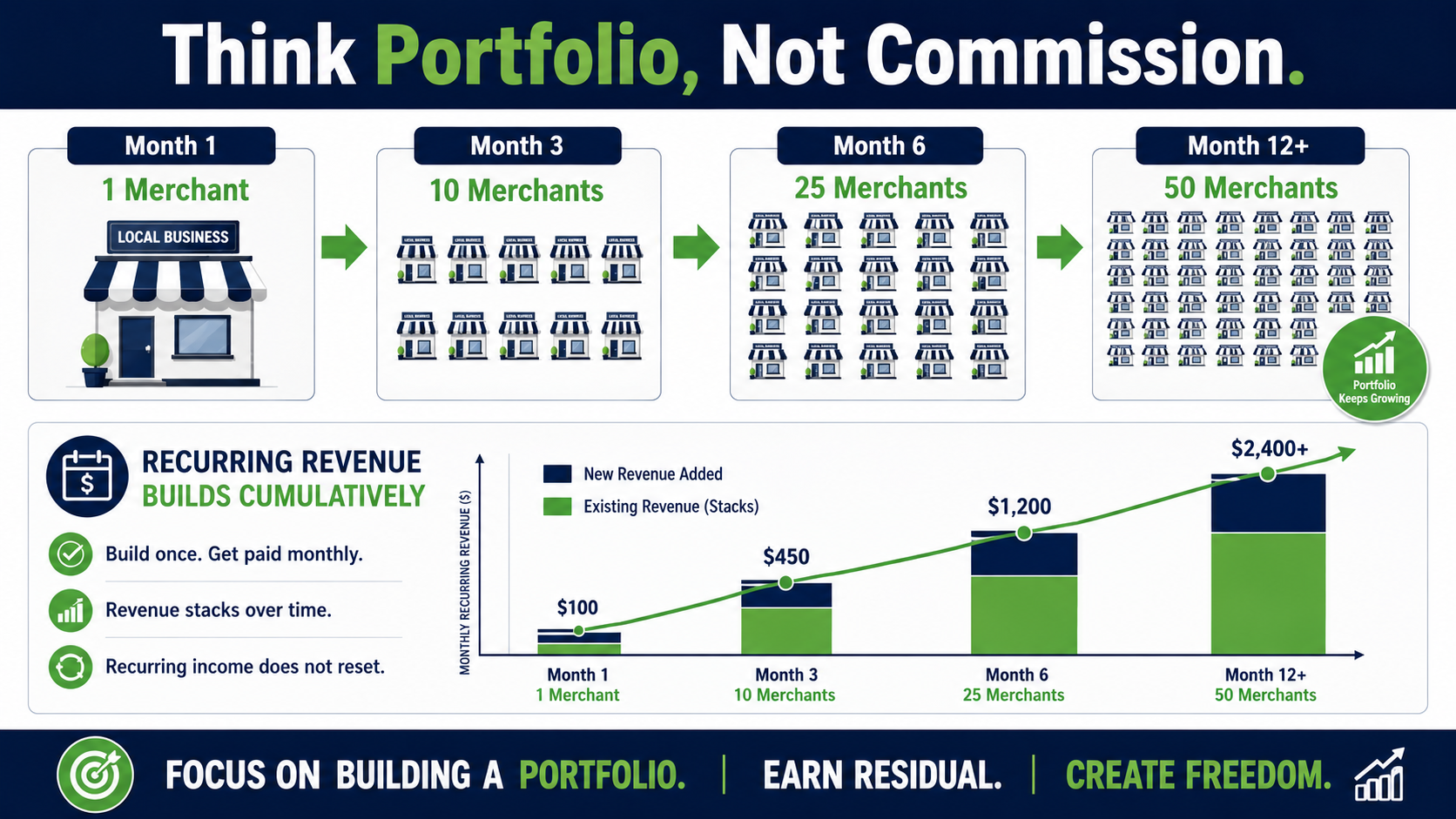
Imagine you sign one account.
Then five.
Then 20.
Then 50.
Then 100.
Not every merchant remains forever.
Some businesses close.
Some switch processors.
Some change ownership.
Processing volume fluctuates.
But when you consistently add accounts while retaining the merchants you already have, you're building something completely different from a traditional commission job.
You're stacking recurring revenue.
That was the opportunity that fascinated me when I understood what merchant services could become.
Not:
"How much did I make on today's sale?"
But:
"What can I build if I keep doing this?"
For a deeper breakdown, read How Much Can You Earn in Merchant Services?.
That article goes deeper into the economics of merchant services income and portfolio growth.
5. Your Partner's Support Can Affect Your Income Almost as Much as Your Sales Ability
This lesson gets overlooked.
Salespeople naturally focus on closing.
But what happens after the sale matters tremendously when you're building recurring revenue.
Imagine you work hard for weeks to land an account.
The merchant gets approved.
Then implementation becomes a disaster.
Equipment is late.
Support doesn't answer.
Underwriting asks for additional documents days apart instead of identifying everything upfront.
The system isn't configured correctly.
The merchant becomes frustrated.
Eventually they cancel.
You may have sold the account perfectly.
You still lost the residual.
I've dealt with enough situations over the years where I personally had to jump in and rescue frustrated merchants simply to keep deals alive.
That taught me something important:
Merchant retention begins with the company you choose to put behind your sale.
Before joining an organization, ask how support actually works.
Who does a merchant call?
Who do you call?
How quickly are problems addressed?
What happens during installation?
How experienced is underwriting?
What happens when something goes wrong?
Is there a real escalation process?
Do you have someone who answers when an important merchant is upset?
Sales agents talk about compensation constantly.
I think operational support deserves almost as much attention.
Because a high residual split on merchants who don't stay is not a great residual plan.
6. Prospecting Is the Real Job
People get attracted to merchant services because of residual income.
But residual income is the result.
Prospecting is the activity that creates it.
If you're considering becoming a merchant services agent, understand what you're actually signing up to do.
You need conversations.
Lots of them.
That can come through:
Door-to-door prospecting
Phone prospecting
Networking
Referrals
Vertical relationships
Local business organizations
Email
Social media
Content
Strategic partnerships
Existing professional relationships
There isn't one required prospecting method for everyone.
But there does need to be a method.
You cannot build residual income from businesses you never speak to.
One of the biggest advantages I developed in this business wasn't knowing some secret closing line.
It was being willing to keep talking to businesses.
That's why I've always told agents:
The hardest door is often the car door.
Once you get out and start working, momentum takes over.
People who spend six months researching merchant services but never develop a prospecting habit are usually going to be passed by the person who learns the fundamentals and starts having real conversations.
Education matters.
Activity matters too.
You need both.
7. Don't Try to Sell Every Merchant the Same Thing
Earlier in my career, merchant services was much more heavily centered around terminals, statements and pricing.
The industry has changed.
Today, some merchants still need nothing more than a simple standalone terminal.
And that's exactly what you should give them if that's what makes sense.
A small repair shop that just wants to accept cards may not need a huge, expensive POS system.
Trying to force a complicated system onto that business doesn't make you a better salesperson.
It makes you a worse consultant.
At the same time, another business might desperately need:
Online ordering
Appointment scheduling
Customer profiles
Inventory management
Loyalty
Marketing
Invoicing
Multiple locations
Employee management
Reporting
Integrated ecommerce
Faster funding
Access to business capital
Those merchants need something more sophisticated.
The lesson is simple:
Don't start with the product. Start with the merchant.
Ask questions.
Understand the business.
Find the problem.
Then recommend the technology.
That philosophy is becoming increasingly important as payment processing becomes connected with larger commerce systems.
8. The Company You Work With Should Not Become Your Entire Identity
This is a lesson I understand much better today than I did earlier in my career.
Companies change.
Products change.
Compensation plans change.
Leadership changes.
Technology changes.
Acquisitions happen.
Partnerships end.
A merchant services agent can spend years building an identity around one processor or one product and suddenly find themselves needing to adjust.
Your real asset should be:
Your knowledge.
Your reputation.
Your relationships.
Your ability to sell.
Your ability to solve problems.
Your ability to understand businesses.
The company is a tool.
The processor is a tool.
The POS platform is a tool.
The technology is a tool.
You are the constant.
If I were building my merchant-services career from scratch today, I would deliberately become known for understanding the industry instead of becoming known only for representing one company.
That means learning multiple pricing structures.
Understanding different technology.
Knowing what different types of businesses need.
Understanding why one partner may make sense for one agent while another may make more sense for someone else.
Your value grows when you're able to think independently.
9. The First Company That Recruits You Is Not Automatically the Best Company for You
This sounds obvious when you read it.
But it's not how most people enter the industry.
The company recruiting the hardest is often the company a beginner knows the most about.
That doesn't automatically make it good or bad.
It simply means that company's marketing reached you first.
There are many legitimate merchant services organizations.
There are also dramatically different business models.
One organization may be ideal for a brand-new salesperson who needs training, hands-on support and upfront compensation.
Another may be much better suited to an experienced merchant-services agent who already has a portfolio and primarily cares about economics and ownership.
Someone selling restaurants may need a completely different technology stack from someone specializing in contractors.
Someone who wants to build a team may care about different contract provisions than a solo producer.
Someone building part-time may value something different from someone planning to build a large sales organization.
That's why I no longer believe the most useful question is:
"What's the best merchant services company?"
The better question is:
"What's the best merchant services relationship for what I'm trying to build?"
Those aren't the same question.
10. Real Merchant Services Training Should Teach You More Than a Pitch
A script is useful.
A script is not an education.
If your merchant services training consists of:
"Walk into this business."
"Say these three sentences."
"Ask for their statement."
"Close."
you're learning a sales tactic.
You're not learning the industry.
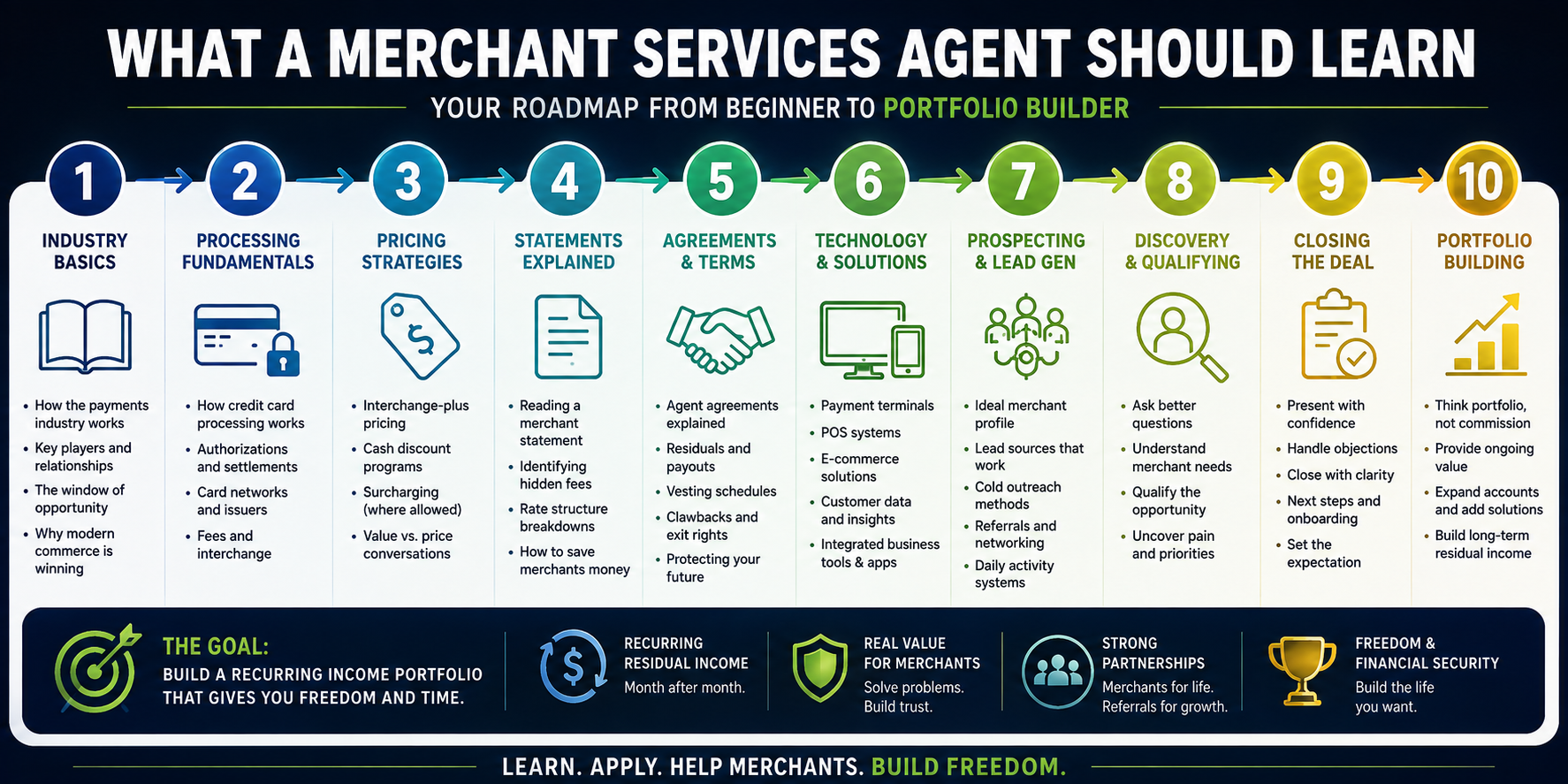
A well-rounded merchant services agent should eventually understand:
Industry Basics
Who the major players are and how money moves through the payment ecosystem.
Payment Processing
Authorization, settlement, merchant accounts and transaction flow.
Pricing
Interchange, processor costs, margins and common pricing structures.
Statements
How to read what a merchant is currently paying.
Agreements
Residuals, Schedule A, vesting, clawbacks and contractual rights.
Technology
Terminals, POS systems, gateways, ecommerce and modern commerce platforms.
Prospecting
How to consistently create new conversations.
Discovery
How to uncover actual business problems.
Presentations and Demos
How to connect features with the merchant's needs.
Closing
How to help the merchant make a decision.
Follow-Up
How to stay organized and nurture opportunities.
Portfolio Building
How to think beyond one transaction and build recurring revenue.
That's merchant services training.
Teaching someone a pitch and sending them into the field isn't enough.
Want to Learn Merchant Services Before Choosing a Company?
If you're reading this because you're seriously considering becoming a merchant services agent, you don't have to figure all of this out by trial and error.
I've opened the core education inside Merchant Service University so people can learn the fundamentals of this industry for free.
The idea behind MSU is simple:
Learn first. Get educated. Understand the industry. Then decide what you want to build.
Inside Merchant Service University, you'll learn about:
How the merchant services industry works
Payment processing
Merchant statements and pricing
Residual income
Portfolio building
Prospecting
Merchant sales
Modern commerce systems
Industry terminology
How to evaluate companies and partnerships
What questions to ask before choosing where you build
There is no charge to access the core education and no obligation to join a specific merchant services company.
I would rather help you understand this industry before someone tries to recruit you into it.
Start Merchant Service University Free
Get free access:
https://merchantserviceuniversity.com
Learn first. Get certified. Then decide what you want to build.
Get educated before you get recruited.
11. You're Not Just Building Income—You're Potentially Building an Asset
This may be the lesson I wish I understood most deeply at the beginning.
When you look at merchant services like a sales job, you think about monthly income.
When you look at it like a business, you think about your portfolio.
A strong portfolio represents relationships with businesses producing recurring economic activity.
That's why the details matter.
Residual rights matter.
Vesting matters.
Attrition matters.
Merchant ownership matters.
Contracts matter.
Your partner matters.
If you're going to spend years building something, you should understand exactly what you're building and what rights you have to it.
That's much different from simply asking:
"What's the commission?"
The goal isn't just to make more money this month.
The goal is to build something that becomes increasingly valuable as your work compounds.
If I Became a Merchant Services Agent Again Today, Here's What I Would Do First
If I lost everything and had to enter this industry again from zero, I wouldn't spend the first month trying to memorize everything.
But I also wouldn't blindly sign with the first company that called me.
I would follow this order.
Step 1: Learn How the Industry Works
Understand the payment ecosystem and terminology.
Start with my Merchant Services Sales: Complete Beginner's Guide.
Step 2: Understand How the Money Works
Learn upfront commissions, residual income, Schedule A economics and how a merchant portfolio grows.
Then read How Much Can You Earn in Merchant Services?.
Step 3: Learn What to Look for in a Partner
Understand contracts, vesting, support, products, compensation and ownership before comparing companies.
Step 4: Get Educated Before You Get Recruited
If you're starting from scratch, go through the free education inside Merchant Service University.
Learn the fundamentals before making a company decision.
Step 5: Choose a Prospecting Method
Decide how you're going to consistently reach businesses.
Not someday.
Every week.
Step 6: Learn Enough to Start Conversations
Don't wait until you know everything.
You won't.
Get competent and begin gaining real-world experience.
Step 7: Review What Happens
What questions are merchants asking?
Where are you getting stuck?
Which businesses respond best?
What objections are you hearing?
Step 8: Improve and Repeat
Merchant sales is learned through a combination of education, repetition and real conversations.
You don't become great before starting.
You become great because you started and kept improving.
For the broader business model, read How to Start a Payment Processing Business.
Who Should Consider Becoming a Merchant Services Agent?
This business can make sense for people who:
Enjoy sales or are willing to learn it
Are comfortable talking with business owners
Want performance-based income
Like the concept of recurring revenue
Want to build something over time
Can work independently
Are willing to prospect consistently
Can handle rejection
Are coachable
Think long term
It may not be a good fit if you're looking for guaranteed income without activity.
Merchant services can create significant leverage.
But leverage comes after the work.
You still have to build the portfolio.
Do You Need to Pay to Become a Merchant Services Agent?
Generally, you should not assume that paying thousands of dollars is necessary simply to gain access to a payment processor or merchant-services sales opportunity.
That does not mean education has no value.
I've paid to learn throughout my life.
Courses can have value.
Coaching can have value.
Consulting can have value.
Specialized education can have value.
The question is:
What are you actually buying?
If you're paying for specialized education, that's one thing.
If someone is charging thousands of dollars and presenting that payment as the only way to gain access to an industry where legitimate companies already recruit independent agents, I would ask more questions.
Education and access are not the same product.
Understand which one you're buying.
That's also part of why I made the core education inside Merchant Service University available free.
You should be able to understand what this industry is before you're expected to choose where to build.
The Advice I Would Give My Younger Self
If I could sit across from myself on my first day in merchant services, I wouldn't give myself a better pitch.
I'd tell myself this:
Learn the industry before pledging loyalty to a company.
Read every agreement.
Understand your Schedule A.
Don't confuse a residual percentage with actual economics.
Protect your merchants.
Choose partners who support what you sell.
Prospect even when you don't feel like it.
Don't sell every business the same solution.
Build your own reputation.
Keep learning.
Think portfolio, not commission.
Those lessons would have saved me years of unnecessary mistakes.
And that's ultimately why I'm putting this information online now.
The payments industry can be an incredible business.
But you should know what you're getting into before someone asks you to sign something.
Ready to Learn Merchant Services for Free?
If merchant services sounds like something you want to explore, your next step doesn't need to be choosing a processor or signing an agent agreement.
Start by getting educated.
Merchant Service University gives you free access to foundational training designed to help you understand the industry before making a long-term partnership decision.
You'll learn the basics of merchant services, residual income, payment processing, merchant statements, sales, modern commerce systems and the questions you should be asking before choosing a company.
Start MSU Free
https://merchantserviceuniversity.com
Free education. No obligation. Learn before you choose.
Get educated before you get recruited.
Frequently Asked Questions About Becoming a Merchant Services Agent
What does a merchant services agent do?
A merchant services agent helps businesses evaluate and implement payment-processing and commerce solutions. Depending on the business, that can include card processing, terminals, POS systems, ecommerce, invoicing and other business technology.
Do I need sales experience to become a merchant services agent?
No. Previous sales experience can help, but new agents can learn the industry. More important factors include willingness to prospect, consistency, coachability and learning the fundamentals of payments and merchant sales.
How does a merchant services agent get paid?
Compensation varies by company and agreement. Agents may receive upfront commissions, activation bonuses, software or equipment compensation and recurring residual income generated from merchants in their portfolio.
What should I look for in a merchant services agent agreement?
Important areas include residual calculations, Schedule A costs, vesting, merchant ownership, production requirements, clawbacks, termination provisions, transfer rights and restrictions on selling competing products.
What is a good residual split for a merchant services agent?
There is no single percentage that automatically makes an agreement good. You need to understand the underlying costs used to calculate profit, contractual rights, support and other compensation before comparing residual percentages.
Can merchant services create passive income?
Merchant-services residuals can create recurring income because active merchant accounts may continue generating compensation after the original sale. Building the portfolio requires substantial upfront and ongoing sales effort, and merchant attrition means the income should not be viewed as completely passive or guaranteed.
Should I join the first merchant services company that recruits me?
Not necessarily. Learn the industry first and compare companies based on your goals, experience, compensation priorities, technology needs, support expectations and contractual rights.
Do I have to pay thousands of dollars to become a merchant services agent?
Paying thousands of dollars should not automatically be considered a prerequisite for gaining access to merchant-services sales. Paid education or coaching can have value, but education and access to a processor are different things and should be evaluated separately.
Where can I learn merchant services for free?
You can access the core education inside Merchant Service University at https://merchantserviceuniversity.com. The training is designed to help people understand merchant services, payment processing, residual income, sales and company evaluation before deciding where they want to build.
Final Takeaway: Get Educated Before You Get Recruited
If you're thinking about becoming a merchant services agent, I'm not trying to convince you that every person should enter this industry.
I'm telling you to understand it before you make the decision.
Learn how the industry works.
Learn how compensation works.
Learn what residual ownership means.
Learn how agreements work.
Learn how to evaluate companies.
Learn how merchants actually use payment technology.
Then choose.
You will walk into that decision with far more leverage than someone who only knows what a recruiter told them.
And once you choose?
Get to work.
Because ultimately, the agreement creates the opportunity.
Your activity builds the portfolio.
About Joe Wagner
Joe Wagner has spent more than 16 years in merchant services and payment-processing sales, building merchant portfolios, selling directly to businesses and training sales professionals across the United States.
His focus today is helping entrepreneurs understand the merchant-services industry before making long-term decisions about compensation, technology and partnerships—and teaching agents how to build recurring-revenue portfolios through real merchant acquisition.
Continue learning through the Merchant Sales Training Blog, browse additional Merchant Sales Resources, or start the free education inside Merchant Service University.