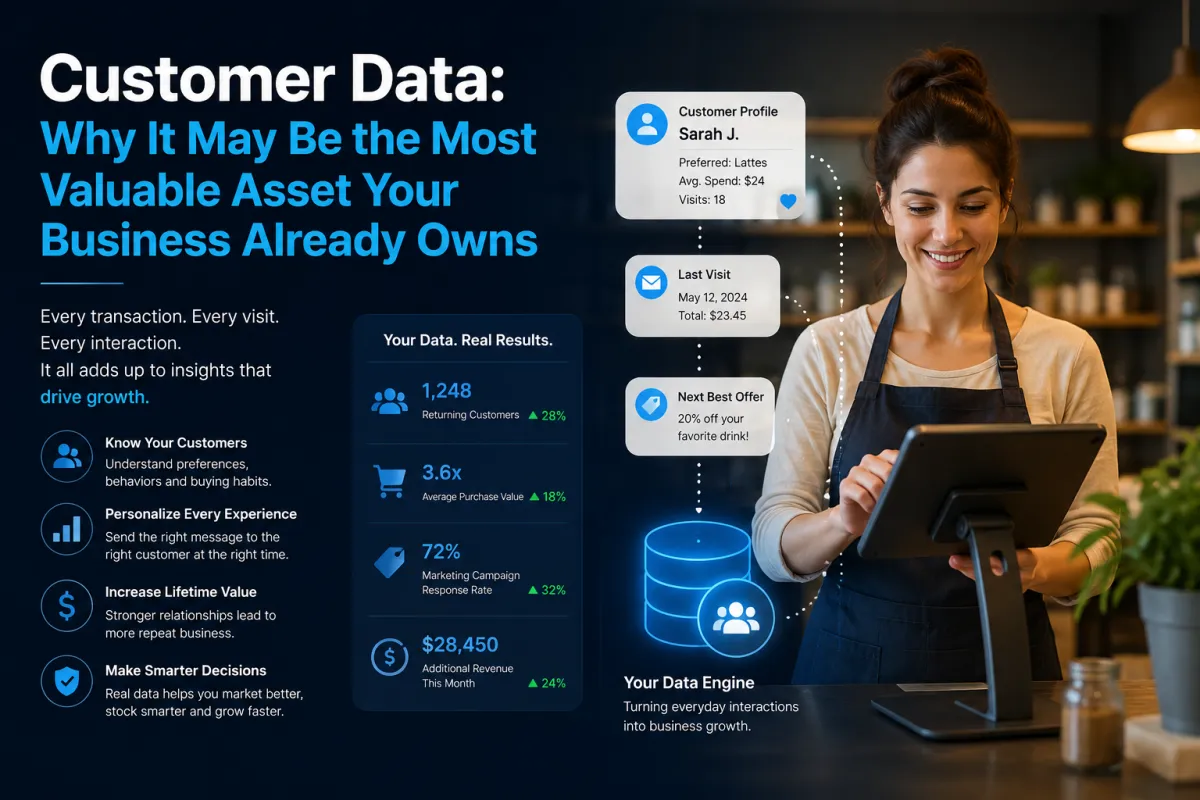
Customer Data: Why It May Be the Most Valuable Asset Your Business Already Owns
Customer Data: Why It May Be the Most Valuable Asset Your Business Already Owns
Most business owners can quickly name the assets inside their company. They think about inventory, equipment, employees, real estate, vehicles, intellectual property, or the money sitting in the bank.
Those are obviously valuable, but I believe many businesses overlook another asset they are building every single day: customer data.
Every transaction creates information. Every repeat visit establishes a pattern. Every purchase tells you something about what that customer wants, how often they buy, how much they typically spend, and whether the relationship with your business is growing or fading.
The problem is that most businesses collect this information without ever really using it.
Modern POS systems and customer profile technology are beginning to change that. Instead of simply processing a payment and forgetting about the customer afterward, a Modern Commerce System can help businesses organize customer history and use it to improve marketing, retention, service, and long-term revenue.
The important question is no longer whether your business has customer data.
It is whether you're doing anything useful with it.
Every Transaction Tells You More Than How Much Money You Made
When a business owner sees a completed transaction, the most obvious information is the sale amount. If someone spends $75, the business records $75 in revenue.
But there may be much more information behind that transaction.
Was this the customer's first visit or their twentieth? What did they purchase? How often do they normally return? Is their average purchase increasing? Which location do they visit? Which products do they consistently buy? Have they responded to previous promotions?
One transaction does not tell you very much.
Hundreds or thousands of transactions begin telling a story.
That story can help a business understand who its best customers are, which customer relationships are growing, which customers are disappearing, and where there may be opportunities to create additional revenue.
That is why customer profiles have become such an important part of modern POS technology.
Most Businesses Already Have the Data. They Just Don't Use It.
I've seen this happen over and over again with businesses.
The information is technically there, but nobody has the time to analyze it.
The merchant may have customer names, email addresses, phone numbers, purchase history, average ticket information, visit frequency, loyalty activity, and years of transaction history sitting inside different systems.
Yet when you ask the owner, "Who are your 100 best customers?" they may not know.
Ask which customers used to visit regularly but haven't returned recently, and they probably don't know that either.
Ask which customers purchase a specific product most frequently, and now someone has to start digging through reports.
That is the real problem.
Data by itself is not valuable.
Useful data is valuable.
A Modern Commerce System should help organize that information so the business can actually act on it.
Customer Profiles Turn Transactions Into Relationships
This is one of the biggest changes modern POS systems are bringing to small businesses.
Traditional payment processing focused almost entirely on completing the transaction. The card was approved, the merchant got paid, and the job was done.
Modern technology gives the merchant an opportunity to think beyond a single purchase.
A customer profile can potentially show purchase history, visit frequency, average spend, customer lifetime value, favorite products, contact information, loyalty activity, and other useful information collected over the course of the relationship.
Instead of viewing someone as a $50 transaction, the business can begin viewing them as a customer who may be worth thousands of dollars over several years.
That is a completely different way of thinking about the customer.
Customer Lifetime Value Changes How You Think About Marketing
Suppose a customer spends $50 today.
Most businesses naturally focus on today's $50 sale.
But imagine that same customer spends $50 every month for five years. That relationship is now worth $3,000 before considering referrals, additional purchases, or increases in spending.
That is Customer Lifetime Value.
Once you start thinking this way, customer retention becomes much more important.
Losing one customer is not necessarily losing one transaction. It may mean losing years of future transactions.
The smartest businesses therefore stop asking only, "How do we make another sale today?"
They begin asking, "How do we keep this customer for the next five years?"
Customer data helps answer that question.
Five Ways Businesses Can Use Customer Data More Effectively
The value of customer information comes from what the business does next.
A restaurant can identify frequent guests and reward them. A salon can recognize when a regular client is overdue for another appointment. An auto repair business can use service history to remind customers about upcoming maintenance. A retailer can identify customers who frequently purchase a particular category and market relevant products to them.
There are several especially practical applications.
1. Identify and Protect Your Best Customers
Not every customer contributes the same amount of value to a business.
Modern customer profiles can help identify customers with the highest lifetime spend, strongest visit frequency, or largest average tickets.
Those customers deserve attention.
That may mean VIP offers, early access to new products, loyalty rewards, personal communication, or simply making sure the business recognizes who they are.
Keeping your best customers can often be far more valuable than constantly chasing new ones.
2. Bring Inactive Customers Back
One of the best marketing opportunities is someone who already knows the business but has stopped coming in.
A coffee shop may have customers who used to visit three times per week but have not returned in two months. A salon might have a customer who normally books every six weeks but is now several months overdue.
The business should not have to rely on someone manually noticing.
Customer data can help identify these changes in behavior so the business can create a win-back campaign before the customer relationship disappears completely.
3. Create More Relevant Marketing
Generic marketing treats every customer the same.
Customer data allows businesses to become much more specific.
A customer who purchases premium products may receive different communication than a customer who shops primarily during promotions. Someone who regularly purchases a particular service can receive a relevant reminder instead of another generic newsletter.
Marketing becomes more effective when it reflects actual customer behavior.
4. Improve Loyalty Programs
Customer profiles also make loyalty programs more useful.
Instead of simply awarding points, the business can better understand who is participating, how frequently they return, what rewards influence behavior, and whether loyalty members actually spend or visit more often.
That turns loyalty from a promotion into a measurable retention strategy.
5. Make Better Business Decisions
Customer data is not only useful for marketing.
It can also influence inventory, staffing, product selection, service offerings, scheduling, and other operating decisions.
If the business knows what customers buy, when they buy it, and how frequently they return, it has better information for deciding what to do next.
Customer Data Becomes More Powerful When Systems Are Connected
This is another reason I believe the Modern Commerce System matters so much.
Customer data becomes less useful when it is scattered across separate platforms.
Payments live in one place. Marketing is somewhere else. Loyalty uses another provider. Ecommerce has a separate customer list. Appointment software has another database.
Now the business has multiple versions of the customer.
Connected systems can create a more complete picture.
Payments show purchase behavior. Customer profiles organize the relationship. Loyalty measures engagement. Marketing provides communication. Ecommerce adds online behavior. AI and automation can help surface patterns and opportunities.
That is where the individual tools begin becoming a system.
You can read my complete breakdown here:
https://iamjoewagner.com/post/what-is-modern-commerce-system
Customer Data Changes the Merchant Services Sales Conversation
This is also a huge opportunity for merchant sales professionals.
For decades, our industry trained people to walk into businesses and immediately start talking about rates, fees, and payment equipment.
I think the better salesperson today asks better questions.
How well do you know your existing customers? Can you identify your highest-value customers? Do you know which regular customers have stopped coming back? Are your loyalty and marketing systems connected to purchase history? How are you currently using customer data to create repeat business?
Those questions lead to a business conversation instead of another processing-rate comparison.
That is where I believe merchant sales is heading.
The most valuable agents will increasingly understand not only payments, but how modern business technology helps merchants retain customers, operate more efficiently, and grow.
Learn Merchant Services Before Choosing What You Sell
This is exactly why I built Merchant Service University (MSU).
A new agent should not have to pick a processor or POS system first and then hope they eventually understand the industry. I believe education should come first.
MSU teaches merchant services fundamentals, pricing, statements, prospecting, sales, POS technology, Modern Commerce Systems, recurring revenue, and the broader business concepts agents need to understand before building a portfolio.
Merchant Service University is normally a paid online training program. However, I provide access at no cost to qualified, serious candidates who are looking for the right place to build in merchant services.
I use the certification process as both education and a filter. If someone is willing to complete the training, communicate, learn the business, and earn certification, that demonstrates they're serious enough for me to invest my time and relationships into helping them move forward.
After certification, I can help qualified candidates connect with partners I believe offer what matters: modern commerce systems, ethical sales agreements, lifetime residual opportunities, strong merchant support, responsive agent support, and a legitimate place to build a long-term portfolio.
If you're serious about learning merchant services and finding the right place to build, begin at:
Final Thoughts: Your Existing Customers May Be Your Greatest Opportunity
Every business wants more customers.
But before spending another dollar trying to find someone new, businesses should understand the relationships they already have.
Who are your best customers?
Who is spending more?
Who is visiting less?
Who disappeared?
What do people buy repeatedly?
Which relationships have the highest long-term value?
That information already exists inside many businesses.
The opportunity is finally learning how to use it.
Customer data does not replace great products, great service, or strong relationships.
It helps businesses understand those relationships better.
And when customer profiles are connected to payments, loyalty, marketing, automation, and reporting, that data can become one of the most valuable assets a business owns.
Related Resources
What Is a Modern Commerce System?
https://iamjoewagner.com/post/what-is-modern-commerce-system
POS Marketing Automation: How Customer Data Creates More Repeat Business
https://iamjoewagner.com/merchant-sales-training-blog
How AI and Business Data Are Making Smart POS Systems More Powerful
https://iamjoewagner.com/post/ai-business-data-smart-pos-systems
Loyalty Programs Explained: How Modern POS Systems Turn Existing Customers Into More Revenue
https://iamjoewagner.com/merchant-sales-training-blog
Merchant Sales Training Blog
https://iamjoewagner.com/merchant-sales-training-blog
Download The New Rules of Merchant Sales
https://ebook.ezdirectsales.com
Apply for Merchant Service University Access
https://ezdirectsales.com
Frequently Asked Questions About Customer Data and Customer Profiles
What is customer data?
Customer data is information a business collects through customer interactions, including purchase history, visit frequency, contact information, average spend, product preferences, loyalty activity, and other behavioral information.
Why is customer data valuable to a business?
Customer data can help businesses understand customer behavior, improve marketing, increase retention, identify high-value customers, and make better decisions based on actual activity instead of guesswork.
What is a customer profile in a POS system?
A customer profile organizes information about an individual customer, potentially including transaction history, contact information, spending, visits, loyalty activity, and other details collected through the business relationship.
How can customer data improve customer retention?
Businesses can use customer data to identify inactive customers, frequent buyers, typical visit patterns, and other behavioral changes that create opportunities for more relevant follow-up.
What is Customer Lifetime Value?
Customer Lifetime Value is the total value a customer may generate throughout their relationship with a business rather than the value of a single transaction.
How can businesses use customer data for marketing?
Businesses can use purchase history, visit frequency, product preferences, loyalty activity, and customer segments to create more relevant promotions, reminders, win-back campaigns, and other marketing.
What is Merchant Service University?
Merchant Service University is Joe Wagner's online training program covering merchant services fundamentals, statements, pricing, sales, prospecting, POS technology, Modern Commerce Systems, and recurring residual income.
How can I get Merchant Service University access for free?
Qualified candidates who are serious about building a merchant services business may receive complimentary MSU access through Joe Wagner's recruiting process. Begin at ezdirectsales.com to learn more and apply.