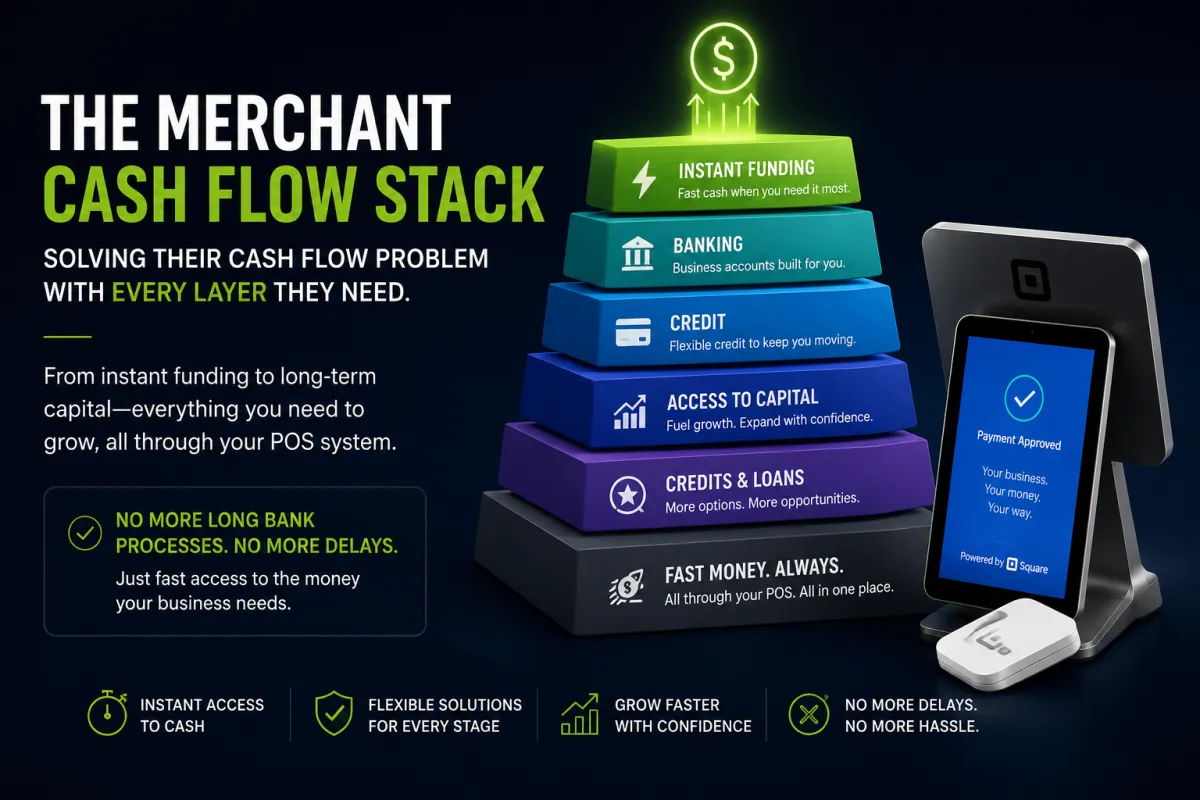
The Merchant Cash Flow Stack: How Square Is Changing Business Cash Flow Forever
The Merchant Cash Flow Stack: How Square Is Changing Business Cash Flow Forever
The payment processing business is changing rapidly, and one of the biggest shifts happening right now is how businesses access, move, and control money through modern commerce systems like Square.
For years, traditional merchant services focused almost entirely on one thing:
Processing payments and saving merchants money on rates.
But modern businesses no longer just need payment processing.
They need:
Faster access to money
Better business cash flow
Real-time payments
Automated savings systems
Easier access to capital
Simpler financial operations
And this is exactly where the merchant cash flow stack changes the game.
If you are researching the future of merchant services, modern POS systems, selling Square, or how business cash flow is evolving, this is one of the most important concepts to understand because it represents the shift from traditional payment processing into full financial ecosystems.
This concept also connects directly to the broader framework I call the modern commerce system, which explains how integrated POS systems are replacing old-school merchant processing models entirely.
Start there first if you have not read it yet:
https://iamjoewagner.com/post/what-is-modern-commerce-system
The merchant cash flow stack is just one piece of the broader picture that solves one of the biggest problem most businesses actually face: Cash flow.
Most Businesses Do Not Have a Profit Problem — They Have a Cash Flow Problem
This is one of the biggest misunderstandings in business.
Most businesses that struggle are not necessarily unprofitable on paper.
In many cases, they are actually generating revenue and sales consistently.
The problem is:
The money moves too slowly.
Businesses make sales today…
But they often do not actually gain access to that money until days later because of:
Batch cutoffs
Banking delays
Weekend processing schedules
Holiday slowdowns
Third-party payout systems
Meanwhile, the business owner still has to:
Pay employees
Cover payroll
Buy inventory
Pay rent
Handle vendor invoices
Survive slow weeks
All while waiting for their own money to arrive.
That is not a profitability problem.
That is a business cash flow problem.
And this is exactly the problem the merchant cash flow stack is designed to solve.
Why Business Owners Are Starting to Care About Faster Access to Money
For years, waiting multiple days for deposits was considered normal in merchant services.
Most business owners never questioned it because every processor operated similarly.
But awareness changes expectations.
And once business owners realize there are systems offering:
Real-time payments
Instant funding
Faster merchant funding
Immediate access to approved transactions
The old model starts to feel broken.
This is exactly why real-time payments are becoming such an important pillar inside the modern commerce system.
If you missed that article, read it here:
https://iamjoewagner.com/post/real-time-payments-merchant-services
Because once merchants understand they could access funds today instead of waiting several days…
They stop wanting to wait.
Restaurants Feel This Problem More Than Almost Any Other Business
Restaurants are one of the clearest examples of why the merchant cash flow stack matters.
Most delivery platforms delay payouts for five to seven business days while simultaneously taking massive percentages from every order.
That creates enormous pressure on restaurants because they already paid for:
Food
Labor
Utilities
Rent
Operations
But they still have not received the revenue from the order.
This creates a dangerous timing gap in business cash flow.
And many restaurant owners live inside that pressure constantly.
[INSERT IMAGE HERE]
Alt Text: restaurant owner reviewing delayed payouts and business cash flow dashboard
Traditional Merchant Services Was Built for a Different Era
Traditional merchant services focused primarily on rates and payment acceptance.
The conversation was simple:
“We can process your cards and save you money.”
And while technology improved over time, the overall model stayed largely the same.
But modern businesses expect much more now.
They expect systems that help them:
Operate faster
Access money faster
Simplify operations
Reduce stress
Improve financial control
That is why modern POS systems are taking over the payment processing business.
If you have not read that breakdown yet, read this next:
https://iamjoewagner.com/post/why-pos-systems-are-taking-over
What Is the Merchant Cash Flow Stack?
The merchant cash flow stack is the layered financial ecosystem inside Square that helps businesses improve how money flows through their operation.
Instead of focusing only on payment acceptance, the merchant cash flow stack focuses on:
👉 Speed
👉 Access
👉 Automation
👉 Stability
👉 Financial flexibility
This is what separates modern commerce systems from traditional merchant processing.
Level 1 — Payments, POS Systems, and Technology
At the base of the merchant cash flow stack is the technology layer.
This includes:
POS systems
Payment processing
Hardware
Reporting
AI integrations
Omnichannel selling
Crypto acceptance
Square is already extremely advanced in this category.
Accounts can be approved quickly. Businesses can begin operating fast. The systems are easy to use and built specifically for modern business operations instead of outdated payment processing models.
But here is the important shift both agents and businesses need to understand:
Technology alone is no longer enough.
Every processor today claims they have technology. Most processors can offer a terminal, a POS system, online ordering, or some sort of reporting dashboard.
That is no longer the differentiator.
The differentiator is how all the technology works together inside one ecosystem to simplify operations and improve business cash flow.
Real-World Example — Restaurant Operations
Imagine a restaurant owner running five disconnected systems:
One for payments
One for online ordering
One for payroll
One for reporting
One for loyalty and marketing
Now every week the owner is:
Logging into multiple dashboards
Exporting spreadsheets
Comparing numbers manually
Trying to understand where profits are actually coming from
That creates operational chaos.
Now compare that to a modern commerce system where:
Orders
Payments
Staff performance
Customer purchase history
Reporting
Marketing campaigns
all exist inside one connected ecosystem.
Now the owner can simply ask:
“What menu item generated the most profit this weekend?”
“Which employee upsold the most desserts?”
“Which customers haven’t returned in 30 days?”
And the system helps provide those insights immediately.
That is not just payment processing anymore.
That is operational intelligence.
Level 2 — Square Checking and Instant Funding
This is where the merchant cash flow stack becomes transformational.
Most businesses do not just need money.
They need access to money quickly.
Square Checking changes the timing of business cash flow by giving merchants access to approved funds much faster than traditional processing systems.
That creates confidence.
Confidence to:
Cover payroll
Pay vendors
Buy inventory
Handle emergencies
Operate without financial stress
This is why Square instant funding and real-time payments are becoming such powerful selling points in modern merchant services.
Real-World Example — The Contractor Waiting on Deposits
Imagine a contractor completes a $15,000 project on Thursday.
Traditionally, that payment may not become fully accessible until Monday or Tuesday because of:
Processing timelines
Weekend delays
Banking cutoffs
Meanwhile, the contractor still needs to:
Pay workers Friday
Buy materials for the next job
Cover fuel and operating expenses
That creates pressure, even though the business technically already earned the money.
Now imagine that same contractor using a modern commerce system with faster access to funds.
Instead of waiting days, they can:
Pay their crew immediately
Buy materials immediately
Keep projects moving without interruption
That changes how the business operates.
The difference is not just speed.
The difference is operational stability.
Why Faster Merchant Funding Changes Behavior
Once businesses experience faster access to money, it becomes extremely difficult to go backward.
This is exactly why real-time payments are becoming one of the most important pillars inside the modern commerce system.
Because once a merchant realizes:
“I can access my money today”
waiting multiple days suddenly feels broken.
[INSERT IMAGE HERE]
Alt Text: business owner using Square checking and instant funding dashboard
Level 3 — Delivery App Cash Flow Bridging
This may be one of the most powerful pieces of the entire merchant cash flow stack for restaurants.
Delivery apps often delay payouts for nearly a week.
That means restaurants are funding operations out of pocket while waiting for money already earned.
Square helps bridge that timing gap by allowing restaurants faster access to those incoming funds.
This is not a small feature.
This can determine whether businesses survive difficult weeks or not.
And this is exactly why modern commerce systems are changing the future of merchant services.
Real-World Example — Restaurant Survival During a Slow Week
Imagine a restaurant has a strong weekend on delivery apps and generates thousands in sales.
On paper, business looks great.
But the actual money from those orders is delayed for nearly a week.
Meanwhile, Monday arrives and the restaurant still has to:
Pay food suppliers
Cover payroll
Restock inventory
Pay utilities and rent
Without access to those funds yet.
This is where restaurants get trapped.
They are profitable, but their cash flow timing creates stress.
Now imagine that same restaurant operating inside the merchant cash flow stack.
Instead of waiting five to seven days for delivery payouts, the system helps bridge the gap so the owner can continue operating without interruption.
That changes everything emotionally and operationally for the business owner.
Why Restaurants Become Extremely Sticky Accounts
Once restaurant owners experience this kind of operational relief, they do not want to leave the system.
Because now the POS system is not just helping them process transactions.
It is helping them survive operational pressure.
That creates long-term merchant retention and stronger portfolios for agents.
Level 4 — Square Savings and Automated Financial Systems
Most businesses do not lack revenue.
They lack systems.
This is another reason the merchant cash flow stack is so powerful.
Instead of manually trying to organize money after deposits arrive, businesses can automate financial organization directly inside the ecosystem.
Funds can automatically be separated for:
Taxes
Payroll
Inventory
Vendor payments
Emergency reserves
This removes chaos from business cash flow and turns financial management into a repeatable system.
And because it happens automatically, it reduces stress while improving operational consistency.
Real-World Example — The Business Owner Who Always Falls Behind on Taxes
Many business owners are profitable but constantly stressed because they are disorganized financially.
They spend money freely during busy months, then panic later when:
Taxes are due
Payroll hits
Slow seasons arrive
The issue is not income.
The issue is lack of financial systems.
Now imagine every sale automatically allocating percentages into separate savings categories:
Tax reserves
Payroll reserves
Emergency funds
Without the owner manually thinking about it.
That changes the psychology of running the business completely.
Instead of reacting emotionally to money problems…
The system creates structure automatically.
Why Automation Reduces Stress
Most business owners are mentally exhausted from making constant financial decisions.
Automation reduces decision fatigue.
And the more automated the system becomes:
The more stable the business becomes.
That is the hidden power of modern commerce systems most traditional processors cannot offer.
Level 5 — Capital, Credit, and Financial Acceleration
At the top of the merchant cash flow stack is access to capital and financial acceleration.
Historically, businesses needed to:
Go to banks
Submit applications
Wait for approvals
Hope they qualified
Modern commerce systems are changing that because the ecosystem already understands the business performance through transaction history and operational data.
That creates a completely different financial experience for business owners.
Instead of relying entirely on traditional banking systems, businesses can gain access to tools tied directly to real sales activity.
Real-World Example — A Seasonal Business Preparing for Busy Season
Imagine a landscaping company entering spring.
The owner knows demand is about to explode and wants to:
Hire more workers
Buy equipment
Increase marketing
Expand operations
Traditionally, they would need to:
Apply for loans
Gather paperwork
Wait for approvals
Hope the bank says yes
Meanwhile, the opportunity window is already passing.
Now imagine a modern commerce system where the ecosystem already understands:
Sales volume
Business history
Revenue patterns
Operational consistency
That creates faster access to capital and faster decision-making.
The business can move immediately instead of getting stuck waiting.
Why Access to Capital Changes Growth
Many businesses do not fail because they lack opportunity.
They fail because they cannot move quickly enough financially.
The merchant cash flow stack changes that by creating:
Faster access
Better flexibility
Improved cash flow confidence
And when businesses feel financially stable, they grow more aggressively and stay inside the ecosystem longer.
That is why this creates such powerful long-term merchant portfolios.
Why This Creates Extremely Sticky Merchant Accounts
This is one of the biggest hidden opportunities in the payment processing business today.
When businesses rely on a full ecosystem for:
Payments
Business cash flow
Instant funding
Savings
Reporting
Financing
Customer operations
They stop switching providers.
Because now the system is deeply integrated into how the business operates.
That creates:
Longer retention
Lower churn
Stronger merchant portfolios
More predictable residual income
This is one of the biggest reasons I believe modern commerce systems will dominate the future of merchant services.
The Shift Agents Need to Understand
Traditional merchant services focused on:
Cost and rates.
The merchant cash flow stack focuses on:
Control and access to money.
That is a completely different conversation.
Because business owners may debate rates…
But they rarely debate cash flow.
Watch the Full Breakdown
[INSERT VIDEO HERE]
👉 Original Video: https://youtu.be/qogZ4kZfrYE
Related Resources
What Is a Modern Commerce System?
https://iamjoewagner.com/post/what-is-modern-commerce-system
Real-Time Payments & Instant Funding
https://iamjoewagner.com/post/real-time-payments-merchant-services
Why POS Systems Are Taking Over
https://iamjoewagner.com/post/why-pos-systems-are-taking-over
Square vs Traditional Payment Processors
https://iamjoewagner.com/post/square-vs-traditional-payment-processors
Learn More About Joe Wagner
https://iamjoewagner.com/about-joe-wagner
Merchant Sales Resources
https://iamjoewagner.com/merchant-sales-resources
Apply to Join the Team
https://modern.ezdirectsales.com
Frequently Asked Questions
What is the merchant cash flow stack?
The merchant cash flow stack is a layered system designed to improve business cash flow using payments, instant funding, savings, and financing tools.
Why is business cash flow important?
Business cash flow determines whether companies can handle payroll, inventory, vendors, and operational stability.
How does Square instant funding work?
Square allows eligible businesses faster access to approved transaction funds through its integrated ecosystem.
Why are real-time payments becoming important?
Businesses are becoming aware that waiting several days for funds is no longer necessary.
Final Thought
The future of merchant services is no longer just about processing transactions.
It is about controlling the speed, movement, and access to money inside a business.
And the companies solving that problem are going to dominate the next era of the payment processing business.
The question is not whether the merchant cash flow stack matters.
The question is whether you position yourself early enough to benefit from the shift.