
Merchant Services Agent Commissions: Complete 2026 Guide
Merchant Services Agent Commissions: How Agents Get Paid Through Commissions, Bonuses & Residual Income
Merchant services agent commissions can look confusing when you're new to the payments industry.
One company advertises a large upfront payment.
Another promotes a 70% residual split.
Another talks about lifetime residual income.
Another offers activation bonuses, equipment compensation or software revenue.
They can all sound attractive.
But none of those numbers tells you whether the overall compensation plan is actually good.
After more than 16 years in merchant services, one of the biggest lessons I've learned is this:
Never evaluate a merchant services opportunity based on one compensation number.
You have to understand the complete economics.
What do you earn upfront?
What do you earn monthly?
What costs come out before your residual is calculated?
Do your residuals vest?
Can you lose them?
Are there production requirements?
Are there clawbacks?
What happens if the merchant cancels?
What happens if you stop selling?
What happens if you leave the company?
Those questions matter much more than a flashy percentage on a recruiting page.
If you're completely new to the business, start with my Merchant Services Sales: Complete 2026 Beginner's Guide.
And if you're deciding whether the agent business is right for you, read What I Wish I Knew Before Becoming a Merchant Services Agent.
This guide goes one step deeper.
Let's talk about how merchant services agents actually get paid.

How Do Merchant Services Agents Get Paid?
A merchant services agent can potentially be compensated in several ways depending on the company, products and agent agreement.
Common compensation categories include:
Upfront commissions
Activation or placement bonuses
Monthly residual income
Equipment compensation
Software or subscription revenue
Performance bonuses
Team or leadership compensation
Not every merchant services company offers all seven.
And that's perfectly fine.
The mistake is assuming that whichever company advertises the largest number in one category automatically offers the best compensation plan.
It doesn't work that way.
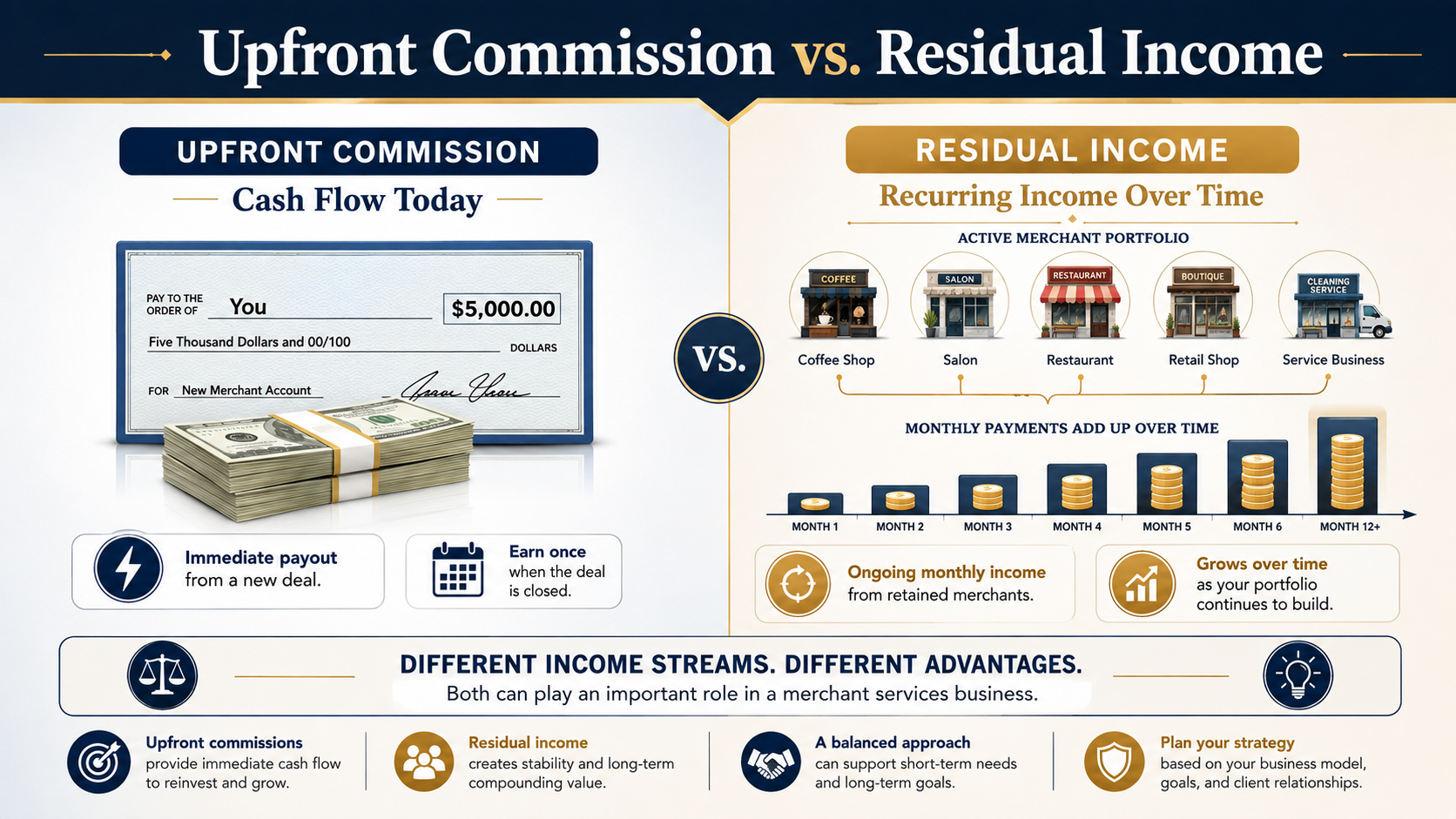
For most agents serious about building a long-term business, I would divide compensation into two major categories:
Cash flow now.
and
Recurring income later.
Understanding the difference between those two can completely change how you evaluate an agent opportunity.
1. Upfront Merchant Services Agent Commissions
An upfront commission is money paid around the time a new merchant is approved, activated, installed or begins processing.
The exact structure varies dramatically.
One company might pay a flat activation amount.
Another might base the commission on expected merchant volume.
Another may pay according to the equipment, product or pricing structure sold.
Some programs may offer very little upfront compensation because they emphasize recurring residual income instead.
Upfront compensation can be extremely valuable for a new merchant services agent.
Why?
Because residual income takes time to build.
You still have bills today.
If you're leaving a traditional sales job where you receive commissions immediately, waiting months for a residual portfolio to become meaningful can create financial pressure.
Upfront commissions can help bridge that gap.
But there is an important tradeoff to understand.
Upfront Money Isn't Always Free Money
If a merchant services company offers very aggressive upfront compensation, understand how the economics work.
Ask:
Does accepting the upfront commission reduce my residual percentage?
Is the payment subject to a clawback?
Does the merchant need to remain active for a minimum amount of time?
Does the merchant have to process a minimum amount?
Is equipment being subsidized?
Is there another compensation option if I choose less upfront money?
Don't assume.
Ask.
The best compensation structure for a brand-new agent trying to create cash flow may be completely different from the best structure for an experienced agent who can afford to prioritize long-term residuals.
That's one reason I don't believe there is one universal "best" merchant services agent program.
Different agents are building different businesses.
2. What Are Merchant Services Activation Bonuses?
An activation bonus is typically tied to successfully getting a new merchant account activated and processing.
A company might use bonuses to encourage:
New account acquisition
Fast merchant implementation
Specific products
Certain merchant types
Monthly production
New-agent momentum
These incentives can be useful.
But always read the terms.
Suppose an agent receives a $500 activation bonus.
That sounds simple.
Now ask:
What happens if the merchant cancels 45 days later?
Does the $500 get clawed back?
What if the merchant never reaches minimum processing volume?
What if the merchant is approved but never activates?
What if underwriting later closes the account?
This is where the real compensation structure starts to emerge.
The headline number gets your attention.
The terms attached to the number determine the economics.
Understand both.
3. What Is Merchant Services Residual Income?
This is the part of merchant services compensation that changed how I looked at sales.
Merchant services residual income is recurring compensation an agent may earn from the ongoing activity of merchants in their portfolio.
You acquire the account once.
The business continues processing.
Under the terms of your agreement, you may continue receiving your share of eligible revenue generated by that account.
That's fundamentally different from traditional commission sales.
Many sales jobs look like this:
Sell → Get Paid → Start Over
Merchant services can look more like:
Sell → Get Paid → Merchant Keeps Processing → Residual Continues → Add Another Merchant
Then another.
Then another.
That's what creates the portfolio effect.
If you want a deeper breakdown of the earning model itself, read How Much Can You Earn in Merchant Services?.
The important concept here is that the value of merchant services is not necessarily what one account pays you this month.
It's what can happen when you repeatedly add accounts to a portfolio.
How Is a Merchant Services Residual Calculated?
This is where new agents often become confused.
People sometimes explain residual income by saying:
"You get paid every time your merchants process cards."
That's an easy way to explain the general concept.
But the actual financial calculation can be more complicated.
A merchant's processing fees can contain multiple costs and revenue components, including things such as:
Interchange
Card-network costs
Processor costs
Authorization costs
Platform expenses
Account fees
Pricing markup
Other program-specific expenses or revenue
The agent generally does not simply receive a percentage of every dollar the merchant pays.
Many traditional compensation structures instead calculate some form of eligible net revenue or profit after applicable underlying costs.
The agent then receives the contractual percentage of that amount.
That's why two companies advertising different residual splits can't be compared by percentage alone.
A Simple Merchant Services Residual Example
Let's intentionally keep the math simple.
Assume a merchant creates:
$500 per month in eligible net revenue after applicable underlying costs.
Your agreement gives you:
60% of that eligible net revenue.
Your monthly residual would be:
$300.
The company retains:
$200.
Now imagine that merchant continues processing month after month.
Then imagine you add another merchant.
Then another.
Then 25.
Then 50.
That's the portfolio model.
But let's change one variable.
Imagine another company advertises an 80% residual split.
Sounds much better than 60%, right?
Not necessarily.
Suppose its underlying costs leave only:
$300 of eligible net revenue.
80% of $300 equals:
$240.
In this hypothetical example:
60% = $300
while
80% = $240
That's why I keep repeating this:
A residual percentage without understanding the underlying economics tells you very little.
The larger percentage does not automatically create the larger paycheck.
What Is a Merchant Services Schedule A?
Your Schedule A can be one of the most important pieces of your merchant services compensation structure.
Yet many agents barely understand it when they start.
A Schedule A generally outlines important pricing or compensation economics associated with an agent relationship.
The exact document varies by organization.
But it may contain underlying costs related to:
Basis points
Transaction fees
Monthly fees
Authorization costs
Platform costs
Equipment
Other processing expenses
Think of it as part of the economic foundation underneath your residual percentage.
If someone tells you:
"I'll pay you 80% residuals."
one of your next questions should eventually be:
"Great. What is that 80% calculated from?"
That's a much more sophisticated conversation than simply choosing the company advertising the highest split.
This topic is important enough that we're covering Merchant Services Schedule A Explained as its own dedicated guide later in this series.
For now, remember the principle:
Split percentage + underlying costs = the real conversation.
4. Equipment Commissions and Hardware Compensation
Some merchant services programs compensate agents when equipment is sold, placed or activated.
This may include:
Traditional terminals
Mobile readers
POS hardware
Full point-of-sale systems
Accessories
Additional devices
The structure depends entirely on the company.
Some providers offer equipment to merchants at little or no upfront cost.
Others sell hardware.
Others subsidize hardware.
Other programs may recover costs through the larger processing relationship.
As an agent, understand where your compensation comes from.
More importantly:
Never let equipment compensation cause you to recommend the wrong technology to a merchant.
If a small business only needs a simple terminal, give them a simple terminal.
If a business needs a sophisticated commerce system, recommend the appropriate system.
Merchant needs first.
Commission second.
That philosophy creates happier merchants.
And happier merchants tend to stay longer.
Merchant retention is ultimately what makes residual income valuable.
5. Software and Subscription Revenue
This is becoming increasingly relevant as merchant services expands beyond basic payment processing.
Modern commerce systems may include software for:
POS functionality
Customer management
Online ordering
Appointments
Inventory
Employee management
Loyalty programs
Marketing
Ecommerce
Reporting
Invoicing
Industry-specific tools
Depending on the company and compensation structure, agents may sometimes participate in software-related revenue.
Not every platform shares software revenue.
Not every system even charges a recurring subscription.
But this is one reason I believe merchant services is evolving into a broader business technology sales profession.
A modern agent may have multiple ways to create value inside a merchant relationship.
Payment processing remains at the center.
But it may no longer be the entire conversation.

6. Performance Bonuses
Merchant services companies may also offer performance-based incentives.
Examples could include bonuses for:
Reaching activation goals
Hitting monthly sales targets
Exceeding production milestones
Selling particular products
Growing processing volume
Winning sales contests
Building a team
Bonuses can create momentum.
I've always believed recognition and incentives can be powerful.
But I would never build my entire merchant services business around temporary promotions.
A promotion can disappear.
A contest ends.
A bonus structure can change.
Your portfolio is the longer-term game.
Use bonuses as accelerators.
Don't mistake them for the foundation.
7. Team and Leadership Compensation
Some merchant services organizations allow experienced agents to build sales teams.
Depending on the agreement, leaders may potentially earn additional compensation from the production of agents they recruit, train or support.
That compensation could include structures such as:
Overrides
Team residuals
Recruiting bonuses
Leadership bonuses
Production incentives
Regional compensation
If your goal is eventually to build an organization instead of remaining a solo producer, these economics matter.
Ask:
What do I earn from team accounts?
Does that compensation vest?
What happens if an agent leaves?
Who owns those merchant relationships?
Can the compensation structure change?
What responsibilities come with the override?
Am I being compensated for actually training and supporting people?
Building a team can create leverage.
It also creates responsibility.
Understand both.
Upfront Commissions vs. Residual Income: Which Is Better?
Neither is automatically better.
They solve different problems.
Upfront Commissions Create Immediate Cash Flow
For a new agent, that can matter tremendously.
You may need money for:
Living expenses
Prospecting
Travel
Technology
Transportation
Sales tools
Events
The time required to build your portfolio
Residual Income Creates Long-Term Leverage
Residuals allow work you did previously to potentially continue contributing to future income.
That's the part that can eventually change the economics of your life.
If I were brand new with limited cash reserves, I might want a balanced plan that gives me some upfront income while still allowing me to build a strong residual portfolio.
If I were an experienced producer with existing cash flow, I might prioritize long-term residual economics much more aggressively.
That's another reason the question:
"Which merchant services company pays the best?"
is too simple.
A better question is:
"Which compensation structure fits what I'm trying to build?"
Why I Care More About Residual Income Today Than When I Started
When you're new, the upfront commission gets your attention.
You close a merchant.
Naturally, you want to know:
"How much am I getting paid?"
I understand that.
But after you've been in the industry for a while, another question starts becoming more important:
"What can this account contribute over the next several years?"
That's when your perspective changes.
You're not simply closing another deal.
You're potentially adding another recurring relationship to a larger portfolio.
My earliest residual checks weren't impressive.
The point wasn't the size of the first residual check.
The point was realizing what happened if I kept adding accounts.
One became more.
Then more.
The portfolio started producing recurring revenue while I continued selling new merchants.
That's when I stopped looking at merchant services only as another sales job.
I started seeing the portfolio.
That distinction is one of the biggest lessons I discuss in What I Wish I Knew Before Becoming a Merchant Services Agent.

What Does "Lifetime Residuals" Actually Mean?
Be careful with this phrase.
"Lifetime residuals" sounds extremely clear.
But there are still questions you should ask.
Does lifetime mean:
As long as the merchant processes?
As long as you remain an active agent?
As long as you meet production requirements?
As long as you remain with the company?
What happens if you stop selling?
What happens if you leave?
Can residual rights transfer?
Can your portfolio be sold?
Can your rights pass to your estate?
Can residuals be forfeited under certain contract provisions?
These questions are why I continually come back to one principle:
Read the agreement.
The phrase used in the recruiting presentation does not create your contractual rights.
The written agreement does.
We'll cover Lifetime Residuals in Merchant Services in detail later in this 21-day series.
What Is Residual Vesting?
Vesting generally relates to the conditions under which contractual rights to residual compensation become secured according to the agent agreement.
Programs can structure this differently.
Some may provide immediate vesting.
Others may use a time period.
Some may require a certain amount of production.
Others may attach different conditions.
Never assume that because you generated the merchant account, you automatically have an unconditional right to that income forever.
Ask specifically:
When do my residuals vest?
What conditions apply?
Can vested residuals ever be forfeited?
What happens if I stop producing?
What happens if I leave?
What happens if I'm terminated?
What happens to the portfolio?
These aren't negative questions.
They're business questions.
If you're planning to spend years building recurring income, you should understand what rights you actually have.
What Are Merchant Services Clawbacks?
A clawback occurs when previously paid compensation is recovered or offset because particular contractual conditions weren't met.
For example, a company may pay a large upfront bonus when a merchant activates.
If the merchant cancels shortly afterward, some programs may recover part or all of the bonus.
The exact rules depend on the agreement.
That's why agents need to distinguish between:
Money paid today
and
money that no longer has future conditions attached to it.
Don't automatically treat the word "clawback" as a red flag.
Many sales compensation programs contain adjustments.
Just know what the rules are before you start spending the money.
Why Merchant Attrition Directly Affects Residual Income
Residual income only remains valuable while the underlying merchant relationships remain productive.
If you sign 100 merchants but lose accounts almost as quickly as you add them, your portfolio won't compound the way you expect.
Merchant attrition can happen because:
A business closes
Ownership changes
A competitor wins the account
Pricing becomes uncompetitive
Technology becomes outdated
Support is poor
Implementation goes badly
The merchant's needs change
That's another reason your choice of merchant-services partner can affect your income long after you close the sale.
If your backend consistently frustrates merchants, you may lose residual revenue you worked hard to create.
If your technology becomes outdated, competitors have an opening.
If service is strong and the product remains useful, the merchant has more reasons to stay.
So when you're evaluating merchant services agent commissions, don't ask only:
"What do I get paid?"
Also ask:
"How good is this organization at helping me keep the merchants I sell?"
That's a long-term compensation question too.
The 8 Questions I Would Ask About Any Merchant Services Compensation Plan
If I were evaluating an agent program today, I would ask at least these eight questions.
1. What Is the Upfront Commission?
Understand how it is calculated and when it is paid.
2. Are There Clawbacks?
Know exactly what can cause previously paid compensation to be recovered.
3. What Is My Residual Split?
Get the percentage.
Then keep asking questions.
4. What Is the Split Based On?
This can matter more than the percentage itself.
Understand the costs underneath your split.
5. Can I See the Schedule A?
If you're building a long-term portfolio, understand the underlying economics.
6. When Do My Residuals Vest?
Know the requirements.
7. What Happens to My Residuals if the Relationship Ends?
Don't wait until you're leaving to read this section of the agreement.
8. What Other Compensation Is Available?
Ask about software, equipment, bonuses, leadership compensation and other potential revenue sources.
Once you have those answers, you can begin comparing programs intelligently.
Before that, you're mostly comparing recruiting headlines.
Want to Learn Merchant Services Before Choosing a Company?
If terms like residual split, Schedule A, vesting, clawbacks and net revenue are new to you, that's exactly why I believe education should come before recruitment.
I've opened the core education inside Merchant Service University so you can learn the merchant services industry for free before deciding which company you want to represent.
Inside MSU, you'll learn about:
Merchant services fundamentals
How payment processing works
Merchant statements
Pricing and fees
Residual income
Portfolio building
Prospecting
Merchant sales
Modern commerce systems
How to evaluate companies
How to evaluate potential partnerships
There is no charge for the core education and no obligation to join a specific merchant services company.
Start Merchant Service University Free
https://merchantserviceuniversity.com
Learn the industry first.
Understand the compensation second.
Choose your partner third.
Get educated before you get recruited.
The Biggest Compensation Mistake New Merchant Services Agents Make
The biggest mistake is chasing whichever number sounds highest.
The highest upfront commission.
The highest residual split.
The biggest activation bonus.
The biggest equipment payout.
I understand why those numbers are attractive.
But they exist inside a larger system.
A company could offer outstanding upfront commissions but weaker long-term residual economics.
Another could offer strong residuals but very little immediate income.
Another may have great compensation but weak merchant support.
Another may pay well but offer technology you don't believe will remain competitive.
Another may offer slightly lower headline compensation but give you training, support and technology that helps you close and retain considerably more merchants.
You have to evaluate the entire relationship.
The real question isn't:
"Who pays the highest commission?"
It's:
"Which compensation model gives me the best opportunity to build the business I'm actually trying to build?"
That's a much more useful question.
Is Merchant Services Residual Income Really Passive Income?
I generally think recurring income is the more accurate phrase.
Yes, an existing merchant can potentially continue generating residual compensation without requiring you to resell that account every month.
That's leverage.
But it doesn't mean you do nothing.
You still need merchants.
You still need retention.
Businesses close.
Accounts leave.
Technology changes.
You may need to maintain merchant relationships.
Your partner needs to support the accounts.
And if you want the portfolio to continue growing, you need to keep acquiring businesses.
So I wouldn't approach merchant services asking:
"How can I make money without working?"
I would ask:
"How can the work I do today continue creating economic value in the future?"
That's what made merchant services so attractive to me.
How Merchant Services Compensation Changes the Way You Think About Sales
Traditional sales often trains you to chase the next commission.
Merchant services can teach you to think differently.
Imagine two salespeople.
Salesperson A
Makes strong commission income this month.
Next month begins largely from zero again.
Salesperson B
Makes less immediate income but also adds accounts to a growing recurring portfolio.
The second person may initially appear to make less.
But what's happening underneath the surface?
Their baseline can be increasing.
Month after month.
Year after year.
That's why comparing merchant sales with a traditional commission job based only on first-month income misses the point.
You're playing a different game.
You're trying to build a base.
Grow the base.
Protect the base.
Then keep adding on top of it.
That's portfolio thinking.
If you want to understand the broader business model behind this, read How to Start a Payment Processing Business.
How I Would Evaluate Merchant Services Agent Commissions Today
If I were starting again today, I would evaluate compensation in this order:
First: Residual Rights
What can I earn long term and what contractual rights do I have to it?
Second: Schedule A Economics
What costs sit underneath the advertised residual split?
Third: Merchant Retention
Do I believe the technology and support can help keep my merchants?
Fourth: Upfront Cash Flow
Will the immediate compensation help me remain financially stable while building?
Fifth: Other Revenue Streams
Equipment, software, bonuses and leadership compensation.
Sixth: Agreement Terms
What contractual provisions could affect what I've built?
That's a much more complete evaluation than simply asking:
"What percentage do you pay?"
Frequently Asked Questions About Merchant Services Agent Commissions
How do merchant services agents get paid?
Merchant services agents may be paid through upfront commissions, activation bonuses, monthly residual income, equipment compensation, software revenue, performance bonuses and sometimes team or leadership compensation. The exact structure depends on the company and agent agreement.
What are merchant services agent commissions?
Merchant services agent commissions are payments earned from acquiring merchant accounts and, depending on the program, other activities connected with those relationships. Compensation may include immediate payments as well as recurring residual income.
What is merchant services residual income?
Merchant services residual income is recurring compensation an agent may earn from active accounts in their merchant portfolio. The calculation depends on underlying costs, pricing, eligible revenue and the contractual residual split.
What is a good merchant services residual split?
There is no universal percentage that automatically creates a good agreement. The residual percentage needs to be evaluated together with underlying costs, Schedule A economics, vesting provisions, merchant retention, support and other compensation.
Is a 70% residual split better than a 50% residual split?
Not necessarily. A higher percentage applied to a smaller net-revenue amount can potentially pay less than a lower percentage applied to stronger underlying economics.
What is a Schedule A in merchant services?
A Schedule A generally contains important economic terms and underlying costs connected with an agent or ISO relationship. These costs can affect the profitability used to calculate residual compensation.
What do vested residuals mean in merchant services?
Vesting relates to contractual rights to ongoing residual compensation. The exact conditions vary between agreements, so agents should understand when residuals vest and what happens if their relationship with the company ends.
What are merchant services commission clawbacks?
A clawback occurs when previously paid compensation is recovered or offset because certain contractual requirements were not satisfied. Some activation bonuses, for example, may be subject to clawbacks if merchants cancel shortly after activation.
Can merchant services residual income become passive income?
Residuals can create recurring income from existing merchant accounts without requiring the agent to resell those accounts each month. However, merchant acquisition, account retention and portfolio management still require work, and the income is not guaranteed.
Where can I learn how merchant services compensation works for free?
You can access free core merchant-services education through Merchant Service University. MSU teaches payment processing, residual income, merchant pricing, statements, sales and other fundamentals designed to help you understand the industry before choosing a company.
Final Takeaway: Don't Chase the Biggest Number
If you're comparing merchant services agent commissions, don't ask only:
What's the upfront commission?
Don't ask only:
What's the residual percentage?
And don't choose a company simply because someone promises the biggest bonus.
Understand the entire compensation structure.
Upfront income matters.
Residual income matters.
Schedule A economics matter.
Vesting matters.
Clawbacks matter.
Technology matters.
Support matters.
Merchant retention matters.
Your agreement matters.
Put those pieces together and you can begin comparing merchant services opportunities intelligently.
The long-term goal isn't to find the biggest number on a recruiting page.
It's to build a compensation structure around a merchant portfolio that can become increasingly valuable as you grow.
Get educated first.
Understand the economics.
Then decide where you want to build.
About Joe Wagner
Joe Wagner has spent more than 16 years in merchant services and payment-processing sales, acquiring merchants, building recurring-revenue portfolios and training sales professionals across the United States.
His focus today is helping people understand the merchant-services industry before making important decisions about compensation, contracts, technology and partnerships.
If you're just getting started, begin with the Merchant Services Sales Beginner's Guide, then read What I Wish I Knew Before Becoming a Merchant Services Agent.
You can also explore the Merchant Sales Training Blog, browse additional Merchant Sales Resources, or start learning free through Merchant Service University.
Free education. No obligation. Get educated before you get recruited.