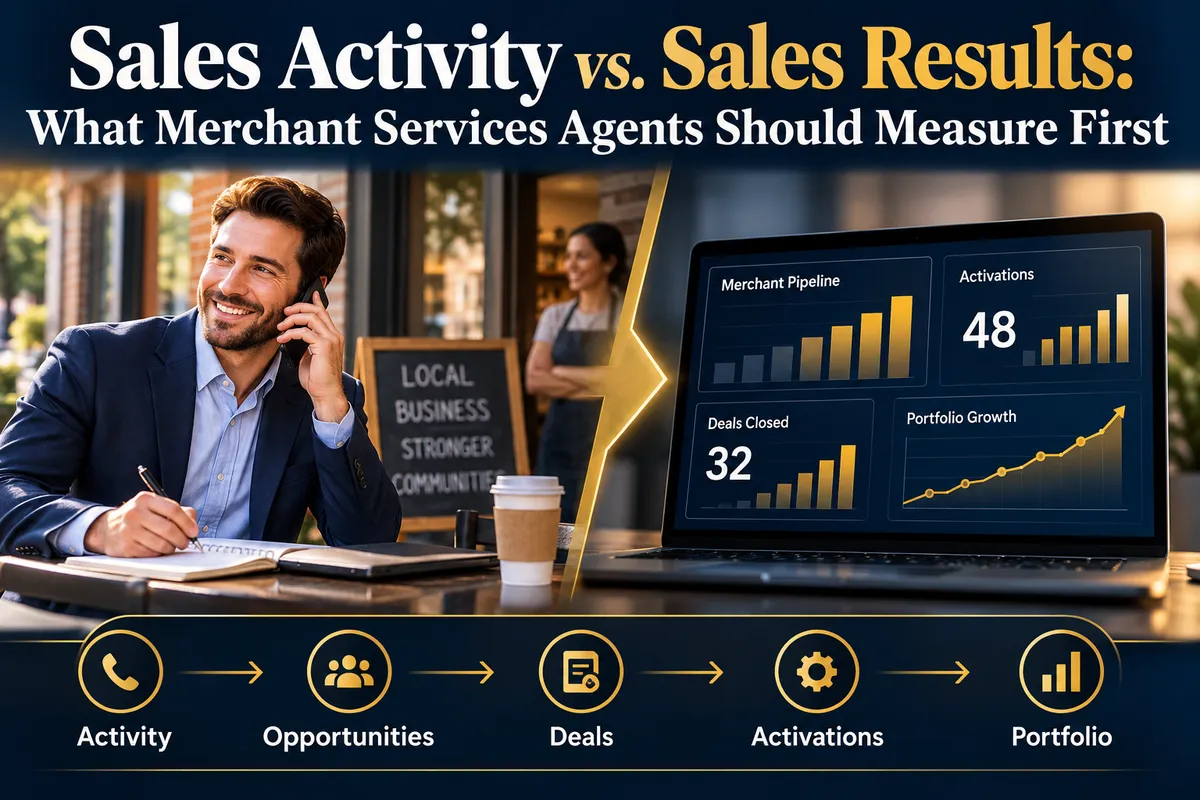
Sales Activity vs. Sales Results: What Merchant Services Agents Should Measure First
Sales Activity vs. Sales Results: What Merchant Services Agents Should Measure First
Everybody wants the result.
More signed deals. More activations. More commissions. More residual income. A bigger merchant portfolio.
That's why we get into merchant services in the first place. Nobody wakes up excited because they get to make another prospecting call, walk into another business or hear another objection from a merchant who isn't interested.
We want what those activities can eventually produce.
But there's a problem with managing your entire sales business around results:
You don't directly control the result.
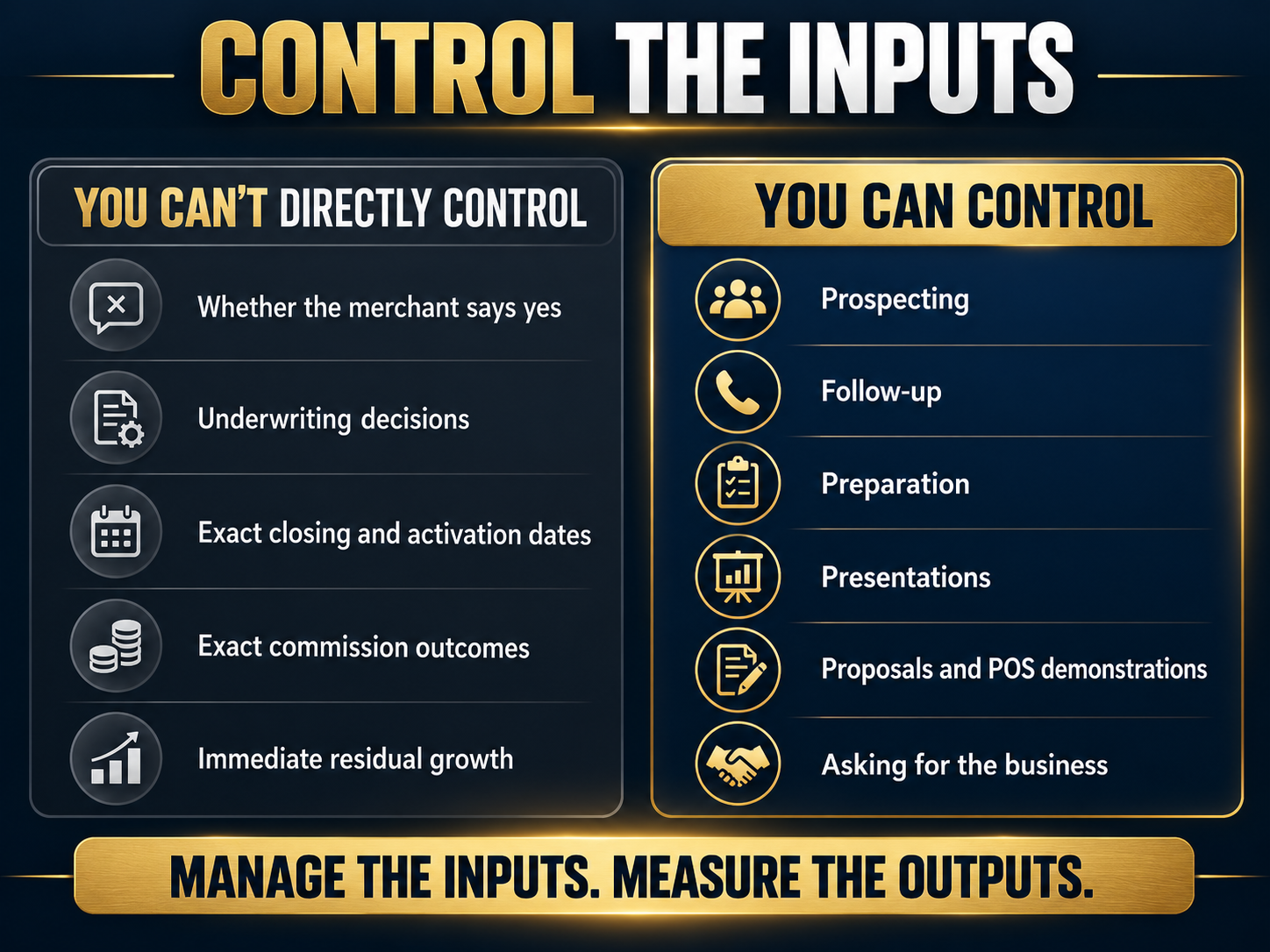
You can walk into a business, make a phone call, follow up with a prospect, deliver a presentation, schedule a POS demonstration, submit a proposal and ask for the business.
You cannot force the merchant to say yes. You cannot guarantee underwriting approval, determine the exact activation date or control every factor affecting your commissions.
That's why one of the biggest shifts I encourage merchant-services agents to make is learning the difference between measuring results and managing productive activity.
You should absolutely measure both. But when you're trying to change your future results, you have to start by understanding the actions creating them.
After more than 16 years building merchant portfolios and training sales agents, I've learned that production begins long before the merchant signs an agreement.
Production builds the business. And production starts with what you do today.
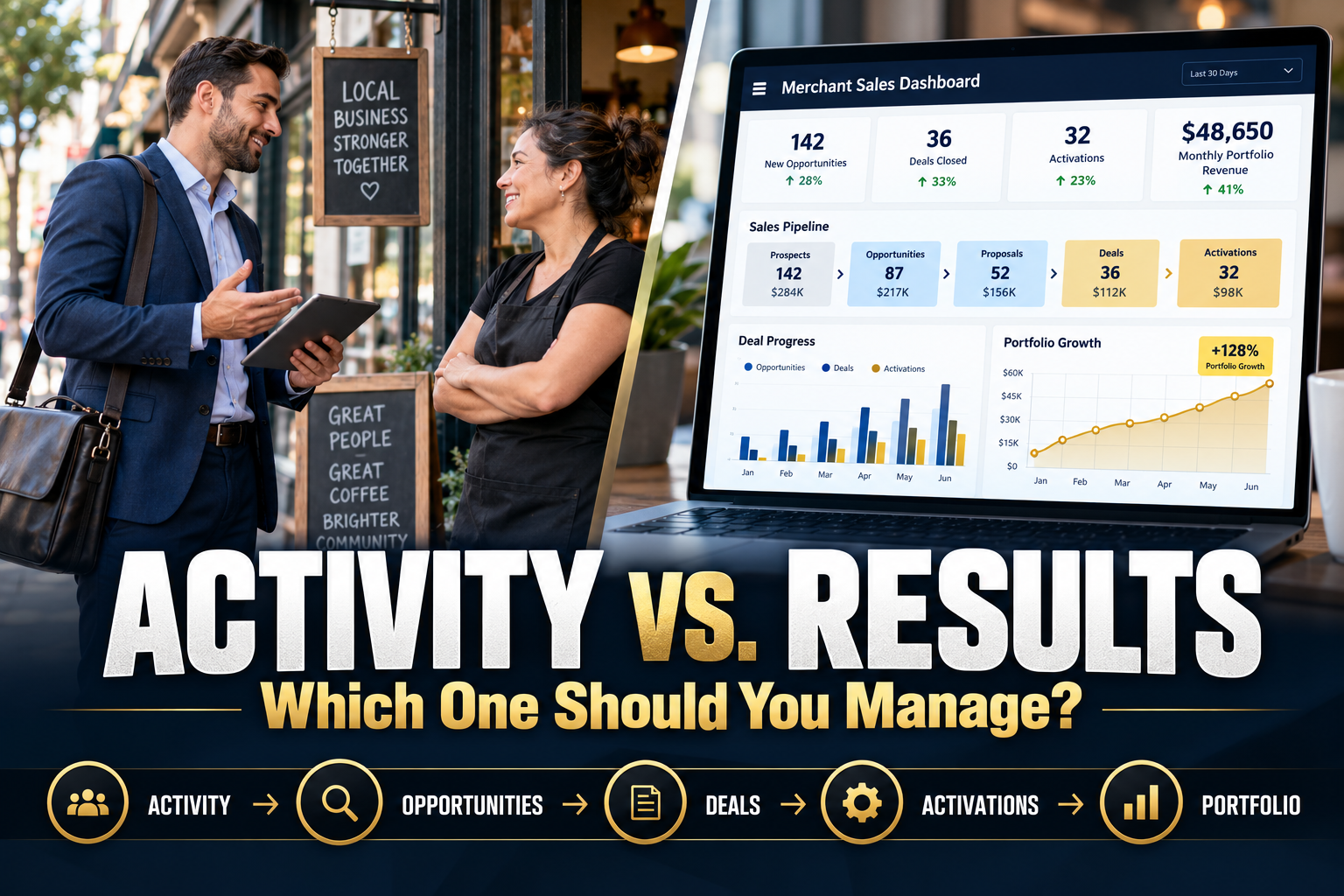
Results Tell You What Happened
Let's start with something important: results matter.
If you signed five merchant accounts this month, that's useful information. If four of those accounts activated, that's important too. Your commissions, residual income and overall portfolio growth are all numbers you should understand.
But those numbers are primarily lagging indicators.
They tell you what already happened.
If you wait until the end of the month, review your results and realize you didn't produce enough, you can't go backward and change the month.
The work that created those results—or failed to create them—has already happened.
That's why I want agents paying attention much earlier.
Your processor's reporting may help you understand your accounts, activations and earnings. But that doesn't necessarily tell you what your personal sales activity looked like along the way.
I explain that distinction in Merchant Services Agent CRM: Why Processor Dashboards Aren't Enough for Salespeople.
Your processor tracks the merchant. Who tracks you?
Activity Gives You Something You Can Change Today
Let's say it's Wednesday afternoon and you're unhappy with your production.
You cannot simply decide to close three accounts before the day ends and guarantee that it happens.
But you can decide to prospect more businesses.
You can call the merchant waiting on a proposal, follow up with a decision-maker, prepare for tomorrow's appointment or schedule another POS demonstration.
You can choose to remain productive instead of mentally writing off the rest of the week.
Those decisions are within your control.
That's the difference between a leading indicator and a lagging indicator.
Results are the scoreboard. Productive activity is what you can still do about it.
When you manage the inputs consistently and measure what comes out, you begin developing a much clearer picture of your business.
Why I Built Daily Production Tracking Into EZ MerchantTracker
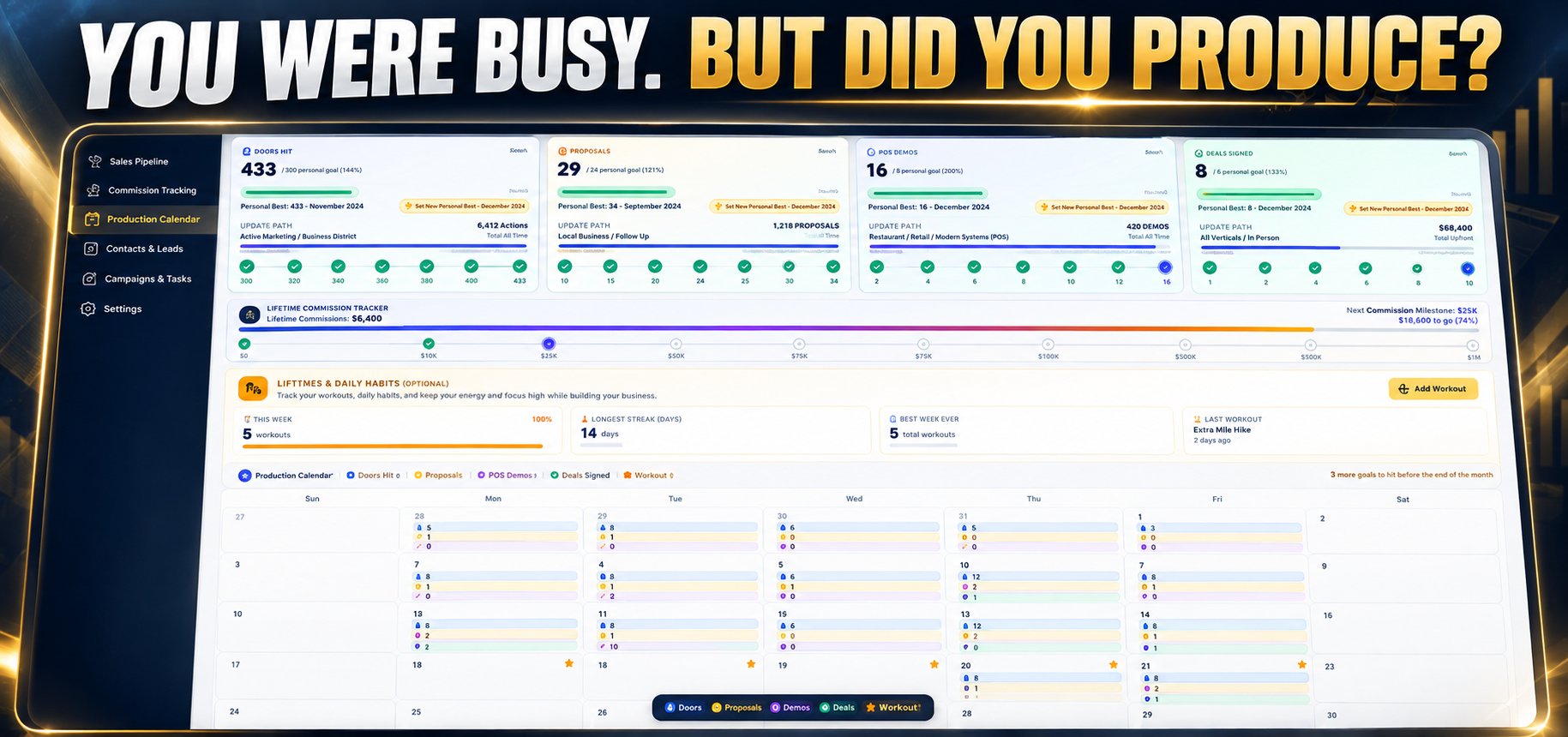
One of the biggest reasons I created EZ MerchantTracker was because I wanted merchant-services agents to see the work taking place before the final results showed up.
Most traditional sales systems focus on opportunities.
Where is the lead? What's the status? When are you following up? Has the application been approved?
Those are important questions, but I also want to know:
What did you do today?
How much prospecting did you complete? How many proposals did you generate? How many POS demonstrations did you perform? How many deals did you sign?
I'm not interested in turning salespeople into data-entry specialists. Tracking should be simple enough that you can quickly record meaningful production and get back to selling.
But over time, those daily records create something extremely valuable: your personal performance history.
Instead of guessing how productive you've been, you can look at actual activity over weeks and months.
You can identify patterns, recognize when your production has dropped and begin connecting the work to the results.
That's the philosophy behind the activity-tracking and production-calendar features inside EZ MerchantTracker.
And now that the software has officially launched, you can experience it yourself.
Start Your 14-Day Free EZ MerchantTracker Trial
You can also watch my complete EZ MerchantTracker software demonstration to see the platform and how it works.
Don't Confuse Productive Activity With Staying Busy
There's another side to this conversation that matters just as much.
Not everything that keeps you busy is production.
You can spend an entire day updating your website, watching training videos, redesigning your business cards, organizing your CRM, researching POS systems, talking with other agents or improving your email signature.
You might feel like you worked hard.
And some of those activities are necessary for operating a business.
But how much of that day actually created or advanced an opportunity with a merchant?
That's the distinction.
I believe business owners and sales agents need time for administration, education, planning and branding. I do those things myself.
But whenever possible, I want those activities handled outside the hours when you have the greatest opportunity to reach business owners and decision-makers.
Production hours should be protected for production.
That means engaging with prospects, visiting merchants, making calls, conducting presentations, performing demonstrations, following up and moving real opportunities forward.
A beautifully organized CRM doesn't build a merchant portfolio by itself.
The work you do with the merchants inside that CRM does.
The Results Pyramid Connects Activity to Results
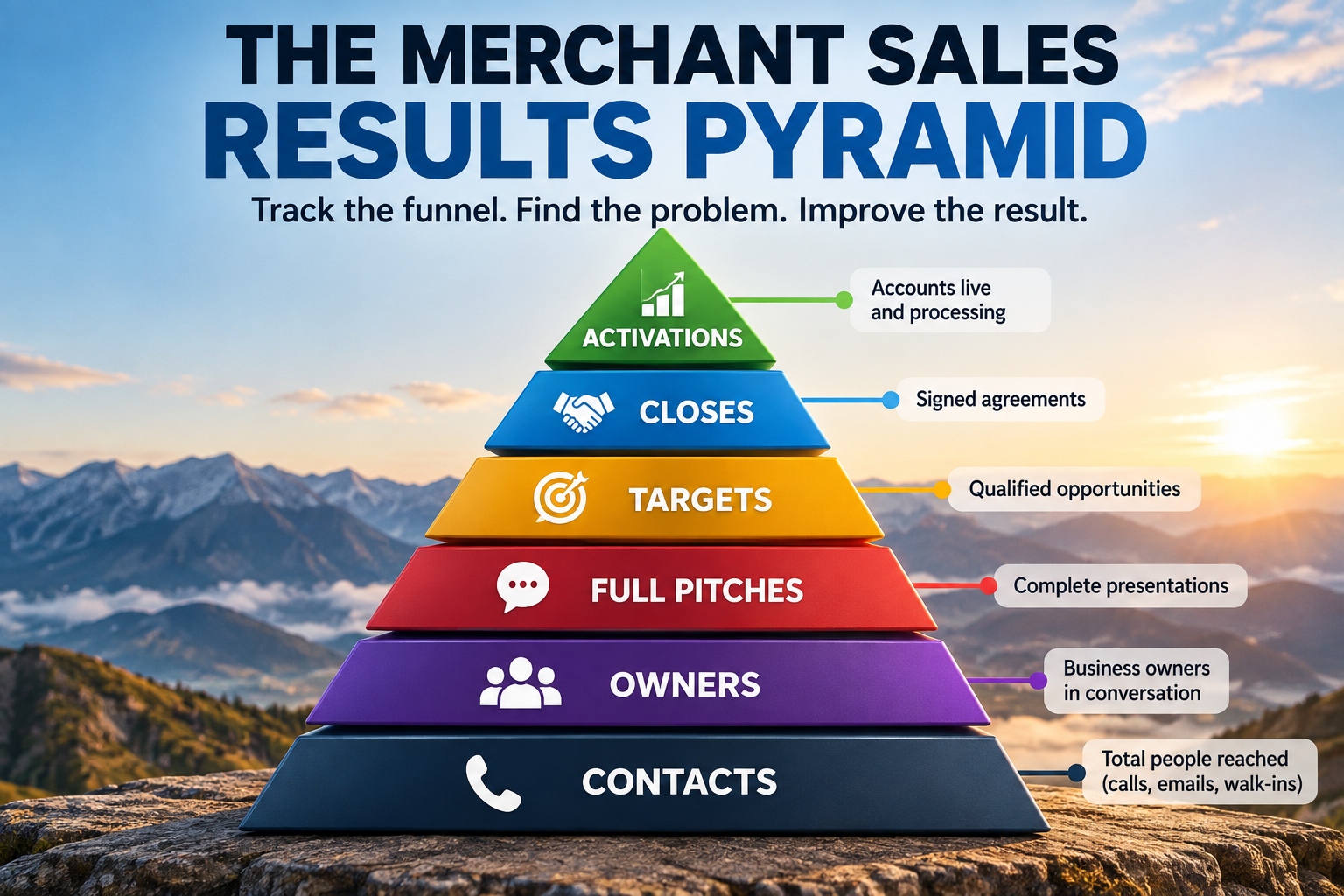
This is why I teach what I call the Results Pyramid.
It follows six stages:
Contacts → Owners → Full Pitches → Targets → Closes → Activations
The bottom begins with activity. The top represents the results you're working toward.
And everything between them helps explain what happened.
If you don't have enough contacts, you probably won't create enough opportunities.
If you're contacting plenty of businesses but rarely reaching owners, that's a different problem.
If you're reaching decision-makers but not getting through meaningful presentations, we need to look at that part of the process.
If you're presenting but rarely identifying legitimate targets, we need to examine qualification and discovery.
If you're generating opportunities but struggling to close, we need to investigate the sales process.
And if you're signing accounts that aren't activating, that's another issue entirely.
The Results Pyramid helps us avoid treating every production problem as a closing problem.
Sometimes the problem is simply that you're not creating enough opportunities.
Other times, you're creating opportunities but failing to convert them.
Those require different solutions.
Two Agents Can Get the Same Result for Completely Different Reasons
Imagine two merchant-services agents each sign two accounts this month.
If we only measure results, they appear equally productive.
But suppose Agent A completed a large number of legitimate presentations and generated many proposals, while Agent B had far fewer opportunities but converted them exceptionally well.
They produced the same number of deals.
They don't have the same problem.
Agent A might need help with qualification, presentations, follow-up or closing.
Agent B might simply need more opportunities entering the pipeline.
If I coach both agents the same way, I'm probably wasting somebody's time.
This is why the numbers underneath the final result matter.
You cannot intelligently improve what you haven't taken the time to understand.
Activity Without Conversion Ratios Still Leaves Questions
Tracking how much work you do is a good start.
Tracking how many deals you sign is also important.
But when you connect the two, you begin understanding your personal conversion ratios.
For example:
How frequently do your proposals become signed deals?
How frequently do POS demonstrations become signed deals?
How much prospecting does it typically take to generate a signed account?
How many of your signed accounts eventually activate?
Some of these ratios can be measured directly inside EZ MerchantTracker, while other stages of the sales process can be reviewed through your pipeline and production history.
Your ratios will change over time, and that's a good thing if they're improving.
You might discover that your closing performance has improved even though your prospecting volume stayed relatively consistent.
Or you might discover that your sales skills are strong, but your activity has declined.
Both are valuable insights.
For a deeper explanation of why I believe these numbers matter, read Merchant Sales Tracking Software: How to Know Your Numbers and Build a Bigger Portfolio.
More Activity Is Not Always the Answer
I talk about productive activity constantly because, in my experience, many salespeople simply aren't doing enough of it.
But I don't believe the solution to every problem is automatically “do more.”
Suppose you're consistently prospecting, reaching owners, completing presentations and generating legitimate proposals.
But almost nothing closes.
Doubling your prospecting might simply create twice as many opportunities that fail to convert.
At that point, we need to improve the process.
Perhaps you're not qualifying merchants properly. Maybe your presentations aren't uncovering enough value. Maybe you're not asking for the business, or you're letting legitimate opportunities go cold because of weak follow-up.
That's where tracking becomes useful.
Measurement should lead to diagnosis, not just pressure to work harder.
Find the Constraint Before Prescribing the Solution
This principle is central to the way I approach Portfolio Builders Coaching.
Before telling an agent what to do differently, I want to understand what's holding them back.
If the problem is insufficient productive activity, we work on consistency and prospecting.
If the problem is reaching decision-makers, we work on access and opening conversations.
If the problem is presentations, we improve the presentation.
If it's qualification, we work on discovery and identifying real opportunities.
If it's follow-up, we improve the follow-up process.
If it's closing, we focus on closing skills.
The solution should follow the problem.
That sounds obvious, but without tracking, agents frequently make decisions based on frustration rather than evidence.
Activity Is Where Accountability Starts
Here's where the conversation becomes uncomfortable.
Results can sometimes give us room to make excuses.
“I had a bad month.”
“The merchants weren't ready.”
“Everybody was happy with their current processor.”
“The market is tough.”
“The deals are coming.”
Maybe those things are true.
But productive activity gives us a much simpler starting point:
Did you do what you said you were going to do?
If you committed to a certain amount of prospecting, did you complete it?
If you agreed to follow up with specific opportunities, did you follow through?
If you had presentations scheduled, were you prepared?
Before we start diagnosing complicated sales problems, we need to know whether the work actually happened.
And if it didn't, the first problem may not be your sales technique.
It may be execution.
Portfolio Builders Coaching: Turning Data Into Accountability
When I asked merchant-services agents what they wanted more help with, three needs consistently stood out:
Accountability. One-on-one help. Mindset.
That's why I launched Portfolio Builders Coaching alongside EZ MerchantTracker.
I didn't want to create another merchant-services course. I already provide free foundational education through Merchant Service University.
Portfolio Builders is designed for agents who want to work directly with me on their sales execution, goals, performance and accountability.
The process starts with understanding where you are and what you're trying to accomplish.
Then we review your activity, your pipeline and your results.
We identify the constraint, develop a plan, establish commitments and review whether those commitments were fulfilled.
Goal → Activity → Data → Constraint → Plan → Commitment → Accountability → Review
EZ MerchantTracker provides the scoreboard.
Portfolio Builders provides the human coaching and accountability around that scoreboard.
And the agent still has to execute.
These are two separate offerings. You can use EZ MerchantTracker independently without joining a coaching program.
If you want to explore the coaching options, including the 90-day and 12-month programs, you can review EZ MerchantTracker and Portfolio Builders pricing.
Motivation Is a Terrible KPI
You won't always feel motivated.
I've watched the same cycle play out with new sales agents for years.
They discover merchant services, learn about the residual-income opportunity, complete their training and get excited about building a portfolio.
Then reality arrives.
Rejection. Missed appointments. Merchants who stop responding. Proposals that don't close. Accounts that take longer than expected to activate.
The initial excitement begins to disappear.
That's when the business starts separating people.
You cannot build a sustainable business around the idea that you'll only work when you feel motivated.
You need standards.
You need consistency.
You need the discipline to execute when the excitement has worn off.
And measurable activity gives you a way to hold yourself accountable to those standards.
Motivation changes. Your commitments shouldn't change every time your mood does.
Today's Activity Can Become Tomorrow's Portfolio
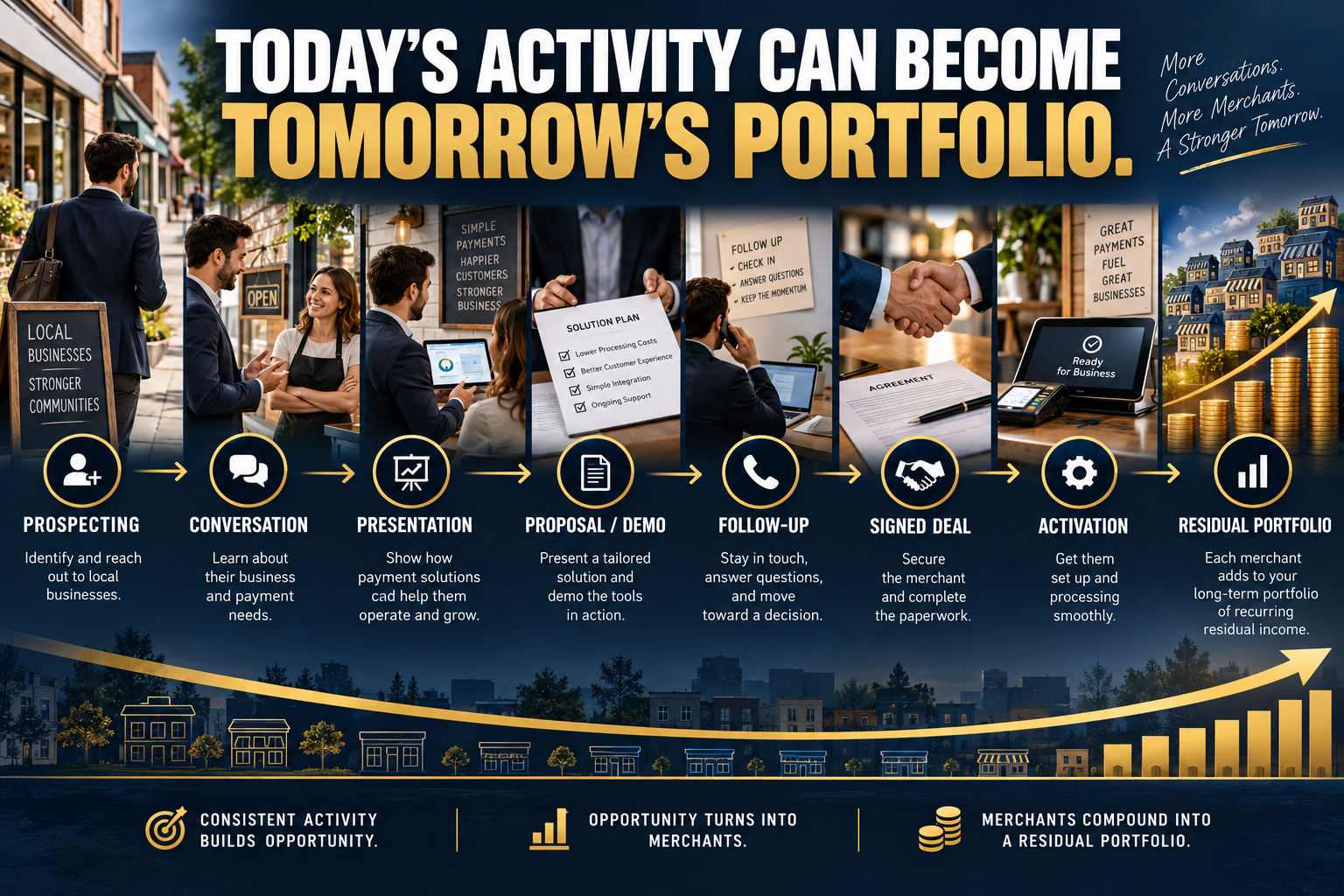
One of the challenges in merchant services is that there can be a delay between productive activity and financial reward.
A contact today might lead to a conversation tomorrow.
That conversation might lead to a presentation next week.
The presentation might create a proposal or POS demonstration.
The merchant might sign later.
The account may then take additional time to approve and activate.
Only after that does the ongoing processing relationship begin contributing to your residual portfolio, subject to your compensation agreement.
That delay can be frustrating, especially for newer agents.
They expect today's work to immediately produce today's income.
Sometimes it does.
Often it doesn't.
But that doesn't necessarily mean the work isn't producing anything.
You may be building the pipeline that produces next month's results.
This is why I want agents to track activity consistently instead of evaluating their entire business based on how they feel after one difficult day.
What Should a New Merchant Services Agent Measure First?
If you're brand new to the industry, don't overwhelm yourself with dozens of KPIs.
You'll spend more time tracking than selling.
Start with the actions closest to production.
Measure how consistently you're prospecting. Pay attention to whether you're reaching decision-makers, completing presentations, identifying qualified opportunities and advancing deals.
Then track what happens to those opportunities.
Are they becoming proposals or demos? Are they signing? Are they activating?
Build the habit of recording meaningful activity before trying to analyze every possible statistic.
If you're still learning the industry, begin with the free training at Merchant Service University.
And if you're ready to evaluate industry partnerships, EZ Direct Sales can help you explore trusted merchant-services opportunities.
What Should an Experienced Agent Measure?
Once you've been selling for a while, I want you looking deeper.
Now your historical performance becomes valuable.
Look at activity consistency, conversion ratios, production trends, pipeline value, commissions, follow-up effectiveness and how your results compare across different periods.
Are you improving your proposal-to-close ratio?
Are you producing more signed accounts from similar levels of activity?
Are opportunities spending too long in certain stages?
Are you having a strong month because you genuinely improved, or because several older opportunities happened to close at once?
These are the kinds of questions that help an experienced agent understand the business more clearly.
Not emotionally.
Numerically.
And that information becomes even more useful when you're working with a coach who can help interpret the patterns and identify what to improve.
How AI Could Make Merchant Sales Coaching More Personalized
There's another direction I'm excited about as EZ MerchantTracker continues developing.
AI.
Most generic AI sales tools can provide broad advice about prospecting, objections and closing.
But imagine combining merchant-services-specific sales knowledge with an agent's actual production history.
Instead of simply asking an AI coach how to improve sales, an agent could eventually receive guidance informed by their own activity, conversion ratios and pipeline trends.
For example, future AI capabilities could help identify whether an agent has strong prospecting activity but weak proposal conversion, whether follow-up opportunities are being neglected or whether production has declined compared with previous periods.
That's the direction I want to explore.
These are future AI coaching possibilities, not a promise that every capability is already available in the launched software.
The principle is what matters: the more useful information we have about an agent's actual performance, the more specific the guidance can become.
The Goal Isn't More Data. It's Better Decisions.
I don't want EZ MerchantTracker to become another piece of software filled with impressive-looking dashboards that nobody actually uses.
The question should always be:
Does this information help you make a better decision?
Should you increase your prospecting?
Should you improve a sales skill?
Should you focus on follow-up?
Should you clean up your pipeline?
Should you work on converting proposals?
Or should you stay the course because your activity and conversion trends are moving in the right direction?
Data should lead to action.
Otherwise, it's just decoration.
That's why I encourage agents to watch the full EZ MerchantTracker demo and see how the platform is organized around the actual work of building a merchant-services portfolio.
How My Merchant Services Education, Software and Coaching Fit Together
Over the years, I've been building an ecosystem designed to help agents at different stages of their business.
Not everybody needs everything.
But there should be a logical path from learning the industry to building and improving a merchant portfolio.
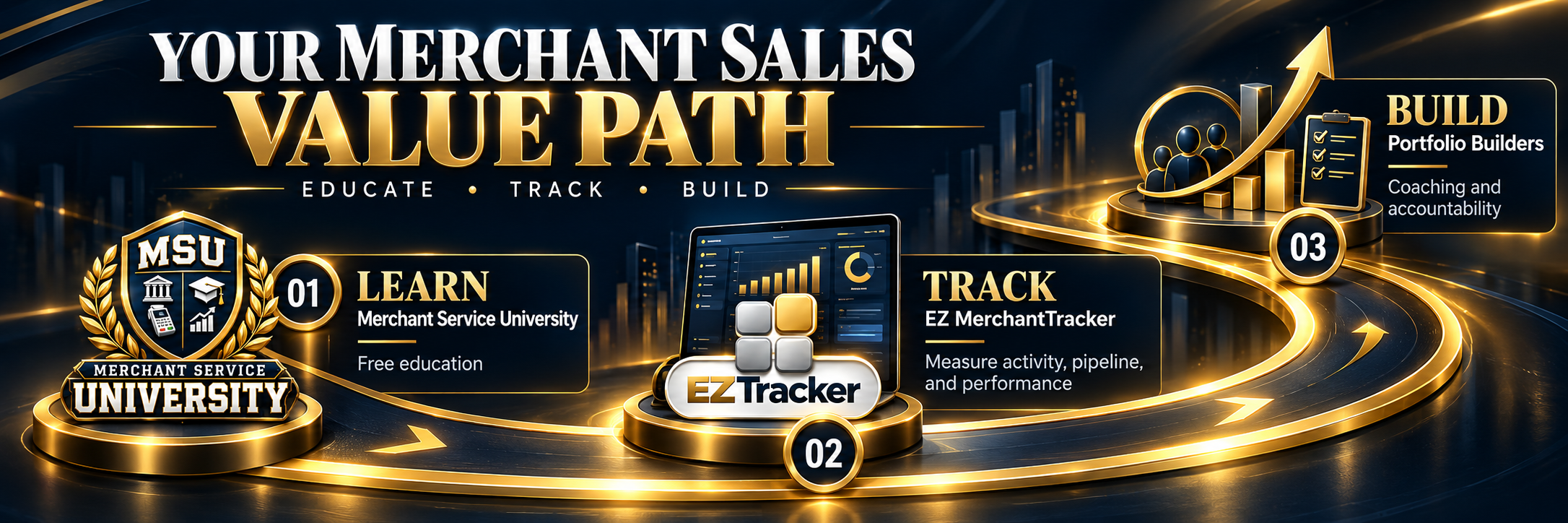
LEARN — Merchant Service University
Get the foundational merchant-services education you need to understand the business, compensation, technology and sales process.
START — EZ Direct Sales
Explore trusted industry partnerships and take the steps toward building your own merchant-services business.
TRACK — EZ MerchantTracker
Manage your pipeline, record production, track commissions and begin understanding your personal sales performance.
IMPROVE — Data, Training and Future AI Coaching
Use the information you're collecting to recognize patterns, strengthen skills and make better decisions. As the platform evolves, AI may provide another layer of guidance.
BUILD — Portfolio Builders Coaching
Work directly with me through coaching, performance reviews, planning and accountability.
The software and coaching programs have officially launched, and you can read the full announcement in EZ MerchantTracker Is Officially Live: Watch the Demo, Start Your 14-Day Free Trial & Explore Portfolio Builders Coaching.
So What Should You Measure First?
If I had to choose between obsessing over today's sales result and understanding today's productive activity, I'd start with the activity.
Because that's what you can change.
Then measure the results.
Connect the two.
Build your ratios.
Study the patterns.
Find the constraint.
Improve the process.
And repeat it long enough to build something meaningful.
If you're new to merchant services, start with free education at Merchant Service University.
If you're already selling and want a better way to organize your pipeline, measure production and understand your performance, start your 14-day EZ MerchantTracker trial.
If you want to see the software before registering, watch the complete demo.
And if you're looking for direct coaching, personalized guidance and accountability, explore Portfolio Builders Coaching and the available plans.
Results are what you want.
Activity is where you start.
Production builds the business.
Frequently Asked Questions
What is the difference between sales activity and sales results?
Sales activity consists of actions such as prospecting, conversations, presentations, proposals, demonstrations and follow-up. Sales results are the outcomes those actions may produce, including signed accounts, activations, commissions and residual portfolio growth.
Should merchant services agents track activity or results?
Both. Activity helps agents understand the work they're doing and what they can improve today. Results show the outcomes of that work. Measuring both makes it possible to identify performance patterns and calculate useful conversion ratios.
What merchant services sales activities should I track?
Start with productive prospecting, decision-maker conversations, presentations, qualified opportunities, proposals, POS demonstrations and follow-up. Compare those activities with signed deals and activations.
What are leading indicators in merchant services sales?
Leading indicators are measurable actions or conditions that can contribute to future sales outcomes. Prospecting, presentations, proposals and scheduled demonstrations are examples.
What are lagging indicators in merchant services sales?
Lagging indicators are outcomes that have already occurred, such as signed accounts, approvals, activations, commissions and residual-income growth.
Does more prospecting always mean more sales?
No. More prospecting can create more opportunities, but poor qualification, presentations, follow-up or closing can limit results. Agents should examine both activity volume and conversion performance.
What is Joe Wagner's Results Pyramid?
The Results Pyramid is a sales-performance framework following Contacts → Owners → Full Pitches → Targets → Closes → Activations. It helps agents identify where opportunities are being created, lost or delayed.
What is EZ MerchantTracker?
EZ MerchantTracker is a merchant-services CRM and performance-tracking platform built for individual merchant-sales agents. It helps agents organize leads, manage their pipeline, track production and commissions, and understand sales performance over time.
Is EZ MerchantTracker available now?
Yes. EZ MerchantTracker has officially launched and offers a 14-day free trial at https://app.ezmerchanttracker.com/register.
Is Portfolio Builders Coaching included with the software?
Portfolio Builders Coaching is a separate coaching and accountability offering. Agents can use EZ MerchantTracker as standalone software or explore coaching packages through the plans page.
How can I improve my merchant services sales performance?
Begin by consistently measuring productive activity and sales results. Identify whether your primary constraint is insufficient prospecting, poor opportunity creation, weak conversion, ineffective follow-up or activation delays. Then focus your improvement efforts on that specific area.
Where can I learn merchant services for free?
Merchant Service University provides free foundational education covering merchant services, payment processing, sales, compensation and industry partnerships.