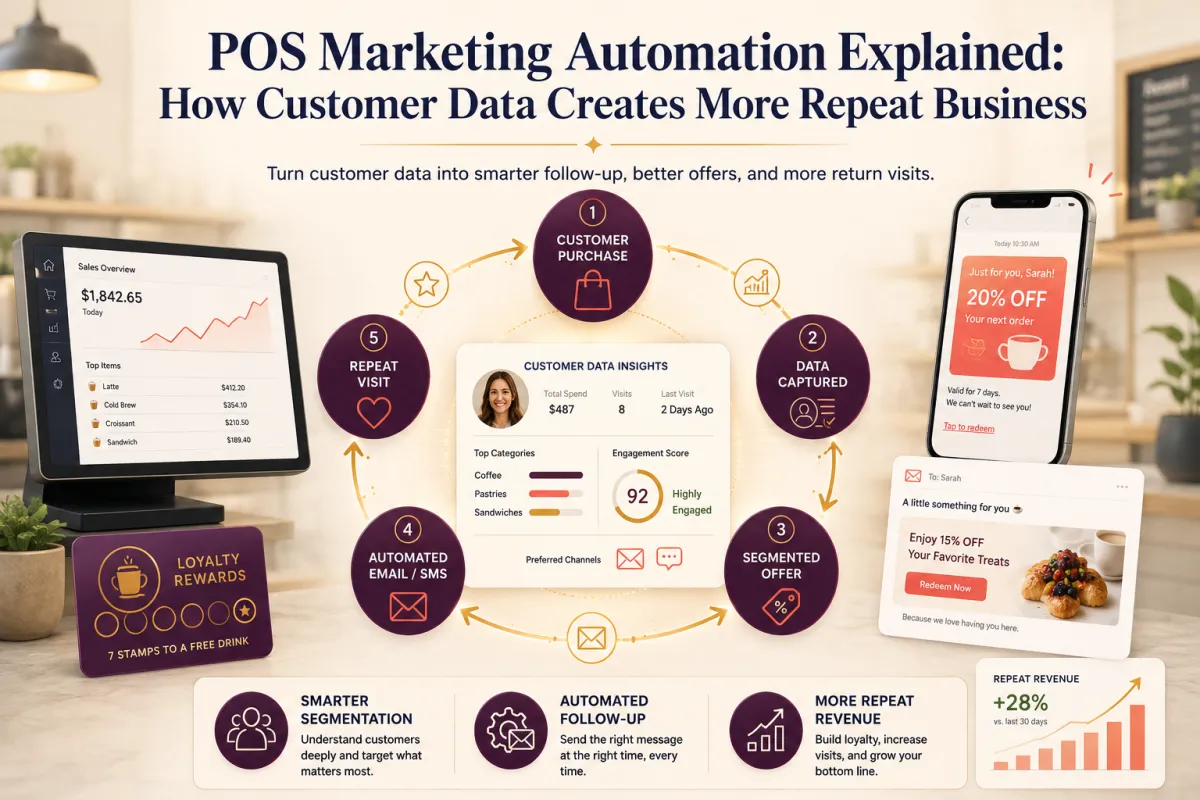
POS Marketing Automation Explained: How Customer Data Creates More Repeat Business
POS Marketing Automation Explained: How Customer Data Creates More Repeat Business
One of the biggest mistakes I see small businesses make is spending nearly all of their energy trying to find new customers while doing very little with the customers they already worked hard to earn.
New customer acquisition is important, but it is expensive. Businesses spend money on Google Ads, social media, SEO, referral programs, local sponsorships, direct mail, promotions, and countless other strategies trying to get someone through the door for the first time. Once that customer has purchased, the hardest part of the relationship is already behind you.
That is why POS marketing automation has become such an important part of modern business technology.
The opportunity is no longer simply collecting customer information. The real value comes from connecting customer data, payment history, loyalty, and marketing tools so a business can intelligently communicate with customers after the transaction.
That is how modern POS systems begin helping businesses create repeat revenue instead of simply recording yesterday's sales.
Customer Retention Is One of the Most Valuable Growth Strategies
Every business owner should ask a very simple question: what is easier, convincing a complete stranger to buy from you, or getting someone who already knows and trusts your business to return?
In most cases, the existing customer is the easier opportunity.
That is why customer retention deserves far more attention than many businesses give it. If a restaurant can bring a guest back one additional time each month, if a salon can increase appointment frequency, or if a retailer can encourage a customer to make another purchase, that creates additional revenue without starting the acquisition process from zero.
The strongest modern POS systems are increasingly helping businesses build those repeat relationships by connecting transactions with customer profiles and marketing automation.
Businesses Already Have Valuable Customer Data
Most businesses already collect more customer information than they realize.
Every transaction tells a story. The business may know what someone purchased, how much they spent, how often they visit, when they last purchased, what products they prefer, whether they are enrolled in loyalty, and whether their activity is increasing or decreasing over time.
The problem is that much of this information traditionally sat unused inside reports.
A business owner might technically have access to customer data but still have no practical system for acting on it. Exporting lists, creating spreadsheets, segmenting customers manually, and building campaigns takes time most small business owners simply do not have.
Modern POS marketing automation changes that by making customer information easier to use.
Automated Marketing Solves the Consistency Problem
Most small businesses do not fail at marketing because the owner does not care. They fail because the owner is busy.
They are managing employees, inventory, payroll, customer service, vendors, scheduling, operations, and everything else required to keep the business moving. Marketing often becomes something they plan to handle when things slow down.
Things rarely slow down.
Automation helps solve that problem by creating repeatable marketing processes that continue working even when the owner is focused somewhere else.
A modern commerce system may allow businesses to create campaigns around new products, seasonal promotions, loyalty rewards, birthdays, customer inactivity, purchase history, or other behaviors. The exact capabilities vary by platform, but the principle is the same.
The system helps the business stay in front of customers consistently.
Customer Data Makes Marketing More Relevant
The real advantage of connecting marketing with a POS system is not simply sending more messages.
It is sending better messages.
Imagine a customer who has visited a restaurant every week for six months and then suddenly stops coming in. A disconnected email platform may have no idea anything changed.
A POS system connected to customer profiles can potentially recognize that change in behavior and help the merchant create a re-engagement campaign.
Maybe the customer receives a loyalty reminder.
Maybe they get an offer related to something they regularly purchase.
Maybe they receive a simple message saying the business has not seen them recently.
That is far more relevant than sending the same generic promotion to every person in the database.
Loyalty and Marketing Become More Powerful Together
Loyalty programs become much more valuable when they are connected to marketing.
A loyalty program tells the business who is participating, how often they return, what rewards they have earned, and how engaged they are with the brand. Marketing gives the business a way to act on that information.
Together, those tools can help a business reinforce the customer relationship over time.
A coffee shop may send a reward reminder to someone who is close to earning a free item. A salon may send a rebooking message based on normal visit frequency. A retailer may notify customers about products related to previous purchases.
This is where a Modern Commerce System becomes much more valuable than isolated software.
The tools begin working together.
AI Can Make Marketing Automation Smarter
Artificial intelligence is also beginning to make customer marketing more efficient.
Business owners often know they should communicate with customers but struggle with questions such as what to send, when to send it, how to write the message, and which customers should receive it.
AI can assist with campaign ideas, subject lines, copy, customer segmentation, and other parts of the marketing process.
The long-term opportunity is not simply AI writing emails.
It is AI helping businesses understand customer behavior and use that information more intelligently.
That is a much bigger shift.
This Changes the Merchant Services Conversation
For merchant sales professionals, customer retention changes the entire value proposition.
Traditional merchant services conversations often focused on rates, processing fees, and equipment. Those areas still matter, but there is a significant difference between discussing how much the merchant pays to process a transaction and discussing how the business can generate another transaction.
That is where the modern merchant sales opportunity becomes more valuable.
Instead of asking only, "What are you paying for processing?" start asking questions like, "How are you bringing customers back? Do you know who your best customers are? Can you identify customers who stopped visiting? Are your loyalty and marketing systems connected?"
Those questions uncover business problems instead of simply pricing objections.
Learn the Industry Before Choosing What You Sell
This evolution is also why I believe new agents need to understand modern business technology before choosing a merchant services company.
Different providers offer different combinations of POS technology, marketing automation, loyalty, customer profiles, reporting, ecommerce, and other tools. A knowledgeable agent should understand what those systems do and which types of merchants benefit from them.
That is why I created Merchant Service University (MSU).
MSU teaches merchant services fundamentals, pricing, statements, sales, prospecting, POS technology, Modern Commerce Systems, residual income, and the broader business concepts agents need to understand before building a portfolio.
Merchant Service University is normally a paid online program, but I provide access at no cost to qualified, serious candidates who are looking for the right place to build in merchant services.
I use certification as both education and a filter. If someone is willing to complete the lessons, learn the industry, communicate, and earn certification, that tells me they are serious about building something.
Once certified, I can help qualified candidates connect with partners I believe provide the combination that matters: modern commerce systems, ethical agent agreements, lifetime residual opportunities, responsive merchant support, strong agent support, and a real place to build a long-term portfolio.
If you are serious about learning merchant services and finding the right place to build, begin at:
Final Thoughts: The Best Marketing Asset May Already Be in the Database
Businesses will always need new customers, but they should not overlook the people who already know them.
Modern POS marketing automation helps businesses use customer data more effectively, communicate more consistently, improve loyalty, and create more opportunities for repeat business.
That is not simply a marketing feature.
It is part of a broader shift in how businesses use technology.
The payment happened yesterday.
The opportunity is using that transaction to help create tomorrow's sale.
That is what modern commerce is really about.
Related Resources
What Is a Modern Commerce System?
https://iamjoewagner.com/post/what-is-modern-commerce-system
How AI and Business Data Are Making Smart POS Systems More Powerful
https://iamjoewagner.com/post/ai-business-data-smart-pos-systems
Loyalty Programs Explained: How Modern POS Systems Turn Existing Customers Into More Revenue
https://iamjoewagner.com/merchant-sales-training-blog
Merchant Sales Training Blog
https://iamjoewagner.com/merchant-sales-training-blog
Merchant Sales Resources
https://iamjoewagner.com/merchant-sales-resources
Download The New Rules of Merchant Sales
https://ebook.ezdirectsales.com
Apply for Merchant Service University Access
https://ezdirectsales.com
Frequently Asked Questions About POS Marketing Automation
What is POS marketing automation?
POS marketing automation connects customer data, purchase history, loyalty, and marketing tools so businesses can communicate with customers more consistently and encourage repeat business.
How can customer data improve marketing?
Customer data can help businesses understand purchase history, visit frequency, spending habits, and customer inactivity, allowing them to create more relevant campaigns.
Can POS systems automatically bring customers back?
Depending on the platform, businesses may be able to create automated campaigns for inactive customers, loyalty members, birthdays, promotions, or other customer behaviors.
Why is customer retention important?
Customer retention helps businesses generate additional revenue from people who already know and trust the company, reducing dependence on constantly acquiring new customers.
How do loyalty and marketing work together?
Loyalty programs provide information about customer activity and rewards, while marketing tools help businesses communicate with those customers and encourage future visits.
Can AI improve POS marketing?
Yes. AI can help with campaign ideas, customer segmentation, messaging, subject lines, and other marketing tasks while making customer data easier to use.
What is Merchant Service University?
Merchant Service University is Joe Wagner's online training program covering merchant services fundamentals, pricing, statements, sales, prospecting, POS technology, Modern Commerce Systems, and recurring residual income.
How can I get Merchant Service University access for free?
Qualified candidates who are serious about building a merchant services business may receive complimentary MSU access through Joe Wagner's recruiting process. Begin at ezdirectsales.com to learn more and apply.