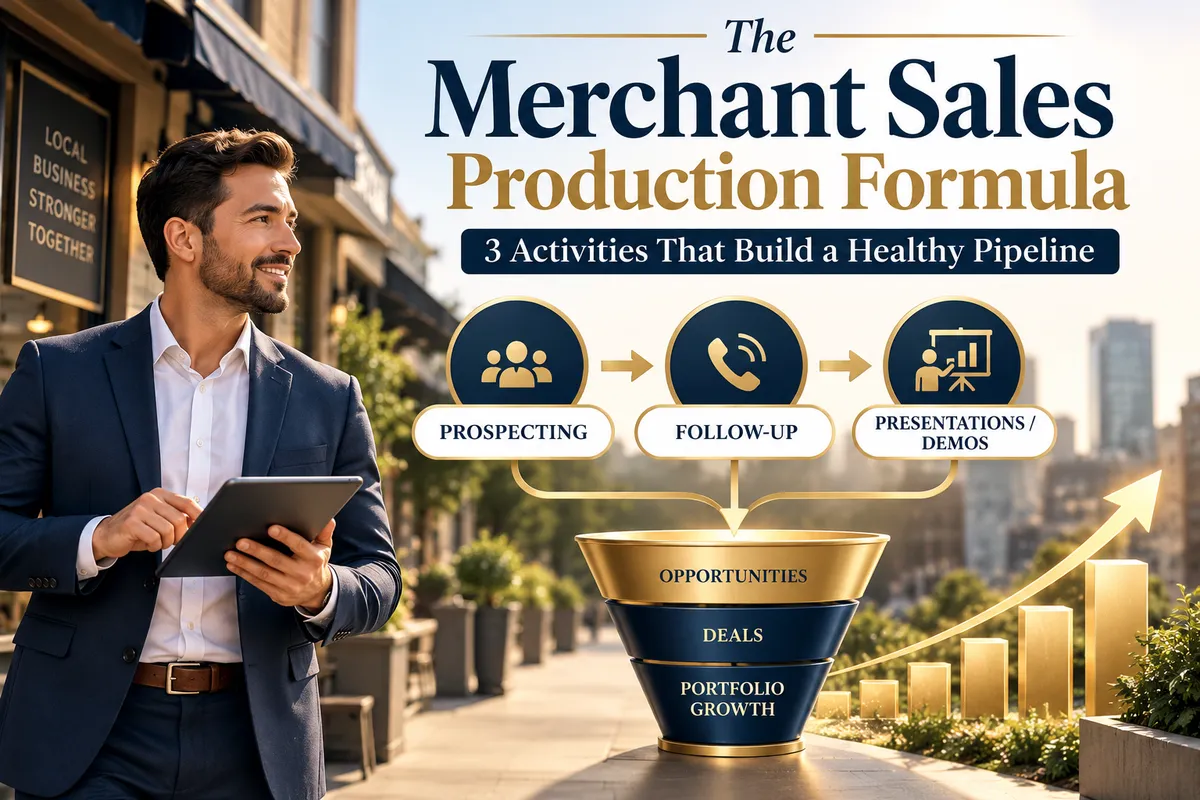
Merchant Sales Production Formula: 3 Activities That Lead to Deals
The Merchant Sales Production Formula: 3 Activities That Build a Healthy Pipeline
If you want to build a successful merchant-services business, stop measuring your entire week by how many deals you closed.
I know that might sound strange coming from someone who has spent more than 16 years in this industry building merchant portfolios.
But here's something I've learned from working with sales agents over the years:
Signed deals are the result. Your daily production activities are what create the opportunities for those results.
I've seen agents close three deals in one week and then go two weeks without closing anything.
I've also seen agents have a week where they didn't sign a single merchant, but they were knocking on doors, running proposals, scheduling POS demonstrations, and building a pipeline full of legitimate opportunities.
Which agent had the more productive week?
You can't answer that question by looking at signed deals alone.
Because the first agent might have closed deals that were already in progress while doing almost nothing to replace them.
The second agent might have created opportunities that turn into signed accounts over the next several weeks.
That's why I teach agents to focus on three core production activities:
1. Prospecting
2. Proposals
3. POS Demonstrations
These activities are the foundation of what I call the Merchant Sales Production Formula.
And if you understand how they work together, you'll have a much better idea of whether you're actually building a business or simply hoping to close your next deal.
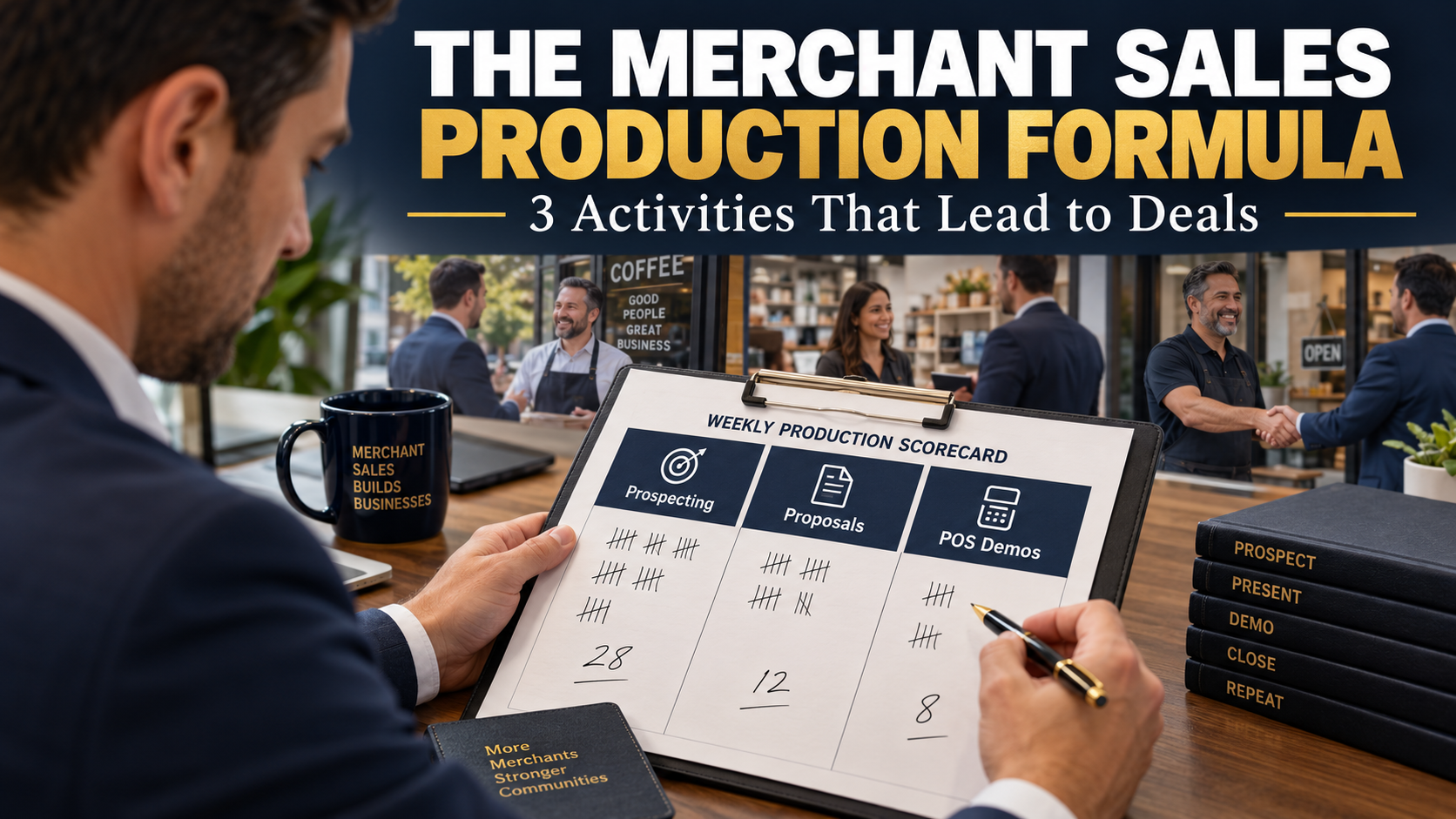
The Difference Between Being Busy and Actually Producing
One of the biggest mistakes I see new agents make is confusing activity with productivity.
They spend their mornings designing business cards.
They work on their website.
They rewrite their sales scripts.
They create social media posts, update their branding, or spend hours learning about the next processing product.
Those things can have value.
I do many of them myself.
But there's a major difference between working on your business and doing the work that directly creates opportunities to earn money.
I teach agents to protect their production hours.
Those are the hours when business owners and decision-makers are most likely to be available, often somewhere around 9 a.m. to 5 p.m., depending on the market and type of business.
During those hours, your priority should be engaging with prospects, presenting solutions, running demonstrations, working meaningful follow-ups, and moving deals forward.
You can work on your website or business cards before or after production hours.
But if you're spending your best selling hours doing administrative work, you're making it harder to build the pipeline you need.
I've explained this distinction in greater detail in my article on sales activity versus sales results in merchant services.
The principle is simple:
Being busy doesn't necessarily mean you're producing.
And production is what eventually gives you the opportunity to build a merchant portfolio.
Why I Focus on Three Specific Merchant Sales Activities
There are dozens of things a merchant-services agent might do throughout the week.
But not every activity has the same relationship to generating new business.
After years of training agents and watching how opportunities develop, I've narrowed my recommended weekly production benchmarks down to three activities that deserve consistent attention.
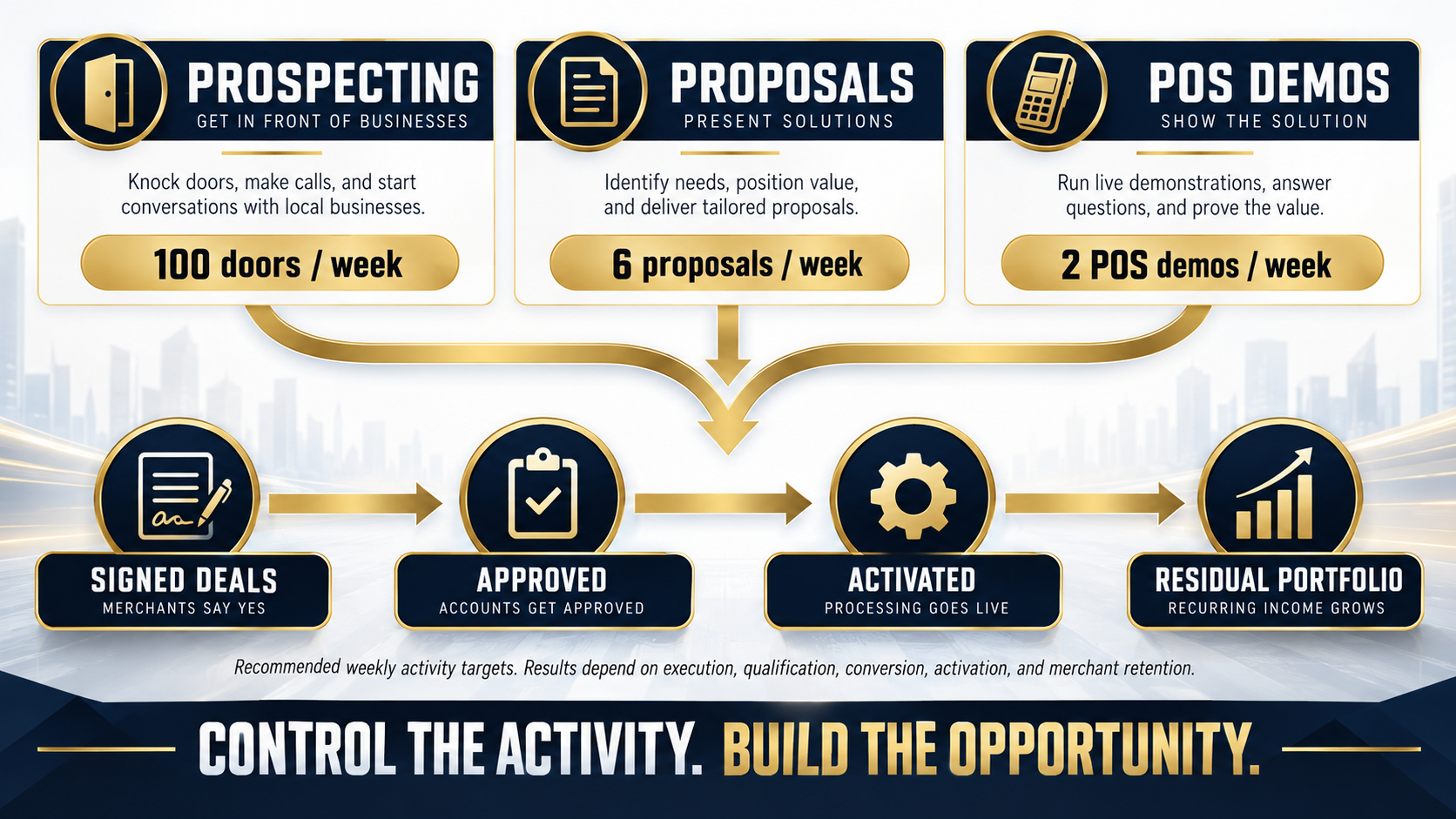
Production Activity | My Recommended Weekly Benchmark |
|---|---|
Prospecting | 100 business doors |
Proposals | 6 qualified proposals |
POS Demonstrations | 2 qualified POS demos |
These are the minimum weekly activity targets I recommend for agents using a door-to-door prospecting model.
They're not industry-wide statistics or guaranteed formulas for closing a certain number of deals.
They're practical benchmarks I've developed to help agents stay focused on activities that create sales opportunities.
And they serve three different purposes.
Prospecting fills the pipeline.
Proposals move qualified opportunities toward a decision.
POS demonstrations help merchants evaluate solutions and create additional opportunities to close business.
A proposal and a POS demo aren't necessarily consecutive steps. Some merchants need a proposal, others need a demonstration, and some need both.
But when these activities are consistently happening, you're giving yourself opportunities to generate signed deals.
Let's break them down.
1. Prospecting: The Activity That Keeps Your Pipeline Alive
You cannot build a long-term merchant-services business without consistently creating new opportunities.
I don't care how good your closing skills are.
If you're not talking to new business owners, eventually your pipeline is going to run dry.
This is why prospecting is the first part of the production formula.
My Weekly Prospecting Benchmark: 100 Business Doors
For agents who prospect in person, I recommend a minimum of 100 business visits per week.
That averages 20 businesses per day over a five-day workweek.
This doesn't mean 100 guaranteed conversations with decision-makers.
It means consistently getting out into your market, approaching businesses, and creating opportunities to speak with owners.
Some owners won't be available.
Some businesses won't be a good fit.
Some merchants won't be interested.
That's normal.
But you cannot control those outcomes.
You can control whether you show up and make the effort.
Prospecting Is About Creating Opportunities, Not Just Counting Doors
Here's something I want to make clear.
The goal isn't to knock on 100 doors just so you can tell me you knocked on 100 doors.
The goal is to create qualified conversations.
If you're walking into businesses, dropping off cards, and leaving without trying to engage the decision-maker, you may be checking off an activity without giving yourself a meaningful opportunity.
Your objective should be to:
Identify the owner or decision-maker.
Start a professional conversation.
Learn something about the business.
Discover whether there's an opportunity to help.
Establish a meaningful next step when appropriate.
And if the owner isn't available, record what you learned and determine whether returning makes sense.
What About Phone Prospecting?
I teach two primary sales models: door-to-door prospecting and phone prospecting.
Both can work.
The 100-door benchmark is designed specifically for in-person prospecting.
If you're working by phone, your activity target should reflect the number of calls, decision-maker conversations, qualified appointments, and opportunities you're creating.
I have also taught a high-volume phone prospecting model built around approximately 150 calls per day during dedicated calling days.
That is a separate prospecting approach, not an instruction to make 150 calls and knock on 100 doors every day.
The important thing is choosing a prospecting model and executing it consistently.
For a deeper explanation, watch my training on the two primary merchant sales prospecting models.
What Happens When You Stop Prospecting?
Imagine an agent who closes four deals this week.
They're excited.
They spend the next week focused entirely on paperwork, underwriting, installations, and celebrating those wins.
They stop prospecting.
Now imagine they do the same thing the following week.
Eventually, those deals get activated, and they look around wondering where the next opportunity is coming from.
That's the danger of an inconsistent pipeline.
You can't keep harvesting opportunities if you stop planting them.
Prospecting needs to remain part of your weekly routine even when you're busy closing existing business.
2. Proposals: Turning Conversations Into Real Opportunities
Prospecting gets you in front of business owners.
But conversations alone don't necessarily move your business forward.
At some point, you need to present a specific solution.
That's where proposals come in.
My Weekly Proposal Benchmark: 6 Qualified Proposals
I recommend that agents work toward a minimum of six meaningful merchant-services proposals per week.
That doesn't mean sending six generic quotes to random businesses.
I'm talking about real proposals for merchants who have a potential need, an identifiable opportunity, and a reason to consider your solution.
A proposal might involve:
Reviewing a merchant's processing statement.
Comparing current costs with a proposed solution.
Recommending a different pricing structure.
Addressing specific payment-processing problems.
Presenting a modern commerce solution.
Explaining the value of changing processors or technology.
A good proposal should be built around the merchant's business.
Not around whatever product you're trying to sell that week.
A Proposal Is Not Just a PDF You Email
Here's where a lot of agents lose momentum.
They finally get a merchant interested.
They collect the statement.
They prepare a proposal.
Then they email it and wait.
A week goes by.
Nothing.
Another week goes by.
Still nothing.
Then they tell me the merchant must not have been interested.
Maybe.
But maybe the merchant had questions.
Maybe they didn't understand the pricing comparison.
Maybe they wanted to know how the transition would work.
Maybe they were simply busy.
Your proposal should create a conversation, not replace one.
Whenever possible, schedule time to review the recommendation with the decision-maker.
Walk through the relevant numbers.
Explain the value.
Answer questions.
And establish what needs to happen next.
Why Six Proposals Matter
Think about what it takes to consistently prepare six legitimate proposals in a week.
You need to be talking to business owners.
You need to be identifying opportunities.
You need to be gathering the right information.
And you need to be moving prospects beyond casual conversations.
That's why proposals are such an important production benchmark.
They tell me you're not simply collecting business cards.
You're creating actual sales opportunities.
But remember: six proposals don't automatically equal six deals, or even one deal.
You still need to understand your own conversion rates.
3. POS Demonstrations: Showing Merchants What Their Business Could Look Like
Merchant services has changed tremendously since I entered the industry in 2009.
When I started, a lot of conversations centered on credit card terminals, processing rates, and monthly fees.
Those things still matter.
But today, many merchants are also evaluating the technology they use to operate their businesses.
Restaurants need solutions for ordering, payments, reporting, staff workflows, and customer experiences.
Retail businesses may need inventory, checkout, reporting, and other operational tools.
Service businesses have their own needs.
And sometimes the opportunity isn't simply to save a merchant money on processing.
It's to help them improve how their business operates.
That's why POS demonstrations are the third part of my production formula.
My Weekly POS Demo Benchmark: 2 Qualified Demonstrations
I recommend that agents work toward at least two qualified POS demonstrations per week.
These should involve real business opportunities where the merchant has a potential need for the technology.
A qualified demonstration should ideally include the appropriate decision-makers and focus on the business problems the proposed system can address.
Don't Sell Features. Demonstrate Solutions.
A common mistake is walking into a POS demonstration and showing every feature the system offers.
That's not necessarily what the business owner wants.
If you're meeting with a restaurant owner who's frustrated with their current ordering system, focus on that problem.
If a retailer needs better reporting or inventory tools, demonstrate the relevant capabilities.
If a business owner is worried about switching systems, explain the implementation process, available support, and what the transition may involve.
The demonstration should help the merchant understand how the proposed solution could fit their business.
The goal isn't to impress the merchant with technology. It's to help them see how that technology can solve a problem.
Why Two Demos Per Week Can Be Valuable
POS opportunities can involve more complex conversations, multiple decision-makers, and additional implementation considerations.
They may take longer to develop than a straightforward processing opportunity.
But consistently scheduling qualified demonstrations helps ensure you're creating opportunities beyond basic rate comparisons.
And as merchant technology continues to evolve, the ability to understand and present modern commerce solutions becomes increasingly valuable.
How These Three Activities Work Together
Now let's look at the bigger picture.
Your weekly prospecting creates opportunities to speak with new business owners.
Some of those conversations develop into proposals.
Others may lead to POS demonstrations.
Some merchants may require both.
And some of those opportunities eventually become signed deals.
Signed deals then need to progress through approval and activation.
That's the business-building cycle.
A Healthy Pipeline Needs All Three
Consider what happens when one part of the formula is missing.
Plenty of prospecting, but few proposals?
You may be creating conversations without developing enough qualified opportunities.
That could mean you need to improve your qualification, presentation, or ability to identify merchant needs.
Plenty of proposals, but few signed deals?
You may need to evaluate your pricing, value proposition, follow-up, closing process, or the quality of the opportunities you're pursuing.
No POS demonstrations?
You may be overlooking merchants whose needs extend beyond basic payment processing, or you may need to improve how you identify and introduce technology opportunities.
These are possibilities to investigate, not automatic conclusions.
And that's exactly why measuring activity matters.
It helps you ask better questions about your business.
The Results Pyramid: Why Your Results Begin Before the Close
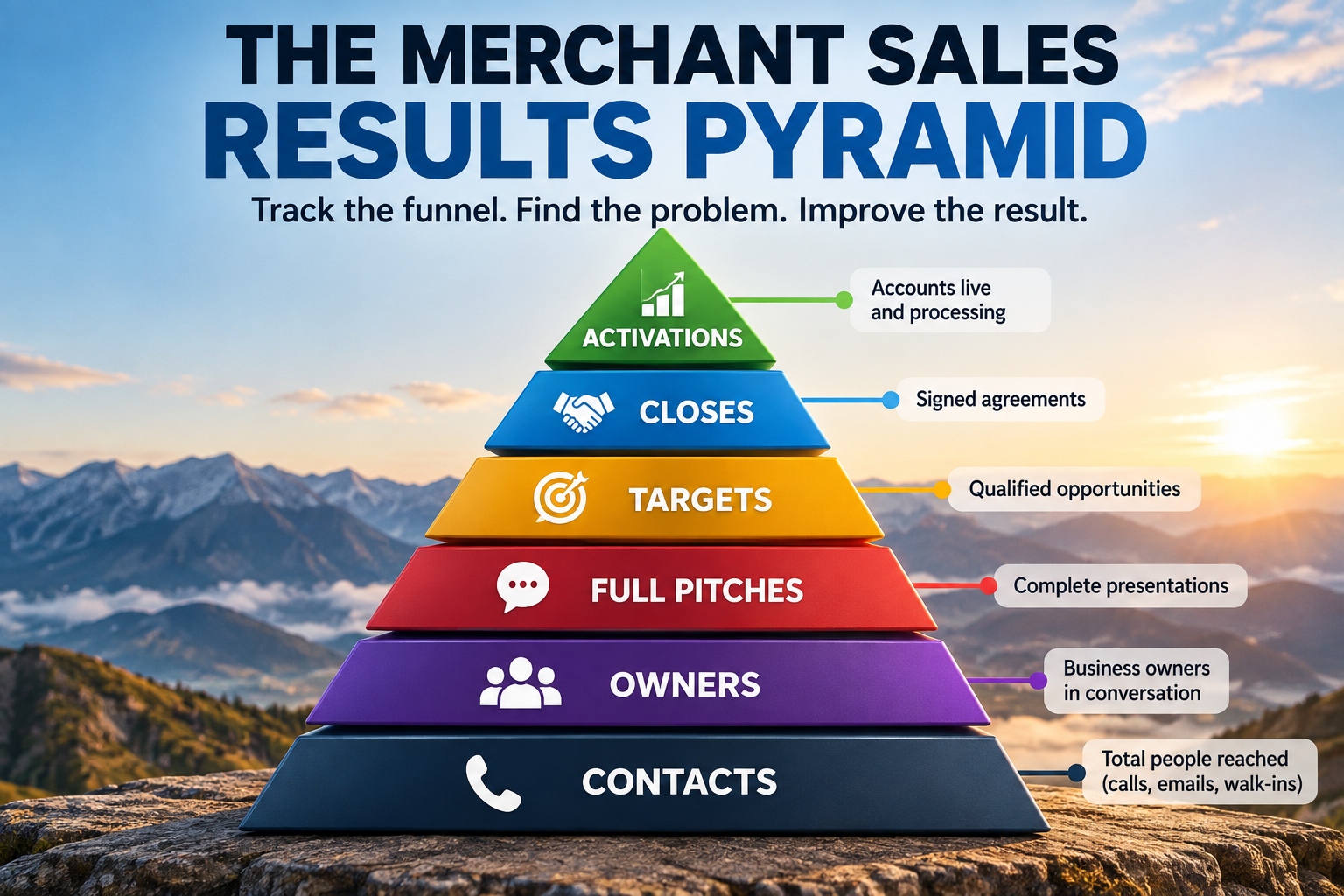
Years ago, I started teaching agents a concept I call the Results Pyramid.
It's a way of understanding how the sales process develops from initial prospecting activity into actual business.
The framework follows this progression:
Contacts → Owners → Full Pitches → Targets → Closes → Activations
At the bottom, you have the prospecting activity that creates opportunities to engage business owners.
As you move through the pyramid, you're qualifying prospects, presenting solutions, developing opportunities, and ultimately working toward signed and activated accounts.
The important lesson is that the final result depends on what happens earlier in the process.
You can't consistently expect closes without opportunities.
And you can't consistently expect opportunities without meaningful prospecting activity.
My three weekly production benchmarks work alongside this framework.
Prospecting creates the initial opportunities.
Proposals and POS demonstrations represent important ways to develop those opportunities.
Signed deals and activations show what the sales process ultimately produces.
Watch My Original Results Pyramid Training
I've taught this principle for years, and it remains one of the most important lessons I can share with new agents.
Watch: How to Succeed in Merchant Sales — The Results Pyramid
The video explains why your activity and sales process matter so much more than simply hoping for a good closing week.
Leading Indicators vs. Lagging Indicators: What You Can Actually Control
If you want to understand your business, you need to know the difference between leading and lagging indicators.
A leading indicator is an activity or measurement that may help predict future results.
A lagging indicator measures an outcome that has already occurred.
In merchant services, your leading indicators include:
Prospecting activity
Qualified conversations
Proposals
POS demonstrations
Meaningful follow-up activity
Your lagging indicators include:
Signed deals
Approved accounts
Activated accounts
Commissions earned
Residual income generated
Both matter.
But they serve different purposes.
You Cannot Control Every Deal
You cannot directly control whether a merchant says yes.
You cannot control every underwriting decision.
You cannot control exactly when an account will be approved or activated.
And you cannot guarantee how much residual income a merchant will produce.
But you can control whether you prospect.
You can control whether you prepare quality proposals.
You can control whether you create opportunities for POS demonstrations.
You can control whether you follow up professionally and consistently.
That's why I want agents to focus so heavily on these activities.
You manage the actions. Then you measure the results.
If the results aren't improving, you examine the quality of the actions and make adjustments.
What Happens When You Hit Your Benchmarks for 90 Days?
Let's look at what consistent activity could look like over approximately 13 weeks.
If an agent meets the recommended weekly benchmarks, the activity totals would be:
Activity | Weekly Target | 13-Week Total |
|---|---|---|
Business doors | 100 | 1,300 |
Qualified proposals | 6 | 78 |
Qualified POS demos | 2 | 26 |
That's 1,300 business visits, 78 proposals, and 26 POS demonstrations over approximately 90 days.
Now, I want to be careful here.
Those numbers don't guarantee a certain number of signed deals.
They don't mean every proposal was qualified equally.
And they don't account for differences in territory, sales ability, pricing, competition, or merchant needs.
But they do represent a substantial amount of focused sales activity.
Compare that with an agent who spends 90 days occasionally prospecting, rarely presenting proposals, and never scheduling demonstrations.
Which agent is consistently creating more opportunities to do business?
That's the reason I believe benchmarks matter.
They create an objective standard for effort and execution.
They also make it easier to identify whether the agent's biggest problem is insufficient activity or something happening within the sales process.
Track Your Conversion Ratios, Not Just Your Activity Totals
Reaching your activity benchmarks is important.
But it's only part of the picture.
You also need to understand what those activities are producing.
For example, suppose two agents each prepare 24 proposals over a four-week period.
Agent A signs six deals.
Agent B signs two.
Both agents completed the same number of proposals.
But their proposal-to-signed-deal conversion rates are different.
Agent A converted 25% of proposals into signed deals.
Agent B converted approximately 8.3%.
That difference is worth examining.
It doesn't automatically mean Agent B is a poor salesperson.
The two agents may be working with different types of merchants, deal sizes, timelines, or sales conditions.
But it gives you a reason to investigate.
Maybe one agent is better at qualifying prospects.
Maybe another is stronger at reviewing proposals.
Maybe follow-up is the difference.
The same principle applies to POS demonstrations and prospecting.
Three ratios I believe are especially useful are:
Proposals to signed deals
POS demos to signed deals
Business doors to signed deals
These are practical measurements for understanding how your production activity relates to actual sales outcomes.
Keep in mind that sales cycles may cross weeks or months, so these ratios are directional performance indicators rather than perfect measures of which individual activity caused a particular deal.
If you want to explore this further, read my guide to merchant services KPIs and sales performance tracking.
Your Pipeline Should Tell You Whether You're Building Momentum
A healthy sales pipeline isn't simply one that contains a lot of names.
It's one that consistently receives new opportunities and moves qualified prospects toward decisions.
You should be able to look at your pipeline and answer questions like:
Am I adding new prospects every week?
Am I turning conversations into proposals?
Am I creating opportunities to demonstrate POS solutions?
Are my proposals receiving meaningful follow-up?
Are opportunities moving toward signed deals?
Are signed deals progressing toward activation?
Am I consistently replacing opportunities that close or fall through?
That's why I encourage agents to manage their pipeline as a daily business process.
Not something they review only when sales slow down.
I've written a full guide on how to organize your merchant services sales pipeline, leads, and follow-ups.
If your pipeline is disorganized, start there.
Because even strong prospecting activity can lose value when you fail to follow through.
Why I Built These Three Benchmarks Into EZ MerchantTracker
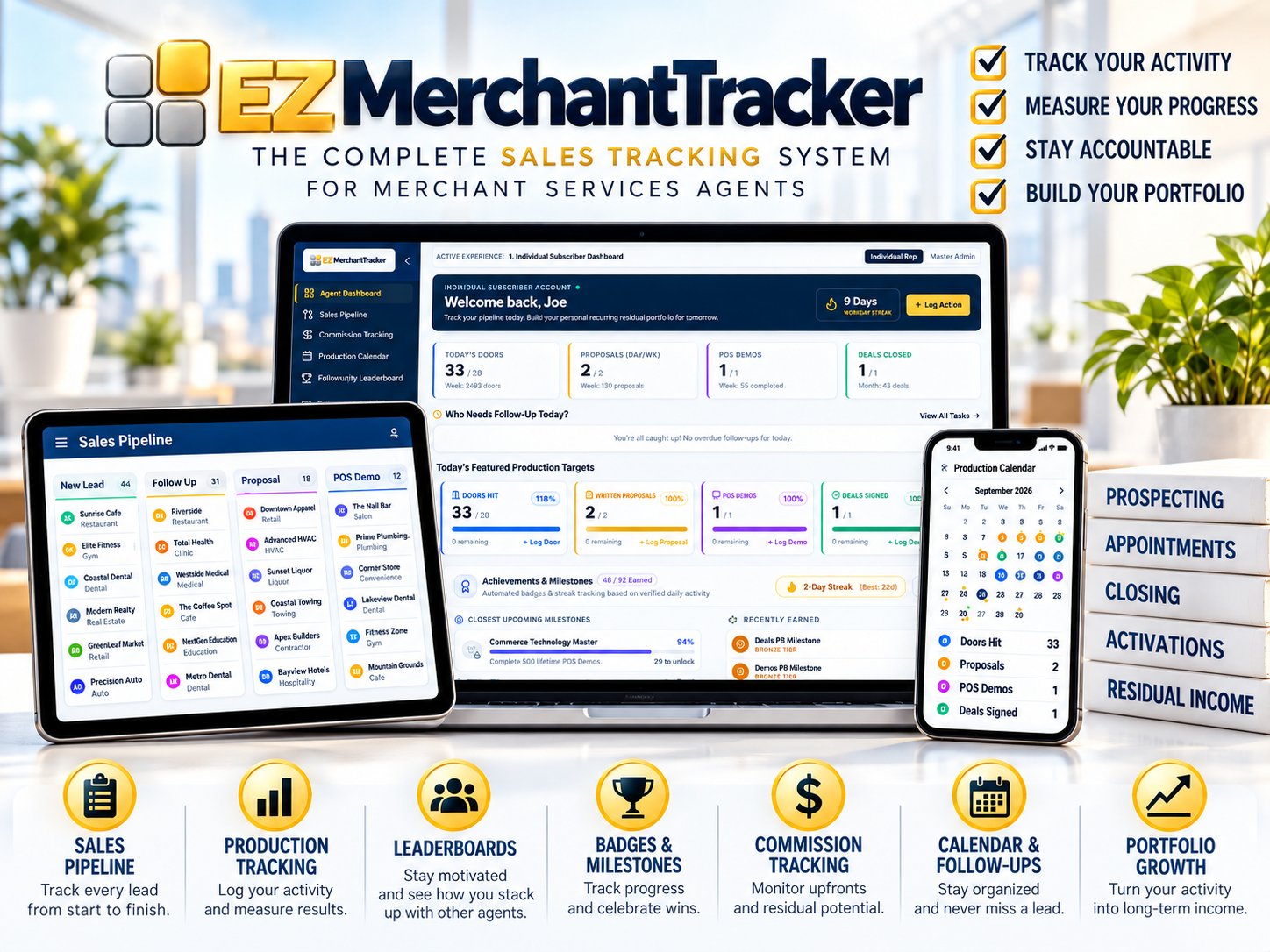
These three activities are so important to me that I built them directly into the production-tracking system inside EZ MerchantTracker.
I didn't want agents to have to guess whether they were putting in enough work.
I wanted them to be able to track their prospecting, proposals, and POS demonstrations, compare their activity against recommended weekly benchmarks, and review how their production relates to signed deals.
But here's what I want you to understand.
You don't need my software to believe in these principles.
You can start tracking your numbers today with a notebook or spreadsheet.
The important thing is to actually track them.
I created EZ MerchantTracker because I wanted to make that process easier and give agents a system built specifically for the merchant-services industry.
If you're looking for a way to organize your pipeline, track your production, and better understand your numbers, you can explore the software and start with a 14-day free trial.
Try EZ MerchantTracker Free for 14 Days
You can also watch my full EZ MerchantTracker demonstration.
The software is a tool.
Your willingness to do the work is what matters.
My Advice to New Merchant Services Agents
If you're brand new to merchant services, don't overwhelm yourself trying to master every part of the industry at once.
Get educated.
Choose a reputable processing partner.
Learn how to start conversations with business owners.
Understand the products and solutions you're representing.
Then build a consistent production routine.
For agents using the door-to-door model, work toward these three weekly benchmarks:
100 business doors.
6 qualified proposals.
2 qualified POS demonstrations.
Track your results.
Review what you're learning.
Ask for help when you need it.
And don't get discouraged if your first few weeks don't produce the results you hoped for.
Focus on improving both the quantity and quality of your work.
If you're new to the industry, you can begin with the free training available through Merchant Service University.
You can also explore merchant-services agent opportunities and processing partnerships.
The goal is to build a real foundation before expecting the benefits of a long-term residual portfolio.
Final Thought: Stop Chasing Deals and Start Building a Production System
I want you to remember something.
You can have a great week in sales and still be building a weak business.
And you can have a week without a signed deal while making meaningful progress toward future business.
The difference is what you're doing consistently.
Are you prospecting?
Are you presenting real proposals?
Are you demonstrating solutions to qualified business owners?
Are you following up?
Are you learning from your results?
That's what I want agents to measure.
Because when you focus only on the deals you've already closed, you're looking backward.
When you focus on the productive activities that create new opportunities, you're building forward.
Prospecting creates opportunities. Proposals and POS demos develop those opportunities. Consistent execution gives you more chances to sign deals and build your merchant portfolio.
That's the Merchant Sales Production Formula.
And it's one of the most important foundations of a healthy merchant-services business.
Frequently Asked Questions About Merchant Sales Production Benchmarks
What are the three most important activities in merchant services sales?
Three core activities I recommend tracking are prospecting, qualified proposals, and POS demonstrations. Prospecting creates new opportunities, while proposals and demonstrations help merchants evaluate solutions and make purchasing decisions.
How many businesses should a merchant services agent visit each week?
For a door-to-door prospecting model, I recommend a minimum benchmark of 100 business visits per week. This is a practical activity target I teach, not a universal industry requirement or a guarantee of sales results.
How many merchant services proposals should I do per week?
My recommended weekly benchmark is six qualified proposals. These should involve legitimate opportunities where you've identified a merchant's needs and can present a relevant solution.
How many POS demonstrations should a merchant services agent schedule?
I recommend working toward two qualified POS demonstrations per week. The appropriate number can vary depending on the products you represent, your target market, and the type of opportunities you're developing.
Do proposals and POS demos have to happen in a specific order?
No. Some merchants need a processing proposal without a POS demonstration. Others may want to see a POS system before discussing a detailed proposal. The order depends on the merchant's needs and sales process.
Will hitting these benchmarks guarantee signed deals?
No. These benchmarks measure activity, not guaranteed outcomes. Results depend on qualification, sales skills, merchant needs, competition, pricing, follow-up, and other factors.
What's the difference between sales activity and sales results?
Sales activity includes actions such as prospecting, presenting proposals, and conducting demonstrations. Sales results include signed deals, activated accounts, and commissions. Both should be measured to understand business performance.
How can I measure whether my merchant sales activity is working?
Track your weekly activity totals and compare them with meaningful outcomes over time. Useful ratios include proposals to signed deals, POS demos to signed deals, and doors visited to signed deals. Review the quality of opportunities and account for the time between activity and closing.
Should new merchant services agents track their numbers from day one?
Yes. Tracking activity early helps establish productive habits and provides a clearer picture of what's happening in your business. Even a basic tracking system is better than relying entirely on memory.
Can EZ MerchantTracker track these production benchmarks?
Yes. EZ MerchantTracker includes production tracking for business doors, proposals, and POS demonstrations, along with recommended weekly benchmarks and related sales-performance measurements. You can start a 14-day free trial here.