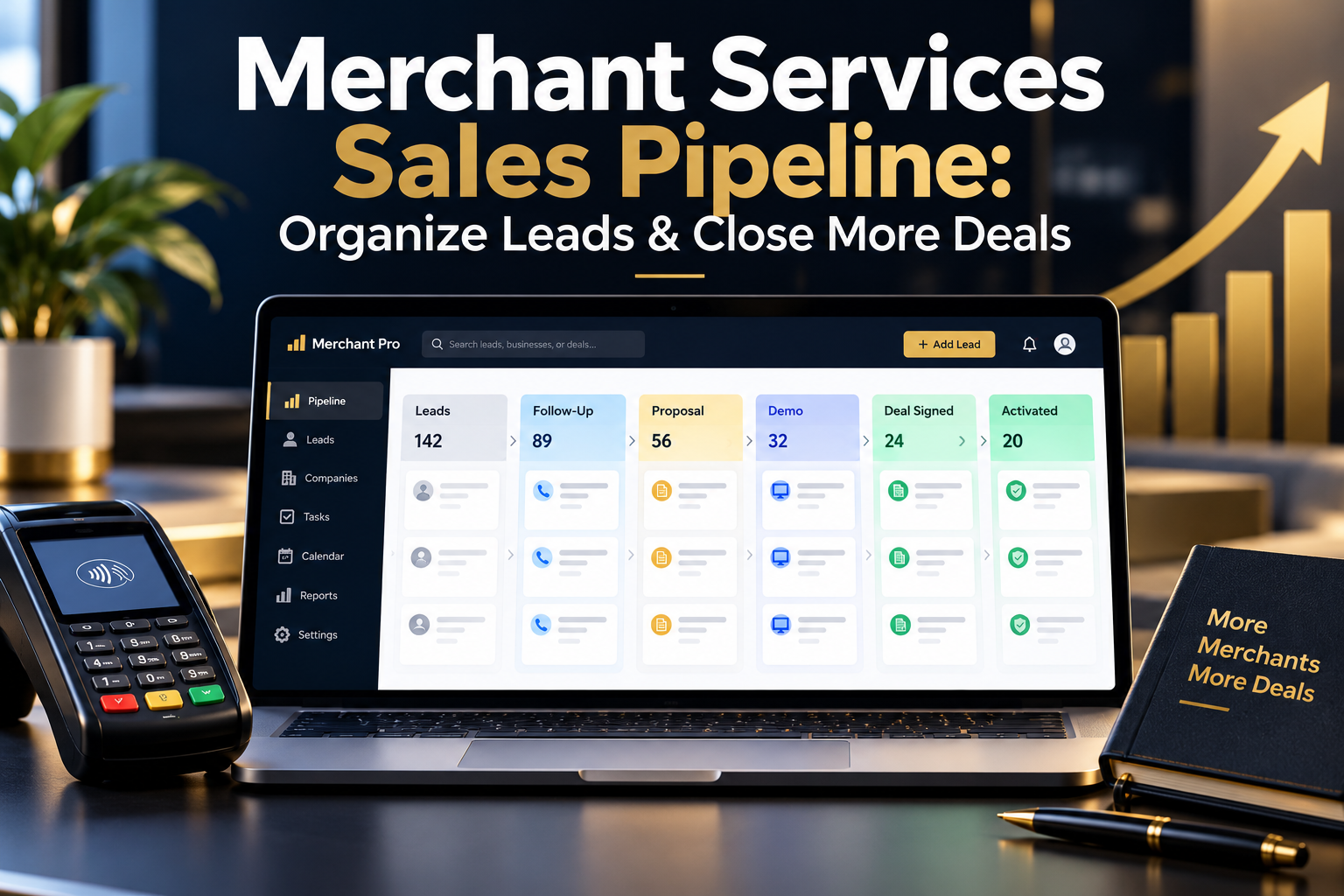
Merchant Services Sales Pipeline: Organize Leads & Close More Deals
Merchant Services Sales Pipeline: How to Organize Leads, Follow-Ups, and Deals
You don't need more leads if you can't keep track of the ones you already have.
That's something I've learned after more than 16 years in merchant services.
I've watched agents spend hours prospecting, knock on dozens of doors, make hundreds of phone calls, and finally get a business owner interested.
Then what happens?
They write the owner's name on a business card. They make a note in their phone. Maybe they send a proposal. They promise to follow up next Tuesday.
And three weeks later, they can't remember what happened to that opportunity.
The merchant didn't necessarily say no. The agent simply lost control of the sales process.
A merchant services sales pipeline isn't just a list of businesses you've contacted. It's a system for knowing where every opportunity stands, what needs to happen next, and which actions will move that prospect closer to becoming a client.
If you're serious about building a long-term residual income portfolio, learning how to manage your pipeline is just as important as learning how to prospect.
Let me show you how I approach it.
What Is a Merchant Services Sales Pipeline?
A merchant services sales pipeline is the organized process you use to move a prospective business from your first contact to becoming an active merchant account.
It helps answer five important questions:
Who am I currently working with?
Where does each opportunity stand?
What needs to happen next?
When should I follow up?
Which opportunities are progressing toward signed and activated accounts?
Without those answers, you're not really managing a pipeline.
You're managing a collection of names and hoping some of them turn into deals.
And hope isn't a sales strategy.
Think about a restaurant owner you met last week.
They were interested in reviewing their processing costs, but they asked you to return after the weekend because they were short-staffed.
That's not a lost deal.
It's not a signed deal, either.
It's an opportunity that needs a specific next action.
Your pipeline should tell you exactly that.
Why Merchant Services Agents Lose Deals They Could Have Won
One of the biggest problems in this industry is that agents confuse having prospects with managing prospects.
They might have 100 business cards, 50 contacts saved in their phone, and another 30 names written down somewhere.
They feel like they have a huge pipeline.
But ask them how many business owners they're scheduled to speak with this week.
Or how many outstanding proposals need follow-up.
Or how many merchants are waiting for a POS demonstration.
They don't know.
That's a problem because merchant services rarely follows a perfect one-conversation sales process.
Some owners are ready to make a decision immediately.
Others need a processing statement reviewed.
Some want to see a new point-of-sale system.
Others are locked into an existing agreement or simply aren't interested in changing right now.
The job of your pipeline is to keep those opportunities organized until there's a clear outcome.
You shouldn't have to rely on memory to remember who's interested.
And you definitely shouldn't be waiting for interested business owners to call you back.
The 9 Stages of an Organized Merchant Services Sales Pipeline
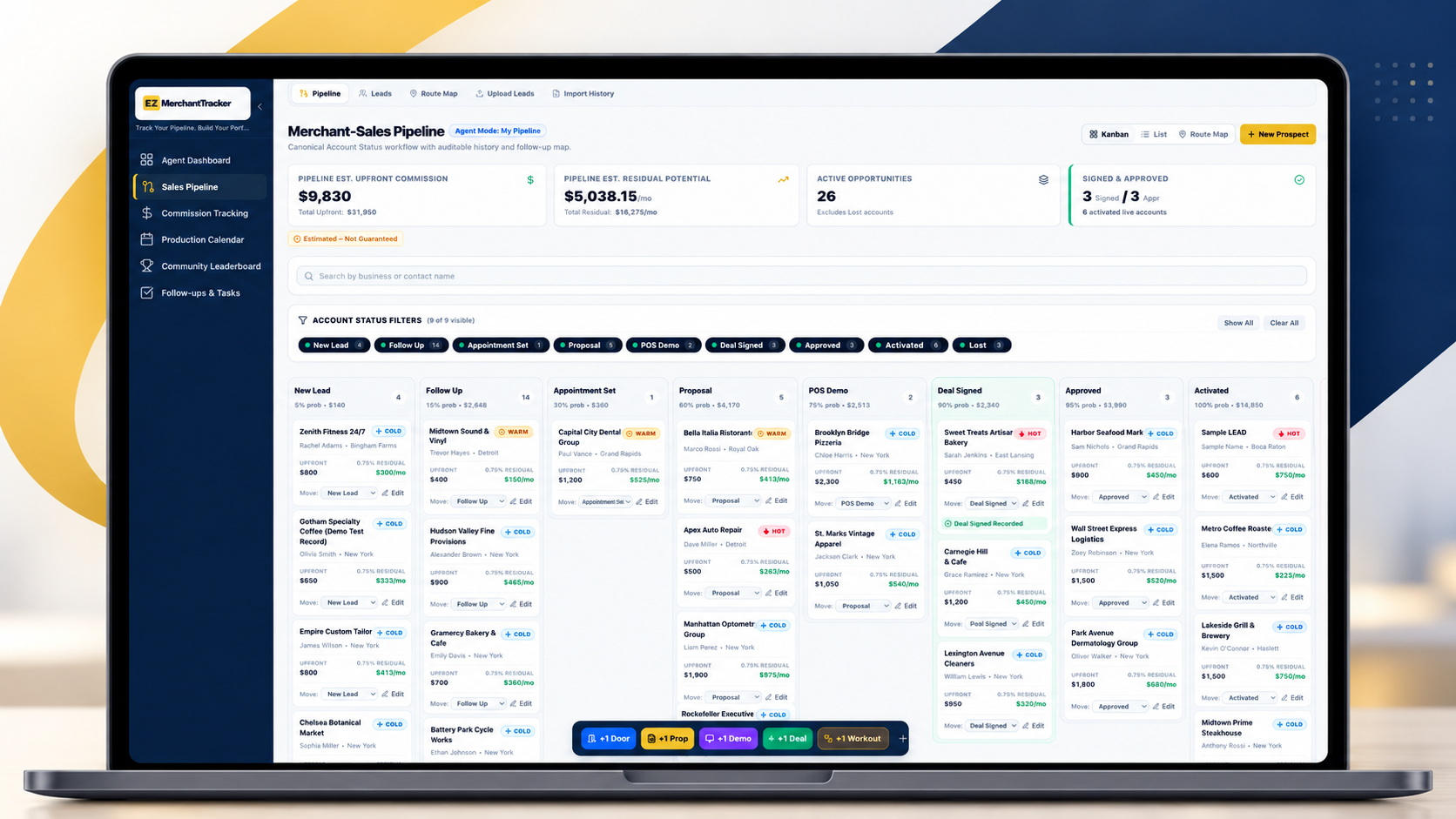
When I built EZ MerchantTracker, I wanted a pipeline designed around how merchant-services agents actually sell.
Not a generic CRM built for real estate, insurance, or some other industry.
The platform uses nine pipeline statuses to help agents organize opportunities throughout the sales process.
Here's how to think about each one.
1. New Lead
This is a business you've identified but haven't fully qualified or advanced through your sales process.
It could come from:
Door-to-door prospecting
Phone prospecting
A referral
Networking
An online inquiry
A business relationship
A prospecting list you've imported
At this stage, your goal is simple: make contact and determine whether there's an opportunity.
Don't mistake a large collection of new leads for actual production.
A name on a list doesn't generate residual income.
2. Follow Up
This is one of the most important stages in your entire pipeline.
A business owner has expressed some level of interest, or you've identified a reason to reconnect.
Maybe they're busy.
Maybe they asked you to call next week.
Maybe their current contract is ending.
Maybe they're waiting for a partner to review the information.
Whatever the reason, the opportunity needs a next action.
Every legitimate follow-up should have a purpose and a date.
"Call sometime next month" isn't a very useful plan.
"Call the owner on October 22 to review their latest processing statement" is.
3. Proposal
This stage is for opportunities where you've prepared or presented a specific solution.
For example:
A processing rate comparison
A cash discounting proposal
A merchant-services pricing analysis
A recommendation for a new payment solution
A proposal involving processing and related commerce technology
The mistake I see agents make is assuming that sending a proposal means the deal is almost done.
It doesn't.
A proposal creates another opportunity to move the conversation forward.
If you email a proposal and never schedule a conversation to review it, you're leaving too much to chance.
4. POS Demo
This stage is especially important as merchant services continues to involve more than basic credit card terminals.
Restaurants, retail businesses, and service companies may need to evaluate software, hardware, reporting, inventory, online ordering, or other operational tools.
A POS demonstration gives the merchant a chance to understand how a proposed system could work for their business.
Your job isn't simply to show features.
It's to connect those features to problems the business actually wants to solve.
A strong demo should help the owner answer:
Will this system make my business easier to operate?
Does it solve the problems I'm experiencing?
Can my staff learn it?
What will the transition involve?
Is this the right investment for my business?
A POS demo is an important sales opportunity, but it's still not a signed deal.
5. Appointment Set
This status helps you organize opportunities with a scheduled meeting or sales conversation.
That appointment might involve an initial presentation, a follow-up discussion, a decision-maker meeting, or another important step.
The critical thing is to know:
Who you're meeting
When you're meeting
Why you're meeting
What you need to accomplish
An appointment without a clear purpose can become another conversation that goes nowhere.
6. Deal Signed
Congratulations. The merchant has agreed to move forward and signed the required paperwork.
But there's an important distinction here.
A signed deal is not necessarily an activated merchant account.
Underwriting, equipment, setup, documentation, installation, and other requirements may still need to be completed.
You should celebrate the progress without confusing it with the final outcome.
7. Approved
The application has progressed through the approval process.
Depending on the processor and the merchant's situation, there may still be additional steps before the account begins processing.
This is where staying organized matters.
You don't want an approved account sitting unnecessarily because nobody followed up on installation, equipment, or remaining requirements.
8. Activated
This is the milestone that matters for building an active merchant portfolio.
The merchant account is activated and ready for or beginning the intended processing activity, depending on the processor's activation criteria.
An activated account is a meaningful achievement, but actual residual compensation depends on processing activity, the agent agreement, pricing, and other factors.
If you're trying to build recurring income, your focus needs to extend beyond signed paperwork.
You want merchants successfully operating with the solutions you've provided.
9. Lost
Not every prospect will become a client.
Some merchants choose a competitor.
Some decide not to change.
Others stop responding or simply aren't qualified.
That's part of sales.
But lost opportunities still provide useful information.
Why didn't the merchant move forward?
Was it pricing? Timing? Technology? Competition? Lack of follow-up?
Understanding those patterns can help you improve your process.
And keeping genuinely lost opportunities out of your active pipeline prevents you from exaggerating how much business you're actually working.
Your Pipeline Doesn't Have to Follow a Perfect Order
Here's something important about the stages I just outlined.
They're not meant to suggest every merchant follows exactly the same path.
A restaurant owner might schedule an appointment before receiving a proposal.
Another merchant might review a proposal before deciding to schedule a POS demo.
A referral might move from an initial conversation to signed paperwork very quickly.
That's normal.
The purpose of your CRM isn't to force every merchant through an artificial sequence.
It's to give you an accurate picture of where each opportunity stands right now.
Use the stage that best describes the current situation, and make sure you know the next step.
The Most Important Part of Your Pipeline Is the Next Action
You can have the most organized-looking CRM in the world and still struggle to close deals.
Why?
Because organization alone doesn't create production.
Action does.
Every active opportunity should have a clear next step.
Let's look at three examples.
Example 1: The Busy Restaurant Owner
You visited a restaurant on Thursday afternoon.
The owner seemed interested but asked you to return Tuesday morning.
Your next action should be to return or contact the owner Tuesday morning, not simply leave the prospect marked as interested.
Example 2: The Outstanding Processing Proposal
You completed a cost analysis and emailed the proposal.
Your next action should be to schedule or conduct a review conversation, answer questions, and determine whether the merchant wants to move forward.
Example 3: The POS Demo
The merchant likes the system but needs their business partner to see it.
Your next action is to coordinate a demonstration with both decision-makers.
Notice the pattern?
Every opportunity has a reason for the next conversation.
If you don't know what you're supposed to do next, that prospect isn't being managed effectively.
Stop Treating Every Lead Like It's Equally Valuable
Another mistake agents make is spending too much time on opportunities that aren't likely to move forward.
Not every prospect deserves the same amount of attention.
You need to consider:
Whether you're speaking with a decision-maker
Whether the merchant has a genuine problem you can solve
Whether they're willing to review a proposal
Whether there's a realistic timeline
Whether they fit the products and services you offer
Whether they've taken any meaningful action toward a decision
A business owner who has scheduled a POS demonstration with their partners may deserve more immediate attention than someone who casually said, "Stop by sometime."
That doesn't mean you abandon long-term prospects.
It means you manage your time intelligently.
In EZ MerchantTracker, lead temperature can help you identify the level of interest separately from the actual pipeline status.
That distinction matters.
A prospect can be highly interested and still be waiting for a proposal.
Another can have a proposal outstanding but show very little urgency.
Pipeline stage tells you where the opportunity stands. Lead temperature helps describe how engaged the prospect appears to be.
Both can help you decide where to focus your attention.
Build Your Pipeline Every Day, Not Just When Business Slows Down
This is where we need to talk about prospecting.
I teach agents that their business needs consistent new opportunities entering the pipeline.
You can't spend all week following up with the same five merchants and expect your portfolio to grow indefinitely.
At some point, you need new conversations.
That means prospecting.
Whether you're knocking on doors, making phone calls, asking for referrals, or connecting with business owners through your existing network, the objective is the same:
Create new qualified opportunities while continuing to work the ones already in your pipeline.
I teach two primary prospecting models for merchant-services agents: door-to-door and phone-based prospecting.
Both can work.
The important thing is choosing a repeatable process and actually executing it.
Watch: Two Sales Models for Merchant Services
In this training, I explain the door-to-door and phone prospecting approaches agents can use to create new opportunities.
Watch My Two Merchant Sales Models Training
And if you're prospecting by phone, I've also created a walkthrough explaining how to find free business leads to call.
Those leads can be organized and imported into EZ MerchantTracker using CSV, giving you a place to manage your outreach and follow-up.
The point isn't to collect the biggest possible list.
It's to consistently turn prospecting into real conversations and qualified opportunities.
Activity vs. Results: Know What Your Pipeline Is Actually Producing
Here's where a lot of agents get confused.
They measure how busy they are instead of measuring what their activity produces.
An agent might tell me:
"Joe, I talked to 40 businesses this week."
That's a start.
But I want to know what happened after those conversations.
How many owners did you speak with?
How many full presentations did you complete?
How many proposals did you prepare?
How many POS demonstrations did you schedule?
How many deals did you sign?
How many accounts became active?
Those numbers tell a much more useful story.
I've written a separate article explaining the difference between merchant-services sales activity and sales results.
I also break down the merchant services KPIs every agent should track.
These measurements matter because they help you identify where your sales process may need attention.
The Results Pyramid
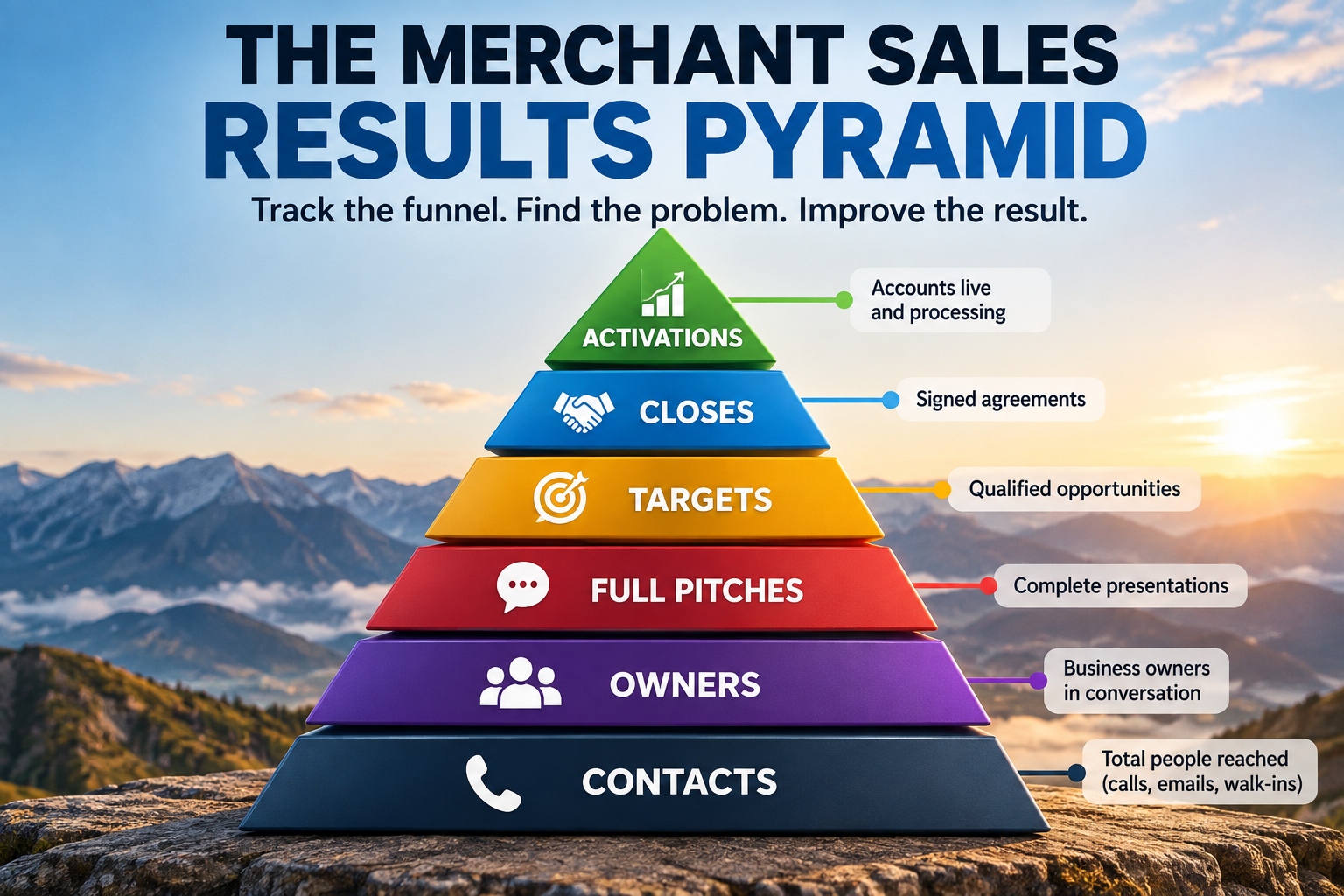
One of the frameworks I've taught agents for years is my Results Pyramid.
It follows the progression from:
Contacts → Owners → Full Pitches → Targets → Closes → Activations
Every stage depends on activity and effectiveness at the stages before it.
If you're not getting enough owner conversations, you may need to improve your prospecting approach.
If you're having plenty of conversations but not generating qualified opportunities, you may need to improve your presentations or qualification.
If you're preparing proposals but not signing deals, your follow-up or closing process may deserve a closer look.
Those aren't automatic diagnoses.
They're starting points for evaluating your performance.
Watch: How to Succeed in Merchant Sales — The Results Pyramid
This is an older training video, but the underlying principles still apply.
Watch My Results Pyramid Training
Why Follow-Up Is Where So Many Merchant Services Deals Are Won or Lost
Most merchants aren't sitting around waiting for a payment-processing salesperson to walk through their door.
They're busy running businesses.
They're dealing with employees, customers, inventory, scheduling, vendors, and a hundred other responsibilities.
Even when they're interested in what you offer, changing payment systems might not be their top priority that day.
That's why follow-up matters.
But there's a difference between professional follow-up and repeatedly asking someone whether they've made a decision.
Weak follow-up sounds like:
"Just checking in."
Better follow-up provides a reason to reconnect.
For example:
Reviewing the processing analysis you prepared
Answering a question about the proposed system
Coordinating a POS demonstration
Confirming installation requirements
Discussing a merchant's upcoming contract renewal
Sharing relevant information about a problem the merchant mentioned
Good follow-up helps move the conversation forward.
It also respects the merchant's time.
The Follow-Up Rule I Want Every Agent to Remember
Never end a productive sales conversation without trying to establish the next step.
That doesn't mean pressuring someone into a commitment.
It means creating clarity.
If a merchant wants to think about your proposal, ask when it would be useful to reconnect.
If they need to involve another decision-maker, discuss how to include that person.
If the timing isn't right, find out when the situation may change.
And then record it.
Because remembering to follow up shouldn't depend on whether you happen to think about that merchant next week.
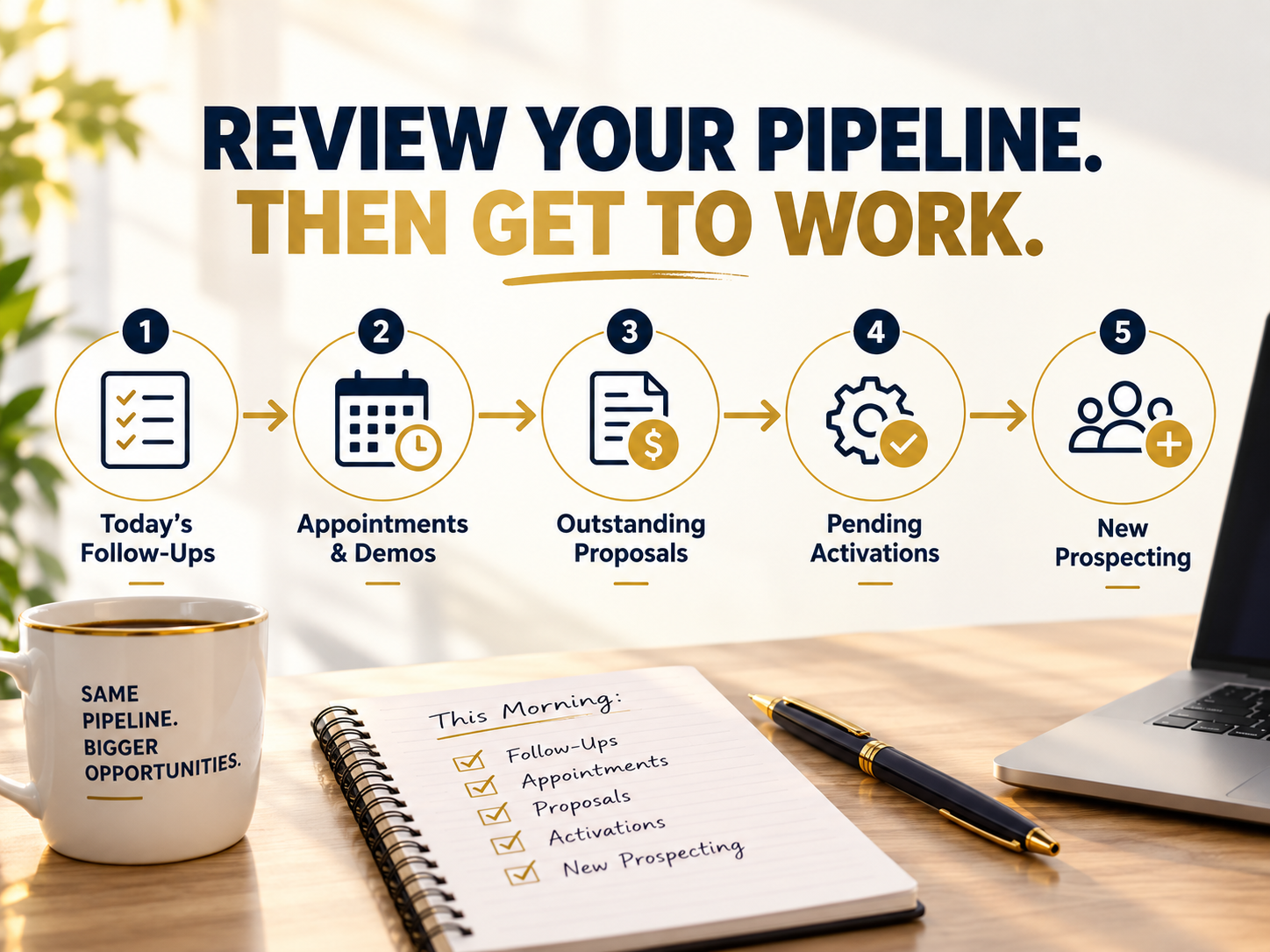
How to Review Your Merchant Sales Pipeline Every Morning
You don't need to spend an hour organizing your CRM before you start selling.
In fact, I'd argue that's another form of avoiding production.
Your pipeline should help you get to work faster.
Here's a simple routine.
Step 1: Review Today's Follow-Ups
Identify the merchants you're scheduled to contact.
Look at your notes so you remember the last conversation and why you're reaching out.
Step 2: Check Upcoming Appointments and POS Demos
Make sure you know who's attending, what needs to be prepared, and what you want to accomplish.
Step 3: Review Outstanding Proposals
Which merchants are waiting for a review conversation?
Which proposals have stalled?
Which opportunities need clarification or another decision-maker?
Step 4: Check Signed Deals Awaiting Approval or Activation
Identify anything that needs your attention to help the merchant move toward a successful activation.
Step 5: Get Back to Prospecting
Once you've handled the most important pipeline priorities, focus on generating new business.
This is the part agents can't afford to skip.
Your CRM should help you organize production.
It shouldn't become an excuse to avoid it.
Your Pipeline Should Help You Forecast Opportunities, Not Promise Income
One of the advantages of maintaining an organized pipeline is having a clearer picture of potential future business.
You may have:
Several proposals under review
Two scheduled POS demonstrations
A few signed deals awaiting approval
Approved accounts waiting for activation
That's useful information.
It tells you what may be coming.
But there's an important distinction between potential income and actual income.
A proposal isn't a commission.
A signed deal isn't necessarily an activated account.
And an activated account doesn't guarantee a particular residual payment.
Actual compensation depends on the processor, merchant activity, your agreement, and other factors.
This is why I believe agents should track pipeline opportunities and commission information separately.
An organized CRM helps you see what's in progress without confusing projections with money you've already earned.
Why I Built EZ MerchantTracker for Merchant Services Agents
For years, I've watched agents try to manage their merchant-services businesses with generic spreadsheets, scattered notes, and processor dashboards.
And processor dashboards serve an important purpose.
They help you review information related to merchant accounts, processing activity, underwriting, and compensation.
But they're not always designed to help you manage everything that happens before a merchant becomes an active account.
That's the gap I wanted to address.
I built EZ MerchantTracker specifically around the needs of individual merchant-services agents.
It brings important parts of the sales process into one place so you can:
Organize leads and contacts
Manage your sales pipeline
Track follow-ups
Record prospecting activity
Monitor proposals and POS demonstrations
Track signed, approved, and activated deals
Review personal conversion ratios
Keep better visibility into commissions and potential opportunities
The goal isn't to make you spend more time staring at software.
The goal is to help you spend less time wondering what you should be doing and more time actually producing.
New Agent? Start Tracking Your Business From Day One
One of the biggest mistakes you can make is waiting until you have dozens of prospects before creating a system.
Your first five leads deserve to be organized just as much as your next 500.
If you're just entering merchant services, developing good pipeline habits early can save you a lot of frustration later.
EZ MerchantTracker is officially available, and you can try it free for 14 days.
Start Your 14-Day Free Trial of EZ MerchantTracker
Want to see how the software works first?
Watch My Full EZ MerchantTracker Demonstration
You can also explore the software and coaching plans.
Software Helps You Stay Organized. Accountability Helps You Execute.
I believe having a good CRM is important.
But I also know software alone won't make someone successful.
You still have to knock on doors.
You still have to make calls.
You still have to conduct presentations, follow up, run demos, and close deals.
You have to develop the discipline to repeat those actions consistently.
That's why I also created Portfolio Builders Coaching.
It's a separate coaching and accountability program for agents who want direct guidance on their sales activities, pipeline, performance, and long-term goals.
The coaching focuses on helping agents identify where they need to improve and stay accountable to the work required.
For some agents, a good CRM is exactly what they need.
Others want software combined with direct coaching and support.
Both options are available.
Explore Portfolio Builders Coaching
The Biggest Merchant Sales Pipeline Mistakes to Avoid
Before we wrap up, here are the mistakes I want you to watch for.
Mistake 1: Collecting Leads Without Working Them
A long prospect list means very little if you aren't contacting business owners and creating opportunities.
Mistake 2: Forgetting Follow-Ups
Interested merchants can slip away simply because nobody followed through.
Mistake 3: Keeping Dead Opportunities Active Forever
An inflated pipeline makes it difficult to understand what's genuinely progressing.
Mistake 4: Confusing Signed Deals With Active Accounts
Track the steps after the signature, including approvals and activations.
Mistake 5: Spending Too Much Time Organizing Instead of Selling
Your CRM should support production, not replace it.
Mistake 6: Failing to Track Your Results
If you don't know how many proposals, demos, and signed deals your activity produces, it's harder to identify opportunities to improve.
Mistake 7: Starting Over Every Monday
Your pipeline should carry your opportunities forward from week to week.
Every Monday should involve new prospecting and continued progress on existing opportunities, not rebuilding your business from scratch.
Final Thought: Your Pipeline Is the Foundation of Your Future Portfolio
Here's how I want you to think about this.
Every active merchant account in your portfolio started as an opportunity.
At some point, someone identified a business, started a conversation, presented a solution, and followed through.
Some of those conversations moved quickly.
Others took time.
But the process required organization, persistence, and action.
If you're serious about building residual income in merchant services, stop treating your pipeline like a collection of random contacts.
Treat it like the operating system for your sales business.
Know who you're working with.
Know where every opportunity stands.
Know what needs to happen next.
And then do the work.
Because the goal isn't to build the biggest pipeline on paper.
The goal is to turn consistent sales activity into signed deals, activated merchants, and a stronger long-term portfolio.
Continue Learning
If you want to improve the way you manage your merchant-services business, these related articles will help:
Merchant Services KPIs: The Sales Numbers Every Agent Should Track
Sales Activity vs. Sales Results: What Merchant Services Agents Should Measure First
Merchant Services Agent CRM: Why Your Processor Dashboard Isn't Enough
Merchant Sales Tracking Software: Why Agents Need to Know Their Numbers
If you're completely new to the industry, you can also start learning through Merchant Service University, my free merchant-services education platform.
And if you're ready to organize your sales business, start your free 14-day EZ MerchantTracker trial.
Frequently Asked Questions About Merchant Services Sales Pipelines
What is a merchant services sales pipeline?
A merchant services sales pipeline is a system for organizing prospective business clients and tracking their progress from initial contact through proposals, demonstrations, signed agreements, approvals, and activation. It helps agents understand where opportunities stand and what actions need to happen next.
How do I organize merchant services leads?
Start by recording each business's name, contact information, decision-maker, current status, relevant notes, and next follow-up action. A merchant-services CRM can help keep this information organized and make it easier to manage opportunities as your pipeline grows.
How often should merchant services agents follow up?
There isn't one follow-up schedule that works for every prospect. Timing should depend on the merchant's needs, level of interest, agreed next steps, and the reason for reconnecting. The most important thing is to establish a specific purpose and appropriate time for each follow-up.
What's the difference between a lead and a qualified prospect?
A lead is a business you may want to contact. A qualified prospect is a business where you've identified a realistic opportunity, such as a decision-maker willing to evaluate your solution, a problem you can help solve, or an appropriate timeline for making a decision.
Should new merchant services agents use a CRM?
Yes, a simple CRM can be valuable even when you're just getting started. Developing good lead-management and follow-up habits early can make it easier to stay organized as your business grows. The CRM should be easy enough to use consistently without distracting from prospecting.
What's the difference between a signed deal and an activated merchant account?
A signed deal means the merchant has agreed to move forward and completed the required sales paperwork. An activated account has progressed through the applicable approval and setup steps. Actual residual compensation generally depends on subsequent merchant processing activity and the terms of the agent's agreement.
How can I tell if my merchant sales pipeline is healthy?
Look beyond the total number of leads. Review whether you're consistently adding new opportunities, scheduling meaningful follow-ups, producing proposals and demos, signing deals, and moving accounts toward activation. Your personal conversion ratios can help identify areas that deserve attention.
Can EZ MerchantTracker help manage my merchant services pipeline?
Yes. EZ MerchantTracker is built for individual merchant-services agents and includes lead management, pipeline statuses, follow-up organization, production tracking, and performance measurement. You can explore it through the 14-day free trial.