Merchant Services KPIs: The Sales Numbers Every Agent Should Track
Merchant Services KPIs: The Sales Numbers Every Agent Should Track
If I asked you how your merchant-services business is doing right now, what would you tell me?
“Pretty good.”
“I'm working hard.”
“I've got a few deals going.”
“I should have a couple close soon.”
“I've been really busy.”
None of those are numbers.
And that's a problem.
I've been in merchant services for more than 16 years, and one of the strangest things about this business is how many salespeople build their income around production without consistently measuring the activities that create that production.
They know their residual check. They might know how many accounts they signed last month. But ask them how much prospecting produced those accounts, how many proposals they generated, how many POS demonstrations they completed, or whether their conversion rates are improving, and suddenly the answers become guesses.
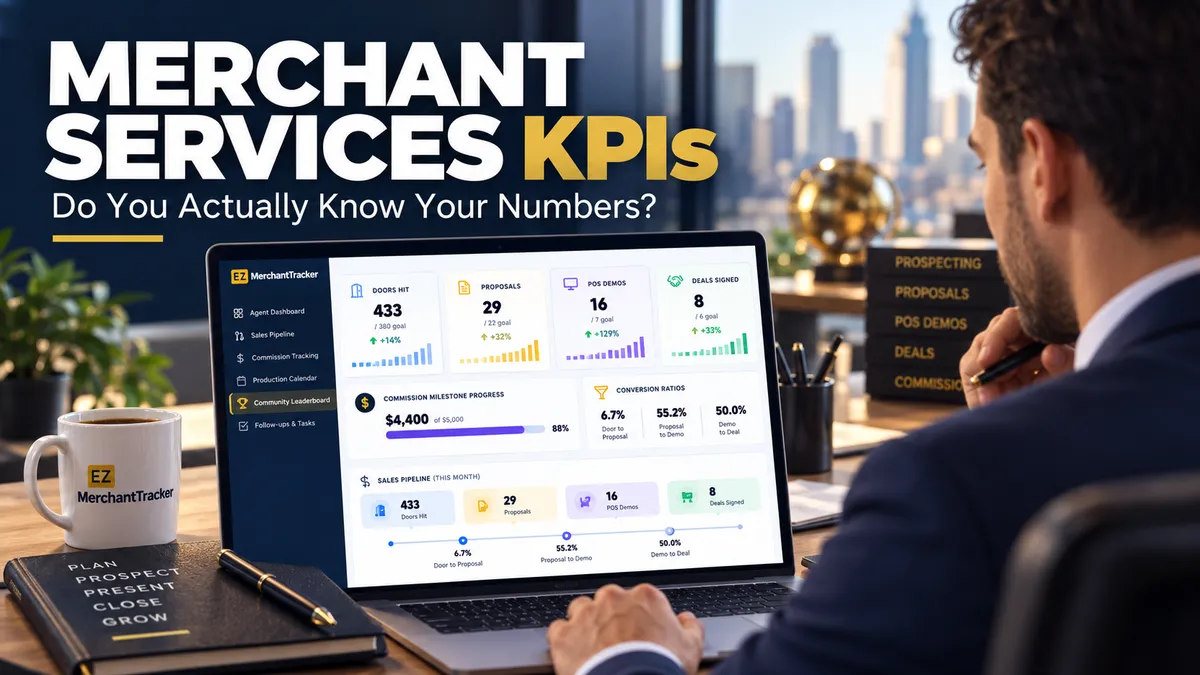
That's one of the primary reasons I built EZ MerchantTracker, a CRM and performance-tracking platform specifically for merchant-services sales agents.
I don't just want to know the final result.
I want to understand what created it.
Because when you know the numbers behind your production, you can stop guessing about your business and start diagnosing it.
And when you combine that data with human coaching and accountability through Portfolio Builders, those numbers become even more useful.
They give us somewhere to look.
Watch the EZ MerchantTracker Demo | Start Your 14-Day Free Trial
What Are Merchant Services KPIs?
KPI stands for key performance indicator.
In merchant sales, a KPI is a measurable number that helps you understand some part of your sales performance.
But there's an important distinction.
Not every number you can measure deserves to become a KPI.
I'm not interested in collecting data just because software allows us to collect it. A useful KPI should help answer a meaningful question.
Are you doing enough productive activity? Are you generating legitimate opportunities? Is your pipeline moving? Are proposals becoming signed accounts? Are those accounts activating? Are you becoming more effective over time?
Those are questions worth answering.
Tracking without interpretation is just collecting numbers. The goal is to make better decisions.
Leading vs. Lagging Indicators: Two Types of Sales Numbers
Before getting into the individual KPIs, understand the difference between leading indicators and lagging indicators.
Leading indicators are the activities and conditions that can contribute to future sales results. Prospecting, presentations, proposals and POS demonstrations are examples.
Lagging indicators are the outcomes that have already occurred. Signed deals, activations, commissions and residual growth fall into this category.
Both matter.
The mistake is measuring only the reward.
If you tell me you signed two accounts this month, I still don't know enough.
Did you generate a large number of opportunities and struggle to convert them? Or did you complete very little prospecting and happen to close two merchants?
Same result. Completely different performance.
That's why I teach agents to measure productive sales activity alongside their results.
Results tell you what happened. Activity helps explain why.
KPI #1: Prospecting Activity
Everything starts somewhere.
For most merchant-services agents, that means creating conversations with business owners.
If you're selling door-to-door, prospecting activity might be measured by businesses visited. If you're selling by phone, it might include calls made and meaningful contacts. If you're using referrals, networking or existing business relationships, your approach may look different.
That's why I don't believe every agent needs to use one universal prospecting method.
But regardless of how you prospect, the fundamental question remains:
Are you consistently creating enough new conversations to feed your pipeline?
An agent might believe they have a closing problem when they simply aren't generating enough opportunities to close.
This is where tracking can eliminate a lot of unnecessary guesswork.
And don't confuse prospecting activity with driving around town, researching businesses or organizing lists. Those things can support prospecting, but the meaningful activity is actually engaging with potential clients.
KPI #2: Owner and Decision-Maker Conversations
Prospecting volume doesn't automatically equal opportunity.
You can walk into a lot of businesses without reaching a decision-maker. You can make a lot of phone calls without ever speaking with someone who has the authority to evaluate a change.
That's why I want to know how often your activity gets you in front of the right person.
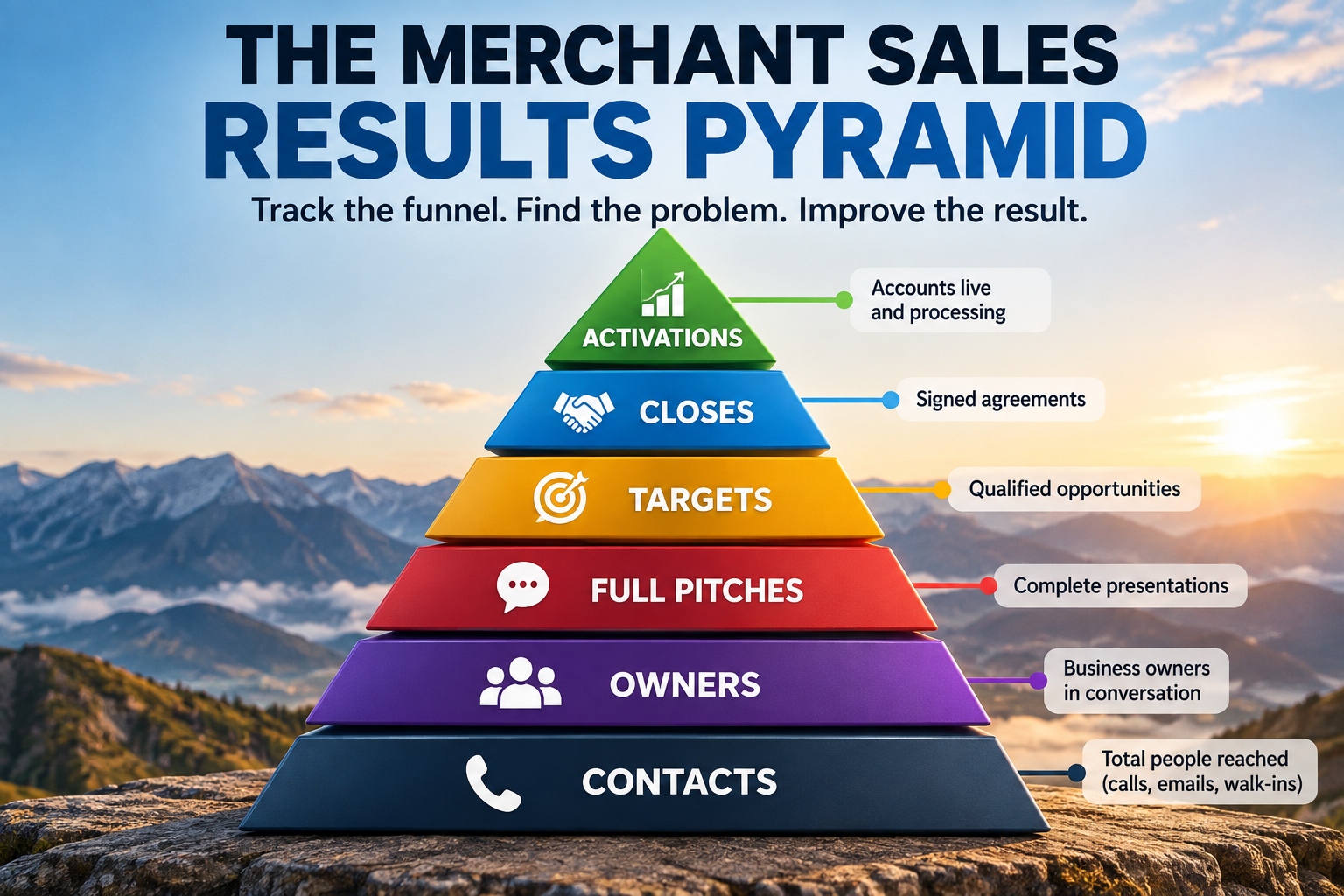
This is also where my Results Pyramid becomes useful.
The framework follows:
Contacts → Owners → Full Pitches → Targets → Closes → Activations
Contacts matter, but they're only the beginning.
If you're creating plenty of contacts but rarely reaching owners, the problem may not be effort. It may be your approach, timing, territory or ability to navigate the business.
The numbers tell us where to investigate.
KPI #3: Full Sales Presentations
Getting in front of an owner still isn't enough.
What happened after you reached them?
Did you have a meaningful conversation about their business? Did you ask questions, understand their current processing or POS setup, and uncover anything worth improving?
Or did you introduce yourself, hear “we're happy,” and walk away?
An agent might tell me they spoke with 20 business owners.
Great.
How many real presentations came from those conversations?
Now we're getting closer to understanding performance.
A full presentation doesn't have to mean delivering a formal slideshow. It means advancing beyond an introduction into a substantive sales conversation.
When agents struggle at this stage, we may need to improve their opening, short story, discovery questions or ability to keep the conversation moving.
KPI #4: Qualified Merchant Targets
Not every business you speak with is a legitimate opportunity right now.
And that's okay.
Your job isn't to convince yourself that every conversation should become a deal.
Your job is to identify businesses where you can create real value.
Maybe the merchant is experiencing poor service. Maybe there's an opportunity to improve processing costs. Maybe their equipment is outdated, their POS system creates unnecessary work, or their current technology doesn't support the way their business operates.
When you identify a genuine problem you can help solve, you've found a target.
This is where quality begins to matter just as much as quantity.
An agent who speaks with many owners but identifies very few legitimate opportunities may need help with discovery, qualification or targeting.
And that's a different problem from not prospecting enough.
KPI #5: Proposals and Processing Rate Analyses
Once you've identified a legitimate target, what happened next?
Did you move the opportunity forward?
One of the things I teach agents is to avoid constantly leaving promising merchant conversations with nothing accomplished except, “I'll come back another day.”
If pricing is part of the opportunity, can you obtain the information needed to complete a proper processing cost analysis?
If the merchant needs a new solution, can you prepare a proposal that addresses the problem you've identified?
Those are measurable commitments.
Proposals are important because they indicate that a conversation has advanced into a more serious sales opportunity.
If you're completing plenty of presentations but generating very few proposals, that's useful information.
And if you're producing plenty of proposals but rarely closing, that tells us something different.
KPI #6: POS Demonstrations
If a merchant needs new technology, a POS demonstration may be the most valuable next step.
Some merchants need relatively straightforward processing solutions. Others need more sophisticated systems for restaurants, retail operations or other business environments.
When technology is a meaningful part of the opportunity, a demonstration can move the conversation from discussing features to seeing how a solution could work inside the business.
That's why POS demos are one of the production activities I emphasize.
If you're selling technology-driven solutions but rarely getting merchants into demonstrations, there's something worth investigating.
Maybe you aren't uncovering enough operational problems. Maybe you aren't presenting the value of the demonstration. Or maybe you're relying too heavily on price when the real opportunity is solving a business problem.
Start Tracking Your Production With EZ MerchantTracker
You don't have to wait until the end of the year to wonder why your sales results were better or worse than expected.
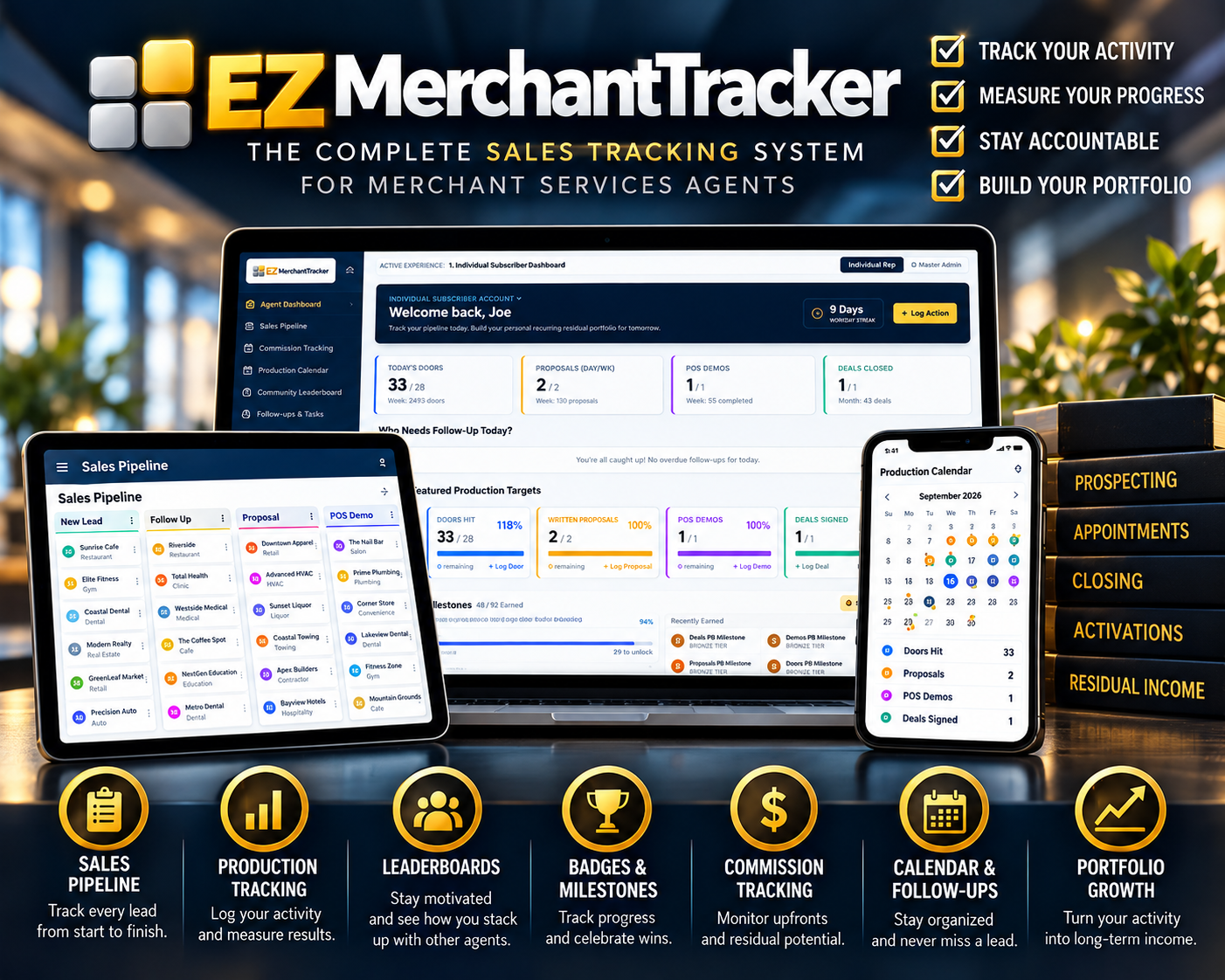
EZ MerchantTracker has officially launched, and you can now begin tracking your pipeline, daily production, conversion ratios, commissions and performance history.
You can start your 14-day free trial here, or watch my full software demonstration before registering.
For a deeper look at how the platform connects these measurements, read Merchant Sales Tracking Software: How to Know Your Numbers and Build a Bigger Portfolio.
KPI #7: Deals Signed
Now we reach the number everybody wants.
Deals.
How many merchants actually agreed to move forward?
This absolutely matters. Signed accounts are an important measure of sales production.
But I still want more context.
How many opportunities did it take to create those deals? How many proposals? How many demos? How much prospecting?
If you signed four merchants, that's a result.
If you also know what produced those four merchants, you begin developing a repeatable understanding of your sales process.
And that's where the information becomes much more valuable.
KPI #8: Approvals and Activations
A signed application isn't the finish line.
The merchant still needs to move through underwriting, approval, implementation and activation.
That's why I don't want the sales process ending at “Deal Signed.”
We also need visibility into Approved and Activated.
If you're signing plenty of merchants but a significant number never activate, there's another constraint to investigate.
Maybe expectations weren't set properly. Maybe underwriting is creating delays. Maybe implementation has become complicated. Maybe the merchant wasn't properly rehashed before the agreement was submitted.
Whatever the reason, the data tells us where to start looking.
A signed deal that never activates doesn't contribute to the residual portfolio the way an active processing account can.
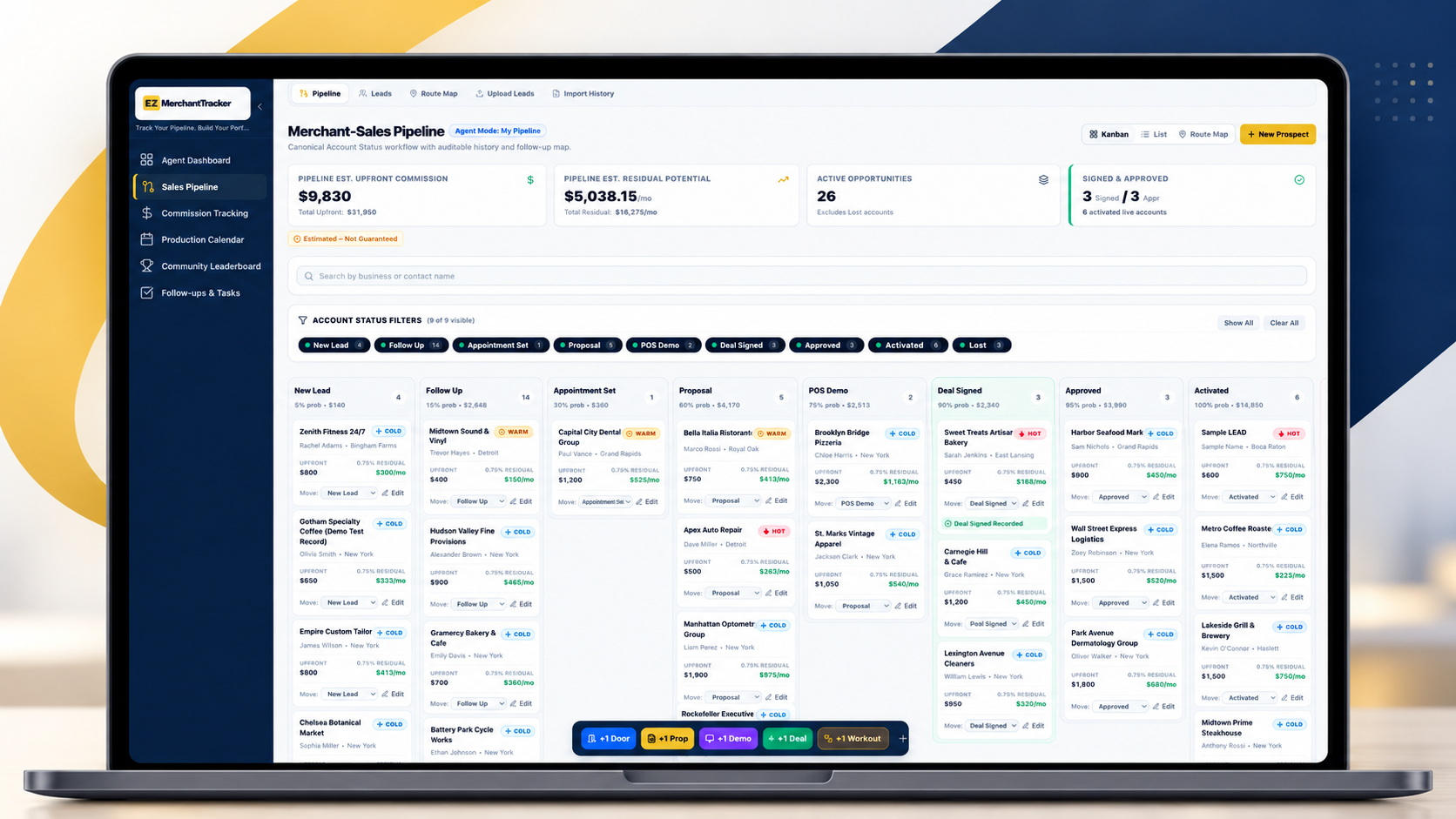
KPI #9: Follow-Up and Pipeline Movement
Follow-up is one of the easiest parts of sales to underestimate.
A merchant tells you to call Tuesday. Tuesday comes, and you forget.
A proposal goes out, but nobody schedules the next conversation.
A business owner expresses interest but needs more time. You make a mental note, and suddenly two weeks have passed.
Good opportunities can disappear because nobody took the next step.
That's why follow-up should be organized, visible and consistent.
I want agents asking themselves whether every legitimate opportunity has a next action, whether proposals are moving forward, and which merchants have been sitting too long without meaningful contact.
This is where a dedicated CRM becomes valuable.
Your processor's platform may help manage accounts and applications, but the individual agent also needs a way to manage the work happening before a merchant becomes an active account.
I explain this in Merchant Services Agent CRM: Why Processor Dashboards Aren't Enough for Salespeople.
A full pipeline means nothing if nothing moves.
KPI #10: Your Personal Sales Conversion Ratios
This is where the individual numbers begin connecting.
Instead of simply knowing you signed four accounts, you can start asking what produced those four accounts.
How frequently do proposals become signed deals?
How frequently do POS demos convert into business?
How much prospecting typically produces a signed account?
And how does that performance change over time?
Inside EZ MerchantTracker, the core conversion measurements focus on prospecting activity, proposals and POS demonstrations in relation to signed deals.
Other measures, such as signed-to-activated performance, can be examined by reviewing pipeline outcomes.
The important distinction is that you don't need to rely entirely on somebody else's industry-average closing ratio.
I have standards and benchmarks I teach.
But I also want agents to develop something more valuable.
Their own numbers.
Your market, experience, prospecting approach, merchant types and sales process can all influence your conversion rates.
The objective is to build a personal baseline and then improve it.
Historical Trends Matter More Than One Great Month
Anybody can have a great week.
Anybody can have a terrible week.
What interests me is the trend.
Are you becoming more productive? Are your ratios improving? Is your prospecting becoming more consistent? Are you producing more opportunities from the same amount of effort?
Did your production drop because your activity declined?
Did a change in your approach improve your closing performance?
Now we're learning something.
One isolated number gives you a snapshot.
Historical performance gives you a story.
That's why I want agents recording meaningful data over time rather than waiting until they have a problem to start paying attention.
Your Sales Pipeline Is a KPI Too
Your active pipeline matters because it gives you visibility into potential future production.
How many legitimate opportunities are you working?
Where are they in the sales process?
How many are awaiting proposals, POS demos or appointments?
How many signed deals are waiting for approval or activation?
And what is the estimated financial potential associated with those opportunities?
EZ MerchantTracker is designed to help agents organize these stages and understand pipeline potential.
But the word potential is critical.
A proposal isn't income. An estimated commission isn't a payment. And a signed deal isn't necessarily an activated merchant.
Pipeline projections should help you plan, not convince you that money has already been earned.
For more on how the software is organized around the individual salesperson, see EZ MerchantTracker: A CRM & Performance Tracking System Built for Merchant Services Agents.
Commission Tracking Connects Production to Money
Salespeople work to get paid.
So commission visibility belongs in the conversation.
Depending on your processing partnership, compensation may include upfront commissions, activation-related bonuses, profitability-based payments and ongoing residual income.
I want agents to understand what they've produced, what payments may still be outstanding and what has actually been received.
EZ MerchantTracker provides commission-tracking capabilities alongside the sales pipeline.
However, it doesn't replace your processor's official commission statements or accounting.
Your processing partner remains the authority for official compensation and payment records.
The value of tracking commissions alongside production is that you gain another perspective on the financial side of the business you're building.
The Most Important KPI: Are You Improving?
This isn't a single number.
It's the question all the other numbers should eventually help answer.
Are you getting better?
If you completed the same amount of prospecting six months ago, are you creating more opportunities today?
Are you converting more proposals?
Are your POS demos more effective?
Are you following up more consistently?
Are you signing more accounts from similar activity?
Are more of those accounts activating?
That's what performance tracking should ultimately help you understand.
Not just whether you worked.
Not just whether you got paid.
But whether you're becoming a more effective merchant-services salesperson.
How AI Could Eventually Make Merchant Sales KPIs More Valuable
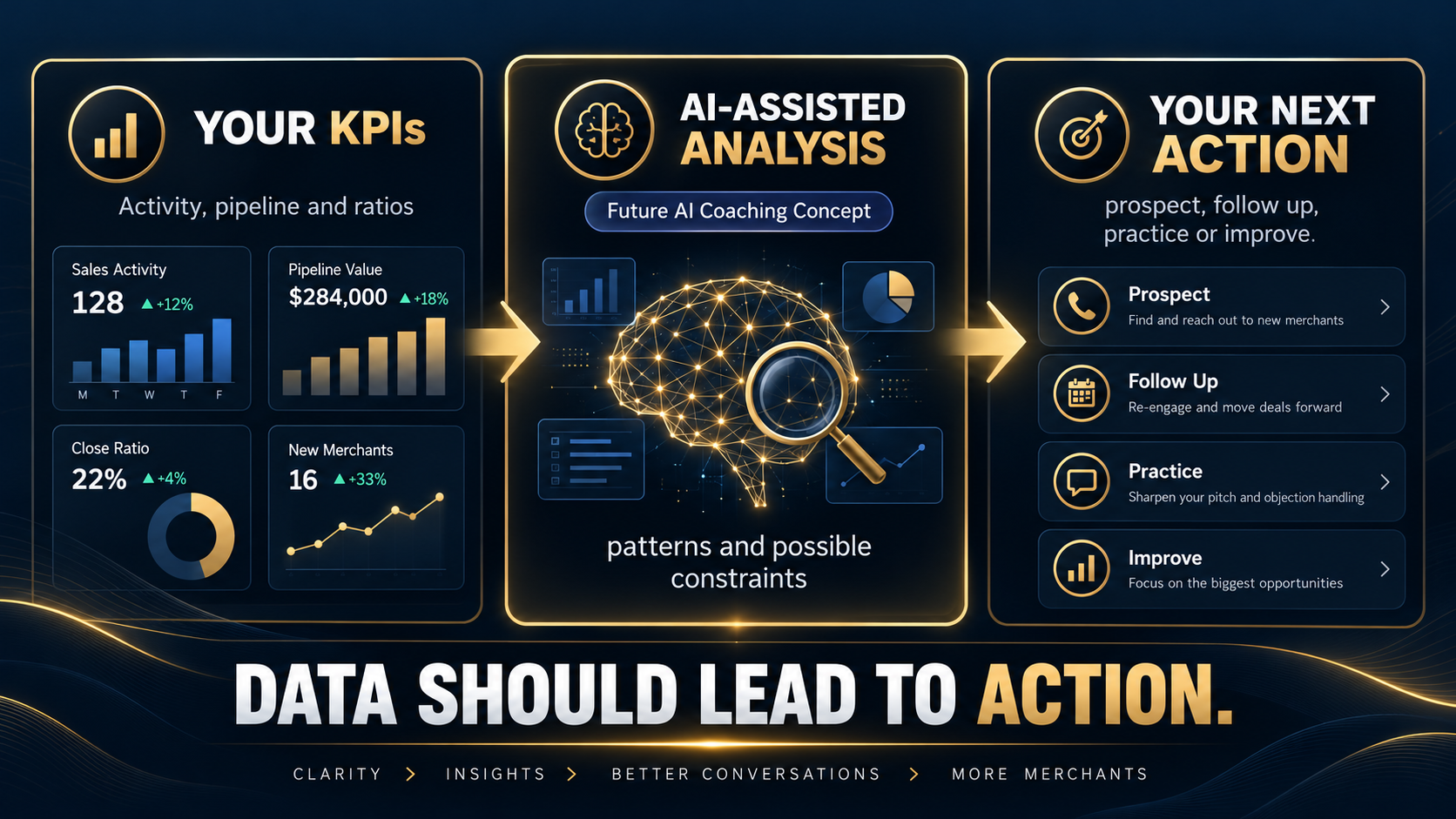
One of the directions I'm excited about as EZ MerchantTracker evolves is AI-assisted sales coaching.
A generic AI coach can provide generic advice about prospecting, objections and closing.
But imagine an AI system that understands both merchant-services sales methodology and an agent's actual performance history.
Instead of automatically telling an agent to prospect more, it might identify that prospecting volume is already strong but proposal conversion has declined.
Or it might recognize that an agent closes well when they create legitimate opportunities, but simply isn't creating enough of them.
That kind of contextual guidance could help make coaching more specific.
This is the direction I'm exploring for future AI capabilities, not a claim that every feature described here is already live.
The principle is straightforward: performance data becomes more valuable when it helps identify the next useful action.
How KPIs Make Portfolio Builders Coaching More Effective
This is also why performance tracking is central to Portfolio Builders Coaching.
I don't want every coaching conversation to begin and end with, “How do you feel things are going?”
I want to understand the numbers.
What did you say you were going to do? What did you actually do? What did it produce? Where are opportunities getting stuck? What do your conversion ratios suggest?
Now we have something useful to work with.
Maybe the agent needs more activity.
Maybe the activity is there, but the sales skill needs improvement.
Maybe the pipeline is full, but follow-up is inconsistent.
Or maybe the numbers show the agent is improving and needs to continue executing the plan.
That's what I mean by coaching around performance rather than assumptions.
EZ MerchantTracker provides the scoreboard. Portfolio Builders provides direct coaching and accountability around that scoreboard. You provide the execution.
Portfolio Builders officially launched alongside EZ MerchantTracker, with coaching options for agents who want more personalized help.
You can review the software and Portfolio Builders plans here.
And to be clear, you do not have to enroll in coaching to use EZ MerchantTracker. The software is available independently.
KPIs Aren't About Micromanaging Yourself
Some agents hear all of this and think tracking sounds exhausting.
They don't want to spend every minute entering data into a CRM.
Neither do I.
That's not the point.
If your tracking system becomes so complicated that you're spending more time feeding the software than selling, you've defeated the purpose.
The right metrics should create clarity.
You should be able to review your business and understand whether you're doing the work, whether opportunities are moving, what is converting, where you're struggling and what needs attention.
Then get back to selling.
The scoreboard isn't the game. It's there to tell you how the game is going.
The Numbers Don't Lie, but They Don't Always Explain Why
Data is powerful.
But it still requires interpretation.
A poor proposal-to-close ratio doesn't automatically prove somebody is a bad closer.
Maybe they're qualifying weak opportunities. Maybe their proposals aren't solving the merchant's actual problem. Maybe they're competing on price when they should be presenting value.
Perhaps the merchant isn't the true decision-maker, follow-up is weak or the solution simply isn't a good fit.
The KPI gives us a signal.
Then we investigate.
That's why I believe the combination of tracking, training, coaching and accountability is so important.
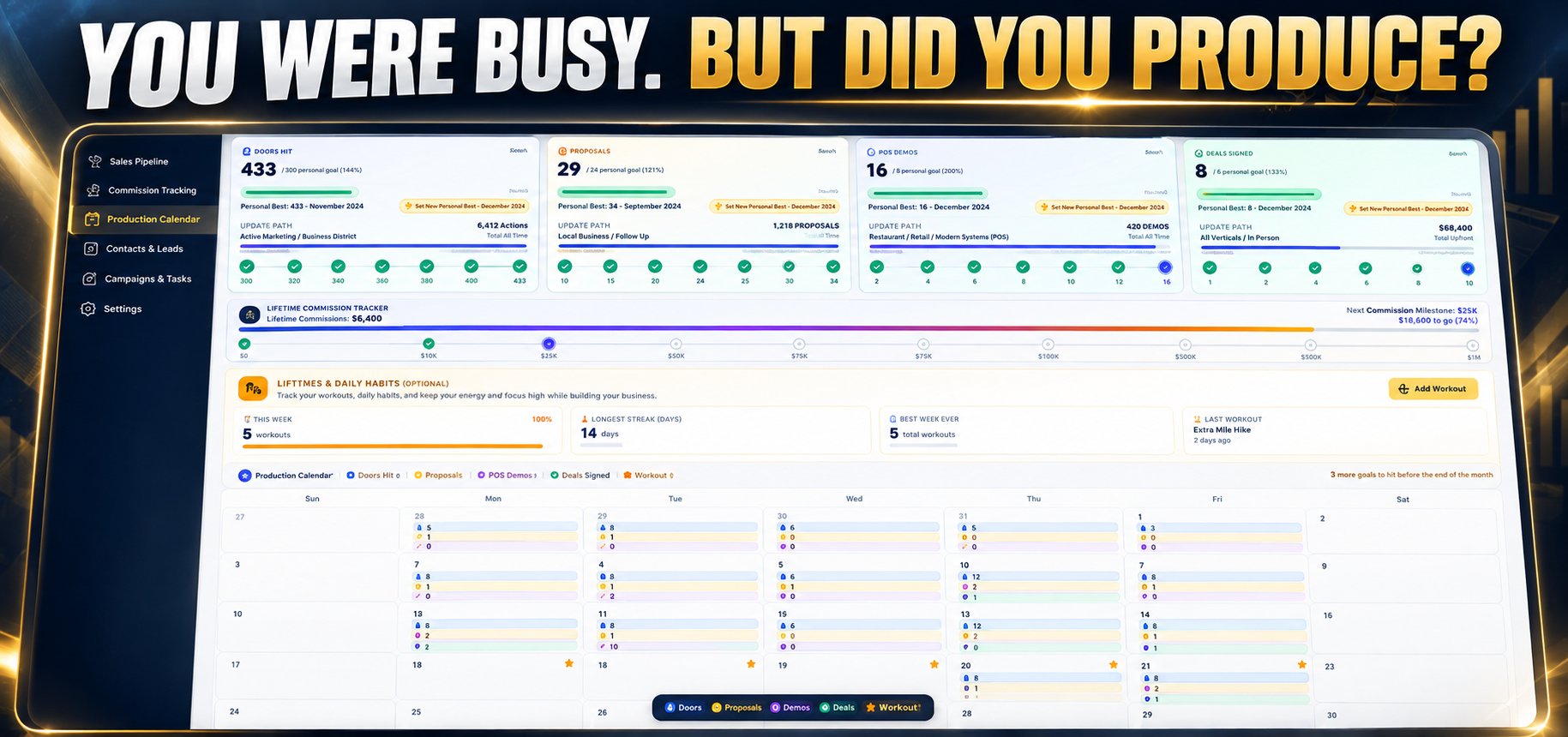
Don't Confuse Being Busy With Producing
This might be the most important lesson in the entire article.
You can stay incredibly busy without producing very much.
Answering emails, researching technology, organizing leads, redesigning a website, watching training, posting on social media and planning your week can all have a place in running a business.
But eventually, we have to ask:
Did you move the business forward?
Did you create conversations? Reach owners? Complete presentations? Identify legitimate targets? Generate proposals? Schedule demonstrations? Follow up? Sign business? Get accounts activated?
That's production.
I encourage agents to protect their best selling hours for activities that create or advance real merchant opportunities.
The supporting work can be important, but it shouldn't continually replace the work that produces revenue.
If you want to explore this distinction further, read Sales Activity vs. Sales Results: What Merchant Services Agents Should Measure First.
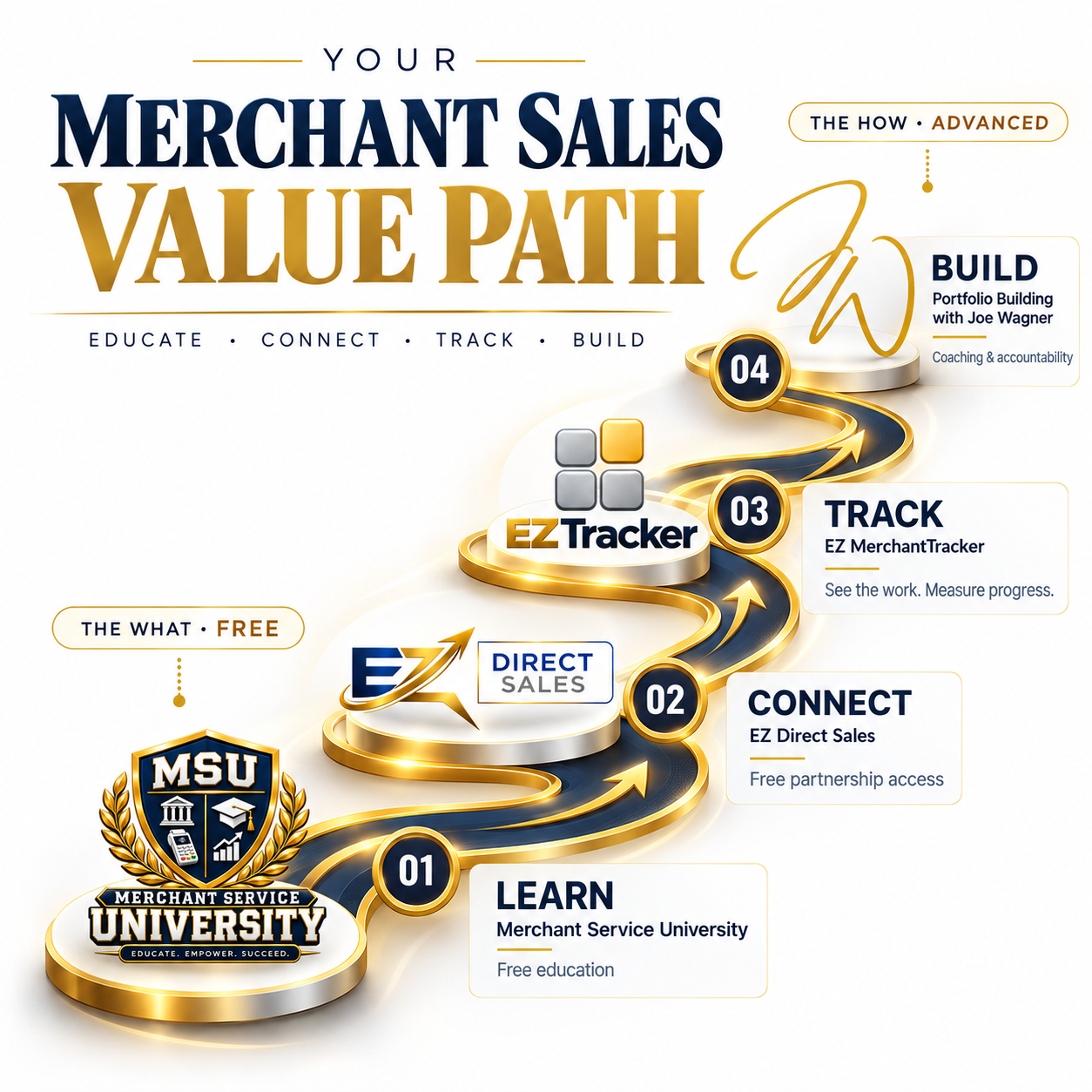
The Merchant Services Performance System
As I've built my education, software and coaching businesses, the different pieces have become increasingly clear.
LEARN — Merchant Service University
Free foundational education to help you understand payment processing, merchant-sales fundamentals and the industry before choosing a partnership.
START — EZ Direct Sales
A way for qualified individuals to explore trusted merchant-services partnerships and begin building their sales business.
TRACK — EZ MerchantTracker
Software to organize your pipeline, record production, track commissions and monitor performance.
IMPROVE — Training, Performance Reviews and Future AI Guidance
Use your data to identify constraints and develop stronger sales habits and skills. Future AI capabilities may provide additional guidance.
BUILD — Portfolio Builders Coaching
Direct human coaching, goal setting, performance reviews, accountability and portfolio-building guidance.
And one final component connects all of them.
YOU — EXECUTION
None of these tools, resources or programs builds the business if you don't do the work.
What Should You Do Next?
Don't make this more complicated than it needs to be.
If you're new to the industry, start with free merchant-services education at Merchant Service University.
If you're ready to evaluate partnerships and begin selling, explore EZ Direct Sales.
If you're already selling and want to understand your numbers, start your 14-day EZ MerchantTracker free trial.
If you'd like to see the platform first, watch my complete software demo or read the official EZ MerchantTracker and Portfolio Builders launch announcement.
And if you want direct help identifying performance constraints, improving your execution and staying accountable, explore Portfolio Builders Coaching.
You don't need 100 meaningless metrics.
You need to understand the numbers that tell you whether you're building the business.
Measure the activity. Measure the result. Learn your ratios. Find the constraint. Improve the performance. Build the portfolio.
Frequently Asked Questions
What are merchant services KPIs?
Merchant services KPIs are measurable indicators of sales activity and results in a payment-processing sales business. They include prospecting, presentations, proposals, POS demos, signed deals, activations, conversion ratios and commissions.
What are the most important KPIs for merchant services agents?
The most useful KPIs generally include prospecting activity, decision-maker conversations, full presentations, qualified targets, proposals, POS demonstrations, signed deals, approvals, activations, follow-up and personal conversion ratios.
Should I track sales activity or closed deals?
Both. Activity shows what you're doing to create opportunities, while closed deals show what those efforts have produced. Measuring both makes it easier to identify where performance can improve.
What is the difference between leading and lagging indicators?
Leading indicators measure activities that can contribute to future results, such as prospecting and presentations. Lagging indicators measure outcomes that have already happened, such as signed deals, activations and commissions.
What is the Results Pyramid?
Joe Wagner's Results Pyramid follows Contacts → Owners → Full Pitches → Targets → Closes → Activations. It helps agents examine each stage between initial prospecting and an activated merchant account.
What are merchant services conversion rates?
Conversion rates measure how frequently one stage of the sales process produces another outcome. Examples include proposal-to-signed-deal, POS-demo-to-signed-deal and prospecting-to-signed-deal ratios.
Is there one ideal closing ratio for every merchant services agent?
No. Conversion rates vary based on experience, merchant types, prospecting methods, solutions offered, qualification and other factors. Tracking personal historical performance can provide a useful baseline for improvement.
Does EZ MerchantTracker track merchant services KPIs?
Yes. EZ MerchantTracker includes production tracking, pipeline management, commission tracking and conversion-ratio reporting designed around merchant-services sales agents.
Is EZ MerchantTracker available now?
Yes. EZ MerchantTracker has officially launched, and you can register for a 14-day free trial at https://app.ezmerchanttracker.com/register.
Does EZ MerchantTracker replace my processor's reporting?
No. EZ MerchantTracker complements your processor's systems by focusing on the agent's sales activity, pipeline and performance. Official compensation and processing records remain with your processing partner.
Can I use EZ MerchantTracker without coaching?
Yes. EZ MerchantTracker is available as standalone software. Portfolio Builders Coaching is a separate option for agents who want direct coaching and accountability.
Where can I learn merchant services for free?
Merchant Service University provides free foundational education for people learning the merchant-services industry.