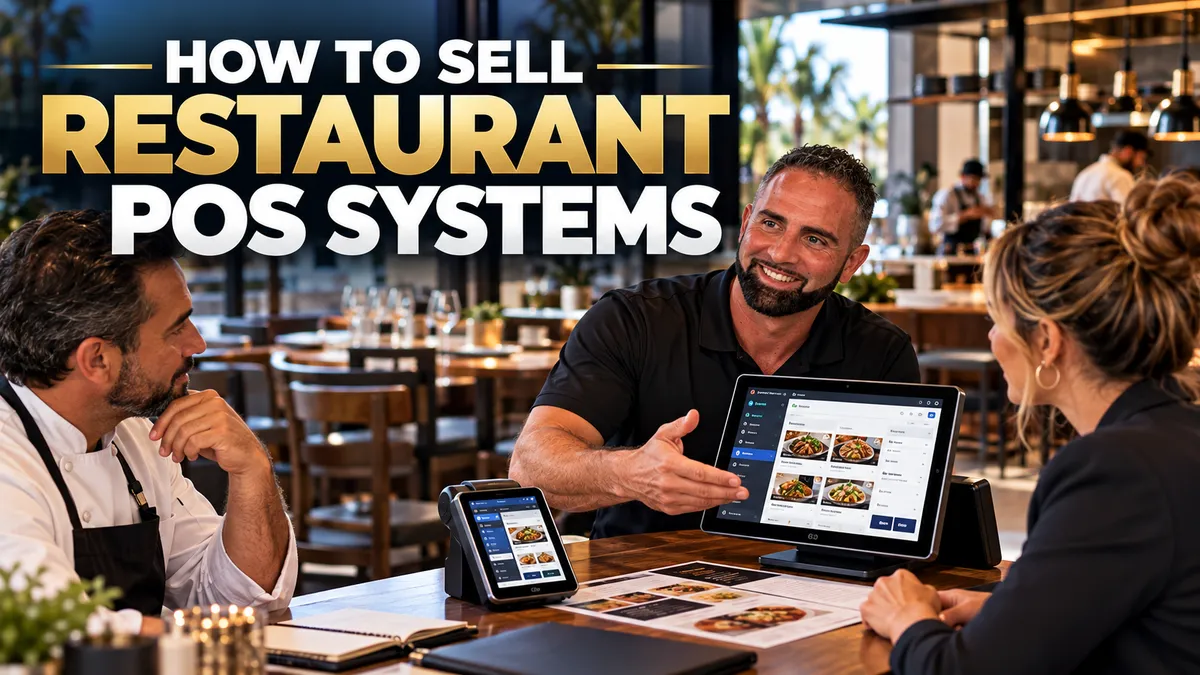
How to Sell Restaurant POS Systems With Demos, Cost Comparisons & Special Offers
How to Sell Restaurant POS Systems With Live Demos, Cost Comparisons, and Compelling Offers
Want to get the attention of a restaurant owner already using Toast or another established POS system? Give them a reason to take your call—and a technology solution worth considering.
One of the biggest challenges in restaurant and hospitality POS sales is getting a successful business owner interested in evaluating something new.
Think about it.
A restaurant owner may already have a POS system that's been running their business for years.
Their servers know how to use it.
Their kitchen is familiar with the workflow.
Their managers know where to find the reports.
Even if the owner has some frustrations, switching systems can feel like more trouble than it's worth.
Now imagine you're the sales agent approaching that restaurant.
You have two challenges.
First, you need a legitimate reason for the merchant to consider a conversation.
Second, once you've earned their attention, you need a POS system that can actually compete with what they already have.
That's why I believe successful restaurant POS sales requires three things working together: advanced technology, a compelling merchant offer, and the support needed to make the transition successful.
I've worked in merchant services since 2009, and I've seen how difficult it can be for agents to compete when they're offering little more than another processing rate or a basic POS terminal.
That's especially true when you're approaching sophisticated restaurants, busy bars, nightclubs, hotel restaurants, and resorts.
These merchants aren't necessarily looking for the cheapest payment device.
They need technology that supports their operations.
But even when you have the right system, you still need a way to get the owner's attention.
That's where a strong promotional campaign can make a difference.
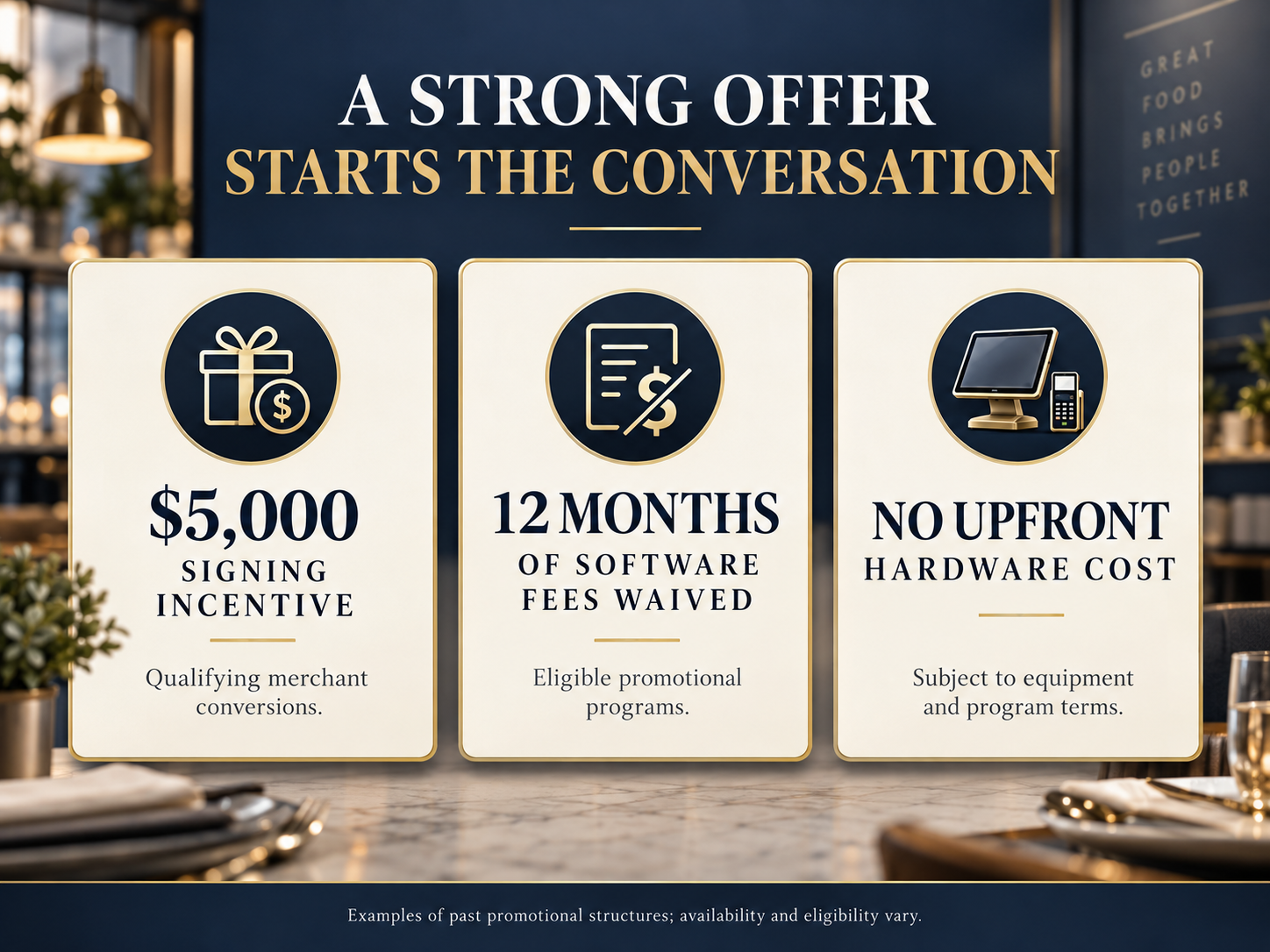
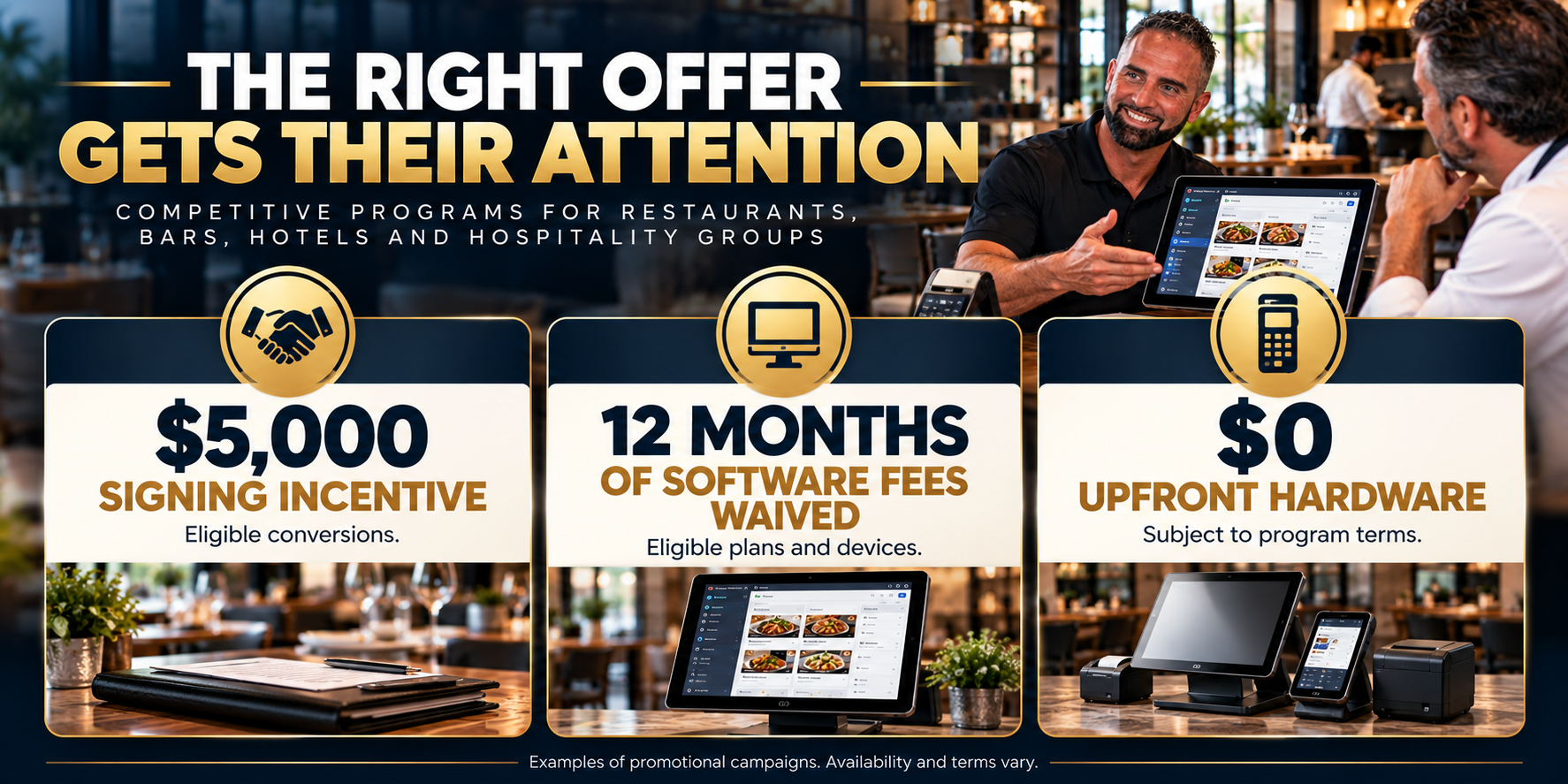
For example, restaurant POS campaigns we've worked with have included offers such as a $5,000 merchant signing incentive for qualifying conversions, or 12 months of waived POS software subscription fees for eligible merchants.
Those are the kinds of offers that can make a busy restaurant owner interested in hearing what you have to say.
But the promotion alone doesn't close the account.
Once the merchant agrees to take a look, you need to show them why the technology makes sense, how the costs compare, and who will help manage the installation.
In this guide, I'll explain how I approach that entire process—and why having access to the right hospitality POS partnership can make such a difference for independent sales agents.
If you're considering this specialization, start with my complete guide to becoming a restaurant POS sales agent and why selling restaurant POS systems creates an opportunity for merchant services agents.
1. The Two Reasons Agents Struggle to Get Larger Restaurant Accounts
I believe many merchant services agents are at a disadvantage before they ever walk into a sophisticated restaurant.
And there are two major reasons.
Problem One: They Don't Have the Right Technology
An agent might have access to a basic POS system that's perfectly suitable for a small retail store or a simple café.
But that doesn't mean the same system can support a full-service restaurant with complex kitchen routing, multiple bars, handheld ordering, detailed reporting, or specialized integrations.
Now consider a hotel restaurant that needs to post food-and-beverage purchases to guest room folios.
If your system can't support the property's required PMS integration, the opportunity may end before you even prepare a proposal.
You can be a great salesperson and still lose the account because your technology isn't the right fit.
Problem Two: They Don't Have an Offer That Gets the Merchant Interested
Even if your technology is capable, the merchant still needs a reason to take time out of their day to evaluate it.
If you approach a restaurant owner and say:
"I'd like to show you another POS system."
You may not get very far.
But imagine approaching that same merchant with a relevant promotional opportunity.
For example:
"We're working with restaurant owners who are evaluating new POS technology, and there have been programs offering qualifying merchants substantial switching incentives. Would you be open to seeing whether your restaurant qualifies and whether the system could improve your operation?"
That's a different conversation.
You're not simply asking the owner to look at equipment.
You're offering a reason to investigate.
The strongest sales position is having both: a reason to get the meeting and a product capable of winning the account.
2. Why Compelling POS Promotions Can Open Doors
Restaurant owners are busy.
They hear sales pitches constantly.
Credit card processing.
Payroll.
Advertising.
Insurance.
Food suppliers.
Technology.
Everyone wants a few minutes of their time.
That's why a promotional offer can be so useful when it's legitimate, relevant, and clearly explained.
It gives the merchant a specific reason to consider a conversation.
Example: A $5,000 Merchant Signing Incentive
One promotional campaign has offered a $5,000 signing bonus to qualifying restaurants switching from another POS provider.
Think about how different that sounds from the usual processing-rate pitch.
Instead of asking the owner to evaluate another system with no immediate reason to consider it, you're introducing a potentially meaningful financial incentive.
A restaurant owner might be thinking about upgrading equipment, remodeling, or replacing a system they're unhappy with.
A qualifying promotional incentive can make that evaluation more attractive.
But the terms matter.
A $5,000 signing bonus isn't automatically available to every restaurant.
For example, the published conversion promotion includes eligibility requirements involving the merchant's existing POS, processing volume, migration, and activation timing.
Agents need to verify the specific campaign's availability and conditions before advertising it to a prospect.
Example: Twelve Months of Waived SaaS Fees
Another compelling promotional structure we've worked with is waiving POS software subscription fees for the first 12 months for eligible merchants.
Imagine speaking with a restaurant owner who pays $250 per month in qualifying software subscriptions.
Twelve months at that amount represents $3,000 in software expenses.
If a promotion actually waives all $250 of those qualifying monthly charges, that's an illustrative $3,000 first-year benefit.
But the agent must confirm exactly which charges are waived, the number of covered devices, and any exclusions.
Not every fee on a restaurant's statement is necessarily covered by a software promotion.
Example: No Upfront Hardware Cost
Another way to get a merchant's attention is an eligible equipment program with no upfront hardware purchase requirement.
That can be meaningful when a restaurant needs multiple workstations, handhelds, or other devices.
But again, agents should explain the actual equipment arrangement, applicable terms, and any obligations.
Why These Offers Matter
The purpose of a promotional campaign isn't to convince a restaurant owner to accept technology that doesn't fit their business.
It's to create an opportunity for the merchant to evaluate a suitable alternative.
A promotion gets the conversation started. The technology and overall business value give the merchant a reason to move forward.
3. Don't Confuse a Promotional Hook With Your Entire Sales Presentation
Here's something I want agents to understand.
A great promotional offer may help you schedule more appointments.
But if you can't demonstrate the technology or explain the financial picture, you may still lose the account.
Imagine a restaurant owner agrees to meet because they're interested in a $5,000 incentive.
You arrive and discover the restaurant needs advanced kitchen routing, multiple handheld devices, and integrations your POS system doesn't support.
Now what?
The merchant may have been interested in the promotion, but the underlying solution isn't suitable.
That's why I want agents to qualify the opportunity before making promises.
The Three Questions That Matter
Does the merchant qualify for the promotional offer?
Confirm the current program terms, processing requirements, merchant type, and any activation deadlines.
Can the POS system meet the merchant's operational needs?
Understand the restaurant's workflows, required equipment, integrations, and service model.
Does the complete financial proposal make sense?
Review processing costs, software expenses, equipment arrangements, implementation, and any switching obligations.
When all three align, you may have a strong opportunity.
When one is missing, you need to address it before asking the merchant to make a decision.
4. Advanced Hospitality Technology Is What Makes the Opportunity Real
This is where I believe the right POS partnership can make a major difference.
A restaurant owner isn't necessarily interested in switching from an established system to something less capable.
They need a credible alternative.
That's why I'm focused on comprehensive hospitality POS technology rather than basic retail payment equipment.
Full-Service Restaurants
A sophisticated restaurant may need tableside ordering, kitchen display systems, table management, split checks, and multiple service stations.
Bars and Nightclubs
A busy bar may require efficient tab management, tip handling, staff permissions, and dependable transaction workflows during peak service.
Multi-Location Restaurants
A restaurant group may need centralized management, consistent menus, location-level reporting, and support across multiple sites.
Hotel Restaurants and Resort Bars
These merchants may have an additional requirement: integration with a compatible hotel property management system.
That integration can be critical when guests want to charge meals or drinks directly to their rooms.
And if your system can't support the hotel's required workflow, a promotional incentive alone isn't going to solve the problem.
Why Room Charges Are Such an Important Hospitality Feature
Imagine a guest at a resort who orders dinner at the hotel restaurant.
The bill is $125.
Instead of paying with a card at the table, the guest wants the charge posted to their room.
With a properly configured and compatible POS-to-PMS integration, the restaurant can verify the guest and post the eligible charge to the hotel folio.
Now imagine that same guest orders drinks at the pool bar the next day.
The hotel may need that charge handled through the same guest-account process.
For properties that rely on these workflows, room-charge integration can be a critical requirement.
Shift4 Dine documents room-charge functionality for properly integrated hotel locations, but compatibility and supported features must be verified for each property.
5. How to Get the Restaurant Owner Interested Without Sounding Like Every Other Salesperson
The opening conversation is important.
But I don't think you need a complicated pitch.
You need a compelling reason to speak with the merchant and a clear understanding of the business you're approaching.
The Promotional Offer Introduction
Here's an example of how I might approach an independent restaurant owner when a qualifying promotion is available:
"Hi, I'm Joe. I work with restaurants on their POS and payment technology. We're helping owners evaluate advanced restaurant systems, and there's a promotional program available for qualifying businesses switching from another provider.
I'd be interested in seeing whether your restaurant could qualify and whether the technology would make sense for your operation. Are you happy with what you're currently using?"
That's a much stronger opening than simply offering a lower processing rate.
If the $5,000 Campaign Is Available
You can be more specific:
"One reason I'm reaching out is that there's a promotion offering a $5,000 signing incentive for qualifying restaurants that switch POS systems. I don't know whether your restaurant qualifies yet, but if you're open to reviewing your current setup, I'd be happy to find out."
Notice that you're not guaranteeing the incentive.
You're giving the owner a reason to evaluate eligibility.
If a SaaS-Fee Waiver Is Available
You might say:
"We've had programs that waive qualifying POS software fees for the first 12 months. If something like that is available for your restaurant, would it be worth comparing the technology and total costs with what you're using today?"
Again, the offer is the introduction.
The next step is discovery.
For a Hotel Restaurant
I'd take a different approach:
"We work with hospitality POS technology, including solutions with compatible hotel PMS integrations for room charges. I'd be interested in learning what your restaurant and bars use today, whether those systems are connected to your property management platform, and whether you're considering any upgrades."
For a hotel, the operational capabilities may be a stronger initial hook than a general restaurant promotion.
And you should never assume a hotel qualifies for a restaurant-specific incentive.
6. The Live POS Demonstration Is Where You Prove the Value
Once the merchant is interested, the next challenge is showing them what the technology can actually do.
I believe a live demonstration is one of the most important parts of selling restaurant POS systems.
Why?
Because owners already have a POS system.
They understand the concept.
They don't need another brochure explaining that a terminal can accept credit cards.
They want to see whether the proposed system can make sense for their business.
Demonstrate the Restaurant's Actual Workflow
For a full-service restaurant, I would focus on:
Entering orders from a handheld device
Sending orders to the appropriate kitchen station
Managing tables and checks
Splitting payments
Processing payments at the table
Reviewing relevant reports
For a bar, I'd focus on:
Opening and managing tabs
Adding items to existing checks
Handling tips
Closing tabs efficiently
Staff permissions and operational controls
For a hotel restaurant, I'd want to verify:
Compatibility with the property's PMS
Supported room-charge workflows
Guest verification requirements
Multiple food-and-beverage outlet needs
Reporting and reconciliation
Implementation responsibilities
Don't Show Every Feature
One of the mistakes agents make is trying to demonstrate everything.
Instead, focus on the merchant's concerns.
If the owner is unhappy with bar tab management, spend time on that.
If the restaurant wants handheld ordering, let the staff see how it works.
If the hotel needs room charges, involve the technical team and validate that integration.
A good demonstration answers the question: "Can this system do what my business needs?"
Let the Merchant Participate
Encourage the owner, manager, or relevant staff to ask questions.
Have them walk through realistic scenarios.
Ask what they like.
Ask what concerns them.
Ask whether there are functions they use today that haven't been demonstrated.
You want to discover any potential problem before the merchant signs an agreement.
7. Use a Complete Cost Comparison to Support the Decision
This is another area where agents need to become more professional.
Too many merchant services presentations focus exclusively on credit card processing rates.
But a restaurant's technology expenses may include much more.
You need to understand the entire relationship.
What I Would Request From the Merchant
With the merchant's permission, I would ask for:
Recent processing statements
These help establish the current processing costs, transaction volume, and pricing structure.
POS software invoices
These show what the merchant pays for the core system and additional software services.
Equipment agreements
These may reveal financing obligations, remaining balances, or equipment return requirements.
Integration expenses
Some restaurants pay for third-party services or connections that need to be included in the comparison.
Implementation or switching costs
The merchant may have expenses associated with training, setup, existing contracts, or migration.
Why This Matters
Imagine a restaurant owner tells you:
"My processing rate is already great."
That may be true.
But it doesn't tell you what they're paying for software, hardware, integrations, or additional services.
You need to understand the complete financial picture.
Illustrative Restaurant POS Cost Comparison
Expense | Current system | Proposed system |
|---|---|---|
Monthly processing costs | $2,100 | $0 |
POS software | $250 | $150 |
Additional software | $175 | $100 |
Total monthly expense | $2,525 | $250 |
These are fictional figures for training purposes, not actual provider quotes or guaranteed savings.
Now suppose a qualifying campaign also waives the proposed system's $150 monthly software fee for the first year.
That could add an illustrative $27,000 first-year benefit, assuming the entire $150 fee qualifies.
The first-year comparison would then look different from the ongoing monthly comparison.
That's why you need to separate recurring costs from temporary promotional benefits.
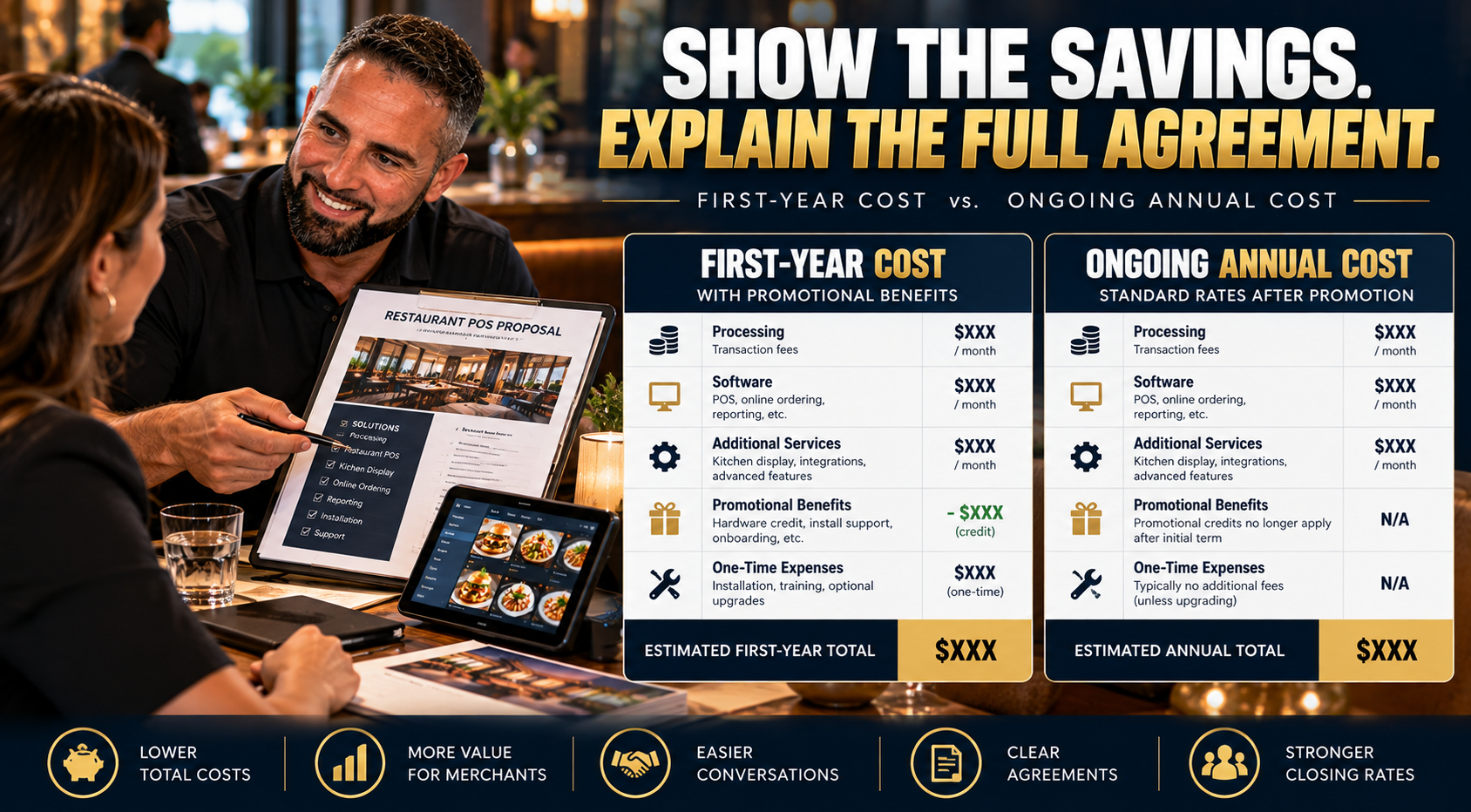
Compare Year One and the Years After
This is important.
A promotion may make the first year attractive, but the restaurant still needs to understand what happens afterward.
I would show:
First-year cost: Including any verified promotional benefits.
Ongoing annual cost: After temporary promotional benefits expire.
One-time costs: Including any installation, migration, financing, or contract-related expenses.
Operational differences: Features, support, and workflow improvements that may justify a change even when the lowest price isn't available.
You don't want to win a merchant by hiding what happens after the promotion ends.
You want a satisfied long-term customer.
8. Why Professional Installation Can Help Close More Sophisticated Accounts
A restaurant owner may love your demonstration.
They may qualify for a promotional incentive.
They may see a financial benefit.
And they may still hesitate.
Why?
Because switching restaurant POS systems can be disruptive.
Menus need to be configured.
Equipment needs to be installed.
Kitchen routing needs to be tested.
Staff need training.
Existing systems may need to be replaced.
For hotels, compatible PMS integrations may need to be configured and validated.
And the restaurant needs to continue serving customers.
This Is Where the Right Partner Makes a Difference
I want agents to understand that they're not simply selling a box.
They're helping a merchant evaluate an operational technology transition.
A partner with professional installation and implementation resources can make that conversation much easier.
But agents need to understand exactly what's included.
Ask:
Who performs the site survey?
Who installs the equipment?
Who configures menus and kitchen routing?
Who handles integration requirements?
Who trains employees?
Who coordinates the go-live schedule?
Who supports the merchant during and after the transition?
The answers should be part of the sales presentation.
What I'd Tell the Restaurant Owner
"I know changing POS systems is a serious decision. Before you move forward, I want you to understand exactly how the installation would work, who would handle the setup, and what support would be available afterward."
That's much more credible than simply saying the switch will be easy.
9. Support Matters More Than a Big Commission Split
I've said this many times throughout my merchant services training.
Support is one of the most important things an agent should evaluate when choosing a processing partner.
And that becomes even more important when you're selling advanced restaurant and hospitality technology.
A restaurant can't afford to have critical POS issues ignored during a dinner rush.
A bar needs help when payment or tab workflows stop functioning.
A hotel may need coordination between the restaurant POS provider and the PMS vendor.
Those are serious operational issues.
Think About Your Long-Term Merchant Portfolio
If you're earning residual income from active processing accounts, you want those merchants to stay satisfied.
A large upfront commission doesn't necessarily make up for a merchant relationship that becomes difficult to maintain.
That's why I want agents to think beyond the advertised split.
Look at the product.
Look at the installation team.
Look at technical support.
Look at the training.
Look at the company's ability to help you solve problems.
And then look at the compensation.
A strong merchant offer can help you acquire an account. Dependable technology and support help give that relationship a reason to last.
10. The Sales Process I Would Teach Restaurant POS Agents
Here's how I'd organize the complete process.
Step 1: Identify the Right Prospect
Focus on restaurants, bars, nightclubs, hotels, and other hospitality businesses that match your POS system's capabilities.
Step 2: Introduce a Relevant Reason to Talk
Use a legitimate promotional offer, operational capability, or business concern to begin the conversation.
Step 3: Qualify the Merchant
Understand the current POS system, decision-maker, operational requirements, processing volume, and timing.
Step 4: Verify Promotional Eligibility
If you're discussing a signing incentive or software-fee waiver, confirm the current terms before promising anything.
Step 5: Schedule the Demonstration
Involve the appropriate technical specialists when necessary.
Step 6: Review the Financial Picture
Analyze processing statements, software invoices, equipment agreements, and other relevant costs.
Step 7: Present a Complete Proposal
Explain the recommended system, financial terms, verified promotional benefits, installation responsibilities, and support.
Step 8: Ask for the Business
If the merchant sees the value and is comfortable with the proposal, guide them through the application and next steps.
Step 9: Follow Through to Activation
Stay involved until the account is approved, installed, and processing.
Step 10: Maintain the Relationship
Continue to support the merchant through the appropriate channels and look for opportunities to earn referrals.
That's how a promotional conversation becomes a potential long-term merchant relationship.
And that's how an agent begins building a portfolio.
For more on finding these prospects, read How to Prospect Restaurants, Bars, and Nightclubs for POS Sales.
11. Why I'm Excited About the Hospitality POS Opportunity for Agents
I want to bring this back to the bigger picture.
I've worked with merchant services agents for years, and I've seen how often talented salespeople struggle because they don't have the right product or partnership.
They may be good at prospecting.
They may know how to close.
They may already have relationships with restaurant owners.
But when they approach a sophisticated restaurant or hotel, they discover that their POS offering can't handle the business.
Or they have a capable product but no compelling offer to get the owner interested in taking a look.
Or they can get the merchant to sign, but don't have dependable implementation and support behind them.
Those are serious limitations.
What I Want Agents to Have Access To
I want agents to be able to approach a restaurant with a credible combination of:
Advanced hospitality technology: A system designed for meaningful restaurant and bar operations.
Specialized capabilities: Including verified integrations for qualifying hotel and resort opportunities.
Compelling merchant campaigns: Promotional programs that can help get a business owner's attention.
Live demonstrations: Access to knowledgeable people who can show the system properly.
Professional installation: Resources to help manage the transition.
Ongoing support: Assistance for both the merchant and the agent.
Residual income opportunities: The ability to build a portfolio of active merchant accounts under the applicable compensation agreement.
This is why I'm putting more attention into the restaurant and hospitality POS market.
I'm interested in helping agents compete for businesses they may not have felt equipped to approach before.
Imagine Having a Better Reason to Make the Call
Instead of calling a restaurant and saying:
"I can review your processing rates."
Imagine being able to say:
"We have an advanced restaurant POS solution, professional implementation resources, and a promotional program that may provide a substantial incentive for qualifying restaurants to switch. Would you be open to seeing whether it's a fit?"
Now you're bringing something different to the conversation.
And when the merchant agrees to meet, you have a serious technology solution to demonstrate.
That's the kind of sales opportunity I want agents to explore.
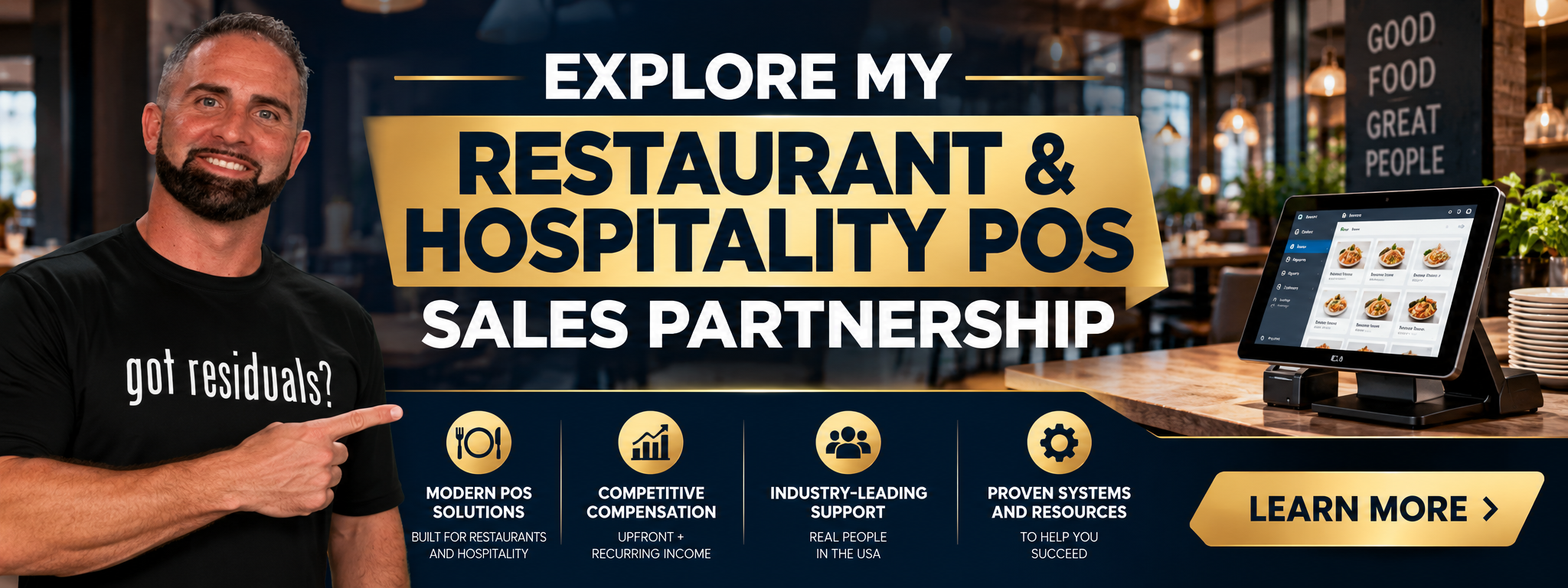
Explore the Restaurant & Hospitality POS Sales Partnership
If you're an experienced merchant services agent, think about how many opportunities you've passed up because your current POS offering wasn't sophisticated enough.
Think about how many restaurant owners have declined to meet because you didn't have a compelling reason for them to evaluate another system.
And think about how much more confident you'd feel approaching those businesses if you had advanced hospitality technology, strong promotional campaigns, professional demonstrations, and dependable installation support behind you.
You don't have to compete for sophisticated hospitality accounts with a basic POS system and an ordinary processing-rate pitch.
I'm building a specialized restaurant and hospitality POS sales opportunity for agents who want to pursue these types of businesses.
If you'd like to learn about the technology, available promotional programs, training, demonstrations, and partnership support, I invite you to explore it.
Explore the Restaurant & Hospitality POS Sales Opportunity
For foundational merchant services education, visit Merchant Service University.
Frequently Asked Questions About Restaurant POS Demos, Cost Comparisons, and Promotions
How do you get a restaurant owner interested in switching POS systems?
Start with a legitimate reason to evaluate an alternative. That could be an operational problem, a technology improvement, or a promotional campaign for qualifying merchants. A strong offer can help secure the conversation, but the system must still meet the restaurant's needs.
Are there restaurant POS systems that offer a $5,000 signing bonus?
Certain promotional campaigns have offered $5,000 signing incentives to qualifying restaurants switching POS providers. Eligibility, processing requirements, promotional dates, and other conditions apply. Agents should verify the current offer before presenting it as available. You can explore my restaurant POS sales partnership to learn about available programs.
Can restaurants get 12 months of POS software fees waived?
Some restaurant POS promotions have offered 12 months of waived qualifying software fees. Coverage may depend on the merchant's plan, device count, and program terms. Not all charges are necessarily waived.
Can restaurants get POS equipment with no upfront hardware costs?
Some providers offer eligible equipment packages with no upfront hardware purchase cost. Agents should explain the specific equipment arrangement, included devices, processing commitments, and applicable terms.
What should an agent demonstrate during a restaurant POS presentation?
Focus on the merchant's actual needs. Common examples include handheld ordering, kitchen routing, table management, split checks, bar tabs, and reporting. For hotels, verify any required PMS integration and room-charge workflows.
Can restaurant POS systems integrate with hotel property management systems?
Certain hospitality POS systems support integrations with compatible hotel PMS platforms. These can enable workflows such as posting eligible restaurant and bar purchases to guest room folios. Compatibility and functionality must be confirmed for the specific property.
How do you compare restaurant POS costs against Toast?
Review the merchant's actual processing statements, software invoices, equipment obligations, and required features. Compare first-year costs, ongoing costs, one-time expenses, and the operational value of each system. Avoid assuming every merchant has the same Toast pricing.
Should an agent lead with a promotion or the technology?
Use whichever is most relevant to the merchant. A qualifying incentive may be an effective conversation starter for an independent restaurant. A hotel food-and-beverage director may care more about PMS compatibility and room charges. The complete proposal should explain both the technology and any applicable offer.
Can restaurant POS agents earn residual income?
Some merchant services partnerships provide recurring residual compensation on active processing accounts. Actual earnings depend on account economics, activations, merchant retention, and the agent agreement. Learn more about the industry through Merchant Service University.
Do I need to run POS demonstrations and installations myself?
Not necessarily. Some partnerships provide dedicated technical specialists and professional installation resources. Agents should understand what's available, what they're responsible for, and how merchants receive support. You can explore the hospitality POS sales opportunity for more information.
What's the biggest advantage of having access to advanced hospitality POS technology and strong promotions?
It gives agents two important tools: a compelling reason to start the conversation and a capable solution to present once the merchant is interested. Combined with qualified demonstrations, accurate proposals, and dependable support, that can help agents compete for more sophisticated accounts.
Final Thoughts: Give Restaurant Owners a Reason to Listen and a Reason to Switch
I want agents to remember two things.
First, you need a reason for the merchant to take your call.
A compelling, legitimate promotional offer can help.
Second, once you have the merchant's attention, you need a system capable of meeting their business requirements.
That's where advanced hospitality technology, demonstrations, professional installation, and ongoing support become so important.
You can't build a long-term merchant portfolio on promotional incentives alone.
And you can't win sophisticated hospitality accounts with technology that doesn't fit their operations.
But when you combine the right product, the right offer, and the right people behind it, you put yourself in a much stronger position.
That's the kind of opportunity I'm focused on bringing to restaurant and hospitality POS sales agents.
Ready to learn what you could offer restaurant, bar, and hotel prospects with the right partnership?
https://hospitality.ezdirectsales.com
About Joe Wagner
I'm Joe Wagner, a merchant services entrepreneur and sales trainer who has worked in the payment processing industry since 2009.
Through Merchant Service University, I provide free education to help people understand merchant services, payment technology, sales prospecting, and building a merchant portfolio.
I also help agents evaluate processing partnerships and develop the skills needed to compete for more sophisticated business opportunities.
Get educated before you get recruited.