Why Selling Restaurant POS Systems Is a Huge Opportunity for Merchant Services Agents
Why Selling Restaurant POS Systems Is a Huge Opportunity for Merchant Services Agents
Want to build a bigger merchant portfolio? Stop limiting your sales conversations to credit card processing rates.
I've been in the merchant services industry since 2009, and one of the biggest opportunities I see for sales agents today is specializing in restaurant and hospitality point-of-sale systems.
Not because restaurants are suddenly a new market.
Restaurants have always needed to accept payments.
The opportunity comes from how much technology now influences nearly every part of running a restaurant, bar, nightclub, hotel, or hospitality business.
Think about what restaurant owners deal with every day.
They're managing employees, controlling food costs, processing online orders, serving customers, coordinating kitchen operations, tracking tips, and trying to maintain profitability in a competitive industry.
Meanwhile, many are paying separate fees for their POS software, payment processing, online ordering, loyalty programs, and other business tools.
That creates an opportunity for knowledgeable merchant services agents.
Instead of walking into a restaurant and asking whether you can save the owner a few basis points on processing, imagine being able to discuss their entire operation.
What if you could introduce a modern restaurant POS solution with handheld ordering, kitchen displays, integrated payments, reporting, customer engagement tools, and professional installation?
What if qualifying merchants could also access promotional hardware packages or financial incentives that make switching more attractive?
Now you're having a very different conversation.
You're no longer just trying to sell credit card processing. You're helping restaurant owners evaluate the technology they use to run their businesses.
And for agents who choose the right partnership, that can create opportunities for upfront compensation, recurring residual income, and long-term portfolio growth.
Here's why I believe this is a specialization worth serious consideration.
1. Restaurant Owners Need More Than Credit Card Processing
One of the challenges in traditional merchant services sales is that many agents lead with essentially the same pitch.
"Let me look at your processing statement."
"I can save you money."
"I can beat your current rate."
There's nothing inherently wrong with reviewing a merchant's processing costs. I've built a career in this industry, and helping businesses understand what they're paying is important.
But when everyone is offering the same thing, it becomes difficult to stand out.
Restaurant POS sales creates additional reasons for an owner to talk with you.
A restaurant might be struggling with slow table turnover, missed kitchen tickets, complicated online ordering, unreliable hardware, or expensive software subscriptions.
Those problems aren't solved simply by reducing a processing rate.
They require understanding the business and evaluating the technology behind its operations.
A Better Sales Conversation
Consider these two approaches.
Traditional processing approach:
"Who processes your credit cards? I'd like to see if I can save you money."
Restaurant technology approach:
"Are you happy with your current POS system? How are you handling tableside payments, online orders, kitchen communication, and monthly software costs?"
The second approach opens a much broader discussion.
It gives you an opportunity to discover whether the merchant has a problem worth solving.
And it gives the restaurant owner a reason to evaluate your solution beyond processing rates alone.
For agents looking to establish themselves in the industry, that differentiation can be valuable.
If you're new to the business, start with my guide on how to become a restaurant POS sales agent.
2. The Restaurant and Hospitality Market Includes More Than Restaurants
When people hear "restaurant POS," they often picture a touchscreen register sitting next to a cash drawer.
But hospitality technology serves a much wider range of businesses.
Full-Service Restaurants
Full-service restaurants need systems that help manage dining rooms, servers, tables, orders, kitchen communication, split checks, and payments.
For the right operation, handheld ordering and payment devices can reduce unnecessary trips between the table and a stationary terminal.
Kitchen display systems can also help coordinate orders and reduce reliance on printed tickets.
Quick-Service and Fast-Casual Restaurants
Quick-service operators are focused on speed, order accuracy, and efficient workflows.
They may benefit from online ordering, counter-service POS systems, kitchen routing, and compatible self-service technology.
Bars and Sports Bars
Bars have different operational challenges.
They may need to manage open tabs, card preauthorizations, tip adjustments, multiple bartenders, and high-volume transactions.
Sports bars may also need to handle large groups and busy game-day service.
Nightclubs and Entertainment Businesses
Nightclubs may have multiple bars, VIP sections, high transaction volumes, and a need for fast payments.
Some operations also require specialized capabilities such as ID scanning, age-verification workflows, and cover-charge management.
The exact available features depend on the POS product and its configuration.
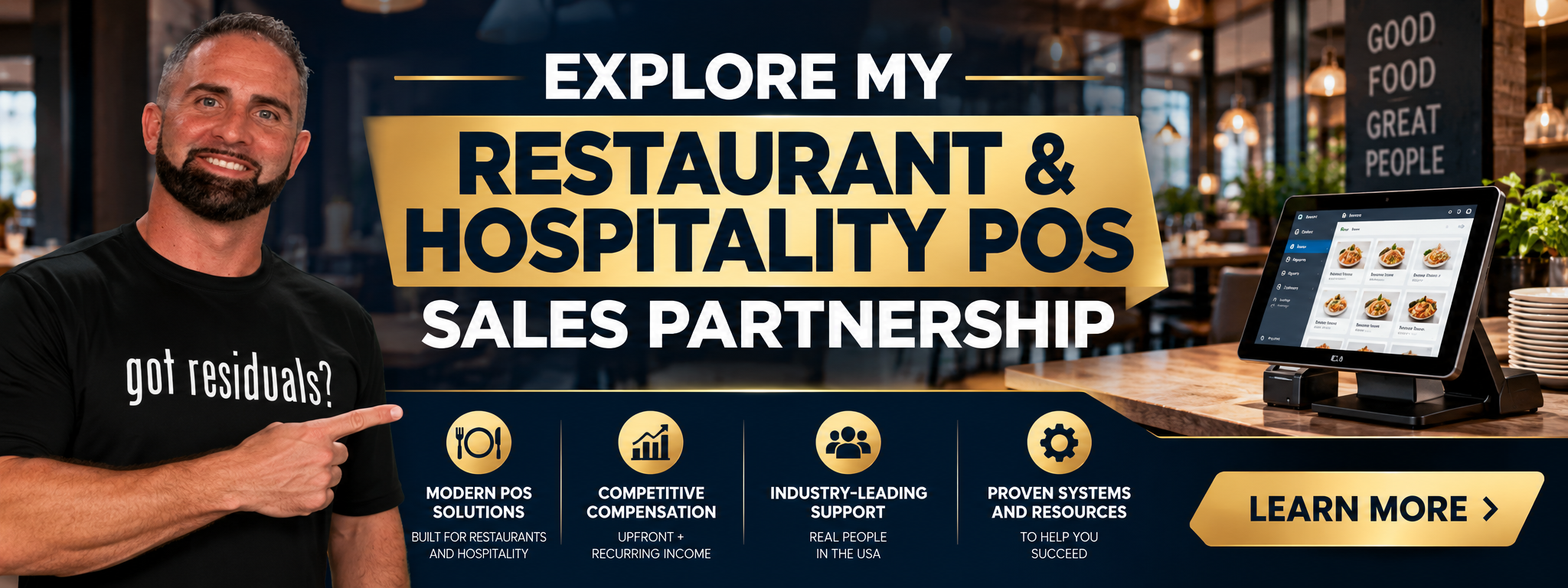
Hotels and Resorts
This is where hospitality technology becomes particularly interesting.
A hotel may operate a restaurant, lobby bar, poolside café, room-service operation, and other food-and-beverage outlets.
Some hotels also require POS integration with a compatible property management system so eligible purchases can be charged to a guest's room.
Think about that from a sales perspective.
You're no longer discussing only the restaurant's payment terminal.
You're discussing how food-and-beverage transactions fit into the property's broader guest experience.
Multi-Location Hospitality Groups
Restaurant groups and hospitality operators with several locations may need centralized reporting, consistent menu controls, and better visibility into performance across their businesses.
These opportunities can be more complex, but they also allow agents to develop specialized expertise.
Stadiums, Arenas, and Event Venues
Major sports and entertainment venues also depend on sophisticated commerce technology.
Their needs can include concessions, mobile ordering, premium hospitality, high-volume payments, and integrated retail operations.
Not every enterprise venue uses the same POS product as an independent restaurant, but understanding the broader hospitality technology market helps agents recognize opportunities and know when specialized support is needed.
The takeaway is simple: restaurant POS specialization can open doors across multiple types of hospitality businesses.
You aren't limited to selling one piece of equipment to one type of merchant.
3. Modern POS Technology Gives Agents More Value to Offer
A restaurant POS system is no longer just a device that records sales.
Depending on the platform and available modules, it may support important parts of the restaurant's daily operation.
Here are several areas agents should understand.
Tableside Ordering and Payments
Handheld devices allow servers to take orders and accept payments closer to the guest.
For restaurants that rely heavily on table service, this can help streamline certain steps in the service process.
Kitchen Display Systems
Kitchen displays can organize incoming orders, route tickets to appropriate preparation areas, and help staff manage order status.
The value is not simply replacing paper tickets.
It's helping the restaurant coordinate its kitchen workflow.
Online Ordering
Restaurants increasingly need ways to accept orders beyond the dining room.
Agents should understand how the POS handles online ordering, which integrations are available, and what fees apply.
Bar Tab Management
Bars need a convenient way to open, maintain, and close tabs.
Card preauthorization and other tab-management features can be important, although agents must understand their limitations and payment-network requirements.
Reporting and Analytics
Owners want visibility into sales, menu performance, employee activity, and other operational metrics.
Agents who understand reporting can ask better questions about how owners currently manage their businesses.
Loyalty and Customer Engagement
Gift cards, loyalty programs, and customer marketing tools may help restaurants encourage repeat visits.
Some capabilities are included in certain packages, while others involve additional services or fees.
Installation and Support
A restaurant depends on its POS system during critical business hours.
That makes implementation, staff training, equipment replacement policies, and ongoing support major considerations.
As an agent, you should understand who handles these responsibilities before making promises to a merchant.
The more you understand these features, the less dependent you become on competing exclusively through pricing.
4. Competing Against Toast Creates an Opportunity to Offer a Meaningful Alternative
Let's talk about one of the most recognizable names in restaurant technology: Toast.
Toast is a well-established restaurant POS provider with substantial capabilities, and many restaurant owners already know the brand.
That's actually useful for an agent who is learning this market.
You don't have to explain why restaurants need POS technology.
Many already understand its importance.
Your job is to help them determine whether their current system is still the best fit.
What Should Agents Compare?
When you're speaking with a restaurant using Toast or another established provider, I'd recommend reviewing the entire relationship.
Ask about:
Monthly POS software subscriptions
Hardware expenses and replacement policies
Payment processing costs
Online ordering and additional software fees
Customer loyalty and marketing costs
Support and service experience
Contractual commitments
Implementation and switching requirements
One of the biggest mistakes an agent can make is comparing only one monthly fee.
A restaurant might have several connected services, each with its own cost.
Another system might combine certain functions or offer a different pricing structure.
But you won't know whether it's actually a better value until you review the complete setup.
Promotional Offers Can Make the Conversation More Attractive
One reason I'm excited about the restaurant POS solutions I'm focusing on is the potential availability of compelling promotional offers.
Depending on current programs and merchant eligibility, these may include equipment packages with little or no upfront hardware expense, professional installation, or additional financial incentives.
Some promotional programs have advertised incentives as high as $5,000 for qualifying businesses.
Those offers can be powerful when a restaurant is already considering an expensive equipment replacement or system upgrade.
However, promotions change, and eligibility, contract terms, and whether offers can be combined must always be confirmed.
I would never train an agent to promise a $5,000 incentive to every restaurant they visit.
Instead, I'd train them to say:
"Before you spend money upgrading your current POS, let's compare what you're paying now against a complete alternative and see which promotional programs your business may qualify for."
That's a professional conversation that gives the owner a reason to explore their options.
We'll cover the competitive sales process in greater detail in How to Sell Restaurant POS Systems Against Toast and Other Competitors.
5. Restaurant POS Sales Can Help Agents Build Recurring Residual Income
For me, this is one of the most important reasons to consider the merchant services industry.
I didn't spend years building my business simply to earn one commission and start over every month.
I wanted to build a portfolio.
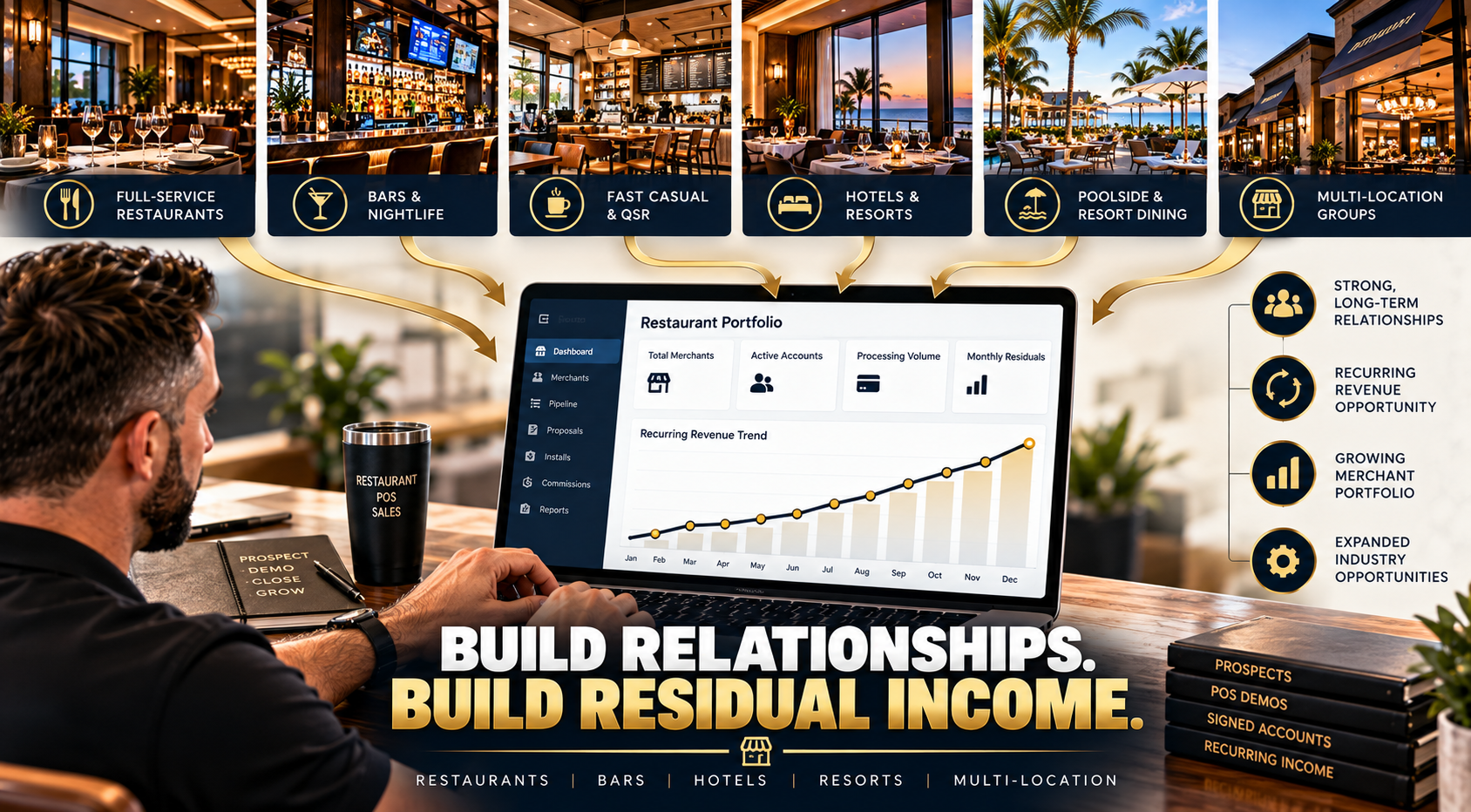
A merchant portfolio is a collection of active merchant accounts that may generate recurring residual compensation according to your processing agreement.
And restaurant POS sales can provide a way to acquire those accounts by leading with a more comprehensive business solution.
How the Compensation Model May Work
Depending on the partnership, an agent may earn:
Upfront compensation: A commission or activation bonus tied to a qualified merchant account.
Recurring residual income: Ongoing compensation based on the economics of active payment-processing accounts.
Additional incentives: Certain programs may offer bonuses or other compensation under specified conditions.
Not every partner offers all three, and the terms vary.
The important thing is to understand your agreement before joining.
What Could a Restaurant Portfolio Look Like?
Here's a hypothetical example—not an earnings prediction.
Active merchant accounts | Assumed average monthly residual per account | Illustrative monthly residual income |
|---|---|---|
10 | $500 | $5,000 |
25 | $500 | $12,500 |
50 | $500 | $25,000 |
100 | $500 | $50,000 |
Actual residuals can be higher or lower, and some accounts may generate very little or no compensation. Merchant attrition, pricing changes, processing activity, expenses, and contract terms all affect results.
The example illustrates the cumulative nature of a portfolio—not a typical or guaranteed income outcome.
This is why I teach agents to think beyond their next upfront commission.
Every merchant relationship can contribute to the long-term business you're building, provided the account remains active and your agreement provides continuing compensation.
But getting accounts signed is only part of the job.
You need consistent prospecting, follow-up, and the right support to help merchants successfully activate and continue using their services.
For more on the activity required to build a portfolio, read my Merchant Sales Production Formula.
6. The Right Restaurant POS Partner Can Make an Enormous Difference
I want to emphasize something I've learned repeatedly throughout my career.
The partner behind the agent matters just as much as the opportunity in front of the agent.
Restaurant POS systems are more involved than basic countertop credit card terminals.
A restaurant may have several workstations, kitchen displays, handheld devices, printers, network requirements, online ordering integrations, and employee workflows.
Switching systems can be a major undertaking.
Now imagine signing a restaurant and then discovering you're personally responsible for solving every installation issue.
Or the restaurant has a problem during a busy Saturday night and can't get the support it needs.
That's not the kind of partnership I want to build a business around.
What I Look for in a Partner
Strong restaurant technology: The solution needs to address real operational needs.
Professional installation: A qualified implementation process can reduce the burden on both the merchant and the sales agent.
Dependable merchant support: Restaurants need to know where to turn when something goes wrong.
Agent sales assistance: Help with complex opportunities, demonstrations, and proposals can make a major difference.
Competitive financial offers: Equipment and promotional programs can make an alternative worth evaluating.
Clear compensation agreements: Agents need to understand how commissions, residuals, and account ownership work.
Long-term relationships: The goal is to acquire merchants who are satisfied with their systems and continue doing business.
I would rather have a partner that helps me build a durable portfolio than chase an impressive advertised split without understanding the support behind it.
That's why one of our next articles will focus on choosing the best restaurant POS sales partner.
7. You Don't Have to Be a Restaurant Technology Expert to Get Started
One of the questions I hear from people exploring merchant services is whether they need experience in the industry.
The answer is no.
But you do need to be willing to learn.
If you've sold insurance, real estate, advertising, business services, telecommunications, or other products, you may already understand prospecting, presentations, follow-up, and closing.
Those skills can transfer into merchant services.
And if you already have relationships with restaurant owners, that can be helpful too.
What you need to add is product knowledge.
Start With the Basics
Learn how payment processing works.
Understand merchant pricing.
Learn how to read processing statements.
Understand how agents get paid.
Learn how restaurant POS systems connect different operational functions.
Get familiar with common restaurant terminology and workflows.
I created Merchant Service University to help people learn the merchant services industry before choosing where and how to build their businesses.
The core merchant-services education is free, and I'm developing additional training focused on restaurant and hospitality POS sales.
You don't need to know everything on day one.
But you should become knowledgeable enough to recognize a good opportunity, ask intelligent questions, and know when to involve a specialist.
8. The Agents Who Succeed Will Focus on Production, Not Just Learning Features
Here's something I don't want you to overlook.
You can learn every feature of a restaurant POS system and still never sign a merchant.
Why?
Because knowledge alone doesn't produce sales.
You still have to engage with business owners.
You have to prospect.
You have to ask questions.
You have to schedule demonstrations.
You have to prepare proposals and follow up.
This is something I emphasize in my broader merchant-sales training.
There's a difference between staying busy and doing the activities that actually move deals forward.
Creating a website, designing business cards, studying another product brochure, or rewriting your sales script can all feel productive.
But those activities don't replace conversations with qualified prospects.
Three Activities I Want Agents to Focus On
Prospecting: Consistently getting in front of restaurant and hospitality decision-makers.
Proposals: Presenting solutions and financial comparisons to qualified businesses.
POS demonstrations: Helping interested merchants see how a system works in their actual environment.
These activities form the foundation of a repeatable restaurant POS sales process.
If you're serious about building a portfolio, learn to measure them.
My articles on merchant services prospecting, merchant services proposals, and POS demonstrations explain these activities in greater detail.
9. Specializing in Hospitality Can Help You Stand Out as an Agent
One of the biggest advantages of choosing a specific industry is that you can become more knowledgeable about the people you serve.
Instead of trying to sell every product to every business, you begin to understand a defined market.
You learn what restaurant owners complain about.
You understand why bartenders need fast tab management.
You learn why kitchens care about ticket routing.
You understand why hotel operators need compatible room-charge integrations.
And you learn how to recognize situations where a merchant might benefit from reviewing its existing technology.
That knowledge changes how you prospect.
It changes your questions.
It changes your presentations.
And it can make you a more credible resource.
You Can Build a Repeatable Sales Process
Once you understand the hospitality market, you can develop a consistent approach:
Identify restaurants and hospitality businesses in your market.
Research their current operations where possible.
Introduce yourself and ask discovery questions.
Identify meaningful operational or financial concerns.
Review current costs and technical requirements.
Arrange a qualified product demonstration.
Present a complete proposal.
Follow through on approval, installation, and activation.
Maintain the merchant relationship.
You don't need to invent a completely new sales strategy for every prospect.
You need a strong process and the discipline to follow it.
For more practical guidance, see How to Prospect Restaurants, Bars, and Nightclubs for POS Sales.
10. Why I'm Personally Excited About This Opportunity
I've spent more than 16 years working in merchant services.
I've seen agents succeed, struggle, change processing partners, lose confidence, and sometimes leave the industry altogether.
I've also seen how much difference the right education, support, and consistent activity can make.
That's part of the reason I'm focusing more attention on restaurant and hospitality POS sales.
I believe there is a meaningful opportunity for agents who want to specialize in a business category with substantial technology needs.
And I'm especially interested in partnerships that combine comprehensive products, professional installation, merchant support, and compelling offers for qualifying businesses.
But I don't want to simply recruit people and hand them a product brochure.
I want agents to understand the opportunity.
I want them to learn how the systems work.
I want them to understand how to approach restaurants, qualify opportunities, and use demonstrations effectively.
And I want them to understand how to build a long-term merchant portfolio instead of chasing one deal at a time.
That's the direction I'm taking with the restaurant and hospitality specialization.
Explore the Restaurant & Hospitality POS Sales Opportunity
If you're an existing merchant-services agent looking for a stronger restaurant technology offering—or you're an experienced salesperson interested in entering this industry—I invite you to explore the opportunity I'm building.
The goal is to help agents specialize in restaurants, bars, nightclubs, hotels, resorts, and other hospitality businesses while learning how to sell comprehensive POS and payment solutions.
You'll have an opportunity to learn more about the available partnerships, technology, support, and business model.
Explore the Restaurant & Hospitality POS Sales Opportunity
And if you're brand new to merchant services, start by getting educated through Merchant Service University.
The more you understand this business, the better equipped you'll be to decide whether it's right for you.
Frequently Asked Questions About Restaurant POS Sales Opportunities
Is selling restaurant POS systems a good business opportunity in 2026?
It can be a worthwhile specialization for sales professionals who want to serve restaurant and hospitality businesses. Modern POS technology addresses more than payment acceptance, allowing agents to discuss operational needs, software costs, service workflows, and business technology. Success depends on product fit, sales execution, support, and the terms of the partnership. You can explore my hospitality POS sales partnership to learn more.
Can merchant services agents earn residual income from restaurant POS accounts?
Some processing partnerships pay recurring residual compensation on active merchant accounts. The amount and duration depend on processing economics and the agent agreement. Agents should review residual rights, vesting, expenses, and termination provisions before joining.
Do I need to know how to install restaurant POS systems?
Not necessarily. Some providers use professional installation and implementation teams. However, agents should understand the product, qualification process, installation requirements, and who is responsible for technical support. Choosing a partnership with a strong implementation process is important.
Can I sell restaurant POS systems to bars and nightclubs?
Yes, provided your partner has products suited to those operations. Bars and nightclubs may need tab management, card preauthorization, fast payment acceptance, tip management, and other specialized capabilities. Confirm the exact features supported by the product you're representing.
Can I sell hospitality POS systems to hotels and resorts?
Potentially. Hotels and resorts may need restaurant and bar POS systems, multiple food-and-beverage outlets, and integrations with compatible property management systems. Complex properties may require specialized technical evaluation before a proposal can be made.
How do I compete against Toast when selling restaurant POS systems?
Start with a complete evaluation of the merchant's current setup. Compare relevant features, software subscriptions, payment-processing costs, hardware, support, contractual terms, and implementation requirements. Demonstrate the alternative rather than assuming every merchant will benefit from switching.
Are there restaurant POS programs offering free equipment or financial incentives?
Some programs offer promotional equipment packages, reduced upfront costs, installation assistance, or financial incentives for qualifying merchants. Availability and eligibility vary, and offers may change. Agents should verify the current terms before presenting them. You can explore the restaurant POS sales partnership to learn about available programs.
Can I sell restaurant POS systems part-time?
Some independent agent programs may allow part-time sales activity. However, restaurant prospecting, appointments, demonstrations, follow-up, and merchant communication still require consistent effort. Review the expectations of any partnership before joining.
What's the best way to find restaurants interested in switching POS systems?
Look for operational frustrations, equipment replacement needs, high software expenses, support concerns, and upcoming contract decisions. Ask discovery questions rather than assuming every restaurant wants to change providers. A qualified demo and full cost analysis can help determine whether an alternative is appropriate.
Where can I learn to sell restaurant POS systems?
Begin by learning merchant services and payment processing through Merchant Service University. Then develop your knowledge of restaurant operations, POS features, cost comparisons, and demonstrations. You can explore my specialized restaurant and hospitality POS sales partnership.
Final Thoughts: Stop Competing Only on Rates and Start Building Expertise
I believe the future of successful merchant services sales belongs, in part, to agents who understand more than payment processing.
Restaurant and hospitality technology is one area where that expertise can make a meaningful difference.
You can learn to help businesses evaluate their systems, understand their expenses, improve workflows, and select technology that fits their operations.
At the same time, you can work toward building a portfolio of merchant relationships that may generate recurring residual income.
But the opportunity still requires effort.
Learn the industry.
Choose your partners carefully.
Understand the products.
Prospect consistently.
Use demonstrations.
Follow up.
And build your business one merchant relationship at a time.
Explore the Restaurant & Hospitality POS Sales Opportunity
About Joe Wagner
I'm Joe Wagner, a merchant-services entrepreneur and sales trainer who has worked in the payment-processing industry since 2009.
Through Merchant Service University, I provide free education to help people understand merchant services, modern payment technology, and the process of building a merchant portfolio.
I also help interested sales professionals explore processing partnerships and develop the skills needed to build their businesses.
Get educated before you get recruited.