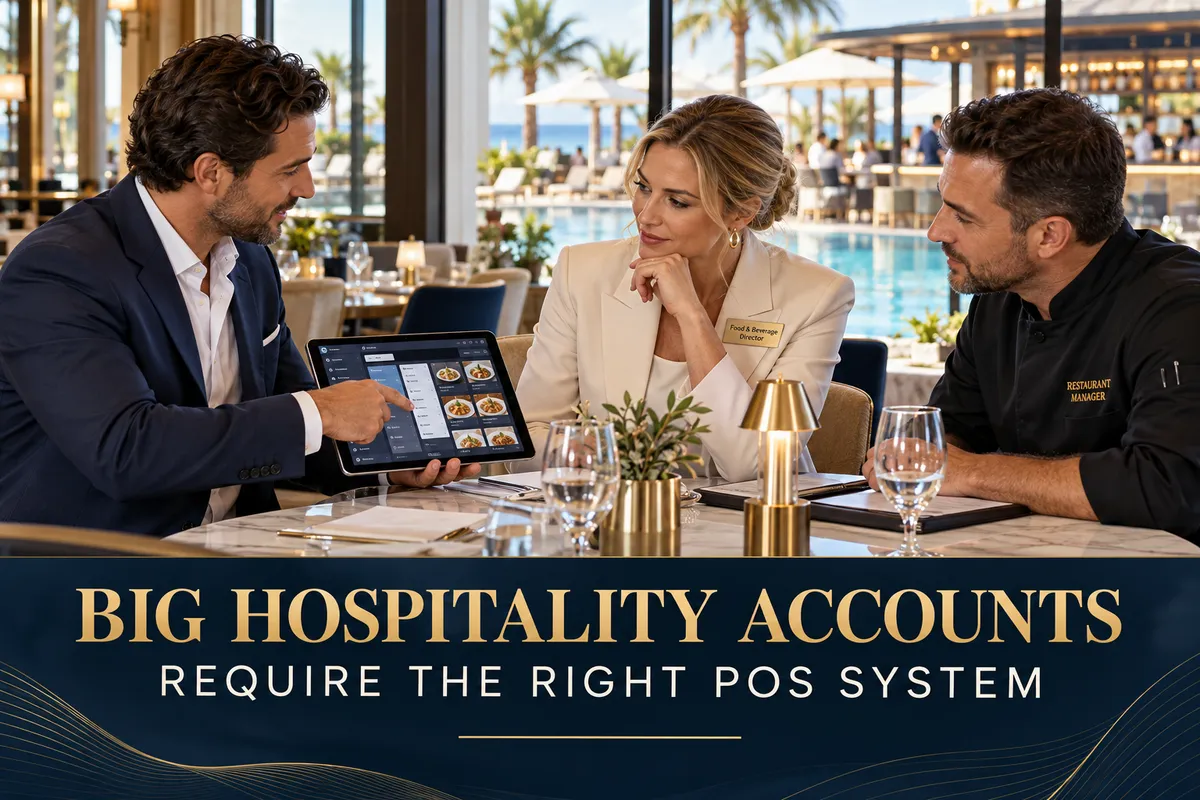
How to Prospect Restaurants, Bars & Hotels for POS Sales
How to Prospect Restaurants, Bars, and Nightclubs for POS Sales
Want to land larger restaurant, bar, and hotel accounts? Make sure you have a POS system capable of winning their business before you start prospecting.
One of the biggest problems I see in merchant services is that sales agents are trying to compete for valuable restaurant and hospitality accounts without having the right technology to offer.
They may be excellent salespeople.
They may know how to prospect, build relationships, analyze processing statements, and close deals.
But when they walk into a sophisticated restaurant, high-volume nightclub, or hotel with multiple food-and-beverage outlets, they quickly discover something.
Their POS system isn't capable of doing what the merchant needs.
And when that happens, the sales conversation is practically over.
I've been in merchant services since 2009, and I've watched agents struggle to win larger accounts because the products available through their processing partners weren't designed for complex hospitality operations.
They're trying to compete against established POS companies like Toast and Square, but they don't have the product capabilities, integration options, implementation resources, or technical support needed to present a serious alternative.
That's not simply a prospecting problem.
It's a partnership and product problem.
You can knock on 100 restaurant doors, deliver an excellent introduction, and build a great relationship with the owner.
But if the restaurant requires advanced kitchen routing, sophisticated bar tab management, multiple revenue centers, or hotel room-charge integration—and your system can't provide it—your prospecting efforts won't turn that account into a successful installation.
This is why I'm so excited about the restaurant and hospitality POS opportunity I'm building for agents.
I want agents to have access to technology that gives them a legitimate reason to approach larger, more sophisticated businesses.
And I want them to have the training, demonstrations, professional installation resources, and ongoing support needed to compete.
Because when you have the right solution, your entire prospecting strategy changes.
Instead of avoiding large restaurants, bars, hotels, and resorts because you're unsure whether your system can handle them, you can start identifying the businesses whose requirements align with the capabilities of your hospitality POS offering.
In this guide, I'll show you how to identify those opportunities, prospect decision-makers, recognize high-value operational requirements, and move qualified merchants toward demonstrations and proposals.
If you're new to this specialization, start with my guide to becoming a restaurant POS sales agent and why selling restaurant POS systems is an opportunity for merchant services agents.
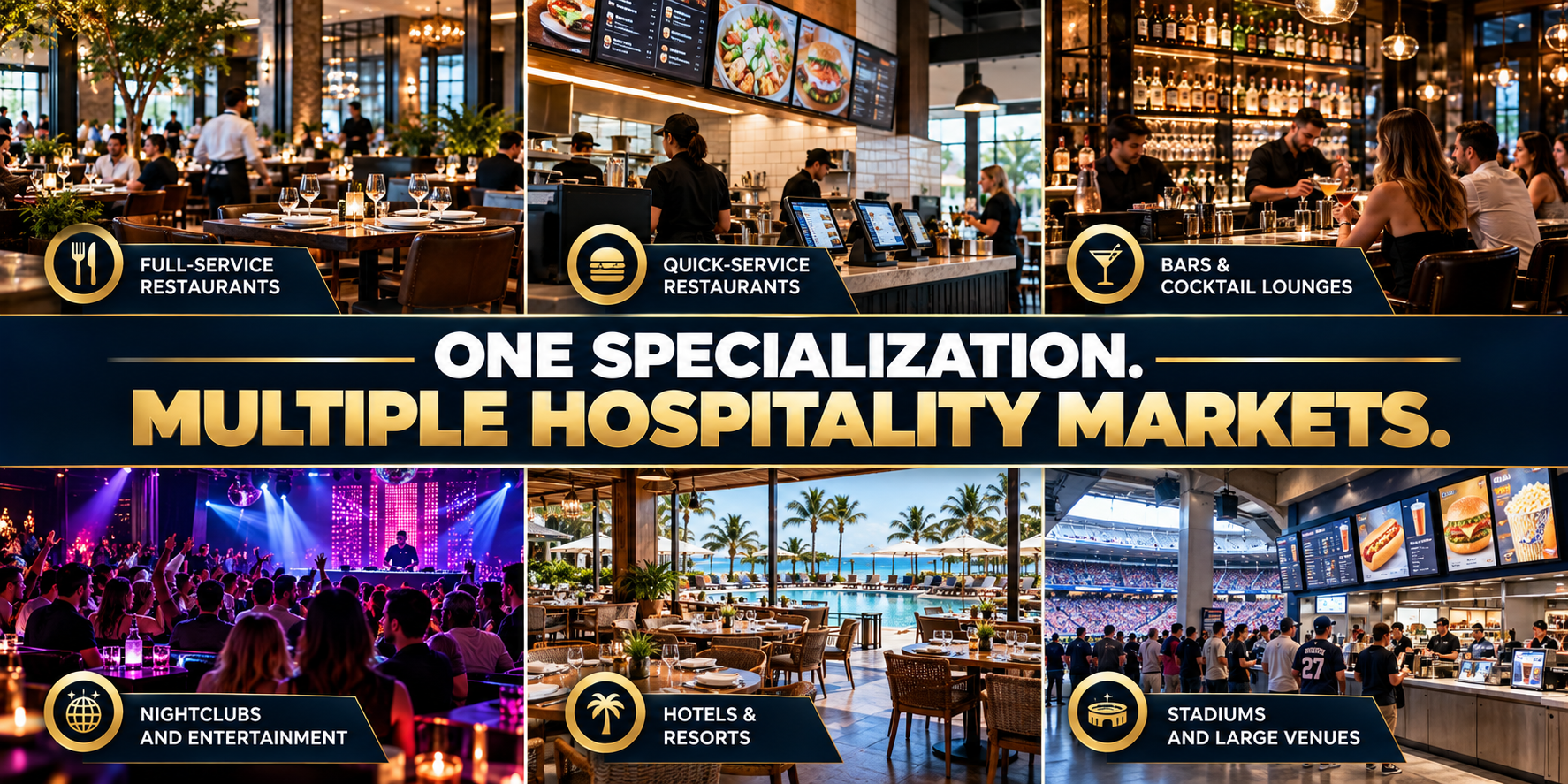
1. Why So Many Merchant Services Agents Struggle to Win Larger Restaurant Accounts
Let's start with the real obstacle.
A lot of merchant services agents have access to perfectly reasonable payment-processing products for smaller businesses.
They can sell countertop terminals.
They can provide basic mobile payment devices.
They may even have access to entry-level POS systems.
And those products can work well for the right merchants.
But there's a major difference between providing a payment terminal to a small retail store and replacing the technology used by a sophisticated restaurant or hospitality property.
Consider What a Large Restaurant Actually Needs
A busy full-service restaurant might require:
Multiple POS workstations
Handheld ordering and tableside payments
Kitchen display systems
Different preparation stations
Complex menu modifiers
Table management and split checks
Bar tab management
Employee permissions
Detailed reporting
Online ordering integrations
Reliable support during operating hours
Now consider a nightclub with several bars, hundreds of customers, and high transaction volume.
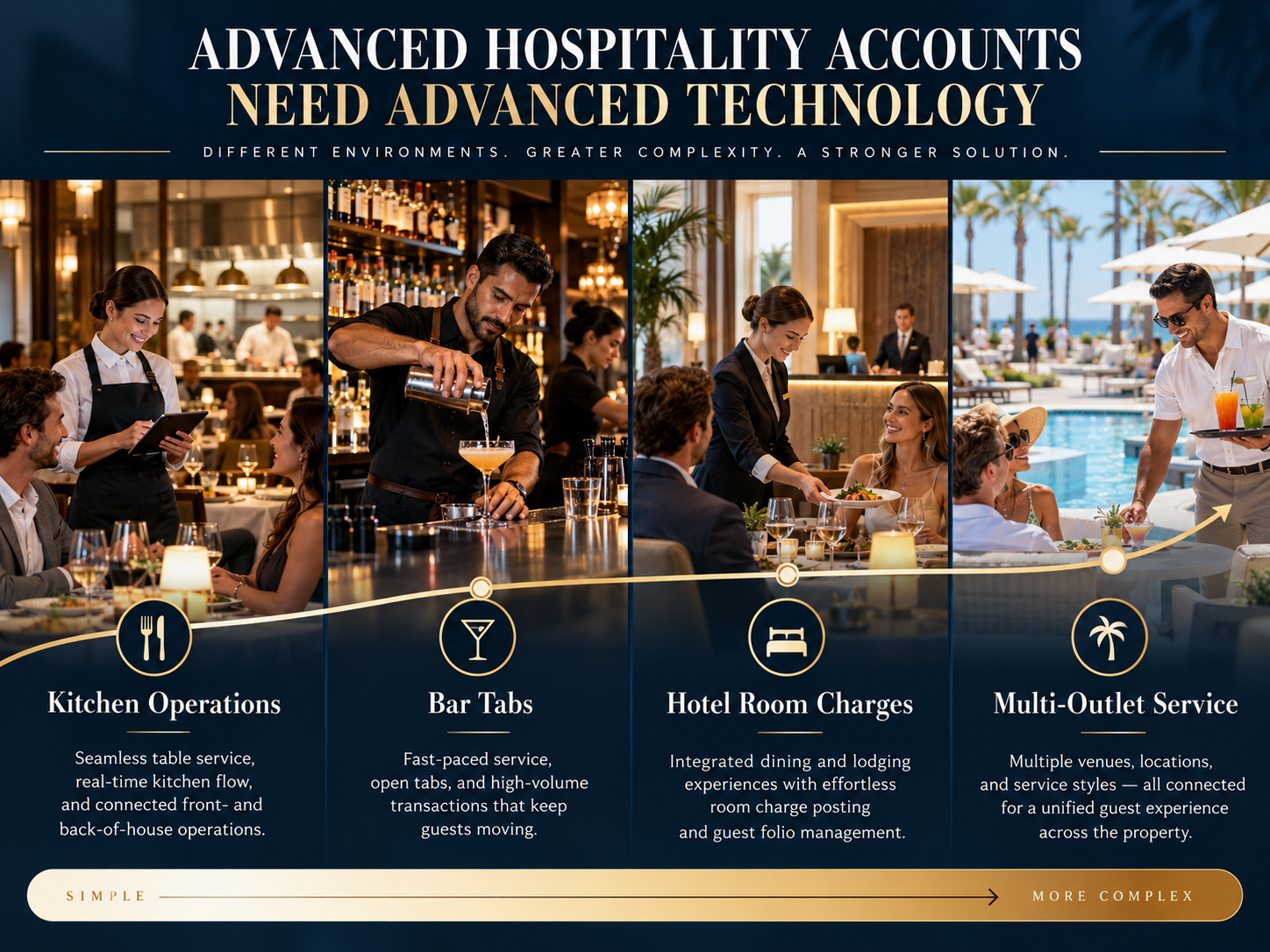
Or a hotel with a restaurant, lobby bar, poolside café, and room service.
These are not basic payment-terminal opportunities.
They're technology and operational sales.
And if the agent doesn't have a system that can meet the business's requirements, the merchant has very little reason to consider switching.
The Wrong POS System Can Eliminate You Before the Proposal
Imagine getting an appointment with the owner of a busy restaurant.
You ask excellent questions.
You discover they're spending a significant amount on software and payment processing.
They're interested in reviewing alternatives.
Everything is going well.
Then they ask:
"Can your system handle our kitchen routing, multiple bars, and the integrations we currently use?"
If your answer is no, the opportunity may end immediately.
Not because you failed to prospect.
Not because you didn't build rapport.
And not because your processing rates weren't competitive.
You simply didn't have the right product.
Before you invest your time prospecting larger hospitality accounts, make sure you have access to technology designed for the businesses you want to serve.
2. Stop Competing for Complex Accounts With Basic POS Equipment
One of the most important distinctions agents need to understand is that not all POS systems are designed for the same type of business.
A retail POS system may be excellent at processing transactions, managing inventory, and producing receipts.
But that doesn't automatically make it suitable for a hotel restaurant, high-volume bar, or multi-location hospitality operation.
Basic Payment Acceptance Versus Hospitality Operations
A basic system may be designed primarily around completing a transaction.
A hospitality-focused system may need to support an entire service workflow.
That includes what happens before the payment, during the order, and after the sale.
For example, a restaurant needs to know:
Where should the food order go?
Which kitchen station prepares it?
Which server owns the table?
Can guests split the check?
Can a bartender keep a tab open?
Can the system manage multiple service areas?
Can the owner review activity across locations?
And for hotels:
Can a guest charge dinner or drinks directly to their hotel room?
That last question opens up an entirely different category of opportunities.
Why This Matters When Competing Against Toast and Square
Toast and Square both offer restaurant-related products, but their capabilities vary by product, plan, integration, and configuration.
The right comparison isn't simply which company has the better advertised price.
It's whether the specific system you're offering can support the merchant's requirements.
You shouldn't assume that a competitor lacks a feature without checking.
But you also shouldn't assume that every POS system can support a complex hospitality property.
A restaurant owner isn't going to replace a functioning system with one that creates operational problems.
The stronger your product capabilities, the broader the range of merchants you may be qualified to pursue.
For more on evaluating competitive opportunities, read How to Sell Restaurant POS Systems Against Toast and Other Competitors.
3. Hotel Restaurants and Bars: An Opportunity Many Agents Aren't Equipped to Pursue
Now I want to discuss a hospitality segment that I believe deserves far more attention from merchant services agents.
Restaurants and bars located inside hotels and resorts.
Think about the food-and-beverage operations inside a hotel.
A property may have a breakfast restaurant, full-service dining room, lobby bar, poolside bar, café, and room-service operation.
Each location may need to accept payments, manage orders, and report revenue.
But these businesses can have an additional requirement that changes the entire POS conversation.
They may need to connect their restaurant POS system to the hotel's property management system.
What Is a Hotel Property Management System?
A property management system, commonly called a PMS, is the software hotels use to manage important parts of their operations.
Depending on the system, it may handle:
Guest reservations
Check-in and check-out
Room assignments
Guest accounts
Billing and folios
Property operations
Reporting
The restaurant POS handles food-and-beverage transactions.
The PMS manages the guest's stay.
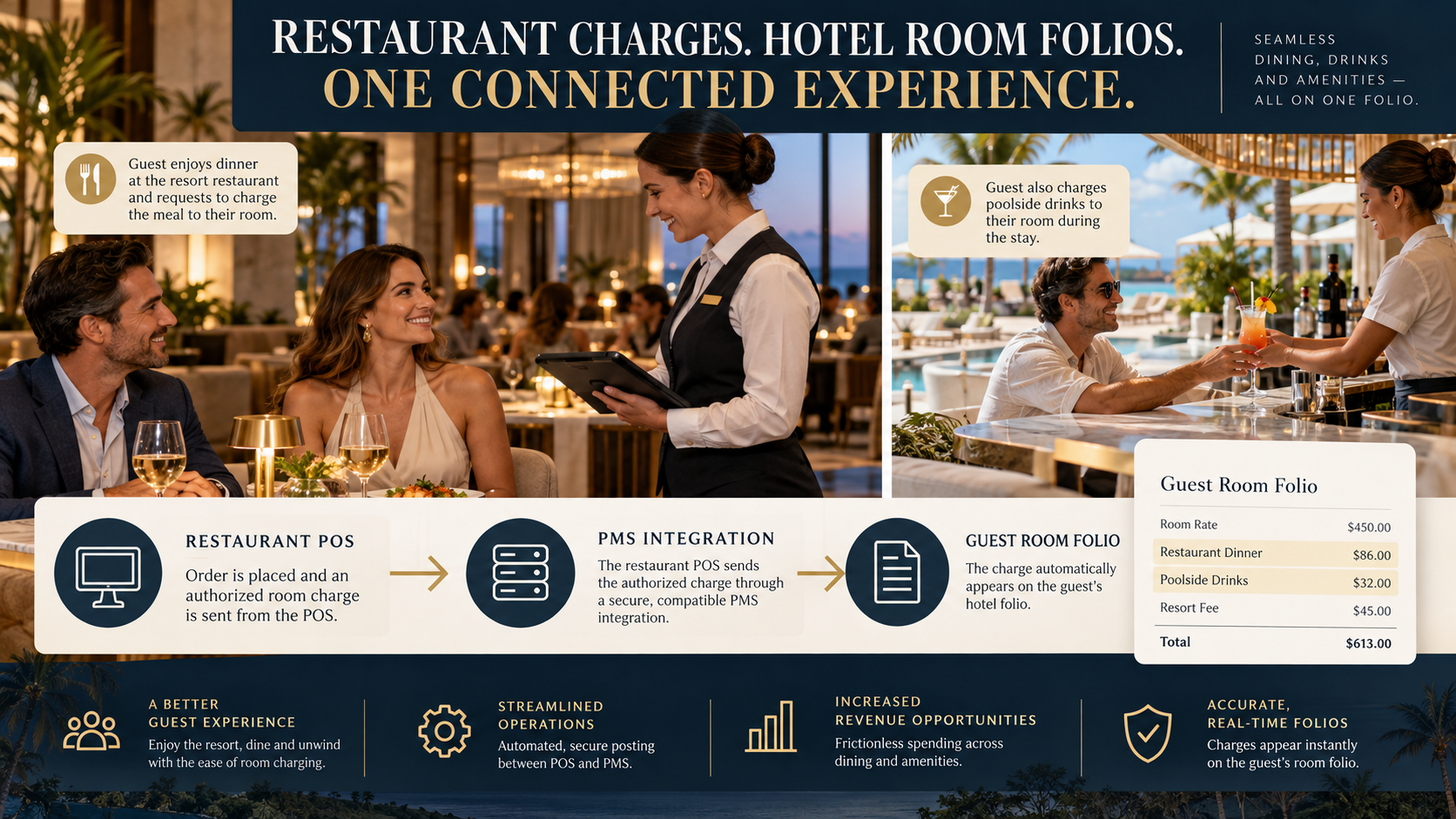
When the two systems are properly integrated, certain restaurant and bar purchases can be posted to a guest's hotel account.
That's where the opportunity becomes interesting.
The Hotel Room-Charge Scenario
Imagine you're visiting a resort with a busy restaurant and a poolside bar.
You sit down with the hotel's food-and-beverage director.
The director tells you:
"We process a lot of credit cards, and we'd be interested in reviewing our restaurant POS costs. But our guests need to be able to charge food and drinks to their rooms."
That one requirement can determine whether you're a legitimate contender.
Let's say a guest is staying in Room 412.
They visit the hotel restaurant, order dinner, and receive a $95 bill.
Instead of paying with a credit card at the restaurant, they ask:
"Can you charge this to my room?"
With a properly configured, compatible POS-to-PMS integration, the employee can verify the guest and eligible room, then post the restaurant charge to the guest's hotel folio.
The guest can review and settle the eligible charges according to the hotel's billing arrangements.
Now imagine the same guest visits the poolside bar the following afternoon.
They order drinks and food.
They want those purchases charged to their room as well.
The hotel needs the appropriate workflow to handle those transactions accurately.
What Happens If Your POS Doesn't Support Room Charges?
If your system cannot connect to the hotel's required PMS or otherwise support the necessary room-charge workflow, the hotel may have no practical reason to consider your proposal.
You could offer competitive processing.
You could provide attractive hardware.
You could have a great relationship with the director.
But you still can't meet a critical requirement.
That's the difference between having a product that accepts payments and having a solution designed for the hospitality operation you're targeting.
4. Why Hotel POS and PMS Integrations Can Create Valuable Sales Opportunities
A hotel restaurant isn't necessarily more valuable than every independent restaurant.
But the operational complexity can make it a more specialized sales opportunity.
And specialized opportunities may face less competition from agents who only have access to basic POS products.
Multiple Revenue Centers
A hotel might have several food-and-beverage operations under one property.
That creates opportunities to discuss how each location accepts payments and whether reporting and technology can be coordinated.
Guest Room Charges
Room-charge functionality may be essential for hotels that allow guests to charge food, drinks, and other purchases to their room accounts.
Guest Folio Accuracy
A compatible integration can help reduce manual entry and support more organized guest billing.
Front-Desk and Restaurant Coordination
The restaurant and hotel need to understand which guests are eligible to post charges and how those transactions are reconciled.
Property Management System Compatibility
Not every POS supports every PMS.
And even when an integration is advertised, specific versions, features, configuration requirements, and fees may apply.
Professional Implementation
A hotel POS installation may require coordination between the restaurant team, hotel management, IT staff, PMS provider, and POS implementation team.
This is not the kind of opportunity where an agent should simply drop off equipment and hope everything works.
Questions to Ask Every Hotel Restaurant Prospect
Before promising a solution, ask:
What property management system does the hotel use?
Does the restaurant currently allow guests to charge purchases to their rooms?
Which outlets need room-charge functionality?
Does the hotel have one POS system or several?
Are guest charges posted automatically or entered manually?
What guest-verification process is required?
Are there multiple properties or locations?
Who is responsible for approving POS and PMS integrations?
Are there existing contracts or integration fees?
Would the hotel consider a demonstration if compatibility can be confirmed?
Those questions immediately separate a knowledgeable hospitality sales agent from someone simply offering another credit card terminal.
Never Promise Compatibility Without Verification
Before advancing a hotel opportunity, have your technical team confirm the exact PMS product, version, integration availability, required workflows, and implementation responsibilities.
Some integrations support room charges but have limitations involving guest status, revenue-center details, voids, or other functions.
The existence of an integration does not automatically mean every feature the hotel wants is supported.
That's why access to experienced technical and implementation resources matters so much.
5. Prospect Hotel Restaurants and Bars Differently From Independent Restaurants
If you're trying to win a hotel restaurant account, walking up to the front desk and asking who handles credit card processing probably isn't your strongest approach.
You need to identify who actually makes decisions about the food-and-beverage technology.
Depending on the property, that could include:
Food-and-Beverage Director: Responsible for the property's restaurant and bar operations.
Restaurant General Manager: May oversee daily operations and help evaluate technology.
Hotel General Manager: May approve significant operational changes.
Director of IT: May evaluate integration, networking, and security requirements.
Ownership or Management Company: May control technology decisions across multiple properties.
Corporate Purchasing or Operations: May be involved when a hotel belongs to a larger group.
My Hotel Restaurant Prospecting Introduction
"Hi, I work with restaurants and hospitality properties on their POS and payment technology, including systems that can integrate with compatible hotel property management platforms for guest room charges.
I'm trying to reach whoever oversees the restaurant and bar POS systems for your property. Would that be your food-and-beverage director or someone else?"
Notice the difference.
You're not introducing yourself as someone trying to save a few dollars on credit card fees.
You're immediately speaking about a technology requirement that matters to hotel operations.
Once You Reach the Decision-Maker
"I wanted to introduce myself because we're working with restaurant and hospitality POS technology, including solutions with hotel PMS integration capabilities. Are your restaurant and bar systems connected to your property management system today, and are you happy with how they're working?"
That question gives the prospect an opportunity to discuss their current setup.
If they have concerns, you can qualify the property and determine whether your solution may be a fit.
If they're satisfied, respect that and maintain the relationship.
6. Identify the Hospitality Businesses Your POS System Can Actually Serve
One of the advantages of having access to a more comprehensive hospitality POS offering is that you can prospect with a broader set of business requirements in mind.
But that doesn't mean every restaurant, nightclub, hotel, or entertainment venue is automatically a fit.
You still need to qualify the opportunity.
Full-Service Restaurants
Look for businesses with multiple servers, complex menus, table management needs, kitchen displays, and handheld ordering requirements.
High-Volume Bars and Nightclubs
Focus on tab management, payment speed, tip workflows, employee permissions, and operational reliability.
Sports Bars
Evaluate multiple service areas, high-volume periods, bar tabs, kitchen routing, and reporting.
Hotel Restaurants and Bars
Prioritize PMS compatibility, room charges, multiple outlets, reporting, and implementation requirements.
Resorts
Consider poolside service, dining outlets, guest billing, and the need to coordinate different revenue centers.
Multi-Location Restaurant Groups
Look for centralized reporting, consistent configurations, and the ability to support multiple operating locations.
Entertainment Venues
Some venues require enterprise commerce capabilities that differ from standard restaurant POS products. Confirm whether the specific solution and implementation team can support the venue's requirements.
The goal is not to promise that one product can do everything. It's to gain access to a hospitality technology offering and support team that allow you to pursue more sophisticated opportunities with confidence.
7. Once You Have the Right Product, Build a Focused Prospecting Routine
Now let's talk about prospecting activity.
Because having access to the right POS technology is only the first step.
You still need to get in front of business owners.
But your approach should be more focused than randomly visiting every business that accepts credit cards.
Build a Hospitality Prospect List
Start by identifying businesses that match the capabilities of your system.
Research:
Full-service restaurants
Sports bars
High-volume bars
Nightclubs
Hotel restaurants
Hotel lobby bars
Resort dining outlets
New restaurant openings
Restaurant groups
Hospitality properties planning renovations
Prioritize prospects where you have a credible reason to start a conversation.
Prospect at the Right Time
For many restaurants, late morning before lunch or midafternoon between meal services can provide better opportunities to reach management.
For bars, the period before evening service may be more practical.
For hotels and resorts, scheduled appointments with food-and-beverage or operations leadership may be more effective than unannounced visits.
Respect the business's operating schedule.
Don't Start With a Processing Rate
For an independent restaurant, you might ask:
"Are you happy with your current POS system, or is there anything you'd like to improve about the technology or monthly costs?"
For a bar:
"How are you handling open tabs and payments during your busiest periods?"
For a hotel:
"Does your restaurant POS integrate with your PMS for room charges, and are you satisfied with how that works?"
Those questions are more relevant than opening every conversation with a request for a processing statement.
8. Use the Right Prospecting Script for the Business
Your introduction should reflect the type of merchant you're approaching.
Full-Service Restaurant Script
"Hi, I work with restaurants on their POS technology and payment systems. We're helping businesses evaluate advanced restaurant features, software costs, and available equipment programs. Are you happy with your current setup, or is there anything you'd like to improve?"
Bar and Nightclub Script
"Hi, I specialize in POS and payment technology for restaurants and bars. Quick question: Are you happy with how your system handles tabs, tips, and high-volume service, or are there areas you'd like to improve?"
Hotel Restaurant Script
"Hi, I work with hospitality businesses on restaurant and bar POS technology, including solutions that can connect with compatible hotel property management systems for room charges. Who oversees the POS technology for your food-and-beverage outlets?"
Hotel Food-and-Beverage Director Script
"I'm reaching out because we're working with hospitality POS solutions that can support restaurant and bar operations, including room-charge integrations with compatible property management systems. I'd be interested in learning what your property uses today and whether you're planning any upgrades."
What Happens Next?
Listen to the merchant.
Identify their current system.
Understand what they need.
Confirm whether your solution supports those requirements.
Then schedule a demonstration or cost review if there's a legitimate opportunity.
You don't need to make the entire presentation during the first conversation.
9. Use Demonstrations to Prove You Can Handle the Account
When you're competing for a sophisticated restaurant or hospitality account, the demonstration becomes especially important.
The merchant doesn't simply want to know whether your system accepts payments.
They want to see how it will work in their business.
For a Restaurant
Demonstrate tableside ordering, kitchen routing, split checks, and the relevant management features.
For a Bar
Show tab management, tip workflows, payment acceptance, and operational controls.
For a Hotel Restaurant
If PMS integration is essential, involve a qualified specialist and demonstrate or validate the actual room-charge workflow for the property's compatible PMS.
Don't show a generic restaurant demo and assume the hotel will accept that as proof of integration.
For a Resort
Discuss the different food-and-beverage outlets, equipment needs, reporting, guest billing, and implementation requirements.
The demonstration should be designed around the merchant's operation.
And if your partner provides dedicated technical sales specialists, use them.
One of the advantages of working with the right hospitality POS partner is that you don't have to personally become the expert on every integration or installation. You need to know how to identify the opportunity and bring in the right people.
I'll cover this in more detail in How to Sell Restaurant POS Systems With Live Demos and Cost Comparisons.
10. Professional Installation and Support Are Part of the Offer
Here's another reason I believe agents need to think carefully about their processing partnerships.
Selling a sophisticated hospitality POS system is one thing.
Successfully installing and supporting it is another.
A hotel restaurant may require coordination with its PMS provider.
A nightclub may need several workstations and payment devices configured.
A full-service restaurant may require menu programming, kitchen routing, and employee training.
A resort may need multiple outlets to go live according to an agreed schedule.
These are not tasks that every independent sales agent should be expected to handle personally.
What I Want Agents to Understand Before They Sell
Who conducts the site survey?
Who confirms technical compatibility?
Who configures the menus?
Who installs the hardware?
Who coordinates the PMS integration?
Who trains the employees?
Who handles problems during the transition?
Who provides ongoing merchant support?
These answers matter.
A competitive product without dependable implementation and support can create serious problems for both the merchant and the agent.
That's why I've always emphasized that support is more important than simply chasing the highest advertised commission split.
If you're evaluating partnerships, read Choosing the Best Restaurant POS Sales Partner: Products, Support, and Residual Income.
11. Track Qualified Opportunities, Not Just the Number of Doors You Knock
I've spent years teaching agents the importance of consistent prospecting.
And I still believe that productive sales activity is essential.
But restaurant and hospitality specialization introduces another important consideration.
You need to measure the quality of the opportunities you're creating.
An agent who visits 20 businesses with a product that doesn't meet their needs may accomplish less than an agent who identifies five qualified hospitality prospects and schedules two meaningful demonstrations.
That doesn't mean you should stop prospecting.
It means you should prospect intelligently.
What I Recommend Tracking
Businesses contacted: How many potential merchants did you reach?
Decision-makers engaged: How many meaningful conversations did you have?
Qualified opportunities: How many businesses have needs your solution can address?
Demonstrations scheduled: How many prospects agreed to evaluate the system?
Proposals delivered: How many qualified opportunities received a complete recommendation?
Deals signed: How many merchants committed to moving forward?
Accounts activated: How many merchants successfully began processing?
Those numbers can help you identify where you're succeeding and where you need support.
If you're having plenty of conversations but cannot qualify accounts because of product limitations, you may need a different technology offering.
If you're qualifying opportunities but struggling with demonstrations, you may need better technical sales assistance.
If you're signing merchants but experiencing implementation problems, you may need stronger onboarding support.
This is why I built EZ MerchantTracker, a CRM designed around merchant services prospecting, follow-up, proposals, POS demonstrations, and deal tracking.
You can also read my Merchant Sales Production Formula to understand how consistent activity contributes to building a merchant portfolio.
12. Why I'm Building a Specialized Restaurant and Hospitality POS Sales Opportunity
I've worked with merchant services agents for years.
I've seen talented salespeople struggle because they didn't have the products or support they needed to compete for better accounts.
And I've seen how much difference the right partnership can make.
That's why I'm putting more attention into restaurant and hospitality POS technology.
I want agents to be able to approach more than basic retail and small restaurant accounts.
I want them to understand opportunities involving sophisticated restaurants, busy bars, nightclubs, hotel restaurants, and resort food-and-beverage operations.
And I want them to know that when a prospect asks about advanced features or integrations, they have a knowledgeable team available to help determine whether the opportunity can be supported.
That doesn't mean every business will qualify.
It doesn't mean every hotel PMS is compatible.
And it doesn't mean every restaurant will benefit from switching.
But it does mean agents should be able to evaluate these opportunities with a serious technology offering rather than immediately disqualifying themselves because their POS system lacks essential features.
What I'm Looking for in a Hospitality POS Partnership
Comprehensive restaurant technology: Systems capable of supporting meaningful restaurant and bar operations.
Hospitality integration options: Including verified PMS integrations for eligible hotel and resort properties.
Professional demonstrations: Access to knowledgeable people who can explain and show the technology.
Professional installation: Resources to help merchants transition to the new system.
Dependable support: Assistance for merchants and agents when problems arise.
Competitive offers: Equipment programs and incentives for qualifying businesses, subject to current terms.
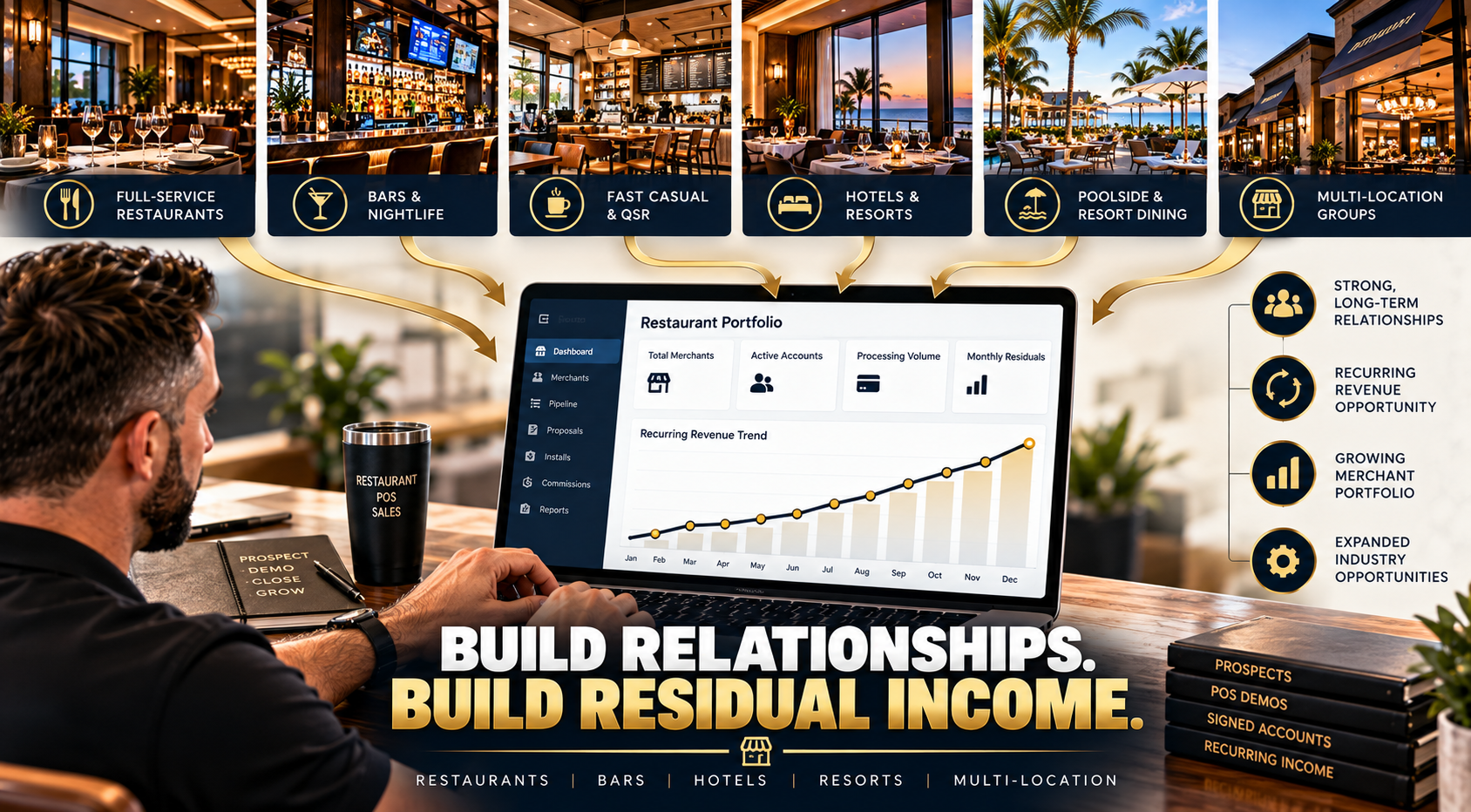
Residual income opportunities: A compensation structure that can help agents build a merchant portfolio over time.
Education and guidance: Training to help agents recognize and pursue the right opportunities.
That's the kind of foundation I want agents to have before they invest significant time chasing sophisticated hospitality accounts.
Explore the Restaurant & Hospitality POS Sales Partnership
If you're already selling merchant services, I want you to consider something.
How many restaurant, bar, or hotel opportunities have you passed on because you weren't confident your POS system could handle the business?
How many prospects have asked about a feature or integration you couldn't provide?
How many larger accounts have you avoided because your current processing partner focuses primarily on basic terminals or simpler POS products?
Those are the opportunities I want agents to start thinking about differently.
The answer isn't always to prospect harder. Sometimes it's to get access to a better solution and the right people behind it.
I'm building a specialized restaurant and hospitality POS sales opportunity for agents who want to compete for these types of businesses.
If you'd like to learn about the technology, integration capabilities, available offers, training, and partnership support, I invite you to explore it.
Explore the Restaurant & Hospitality POS Sales Opportunity
If you're new to merchant services, start with the free education at Merchant Service University.
Frequently Asked Questions About Restaurant and Hospitality POS Prospecting
Why do merchant services agents struggle to sell POS systems to larger restaurants?
One major obstacle is that agents may not have access to a POS system that supports the restaurant's operational requirements. Complex restaurants can require advanced kitchen routing, bar tabs, handheld ordering, reporting, integrations, and professional implementation. If your current offering can't meet those needs, explore a specialized restaurant and hospitality POS sales partnership.
What is the best POS system for selling to large restaurants and bars?
The best fit depends on the merchant's requirements. Agents should evaluate restaurant workflows, equipment, integrations, installation, ongoing support, and total costs. Rather than selecting a product solely because of its commission structure, choose a partnership with technology suited to the accounts you want to pursue.
Can restaurant POS systems charge purchases to hotel rooms?
Yes, certain hospitality POS systems can post eligible restaurant and bar charges to a guest's hotel folio when properly integrated with a compatible property management system. The functionality must be verified for the specific POS, PMS, property configuration, and required workflows.
What is PMS integration in a hotel restaurant POS system?
PMS stands for property management system. A POS-to-PMS integration connects eligible restaurant or bar transactions with the hotel's guest-account system. Depending on the integration, it may allow authorized purchases to be posted to a guest's room folio for later settlement.
How do hotel guests charge restaurant meals to their rooms?
At a property with a properly configured POS-to-PMS integration, restaurant staff can verify the guest's room and eligibility, then post the eligible charge to the guest's hotel account. The specific steps depend on the systems involved and the hotel's policies.
Do all restaurant POS systems support hotel room charges?
No. Room-charge capabilities depend on the POS product, compatible PMS integrations, configuration, and supported workflows. Agents should never assume that a restaurant POS automatically supports hotel guest folios. If you want to pursue these accounts, learn more about my hospitality POS sales partnership.
Can a POS sales agent sell systems to hotel restaurants and bars?
Yes, provided the agent's partner has a suitable solution and the technical resources needed to qualify the property. Hotel accounts may require coordination with food-and-beverage management, IT teams, PMS providers, and professional installers.
Who makes POS purchasing decisions at a hotel?
Depending on the property, decisions may involve the food-and-beverage director, restaurant general manager, hotel general manager, IT director, ownership group, or corporate operations team. Agents should identify the appropriate decision-makers before presenting a proposal.
Can hotel restaurant POS accounts generate recurring residual income?
Some merchant services partnerships pay residual compensation on active processing accounts. A hotel restaurant or bar may represent a worthwhile opportunity, but income depends on the specific account, processing economics, and agent agreement. There are no guaranteed residual amounts.
Do I need to personally install hotel restaurant POS systems?
Not necessarily. Some providers have professional implementation teams and technical specialists. Agents should confirm exactly which services their partnership includes and which responsibilities remain with the merchant.
How do I compete against Toast or Square for sophisticated restaurant accounts?
Start with the merchant's operational requirements. Confirm that your proposed system supports the necessary workflows, integrations, hardware, and service needs. Then use a relevant demonstration and complete cost comparison to show why the alternative deserves consideration.
Where can I get access to advanced restaurant and hospitality POS systems to sell?
You can explore my restaurant and hospitality POS sales opportunity to learn more about the available partnership, technology, and support. For foundational merchant services education, visit Merchant Service University.
Final Thoughts: The Right Hospitality POS System Changes Who You Can Sell To
I want agents to understand something before they spend another year trying to win bigger accounts.
You can be an excellent salesperson and still lose opportunities because the technology you're offering isn't right for the merchant.
You can have a great relationship with a restaurant owner and still lose the deal because your system doesn't support a critical workflow.
You can get an appointment with a hotel food-and-beverage director and immediately discover that room-charge integration is a requirement your current product cannot meet.
Those aren't problems you can solve with a better closing script.
You need the right product.
You need technical expertise.
You need professional installation.
You need dependable support.
And then you need to do the prospecting, demonstrations, proposals, and follow-up necessary to build your business.
That's the combination I'm focused on helping agents develop.
Stop limiting your opportunities to the capabilities of a basic POS system. Find out what you could pursue with a hospitality-focused technology offering and the right support behind it.
Explore the Restaurant & Hospitality POS Sales Opportunity
About Joe Wagner
I'm Joe Wagner, a merchant services entrepreneur and sales trainer who has worked in the payment processing industry since 2009.
Through Merchant Service University, I provide free education to help sales professionals understand merchant services, payment technology, prospecting, and the process of building a merchant portfolio.
I also help agents evaluate processing partnerships and develop the skills needed to compete for more sophisticated business opportunities.
Get educated before you get recruited.