How to Become a Restaurant POS Sales Agent in 2026: A Complete Guide
How to Become a Restaurant POS Sales Agent in 2026: A Complete Guide
Want to build a merchant-services business with recurring income? Start by learning how to sell technology that restaurants actually need.
If I were starting my merchant-services career again in 2026, restaurant and hospitality point-of-sale systems would be one of the first markets I would seriously consider specializing in.
I've worked in merchant services since 2009, and I've seen how much the industry has changed.
Years ago, many agents built their businesses primarily by helping merchants lower their credit card processing costs. That approach still has its place, but today, restaurant owners are dealing with much bigger challenges.
They're trying to manage labor costs, improve service, control expenses, handle online orders, retain customers, and keep their technology working during the busiest hours of the day.
A modern restaurant POS system can touch nearly every part of those operations.
That creates an opportunity for sales professionals who want to do more than sell credit card processing.
Instead of approaching every merchant with the same rate-saving pitch, you can learn to identify operational problems, introduce relevant technology, arrange demonstrations, and help restaurant owners evaluate solutions that make sense for their businesses.
And depending on your processing partnership and compensation agreement, you may have the opportunity to earn upfront commissions and recurring residual income from the merchants you acquire.
You don't need to own a restaurant, develop software, or become a payment processor to explore this business.
You need to understand the market, learn the products, develop a consistent sales process, and choose the right partners.
In this guide, I'll explain how restaurant POS sales works, what you can sell, which businesses to approach, how agents get paid, and how to get started.
Planning to watch instead of read? I'll be adding a video walkthrough of this restaurant POS sales opportunity to this article.
What Is a Restaurant POS Sales Agent?
A restaurant point-of-sale sales agent is a professional who helps restaurants and hospitality businesses evaluate and acquire technology used to accept payments and manage operations.
Depending on the products and partnerships involved, this can include:
Restaurant POS workstations and touchscreen systems
Handheld ordering and payment devices
Kitchen display systems
Online ordering and mobile payments
Table management and reservations
Employee and tip management
Reporting and analytics
Customer loyalty and marketing tools
Integrated payment processing
Multi-location restaurant management
The agent's role isn't necessarily to build, install, or personally support every component.
In a well-structured partnership, the technology provider and its implementation teams may handle much of the technical work.
Your primary responsibility is to find qualified business owners, understand their needs, present appropriate solutions, coordinate the sales process, and maintain strong relationships.
Selling a Restaurant POS System Is Different From Selling a Credit Card Terminal
A traditional payment-processing conversation might begin with:
"Who handles your credit card processing, and can I save you money?"
A restaurant POS conversation can begin with much more valuable questions.
"How are you handling online orders?"
"Do your servers take payments at the table?"
"Are you paying separately for your POS software and payment processing?"
"How do orders get from the dining room to the kitchen?"
"What happens when your system goes down on a busy Friday night?"
These questions open the door to understanding the restaurant's operation.
And when you understand the business, you have a better opportunity to provide value.
That's why I believe restaurant POS specialization can be a strong direction for merchant-services agents who want to differentiate themselves.
Why Restaurant POS Sales Is an Opportunity in 2026
Restaurants have to accept payments, but accepting payments is only one part of running a restaurant.
Consider what happens during a typical dinner rush.
Customers arrive and need to be seated.
Servers take orders.
Those orders have to reach the kitchen correctly.
Food and drinks need to be delivered.
Checks may need to be split.
Tips need to be recorded.
Customers want to pay quickly.
Managers need to track sales and employee performance.
Now add online orders, delivery services, reservations, gift cards, and customer loyalty.
A restaurant POS system can become the technology connecting many of these activities.
That means an agent who understands restaurant operations can have a much more meaningful conversation than someone offering only a lower processing rate.
Restaurant Owners Don't Always Want the Cheapest System
Price matters, especially in an industry where owners closely monitor operating expenses.
But the cheapest monthly software subscription isn't necessarily the least expensive system to operate.
A restaurant owner may also be concerned about:
Equipment purchases and replacement costs
Additional software modules
Processing expenses
Installation and migration costs
Employee training
System reliability
Customer support
Operational disruption when switching providers
This is why understanding the total cost of ownership is so important.
A restaurant could be paying for multiple services that another system may consolidate.
Or a lower-priced alternative might lack a feature the restaurant genuinely needs.
Your job is to help the owner understand the complete picture.
The strongest sales opportunity isn't always the restaurant with the highest processing bill. It's often the restaurant with an operational problem you can help solve.
What Types of Businesses Can Restaurant POS Agents Sell To?
One of the reasons I like this specialization is the variety of businesses that use restaurant and hospitality technology.
You aren't limited to traditional sit-down restaurants.
1. Full-Service Restaurants
These businesses may need table layouts, seat management, coursing, split checks, handheld ordering, kitchen displays, and integrated payments.
A full-service restaurant owner may care deeply about how quickly servers can serve guests and close checks.
2. Quick-Service Restaurants
Fast-casual restaurants, counter-service locations, and takeout-focused businesses often prioritize speed, order accuracy, online ordering, and efficient kitchen workflows.
Self-service kiosks may also be relevant for some operations.
3. Bars and Nightclubs
Bars and nightlife businesses have a different set of challenges.
They may need fast bar tabs, card preauthorization, tip tracking, happy-hour pricing, mobile payments, and high-volume service.
A nightclub might also need to process cover charges and manage different service areas.
4. Sports Bars
Sports bars combine restaurant operations with high-volume bar service.
They may have large numbers of open tabs, multiple service stations, and major fluctuations in business during sporting events.
5. Hotels and Resorts
Hospitality businesses can have restaurants, bars, cafés, poolside service, and other food-and-beverage outlets.
Some properties need their restaurant POS system to communicate with the hotel's property management system so eligible guest purchases can be charged to a room.
These integrations depend on the specific systems and configurations, but they create a specialized opportunity for agents who understand hospitality operations.
6. Multi-Location Restaurant Groups
A restaurant group operating several locations may need centralized reporting, consistent menu management, location-level controls, and scalable technology.
These sales can involve more decision-makers and a longer evaluation process, but they may also represent larger opportunities.
7. Event Venues and Entertainment Facilities
Concert venues, arenas, and other entertainment properties can require high-volume payment systems, concessions, mobile ordering, and specialized commerce technology.
These environments may use different enterprise products from those sold to independent restaurants.
An agent should understand the distinction rather than assuming one restaurant POS package fits every venue.
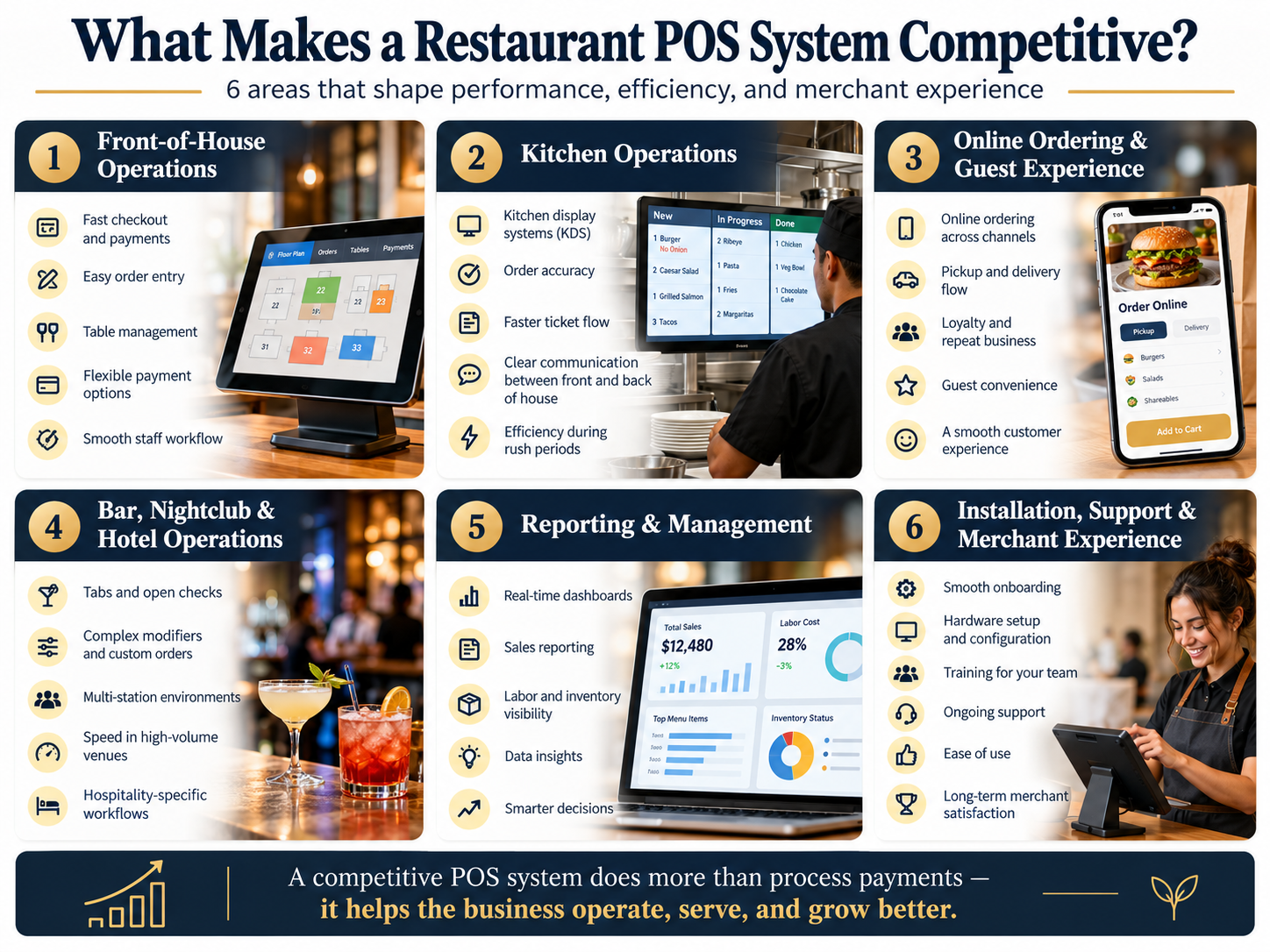
What Makes a Restaurant POS System Competitive?
Before selling any restaurant POS product, you need to understand what makes the technology valuable.
I would begin by learning six major areas.
1. Front-of-House Operations
Understand how servers enter orders, manage tables, split checks, and collect payments.
Learn the difference between a stationary POS workstation and a handheld device.
Ask how the technology affects the customer experience.
2. Kitchen Operations
Learn how orders reach the kitchen.
Understand kitchen display systems, ticket routing, modifiers, and the communication between front-of-house and back-of-house employees.
A system that helps prevent confusion during busy service can be valuable to the right restaurant.
3. Online Ordering and Guest Experience
Understand how customers order online, pay from mobile devices, make reservations, and interact with loyalty programs.
Don't assume every feature is included in every package.
Learn which features are standard, optional, or dependent on integrations.
4. Bar and Nightclub Operations
Learn how bar tabs work, how card preauthorizations are handled, how tips are tracked, and how payments can be accepted away from the main bar.
You should also understand that card preauthorization does not guarantee collection of every possible final charge.
5. Reporting and Management
Restaurant owners need to understand what's happening in their businesses.
Learn how managers review sales, labor, menu performance, and location-level results.
The more you understand the information owners use to make decisions, the better your discovery questions become.
6. Installation, Support, and Merchant Experience
This is an area I believe agents sometimes underestimate.
A restaurant POS system can be central to daily operations.
If something goes wrong during dinner service, the owner needs reliable assistance.
Before recommending a partner, understand its installation process, training resources, support structure, and responsibilities after the sale.
A strong product gets attention. A strong product backed by dependable service helps build lasting merchant relationships.
Can You Sell Restaurant POS Systems Without Technical Experience?
Yes, you can learn the industry without having a technical background.
You don't need to know how to write POS software.
You don't need to personally configure every restaurant menu.
And you don't need to become a network engineer.
But you do need enough knowledge to understand the merchant's operation, recognize potential solutions, and know when to involve a product specialist.
If you're already experienced in sales, you have skills that can transfer directly into this business.
Face-to-Face Sales Experience
If you're comfortable visiting businesses, introducing yourself, asking questions, and handling objections, you already understand important parts of merchant prospecting.
Phone Sales Experience
If you've worked in outbound calling or appointment setting, you may be able to use those skills to reach restaurant owners and schedule qualified meetings.
Virtual Sales Experience
If you're accustomed to selling through Zoom or other online meetings, you may be comfortable coordinating remote discovery calls and demonstrations.
Existing Business Relationships
If you're an entrepreneur, consultant, or salesperson who already knows restaurant owners, you may have opportunities to begin conversations through relationships rather than cold outreach.
However, existing relationships don't replace product knowledge.
The goal is to combine the skills you already have with education about restaurant technology.
How Do Restaurant POS Sales Agents Make Money?
This is one of the most important questions to understand before joining a program.
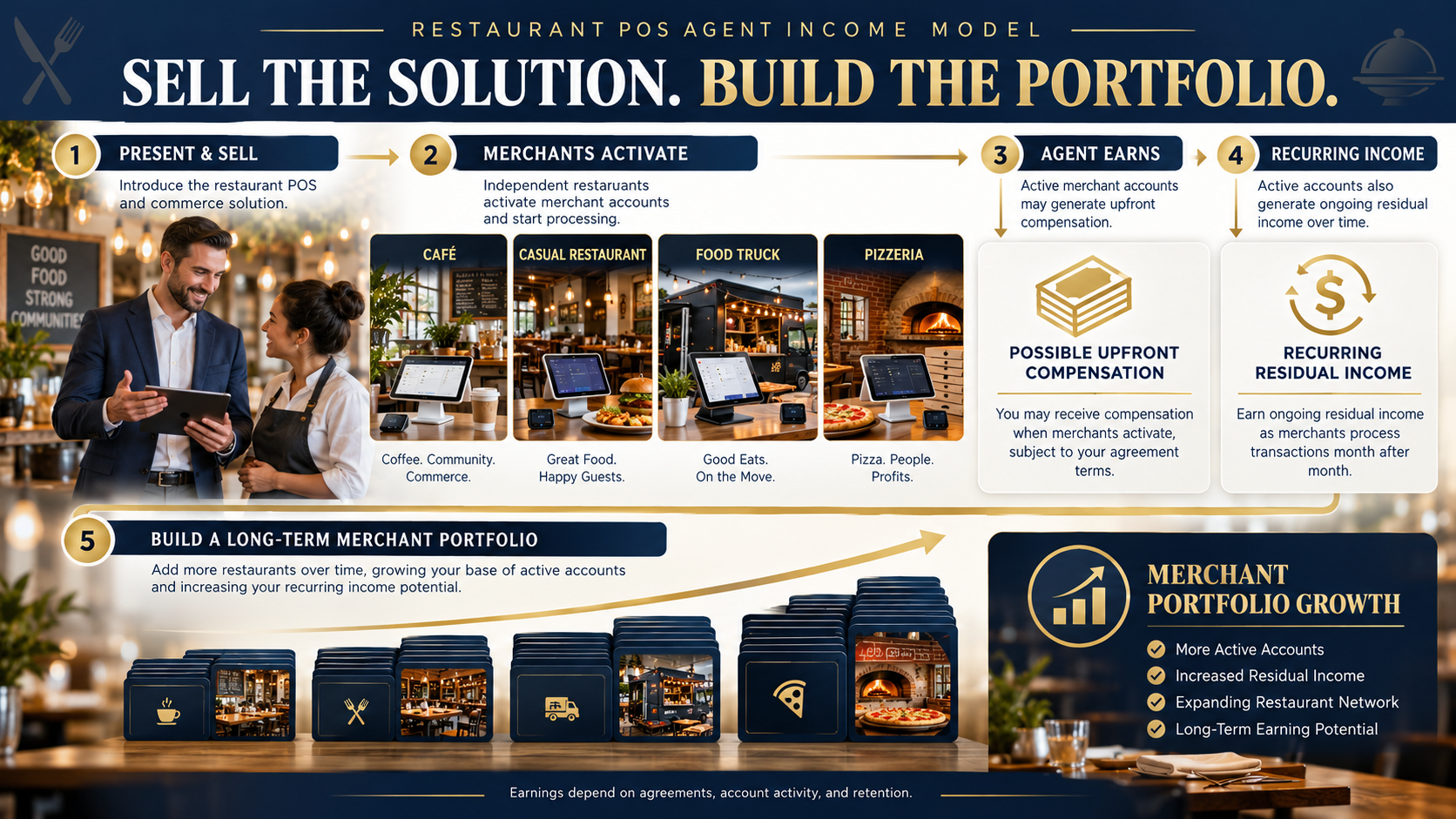
Depending on the partnership, restaurant POS sales agents may have opportunities to earn compensation through upfront commissions, payment-processing residuals, bonuses, or other contractually defined arrangements.
Not every program offers all of these.
Upfront Commissions
Some programs pay compensation when a merchant account is approved, activated, or meets other specified conditions.
The amount and timing depend on the agent agreement.
You should also understand any chargeback or clawback provisions.
Recurring Residual Income
Many merchant-services programs compensate agents based on the ongoing economics of active merchant accounts.
This can allow an agent to build a portfolio that generates recurring income over time.
The actual residual amount depends on processing volume, pricing, costs, compensation terms, and merchant retention.
Portfolio Growth
Here's a hypothetical example to illustrate the business model.
Suppose an agent eventually builds a portfolio of 50 active merchants, and those merchants generate an average of $150 per month in residual compensation for that agent.
That would represent $7,500 per month in illustrative residual income.
But that's not an earnings forecast or a typical outcome.
Real accounts generate different amounts, and some merchants leave or change providers.
The important point is that a recurring-income model can make long-term portfolio building possible.
To understand the underlying economics, read my Merchant Services Agent Commissions guide.
How to Become a Restaurant POS Sales Agent: 7 Steps
If I were starting this business today, here's the process I would follow.
Step 1: Learn the Merchant Services Industry
Before you choose a processing company, learn how payment processing works.
Understand the basic transaction flow, merchant pricing, processing statements, agent compensation, and common industry terminology.
This foundation will make the restaurant POS side much easier to understand.
You can begin with the free education available at Merchant Service University.
Step 2: Learn Restaurant Operations
Spend time understanding how different hospitality businesses operate.
A full-service restaurant is different from a quick-service location.
A nightclub is different from a coffee shop.
A hotel restaurant with room-charge requirements is different from an independent neighborhood restaurant.
Learn the workflows, common frustrations, and buying considerations of the businesses you want to serve.
Step 3: Choose a Restaurant POS Sales Partner
Don't select a partner solely because it offers an attractive commission.
Evaluate the technology, support, installation process, merchant experience, compensation structure, and agent agreement.
You want to know who will help when a merchant needs assistance and how the sales process works from beginning to activation.
I'll cover this in more detail in Choosing the Best Restaurant POS Sales Partner: Products, Support, and Residual Income.
Step 4: Learn the Products Through Demonstrations
You should understand what you're selling well enough to identify which features matter to each type of merchant.
Participate in product demonstrations.
Ask questions.
Learn the limitations.
Understand what requires additional software, hardware, or integrations.
You don't have to personally deliver every technical demo, but you should know how to qualify a merchant for one.
Step 5: Build a Prospecting Plan
Choose how you'll consistently reach restaurant and hospitality decision-makers.
You might visit restaurants in person, make outbound calls, work through referrals, or use existing business relationships.
The important part is having a repeatable process.
For more detailed guidance, read How to Prospect Restaurants, Bars, and Nightclubs for POS Sales.
Step 6: Learn to Compare the Full Cost
Many restaurants pay for both payment processing and POS software.
Some receive separate statements for each.
That means a useful cost analysis may require more than the processing statement alone.
Learn how to compare hardware, monthly subscriptions, processing fees, optional features, implementation costs, and support.
Don't promise savings until you've reviewed the actual numbers.
Step 7: Build and Manage Your Pipeline
Restaurant POS opportunities may involve several conversations, decision-makers, demonstrations, and follow-ups.
Track your prospects.
Know which merchants need a proposal.
Know which ones have scheduled demos.
Know which deals are waiting on underwriting, installation, or activation.
You can't build a consistent business if every opportunity exists only in your memory.
How to Find Restaurants That May Be Ready to Switch POS Systems
One of the biggest mistakes an agent can make is assuming every restaurant wants to replace its current technology.
Many don't.
And a complete POS replacement is a serious decision.
The owner may have years of menu data, employee training, integrations, and established workflows tied to the current system.
That's why discovery matters.
I would look for restaurants experiencing specific frustrations.
Common Restaurant POS Pain Points
High software costs: The restaurant may be paying for multiple subscriptions, modules, or services.
Outdated hardware: Slow or unreliable equipment can create problems during peak service.
Limited mobility: Servers may be forced to return to a stationary terminal to enter orders or close checks.
Poor support: The owner may struggle to get timely help when something breaks.
Disconnected online ordering: Online orders may require separate systems or manual work.
Kitchen communication problems: Tickets, modifiers, and order changes may not flow efficiently.
Expansion needs: A growing restaurant group may need better reporting and management across locations.
Contract renewal or equipment replacement: An upcoming renewal can be a natural time to evaluate alternatives.
These situations can create a reason for the owner to explore options.
But don't assume a switch is appropriate before understanding the full operation.
How to Compete Against Toast and Other Restaurant POS Providers
Toast is a recognizable restaurant technology provider, and many restaurant owners are already familiar with its products.
That means agents entering this market need to understand how to compete professionally.
I would not build a sales pitch around telling every restaurant owner that their existing system is bad.
Instead, I'd focus on asking better questions.
What does the merchant currently pay for software?
What equipment do they own or lease?
Which features do they actually use?
How satisfied are they with support?
Are there contractual obligations?
What would switching involve?
What alternatives meet their needs?
Why Promotions Can Be Powerful Sales Tools
Some restaurant POS providers offer promotional equipment packages, installation assistance, reduced upfront costs, or financial incentives for qualifying merchants.
These offers can make it easier for a restaurant owner to consider replacing an expensive or outdated system.
But agents need to understand the exact terms.
A promotional offer may have eligibility requirements, minimum commitments, processing conditions, or limitations on combining incentives.
You should never promise a merchant an offer that hasn't been confirmed.
The right approach is to use the promotion as a reason to conduct a serious comparison.
A great promotion can open the door. The technology, economics, and merchant experience still need to justify the decision.
I'll go deeper into this subject in How to Sell Restaurant POS Systems Against Toast and Other Competitors.
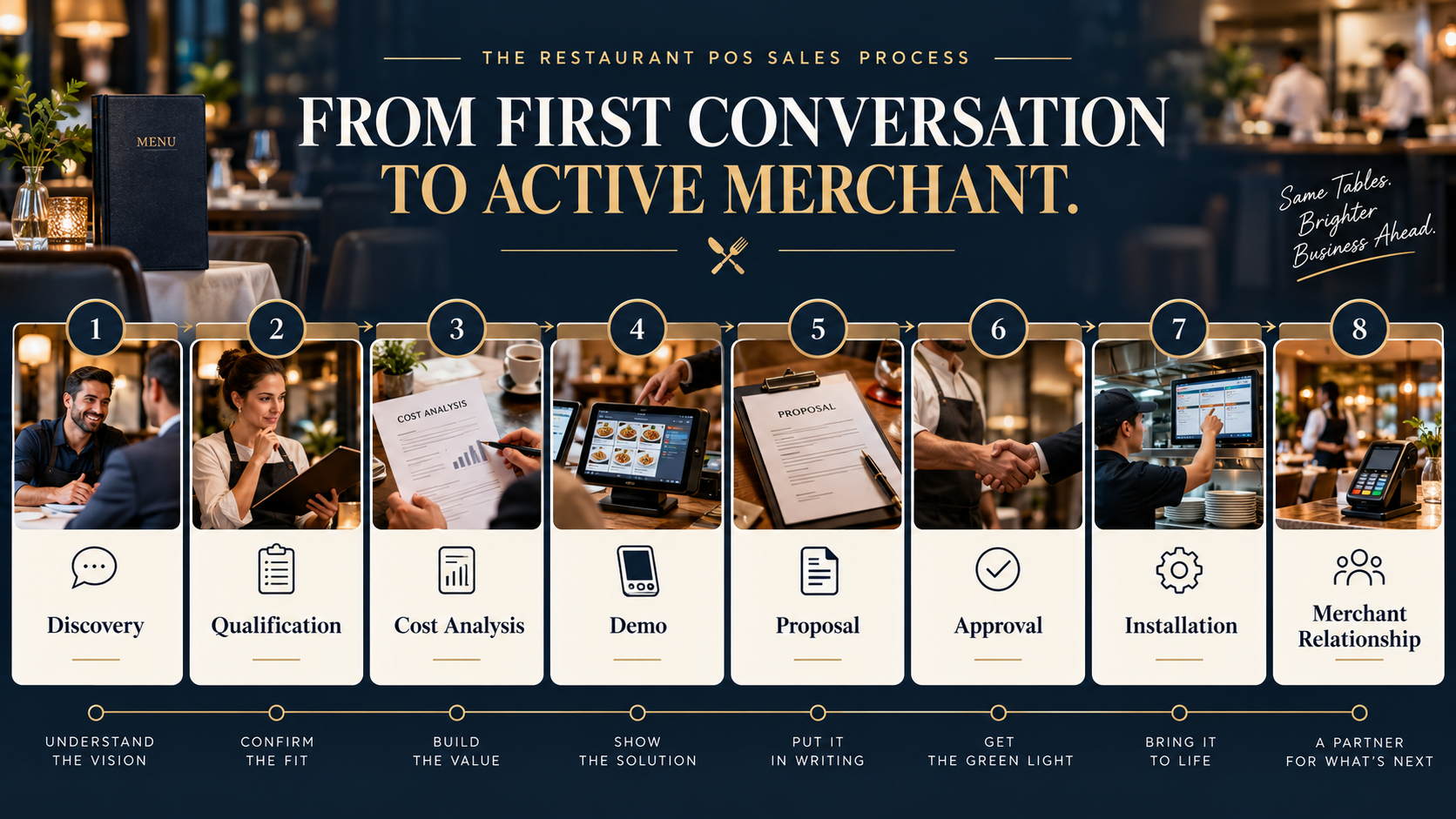
The Restaurant POS Sales Process: From Prospect to Activation
Once you find a restaurant owner who may be interested, the next steps should be organized.
I recommend a straightforward process.
1. Discovery: Understand the restaurant's operation, current POS system, pain points, and decision-making process.
2. Qualification: Determine whether your available solutions appear to meet the merchant's requirements.
3. Cost analysis: Review processing and software costs where relevant, including statements and contractual considerations.
4. Product demonstration: Arrange a demonstration that focuses on the restaurant's actual workflows and questions.
5. Proposal: Present the recommended solution, complete costs, promotional terms, and implementation considerations.
6. Agreement and approval: Complete the required merchant paperwork and underwriting process.
7. Installation and activation: Coordinate the transition according to the provider's process.
8. Relationship management: Stay connected and help the merchant reach the appropriate support resources when needed.
A good agent should know where each opportunity stands and what needs to happen next.
Read How to Run a Restaurant POS Demonstration That Helps Close Deals for a deeper look at this process.
What Should You Look for in a Restaurant POS Sales Partnership?
I've worked with merchant-services companies and processing partners for many years.
One lesson I've learned is that the company behind you matters.
A strong sales agent can still have a difficult experience if the partner doesn't provide the right technology, implementation process, or support.
Before joining a program, I would ask:
Does the product fit the types of restaurants I want to serve?
Can I get help qualifying complex opportunities?
Who conducts demonstrations?
Who handles installation and training?
What happens when a merchant needs technical support?
How are commissions and residuals calculated?
What are the vesting and residual-rights provisions?
Are there clawbacks or other compensation conditions?
What happens if I stop actively selling?
Can I build a long-term portfolio under the agreement?
Don't evaluate a partner based only on the largest advertised residual split.
A strong support organization, dependable technology, and good merchant experience can be just as important to building a sustainable business.
Why I'm Focusing on Restaurant and Hospitality POS Sales
I've spent more than 16 years in merchant services, and my focus has always been on helping agents understand the business and build recurring-income portfolios.
I believe specializing in restaurants and hospitality is a logical opportunity for agents who want to develop expertise beyond basic processing-rate conversations.
The industry offers a variety of business types, meaningful technology needs, and opportunities to develop long-term merchant relationships.
But I also believe agents need education and support.
It's not enough to sign up with a company, receive a login, and be told to start selling.
You should understand what you're offering, which merchants are a good fit, how to identify opportunities, and how to move a qualified prospect through the sales process.
That's why I'm developing additional restaurant and hospitality sales education through Merchant Service University and expanding my focus on helping agents evaluate appropriate industry partnerships.
The objective is to help sales professionals become more knowledgeable, more confident, and better equipped to serve the merchants they approach.
Explore My Restaurant & Hospitality POS Sales Partnership
If you're already selling merchant services—or you're an experienced salesperson interested in entering the industry—restaurant POS specialization may be worth exploring.
The right opportunity can give you access to modern restaurant technology, a defined market to prospect, and a business model that may include upfront commissions and recurring residual income.
But you should understand the products, compensation, support, and expectations before making a decision.
I've created a dedicated page where you can learn more about the restaurant and hospitality POS sales opportunity and the partnerships I'm working with.
Explore the Restaurant & Hospitality POS Sales Opportunity
If you're new to merchant services, I also encourage you to begin with the free training at Merchant Service University.
Learn the business first.
Then choose the opportunity that makes sense for you.
Frequently Asked Questions About Becoming a Restaurant POS Sales Agent
How do I become a restaurant POS sales agent?
Start by learning merchant services and restaurant POS technology. Then evaluate processing and POS sales partnerships, understand the compensation agreement, learn the product through demonstrations, and begin prospecting qualified restaurants. You can explore my restaurant POS sales partnership at https://consultant.ezdirectsales.com.
Do I need restaurant experience to sell POS systems?
No. Restaurant experience can help, but sales professionals can learn the workflows and technology used by restaurants, bars, and hospitality businesses. Merchant Service University provides a free starting point for learning the broader merchant-services industry.
Can I sell restaurant POS systems without being a registered ISO?
In many cases, yes. Independent sales agents can work through established processing organizations rather than becoming registered ISOs themselves. The exact structure depends on the partner, agreements, and applicable requirements.
How much do restaurant POS sales agents make?
Earnings vary widely. Compensation may include upfront commissions, recurring residual income, or other incentives, depending on the agent agreement. There is no guaranteed income amount, and agents should review compensation terms carefully before joining.
Can I earn residual income selling restaurant POS systems?
Some merchant-services partnerships provide recurring residual compensation from active processing accounts. The amount depends on merchant activity, underlying economics, contractual terms, and retention. If long-term portfolio building is your goal, make sure you understand your residual rights.
Is selling restaurant POS systems better than selling credit card processing?
It can create a broader sales conversation. Rather than competing exclusively on processing rates, agents can help restaurants evaluate software, hardware, service workflows, online ordering, and support. The best approach depends on the merchant's actual needs.
Can I sell POS systems to bars and nightclubs?
Yes, if your partner offers solutions suitable for those businesses. Bars and nightclubs may need tab management, preauthorization, tip tracking, mobile payments, and high-volume service features. You should verify which capabilities are supported in the specific configuration.
Can restaurant POS agents sell to hotels and resorts?
Potentially. Some hospitality POS systems support integration with property management systems and guest room-charge workflows. Compatibility and configuration need to be confirmed for each property. Agents should work with qualified product specialists on complex hospitality opportunities.
Do I need to install the POS system myself?
Not necessarily. Some providers have professional installation and implementation teams. Before joining a partnership, verify exactly which responsibilities belong to the agent and which are handled by the provider.
How do I compete with Toast?
Learn how to compare complete systems rather than relying on rate-based pitches. Review the restaurant's current software expenses, processing costs, equipment, support, functionality, and switching requirements. Use verified promotional offers where applicable and arrange a qualified demonstration.
Can I sell restaurant POS systems part-time?
It may be possible, depending on your partner's expectations and your availability. You'll still need time for prospecting, appointments, follow-ups, and merchant communication. The restaurant also needs dependable support after the sale.
Where can I find a restaurant POS sales partnership?
You can learn about the restaurant and hospitality POS sales opportunity I'm developing at consultant.ezdirectsales.com. Review the products, compensation, support, and agreement terms to determine whether the partnership fits your goals.
Final Thoughts: Is Restaurant POS Sales a Good Opportunity?
I believe restaurant POS sales is worth serious consideration for people who enjoy selling, want to learn modern business technology, and are interested in building a merchant portfolio.
But I wouldn't enter the business expecting an effortless income stream.
I'd enter with a plan.
Learn payments.
Understand restaurant operations.
Choose a strong partner.
Get comfortable with demonstrations.
Prospect consistently.
Follow up.
Help merchants make informed decisions.
And build relationships that last beyond the original sale.
If you're willing to do those things, restaurant and hospitality POS sales can offer a meaningful specialization within the merchant-services industry.
Learn More About Becoming a Restaurant & Hospitality POS Sales Agent
About Joe Wagner
I'm Joe Wagner, a merchant-services entrepreneur and sales trainer who has worked in the payment-processing industry since 2009.
Through Merchant Service University, I provide free education to help people understand payments, merchant sales, and the business of building recurring-revenue portfolios.
I also help interested sales professionals explore industry partnerships and develop the skills needed to acquire and support merchants.
My philosophy is simple:
Get educated before you get recruited.