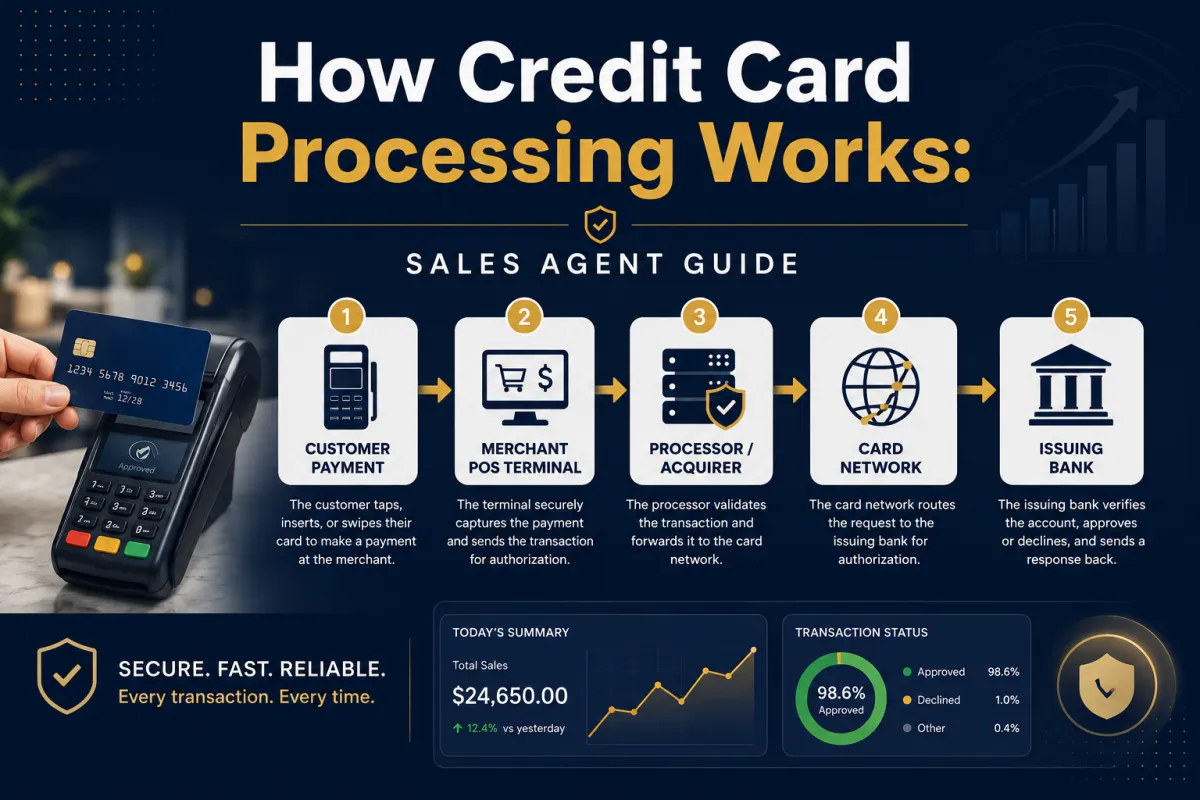
How Credit Card Processing Works: Sales Agent Guide
How Credit Card Processing Works: A Guide for Merchant Services Sales Agents
If you're going to sell merchant services, you should be able to explain how credit card processing works without turning the conversation into a finance class.
You don't need to become a payment engineer. You don't need to memorize every technical message traveling between financial institutions, and you don't need to overwhelm a merchant with industry terminology they never asked for. But you should understand what happens between the moment a customer presents a card and the moment the merchant receives the money.
That knowledge makes you a better salesperson because it helps you understand what you're actually selling. It also makes conversations about processing fees, authorization costs, deposits, declines, chargebacks, payment security and merchant statements much easier to understand.
I've seen plenty of new merchant services agents memorize a pitch before they understand the product underneath it. I think that's backwards. If you're building a career in this industry, understanding the payment ecosystem should be part of your foundation.
If you're brand new, I recommend reading my Merchant Services Sales: Complete 2026 Beginner's Guide first. That article explains the larger merchant-services industry. This guide goes deeper into one specific question: What actually happens when a customer pays a business with a credit card?
Credit Card Processing Explained in Simple Terms
At the simplest level, credit card processing is the system that allows a business to request payment from a customer's card account, receive an approval or decline, complete the transaction and ultimately receive the funds.
A lot has to happen behind the scenes to make that possible. The merchant needs technology capable of securely accepting the payment information. The transaction needs to reach the correct financial institutions. The customer's bank needs to determine whether the transaction should be approved. The financial institutions then need to reconcile the transaction and move the money to the merchant.
Most of that happens without the customer or merchant ever thinking about it.
A customer taps a card.
The terminal says Approved.
The customer leaves.
The merchant sees the deposit later.
For a merchant services agent, however, everything happening between those steps matters because the companies and systems involved are part of the service you're helping the merchant buy.
A current Stripe explanation of payment processing breaks the transaction into the same broad stages you'll repeatedly hear throughout the industry: authorization, clearing and settlement. You can review its payment-processing overview here:
https://stripe.com/resources/more/how-payment-transaction-processing-works
Those three concepts are a good framework for learning the payment flow.
The Main Players in a Credit Card Transaction
Before following a transaction from beginning to end, you need to know who is involved. The exact structure can vary depending on the processor, payment platform and type of transaction, and modern payment companies sometimes combine multiple roles into a single platform. However, a traditional card transaction commonly involves several key participants.
The Cardholder
The cardholder is the customer making the purchase. They may present a physical credit or debit card, tap a digital wallet or enter their payment credentials through an online checkout.
The Merchant
The merchant is the business accepting the payment. This is the customer you're serving as a merchant services agent.
The POS System, Terminal or Payment Gateway
This is where payment information enters the payment environment. In a retail store, it might be a countertop terminal or full point-of-sale system. A contractor might use a mobile reader. An ecommerce business may use an online checkout connected to a payment gateway.
These systems can look completely different to the merchant while still serving the same basic purpose: securely capturing the information required to initiate the transaction.
The Payment Processor
The payment processor helps facilitate the communication necessary to authorize and settle electronic transactions. Processors can play different roles depending on the payment architecture, but for a new sales agent, it is useful to think of the processor as a major part of the infrastructure moving transaction information between the merchant side of the transaction and the larger payment networks.
The Acquirer
The acquiring bank or acquiring institution operates on the merchant side of the card transaction. It participates in accepting card transactions on behalf of merchants and communicating with the networks necessary to complete those transactions.
The Card Network
Card networks such as Visa and Mastercard provide the network infrastructure that helps route card transactions between the acquiring and issuing sides of the payment ecosystem.
The Issuing Bank
The issuing bank is the financial institution that issued the customer's card. When an authorization request arrives, the issuer determines whether the transaction should be approved or declined based on factors such as account status, available credit or funds, card validity and risk controls.
Once you understand those players, the entire payment flow becomes much easier to visualize.
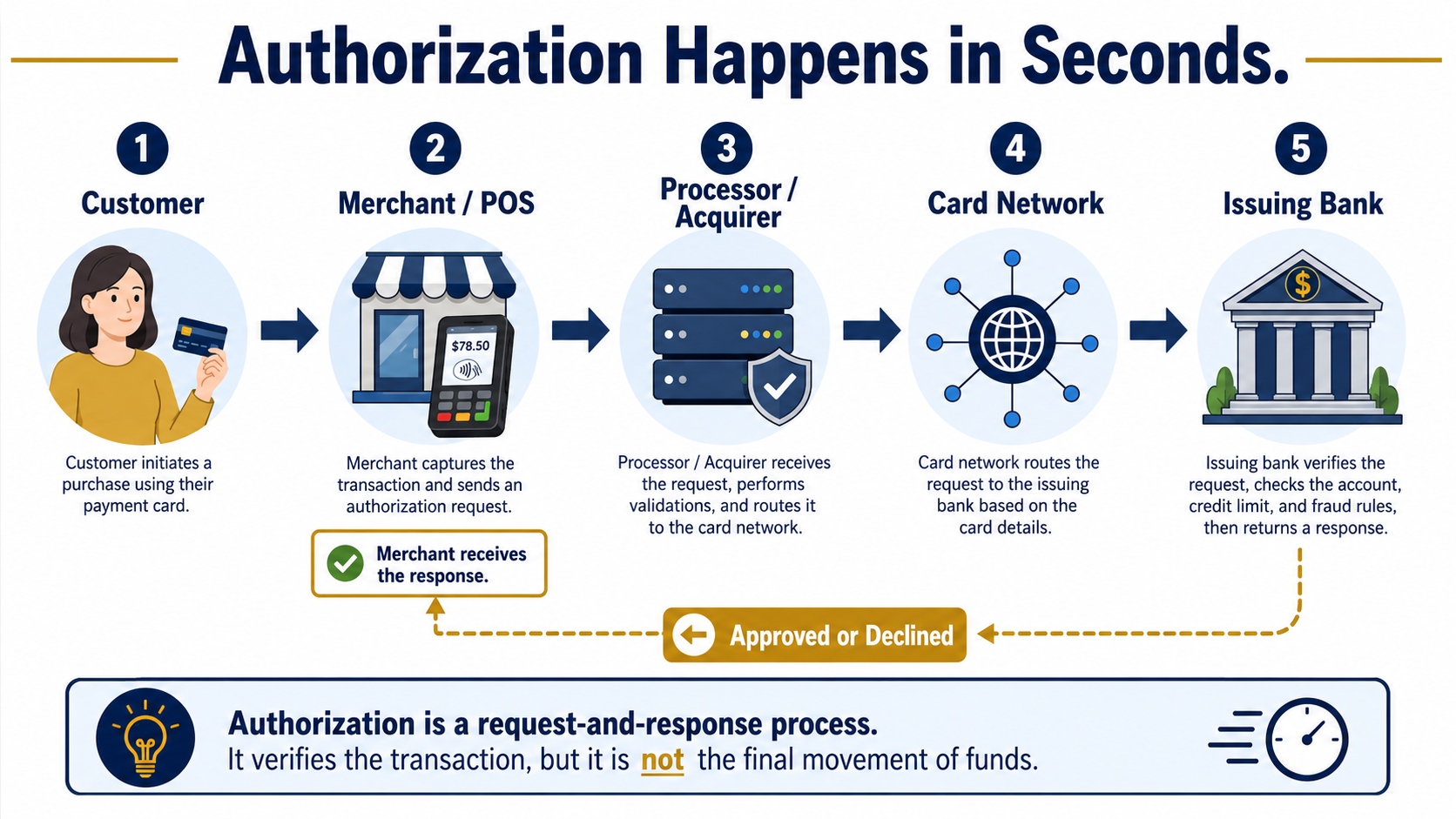
How Credit Card Processing Works Step by Step
Now imagine a customer walks into a local restaurant and pays a $100 bill with a credit card. The customer sees a transaction that takes only a few seconds, but multiple events are happening behind the scenes.
Step 1: The Customer Presents a Payment Method
The transaction begins when the customer presents their payment credentials. That may happen by inserting an EMV chip card, tapping a contactless card or digital wallet, swiping where supported, or entering card information during an ecommerce transaction.
The merchant's POS system, payment terminal or online checkout captures the information necessary to initiate the transaction. The goal is to transfer that information securely into the payment system so an authorization decision can be requested.
For a merchant services salesperson, this is where the visible portion of the payment experience begins. Merchants care about how fast the terminal works, how easy the checkout is for employees and customers, what payment methods they can accept, and whether the payment experience integrates with the rest of the business.
That is one reason selling merchant services has become much larger than simply discussing processing rates.
Step 2: The Payment Information Is Securely Transmitted
Once the merchant's payment technology captures the transaction, that information needs to travel through the payment infrastructure.
In an ecommerce environment, a payment gateway commonly plays an important role in securely transmitting payment information. In modern integrated systems, gateway and processing functionality may be bundled into a larger platform, so the merchant may never think about these as separate products.
Security matters throughout this process because payment-card information is sensitive financial data. The PCI Security Standards Council maintains the PCI Data Security Standard, which establishes technical and operational requirements designed to protect payment account data.
You can review PCI SSC's merchant payment-security resources here:
https://www.pcisecuritystandards.org/merchants/process/
As an agent, you don't need to become the merchant's PCI security assessor. You should, however, understand why approved hardware, secure payment software, encryption, PCI compliance and good payment-data practices matter.
Step 3: An Authorization Request Is Sent
Once the transaction information enters the processing system, an authorization request is sent toward the customer's card issuer.
In a traditional transaction flow, information moves through the merchant's payment infrastructure toward the acquiring side, through the relevant card network and ultimately to the issuing bank.
This entire trip can happen very quickly.
The merchant isn't asking the issuing bank to transfer the money yet. At this stage, the merchant is essentially asking:
"Is this transaction approved?"
That distinction is important because authorization and settlement are not the same thing.
Step 4: The Issuing Bank Evaluates the Transaction
The issuing bank evaluates the request and determines whether it should approve or decline the transaction.
A number of factors can influence that decision. The account may not have enough available credit or funds. The card may be expired. Fraud controls may flag the transaction. The card information may be entered incorrectly. The account may be restricted.
If everything checks out, the issuer returns an approval.
If not, it returns a decline response.
This is also why a merchant services agent shouldn't promise a merchant that a processor can somehow approve every transaction. The processor facilitates communication, but the issuing institution has a significant role in deciding whether a particular card transaction is authorized.
Step 5: The Approval or Decline Travels Back to the Merchant
The issuer's decision travels back through the payment ecosystem until the merchant's terminal, POS or online checkout receives the response.
If the transaction is approved, the merchant can complete the sale.
If the transaction is declined, the merchant generally asks the customer for another payment method.
All of those steps can occur in just a few seconds, which is pretty remarkable when you consider the number of systems involved.
This is also one reason merchants care about authorization performance and reliability. A payment system that creates unnecessary friction at checkout can affect the customer experience and potentially cost the merchant sales.
Step 6: The Transaction Is Captured
Authorization means the issuer has approved the transaction, but the actual transfer of funds generally comes later.
Capture is the stage where an approved transaction is finalized for payment. Depending on the merchant and payment environment, capture may happen almost immediately or after a delay.
Restaurants provide a useful example. A restaurant may authorize a card before the final tip amount is known. Hotels, rental businesses and other industries can also have transaction flows where the final captured amount is different from the initial authorization.
For a merchant services agent, understanding capture helps explain why "approved" does not necessarily mean "the money is already sitting in the merchant's bank account."
Step 7: Transactions Are Cleared
After transactions have been authorized and captured, information needs to be reconciled between the financial institutions participating in the transaction.
This is the clearing stage.
Transaction details are transmitted through the payment networks so the issuing and acquiring sides can determine their respective obligations. Interchange and network-related economics are also part of this larger process.
This is where learning how a card transaction works begins connecting directly with learning how a merchant statement works.
When new agents see dozens of card types, interchange categories, assessment fees, authorization charges and processing costs on a statement, those items seem random. They're not. They relate to the infrastructure required to authorize, route, clear and settle electronic payments.
That's why I strongly believe agents should understand the payment flow before trying to become experts at statement analysis.
Step 8: Settlement Occurs
Settlement is the stage in which funds move between the financial institutions involved in the transaction.
The issuing side satisfies the amount owed through the card-network settlement process, and the acquiring side receives the funds associated with the merchant's transactions, subject to the applicable fees and payment arrangements.
Stripe's 2026 payment-processing guide explains that clearing and settlement follow authorization, with funds ultimately moving through the payment ecosystem to the business. Its more detailed processor guide notes that the timing commonly varies by processor and banking arrangement.
The important lesson for an agent is that authorization and settlement are separate stages. The merchant may receive an approval in seconds while the movement and availability of the underlying funds occurs later.
Step 9: The Merchant Is Funded
Funding is what most merchants actually care about.
They want to know:
"When does my money hit my bank account?"
Once transactions have been settled according to the provider's process, the merchant receives the applicable deposit into its designated bank account.
Funding schedules vary. Some providers and programs offer next-day funding, same-day or faster funding options, while other situations can take longer depending on weekends, banking relationships, risk, transaction timing, industry and other factors.
This is an area where sales agents need to be accurate.
Do not tell every merchant they'll get their money tomorrow simply because that sounds good in a presentation. Know the actual funding schedule of the solution you're selling.
A merchant running tight cash flow may care more about dependable deposits than saving a few basis points.
That's discovery.
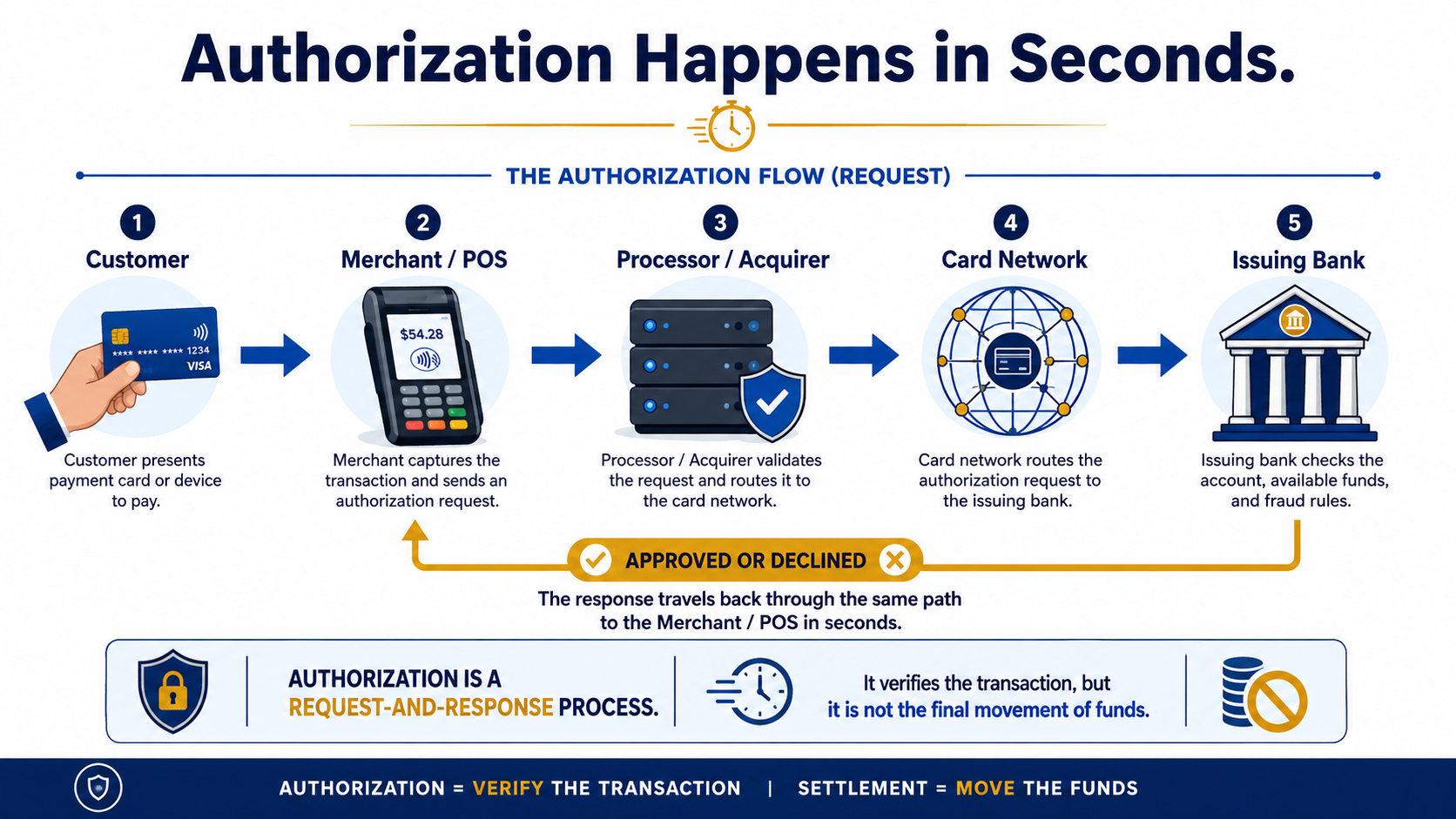
Authorization vs. Settlement: A Distinction Every Agent Should Understand
One of the easiest ways to sound more knowledgeable when discussing payments is simply understanding the difference between authorization and settlement.
Authorization answers the question, "Will the issuer approve this transaction?"
Settlement relates to the later financial process in which the funds move through the participating institutions.
If a $100 restaurant transaction is approved at 7:15 p.m., that does not necessarily mean $100 was instantly deposited into the restaurant owner's checking account at 7:15 p.m. The approval and the ultimate funding of the merchant are different parts of the payment lifecycle.
This becomes particularly important when you're helping merchants understand pending transactions, batching, funding delays, tips, reversals and other situations in which the visible payment experience and the banking movement don't happen at exactly the same moment.
What Does the Payment Processor Actually Do?
The term processor gets thrown around constantly in merchant services, sometimes as though it refers to every company involved in the transaction.
A payment processor generally provides important technical infrastructure that facilitates card transactions between merchants and the larger financial ecosystem. Depending on the processing relationship, the processor can help route authorization requests, communicate transaction data, manage settlement processes and connect merchants with acquiring infrastructure.
Modern payments makes the terminology even more confusing because one company may package processing, acquiring relationships, gateway technology, POS software, reporting and other services into one merchant-facing platform.
From the merchant's perspective, that simplicity can be a good thing.
From an agent's perspective, you still need to know what is happening underneath.
If a merchant asks why their payment isn't funding, why a transaction declined, why their gateway isn't connecting, or why their POS processed a transaction differently than expected, understanding the layers helps you know where the issue might live.
What Is the Difference Between a Processor and an Acquiring Bank?
The processor provides technical and transaction-processing capabilities, while the acquiring institution operates on the merchant side of the financial transaction.
In some payment arrangements, these roles can appear tightly integrated from the merchant's perspective. That is why agents sometimes use terms such as processor, acquirer and merchant-services provider too casually or interchangeably.
You do not need to deliver a technical banking lecture to merchants, but your own understanding should be better than the language you use in your pitch.
This relates directly to the distinction between a merchant services agent and an ISO. You can build a significant sales business without operating every layer of the infrastructure yourself, but you should still understand who your partners are and what functions they perform.
What Is the Difference Between an Issuer and an Acquirer?
This becomes easy once you remember whose side each institution is on.
The issuer is associated with the customer's card. The issuing institution provided the credit or debit card account being used to make the purchase.
The acquirer operates on the merchant side and participates in accepting and settling card transactions for merchants.
A simple memory trick is:
Issuer = customer's side. Acquirer = merchant's side.
That is simplified, but it's enough for a salesperson to keep the roles straight.
What Does the Card Network Do?
Card networks provide the infrastructure and rules that help card transactions move between the acquiring and issuing sides of the ecosystem.
Visa and Mastercard are well-known examples.
Agents sometimes speak as though Visa or Mastercard is "the processor." That's usually not the clearest way to describe the relationship. The network is part of the larger payment ecosystem through which transactions are routed between financial institutions.
This distinction becomes increasingly important when you begin learning interchange, card-brand assessments and merchant pricing, because different components of the merchant's processing expense can originate from different parts of the ecosystem.
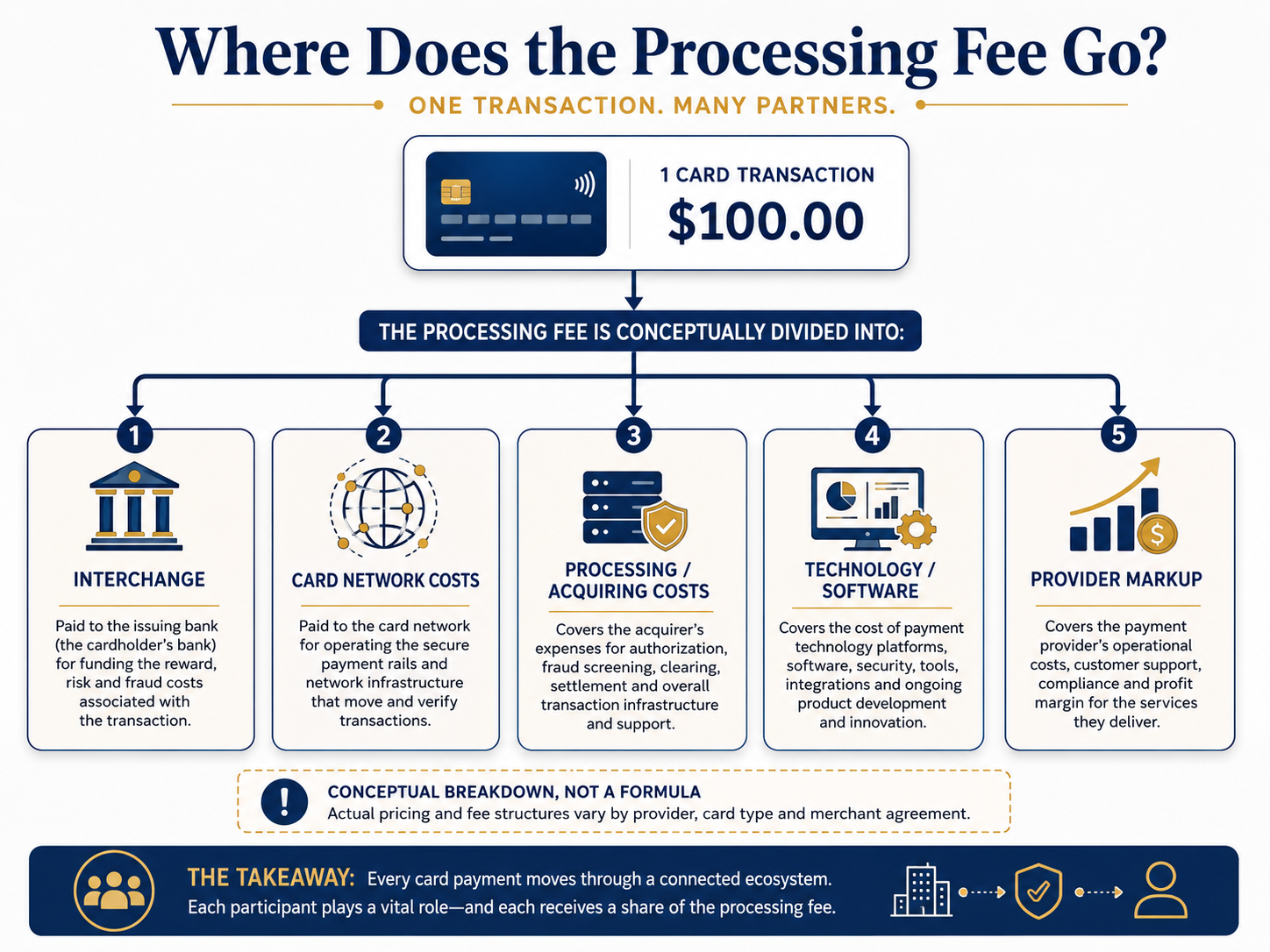
Where Do Credit Card Processing Fees Come From?
Once you understand the payment flow, the existence of processing fees makes more sense.
A card transaction involves technology, financial institutions, networks, fraud management, security systems, authorization infrastructure, software and merchant-service providers. Different portions of the overall processing cost can relate to different participants in that chain.
A merchant might see expenses connected to interchange, network assessments, processor markup, transaction fees, authorization charges, monthly services, software or other program-specific fees.
The exact pricing depends on the merchant's processing relationship.
This is also where your compensation as an agent begins fitting into the picture. If you haven't already, read Merchant Services Agent Commissions: How Agents Get Paid. It explains how processing economics can ultimately create upfront commissions and recurring residual income for agents.
Later in this series, we'll get much deeper into Schedule A costs, residual splits and merchant statements. For now, understand the underlying concept: the merchant's processing expense is connected to a real payment infrastructure, not one single mysterious "credit card fee."
Why Different Cards Can Cost Merchants Different Amounts
This is another concept new agents need to understand before they start promising merchants a particular rate.
Not every card transaction necessarily has the same economics.
Factors can include the type of card, card network, transaction environment, merchant category, card-present versus card-not-present acceptance, rewards products and other elements of the transaction.
That's one reason merchant statements can initially look complicated.
A merchant may think:
"I processed $100,000 and my processor charged me X."
As an agent, you eventually need to understand the layers underneath that number.
You don't need to master interchange on your first day. You do need to understand that there is more happening than simply taking the merchant's monthly processing volume and multiplying it by one universal percentage.
Card-Present vs. Card-Not-Present Transactions
A card-present transaction generally occurs when the customer's payment credential is presented through an in-person payment environment. A card-not-present transaction occurs when the physical card isn't presented at the point of sale, such as many ecommerce, phone or manually entered transactions.
This difference matters because the transaction environments can have different security characteristics, fraud risks and processing economics.
An ecommerce merchant has different payment concerns than a local coffee shop.
A contractor accepting payments over the phone may have different needs than a retailer using EMV chip transactions.
A restaurant may need another completely different setup.
This brings us back to one of the central lessons throughout this blog series: don't sell every business the same payment solution.
Understand how the merchant accepts payments first.
Then determine what system actually fits that environment.
What Happens When a Credit Card Is Declined?
When a transaction is declined, it means the issuing side has not approved the authorization request.
There can be many reasons for a decline, and the merchant or processor may receive a code providing information about the issue. The merchant may need to ask the customer for another form of payment.
Agents need to be careful here.
A decline is not automatically evidence that the merchant's processor is broken.
The payment infrastructure may have worked perfectly by delivering the authorization request and returning the issuer's decision.
Understanding that distinction helps you troubleshoot merchant complaints intelligently instead of immediately blaming whichever system is most visible.
What About Chargebacks?
A chargeback or payment dispute occurs later in the payment lifecycle, when a cardholder disputes a transaction and the applicable dispute process begins.
That is different from an authorization decline.
The merchant may already have completed the transaction and received funds before a dispute arises.
Chargebacks are important because they affect merchant risk, profitability and sometimes the merchant's ability to maintain a processing relationship. Certain industries and business models naturally carry more dispute risk than others.
A new agent doesn't need to become a chargeback expert immediately, but you should understand that getting a transaction approved is not always the end of the payment lifecycle.
Why PCI Compliance Matters to a Merchant Services Agent
Payment security is another area where agents sometimes learn just enough terminology to repeat a sales line without understanding why it matters.
PCI DSS exists to establish security requirements for organizations that store, process or transmit cardholder data. The PCI Security Standards Council specifically states that payment security responsibilities apply across merchants, financial institutions and other entities involved with cardholder data.
For agents, the practical lesson is straightforward: don't casually tell merchants that PCI compliance doesn't matter because they're small or because they use a third-party processor.
PCI SSC explains that even merchants outsourcing their payment processing retain responsibilities around ensuring applicable third-party providers properly protect account data.
You can review that guidance here:
https://www.pcisecuritystandards.org/faqs/1092/
Your role isn't to frighten merchants about compliance.
Your role is to help them use secure, appropriate payment technology and direct technical compliance questions to qualified resources when necessary.
Why Understanding Payment Processing Makes You a Better Salesperson
I don't believe technical knowledge closes deals by itself.
A merchant isn't going to switch processors because you can draw a perfect diagram of authorization and settlement.
But understanding the payment ecosystem improves almost every other part of your sales ability.
You can explain fees with more confidence because you understand where costs come from. You can discuss merchant statements more intelligently. You can explain why online and in-person transactions can behave differently. You can help merchants understand deposits. You can ask better discovery questions because you understand how their payment environment affects the solution they need.
Most importantly, you stop sounding like someone who memorized a pitch yesterday.
You start sounding like someone who understands the business you're asking the merchant to trust you with.
That's what education should do.
The Mistake of Teaching Agents the Pitch Before the Industry
This is one of the things I want to change through Merchant Service University.
Too many people get introduced to merchant services like this: they're recruited into a company, given a product presentation, handed a script and told to start calling or walking into businesses.
The new agent can repeat the pitch, but they don't really know what they're selling.
Then a merchant asks:
"What's interchange?"
"Why was this transaction declined?"
"What's the difference between the gateway and processor?"
"When do I actually get funded?"
"Why are these fees different?"
And suddenly the agent realizes they were trained to sell before they were trained to understand.
I believe it should be the opposite.
Teach the industry.
Teach payment processing.
Teach pricing.
Teach statements.
Teach technology.
Then teach the salesperson how to communicate those concepts to merchants.
That produces a better professional.
It also gives the agent an education they can take with them regardless of which processor or ISO they ultimately work with.
Want to Learn Payment Processing Before Someone Tries to Recruit You?
That's one of the primary reasons I created Merchant Service University.
MSU is designed to teach the foundation of the merchant-services industry before you make a decision about which company, ISO or payment partner you want to work with. The core education is available free because I believe someone should be able to understand the business before being asked to commit to an opportunity.
Inside Merchant Service University, you'll learn how payment processing works, industry terminology, merchant pricing and statements, residual income, modern commerce systems, prospecting, merchant sales and the questions you should understand before evaluating a partner.
Start Merchant Service University Free
https://merchantserviceuniversity.com
There is no charge for the core education and no obligation to join a specific company. Learn how the business works first, then decide what you want to build and who you want to build it with.
Get educated before you get recruited.
What a New Merchant Services Agent Should Learn Next
Once you understand the basic transaction flow, several subjects become much easier to learn.
The next layer is pricing. You should understand what interchange is, what card-network costs are, how processors and payment providers make money, and how a merchant's pricing model affects what they pay.
From there, learn how to read a merchant statement. A statement starts making much more sense once you understand the transactions behind all those numbers.
Then learn the economics of being an agent. My guide to Merchant Services Agent Commissions explains upfront commissions, bonuses, residual income and why a high advertised residual percentage doesn't automatically mean a better compensation plan.
You should also understand the organizations you're working through. Merchant Services Agent vs. ISO explains why I personally prefer having a strong ISO handle the backend payment infrastructure while I focus on selling, recruiting, training and portfolio growth.
Finally, don't lose sight of what this education is ultimately for. You're not trying to become a walking payment-processing encyclopedia. You're learning enough to become useful to merchants and build a long-term portfolio. If you're still deciding whether that business appeals to you, read Is Merchant Services Sales Worth It in 2026?.
Frequently Asked Questions About How Credit Card Processing Works
How does credit card processing work?
Credit card processing begins when a customer presents payment information to a merchant. The transaction information is transmitted through the payment-processing system so the issuing bank can approve or decline the authorization request. Approved transactions are later captured, cleared and settled so the merchant can ultimately receive the funds.
Who is involved in a credit card transaction?
A traditional card transaction can involve the cardholder, merchant, payment terminal or gateway, payment processor, acquiring institution, card network and issuing bank. Modern payment platforms may combine several functions, so the exact structure varies by provider.
What is credit card authorization?
Authorization is the process of requesting approval for a card transaction. The issuing bank evaluates the transaction and sends back an approval or decline response through the payment network.
What is the difference between authorization and settlement?
Authorization determines whether a transaction is approved. Settlement happens later and involves the movement and reconciliation of funds between the financial institutions participating in the transaction.
What is payment capture?
Capture occurs when an approved card transaction is finalized for payment. In some environments authorization and capture happen closely together, while other industries may authorize first and capture the final amount later.
What does a payment processor do?
A payment processor provides technology and services that help facilitate transaction authorization and settlement between merchants, acquiring institutions, card networks and issuing banks. Exact processor responsibilities vary by payment arrangement.
What is an acquiring bank?
The acquirer operates on the merchant side of a card transaction and participates in accepting and settling card payments for merchants.
What is an issuing bank?
The issuer is the financial institution that issued the customer's payment card. It evaluates authorization requests and determines whether transactions should be approved or declined.
Why do credit card processing fees vary?
Processing costs can vary based on card type, card network, transaction method, merchant category, pricing structure, provider markup and other components of the payment ecosystem.
Where can I learn credit card processing and merchant services for free?
You can access free foundational merchant-services education through Merchant Service University. MSU teaches payment processing, industry terminology, statements, pricing, residual income, sales and modern commerce technology.
Final Takeaway: Understand What You're Selling
You do not need to explain every stage of a payment transaction every time you talk to a merchant. Most business owners don't care about the technical details unless those details affect a problem they're trying to solve.
But you should understand them.
When a customer presents a card, a payment request moves through a sophisticated financial and technical ecosystem. The transaction is authorized, captured, cleared and settled before the merchant ultimately receives the funds. Processors, acquiring institutions, issuing banks, card networks, payment technology and security systems all play roles in making that happen.
Once you understand that foundation, pricing makes more sense. Merchant statements make more sense. Funding makes more sense. Residual income makes more sense. Even the structure of the merchant-services industry begins making more sense.
That's why I don't believe the first thing a new agent should learn is a pitch.
Learn the business first.
Then learn how to sell it.
About Joe Wagner
Joe Wagner has spent more than 16 years in merchant services and payment-processing sales, acquiring merchants, building recurring-revenue portfolios and training sales professionals across the United States.
His focus today is helping people understand how the merchant-services industry actually works before making decisions about companies, contracts, compensation and partnerships.
If you're new to the industry, begin with the Merchant Services Sales Beginner's Guide, then read What I Wish I Knew Before Becoming a Merchant Services Agent. You can learn about compensation in Merchant Services Agent Commissions, decide whether merchant services sales is worth it in 2026, and understand the difference between a merchant services agent and an ISO.
For additional training, visit the Merchant Sales Training Blog, browse Merchant Sales Resources, or start learning free through Merchant Service University.
Free education. No obligation. Get educated before you get recruited.