How to Sell Restaurant POS Systems Against Toast and Other Competitors
How to Sell Restaurant POS Systems Against Toast and Other Competitors
Want to win more restaurant POS deals? Stop trying to beat Toast on price alone.
One of the biggest mistakes I see merchant services agents make is assuming that a restaurant owner will switch POS systems simply because someone offers lower credit card processing rates.
That might work when you're replacing a basic countertop terminal.
But restaurant POS systems are different.
A restaurant's point-of-sale system may control how servers enter orders, how the kitchen receives tickets, how bartenders manage tabs, how managers track sales, and how customers pay their bills.
For many restaurant owners, their POS system is at the center of their daily operations.
Replacing it is not a small decision.
I've been selling merchant services since 2009, and I've learned that getting a business owner to consider a change requires more than presenting a better price.
You need to understand what they currently have, identify what they would genuinely like to improve, and give them enough confidence that making a change is worth the effort.
This is especially important when you're competing against established restaurant technology companies like Toast.
Toast has built a recognizable brand and offers a broad range of restaurant technology. Many restaurant owners are comfortable with it, and some have no reason to switch.
That's fine.
Your job isn't to convince every Toast merchant to leave. Your job is to identify restaurants where a different solution could provide a better overall fit.
In this guide, I'll explain how I would approach those opportunities, what questions agents should ask, how to compare total costs, how to use demonstrations, and why professional installation and ongoing support can be powerful parts of your sales presentation.
If you're just getting started in this specialization, read my complete guide to becoming a restaurant POS sales agent and why restaurant POS sales is an opportunity for merchant services agents.

1. Understand Why Restaurants Choose Toast in the First Place
Before you can successfully compete against a product, you need to understand why business owners buy it.
Toast didn't become a recognizable restaurant POS company by accident.
Its platform includes restaurant-focused software, payment processing, hardware, and optional business management tools.
Restaurants may use Toast for tableside ordering, kitchen operations, online ordering, reporting, employee management, and other functions.
It also offers different pricing and equipment arrangements depending on the merchant's needs and eligibility.
That means you should never walk into a restaurant and assume its current POS system is terrible.
You may discover that the owner likes the technology.
You may even discover that they're completely satisfied.
And if that's the case, respect it.
Your First Goal Is to Understand the Existing Relationship
Instead of criticizing Toast, ask:
How long have you been using your current POS system?
What made you choose it originally?
Which features do you use most often?
What do your servers and bartenders like about it?
What would you change if you could?
Are you satisfied with the support?
Have your software costs changed since you started?
Have you considered another system recently?
Notice something about those questions.
You're not trying to convince the owner that they have a problem.
You're allowing the owner to tell you whether one exists.
That's an important difference.
If the merchant is satisfied, stay professional, leave your information, and move on to the next opportunity.
But if they start describing frustrations, now you have something worth exploring.
2. Stop Selling Against the Brand and Start Selling Against the Problem
I've always believed that one of the most effective ways to sell merchant services is to understand what the merchant wants to accomplish.
Restaurant POS sales is no different.
When you're competing against Toast, Square, Clover, Lightspeed, or another provider, don't make the conversation about which company has the better logo or marketing.
Make it about the restaurant.
Common Problems Worth Investigating
High overall technology costs
The restaurant may be paying for software subscriptions, payment processing, online ordering, marketing tools, and additional integrations.
Operational frustrations
Servers may be making unnecessary trips to a stationary terminal, kitchen tickets may be difficult to manage, or certain workflows may be inefficient.
Equipment concerns
The merchant may need additional handheld devices, kitchen displays, terminals, or replacement equipment.
Support experiences
The restaurant may have concerns about response times, issue resolution, or getting help when business is busy.
Limited or expensive features
The owner may want additional capabilities but be reluctant to increase monthly costs.
Upcoming expansion or remodeling
A restaurant opening another location or upgrading its dining room may be willing to evaluate a different system.
These are discovery opportunities, not assumptions.
The Question I Would Ask
"If you could change one thing about your current POS system without disrupting your business, what would it be?"
That's a simple question.
But it can reveal exactly what matters to the merchant.
Once you know the answer, your presentation should focus on that issue.
Don't give a restaurant owner a 45-minute explanation of every feature in your POS system if the only thing they care about is managing bar tabs more efficiently.
Solve the problem they're interested in solving.
3. Learn to Compare the Total Cost of Restaurant POS Systems
This is one of the most important skills an agent can develop.
A restaurant owner might tell you:
"My processing rate is already competitive."
Or:
"My POS software only costs $69 per month."
That doesn't necessarily tell you what the restaurant is spending.
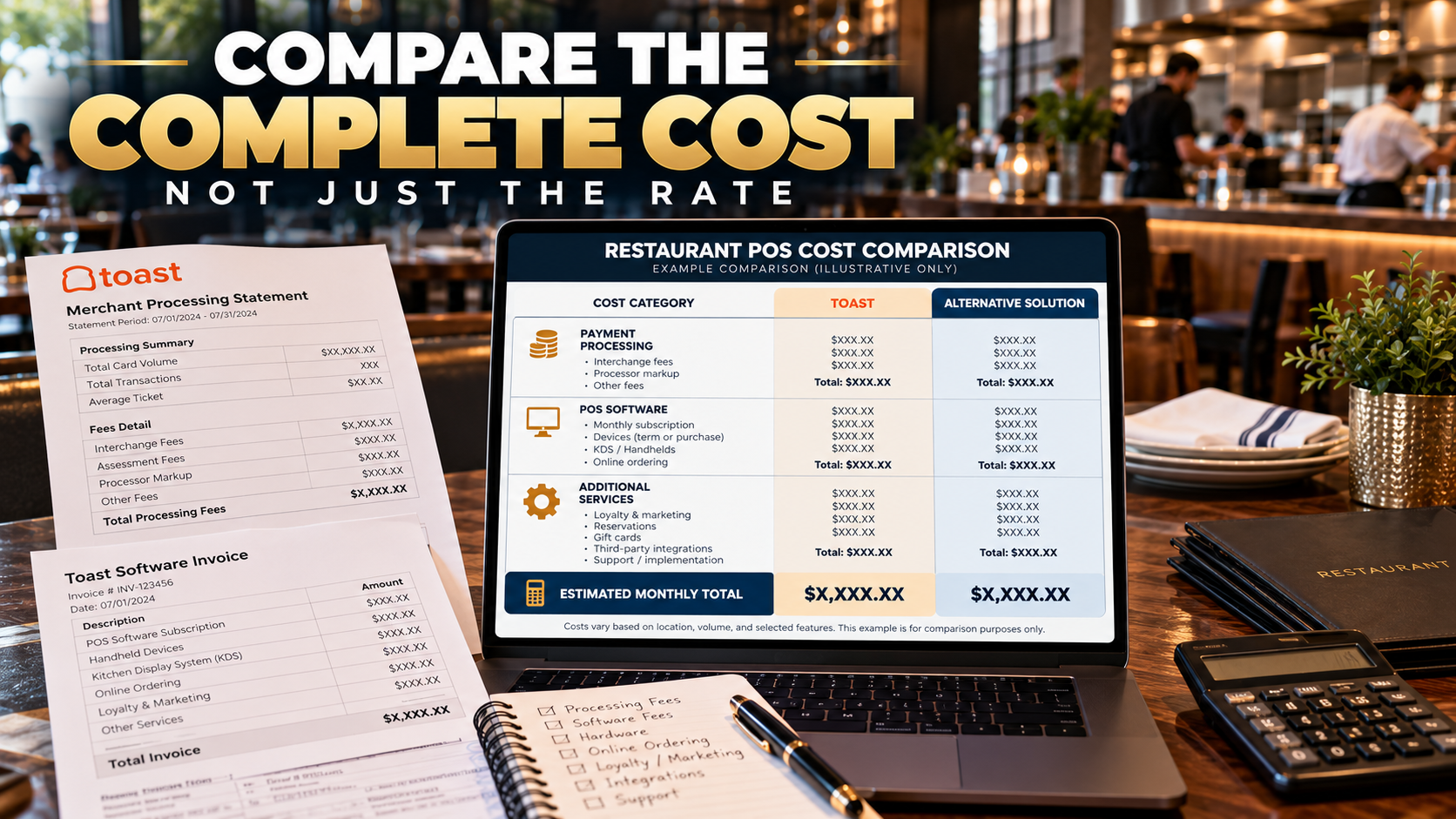
The true cost of a restaurant POS relationship may involve several separate expenses.
The Seven Areas I Would Review
1. Credit card processing
Review the merchant's processing statements and understand the actual pricing structure, transaction mix, and effective cost.
2. POS software subscriptions
Identify recurring charges for the core software platform.
3. Additional software features
Look for online ordering, loyalty programs, marketing tools, reporting, payroll integrations, and other paid services.
4. Hardware
Review the cost of terminals, handhelds, kitchen displays, printers, and other equipment.
5. Installation and implementation
Determine whether the merchant paid for setup, menu configuration, training, networking, or migration.
6. Support and maintenance
Understand what support is included and whether any premium services or equipment replacement charges apply.
7. Contractual obligations
Review remaining commitments, equipment agreements, financing obligations, and potential termination expenses.
Why You May Need More Than One Statement
When I'm evaluating a restaurant POS opportunity, I don't want to see only the credit card processing statement.
I also want to review the software invoices.
A restaurant might have a competitive processing arrangement but still be spending hundreds of dollars per month on software and related services.
Without reviewing those charges, you're missing part of the financial picture.
And without understanding the features those charges provide, you can't make a fair comparison.
An Illustrative Restaurant POS Cost Comparison
Consider this hypothetical restaurant:
Monthly expense | Existing POS | Proposed alternative |
|---|---|---|
Payment processing | $1,950 | $1,850 |
Core POS software | $175 | $125 |
Additional software | $225 | $100 |
Total monthly cost | $2,350 | $2,075 |
Illustrative monthly difference: $275
Illustrative annual difference: $3,300
These are fictional numbers to demonstrate the process. They are not actual Toast pricing, a quote from any specific provider, or a prediction of savings.
The comparison also assumes the two systems meet the same required business needs. Hardware, implementation, financing, switching costs, and contractual obligations must be considered separately.
Now imagine you're speaking with an owner who has been focused entirely on processing rates.
You might discover that the bigger opportunity is in the combined cost of the technology.
Or you might discover that the existing solution is actually the better value.
Either way, you're giving the merchant useful information.
4. Understand That Toast Has Competitive Offers Too
One of the worst things you can do as a sales agent is build your presentation around information that isn't accurate.
For example, don't assume that every Toast merchant paid thousands of dollars upfront for hardware.
Toast advertises eligible starter configurations with no upfront hardware cost, along with other payment options and custom packages.
Its published pricing also includes different software plans, optional products, and processing arrangements.
The specific terms depend on the configuration and agreement.
That means saying, "Our equipment is free and Toast charges for everything," is not a credible sales strategy.
A knowledgeable restaurant owner may already know that isn't true.
Compare the Actual Agreements
Instead, ask the merchant:
"What equipment do you have today, what did it cost you, and what would it cost to replace or expand?"
Then determine what your proposed solution includes.
Compare:
Upfront hardware expenses
Equipment ownership and return requirements
Any financing or repayment obligations
Additional devices and accessories
Software subscriptions
Processing terms
Implementation and training
Support arrangements
Total cost over the expected contract period
This is how you become a professional consultant instead of just another salesperson.
Use Promotional Offers Responsibly
Some restaurant POS programs provide substantial incentives for qualifying businesses.
Depending on the current promotion, those offers may include equipment packages with little or no upfront hardware cost, professional installation, or additional financial incentives.
Certain programs have advertised incentives of up to $5,000 for eligible merchants.
Those offers can make a restaurant owner more interested in reviewing an alternative.
But don't make the incentive your entire sales presentation.
And don't promise a merchant they qualify before the program requirements have been reviewed.
A promotional offer is most useful when it supports a legitimate business decision.
5. Use Live POS Demonstrations to Show the Difference
I believe demonstrations are one of the most important activities in restaurant POS sales.
Why?
Because restaurant owners already understand what a POS system is supposed to do.
They don't need another brochure telling them that a system accepts credit cards.
They want to see how it works.
Make the Demo Relevant to the Restaurant
If you're speaking with a full-service restaurant, demonstrate:
Entering a tableside order
Sending items to the kitchen
Managing checks
Splitting payments
Accepting payment at the table
If you're speaking with a bar, focus on:
Opening and managing tabs
Adding items to existing tabs
Closing checks
Handling tips
Managing high-volume service
If you're speaking with a quick-service restaurant, demonstrate:
Fast order entry
Menu modifiers
Kitchen routing
Counter payments
Relevant online ordering workflows
For a hotel restaurant, confirm whether the proposed product supports the property's required PMS integration and room-charge workflows before including those in the demonstration.
Let the Merchant Participate
One of the best things you can do during a demonstration is let the owner or manager ask questions and test relevant workflows.
Don't turn the demonstration into a speech.
Ask:
"How would your team handle this situation today?"
"Would this workflow make sense for your servers?"
"Is there anything your current system does that you haven't seen here?"
That last question is especially important.
You want to uncover missing functionality before the merchant makes a decision.
If a critical feature isn't supported, you need to know.
A good POS demonstration isn't about showing everything your system can do. It's about proving that it can do what the restaurant needs.
I'll go deeper into this process in How to Sell Restaurant POS Systems With Live Demos and Cost Comparisons.
6. Professional Installation Can Help Remove a Major Objection
Here's something I want every agent to understand.
Even when a restaurant owner likes your technology and sees potential savings, they may still hesitate to switch.
And there's a very good reason.
They're worried about disrupting their business.
Think about everything involved in changing a restaurant POS system.
Menus may need to be configured.
Modifiers need to work correctly.
Taxes and tips must be set up.
Kitchen routing has to be tested.
Hardware needs to be installed.
Employees need to be trained.
And the restaurant has to be ready to serve customers when the new system goes live.
For a busy restaurant, that's a serious undertaking.
This Is Where Your Partner Matters
When a POS provider offers professional implementation and installation support, it can make the transition easier to evaluate.
But the agent needs to understand exactly what's included.
Ask your processing partner:
Who configures the menu?
Who installs the equipment?
Who handles networking requirements?
Who trains employees?
Who coordinates the go-live date?
Who helps resolve problems during the transition?
What responsibilities remain with the restaurant?
Are there additional installation charges?
Don't simply tell the owner, "We'll take care of everything."
Explain the actual process.
How I Would Address the Switching Concern
"I understand that changing POS systems is a major decision. Before you make any commitment, let's review how the installation would work, what your team would need to do, and who would be responsible for each part of the transition."
That response respects the merchant's concern.
It also gives you an opportunity to show the value of having a professional implementation team behind the product.
7. Support Can Be More Important Than a Small Difference in Price
I've talked for years about how important support is in merchant services.
And I believe it becomes even more important when you're selling restaurant technology.
A restaurant can't afford to have its operations interrupted during a busy dinner rush.
A bar can't have employees standing around trying to figure out why tabs aren't working.
A hotel restaurant needs to know what happens when a critical integration experiences a problem.
That doesn't mean any provider can guarantee there will never be technical issues.
Every technology platform can experience problems.
What matters is how those problems are handled.
Questions Agents Should Ask Their POS Partner
Before you start selling a restaurant POS product, understand:
What support channels are available?
What are the support hours?
Is support handled directly or through outside providers?
What happens when hardware fails?
How are urgent problems escalated?
Who supports integrations?
What is the agent's role after installation?
Who helps when an account has an underwriting or activation issue?
You should also know whether support claims can be documented.
Don't promise 24/7 service, immediate equipment replacement, or guaranteed resolution times unless those commitments are actually part of the offering.
Why This Matters for Your Merchant Portfolio
When you build a portfolio of active merchants, you want those merchants to stay satisfied.
A merchant who has repeated unresolved problems may eventually leave.
And when an account closes, your future residual compensation may stop.
That's why I look beyond the commission split when evaluating partnerships.
I want to know whether the people behind the product can help agents take care of their merchants.
For a deeper discussion, read Choosing the Best Restaurant POS Sales Partner: Products, Support, and Residual Income.
8. How to Handle the Most Common Toast Sales Objections
Let's look at several situations you're likely to encounter.
Objection: "We Already Have Toast."
My response:
"That's fine. A lot of restaurants use Toast. How long have you had it, and are you happy with everything?"
The goal is to start a conversation, not argue about their current provider.
If they're satisfied, respect that.
If they're not, ask what they would like to improve.
Objection: "We're Happy With Our System."
My response:
"That's good to hear. Is there anything you'd improve if you could, or are you completely satisfied with the features, costs, and support?"
If the merchant is genuinely satisfied, I wouldn't push.
But sometimes that question reveals an issue they hadn't mentioned.
Objection: "Switching Systems Is Too Much Work."
My response:
"I understand. The last thing you want is to interrupt service. Before we discuss switching, I'd want you to understand the installation process, who handles the setup, and how your staff would be trained. Then you can decide whether it's worth considering."
Don't minimize the work involved.
Show them how the transition would be managed.
Objection: "Our Processing Rates Are Already Low."
My response:
"That's great. I'm not assuming we can improve your rates. What I'd like to understand is what you're paying for the entire POS relationship, including software, additional services, and processing. If there's no meaningful improvement available, I'll tell you."
That keeps the conversation honest and broadens the financial analysis.
Objection: "Our Current System Does Everything We Need."
My response:
"Then you may already have the right solution. Before I make any recommendation, I'd like to understand what you're using and whether there's anything worth comparing."
You don't have to force an opportunity that isn't there.
Objection: "What Happens If the New System Doesn't Work?"
My response:
"That's exactly why I want you to see a demonstration and understand the implementation and support process before making a decision. We'll confirm the features you need, review the technical requirements, and make sure you know who handles the transition."
Don't guarantee that a technology product will never fail.
Give the merchant a clear evaluation process.
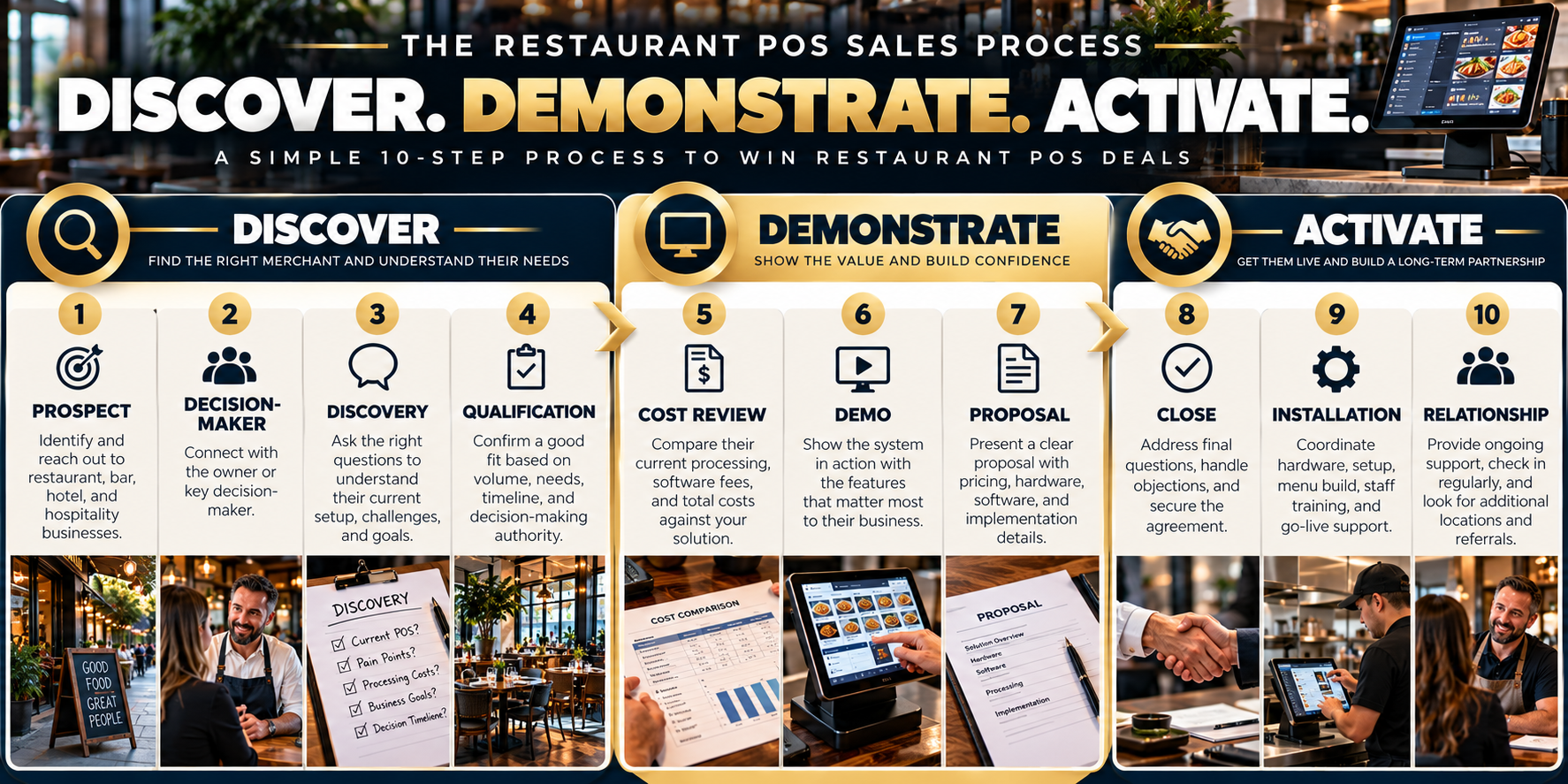
9. Follow a Repeatable Process to Win Restaurant POS Deals
You don't need a completely different sales process every time you walk into a restaurant.
You need a consistent approach that allows you to identify good opportunities and move them forward.
Here's the process I would teach.
Step 1: Prospect the Right Businesses
Focus on restaurants, bars, nightclubs, and other hospitality operations that match the products and support capabilities of your partner.
Learn more in How to Prospect Restaurants, Bars, and Nightclubs for POS Sales.
Step 2: Find the Decision-Maker
You need to speak with someone who can evaluate the business's technology and authorize a change.
That might be the owner, operating partner, general manager, or another authorized decision-maker.
Step 3: Conduct Discovery
Understand their current POS, costs, operational concerns, contract obligations, and desired improvements.
Step 4: Qualify the Opportunity
Make sure your solution can meet the merchant's essential requirements.
Don't schedule a demonstration for a system that cannot support a critical workflow.
Step 5: Review Processing and Software Costs
Request the necessary statements and invoices with the merchant's permission.
Prepare a complete comparison.
Step 6: Arrange a Relevant Demonstration
Show the functions that matter to that particular restaurant.
Step 7: Present the Proposal
Explain the recommended system, included equipment, software, processing arrangement, implementation responsibilities, support, and financial terms.
Step 8: Ask for the Business
If the merchant understands the solution and wants to move forward, guide them through the next steps.
Don't leave a qualified opportunity hanging because you're uncomfortable asking for a decision.
Step 9: Follow Through Until Activation
Signing the agreement isn't the finish line.
You need to stay engaged through underwriting, implementation, installation, and activation.
Step 10: Maintain the Relationship
A restaurant POS account can become part of your long-term merchant portfolio.
Stay accessible, help direct the merchant to appropriate support, and look for opportunities to earn referrals.
10. The Real Goal Is Building a Merchant Portfolio, Not Winning an Argument
I want to finish with something that matters more than any competitor comparison.
You don't build a successful merchant services business by proving another POS company is bad.
You build it by acquiring and maintaining satisfied merchant relationships.
When you're selling restaurant technology, that means recommending systems that actually fit the operation.
It means being transparent about costs.
It means understanding the features.
It means knowing how installation works.
And it means choosing a partner that provides the support necessary to help your merchants succeed.
For agents who receive recurring residual compensation, the long-term value of the relationship can be more important than the immediate upfront commission.
But that portfolio doesn't build itself.
You still have to prospect, schedule appointments, prepare proposals, run demonstrations, and follow up.
Those are the productive activities that create opportunities.
If you're looking for a structured foundation, my Merchant Sales Production Formula explains why consistent sales activity matters.
Want to Sell Restaurant and Hospitality POS Systems?
If you're an existing merchant services agent or an experienced salesperson interested in specializing in restaurant technology, I'm building a partnership opportunity focused on this market.
The objective is to help agents learn how to sell comprehensive restaurant and hospitality POS solutions, understand the competitive landscape, and build long-term merchant portfolios.
I'm particularly interested in solutions that combine strong restaurant technology, professional installation, dependable merchant support, and compelling promotional programs for qualifying businesses.
If that sounds like the kind of business you'd like to build, I invite you to learn more.
Explore the Restaurant & Hospitality POS Sales Opportunity
If you're brand new to the payments industry, you can also begin with the free education at Merchant Service University.
Frequently Asked Questions About Selling POS Systems Against Toast
How do you compete against Toast POS as a sales agent?
Start by understanding what the restaurant likes and dislikes about its existing system. Review its operational needs, software expenses, payment-processing costs, equipment, and support experience. Then demonstrate how a suitable alternative compares. If you want to specialize in this type of sale, explore my restaurant and hospitality POS sales partnership.
Is Toast difficult to sell against?
Toast is an established restaurant POS competitor with a broad product offering, so agents should expect informed buyers. However, individual restaurants have different needs, costs, and experiences. A strong discovery process can reveal opportunities where another system deserves consideration.
What is the best way to approach a restaurant using Toast?
Avoid opening with criticism or unsupported promises of savings. Ask how long the restaurant has used Toast, which features it values, what it pays for software and processing, and whether anything could be improved. Let the owner's answers guide the conversation.
Can you save restaurants money by switching from Toast?
Sometimes, but not always. Savings depend on the restaurant's existing agreement, processing volume, software subscriptions, required features, equipment, and switching expenses. Agents should compare the complete financial picture before promising any savings.
Does Toast offer free POS hardware?
Toast advertises eligible starter configurations with no upfront hardware cost, subject to plan and processing terms. Agents should review the specific agreement rather than assuming every Toast merchant purchases equipment outright.
What documents should an agent request for a POS cost comparison?
With the merchant's permission, request recent payment-processing statements, POS software invoices, applicable equipment or financing agreements, and details of required integrations. These help establish the current costs and identify obligations that could affect a switch.
Why are live demonstrations important when selling restaurant POS systems?
A demonstration lets the owner evaluate actual workflows rather than relying on a list of features. It also helps uncover missing capabilities, integration concerns, and staff-training requirements before the merchant commits.
Can a restaurant POS agent earn residual income?
Some merchant-services partnerships provide recurring residual compensation on active processing accounts. Compensation varies according to the agreement and account economics. Learn the basics through Merchant Service University and review the specific terms of any partnership before joining.
Do restaurant POS agents have to install the systems themselves?
Not necessarily. Some providers have dedicated installation and implementation teams. Agents should confirm which services are included, what the merchant must provide, and how ongoing support works. You can explore the hospitality POS sales opportunity to learn more about the partnership I'm developing.
What's the biggest mistake agents make when selling against Toast?
Focusing entirely on price without understanding the restaurant's operational needs. A cheaper quote is not automatically a better solution. Agents need to demonstrate value, confirm required features, and account for the cost and complexity of switching.
Final Thoughts: The Best Way to Beat Toast Is to Be the Better Choice for the Right Restaurant
Don't make your entire restaurant POS sales strategy about convincing merchants that Toast or another provider is bad.
Focus on becoming knowledgeable about restaurant technology.
Learn to identify operational problems.
Understand how to review processing statements and software invoices.
Use live demonstrations to show relevant features.
Understand implementation and support.
And build relationships with merchants who have a legitimate reason to evaluate an alternative.
That's how you create meaningful sales opportunities.
And that's how you work toward building a merchant portfolio that can generate recurring income over time.
Ready to explore selling restaurant and hospitality POS systems?
https://hospitality.ezdirectsales.com
About Joe Wagner
I'm Joe Wagner, a merchant-services entrepreneur and sales trainer who has worked in the payment-processing industry since 2009.
Through Merchant Service University, I provide free education to help people understand payment processing, merchant services sales, POS technology, and the process of building a merchant portfolio.
I also help interested sales professionals evaluate processing partnerships and develop the skills needed to build their businesses.
Get educated before you get recruited.