
Lifetime Residuals in Merchant Services: What They Really Mean
What Do Lifetime Residuals Really Mean in Merchant Services?
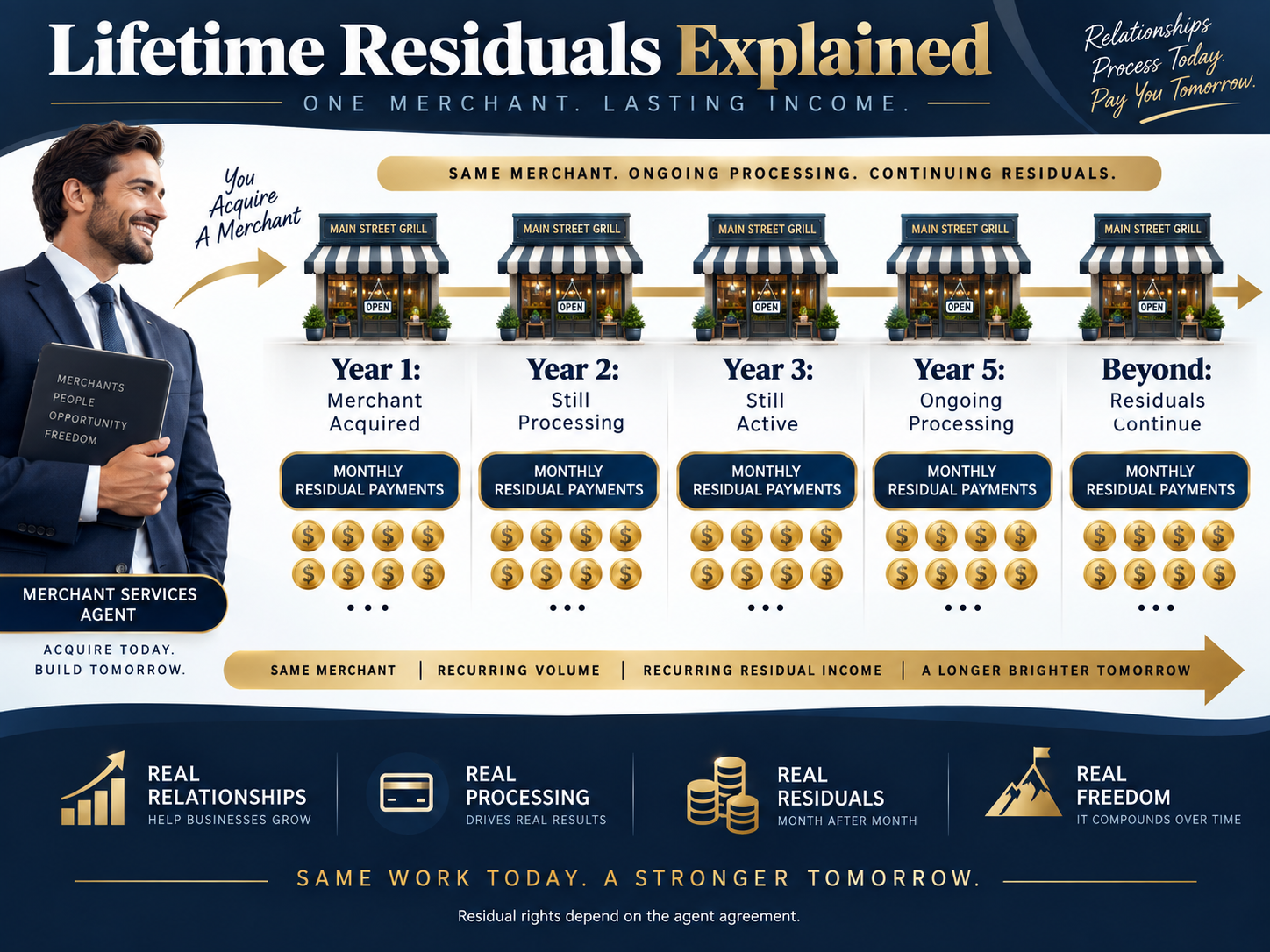
Lifetime residuals in merchant services are one of the biggest reasons people become interested in the payments industry. The concept is powerful: acquire a merchant today, the merchant continues processing payments, and you continue receiving your contractual share of the residual revenue generated by that account month after month.
That recurring-income model is one of the biggest reasons I fell in love with this industry.
But there is one word in that sentence that matters more than most people realize:
Contractual.
When a recruiting presentation tells you that an agent receives "lifetime residuals," don't assume that phrase automatically means you'll receive a check forever regardless of what happens. You need to understand whose lifetime we're talking about, what happens if the merchant stops processing, what happens if you stop selling, whether your residuals are vested, what happens if you leave the company and what the agent agreement actually says about termination.
In the strongest version of a lifetime-residual arrangement, the concept is straightforward: you place a merchant, that merchant continues producing revenue through the organization, and you continue receiving your contractual residual share even if you eventually stop actively selling.
That is the type of residual structure I want agents to understand and protect.
The recruiting phrase is easy.
The agreement is what gives the phrase meaning.
If residual income is still new to you, first read Merchant Services Agent Commissions and Merchant Services Residual Splits Explained. Those articles explain where the residual comes from and how a typical 50%–60% agent split works. This article is about what happens to that residual over time.
What Are Lifetime Residuals in Merchant Services?
A merchant-services residual is recurring compensation generated from active merchants in an agent's portfolio according to the terms of the agent agreement.
When someone uses the phrase lifetime residuals, they are generally describing residual payments intended to continue for the life of the merchant relationship rather than ending simply because the original sale happened months or years ago.
For example, suppose you place a merchant and your contractual share of that account averages $150 per month. If the merchant continues processing and your residual rights remain intact, that account may continue producing monthly income without requiring you to resell the merchant every month.
That is the beauty of the model.
Traditional sales often requires you to close another deal to create another commission. Merchant services can allow past sales to continue contributing to your current income while you add new merchants to the portfolio.
But "lifetime" does not mean the merchant itself is guaranteed to remain forever. Businesses close, owners sell, merchants switch providers, processing volume changes and technology evolves. If the merchant stops generating the revenue covered by your agreement, the residual from that merchant can stop as well.
The better way to understand the phrase is:
Lifetime residuals can continue for the productive life of the merchant account, subject to the terms of your agreement.
The Most Important Question: Are the Residuals Actually Vested?
Vesting is what turns the conversation from marketing into contract language.
A company may advertise lifetime residuals, but you still need to determine when those residual rights become vested and what conditions could cause them to stop.
Some agreements may provide strong continuing residual rights after termination. Others may allow residuals to stop if the agent commits certain breaches. Other arrangements may include production requirements or active-agent provisions that affect compensation.
This is why asking only, "Do I get lifetime residuals?" isn't enough.
I would ask:
"Where in the agreement does it explain my right to continue receiving those residuals?"
Then read that section.
Current payments-industry legal guidance makes the same point: continuing residual rights are controlled by the agent agreement, and termination provisions can determine when an ISO may stop paying an agent.
If you're going to build recurring income for several years, that language deserves considerably more attention than the recruiting presentation.
Lifetime Residuals Do Not Necessarily Mean You Have to Keep Selling Forever
This is one of the biggest distinctions I would investigate before signing an agreement.
Suppose you build a portfolio of 100 merchants over several years and eventually decide to slow down.
What happens to the accounts you've already acquired?
A strong lifetime-residual structure may allow you to continue receiving compensation from those merchants as long as the accounts continue producing eligible revenue, even though you're no longer actively bringing in new merchants.
Other programs may impose ongoing production requirements.
For example, an agreement could require a certain number of new accounts per month, quarter or year to maintain a particular compensation level. In a more restrictive arrangement, failing to meet a production requirement could potentially affect existing residual rights.
Those are very different structures.
I have no problem with production affecting future incentives. A company might start agents at 50% and offer a 55% or 60% residual structure to proven producers. That makes sense.
What I would want to understand very carefully is whether failing to produce new merchants could cause me to lose the recurring income from merchants I already spent years acquiring.
If someone tells me the residuals are lifetime, but I have to continue submitting new accounts forever to keep receiving them, I want that explained very clearly.

"Lifetime" Usually Means the Life of the Merchant, Not Your Lifetime
This sounds obvious once someone says it, but it is worth explaining.
Suppose a merchant produces $200 per month in residual compensation to you for three years and then closes the business.
That residual ends.
There is no longer a productive merchant account generating the revenue.
Suppose another merchant stays with the same processing relationship for ten years. That account could potentially generate residual income much longer.
This is why merchant retention is such a major part of portfolio building.
The value isn't simply signing an account.
The value is signing an account that stays.
Technology matters. Pricing matters. Merchant support matters. Implementation matters. The relationship matters.
A 50% residual split from a merchant that remains for years can be far more valuable than a higher split from an account that leaves after six months.
The residual model rewards both acquisition and retention.
A Simple Lifetime Residual Example
Let's use a deliberately simple example.
Suppose one merchant generates enough eligible monthly profit that your 50% contractual residual share averages:
$100 per month
If the merchant remains active for one year, the account would generate approximately:
$1,200 in agent residuals
If that merchant remains active for five years at the same illustrative average:
$6,000
If it remained active for ten years:
$12,000
That does not mean the account is guaranteed to produce $100 every month. Processing volume changes, pricing changes, costs can change and merchants can leave.
The example simply demonstrates why merchant longevity matters so much.
Now imagine repeatedly adding merchants.
One $100 residual account is useful.
Fifty comparable accounts would represent a much more substantial recurring portfolio.
That's when the way you think about sales begins changing.
You're no longer asking only what you're being paid to close the merchant today.
You're asking what the relationship could contribute to the portfolio over time.
The Agreement Matters More Than the Phrase "Lifetime Residuals"
If you remember one thing from this article, make it this:
"Lifetime residuals" is a description. Your agent agreement establishes your rights.
Payments attorney Paul Rianda notes that many modern agent agreements provide some form of continuing residual payment after an agreement terminates, but the specific termination provisions can vary significantly. He recommends that agents pay close attention to language describing exactly when residual payments survive and when they may be terminated.
There are also real cases showing why individual clauses must be read together. A recent legal analysis of payment-industry case law highlights an agreement that contained lifetime residual language but also contained a portfolio-sale provision capable of ending those residual rights under a qualifying sale.
That is exactly why I don't stop reading once I find the words I want to see.
You have to understand the complete agreement.
My previous article, 11 Questions to Ask Before Signing a Merchant Services Agent Agreement, walks through the contract questions I think every agent should understand.
What Could Cause Lifetime Residuals to Stop?
The exact answer depends on your agreement, but several issues deserve attention.
The merchant itself can stop processing, which naturally removes the revenue supporting that residual. Your agreement may also describe circumstances involving termination, material breach, fraud, solicitation of merchants, production requirements, unpaid liabilities or other contractual violations that can affect residual payments.
A company has legitimate reasons to protect itself.
If an agent commits fraud, intentionally damages the organization or violates serious contractual obligations, I understand why the agreement needs remedies.
What I don't want is ambiguity.
I want to know what actions could cause my residual rights to disappear before I spend years building them.
Current 2026 industry discussions specifically warn agents to examine production minimums and termination-forfeiture provisions rather than assuming that the marketing phrase "lifetime residuals" overrides the contract.
The question isn't whether a contract contains protections for the ISO.
It should.
The question is whether you understand them.
What Happens if You Leave the ISO?
This is one of the first questions I would ask.
Imagine you have built a substantial merchant portfolio and another opportunity eventually makes more sense for your future.
Can you leave and continue receiving residuals from the merchants you already placed?
The answer should come directly from the agreement.
Some contracts may provide continuing residual compensation after termination unless specific conditions occur. Others may handle the relationship differently.
Do not assume that because the recruiter used the word vested, your interpretation matches the contract.
Ask what happens if:
You resign voluntarily.
The ISO terminates you without cause.
The agreement expires.
You stop actively selling.
You begin selling another product.
You commit a breach and later cure it.
The ISO itself is sold.
Those questions help define what "lifetime" actually means in your specific relationship.
What Happens if the ISO Is Sold?
This issue gets overlooked.
You may have a great relationship with the company you're joining today, but payment organizations can be acquired.
What happens to your residual rights if your upstream ISO sells its portfolio or the entire organization?
Does the buyer assume your agreement?
Do your residual payments continue?
Can the sale itself trigger a provision affecting your residual rights?
Historical payment-industry litigation shows that lifetime-residual language and portfolio-sale provisions can coexist in the same agreement, making the precise contract language extremely important.
You don't need to become a mergers-and-acquisitions attorney.
You should simply ask what happens to you if the company changes hands.
What Happens to Your Residuals if You Die?
This is uncomfortable to think about when you're starting a business, but it matters if you're serious about building something valuable.
Suppose you spend 15 years building recurring residual income.
What happens to it if you die?
Can the residual stream continue to your estate?
Can your spouse or beneficiaries receive it?
Is the agent agreement held through your business entity?
Does the agreement contain a survivor or next-of-kin provision?
Some current merchant-services agent programs specifically advertise next-of-kin clauses alongside vested residuals, which shows that this is a real contractual issue agents should consider.
Don't assume the answer.
If building lifetime residual income is part of your long-term wealth strategy, ask how the agreement handles death and succession.
For meaningful estate or business-planning decisions, talk to the appropriate legal and tax professionals.
Can Lifetime Residuals Become an Asset You Can Sell?
Potentially, but again, the agreement matters.
There is a difference between selling merchants and selling the economic right to receive a residual stream.
Some agreements may allow an agent to assign or sell residual-payment rights. Other agreements may require consent, provide a right of first refusal or prohibit certain transfers.
Rianda specifically identifies the right to sell a residual stream as a provision agents may want addressed in their agreements because it can allow an agent to exchange future recurring payments for a lump-sum payment.
This is where residual income begins looking less like a traditional commission and more like a business asset.
But I would never tell someone, "Your portfolio is automatically worth X multiple."
Portfolio value can depend on merchant attrition, concentration, processing trends, contract rights, transferability and many other factors. Current industry analysis similarly emphasizes that receiving residual payments does not automatically mean the recipient has unrestricted transferable ownership rights.
First understand what you actually own.
Then worry about what it might be worth.

Lifetime Residuals Are Not the Same as Guaranteed Passive Income
I love residual income, but I think we should describe it accurately.
Residuals can become increasingly passive compared with traditional commission income because you do not necessarily have to resell the same merchant every month to continue receiving compensation.
However, the portfolio still lives inside a real business environment.
Merchants need support. Accounts leave. Businesses close. Competition exists. Technology changes. Your portfolio can experience attrition.
If you want the overall residual base to continue growing, you generally need to continue adding merchants faster than you're losing them.
That's why I prefer describing merchant-services residuals as recurring income.
The leverage is real.
But it is built on active merchant relationships and contractual rights, not magic.
Why I Care More About Lifetime Rights Than an Extra Five Points of Split
Suppose one company offers me a 50% residual split with strong vesting language and clearly defined continuing residual rights.
Another company gives me 55% but the agreement makes my ongoing residual rights substantially less secure.
I'm going to pay very close attention to the 50% relationship.
That extra five percentage points means very little if I can lose the underlying residual stream.
This is why I keep teaching agents to stop looking at one compensation number.
The Schedule A matters because it affects how much profit exists to divide.
The residual split matters because it determines your share.
The agent agreement matters because it determines your rights to continue receiving that share.
You need all three.
What I Want to See When Someone Says "Lifetime Residuals"
I don't need an agreement containing no protections for the ISO. That's unrealistic.
What I want is clarity.
If someone tells me I'm building lifetime residual income, I want to understand whether the residual continues after I stop producing, whether it survives normal termination or expiration, what specific conduct can cause forfeiture, whether I can transfer my residual rights, how death is handled and what happens during a sale or acquisition.
I also want transparent residual reporting so I can understand what the portfolio is producing.
That is what makes the phrase meaningful.
The Real Goal Is to Build a Portfolio That Lasts
Lifetime residual rights only become valuable if you actually build merchants underneath them.
This is where agents can get distracted by contracts and compensation percentages and forget the activity that creates the income.
You still have to prospect.
You still have to sell.
You still have to retain merchants.
A beautifully written lifetime-residual clause attached to three merchants isn't going to create the same business as a fair agreement attached to 100 strong merchant relationships.
Protect the economics.
Then build.
That's the order.
Want to Understand Residuals Before You Sign With a Company?
This is one of the reasons I built Merchant Service University.
I don't believe you should hear phrases such as lifetime residuals, vested residuals, Schedule A or residual split for the first time while someone is trying to get you to sign their agent agreement.
Learn what the terminology means first.
Inside Merchant Service University, the core education covers payment processing, compensation, pricing, merchant statements, recurring residual income, commerce technology, sales and the larger structure of the merchant-services industry.
There is no charge for the core education and no obligation to join one specific processing company.
Start Merchant Service University Free
https://merchantserviceuniversity.com
Understand what you're building before you decide where you're going to build it.
Get educated before you get recruited.
Frequently Asked Questions About Lifetime Residuals in Merchant Services
What are lifetime residuals in merchant services?
Lifetime residuals generally refer to recurring agent compensation intended to continue for the productive life of merchant accounts, subject to the terms and conditions of the agent agreement.
Are merchant services lifetime residuals really lifetime?
They can be, but the contract determines the actual rights. Agents should review vesting, termination, production requirements and other provisions rather than relying solely on the phrase "lifetime residuals."
What does vested lifetime residuals mean?
Vesting relates to the contractual rights an agent has to continue receiving residual compensation. The exact conditions vary by agent agreement, so agents should determine when residuals vest and under what circumstances they can stop.
Do lifetime residuals continue if I stop selling?
That depends on the agreement. A strong lifetime-residual structure may allow residual payments to continue while existing merchants remain active even if the agent stops producing new business, while other agreements may include ongoing production requirements.
What happens to residuals if a merchant closes?
If the merchant stops processing and no longer generates the revenue covered by the agent agreement, the residual generated by that merchant generally ends.
Can an ISO stop paying my residuals?
Potentially, depending on the agent agreement and circumstances. Termination, breach and forfeiture provisions can define circumstances in which residual payments may stop.
What happens to my residuals if I leave the ISO?
The agreement should specify whether residual payments survive resignation, expiration or termination of the relationship and any conditions attached to continuing payments.
Can lifetime residuals pass to my family when I die?
Possibly, but this depends on the agreement and business structure. Agents interested in long-term succession should review estate, assignment and survivor provisions with appropriate legal and tax professionals.
Can I sell my merchant-services residual stream?
Some agreements may permit assignment or sale of residual-payment rights, while others may restrict transfers or require approval. The contract determines what rights can be sold or assigned.
Is a 50% lifetime residual split good?
A clean 50% split can be a strong arrangement when the underlying Schedule A economics are competitive and the residual rights are properly protected. A slightly higher percentage is not automatically more valuable if the continuing residual rights are weaker.
Where can I learn how merchant-services residuals work?
You can learn merchant-services compensation and portfolio fundamentals through Merchant Service University, including residual income, payment processing, pricing and the concepts agents should understand before choosing a partner.
Final Takeaway: "Lifetime" Is Only as Strong as the Agreement Behind It
Lifetime residuals are one of the reasons I believe merchant services can be such an incredible industry for salespeople.
You can acquire a business once and potentially continue participating in the economics of that relationship for years.
But don't let the word lifetime do all your thinking for you.
Find out when your residuals vest.
Find out what happens if you stop producing.
Find out what happens if you leave.
Find out which circumstances can terminate your residual rights.
Find out what happens if the company is sold.
Find out whether the residual can transfer or survive after your death.
Then put those protections beside your Schedule A and your residual split and evaluate the complete business relationship.
A clean 50% residual stream that is well protected can be tremendously more valuable than a bigger percentage attached to rights you don't fully understand.
The percentage tells you how much you receive.
The agreement tells you whether you can continue receiving it.
And the portfolio you build determines whether any of it becomes meaningful.
About Joe Wagner
Joe Wagner has spent more than 16 years in merchant services and payment-processing sales, acquiring merchants, building recurring-revenue portfolios and developing sales organizations.
His focus today is helping agents understand the business behind merchant services before making long-term decisions about compensation, contracts and partnerships.
To continue learning, read Merchant Services Agent Commissions, review the 11 Questions to Ask Before Signing a Merchant Services Agent Agreement, understand Merchant Services Schedule A, and learn how Merchant Services Residual Splits actually work.
You can also explore Merchant Sales Resources or start learning free through Merchant Service University.
Free education. No obligation. Get educated before you get recruited.