
Merchant Services Residual Splits Explained: 50% vs. 60%
Merchant Services Residual Splits Explained: What 50/50 and 60/40 Really Mean
A merchant services residual split tells you how the eligible profit generated by a merchant account is divided between you and the organization you're partnered with.
If you're on a 50/50 residual split, you generally receive 50% of the eligible residual profit and your upstream organization receives the other 50%. If you're on a 60/40 arrangement where the agent receives 60%, you receive 60% of that eligible profit.
That sounds simple, and conceptually it is.
Where agents get confused is assuming that the percentage tells them how much money they are actually going to make.
It doesn't.
A 60% residual split is not automatically better than a 50% residual split because the percentage is only applied after the underlying costs of the account are taken into consideration according to your agreement.
This is one of the most important compensation concepts I teach new agents. When I'm structuring a relationship, I generally try to offer a clean 50% residual split. Depending on the relationship and production, a 55% or 60% structure may also make sense. I believe those can be very strong compensation arrangements when the underlying economics are good.
I'm much less interested in chasing the highest percentage someone can print on a recruiting page.
I want to know how much money is actually left to split.
If you haven't read the previous article in this series, start with Merchant Services Schedule A Explained. Understanding Schedule A costs makes residual splits dramatically easier to understand.
What Is a Merchant Services Residual Split?
When a merchant continues processing payments, the account may generate recurring revenue for the organizations involved in servicing that relationship. After the applicable costs defined by the processing and agent agreements are accounted for, a remaining amount may be available for revenue sharing.
Your residual split determines your contractual share of that eligible amount.
Suppose an account creates $600 in eligible monthly residual profit after the applicable costs have already been deducted. If you're receiving a 50% residual split, your share would be $300.
The math is simply:
$600 × 50% = $300
If that same $600 were subject to a 60% agent split, the agent would receive:
$600 × 60% = $360
If everything underneath the split were identical, then yes, 60% would obviously pay more than 50%.
The problem is that when you're comparing two different merchant services companies, everything underneath the split may not be identical.
That's where agents get fooled by percentages.
Why a Higher Residual Split Can Still Pay You Less
Let's compare two hypothetical merchant services programs.
Company A gives its agent a 50% residual split and the merchant produces $700 in eligible monthly profit after the applicable underlying costs.
The agent receives:
$700 × 50% = $350
Company B advertises a 60% residual split, but higher underlying costs leave only $500 in eligible monthly profit.
The agent receives:
$500 × 60% = $300
The agent receiving 50% made $350.
The agent receiving 60% made $300.
The higher percentage still produced the smaller check.
This isn't because a 60% split is bad. If Company B had the same underlying economics as Company A, the 60% split would obviously be more valuable.
The lesson is simply that you cannot compare merchant services compensation by percentage alone.
You have to ask:
What is my percentage being applied to?
That is the number that gives the split meaning.

Where Does the Residual Profit Come From?
This becomes easier once you understand how the merchant-services business works.
A merchant pays fees to accept electronic payments. Some of that money is associated with costs throughout the payment ecosystem, including card-issuing banks, card networks, processing infrastructure and other services. Depending on your relationship, your ISO or processor may also have costs outlined through a Schedule A, buy-rate schedule or similar compensation structure.
What remains after the applicable costs is where the residual-sharing calculation becomes relevant.
That is why a merchant paying $1,000 in total processing fees does not necessarily mean you and your ISO are splitting $1,000.
There may only be a fraction of that amount available as eligible residual profit.
If you need a deeper explanation of how the payment itself moves through the ecosystem, read How Credit Card Processing Works. Once you understand who participates in a card transaction, processing economics become much easier to understand.
The Split and the Schedule A Work Together
The easiest way I can explain this is:
Your Schedule A helps determine how much profit exists.
Your residual split determines how that profit is divided.
You need both numbers.
Imagine someone offers you a beautiful 60% residual agreement but gives you a high transaction cost, high monthly account costs and other expensive underlying fees.
Another company gives you a 50% split but has much cleaner underlying economics.
The 50% relationship can potentially produce more actual income.
We demonstrated this in the previous article with transaction fees. A difference between a $0.04 transaction cost and a $0.06 transaction cost is only two cents, but across 5,000 monthly transactions that becomes a $100 difference in account-level cost.
That $100 affects the amount of profit available before your residual split is applied.
This is why I don't look at a residual split without also understanding the costs underneath it.
A 50% Residual Split Can Be a Great Deal
I want to spend some time on this because I think the industry sometimes teaches agents to look at compensation backwards.
People hear:
50%
and immediately wonder if they should be getting 60%, 70% or something even higher.
Maybe.
But before trying to negotiate another ten percentage points, I want to know what I'm already receiving.
If I have a clean 50% split, competitive Schedule A costs, transparent residual reporting, strong vesting language, good technology, excellent merchant support and an ISO handling the backend infrastructure so I can focus on selling, I consider that a potentially strong relationship.
Remember what your upstream organization is doing.
A good ISO may be providing underwriting infrastructure, risk management, merchant support, equipment deployment, technical support, product relationships, residual reporting, compliance resources and operational support.
I want that organization to make money.
My goal isn't to keep 100% of every dollar in the payment ecosystem. My goal is to build an arrangement where both sides are making money while I concentrate on acquiring more merchants.
That's also why I explained in Merchant Services Agent vs. ISO that becoming a registered ISO is overrated for many sales-focused entrepreneurs. I'm comfortable letting somebody else handle the backend heavy lifting if the economics and agreement allow me to build a strong portfolio.
When a 55% or 60% Split Makes Sense
Residual splits can change as relationships grow.
An organization might begin an agent at 50% and later move a productive salesperson to 55% or 60%. Another company may have a different structure from the beginning.
There isn't one universal industry rule.
If you've proven that you can produce substantial business, retain merchants and require less support, it makes sense that you may eventually negotiate stronger economics.
But there is an important distinction between earning a better split because your business has grown and constantly jumping from company to company because somebody promised you another five percentage points.
If you're building a residual portfolio, continuity matters.
Your merchant relationships matter.
Your operational support matters.
Your contract matters.
Sometimes destroying a strong partnership to chase a slightly larger headline split is not a smart trade.
I would evaluate the additional percentage against the entire relationship.
Your Residual Split Is Only Valuable if You Keep the Merchant
This is another part of the compensation conversation agents often overlook.
Imagine two agents.
Agent A receives 60% but works with an organization that provides weak merchant support, outdated technology and poor onboarding. Accounts regularly leave.
Agent B receives 50% but has strong support, competitive products and merchants who tend to remain happy.
Which agent eventually builds the better residual portfolio?
You can't answer that by looking at the split.
Residual income only exists while there is a productive merchant relationship underneath it.
If the merchant leaves, 60% of that account becomes zero.
This is why I consider merchant support part of the compensation equation even though support isn't technically a percentage on your residual report.
Retention protects your income.
The best residual split in the world doesn't help if you can't keep the merchants.

Residual Split vs. Residual Rights
There is another number I care about even more than the percentage:
How protected is the residual itself?
I'd rather have a properly protected 50% residual than a questionable 60% residual I can lose because I stopped producing.
Your merchant services agent agreement can contain provisions governing vesting, production requirements, termination, residual survival and transfer rights.
Those provisions matter.
Suppose one company offers 60% but requires continued production to maintain your residual rights. Another gives you 50% with much stronger vesting and post-termination language.
Which is better?
For someone trying to build long-term recurring income, I would seriously evaluate the 50% relationship.
Again, there is no universal answer. You have to read the actual agreements.
The important point is that residual percentage and residual ownership rights are different things.
Don't confuse them.
What Does a 50/50 Residual Split Actually Mean?
When someone says 50/50 split, they generally mean the eligible residual amount is divided equally between the two parties covered by the agreement.
If there is $400 in eligible residual profit:
Agent receives $200
ISO receives $200
The important phrase is eligible residual profit.
It does not mean the agent receives 50% of the merchant's processing volume.
It does not necessarily mean the agent receives 50% of every fee shown on the merchant's statement.
It does not mean the agent receives 50% of gross processing revenue before applicable costs.
It means the compensation is calculated based on the definitions and costs in the agent agreement.
That's why understanding the contract matters.
What Does a 60/40 Residual Split Mean?
If an agent is receiving 60% under a 60/40 split, the eligible residual profit is generally divided with 60% going to the agent and 40% going to the upstream organization.
If the eligible residual profit is $400:
Agent receives $240
ISO receives $160
Again, if everything else is identical, 60% is obviously better for the agent than 50%.
What I am pushing back against throughout this article is the idea that everything else is automatically identical.
When you're comparing different companies, the cost structure, products, support, agreement and revenue definitions may all be different.
That's why the percentage is only one part of the decision.
How Merchant Pricing Affects Your Residual Split
The way you price a merchant can also affect how much residual income the account produces.
If you price a merchant with more margin, there may be more eligible profit available to share. If you price very aggressively and leave little margin, there may be less.
That does not mean you should try to maximize the price on every merchant.
I think that's short-term thinking.
You want a merchant relationship that makes sense for the business and remains competitive enough to retain the account.
Overpricing a merchant to generate another $30 in residual and then losing the account six months later can be far worse than creating a fair relationship that lasts for years.
I have always viewed merchant services as a portfolio business.
You want good accounts.
You want fair margins.
You want merchants who stay.
Then you keep adding more of them.
Residual Income Is Built Through Volume of Relationships, Not One Huge Split
New agents sometimes spend far too much energy trying to optimize compensation before they've signed enough merchants for the difference to matter.
Imagine an agent fighting for a 60% split but signing one merchant every three months.
Now imagine another agent at 50% consistently adding four or five quality merchants every month.
Which agent would you rather be?
I'll take production.
The size of your portfolio can matter far more than squeezing another few percentage points out of your agreement.
That's not an argument for accepting bad economics.
Understand your compensation. Get a fair agreement. Protect your residuals.
Then go sell.
At some point the biggest thing holding back your residual check is probably not whether you're getting 50% or 55%.
It's whether you're adding merchants.
That is a much more productive problem to solve.
Think Portfolio, Not Percentage
This is the mindset I want agents to develop.
Suppose you have 50 active merchants each producing an average $100 monthly residual to you. That's $5,000 in recurring monthly compensation.
Now you add another merchant.
Then another.
Then another.
The objective becomes growing the base while protecting the merchants you've already acquired.
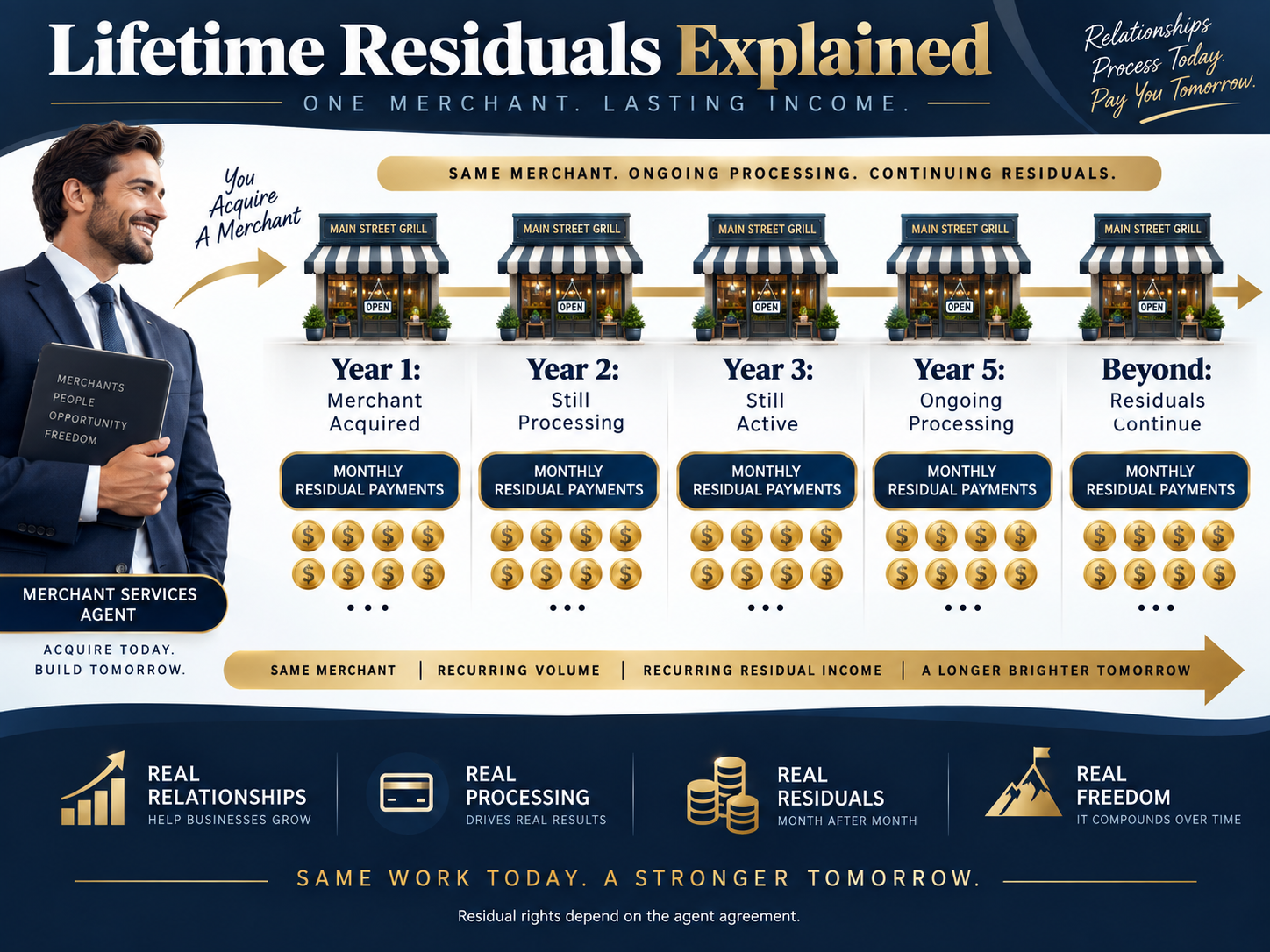
This is why I love the residual model.
You're not necessarily restarting your income every month. You're adding relationships to a portfolio that can continue generating recurring revenue as long as those merchants remain active and your contractual rights continue.
The split matters.
But the portfolio is what makes the split powerful.
The Four Things I Would Evaluate Alongside a Residual Split
When someone tells me what residual percentage they offer, I immediately put that number beside four other questions.
First, what are the underlying costs? I want to understand the Schedule A well enough to know whether the account can generate healthy eligible profit.
Second, what are my residual rights? I want to know when the residuals vest and what happens if I stop producing or eventually leave.
Third, how good is the backend organization? Merchant support, underwriting and technology directly influence retention.
Fourth, how transparent is the reporting? I want enough information to understand what my merchants generated and how my compensation was calculated.
Those four questions tell me far more about the quality of a residual program than the headline percentage alone.
Why I'm Comfortable Offering Agents 50%
When I'm evaluating what I consider a fair agent relationship, I generally try to work around a 50% residual split.
I think it's easy to understand, easy to explain and capable of creating strong long-term economics when the costs underneath it are competitive.
The agent creates the business.
The backend organization provides the processing infrastructure, products, support and operations.
Both parties participate in the economics.
If the agent becomes a major producer and the business relationship justifies moving to 55% or 60%, I'm open to that discussion.
What I don't want to do is market an inflated split simply because a bigger percentage recruits people more easily.
I'd rather teach someone how the economics actually work.
Then they can determine whether the relationship makes sense.
Questions to Ask About Any Merchant Services Residual Split
You don't need a 30-question spreadsheet to understand a residual program.
Ask a few good questions:
What residual percentage do I receive?
What is that percentage calculated from?
What major costs are deducted before the split?
Are all important merchant revenue categories included?
When do my residuals vest?
Can the residual percentage or underlying costs change?
What happens to my residuals if I stop selling?
Can I verify my residual calculations through reporting?
How strong is merchant support and retention?
Are there any production requirements tied to existing residuals?
If you understand those answers, you are already evaluating the opportunity much more intelligently than someone who asks only:
"What's your split?"
Want to Understand Residuals Before Choosing a Company?
This is exactly why I created Merchant Service University.
If you've never worked in payments before, terms such as residual split, Schedule A, vesting, buy rate and eligible net revenue can sound more complicated than they really are.
Once someone explains the concepts in the right order, they become much easier to understand.
Inside MSU, the core education teaches payment-processing fundamentals, merchant pricing, statements, residual income, modern commerce systems, industry structure and merchant sales.
There is no charge for the core education and no obligation to join one specific merchant-services company.
Start Merchant Service University Free
https://merchantserviceuniversity.com
Learn how the compensation works before somebody uses a percentage to recruit you.
Get educated before you get recruited.
Frequently Asked Questions About Merchant Services Residual Splits
What is a merchant services residual split?
A merchant services residual split determines what percentage of eligible residual profit an agent receives from merchant accounts covered by the agent agreement. A 50/50 arrangement generally means the agent and upstream organization each receive 50% of the eligible amount.
Is a 50% merchant services residual split good?
Yes, a clean 50% residual split can be a strong compensation arrangement when the underlying costs are competitive, residual rights are protected, reporting is transparent and the upstream organization provides valuable merchant support and infrastructure.
Is a 60% residual split better than 50%?
Only if the underlying economics are comparable. A 60% split applied to a smaller profit pool can produce less actual compensation than a 50% split applied to stronger economics.
What does a 50/50 merchant services residual split mean?
A 50/50 residual split generally means the eligible residual profit defined by the agent agreement is divided equally between the agent and upstream organization.
What does a 60/40 merchant services residual split mean?
In a 60/40 arrangement where the agent receives 60%, the agent generally receives 60% of eligible residual profit and the upstream organization receives 40%, subject to the terms of the agreement.
Does the residual split apply to all merchant processing fees?
Not necessarily. The agent agreement should define which revenue and costs are included in the residual calculation. An agent should not assume the split applies to every fee shown on the merchant's statement.
Why can a lower residual split pay more?
A lower residual percentage can produce more actual compensation when the underlying Schedule A costs are lower and therefore leave more eligible profit available to divide.
Can my merchant services residual split change?
That depends on the agent agreement. Agents should understand whether compensation percentages or underlying costs can change and whether changes affect existing merchants or only future accounts.
What matters besides the residual percentage?
Schedule A costs, vesting, residual rights, merchant retention, support, technology, reporting and contractual terms can all affect the long-term value of a merchant services residual program.
Where can I learn how merchant services residual income works?
You can learn merchant-services compensation fundamentals through Merchant Service University, including residual income, pricing, statements and the larger payment-processing business model.
Final Takeaway: Stop Chasing the Biggest Percentage
A merchant services residual split matters.
But it's not the entire compensation plan.
A strong 50% split can outperform a 60% split if the underlying costs leave more profit available to divide. A protected 50% residual can be more valuable than a 60% residual you can lose because of unfavorable contract language. A 50% relationship with strong merchant retention can outperform a higher split attached to bad technology and poor support.
So don't ask only:
"What's the residual split?"
Ask:
"What does this split actually produce, and what rights do I have to the income I'm building?"
That's a much better business question.
Understand the Schedule A.
Understand the residual percentage.
Understand the agreement.
Then stop obsessing over percentages and start building the portfolio.
About Joe Wagner
Joe Wagner has spent more than 16 years in merchant services and payment-processing sales, acquiring merchants, building recurring-revenue portfolios and developing sales organizations.
His focus today is helping agents understand how merchant-services compensation works before making long-term decisions about companies, agreements and partnerships.
If you're still building your foundation, learn how merchant services agents get paid, review how to choose a merchant services agent program, understand the 11 questions to ask before signing an agent agreement, and read Merchant Services Schedule A Explained.
You can also browse the Merchant Sales Training Blog, explore additional Merchant Sales Resources, or start learning free through Merchant Service University.
Free education. No obligation. Get educated before you get recruited.