
Merchant Services Agent Agreement: 11 Questions Before Signing
Merchant Services Agent Agreement: 11 Questions to Ask Before You Sign
A merchant services agent agreement can have a bigger impact on your long-term income than almost anything a recruiter tells you during the sales process.
That may sound obvious, but I didn't fully appreciate it when I entered this industry. Like most salespeople, I was more interested in what I could sell, what the compensation looked like and how quickly I could start producing. The agreement felt like the paperwork that needed to be signed before I could get to work.
After more than 16 years in merchant services, I look at it completely differently.
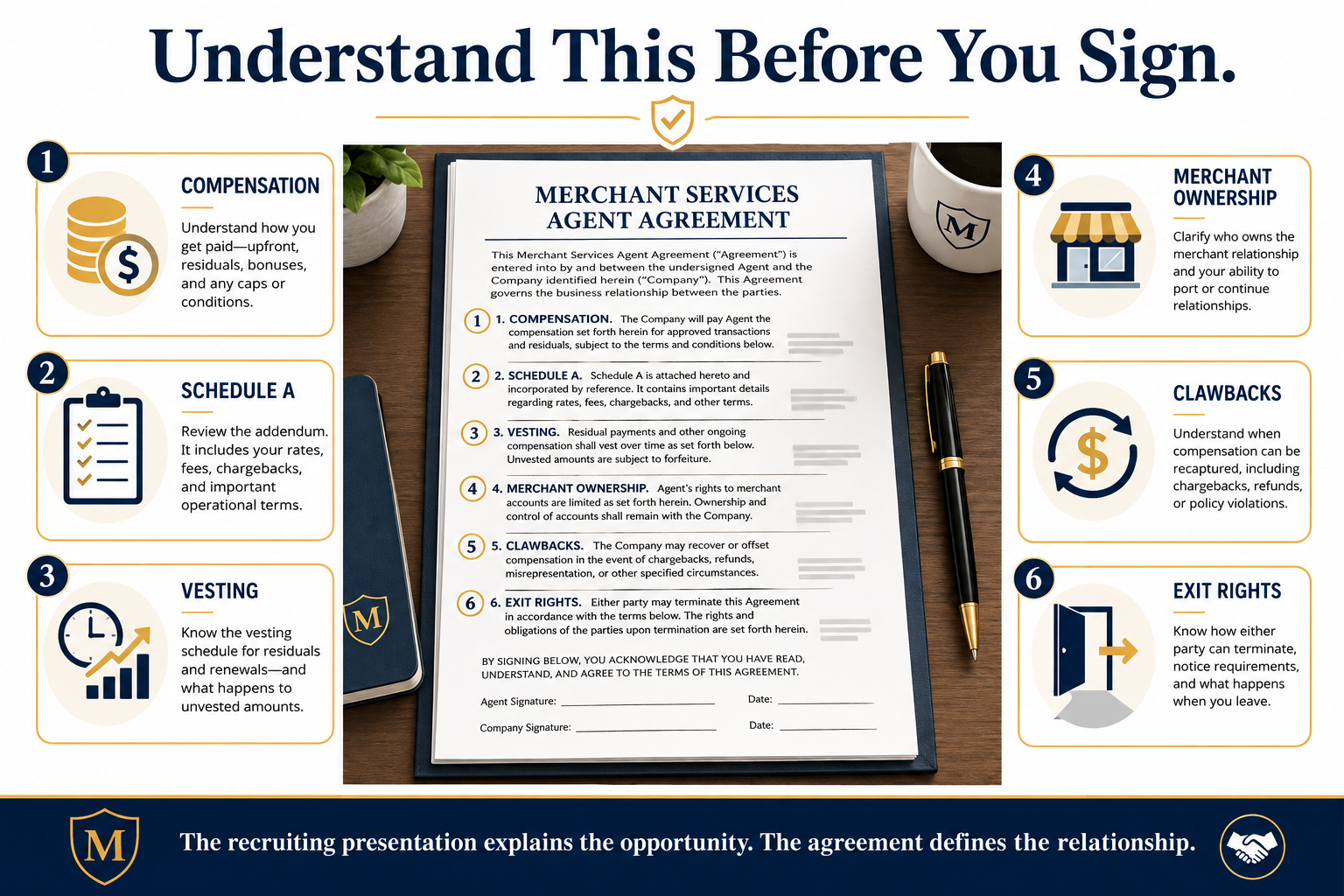
If you're planning to spend years building relationships with businesses and generating recurring residual income, the agreement is not a formality. It is the document that can determine how you're paid, when you're vested, what happens if you leave, whether production requirements exist, what restrictions apply to your merchant relationships and whether the recurring income you believe you're building can actually continue when circumstances change.
This article is not legal advice, and I strongly believe that an important agreement deserves review by a qualified attorney who understands contracts and preferably the payments industry. My goal here is to make sure you know enough to recognize the questions you should be asking before the agreement ever reaches an attorney.
If you haven't already, first read my guide on How to Choose a Merchant Services Agent Program. That article explains the broader company-selection process. This one focuses specifically on the contract.

Why Your Merchant Services Agent Agreement Matters So Much
Merchant services is unusual because a salesperson can acquire an account today and potentially continue earning recurring residual income from that relationship for years. That is one of the things that makes the industry so attractive, but it also means the contract governing that income can remain important long after the original sale is completed.
A traditional salesperson might care primarily about whether this month's commission was calculated correctly. A merchant services agent building a portfolio has to think much further ahead. If you acquire 50, 100 or several hundred merchants, the agreement may eventually govern a meaningful stream of recurring income.
At that point, a sentence you barely noticed when signing the contract can become very important.
There are real examples in payment-industry litigation where questions involving merchant ownership, vesting, residual payments and non-solicitation restrictions became central issues. In Process America, Inc. v. Cynergy Holdings, for example, the underlying ISO agreement contained provisions concerning merchant ownership, vesting, transfer rights, continuing residual payments and post-termination merchant solicitation. The case illustrates something every agent should understand: contract language that looks theoretical when you sign it can become very real when a business relationship changes.
You can review the federal appellate decision here:
https://law.justia.com/cases/federal/appellate-courts/ca2/15-2081/15-2081-2016-10-05.html
You don't need to become an expert in payment-industry litigation.
You do need to read your agreement.
Question #1: Exactly How Is My Residual Compensation Calculated?
Don't stop at asking, "What's my split?"
Suppose the company tells you that you're receiving a 50% residual split. That may be a strong arrangement. In fact, I would personally rather have a transparent 50% relationship with good underlying economics than chase larger headline percentages attached to an expensive cost structure.
But you still need to determine what that 50% is being calculated from.
If the merchant creates $600 in eligible net revenue after the applicable costs, a 50% split would produce $300 for the agent. If another organization offers 60% but its cost structure leaves only $450 in eligible net revenue, that agent receives $270.
The percentage didn't determine the better outcome.
The underlying economics did.
Your agreement should make it possible to determine how compensation is calculated, what revenue is included, what expenses can be deducted and how adjustments are handled.
If you're not comfortable with these concepts yet, read Merchant Services Agent Commissions: How Agents Get Paid before evaluating an agreement.
Question #2: What Does My Schedule A Actually Say?
Your Schedule A can be one of the most important pieces of the compensation relationship because it may define underlying costs used before your residual share is determined.
Depending on the organization, a Schedule A may contain basis-point costs, per-transaction expenses, monthly account fees, authorization costs, platform fees, equipment economics and other items.
Two agents can both be told they receive 50% residuals and end up with very different compensation because their underlying costs are different.
That's why I don't want to hear only:
"You get half."
I want to understand half of what.
I would also ask whether the Schedule A can be changed after I sign. If it can, under what circumstances? Is notice required? Can costs be increased unilaterally? Does the agreement place any limits on changes?
This subject deserves its own article, and Blog #10 in this series will be dedicated entirely to Merchant Services Schedule A Explained. For now, understand that the residual split and the Schedule A belong in the same conversation.
Question #3: When Do My Residuals Vest?
Vesting is one of the most important words to understand before signing a merchant services agent agreement.
Agents often hear phrases such as "vested residuals" or "lifetime residuals" and assume the meaning is obvious. It isn't. What matters is the actual contractual language defining your right to continue receiving compensation.
Ask when vesting occurs. Is it immediate? Does it happen after a period of time? Do you need to reach a certain production level? Do you have to remain actively producing? Can vested residuals still be forfeited for certain contractual breaches?
An attorney who has represented payment-industry agents, Paul Rianda, describes termination provisions as some of the most important and contentious parts of agent agreements because those provisions can determine the circumstances under which an ISO can stop paying residuals.
His discussion of agent-residual termination is available here:
https://www.riandalaw.com/articles/can-they-terminate-your-residuals/
The larger point is simple: don't rely on the word vested by itself.
Ask what it means in your contract.
Question #4: What Happens to My Residuals if I Stop Producing or Leave?
This is different from asking whether residuals are vested.
Imagine that you spend five years building 100 active merchants and then decide you no longer want to actively sell.
What happens?
Do your residual payments continue?
Does the agreement require a minimum number of new accounts every month or quarter? Can inactivity cause compensation to stop? What happens if you resign? What happens if the ISO terminates the agreement without cause? What happens if the ISO claims you breached the contract?
This is an area where I want the language to be extremely clear.
I'm comfortable with an agreement protecting an ISO from fraud, intentional misconduct or legitimate material breaches. A company needs the ability to protect itself.
What I don't want is to spend years building a portfolio only to discover that my long-term compensation depends on continuing to produce indefinitely under terms I barely noticed.
The phrase lifetime residuals should never replace reading the termination section.
Question #5: Are There Production Minimums Attached to My Residual Rights?
Production requirements aren't automatically bad.
An ISO may legitimately create different compensation levels for agents producing different volumes. An organization could decide that a new agent begins at a 50% split and that highly productive agents may qualify for 55% or 60%. That's a business decision.
The issue is whether failing to maintain production can affect compensation you've already built.
Those are two very different things.
I would distinguish between a requirement that affects future compensation levels and a requirement that can eliminate existing residual payments.
Suppose I slow down after years of strong production. Does my split change? Do existing accounts remain at the original compensation structure? Can my residuals stop entirely? Is there a cure period if I miss a requirement?
Don't wait until your production changes to find out.
Ask before you sign.

Question #6: What Rights Do I Have to the Merchant Portfolio?
Agents often use the phrase "I own my portfolio."
I would be very careful with that sentence.
Ownership can mean different things depending on the agreement. The processor or ISO may own the actual merchant agreements while the agent holds contractual rights to residual compensation. Another contract may provide transfer rights after certain conditions are satisfied. Another may significantly restrict what can be assigned or sold.
What matters is what the agreement allows you to do.
Can your residual rights be sold?
Can they be assigned?
Can the merchant accounts be transferred under certain circumstances?
Does the ISO have a right of first refusal?
Does the processor or ISO need to approve a portfolio sale?
Can the residual stream pass to another entity?
A current legal overview of merchant-portfolio transactions notes that ISO and processor agreements can contain termination-for-cause provisions, restrictions on assignment and post-termination forfeiture provisions that directly affect whether a portfolio can actually be sold.
You can review that discussion here:
This is why I prefer the phrase portfolio rights over casually assuming complete ownership.
If you're building something you hope will eventually function as an asset, understand exactly what rights the contract gives you.
Question #7: What Non-Solicitation, Non-Compete or Exclusivity Restrictions Am I Accepting?
You need to know what you're allowed to do both during and after the relationship.
An agreement may contain provisions restricting your ability to solicit merchants you previously placed with the company. It may limit your ability to move merchants to another provider. It may restrict solicitation of other agents, employees or customers. It may contain exclusivity provisions affecting which processing products you can sell while the agreement is active.
These restrictions can matter tremendously if your business strategy changes.
The Process America litigation mentioned earlier involved a post-termination non-solicitation provision covering merchants. That is a very real example of why you should understand these clauses before signing instead of discovering them after the relationship deteriorates.
Rianda also notes that agent agreements commonly restrict agents from moving merchants from the ISO where they were originally placed to a competing organization.
That discussion is available here:
https://www.riandalaw.com/articles/so-you-want-to-move-your-merchants/
Again, this isn't an argument that every restriction is unfair.
The company has legitimate interests to protect.
You simply need to understand the boundaries you're agreeing to.
Question #8: What Clawbacks, Offsets, Indemnification or Liability Could Hit My Compensation?
It's easy to focus on what the company owes you.
You also need to understand what the agreement says you might owe the company.
Some compensation plans allow upfront commissions to be clawed back if a merchant closes quickly, never activates or fails to meet certain requirements. That's fairly easy to understand if the terms are clear.
More complicated agreements may include rights of offset, indemnification obligations, chargeback exposure, fraud-related liability, equipment obligations or other financial responsibilities.
Ask whether the ISO can deduct amounts from future residual payments. If so, under what circumstances? Are there limits? Is notice required? Can disputes be raised before money is withheld?
This is especially important because residual income can become a significant part of your monthly cash flow. You don't want to discover years later that the agreement provides broad offset rights you never understood.
Read the sections dealing with indemnification, damages, chargebacks, reserves, offsets and compensation adjustments carefully.
If you're not sure what they mean, that's exactly the kind of contract language I would want an attorney to explain.
Question #9: Can the Company Change My Compensation or Agreement Later?
This question doesn't get enough attention.
Suppose you sign a 50% residual agreement with a specific Schedule A and spend three years building your portfolio.
Can the company later increase your underlying costs?
Can it reduce the residual split?
Can it create new administrative fees?
Can it change the Schedule A by giving notice?
Can it amend the agreement without your signature?
Many commercial contracts contain amendment provisions, and some changes may be necessary over a long relationship. Costs in payments don't remain frozen forever.
The important issue is understanding the mechanism.
What can change?
Who can change it?
How much notice do you receive?
Do you have the right to reject a material change?
What happens to existing merchants?
Does a new schedule apply only to future accounts or also to the portfolio you've already built?
Those details can matter much more five years from now than they seem to matter on signing day.
Question #10: What Happens if the ISO Is Sold, I Die, Become Disabled or Want to Sell My Business?
Most people sign agreements thinking about how they're going to start.
I want you to think about how things might eventually end.
Companies get acquired. Owners retire. Partnerships change. People become disabled. People die. Businesses are sold.
What happens to your residual rights if the ISO is acquired by another company?
Does the acquiring company assume the obligation to continue paying you?
Can your rights transfer to your LLC?
Can your residual stream pass to your estate?
Can you assign your agreement to a buyer?
Does the company have to approve the transfer?
Does the ISO have a right of first refusal if you want to sell?
If you're telling yourself that your merchant portfolio may eventually become a business asset, these questions aren't theoretical.
They're part of understanding the asset.
This is one of the reasons I continually tell agents that choosing the right company is about far more than this month's commission. You're building through someone else's infrastructure, so the contractual relationship supporting that infrastructure matters.
Question #11: How Are Disputes Handled, and Which Promises Are Actually in Writing?
Nobody starts a new business relationship expecting a lawsuit.
Good.
You shouldn't.
But every serious agreement should tell you what happens if the parties disagree.
Does the contract require arbitration?
Where must a dispute be filed?
Which state's law governs the agreement?
Does one party have the right to recover attorneys' fees?
Are there limitations on damages?
Is there a required notice-and-cure process before termination?
How long do you have to dispute a residual calculation?
These provisions don't feel important while everyone is getting along.
They become extremely important when everyone isn't.
Current merchant-portfolio legal guidance specifically highlights dispute-resolution provisions, governing rights and attorneys' fee language as contractual issues that can meaningfully affect parties when problems arise.
I would also pay attention to the entire agreement or integration clause.
If the recruiter tells you something important such as, "Don't worry, your residuals can never be terminated," but the agreement doesn't say that, you have a problem.
If a promise is important enough to influence your decision, ask where it appears in writing.
I don't say that because I assume everyone is dishonest.
I say it because people leave companies, memories change, management changes and verbal interpretations can differ.
The agreement survives the recruiting conversation.
The Difference Between a Good 50% Split and a Bad 50% Split
This is worth repeating because people focus so heavily on residual percentages.
Two agreements can both say 50% and represent completely different opportunities.
In one relationship, you might have competitive underlying costs, clearly vested residuals, strong post-termination payment language, transparent reporting, fair transfer rights and excellent backend merchant support.
In another, you could have expensive Schedule A costs, production requirements attached to residuals, broad termination rights, weak reporting and restrictions that make the portfolio difficult to transfer.
Both recruiters can say:
"You get 50%."
Those are not the same deal.
I will always care about the split, but I care about the entire structure around the split.
That's why a clean 50% relationship with the right organization can be an excellent business relationship. The goal shouldn't be to squeeze every possible percentage point from your upstream partner.
The goal should be to build a large, protected, profitable portfolio through a relationship where everyone is providing value.
Should You Hire an Attorney Before Signing a Merchant Services Agent Agreement?
If the agreement controls something you intend to spend years building, I think professional legal review is worth serious consideration.
I'm not an attorney, and this article is educational rather than legal advice.
A qualified attorney can do something a blog cannot: read the specific agreement you're actually being asked to sign and explain how the language applies to your situation.
Ideally, I'd look for someone comfortable with commercial contracts and, where possible, merchant acquiring or payment-industry agreements. Payments has its own terminology and contractual structures, so relevant industry experience can be useful.
You may decide not to negotiate every provision.
That's fine.
The goal isn't necessarily to create the world's perfect contract.
The goal is to know what you're signing.
There's a huge difference.
Red Flags That Would Make Me Slow Down Before Signing
I don't automatically walk away from an agreement because one clause needs clarification. Contracts are negotiable business documents, and organizations have legitimate reasons for protecting themselves.
What would make me slow down is a pattern of uncertainty.
If the recruiter can't explain how residuals are calculated, if nobody will provide the Schedule A, if verbal promises don't match written language, if residuals can disappear under vague circumstances, if compensation can be changed without meaningful limits or if the company becomes defensive when I ask reasonable questions, I'm going to become more cautious.
The questions themselves also tell you something about the partner.
A strong company should expect serious producers to perform due diligence.
You're not being difficult.
You're treating your merchant portfolio like a business.
Want to Understand These Terms Before Someone Hands You an Agreement?
If terms such as Schedule A, vesting, residual rights, clawbacks, ISO, net revenue and merchant ownership still feel unfamiliar, that's exactly why I believe people should learn merchant services before they get recruited.
You can access the core education inside Merchant Service University for free.
The goal isn't to give you legal advice or tell you which agreement to sign. It's to teach you enough about the merchant-services industry that when someone puts an agreement in front of you, you actually understand the business concepts the contract is addressing.
Inside MSU, you'll learn payment-processing fundamentals, compensation, residual income, merchant statements, pricing, modern commerce systems, sales and how the different players in the industry fit together.
Start Merchant Service University Free
https://merchantserviceuniversity.com
There is no charge for the core education and no obligation to join a particular merchant-services company.
Learn the industry first. Understand what you're building. Then evaluate the agreement.
Get educated before you get recruited.
My 11-Question Merchant Services Agent Agreement Checklist
Before I signed an agreement today, I would want clear answers to these 11 questions:
How exactly is my residual compensation calculated?
What does the Schedule A say, and can those costs change?
When do my residuals vest?
What happens to residual payments if I stop producing, resign or am terminated?
Are production minimums attached to existing residual rights?
What rights do I have to sell, assign or transfer the portfolio or residual stream?
What non-solicitation, non-compete or exclusivity restrictions apply?
What clawbacks, offsets, indemnification or other liabilities could reduce my compensation?
Can the company change my compensation structure or agreement later?
What happens after an acquisition, death, disability or sale of my business?
How are disputes handled, and are the promises important to me actually written into the agreement?
I wouldn't expect every answer to favor me completely.
That's not how contracts work.
A good agreement protects both parties.
What I want is clarity.
Frequently Asked Questions About Merchant Services Agent Agreements
What is a merchant services agent agreement?
A merchant services agent agreement is the contract governing the relationship between a payment-sales agent or sales organization and its upstream ISO, processor or other payment organization. It commonly addresses compensation, residual rights, responsibilities, termination and restrictions on the relationship.
What should I look for in a merchant services agent agreement?
Important areas include the residual calculation, Schedule A, vesting, post-termination payments, production requirements, portfolio-transfer rights, non-solicitation provisions, clawbacks, offsets, amendment rights and dispute-resolution provisions.
What does residual vesting mean?
Residual vesting refers to the contractual conditions governing an agent's continuing rights to residual compensation. The exact definition varies by agreement, so agents should review the actual contract rather than rely only on phrases such as "vested" or "lifetime residuals."
Can an ISO stop paying residuals?
Whether an ISO can stop paying residuals depends on the agreement and the circumstances involved. Agent agreements often contain termination and breach provisions describing circumstances under which payments may stop, which is why those clauses deserve careful review.
Is a 50% merchant services residual split good?
A clean 50% split can be a strong arrangement if the underlying Schedule A costs are competitive, residual rights are clearly defined and the ISO provides valuable technology, support and infrastructure. The percentage should always be evaluated together with the economics underneath it.
Can my residual split be changed after I sign?
That depends on the amendment and compensation provisions in your agreement. Agents should determine whether the ISO can modify splits, Schedule A costs or other compensation terms, what notice is required and whether changes affect existing merchants.
Can I sell my merchant-services portfolio?
Possibly, but the ability to sell or transfer portfolio rights depends on the agreement. Assignment restrictions, processor consent, rights of first refusal, termination provisions and merchant ownership language can all affect transferability.
What is a non-solicitation clause in a merchant-services agreement?
A non-solicitation clause may restrict an agent from soliciting merchants, agents, employees or other relationships associated with the ISO during or after the agreement. The scope and duration depend on the specific contract and applicable law.
Should I have a lawyer review my merchant services agent agreement?
For an agreement that may govern years of recurring compensation, professional legal review is worth considering. An attorney can evaluate the specific language of the agreement and advise you based on your circumstances.
Where can I learn the terminology in a merchant services agreement?
You can learn merchant-services fundamentals free through Merchant Service University. Understanding compensation, residuals, payment processing and industry structure can make agent agreements easier to evaluate, although MSU does not replace legal advice.
Final Takeaway: Read the Agreement Like You're Building Something Valuable
One of the easiest mistakes to make in merchant services is treating the agent agreement like paperwork.
You want to get started. You're excited about the products. You like the recruiter. The compensation sounds good. You sign the document and assume you'll figure everything else out later.
I understand that because I've been the salesperson who wanted to get to work.
But if you're serious about building merchant services residual income, think differently.
Imagine you've already built 100 merchants.
Imagine that residual stream matters to your family.
Imagine someone offers to buy your portfolio.
Imagine you eventually want to retire.
Now read the agreement from that perspective.
The sections about vesting, termination, assignment, merchant solicitation and residual rights suddenly don't look like boring legal language.
They look like the rules governing something valuable.
That is how I would read a merchant services agent agreement today.
Not because I expect every relationship to go bad.
Because I expect what I'm building to become worth protecting.
About Joe Wagner
Joe Wagner has spent more than 16 years in merchant services and payment-processing sales, acquiring merchants, building recurring-revenue portfolios and developing sales organizations.
His focus today is helping new and experienced agents understand the merchant-services industry before making important decisions about compensation, contracts and partnerships.
If you're still learning the industry, begin with the Merchant Services Sales Beginner's Guide. Then read What I Wish I Knew Before Becoming a Merchant Services Agent, learn how merchant services agents get paid, understand the difference between a merchant services agent and an ISO, review how to learn merchant services before choosing a company, and use my 12-point guide to choosing a merchant services agent program.
You can also browse the Merchant Sales Training Blog, explore additional Merchant Sales Resources, or start learning free through Merchant Service University.
Free education. No obligation. Get educated before you get recruited.