
Merchant Services Contract Red Flags: 8 Things to Watch
Merchant Services Contract Red Flags: Vesting, Clawbacks, Minimums & Non-Competes
There are certain merchant services contract red flags I would pay much more attention to today than I did when I first entered the payments industry.
When you're new, it's easy to focus on the exciting parts of an agent opportunity. You want to know what the residual split is, how much the upfront commission pays, what products you can sell and how quickly you can get started. The contract often feels like paperwork standing between you and your first merchant.
I think that's the wrong way to look at it.
If you're planning to spend years acquiring merchants and building recurring residual income, the agreement can determine whether you continue receiving that income, what happens when production slows, which costs can change, what compensation can be clawed back and what you're allowed to do if the business relationship eventually ends.
That doesn't mean every contract provision protecting an ISO is bad. An ISO should protect itself from fraud, intentional misconduct, merchant poaching and legitimate financial losses. A fair agreement should protect both sides.
A red flag, to me, is something that is unusually broad, unclear, heavily one-sided or capable of affecting years of residual income without the agent fully understanding it.
This article is educational and not legal advice. If an agreement could govern a portfolio you intend to spend years building, I believe having a qualified attorney review the actual contract is worth considering.
If you haven't already, read my 11 Questions to Ask Before Signing a Merchant Services Agent Agreement. That article gives you the due-diligence questions. This one focuses specifically on provisions that would make me slow down.

Red Flag #1: "Vested Residuals" Without a Clear Definition
I like vested residuals.
What I don't like is when the recruiting conversation says your residuals are vested but the agreement makes it difficult to determine what vesting actually means.
If someone tells you that your residuals are protected for life, I want to see where the agreement explains that protection. Does vesting happen immediately? Does it happen after a certain period? Does it depend on production? Are there specific circumstances under which vested residuals can still be forfeited?
The phrase vested lifetime residuals sounds powerful, but your contractual rights come from the agreement.
This is the central point I made in What Lifetime Residuals Really Mean in Merchant Services. Lifetime residual language may describe the intent of the compensation model, but the termination, vesting and forfeiture sections tell you how secure that income actually is.
A red flag isn't necessarily that the agreement contains conditions.
A red flag is when nobody can clearly explain what those conditions are.
Red Flag #2: Broad Language Allowing Existing Residuals to Be Forfeited
This is where I become much more cautious.
Suppose you build 75 merchants over several years. Those accounts are generating recurring income, and you have done the work required to create those relationships.
Now imagine the agreement contains broad language allowing all existing residual payments to terminate because of a relatively minor issue unrelated to those merchant accounts.
I want to understand that provision extremely well.
There are circumstances where forfeiture can make sense. If an agent commits fraud, intentionally steals merchants, falsifies applications or seriously breaches the agreement, I understand why an ISO needs meaningful remedies.
What concerns me is language so broad that almost any disagreement could potentially become a reason to eliminate years of residual compensation.
Payments-industry attorneys have repeatedly identified termination and continuing-residual provisions as critical parts of an agent agreement because they can determine when residual payments survive the end of the relationship.
This is one reason I would never evaluate an opportunity based only on a 50% or 60% residual split. A beautifully protected 50% residual can be far more valuable than a larger percentage that can disappear under vague termination language.

Red Flag #3: Production Minimums That Can Eliminate Residuals You've Already Built
Production goals by themselves do not bother me.
A company may reasonably create incentives for productive agents. For example, an agent might begin at a 50% residual split and eventually qualify for 55% or 60% based on sustained production.
That's normal business.
What I distinguish very carefully is a production requirement affecting future compensation versus one capable of eliminating existing residual income.
Suppose you build 100 merchants and eventually want to slow down. Does missing a future production requirement simply mean you don't qualify for a higher split on new accounts? Or does it mean the company can stop paying residuals on merchants you placed years earlier?
Those are dramatically different consequences.
If someone is advertising lifetime residuals while also requiring you to continually submit a minimum number of new merchants forever in order to keep existing residuals, I want that explained clearly before I sign.
Merchant services is attractive because it can allow today's work to contribute to tomorrow's income.
If the structure effectively requires you to keep selling indefinitely just to preserve the income you've already built, make sure that is the business you're knowingly choosing.
Red Flag #4: A Schedule A That Can Change Without Meaningful Limits or Notice
The Merchant Services Schedule A helps determine the costs underneath your residual split.
That means changes to those costs can change your payout even when your residual percentage never moves.
Imagine your agreement continues to say you receive 50%, but your transaction cost increases, monthly account costs rise or additional charges are introduced.
You still technically receive 50%.
You're simply receiving 50% of a smaller amount.
There are legitimate reasons costs may change over time. Network pricing changes. Processor expenses change. Technology costs evolve.
I don't expect every Schedule A number to remain frozen forever.
What I want to understand is how those changes happen.
Does the agreement require notice? Can costs be changed on existing merchants? Can the ISO make any change it wants at any time? Are increases limited to actual upstream cost changes, or can additional margin be added?
You don't need to negotiate every penny.
You do need to know whether the economics underneath your residual can be materially changed after you've already built the portfolio.
Red Flag #5: Clawbacks and Offsets You Don't Understand
Clawbacks are not automatically bad.
Suppose an ISO pays you a substantial upfront bonus when a merchant activates and that merchant immediately cancels. I can understand why an agreement might require part of the original bonus to be returned.
That's a reasonable concept when the rules are clear.
The red flag is when the contract allows broad deductions from your residual compensation without clearly defining what can trigger them.
I would want to understand whether the company can offset chargebacks, equipment costs, merchant losses, upfront commissions, reserves, legal expenses or other liabilities against my residual payments.
I'd also want to know whether there are limits.
Suppose one merchant creates a financial problem. Can the resulting loss be deducted only from compensation associated with that account, or potentially from your entire residual portfolio?
Can the ISO withhold residual payments while a dispute is investigated?
What rights do you have to challenge a calculation?
The more valuable your portfolio becomes, the more important those questions become.
If your residual income eventually reaches several thousand dollars per month, broad offset language is no longer a paragraph you can afford to ignore.
Red Flag #6: Monthly Minimums or Costs That Can Quietly Make Accounts Unprofitable
This isn't necessarily a legal red flag in the same way a termination clause is, but it can be an economic red flag if the costs aren't understood.
As I explained in the Schedule A article, monthly account costs can continue to exist even when you decide to waive the corresponding fee for the merchant.
Imagine you have a $10 underlying monthly cost on your Schedule A.
You waive the merchant-facing monthly fee to close the deal.
Depending on your compensation structure, the underlying $10 cost may still remain.
Now you haven't simply given up potential revenue. You may have created an expense that reduces the other profit generated by the account.
Do that across 50 merchants and you're talking about:
50 × $10 = $500 per month in underlying account costs
There is nothing wrong with waiving a fee strategically. I've done it when the overall merchant economics made sense.
The red flag is not knowing that you're doing it.
The same principle applies to transaction fees, statement costs, BIN or sponsorship fees and other Schedule A expenses.
A compensation plan can advertise a great residual split while underlying costs slowly eat away at the profit available to divide.

Red Flag #7: Overly Broad Non-Compete, Non-Solicitation or Exclusivity Language
This deserves careful treatment because these clauses are not all the same thing.
A non-compete generally attempts to restrict someone from competing within a defined scope after a relationship ends. A non-solicitation provision may restrict the agent from soliciting specific merchants, agents, employees or other relationships. An exclusivity provision may limit which competing products or processing relationships the agent can represent while the agreement remains active.
An ISO has legitimate interests to protect.
If the company invests in infrastructure, provides confidential information or pays you residual income from merchants boarded through its platform, I understand why it doesn't want an agent intentionally moving those merchants to a competitor.
That is very different from an agreement attempting to prevent someone from earning a living anywhere in an enormous industry.
As of 2026, there is no nationwide FTC rule automatically banning all non-compete agreements. The FTC's 2024 rule was set aside before taking effect, the FTC later dismissed its appeals, and the rule was removed from the Code of Federal Regulations in February 2026. Non-compete enforceability therefore continues to depend heavily on state law and the specific facts, although the FTC continues challenging certain non-compete practices case by case.
That makes generic internet advice especially dangerous.
Someone cannot simply tell you:
"Non-competes are illegal now."
That's not an accurate nationwide statement in 2026.
At the same time, don't assume every restrictive covenant is automatically enforceable simply because it appears in a contract. State laws vary significantly, and the FTC has continued taking action against specific non-compete practices, including a June 2026 final order involving more than 18,000 workers at Rollins.
This is exactly the type of provision I would have an attorney evaluate based on the governing state law and your particular agreement.
My business question would be simpler: Is the restriction reasonably protecting the merchants and relationships associated with this organization, or is it trying to control my entire future career?
Those are not the same thing.
Non-Solicitation Is Often More Relevant to Merchant Services Than a Traditional Non-Compete
For merchant-services agents, the clause I'd often examine very closely is the merchant non-solicitation provision.
Suppose you place 100 merchants through an ISO and later leave.
Can you continue receiving residuals from those merchants?
Can you contact them for unrelated services?
Can you move them if they independently ask you for another processing solution?
How long does the restriction last?
Does it apply only to merchants you boarded through that ISO, or to every merchant you have ever known?
What happens if the merchant independently leaves the processor?
Those details matter.
I don't consider a reasonably written merchant non-solicitation provision shocking. The upstream organization has legitimate interests in merchant relationships being processed through its infrastructure.
What I don't want is vague language that reaches much further than I realized when signing.
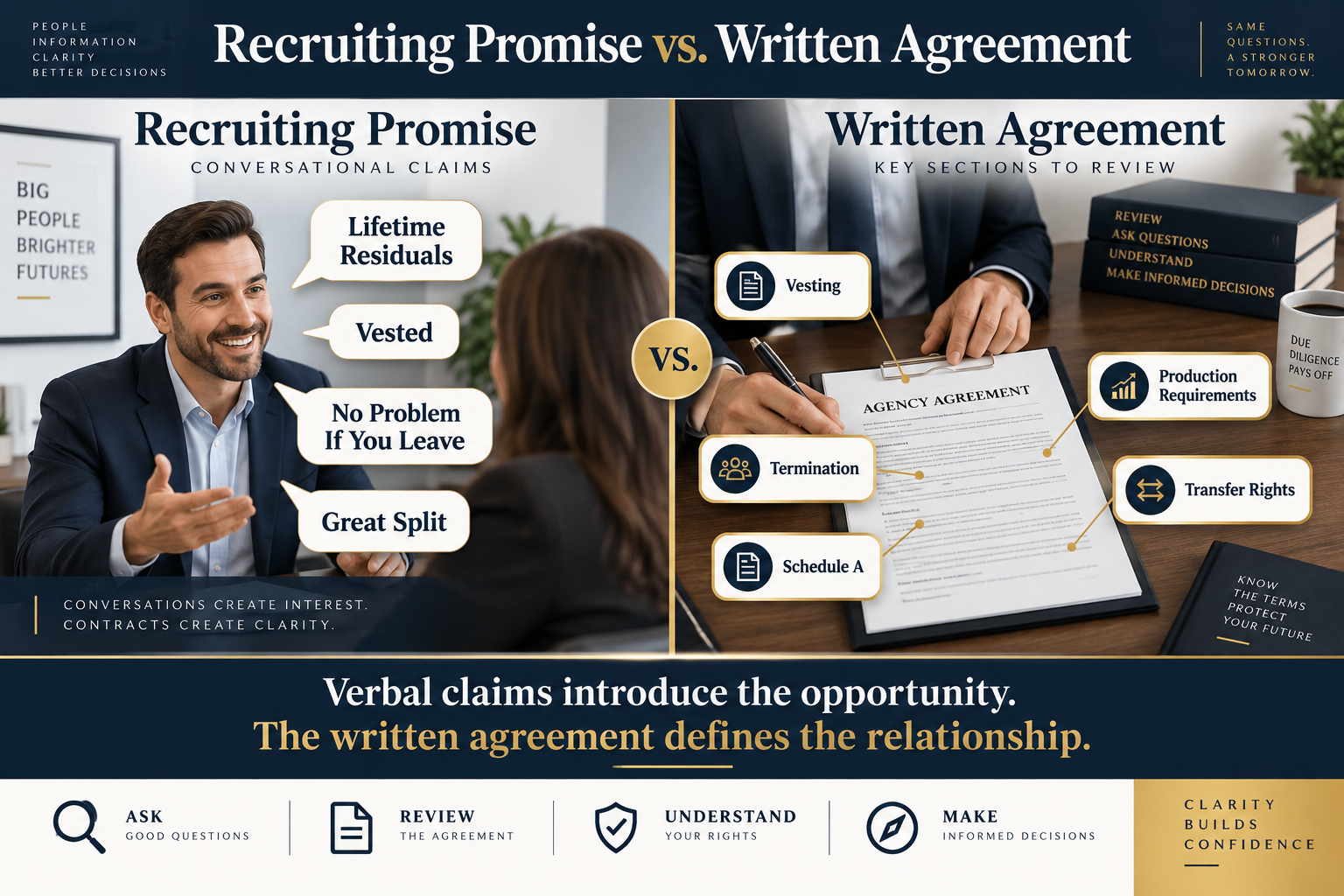
Red Flag #8: Important Promises That Exist Only in the Recruiting Conversation
This may be the simplest red flag in the entire article.
The recruiter says:
"Your residuals are lifetime."
"Don't worry about that production minimum."
"We would never terminate someone's residuals."
"You can always sell the portfolio later."
"That clause doesn't really apply."
Great.
Show me where the agreement supports that interpretation.
I don't say that because I assume recruiters are dishonest. Most people are probably telling you what they genuinely believe.
But employees leave.
Management changes.
Companies get acquired.
People remember conversations differently.
Five years from now, the person who recruited you may not even work there.
The contract will still exist.
If something is important enough to influence whether you spend years building merchants through an organization, it is important enough to understand in writing.
Not Every Contract Protection Is a Red Flag
This is important.
I don't want people reading this series and becoming afraid of every contract provision.
A good ISO needs protection too.
It should protect itself against fraud.
It should protect confidential information.
It should have remedies if an agent intentionally harms the organization.
It may reasonably protect merchants acquired through its infrastructure from being deliberately solicited away.
It may have legitimate policies concerning chargebacks, equipment, upfront commissions and financial losses.
A contract where only the agent has rights and the ISO has none probably isn't realistic either.
The goal is not finding an agreement with zero obligations.
The goal is understanding whether the obligations are clear, reasonable and proportionate to what you're building.
That's what due diligence is.
My Biggest Red Flag: When Reasonable Questions Create Defensiveness
One of the easiest ways to learn about a potential partner is simply to ask questions.
If I ask how residual vesting works, that shouldn't offend anyone.
If I ask to understand the Schedule A, that's a business question.
If I ask what happens to my residuals if I stop producing, that's reasonable.
If I ask someone to explain a non-solicitation clause, I'm not announcing that I intend to steal merchants.
I'm trying to understand the contract.
The companies I want to work with should expect serious producers to care about these things.
If asking basic questions about compensation and contractual rights immediately creates defensiveness, that itself would make me more cautious.
I want a partnership where both sides understand the economics and expectations.
Would I Reject an Agreement Because of One Red Flag?
Not automatically.
A red flag means:
Stop. Understand it. Decide whether it can be clarified or fixed.
Maybe a clause was drafted too broadly and the company is willing to revise it.
Maybe you're misunderstanding the provision.
Maybe there is another section of the agreement that changes how it operates.
Maybe the organization has a legitimate reason for the language and you're comfortable accepting it once you understand the tradeoff.
That's why I don't want these articles turning into:
"See this word? Run."
Real business isn't that simple.
The objective is informed decision-making.
How Compensation Fits Into the Contract Red-Flag Conversation
Sometimes an agent becomes so excited about a 60% residual split that they stop caring about everything else in the agreement.
I would much rather have a clean 50% relationship where I understand the Schedule A, my residuals are properly vested, termination rights are clear and the upstream organization provides excellent support.
The merchant services residual split is only one part of the relationship.
A five- or ten-point difference in compensation does not automatically compensate for weak residual rights.
If I'm trying to build recurring income that may last for years, protecting the stream matters just as much as maximizing the percentage.
The Contract Review I Would Do Before Signing Today
If I were evaluating a new relationship today, I wouldn't attempt to personally become a payments attorney.
I'd first read the agreement myself and identify the areas that matter most to my business: compensation, Schedule A, vesting, termination, production minimums, residual survival, assignment, restrictive covenants and liability.
Then I would ask the company questions.
If anything significant remained unclear, I'd consider having a qualified attorney review the agreement.
What I would not do is sign the contract without reading it because I liked the recruiter and wanted to start selling Monday.
I've spent too many years building residual income to treat the document governing that income casually.
Want to Understand the Business Terms Before Reviewing an Agreement?
If words such as vesting, Schedule A, residual split, clawback, ISO and merchant portfolio still feel unfamiliar, learning the industry first will make the contract much easier to understand.
That's one reason I created Merchant Service University.
The core MSU education teaches how merchant services works, how agents get paid, processing economics, statements, pricing, modern commerce systems and the broader industry structure before requiring you to choose a company.
There is no charge for the core education and no obligation to join one particular merchant-services organization.
Start Merchant Service University Free
https://merchantserviceuniversity.com
Learn what the business terms mean before those terms appear in an agreement controlling your future income.
Get educated before you get recruited.
Frequently Asked Questions About Merchant Services Contract Red Flags
What are the biggest merchant services contract red flags?
Important areas to examine include unclear residual vesting, broad forfeiture provisions, production minimums tied to existing residuals, unrestricted Schedule A changes, broad clawback or offset provisions, restrictive non-compete or non-solicitation language and important verbal promises that do not appear in writing.
Are production minimums always a red flag?
No. Production requirements can reasonably determine bonuses, higher residual splits or eligibility for future incentives. The bigger concern is when failing to meet future production can eliminate residual compensation from merchants an agent has already built.
Are merchant services clawbacks bad?
Not necessarily. A clearly defined clawback on an upfront bonus can be reasonable if a merchant immediately cancels or never satisfies the conditions of the bonus. Agents should understand what can be clawed back and whether deductions can affect unrelated residual compensation.
Can an ISO terminate vested residuals?
That depends on the agreement and circumstances. Agents should review termination, vesting and forfeiture provisions carefully because contracts can define circumstances under which continuing residual payments may stop.
Are merchant-services non-compete agreements legal in 2026?
There is no nationwide federal ban on all non-competes in effect in 2026. Enforceability depends significantly on state law, the specific restriction and the circumstances. Agents should obtain legal advice concerning their actual agreement rather than relying on general internet statements.
What is the difference between a non-compete and non-solicitation clause?
A non-compete generally restricts certain competitive activity, while a non-solicitation provision usually restricts solicitation of specific merchants, employees, agents or other relationships. The wording and enforceability depend on the agreement and applicable law.
Can my Schedule A change after I sign?
Possibly. The agent agreement should explain whether underlying costs can be amended, what notice is required and whether changes can affect existing merchants.
Is a 60% residual split worth accepting a worse contract?
Not automatically. A strong 50% residual relationship with competitive underlying costs and well-protected residual rights can be more valuable than a higher percentage attached to unfavorable contract terms.
Should I have an attorney review my merchant services agreement?
For an agreement that may control years of recurring residual compensation, professional legal review is worth considering. An attorney can evaluate the actual agreement and applicable state law based on your circumstances.
Where can I learn merchant-services contract terminology?
You can learn merchant-services fundamentals through Merchant Service University, including residuals, payment-processing economics, pricing and industry terminology. Educational training does not replace legal advice on a specific contract.
Final Takeaway: The Red Flag Is Usually Lack of Clarity
I don't expect a merchant services agent agreement to give me everything I want.
It's a business contract.
Both sides need protection.
What I want is clarity.
If the residuals are vested, tell me exactly what that means.
If production minimums apply, explain what happens when I miss them.
If compensation can be clawed back, define the circumstances.
If Schedule A costs can change, explain how.
If I'm restricted from soliciting merchants or competing, define the scope.
If certain actions can cause me to lose residual income, make those actions clear enough that I understand the risk before I spend years building the portfolio.
That's the difference between blindly signing an opportunity and entering an informed business relationship.
A strong 50% residual agreement isn't valuable because the number sounds good.
It's valuable when the economics are good, the residual rights are understandable and both sides know exactly what they've agreed to.
Read the contract like the portfolio you're about to build will someday matter.
Because if you do this correctly, it might.
About Joe Wagner
Joe Wagner has spent more than 16 years in merchant services and payment-processing sales, acquiring merchants, building recurring-revenue portfolios and developing sales organizations.
His focus today is helping agents understand the business behind merchant services before making long-term decisions about compensation, agreements and partnerships.
To continue through this series, review the 11 Questions to Ask Before Signing a Merchant Services Agent Agreement, understand Merchant Services Schedule A, learn how Merchant Services Residual Splits work, and understand what lifetime residuals really mean.
You can also explore Merchant Sales Resources or begin learning free through Merchant Service University.
Free education. No obligation. Get educated before you get recruited.