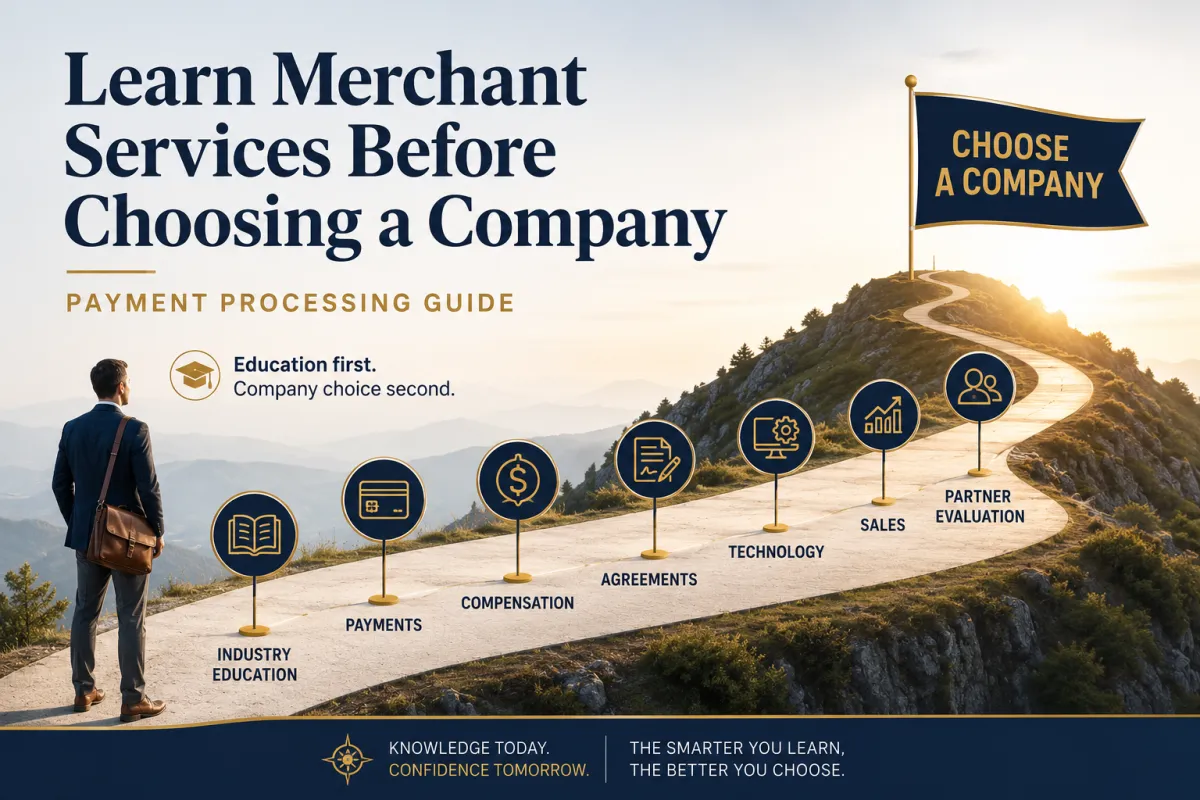
Learn Merchant Services Before Choosing a Company: Payment processing guide
How to Learn Merchant Services Before You Choose a Company
If you want to learn merchant services, I believe one of the biggest mistakes you can make is choosing a company before you understand the industry you're joining.
That may sound backward because most people are introduced to merchant services through a company. They see a recruiting advertisement, talk to an ISO or processor, hear about residual income, get shown a compensation plan and then receive training after they decide to join.
I've watched that sequence play out for years, and I think we can do better.
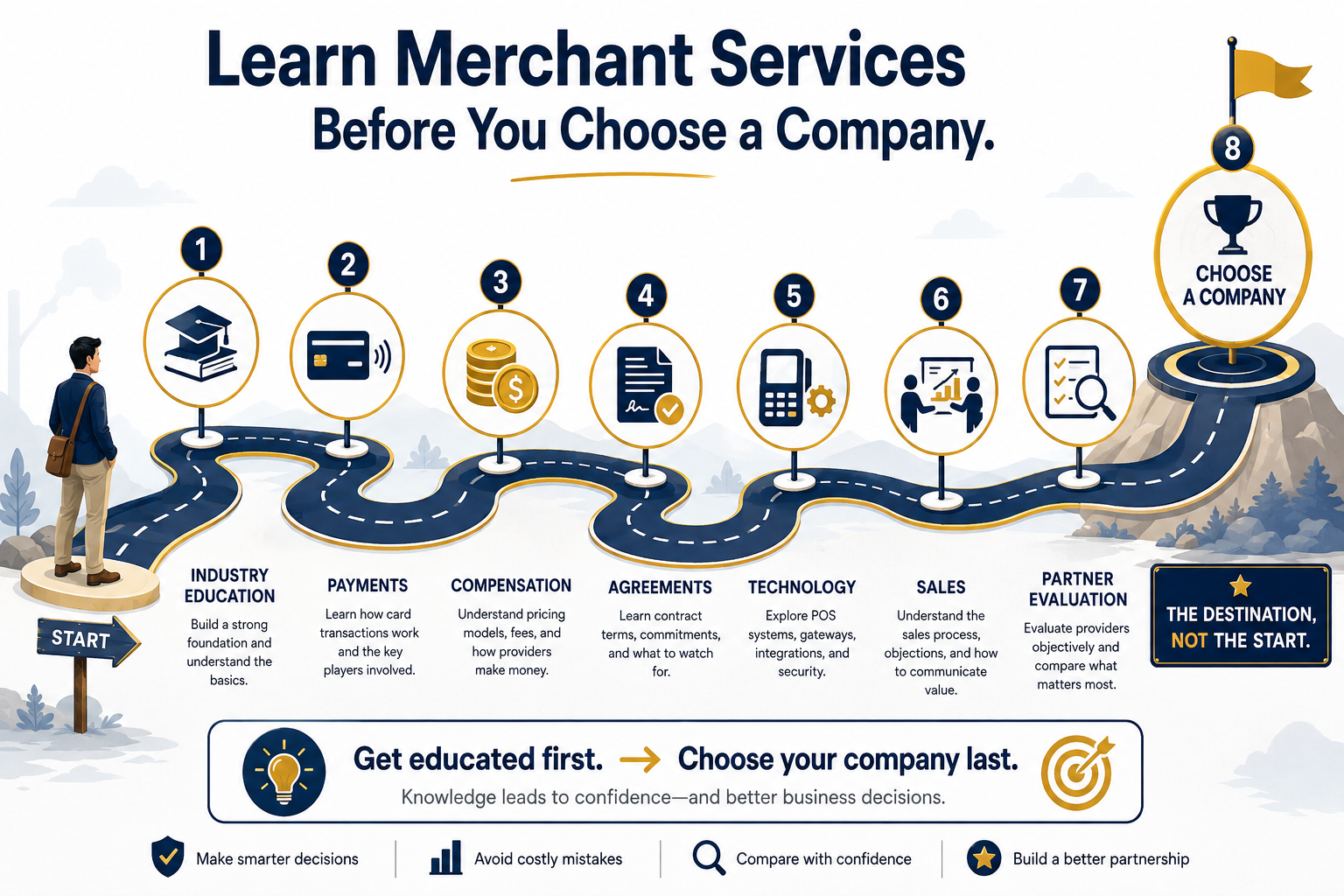
The first thing you should learn isn't why one particular company is great. You should first understand how the merchant services industry works, how a payment moves from a customer to a business, how agents get paid, what residual income actually means, what an ISO does, what your agreement controls, how different payment technologies solve different problems and what questions you should ask before committing years of your sales effort to one partner.
Only after you understand those things are you really prepared to compare merchant services companies intelligently.
That is the philosophy behind this entire series and ultimately why I created Merchant Service University. My goal isn't to convince someone who knows nothing about the industry that they should immediately join a particular company. My goal is to help them become educated enough to make their own decision.
If you're at the very beginning, start with my Merchant Services Sales: Complete 2026 Beginner's Guide. That gives you the broad overview. This article gives you the actual learning path I would follow if I had to start all over again.
Why I Believe Education Should Come Before Recruitment
There is nothing unusual about a company training its own salespeople. Every good company should train agents on its products, systems, application process, support procedures and sales approach.
The problem begins when company training becomes someone's entire understanding of the merchant services industry.
If your education begins and ends with one processor, you naturally see the industry through that processor's perspective. You learn the products they offer, the compensation plan they use, the terminology they prefer and the reasons their sales organization believes you should sell their system.
That doesn't necessarily mean the information is wrong. It simply means you're learning the industry through one particular lens.
I think an independent salesperson should know more.
You should understand why another company might use a different compensation model. You should understand why a restaurant may need a different technology platform from a contractor. You should understand that a large residual percentage doesn't automatically mean better economics. You should know why one agent may prioritize upfront commissions while another prioritizes long-term residual rights.
Most importantly, you should understand that the first company you meet is not automatically the company you need to build your career around.
The stronger your education becomes, the less dependent you are on someone else's recruiting presentation to tell you what matters.
Step 1: Learn What the Merchant Services Industry Actually Is
Before learning scripts, start with the industry itself.
Merchant services is much broader than simply providing a credit card machine. Businesses need systems that allow them to accept electronic payments, but modern merchant relationships can also involve POS software, ecommerce, mobile payments, invoicing, recurring billing, customer data, loyalty, appointments, employee tools, reporting and other business technology.
The first goal for a new agent should be understanding the ecosystem well enough that the terminology stops sounding foreign.
You should know what people mean when they use terms such as merchant, processor, ISO, acquirer, issuer, gateway, interchange, residual, Schedule A and POS system. You don't need a graduate degree in payments. You need enough familiarity that you can follow industry conversations and know what questions to ask when something doesn't make sense.
This is where my complete beginner's guide to merchant services sales fits into the learning process. It gives you the foundation before you move deeper into compensation, contracts and selling.
When I entered the business, much of this knowledge came through experience. Today, someone entering merchant services should be able to learn the framework before they ever walk into their first business.
Step 2: Learn How Payment Processing Actually Works
Once you understand the basic industry structure, learn what actually happens when someone pays a business.
This is one of those subjects that seems complicated until someone explains it in the right order. A customer presents a payment method, the transaction information moves through the payment ecosystem, the issuing institution approves or declines the transaction, and approved transactions later move through capture, clearing, settlement and merchant funding.
Understanding that flow helps everything else make more sense.
When a merchant asks why a transaction was declined, you understand that the processor isn't necessarily the institution making the approval decision. When a merchant asks why an approved transaction hasn't deposited yet, you understand that authorization and settlement aren't the same thing. When you eventually study processing costs, interchange and merchant statements, you understand that there is an actual infrastructure behind those fees.
I broke the complete process down in How Credit Card Processing Works: A Guide for Merchant Services Sales Agents. If you're serious about learning merchant services, I consider that foundational knowledge.
You don't need to explain the entire transaction flow to every merchant you meet. The point is that you should understand what you're selling even when the merchant doesn't need the technical explanation.
Step 3: Learn How Merchant Services Agents Get Paid
This is usually the subject that gets people's attention first, but I actually think it should come after understanding the basic industry and payment flow.
Merchant-services compensation can include upfront commissions, activation bonuses, equipment compensation, software-related revenue and recurring residual income. Different companies structure those economics differently, which is precisely why you need to understand them before comparing agent programs.
One of the biggest beginner mistakes is hearing something like "70% residual split" and assuming that number tells them how good the opportunity is.
It doesn't.
You need to know what the percentage is calculated from. You need to understand the underlying costs. You need to understand the Schedule A. You need to understand whether the residuals vest and what happens if your relationship with the company ends.
My guide to Merchant Services Agent Commissions explains those concepts in detail.
The larger lesson is that you should never choose a partner because one compensation number sounds impressive. Learn how the economics work first so you can compare actual structures instead of marketing headlines.
Step 4: Understand Residual Income as a Portfolio, Not a Quick Commission
Residual income is one of the reasons I've stayed passionate about merchant services for so many years. It changed the way I thought about sales because I stopped looking only at what a single deal paid me and started thinking about what happened when I consistently added merchants to a portfolio.
That shift takes time.
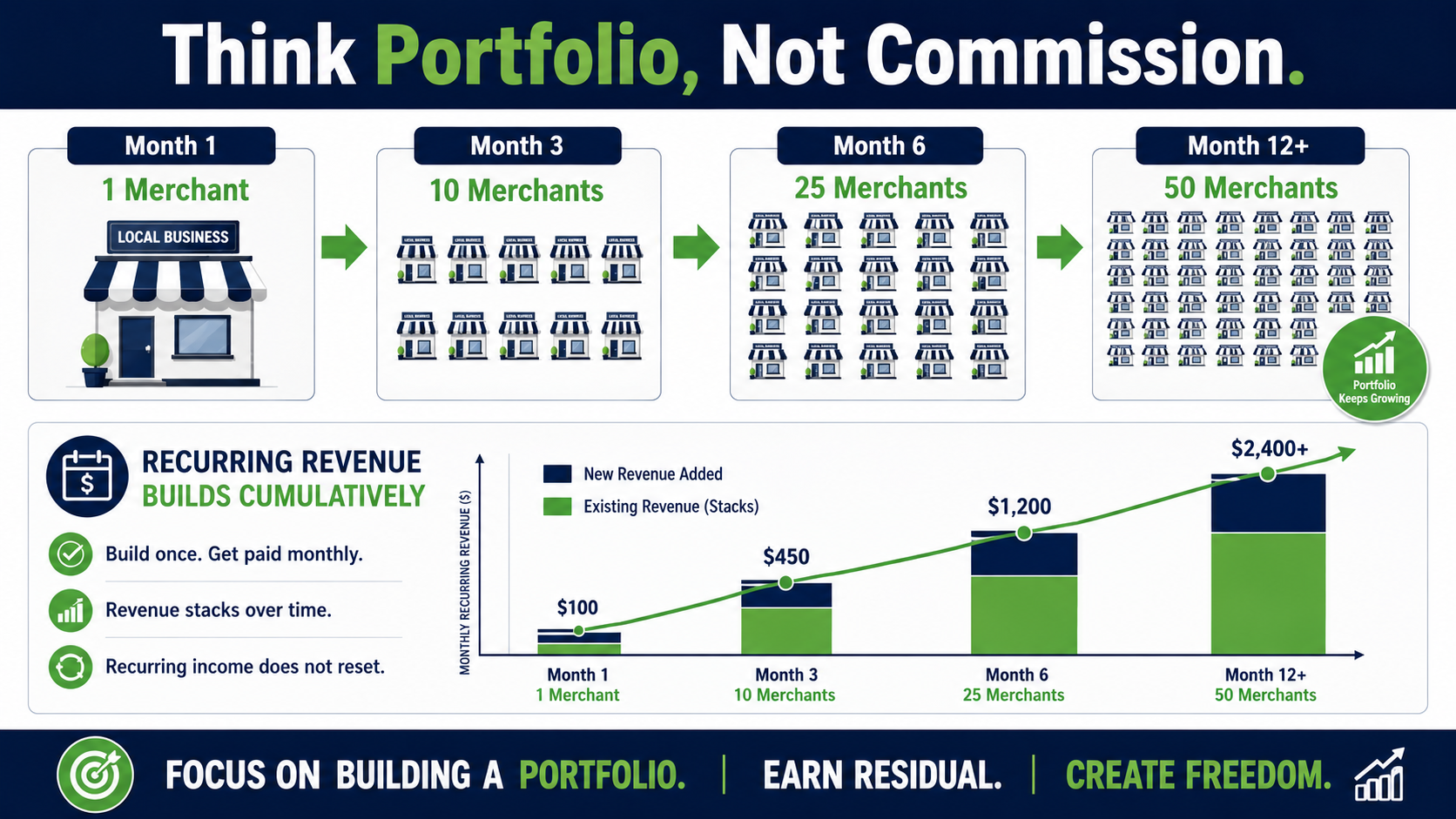
Your first merchant may produce a relatively small residual. Your first few merchants may not create life-changing income. The power is in accumulation. When you continue adding merchants while retaining the accounts you've already acquired, you can begin building a recurring-revenue base underneath your ongoing sales activity.
That doesn't make merchant services guaranteed passive income. Merchants close, change processors, sell their businesses and reduce processing volume. Your contract, residual rights, pricing and merchant retention all matter.
But the model is still fundamentally different from a sales job where every month begins at zero.
If you're trying to understand those economics realistically, read How Much Can You Earn in Merchant Services?.
The mindset I want a new agent to develop isn't "How quickly can I make a giant residual?" It's "How do I build a portfolio correctly enough that today's work can continue contributing to my future income?"
Step 5: Learn What an ISO Does Before You Pick One
If you're going to build your merchant business through an ISO, understand exactly what role that organization plays in your business.
A good upstream organization can provide tremendous leverage. It may provide processor relationships, product access, underwriting infrastructure, merchant support, equipment deployment, technical support, residual reporting, sales support and other backend functions that would be expensive and complicated for an individual agent to recreate.
That's one reason I personally believe becoming a registered ISO is overrated for many sales-focused entrepreneurs.
My preference has always been to let a strong backend organization handle what it is good at while I focus on what I'm good at: selling, recruiting, training, developing relationships and growing a portfolio.
I explain that position fully in Merchant Services Agent vs. ISO: Do You Really Need to Become a Registered ISO?.
That is my personal approach, not a universal rule. Someone building a large payment operation may legitimately want greater infrastructure, responsibility and control.
The important thing for a new agent is understanding the distinction before assuming that becoming an ISO is automatically the ultimate goal.
Step 6: Learn to Read the Agreement Before You Learn to Love the Company
This may save you more money than almost anything else you learn.
Companies are represented by people. People are enthusiastic when they're recruiting. They tell you about support, compensation, residual income, products, growth and everything they believe makes their organization attractive.
That's normal.
But your long-term business relationship is governed by the agreement.
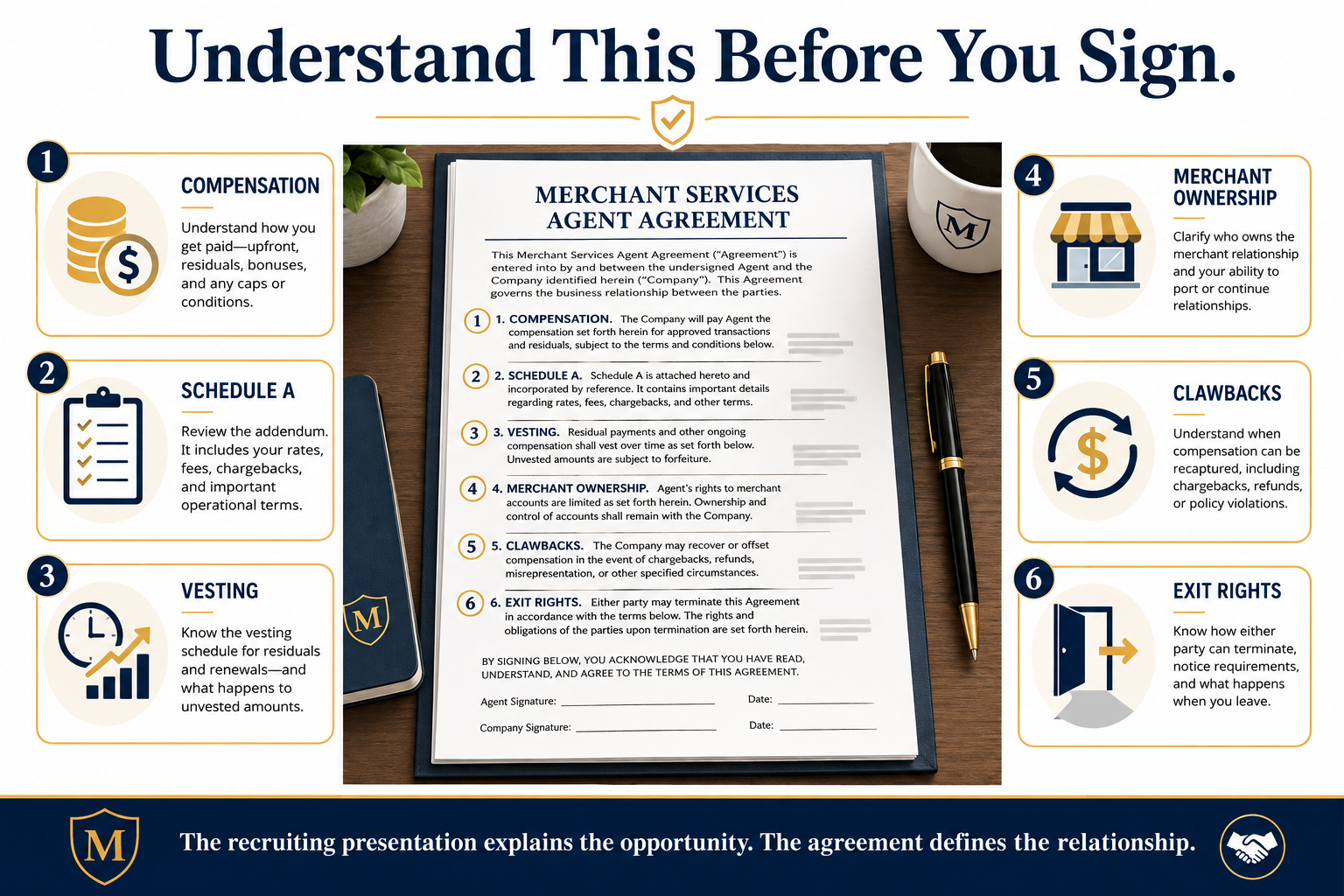
Before you spend years building merchant relationships through a company, you should understand what the contract says about compensation, residual rights, vesting, merchant ownership, termination, production requirements, clawbacks, restrictions, transferability and what happens to your portfolio if circumstances change.
I wish I had understood this better when I started.
It's one of the biggest themes in What I Wish I Knew Before Becoming a Merchant Services Agent.
You don't need to become an attorney. If an agreement is important enough to potentially control years of recurring income, having an attorney review it may be sensible. What you absolutely should not do is sign first and start asking important questions later.
The more educated you become, the easier it is to know which parts of the agreement deserve your attention.
Step 7: Learn Technology by Understanding Merchant Problems
One of the worst habits an agent can develop is becoming so attached to one product that every merchant suddenly looks like the perfect customer for it.
That's not sales expertise. That's product bias.
The better way to learn merchant technology is to start with business problems.
A small contractor may simply need reliable mobile payments and invoicing. A restaurant may need a full POS system with ordering, employee management, inventory and customer tools. A salon may care about appointments, stored customer information and recurring relationships. A retailer may care deeply about inventory and ecommerce synchronization.
The technology should follow the business need.
This is also why I think merchant services has become more interesting, not less. The conversation is expanding beyond rate and terminal placement into broader commerce technology.
A good agent should eventually be able to look at a business and understand the difference between what is technically available and what the merchant actually needs.
That ability also makes you less dependent on one product. If the only thing you know how to sell is one particular POS platform, you're not really learning merchant services. You're learning a product presentation.
Products change. Companies change. Platforms change.
The ability to understand businesses travels with you.
Step 8: Learn Sales—but Don't Confuse a Script With an Education
Sales training absolutely matters.
You should learn how to prospect, begin conversations, ask good discovery questions, present solutions, handle objections, follow up and close.
But a sales script is not merchant-services education.
Someone can memorize an incredible opening line and still have no idea what interchange is, how residual income works, what their contract says or which payment solution actually makes sense for the merchant standing in front of them.
That's dangerous because confidence without knowledge can create bad recommendations.
The best merchant-sales training combines both sides. You learn the industry well enough to understand what you're representing, and then you learn how to communicate that value clearly enough to create customers.
Sales skills create activity and conversions.
Industry knowledge creates competence.
You need both.
What Should Merchant Services Training Actually Include?
If I were evaluating a merchant-services education program, I would expect it to cover considerably more than a handful of sales scripts.
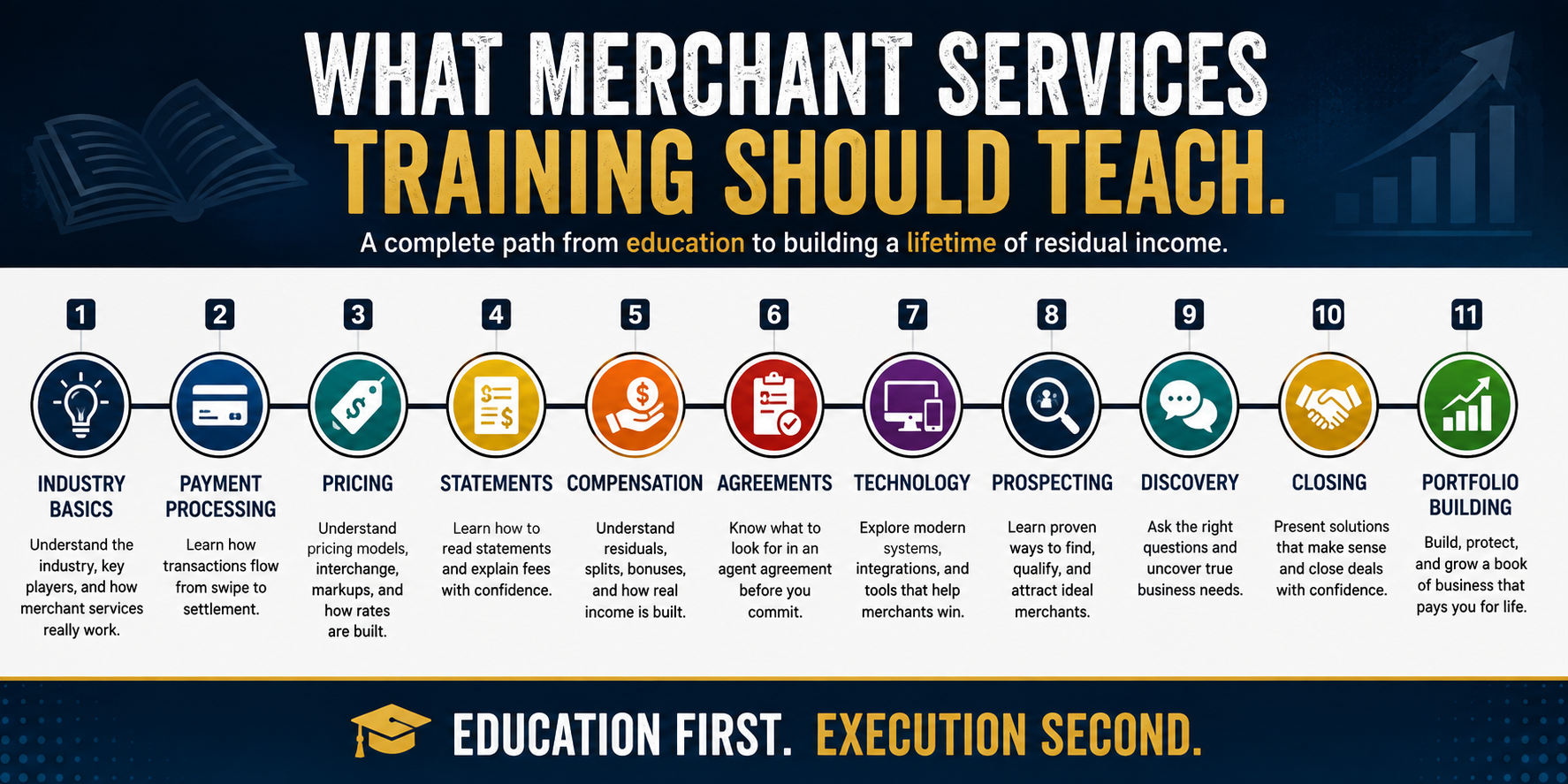
A complete beginner curriculum should build progressively. It should begin with industry structure and payment processing so the student understands what merchant services actually is. It should then cover pricing, statements, compensation and agreements so the student understands the economics. From there, it should teach terminals, POS systems and modern commerce technology so the agent understands what can actually be offered to different businesses.
Only then would I move heavily into prospecting, discovery, presentations, objections, closing, follow-up and portfolio building.
The order matters because the goal isn't simply to create someone capable of repeating a sales pitch.
The goal is to create a knowledgeable merchant-services professional.
Learn the Industry Before You Decide Whether It's Even Right for You
Another reason to learn first is that merchant services isn't for everyone.
I still believe this is a tremendous industry for the right person, which I explain in Is Merchant Services Sales Worth It in 2026?. But I don't think education should exist only to convince someone to join.
Sometimes the right outcome of education is deciding not to enter the business.
Merchant services requires prospecting. You're going to hear no. You have to learn technology that continues changing. You have to deal with merchants, applications, implementation problems and occasional frustration. Your income isn't guaranteed simply because you signed an agent agreement.
On the other hand, if you enjoy sales, like working with business owners, value independence and are attracted to building recurring income over time, the business can be extremely compelling.
Learn enough to make that decision for yourself.
That's healthier than letting excitement about someone's opportunity presentation make the decision for you.
Why I Don't Believe You Should Pay Thousands Just to Access the Industry
I want to be very precise about this because I don't believe all paid education is bad.
Education can absolutely be valuable. Coaching can be valuable. Consulting can be valuable. I've spent money learning throughout my life and will continue doing it.
But paying for education is different from paying thousands of dollars simply because someone makes you believe that's what it costs to gain access to merchant services.
Merchant-services companies need salespeople. ISOs recruit agents. Processors need distribution. This industry has historically created opportunities for independent sales professionals because merchant acquisition creates revenue throughout the payment ecosystem.
If someone wants to charge for advanced coaching, sales systems, personal mentorship or specialized education, evaluate whether that value makes sense for you.
But don't confuse that with the idea that you must buy your way into payment processing itself.
You should be able to understand the industry before making that decision.
That's exactly why I made the core education inside Merchant Service University free.
Merchant Service University: Learn First, Choose Your Partner Later
Merchant Service University exists because I believe the traditional entry process into merchant services is backward.
I don't want your first major decision to be which company you're going to work with. I want your first decision to be whether you're willing to learn the business.
Inside MSU, the goal is to help you understand merchant services, payment processing, industry terminology, pricing, merchant statements, modern commerce systems, residual income, prospecting, selling and the larger business model.
Once you understand the foundation, you're in a much better position to evaluate potential companies and determine what matters to you.
A beginner who needs strong upfront commissions may need a different partner from an experienced salesperson who prioritizes residual economics. An agent focused on restaurants may need different technology than someone targeting service businesses. Someone who wants to build a team may care about different contractual provisions from someone building a personal portfolio.
There isn't necessarily one company that is perfect for every person.
Education helps you understand what you need.
Start Merchant Service University Free
https://merchantserviceuniversity.com
The core education is free, and there is no obligation to join a specific merchant-services company just because you learn through MSU.
Learn first. Get educated. Understand the industry. Then decide what you want to build.
Get educated before you get recruited.
The Learning Order I Recommend for Every New Merchant Services Agent
If you asked me to compress everything in this article into one sequence, I would learn merchant services in this order:
First, understand the industry and who the major players are. Then learn how payment processing works from authorization through settlement. After that, study compensation so you understand upfront commissions and residual income. Learn what an ISO does and decide how much infrastructure you actually want to control. Study the agreement so you understand the rights attached to whatever portfolio you build. Learn merchant technology by focusing on business problems instead of memorizing one product. Finally, develop the prospecting, discovery, presentation, follow-up and closing skills required to actually create merchant relationships.
Only after all of that would I make a serious decision about the company I wanted to build with.
That doesn't mean you need six months of classroom study before you can talk to a business. You don't.
You should start getting real-world experience as soon as you have enough foundation to be useful.
What I'm trying to prevent is the opposite extreme: choosing the company first, learning only what that company wants you to know and discovering years later that you never understood the larger industry.
What Questions Should You Be Able to Answer Before Choosing a Merchant Services Company?
You don't need to know everything, but before committing to a long-term partner I would want to be able to answer questions such as these:
How does payment processing work?
How will I actually be compensated?
What does the residual percentage mean?
What is underneath the Schedule A?
When do residuals vest?
What happens if I stop producing or leave?
What technology can I sell?
Which business types are the strongest fit?
How does merchant support work?
How does underwriting work?
Who helps when an installation goes wrong?
Can I build a team?
What contractual restrictions apply?
What happens to the portfolio I'm building?
Why does this company make sense for the type of business I want to create?
If you can't answer those questions yet, that's not a reason to panic.
It's a reason to keep learning.
Don't Become an Expert Before You Start—Become Educated Enough to Start Correctly
There is another trap I don't want this education-first philosophy to create.
Don't spend a year studying merchant services while never talking to merchants.
You will not learn everything before you begin.
Some of my most important lessons came from real merchants, real sales calls, real objections, real account problems and real mistakes.
Education gives you the framework.
Experience fills in the gaps.
You need both.
The goal isn't to know everything before taking action. The goal is to know enough that you're not blindly entering a business relationship you don't understand.
Learn the foundation, choose carefully and then go get experience.
Frequently Asked Questions About Learning Merchant Services
How do I learn merchant services?
Start by learning the basic payment ecosystem, including processors, ISOs, acquiring banks, issuing banks, card networks, payment gateways and POS systems. Then learn how transactions work, how agents are compensated, how agreements affect residual rights, how merchant technology solves business problems and how to prospect and sell.
Do I need merchant services training before becoming an agent?
Formal training is not legally required simply to call yourself a sales agent, but learning the industry before representing payment products is highly valuable. Good training helps an agent understand payment processing, pricing, statements, technology, contracts, sales and merchant needs.
How long does it take to learn merchant services?
You can learn the foundational concepts relatively quickly, but becoming highly competent takes continued study and real-world experience. Merchant services combines payment knowledge, technology, sales, contracts and merchant operations, so agents should expect to keep learning throughout their careers.
Should I choose a merchant services company before training?
I recommend learning the industry's fundamentals before choosing a company. Understanding residuals, agreements, payment processing, support and technology makes it much easier to compare merchant-services companies intelligently.
What should merchant services training include?
A complete training program should cover industry basics, payment processing, pricing, merchant statements, compensation, agreements, POS and commerce technology, prospecting, discovery, presentations, objections, closing, follow-up and portfolio building.
Can I learn merchant services for free?
Yes. Free educational resources exist, and the core education inside Merchant Service University is available without a course fee or obligation to join a specific payment company.
Do I need to pay for a merchant services course?
Not necessarily. Paid coaching or specialized education can have value, but paying for education is different from paying merely to gain access to a merchant-services sales opportunity. Evaluate exactly what you're purchasing before spending money.
What should I know before joining an ISO?
Understand the ISO's compensation structure, Schedule A, residual vesting, contract terms, merchant support, technology, underwriting process, reporting, product options and what happens to your portfolio if the relationship ends.
Do I need to become a registered ISO to build a merchant services business?
No. Many agents build merchant portfolios and sales organizations through strong upstream ISO relationships. Whether becoming a registered ISO makes sense depends on the level of infrastructure, responsibility and control you actually want.
Where should a beginner start learning merchant services?
A beginner can start with the Merchant Services Sales Beginner's Guide, then learn how credit card processing works, study merchant services agent commissions, and continue through the free core curriculum at Merchant Service University.
Final Takeaway: Get Educated Before You Get Recruited
I spent more than 16 years learning merchant services through selling, building portfolios, working with different organizations, fixing problems, training agents and making mistakes.
If I were starting again today, I would still want real-world experience as quickly as possible. But I would change the order in which I learned.
I would understand the industry before choosing a company. I would learn how payments work before trying to explain them to merchants. I would understand residual economics before getting excited about a percentage. I would read the agreement before committing years of future business to it. I would learn how different technologies solve different merchant problems before becoming loyal to one product.
Then I would choose the partner that made the most sense for what I was actually trying to build.
That is the difference between getting recruited into merchant services and building an educated merchant-services business.
You don't need to know everything.
You do need to know enough to make your own decisions.
Learn first. Choose second. Build third.
About Joe Wagner
Joe Wagner has spent more than 16 years in merchant services and payment-processing sales, acquiring merchants, building recurring-revenue portfolios and training sales professionals across the United States.
His focus today is helping people learn the merchant-services industry before making decisions about companies, compensation, contracts, technology and partnerships.
Start with the Merchant Services Sales Beginner's Guide, read What I Wish I Knew Before Becoming a Merchant Services Agent, learn how merchant services agents get paid, consider whether merchant services sales is worth it in 2026, understand the difference between a merchant services agent and an ISO, and learn how credit card processing works.
You can also browse the Merchant Sales Training Blog, explore additional Merchant Sales Resources, or begin learning free through Merchant Service University.
Free education. No obligation. Get educated before you get recruited.