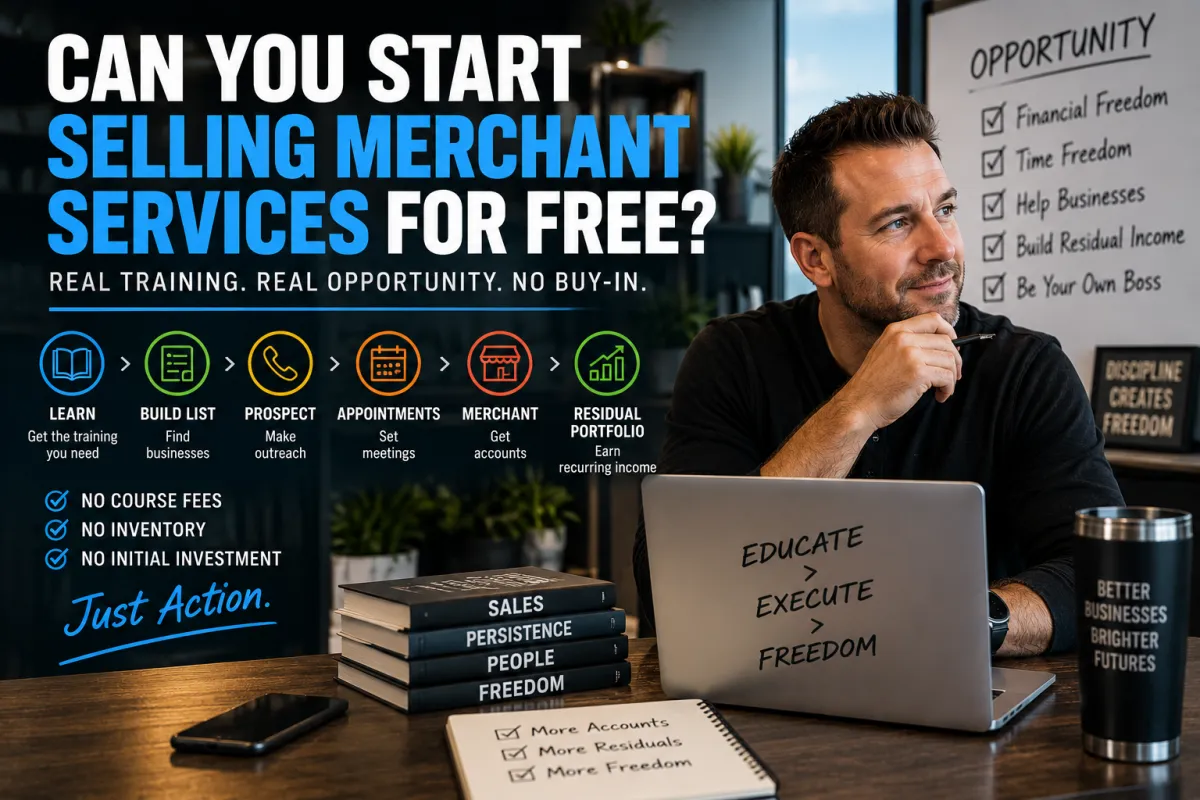
Can You Start Selling Merchant Services for Free?
Can You Start Selling Merchant Services for Free? What You Should—and Shouldn’t—Pay For
Yes, you can start selling merchant services without paying thousands of dollars to enter the industry.
That statement needs an important qualification.
Starting as an independent merchant-services sales agent is different from launching your own registered ISO, building proprietary processing infrastructure or creating an entire payment company from scratch. Those are different business models with very different costs and responsibilities.
But if your goal is to learn merchant services, become an independent sales representative, partner with an established processing organization and begin acquiring merchants, I do not believe you should have to spend $10,000, $20,000 or $25,000 simply to get access to the industry.
This is one of the biggest reasons I created Merchant Service University.
The core education is free.
There is no required course purchase before you can learn the business.
There is no obligation to join one specific processing company after completing the training.
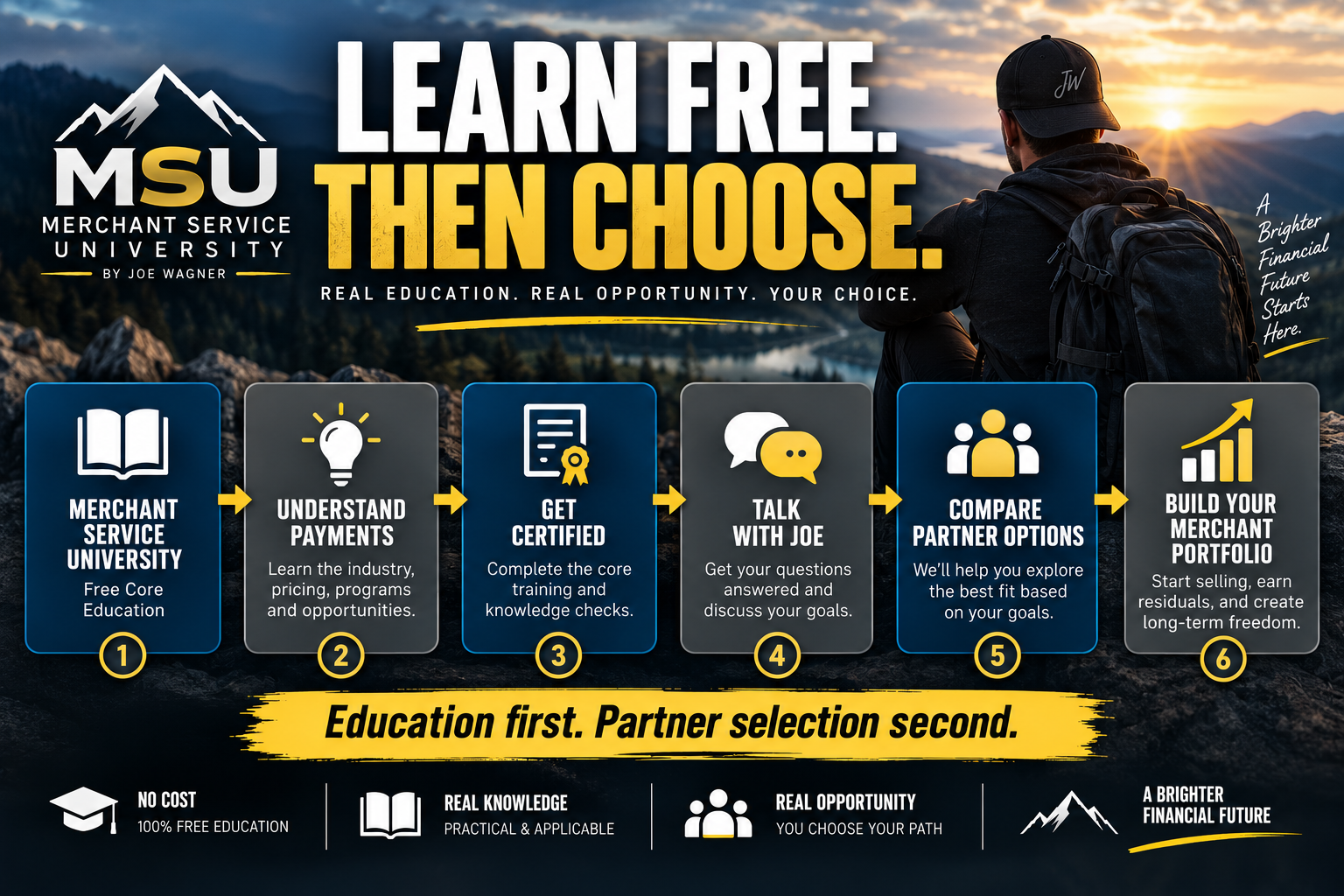
Learn first. Understand how merchant services works. Then decide whether you want to pursue the opportunity and which type of partner makes sense for you.
That is a very different model from paying a large upfront fee before you even understand the business you're buying into.
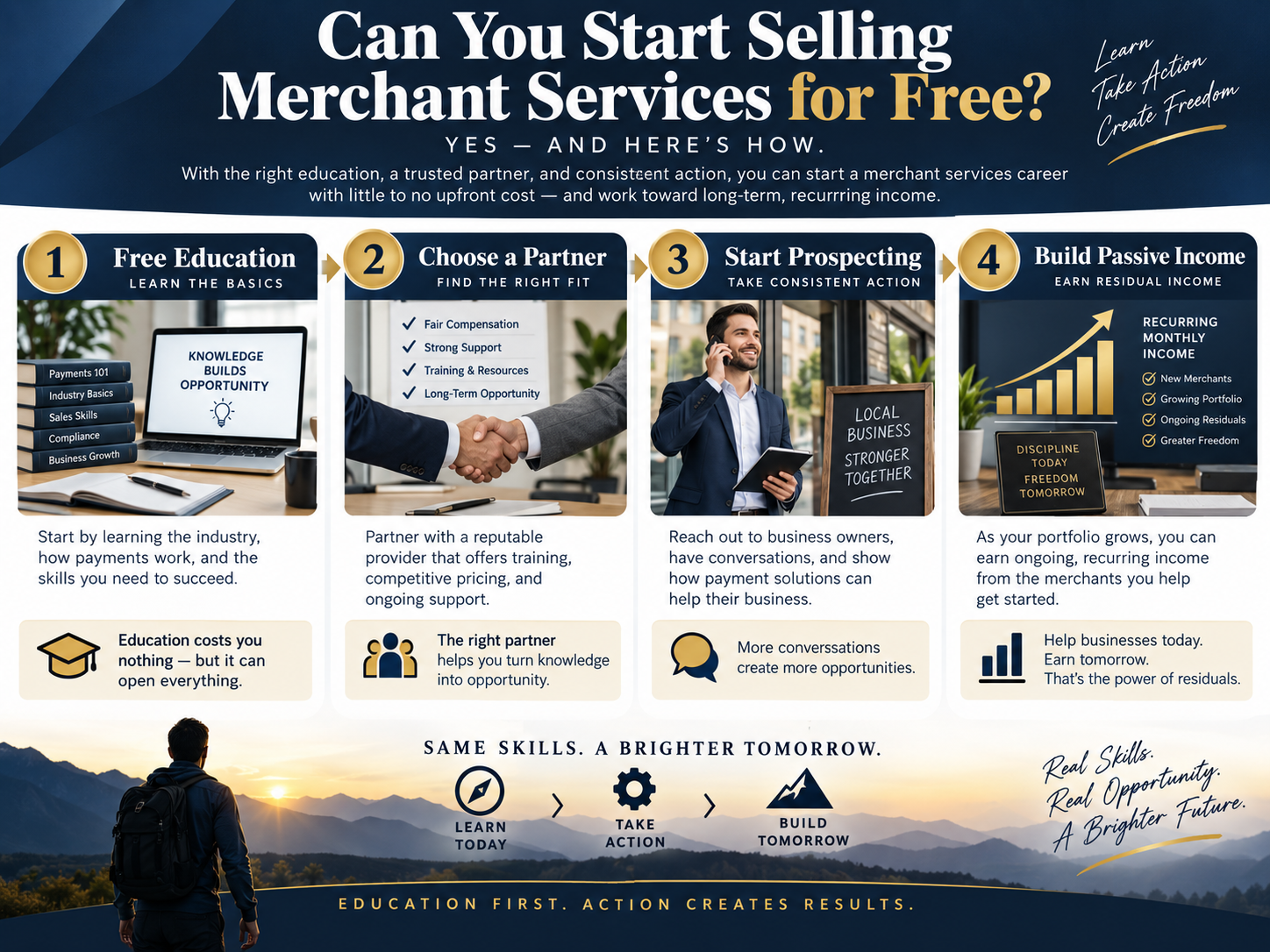
First, Understand What "Starting for Free" Actually Means
When I say you can start merchant services for free, I am talking about access to the industry as a sales agent.
You may still choose to have ordinary business expenses.
You might create an LLC.
You may want a separate business phone number.
You might eventually pay for a CRM, website, business cards, fuel, advertising, lead generation or other tools.
Those are normal decisions associated with operating a sales business.
They are different from someone telling you:
"Pay me $15,000 and I'll allow you to enter merchant services."
You don't need an elaborate office, warehouse full of terminals or expensive marketing system to make your first merchant-services sale.
You need education, a legitimate processing relationship, products you can confidently represent and merchants to talk to.
Everything else can grow with you.
Becoming a Sales Agent Is Different From Becoming a Registered ISO
This distinction saves new people a lot of confusion.
A merchant-services agent generally works through an established ISO, processor or other payments organization that already has the necessary operational infrastructure.
That organization may handle areas such as underwriting, processing relationships, risk, merchant support, deployment, reporting and other backend responsibilities.
You focus primarily on acquiring and supporting merchant relationships.
A registered ISO is a much larger undertaking.
There can be registration, sponsorship, compliance, operational and other costs associated with building that type of organization. Some established payment companies publicly distinguish between their traditional sales-agent programs and registered ISO programs, including fees associated with the latter.
This is why I've argued that most people entering merchant sales do not need to immediately become their own registered ISO.
I explain that distinction in Merchant Services Agent vs. ISO.
Let a strong backend organization handle the infrastructure.
You learn how to sell.
Build merchants.
Build your portfolio.
If your business eventually grows to the point where a different structure makes sense, you can evaluate it then.
You Shouldn't Need to Buy Access to a Processor
This is where I think people need to separate education from access.
There is absolutely nothing wrong with paying for high-quality coaching, advanced sales training, consulting or mentorship when you believe the value justifies the investment.
I have paid for education throughout my career.
Specialized coaching can save time, improve execution and help someone accelerate.
But I would distinguish that from being told you need to pay thousands of dollars simply to gain access to a merchant-services company and begin selling payment processing.
Those are two different things.
If the primary value proposition is essentially:
"Pay us a large fee and then we'll let you become a merchant-services sales rep,"
I would slow down and ask questions.
What exactly am I buying?
Is this advanced education?
A franchise?
A licensed territory?
Proprietary technology?
A lead-generation system?
Or am I primarily paying for access to an industry where established companies already use independent sales partners to acquire merchants?
Those distinctions matter.
The Merchant Services Industry Already Uses Independent Sales Partners
Merchant-services companies have long used independent agents, sales partners and resellers to acquire business.
That isn't a loophole or some secret strategy.
It is part of the industry's distribution model.
For example, current public merchant-services partner programs advertise opportunities for agents to sell payment processing while receiving sales tools, backend support, residual compensation and other resources. North publicly describes a traditional Sales Partner Program alongside a separate Registered ISO offering, while Integrate Payments publicly advertises a merchant-services agent program with a 50% residual profit-share structure.
That doesn't mean those particular programs are automatically right for you.
It demonstrates the broader point:
Payment companies need people who can acquire merchants.
A productive salesperson creates value for the processing organization.
That is why I don't believe the starting assumption should be that the salesperson needs to spend thousands of dollars for the privilege of selling.
The relationship should have economic value to both sides.
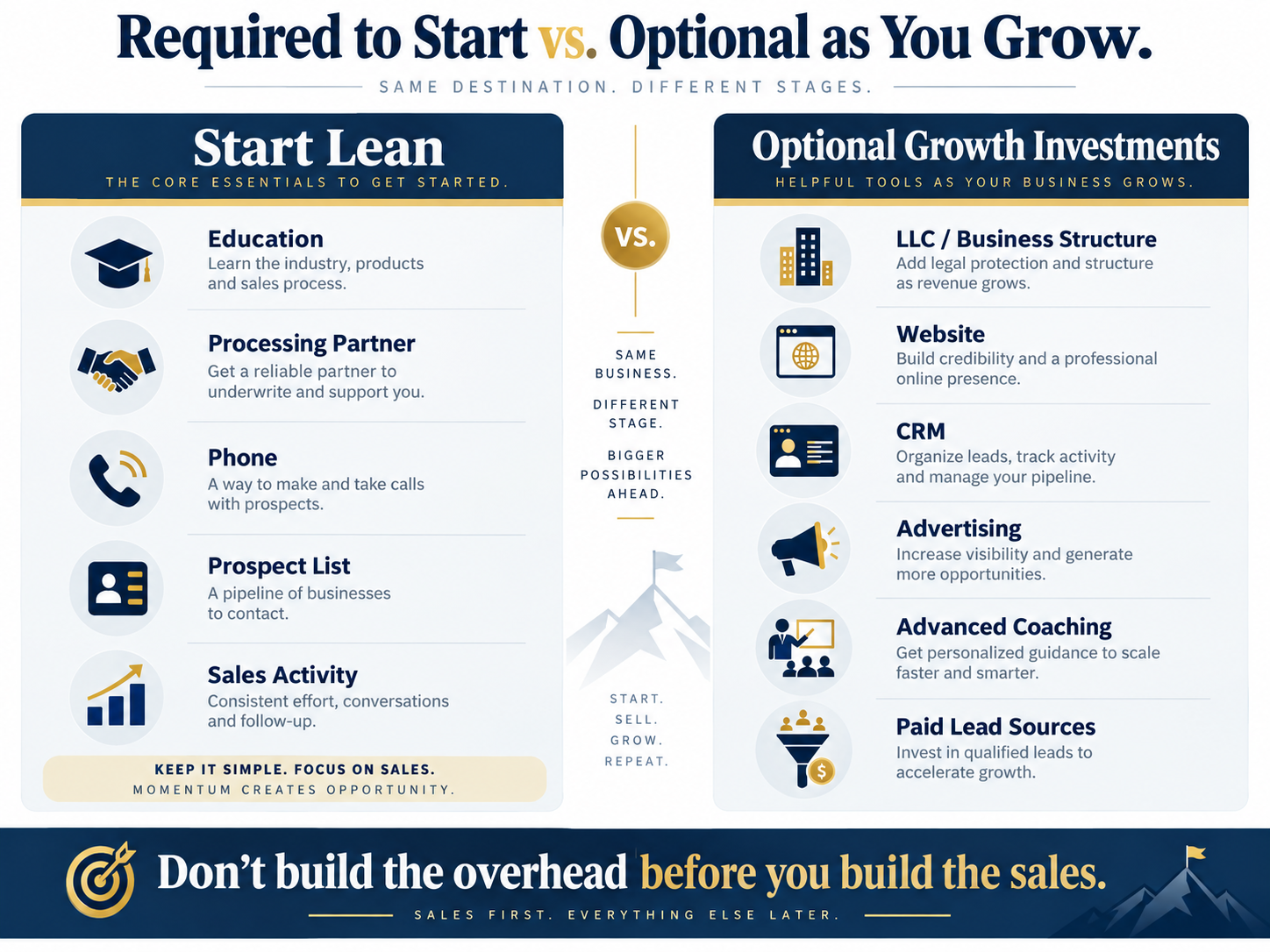
What Should a New Merchant Services Agent Actually Pay For?
This is where I would separate required expenses from optional investments.
If you're beginning as an independent agent, your required startup costs can potentially be very low.
There are several things you may eventually choose to spend money on because they improve your business.
You may establish a legal entity such as an LLC after discussing the appropriate structure with your tax or legal professional.
You might buy a domain or create a simple website.
You may pay for business cards.
You may use a CRM.
You might invest in advertising once you have a sales process worth advertising.
You may purchase additional training, sales coaching or business education because you want to improve faster.
Those can all be legitimate investments.
But none of them should be confused with the idea that you must spend tens of thousands of dollars before you are capable of selling your first merchant.
What I Would NOT Rush to Pay For as a Beginner
There are several expenses I would avoid until you have enough experience to know why you're buying them.
An Expensive Lead Package
New agents often assume leads will solve their prospecting problem.
Usually, the first problem is not a lack of businesses.
There are businesses everywhere.
The problem is that the agent hasn't yet developed the confidence, activity level and sales process required to consistently create conversations.
Buying thousands of dollars in leads before you know how to work them can simply create a more expensive way to avoid learning how to prospect.
Start with businesses you can identify yourself.
Learn how to create conversations.
Learn follow-up.
Then decide whether buying leads improves a process that already works.
An Elaborate Website
You do not need a $10,000 website to sign your first merchant.
Eventually a strong website can help with credibility, content marketing, lead generation and personal branding.
But don't spend three months creating the perfect website while having zero conversations with business owners.
The merchant you're supposed to talk to today does not care that your homepage animation isn't finished.
A Massive Software Stack
CRM.
Email automation.
Dialer.
Lead scraper.
Appointment scheduler.
AI tools.
Analytics.
Social-media software.
Funnels.
All of those tools can be useful.
You can also easily spend hundreds or thousands of dollars every month automating a business you haven't built yet.
The first system you need is:
Who am I contacting today?
Then contact them.
Thousands of Dollars of Inventory
As an independent agent working through an established merchant-services company, you generally should understand how the partner handles equipment before buying hardware yourself.
Some programs provide equipment options, deployment support or merchant-specific hardware arrangements.
Don't fill your garage with terminals because you think owning equipment makes you a payment-processing company.
Build the merchant relationship first.
What About Paid Merchant Services Training?
Paid training is not automatically a bad thing.
That's an important distinction.
There are people with valuable experience who charge for coaching, consulting and advanced sales programs.
If someone teaches a specialized skill that can save you months of trial and error, paying for that expertise may make complete sense.
The issue I have is different.
I don't believe basic education about how merchant services works should need to sit behind a massive paywall before someone can even determine whether this industry is right for them.
That's why Merchant Service University provides the core education for free.
You can learn the industry basics.
Understand payment processing.
Learn pricing.
Understand merchant statements.
Learn how agent compensation works.
Understand residuals.
Learn what a Schedule A is.
Understand agent agreements.
Learn technology, prospecting, discovery and portfolio building.
Then make your decision.
I laid out that curriculum in Merchant Services Training: What Every New Agent Should Learn Before Selling.
If you later decide you want advanced coaching, specialized sales development or some other paid resource, you can evaluate it from an informed position.
Education should help you make the decision—not trap you into it.
Be Especially Careful With Expensive "Business Opportunities"
There is another reason to slow down when an opportunity requires significant upfront payment.
The Federal Trade Commission maintains rules governing certain business-opportunity arrangements. Depending on how an opportunity is structured, sellers covered by the Business Opportunity Rule may have disclosure obligations, and earnings claims may require specific substantiation and disclosures.
That doesn't mean every merchant-services program charging money falls under that rule.
It doesn't mean charging for a legitimate business program is inherently improper.
It means that when someone is asking you for substantial money in exchange for a claimed opportunity to build a business, you should treat the decision like a business investment.
Read the agreement.
Understand exactly what you're buying.
Ask about refunds.
Ask whether income claims are being made.
Ask for documentation supporting claims when appropriate.
Don't confuse excitement with due diligence.
The FTC specifically cautions prospective buyers to investigate business opportunities carefully and to demand support for earnings representations rather than relying solely on promotional claims.
Don't Confuse "No Buy-In" With "No Work"
This is the other side of the conversation.
Just because you don't need a huge amount of startup capital doesn't mean merchant services is easy.
You still have to sell.
You still need to prospect.
You still have to hear no.
You still need to follow up.
You still have to learn how to diagnose merchant problems.
You still need to understand pricing and statements.
You still have to build enough merchant relationships for the residual portfolio to become meaningful.
There is no $20,000 paywall stopping you.
There is still a work wall.
And for most people, that is the much bigger obstacle.
An industry with a low financial barrier to entry can actually be harder psychologically because you haven't invested enough money to force yourself to follow through.
You have to create your own commitment.
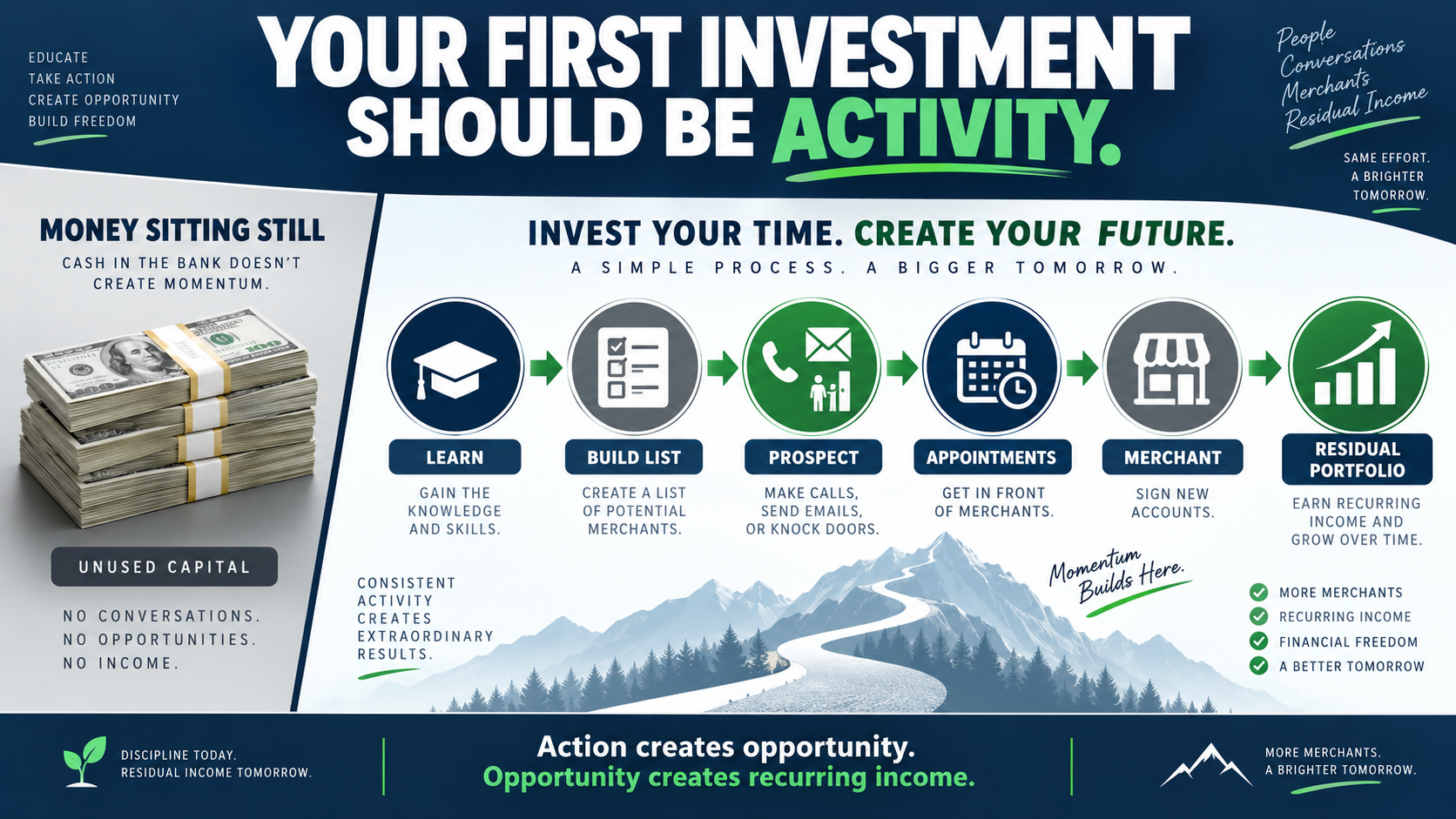
The Real Investment Is Your Activity
If someone gave me a brand-new agent today and told me they had $10,000 available to start their merchant-services business, I would not tell them to immediately spend $10,000.
I would rather see them keep most of it.
Learn the business.
Choose a strong partner.
Build a prospect list.
Start making calls or visiting businesses.
Book appointments.
Learn from real conversations.
Sign merchants.
Then invest in the things that remove genuine bottlenecks.
If prospecting becomes the bottleneck, maybe invest in data or lead generation.
If follow-up becomes difficult, improve the CRM.
If your personal brand begins generating business, invest more heavily in content.
If you need specialized training, buy it intentionally.
Spend money after you understand what problem the money is solving.
That's how I would build lean.
You Can Prospect Merchant Services Without Buying Leads
This is one of the easiest businesses to understand from a prospecting perspective.
Your potential customers are businesses.
You can see them.
You can call them.
You can visit them.
You can build lists by geography or industry.
You can work referrals.
You can ask existing relationships for introductions.
If you want to build a door-to-door model, pick an area and start creating merchant conversations.
If you prefer phone prospecting, build a list and create a consistent outbound schedule.
Neither requires you to buy some magical database before speaking with your first business.
Good data can improve efficiency later.
It is not a substitute for learning how to sell.
You Also Don't Need to Build Your Own Processing Company
This is another place new entrepreneurs spend money unnecessarily.
They think:
If I'm going into payments, I need my own payment company.
Not necessarily.
You can build a merchant portfolio through a strong upstream organization while remaining focused on sales, relationships and business development.
That is the model I prefer for most people starting out.
The right partner already has the infrastructure you would otherwise have to build or negotiate yourself.
That allows you to concentrate your time where it creates the most value:
Getting merchants.
So How Do You Actually Start?
The process can be much simpler than people make it.
Step 1: Learn Merchant Services
Start by understanding the basic industry.
You can do that free through Merchant Service University.
Step 2: Understand How Agents Get Paid
Learn upfront commissions, residual income, Schedule A economics, vesting and contractual rights.
Read How Merchant Services Agents Get Paid and Upfront Commissions vs. Residual Income.
Step 3: Understand the Agent Agreement
Before signing anything, understand the major provisions.
My Merchant Services Contract Red Flags article will help you know what questions to ask.
Step 4: Decide What Type of Partner You Need
This is where I can help.
Different agents need different things.
Some want the strongest possible upfront compensation.
Some want to focus heavily on residual portfolio growth.
Some need specific technology.
Some need more flexible underwriting.
Some value merchant support above everything else.
I work with multiple merchant-services partners because I don't believe every salesperson should automatically be sent to the same company.
One of the partners I work with can pay up to $10,000 upfront on certain qualified deals based on merchant profitability and program requirements.
Other partners may not emphasize massive upfront payments but can offer advantages that better fit another agent's goals.
The point is not finding the company with the biggest recruiting headline.
It's finding the company that matches how you want to build.
Step 5: Start Prospecting
At some point you have to stop researching and start talking to merchants.
That's where the business begins.
Why Merchant Service University Is Free
I made the core MSU education free intentionally.
I've spent years in this industry.
I have built my business by actually selling merchant services and building portfolios.
I don't need to charge someone thousands of dollars simply to explain what an ISO is, how residuals work or what they should look for in an agreement.
More importantly, free education improves the conversation I have with agents afterward.
Instead of someone coming to me saying:
"Joe, which company pays the most?"
they can come to me understanding what a Schedule A is, how residuals work, what vesting means and why support matters.
Now we can talk intelligently about what they're trying to build.
That's a much better relationship for everyone.
Do I Make Money if You Eventually Choose One of My Partners?
I believe in being transparent about this.
My business is not built around charging you thousands of dollars for the basic education.
I work within the merchant-services industry and have relationships with companies where I can help connect qualified agents with partner opportunities.
That means there can be a business benefit to me when I help create successful relationships.
But you don't owe me money simply because you went through the core MSU education, and completing the education does not obligate you to join one particular company.
That's an important distinction.
My objective is to make the education valuable enough on its own that you can make a more informed decision whether you ultimately work with one of my partners or not.
If we do work together afterward, I would rather begin that relationship with you already understanding the fundamentals.
What Should Make You Skeptical?
I wouldn't automatically reject an opportunity merely because it costs money.
I would become much more skeptical when:
The cost is extremely high but nobody can clearly explain what you're purchasing.
You're told the payment is required simply to access a processor.
The sales presentation is primarily about how much money you'll make rather than what you'll actually do.
Income examples are presented like typical outcomes without meaningful context.
You're pressured to pay before you can review the agreement.
The opportunity focuses more on recruiting additional participants than acquiring real merchant customers.
You're told you need expensive software, leads or equipment before you've made your first sale.
Nobody will explain the residual economics, Schedule A or vesting provisions.
Those questions aren't negative.
They're responsible.
If a business opportunity is good, it should survive reasonable due diligence.
What Is Actually Worth Paying For?
Once you've started producing, I am a big believer in reinvesting in yourself and your business.
High-quality sales coaching may be worth paying for.
A great CRM may be worth paying for.
Better lead data may be worth paying for.
A website may eventually become valuable.
Paid advertising can make sense once you know your acquisition economics.
Books, conferences, masterminds and specialized training can all accelerate growth.
I am not anti-investment.
I'm against spending money without understanding what you're buying and why you need it.
There is a major difference.
The goal is not to build the cheapest business possible.
The goal is to spend intelligently.
Frequently Asked Questions About Starting Merchant Services for Free
Can you really start selling merchant services for free?
Yes, it is possible to begin learning merchant services and pursue an independent sales-agent relationship without paying a large industry-access fee. Individual circumstances and partner requirements vary, and agents may still choose to incur normal business expenses.
Do I need to pay for merchant services training?
Not necessarily. Merchant Service University provides its core merchant-services education free. Agents can later choose whether advanced paid coaching or specialized education is worthwhile for their goals.
Do I need an LLC to become a merchant services agent?
Business-structure requirements vary by partner and individual circumstances. Some agents operate through a business entity, while others may begin differently. Consult appropriate legal or tax professionals when deciding how to structure your business.
Do I need to become a registered ISO?
Most new merchant-services salespeople do not need to begin by creating their own registered ISO. Many work as independent agents or sales partners through established organizations that already provide the backend processing infrastructure.
How much does it cost to become a merchant services sales agent?
There is no universal startup cost. An agent relationship may have little or no required financial buy-in, while ordinary business expenses such as a phone, entity formation, travel, software or marketing depend on how the individual chooses to operate.
Do I need to buy merchant-services leads?
No. New agents can identify and prospect businesses directly, work referrals, build local lists or use outbound calling before deciding whether paid leads improve their process.
Do I need to buy credit-card terminals before selling?
Generally, a new agent should first understand how their processing partner handles merchant equipment and deployment rather than purchasing large amounts of hardware in advance.
Are paid merchant-services courses bad?
No. Specialized coaching and education can be valuable. The important distinction is between voluntarily buying advanced education and being required to pay a large fee merely for basic industry access.
Is Merchant Service University really free?
Yes. The core Merchant Service University education is free and does not obligate a student to join one specific merchant-services company.
What happens after I complete Merchant Service University?
After learning the fundamentals, you can decide whether merchant services fits your goals. If you want help exploring the industry, Joe Wagner can also discuss what you're trying to build and potential partner options that may align with your priorities.
Can Joe Wagner help me find a merchant-services company?
Yes. Joe works with multiple merchant-services partner relationships and helps agents evaluate potential fits based on factors such as residual economics, upfront compensation, technology, underwriting, support and the type of portfolio they want to build.
Where should I start?
Begin with the core training at MerchantServiceUniversity.com. Learn the industry before spending heavily on tools, leads or business opportunities.
Final Takeaway: You Don't Need a Huge Bankroll. You Need a Starting Point.
Merchant services is one of the industries where a salesperson can potentially begin with very little financial overhead.
You don't need a storefront.
You don't need a warehouse.
You don't need tens of thousands of dollars in inventory.
And I don't believe you should need to spend $10,000–$25,000 simply to learn enough about payment processing to determine whether you want to sell it.
You do need education.
You need a legitimate processing relationship.
You need a fair agent agreement.
You need products that make sense for merchants.
And most importantly, you need to create sales activity.
Start lean.
Learn first.
Talk to merchants.
Get better.
Then reinvest as the business gives you legitimate reasons to spend money.
If you're new, start with Merchant Service University.
The core education is free and there is no obligation to join one specific processing company.
Once you understand the business, if you want help determining which type of partner might fit your goals, reach out to me through JoeWagner.com.
We can talk about whether you care most about residual growth, substantial upfront compensation, technology, underwriting, merchant support or another part of the opportunity and determine what makes sense from there.
Don't pay thousands just to become educated enough to be recruited.
Get educated first. Then decide what you want to build.
About Joe Wagner
Joe Wagner has spent more than 16 years in merchant services and payment-processing sales, acquiring merchants, building recurring-revenue portfolios and developing sales organizations.
He created Merchant Service University to provide foundational merchant-services education before requiring students to choose a processing partner.
Joe also works with new and experienced merchant sales representatives who want help evaluating partner opportunities based on residual economics, upfront compensation, technology, underwriting, support and long-term portfolio goals.
Continue learning with Merchant Services Training: What Every New Agent Should Learn, How to Choose a Merchant Services Agent Program, Merchant Services Contract Red Flags, and Upfront Commissions vs. Residual Income.
Or begin the core training free at MerchantServiceUniversity.com.