
Merchant Services Upfront Commissions vs. Residual Income
Upfront Commissions vs. Residual Income in Merchant Services: Which Is Better?
One of the first questions new sales agents ask me about compensation is whether they should focus on merchant services upfront commissions or residual income.
My answer is:
It depends on what you're trying to build.
Some merchant sales representatives need stronger cash flow today. They may be leaving another sales job, building a new business or simply want to be rewarded heavily for closing profitable accounts now.
Other agents are willing to sacrifice some of that immediate compensation because their primary goal is building a recurring residual portfolio that could continue paying them month after month.
And increasingly, I work with agents who want both.
This is one reason I don't believe there is one merchant-services company that is automatically right for every salesperson.
I specialize in helping merchant sales representatives understand the industry first and then matching them with partner companies based on what matters most to them. The companies I work with all have residual structures I consider competitive, but they differ in areas such as upfront commissions, products, technology, merchant types, underwriting, support and other opportunities.
For example, I currently work with one partner that can pay up to $10,000 upfront on a qualified merchant deal, depending on the profitability of that specific account and the terms of the program.
That does not mean every account pays $10,000, and it should never be viewed as guaranteed compensation. The amount depends heavily on the economics and qualification of the merchant.
Other partners I work with don't necessarily focus on massive upfront commissions. Instead, they may offer different advantages that make considerably more sense for a particular salesperson or business model.
The key is knowing what you're optimizing for.
Before choosing the company, understand the business.
How Merchant Services Agents Can Get Paid
Merchant-services compensation can contain several components, and the exact structure depends on the agent program.
You may receive an upfront activation or signing commission when a merchant account is approved, activated or begins processing. You may also receive ongoing residual compensation based on the eligible profit generated by merchants in your portfolio.
Some programs combine both.
There can also be bonuses associated with particular products, processing volume, merchant profitability, equipment, software or performance goals.
If you're completely new to this, I explain the larger compensation structure in How Merchant Services Agents Get Paid.
For this article, we're going to simplify the decision into two buckets:
Money now versus money over time.
Neither is automatically right or wrong.
What Are Upfront Commissions in Merchant Services?
An upfront commission is compensation paid in connection with acquiring and activating a new merchant account rather than waiting for the merchant's processing activity to generate months of residual income.
Depending on the program, that upfront amount may be a relatively small activation bonus or a much more substantial payment tied to the profitability of the merchant.
This can make merchant services much more attractive to experienced commission salespeople.
Residual income is powerful, but residuals usually take time to build.
If you're starting with zero merchants, then you have zero portfolio underneath you.
An upfront commission can provide cash flow while you're building that longer-term book of business.
That can be especially valuable for a full-time salesperson who wants to transition into merchant services without waiting a year for a meaningful residual portfolio to develop.
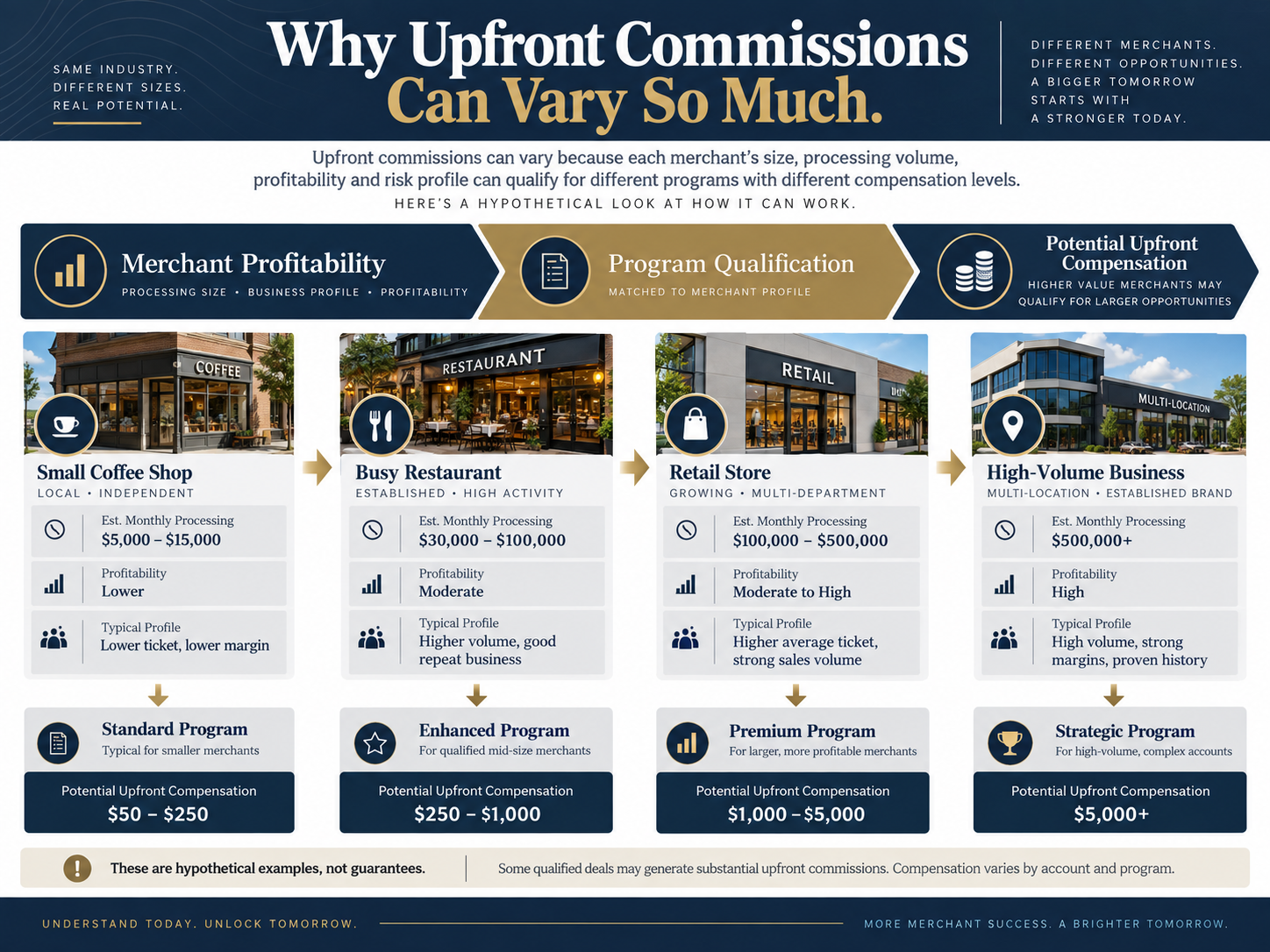
How Can a Merchant Services Deal Pay Thousands Upfront?
This is where understanding profitability matters.
Not every merchant account has the same value.
A small business processing $10,000 per month isn't economically identical to a larger merchant processing several hundred thousand dollars per month with substantial processing margin.
The more profitable the merchant relationship is expected to be, the more room there may be for an organization to provide a meaningful acquisition bonus.
As I mentioned earlier, one of the companies I currently partner with has a program capable of paying up to $10,000 upfront on an individual qualified deal based on the profitability of that account.
That can be an extremely attractive structure for the right salesperson.
Imagine you're an experienced closer with relationships that regularly put you in front of larger businesses. Waiting only for monthly residuals might not be the best use of your opportunity.
A substantial upfront commission can reward you for creating significant value immediately while still allowing you to participate in recurring economics according to the partner program.
But I want to emphasize the phrase:
Up to.
A $10,000 potential payout is not what every merchant produces. It depends on the account, pricing, profitability, processing behavior, qualification and program terms.
This is not an income guarantee.
It's simply an example of how dramatically different merchant-services compensation models can be.
What Is Merchant Services Residual Income?
Residual income works differently.
Instead of receiving all of the economic benefit from the sale immediately, you continue participating in the eligible monthly profit generated by the merchant according to your agreement.
Suppose your 50% residual share from a merchant averages $150 per month.
One month is $150.
Twelve months at that same hypothetical level would be $1,800.
If the merchant remains active longer, the account can continue contributing.
Then you add another merchant.
Then another.
Eventually you're not looking at one account anymore. You're looking at a portfolio.
This is what originally attracted me to merchant services and why I still believe the residual model is one of the most powerful aspects of this industry for salespeople.
You're creating the possibility for a sale you made in the past to continue contributing to income today.
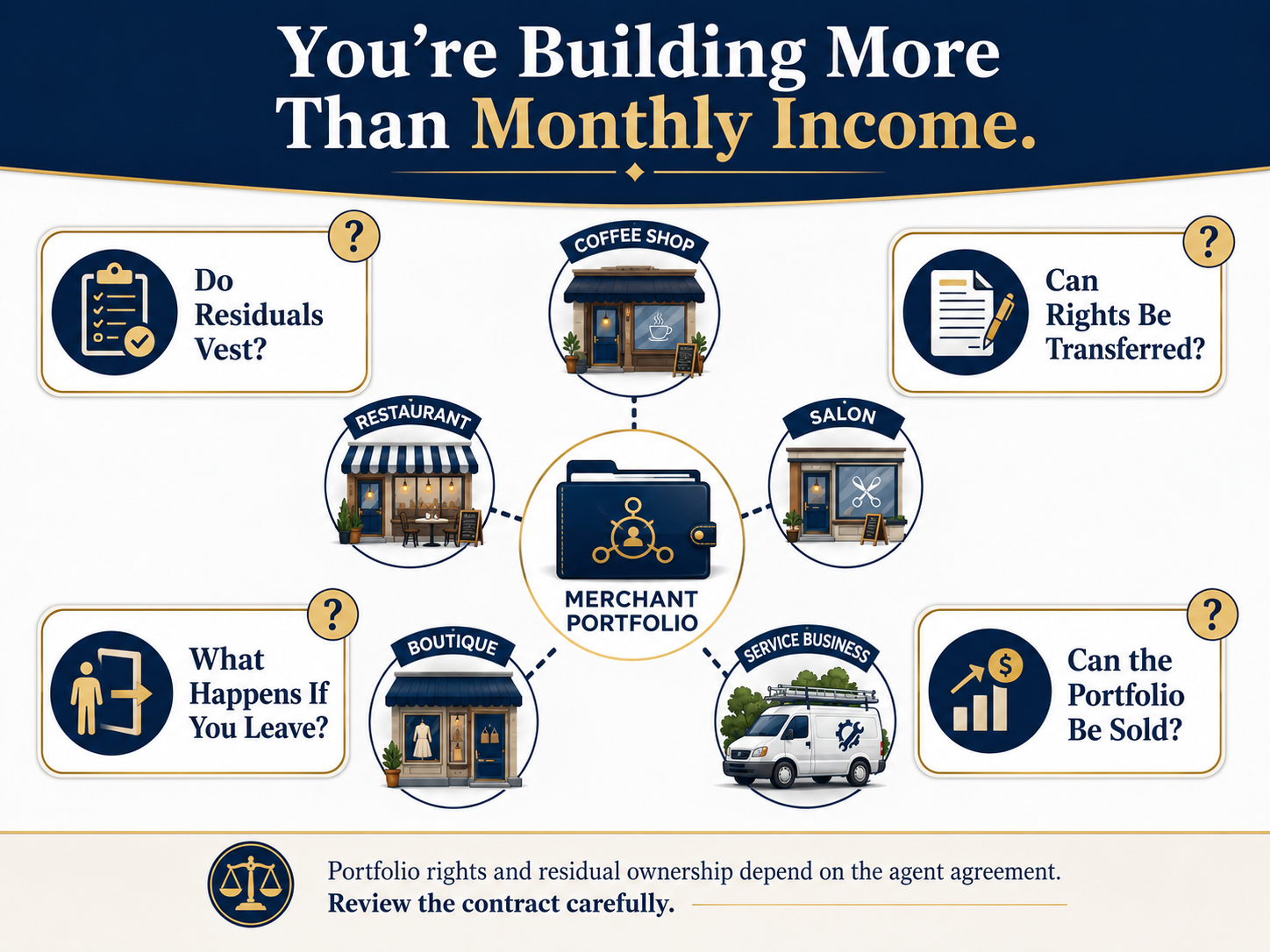
If you want to understand those rights more deeply, read What Lifetime Residuals Really Mean in Merchant Services.
The Advantage of Upfront Commissions: Cash Flow
The biggest advantage of upfront compensation is obvious.
You get paid sooner.
Businesses need cash flow.
Salespeople need cash flow.
If you're trying to build merchant services full time, getting paid several hundred or several thousand dollars for producing qualified business can make it easier to continue prospecting while the residual portfolio is still small.
This is especially relevant during the first year.
If you've only boarded ten merchants, your residual check may not yet be large enough to replace traditional commission income.
That doesn't mean the business isn't working.
The portfolio simply hasn't had enough time to mature.
Strong upfront compensation can help bridge that gap.
It can also make merchant services attractive to experienced high-ticket salespeople who are accustomed to receiving meaningful commissions when they close substantial business.
The Advantage of Residual Income: You're Building Something Behind You
Upfront commissions solve today's cash-flow problem.
Residuals solve a different problem.
They give you the ability to potentially build recurring income from a portfolio of merchant relationships.
That changes the economics of selling.
In many traditional commission jobs, January starts at zero.
You sell.
You get paid.
February arrives.
You start again.
Merchant services can work differently because the merchants you acquired during January may still be producing residual income while you're selling new accounts in February.
The same can happen in March.
And April.
Over time, that accumulation is what creates leverage.
It is also why I encourage agents to think beyond the amount of the first commission.
Do You Have to Choose Between Upfront Commissions and Residuals?
Not necessarily.
This is one of the misconceptions I want to eliminate.
There are merchant-services programs that provide upfront compensation and ongoing residual income.
The real question becomes how the economics are balanced.
A program focused heavily on upfront acquisition may structure compensation differently from a company whose primary value proposition is maximizing long-term residual economics.
Another partner may emphasize a combination of residuals, technology, merchant support, easier underwriting or specialized products.
That's why I don't believe an agent should search Google for:
"Which merchant services company pays the most?"
You first need to define what most means to you.
Most upfront?
Best residual economics?
Best support?
Best technology?
Best fit for your merchant vertical?
Best underwriting options?
Best opportunity to build a long-term portfolio?
Those can produce different answers.
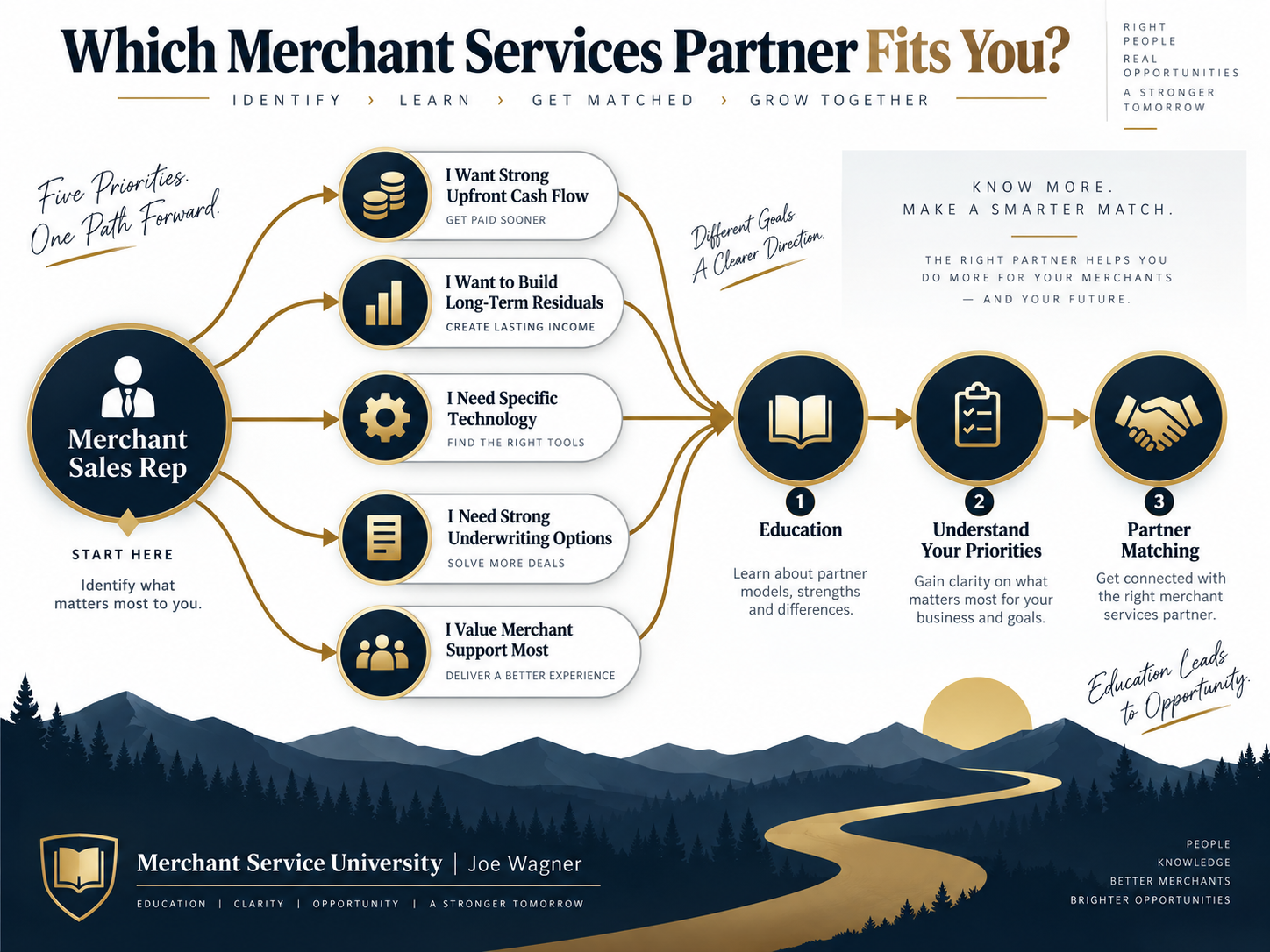
This Is Exactly Why I Match Agents With Different Partners
This is an important part of what I do today.
I'm not trying to force every merchant-services salesperson into one company.
I have developed relationships with different companies because agents have different strengths, circumstances and goals.
I may talk with one salesperson who tells me:
"Joe, I need upfront income. I can close big merchants and I want to get paid aggressively when I produce."
That person may be a very good candidate for the partner I work with that can provide upfront compensation reaching as high as $10,000 on certain qualified, profitable accounts.
Another salesperson may tell me:
"I'm not worried about getting the biggest check today. I want to build the strongest recurring portfolio I can."
That conversation may lead somewhere different.
Another agent may care most about a particular technology solution, vertical, underwriting capability, merchant-support structure or type of business they already know how to sell.
That can lead to another recommendation.
The important thing is that all of the partner relationships I consider for agents need to make sense economically. I'm not suggesting someone accept poor residual splits simply because they receive an upfront bonus.
The compensation needs to make sense as part of the total opportunity.
Why I Don't Start the Conversation With the Company
This is where my approach is different from traditional recruiting.
I don't think the first question should be:
"Which company should I join?"
The first question should be:
"Do you understand the business you're getting into?"
That's why my education process begins with Merchant Service University.
Learn how merchant services works.
Understand processing.
Understand pricing.
Understand the Schedule A.
Understand residual splits.
Understand vesting.
Understand agent agreements.
Understand the technologies businesses are buying.
Then we can have a much better conversation about which type of partner makes sense for you.
If I immediately tell a new salesperson to join Company X before they understand any of those concepts, how are they supposed to know whether Company X is actually a good opportunity?
They can't.
They're simply trusting the recruiter.
My goal is to change that process.
Education first. Partner selection second.
Who Should Prioritize Upfront Commissions?
There are several situations where I think upfront compensation deserves extra attention.
An experienced salesperson moving into merchant services may already have the ability to close significant business but may not want to wait months for portfolio income to develop.
Someone transitioning full time into merchant services may need cash flow while building residuals.
A salesperson with relationships among larger or highly profitable businesses may also be in a position where substantial upfront compensation makes the economics particularly attractive.
And some people simply prefer getting more of their compensation today.
There's nothing wrong with that.
Money today has value.
The mistake would be focusing exclusively on the upfront payment while ignoring everything that happens afterward.
Who Should Prioritize Residual Income?
Residual income should receive more weight if your primary objective is building a long-term merchant portfolio.
Maybe you're comfortable financially and don't need the biggest possible upfront payout.
Maybe your goal is to acquire 50, 100 or several hundred merchant relationships over time.
Maybe you want recurring income to become a larger percentage of your overall compensation.
In that case, the residual split, Schedule A costs, vesting language and merchant retention become particularly important.
A large signing bonus is exciting.
A strong portfolio can fundamentally change your business.
Don't Sacrifice a Great Merchant Relationship Just to Create a Bigger Commission
There is another danger with upfront compensation.
It can tempt agents to make decisions based on their own payout instead of what is best for the merchant.
Don't do that.
If one product pays you more upfront but another solution genuinely fits the merchant better, sell the right solution.
If aggressive pricing creates a larger acquisition bonus but makes the merchant likely to leave six months later, you've potentially damaged the long-term value of the relationship.
Your portfolio is built through retention.
I've spent enough time in this industry to know that the fastest way to destroy recurring income is to treat merchants like transactions instead of relationships.
Upfront compensation should reward good business.
It should never become the reason you recommend bad business.
Upfront Compensation Can Also Have Clawbacks
Before getting excited about a large upfront bonus, understand the conditions attached to it.
Some compensation programs may require a merchant to remain active, process a minimum amount or meet other qualification requirements.
If those conditions aren't satisfied, some or all of an upfront commission may potentially be clawed back depending on the agreement.
That isn't automatically unreasonable.
A company may be advancing you money based on the expectation that the merchant will generate future profitability. If the merchant never activates or immediately leaves, the economics behind the bonus may disappear.
The important thing is understanding the rules before spending the money.
I covered this more extensively in Merchant Services Contract Red Flags.
If somebody tells you that a merchant could create a $5,000 or $10,000 upfront commission, your next questions should include:
What qualifies the account?
When is the commission paid?
What could cause a clawback?
That's business due diligence.
Don't Ignore the Residual Split Just Because the Upfront Is Great
This is especially important with the high-upfront programs I work with.
A large upfront commission is attractive, but I still care about the residual arrangement.
If you're receiving a major acquisition bonus but giving up nearly all of the long-term economics, that's a very different business model.
That may make sense for someone who deliberately wants a transactional commission business.
But that's not what I'm trying to build for most merchant sales agents I work with.
I still want agents participating meaningfully in the recurring value they create.
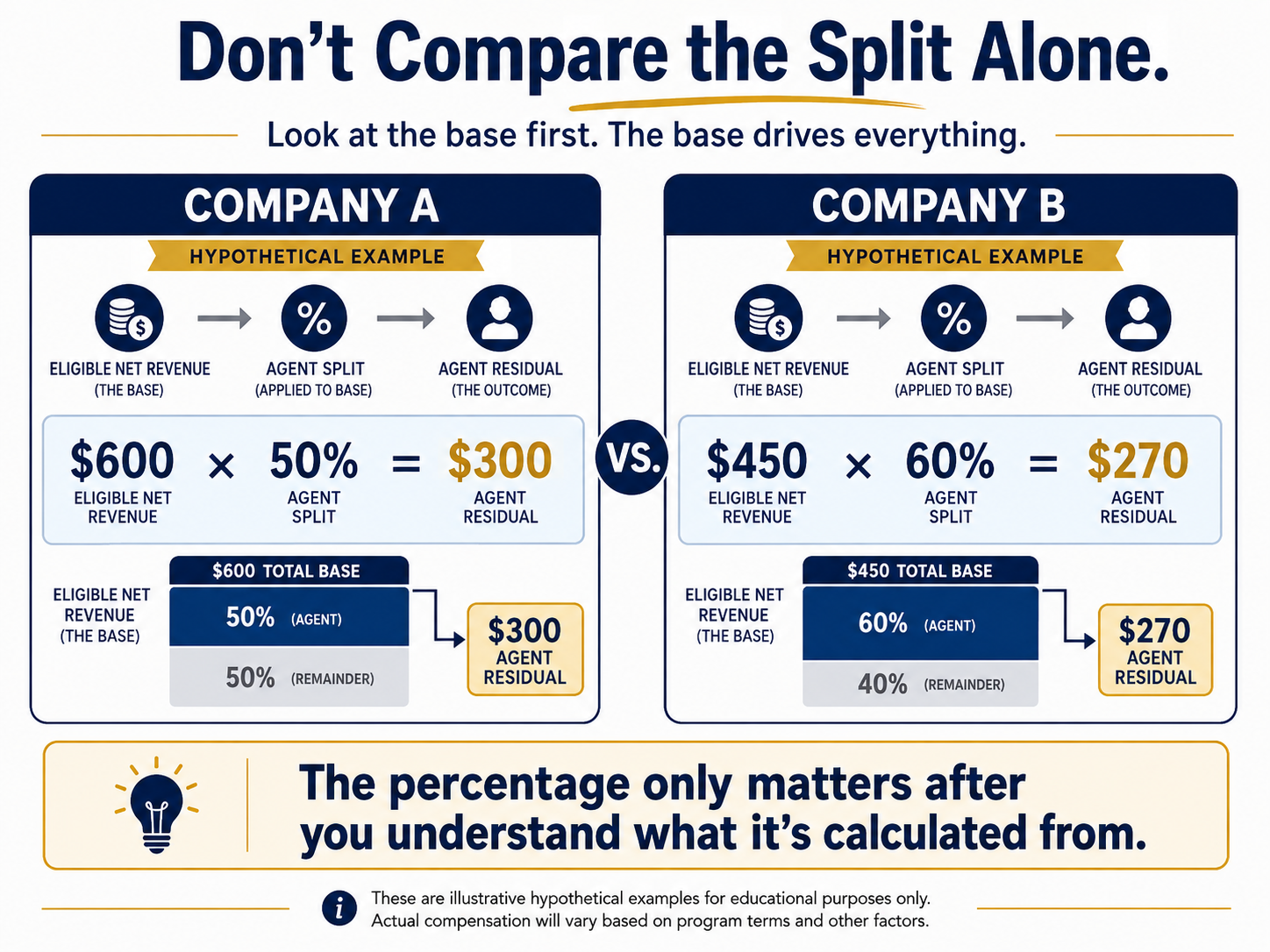
That's why I continue emphasizing reasonable residual structures, often in the 50%–60% range, while evaluating the upfront component separately.
If you haven't read it yet, my article on Merchant Services Residual Splits explains why the percentage itself also has to be evaluated alongside the costs underneath it.
The Best Compensation Plan Depends on Your Goals
Here's the simplest way I think about the decision.
If your number-one priority is cash flow now, put more weight on upfront compensation.
If your number-one priority is long-term recurring income, put more weight on residual economics, vesting and retention.
If you want both, look for a structure that provides meaningful upfront compensation without destroying the long-term residual opportunity.
Then evaluate everything else that affects your ability to actually keep the merchant:
technology, underwriting, support, product fit and merchant experience.
This is why the right answer isn't the same for every person.
Already Selling Merchant Services? I Can Help You Compare Your Options
If you're already selling merchant services and you're trying to figure out whether your current compensation structure makes sense, you don't have to evaluate it in a vacuum.
I work with new and experienced merchant sales representatives to help them understand what they're currently receiving and what type of partner arrangement may make more sense for the business they're trying to build.
Maybe you're happy with your residuals but want better upfront compensation.
Maybe you're making great upfront money but aren't building enough recurring income.
Maybe compensation isn't the problem at all and what you actually need is better technology, underwriting or merchant support.
Those are different problems.
They should have different solutions.
You can begin by learning through Merchant Service University, or if you already understand the industry and want to discuss your situation, reach out through JoeWagner.com.
Tell me what you're trying to build.
Then we can talk about what type of partner may make sense.
New to Merchant Services? Don't Choose a Compensation Plan Yet
If you're just entering the industry, I would actually encourage you to delay the company decision.
Start with education.
Merchant Service University exists specifically so you can learn the core industry before you're recruited into a particular organization.
The core education is free.
There is no obligation to join one company.
Learn how processing works, how agents are paid, what residuals mean, what a Schedule A does, how agent agreements work and how merchants actually buy payment technology.
Once you've completed that foundation, we can have a much more intelligent conversation about what you're looking for.
Maybe the high-upfront path makes sense.
Maybe a different partner makes sense.
That's the point.
Start Merchant Service University Free
https://merchantserviceuniversity.com
Learn first. Get certified. Then decide what you want to build.

Frequently Asked Questions About Merchant Services Upfront Commissions and Residuals
What are merchant services upfront commissions?
Merchant services upfront commissions are payments associated with acquiring, approving or activating qualified merchant accounts. The amount can vary substantially depending on the partner program, merchant profitability, processing volume and qualification requirements.
How much can a merchant services agent make upfront on one deal?
Compensation varies dramatically by program and merchant. One of the partner programs Joe Wagner works with can pay up to $10,000 upfront on certain qualified deals based on profitability and program terms. This is not the payout on every merchant and should not be interpreted as guaranteed income.
What is merchant services residual income?
Merchant services residual income is recurring compensation an agent may receive from active merchants according to the economics and terms of the agent agreement. Residual amounts can change with merchant processing activity, pricing, costs and retention.
Is an upfront commission better than residual income?
Neither is automatically better. Upfront commissions can provide immediate cash flow, while residual income can help an agent build recurring portfolio income over time. The best balance depends on the salesperson's goals and circumstances.
Can merchant services agents receive upfront commissions and residuals?
Yes. Some agent programs combine upfront compensation with ongoing residual income. The amount and structure of each varies by partner and merchant.
Can a large merchant services commission be clawed back?
Potentially. Some programs include conditions governing merchant activation, processing or retention. Agents should understand the program's clawback provisions before accepting or spending upfront compensation.
Is a 50% residual split good if I also receive an upfront bonus?
It can be. A clean 50% residual split can represent strong economics when the Schedule A costs, residual rights and other terms are competitive. The upfront bonus should be evaluated alongside the long-term residual opportunity.
Which merchant services company pays the best commissions?
There is no single answer because programs differ in upfront commissions, residual economics, technology, underwriting, support and merchant focus. The better question is which partner structure best fits the type of business the individual sales representative wants to build.
Can Joe Wagner help me choose a merchant services company?
Yes. Joe works with merchant sales representatives to understand their priorities and connect them with partner opportunities that may fit their goals, including relationships emphasizing substantial upfront compensation and others offering different advantages in residuals, products, technology, underwriting and support.
Do I have to join one of Joe Wagner's partners to take Merchant Service University?
No. The core Merchant Service University education is free and does not obligate a student to join one particular merchant-services company.
Where should a beginner start?
Begin by learning the industry through Merchant Service University. Understand processing, pricing, compensation, residuals and agreements before deciding which partner program best fits your goals.
Final Takeaway: Don't Ask Which Compensation Model Pays More—Ask What You're Trying to Build
Upfront commissions and residual income solve different problems.
Upfront commissions can create cash flow now.
Residuals can help create recurring income later.
A strong merchant-services business can potentially combine both.
One of the partners I currently work with can pay as much as $10,000 upfront on certain qualified, highly profitable deals. For the right salesperson, that's a tremendous opportunity.
But another salesperson may care much more about something else.
Maybe they want a particular technology.
Maybe they want specialized underwriting.
Maybe merchant support matters most.
Maybe they want to maximize the long-term portfolio.
That is why I've built relationships with multiple companies rather than pretending there is one universal "best merchant services company."
I specialize in helping agents understand what they're trying to accomplish and then looking at which partner structure makes the most sense.
The starting point is education.
Understand the industry.
Understand the compensation.
Understand the agreement.
Understand what you're building.
Then choose the company.
If you're new, start free with Merchant Service University.
If you're already selling merchant services and want help thinking through your current situation or potential partner options, reach out to me through JoeWagner.com.
Get educated before you get recruited. Then choose the opportunity that fits what you're actually trying to build.
About Joe Wagner
Joe Wagner has spent more than 16 years in merchant services and payment-processing sales, acquiring merchants, building recurring-revenue portfolios and developing sales organizations.
Today, his focus includes merchant-services education through Merchant Service University and helping new and experienced sales representatives understand the industry before evaluating potential processing partners.
Rather than treating one company as the answer for every salesperson, Joe works with multiple partner relationships and helps agents evaluate opportunities based on the type of compensation, technology, support and business model that fits their goals.
To continue learning, read How Merchant Services Agents Get Paid, understand Merchant Services Schedule A, review Merchant Services Residual Splits, and learn What Lifetime Residuals Really Mean.
You can also explore Merchant Sales Resources or start your education free through Merchant Service University.