
How to Choose a Merchant Services Agent Program: 12 Things to Compare
How to Choose a Merchant Services Agent Program: 12 Things to Compare
Choosing a merchant services agent program is one of the most important decisions you'll make when entering the payments industry, and it's also one of the easiest decisions to get wrong.
Most agent programs look great when they're being presented to you. One company talks about its residual split. Another talks about lifetime residuals. Another promotes huge upfront bonuses. Someone else tells you they have the best technology, the best support or the fastest underwriting in the industry.
The problem is that you're usually comparing those claims before you have enough industry knowledge to know which questions actually matter.
That's exactly why I believe you should learn merchant services before choosing a company. The better you understand payments, compensation, agreements and the role of an ISO, the harder it becomes for someone to recruit you based on one attractive number.
After more than 16 years in merchant services, I don't believe there is one company that is automatically the best merchant services agent program for every salesperson. A new agent who needs significant training may value something very different from an experienced producer with an existing portfolio. Someone selling restaurants may need different technology from someone targeting contractors. An agent who wants immediate cash flow may evaluate compensation differently from someone primarily focused on building long-term recurring income.
What I do believe is that there are specific areas every agent should compare before signing an agreement.
Here are the 12 I would focus on.

1. Understand the Residual Split—But Don't Choose Based on the Split Alone
Residual compensation naturally gets a lot of attention because recurring income is one of the biggest reasons people become interested in merchant services.
I believe a clean 50% residual split can be a perfectly strong foundation for an agent relationship if the economics underneath it are good. Depending on the agent's production, experience and relationship, there may also be situations where a 55% or 60% split makes sense.
What I don't believe in is automatically assuming that the highest advertised percentage represents the best opportunity.
Consider a simple hypothetical example. Company A gives you a 50% split on $600 of eligible monthly net revenue. Your share would be $300. Company B advertises a higher 60% split, but after its underlying costs there is only $450 in eligible net revenue. Your share would be $270.
The 60% program advertised the larger number while the 50% program actually produced more money.
That's why when someone tells me their residual split, my next question is always some version of: What is the split calculated from?
I go much deeper into this concept in Merchant Services Agent Commissions: How Agents Get Paid. If you don't yet understand net revenue, residual splits and the costs underneath them, learn those concepts before comparing companies.
For the type of agent relationship I like, I would much rather have a transparent 50% split with strong economics, good support and protected residual rights than a flashy percentage attached to a weak cost structure.

2. Ask to See the Schedule A and Understand the Economics Underneath It
If the residual percentage tells you how the remaining profit is divided, the Schedule A helps you understand the economics that exist before you get to that split.
Depending on the organization, a Schedule A may contain basis-point costs, per-transaction costs, monthly fees, authorization expenses, equipment economics and other components that affect what remains available to split.
This is where two programs that look nearly identical on a recruiting page can become very different businesses.
Suppose two companies both offer you 50%. If one has significantly higher underlying costs, your 50% may be worth substantially less. That's why I don't think you can intelligently evaluate a long-term residual opportunity without understanding the cost basis.
You don't necessarily need to become an expert capable of auditing every processing statement on your first day. But if you're going to spend years building merchants through a company, you should understand what your compensation is being calculated from.
A current 2026 comparison of ISO agent programs made the same broader point: the recruiting percentage has limited meaning without understanding the cost schedule beneath it.
We'll dedicate an entire article later in this series to Merchant Services Schedule A Explained, because it deserves much more attention than most new agents give it.
For now, remember this: a 50% split doesn't mean much until you know 50% of what.
3. Understand Exactly When Your Residuals Vest
If residual income is part of why you're building a merchant portfolio, vesting should be one of the first contractual concepts you understand.
Vesting generally relates to your contractual rights to continue receiving residual compensation under the terms of your agreement. Different organizations can structure those rights differently. Some relationships may provide immediate vesting. Others may include time requirements, production requirements or other conditions.
Don't simply ask a recruiter, "Are my residuals vested?" and accept a yes.
Ask what that means in the actual agreement.
What happens if you stop selling? What happens if you leave the organization? What happens if you haven't submitted an account in six months? What happens if the company terminates the relationship? Under what circumstances can residual payments stop?
Those are not questions you ask because you're planning to leave. They're questions you ask because you're planning to build something valuable.
One of the biggest lessons I discussed in What I Wish I Knew Before Becoming a Merchant Services Agent is that the agreement matters far more than the recruiting presentation.
If you're building recurring income, understand the language controlling that income before you start building it.
4. Find Out What "Lifetime Residuals" Actually Means
I like lifetime residuals.
What I don't like is assuming the phrase means the same thing everywhere.
A company may tell you that you receive lifetime residuals, but you still need to understand what conditions are attached to that statement.
Does the residual continue as long as the merchant processes? Do you have to remain an active agent? Are there minimum production requirements? Can the residual be forfeited under certain termination provisions? What happens if you retire? Can your residual rights be transferred? What happens to your portfolio if you die?
The answers should come from the agreement, not simply the recruiting presentation.
Current agent-program marketing continues to use phrases such as "lifetime residuals," while current industry commentary also warns agents to examine whether production requirements, termination clauses or other conditions affect those payments.
The phrase itself is attractive.
The contractual definition is what matters.
Later in this series, we'll break down what lifetime residuals actually mean in merchant services and the questions you should ask before assuming your future income is protected.
5. Determine What Rights You Actually Have to the Merchant Portfolio
This is where I want agents to start thinking like business owners.
If you're going to spend years prospecting, driving to businesses, making calls, building relationships and developing recurring revenue, you should understand what rights you have to what you've built.
"Portfolio ownership" can mean different things in different agreements. The merchant-processing contract itself may belong to the processor or acquiring organization while the agent has contractual rights to residual compensation associated with the merchant. Other agreements may contain provisions affecting assignment, transfer or sale of those residual rights.
The terminology matters less than the practical questions.
Can you sell your residual stream? Can it be assigned? Does the company have a right of first refusal? What happens if you leave? Can you continue receiving compensation? Can you contact the merchant? Are there non-solicitation restrictions? What exactly do you own, and what does the upstream organization own?
A 2026 legal overview of ISO agreements highlights portfolio ownership, compensation and termination provisions as major contractual issues because these agreements ultimately define where the economic rights sit.
If you want to review that perspective, the resource is here:
https://dilendorf.com/blog/attorney-iso-agreement-independent-sales-organizations.html
I don't expect new agents to negotiate every contract like a payments attorney. I do expect them to understand that the portfolio they think they're building may be governed very differently depending on the agreement they sign.

6. Evaluate the Agent Agreement as Seriously as the Compensation Plan
I would rather have a great agreement with a clean 50% split than a questionable agreement promising a bigger number.
Your agent agreement can govern years of your business relationship. It may address compensation, residuals, vesting, termination, non-solicitation, merchant relationships, production expectations, confidentiality, competing products, transfer rights and other important areas.
This is why comparing agent programs shouldn't happen in a 20-minute recruiting call.
Read the agreement.
If something doesn't make sense, ask questions. If something is important and the recruiter explains it verbally, find out where that protection exists in writing. If you're building something substantial or the contract contains provisions you don't fully understand, consider having an attorney review it.
I have been in this business long enough to know how easy it is for salespeople to get excited about the opportunity and treat the agreement as paperwork that needs to be signed so they can get started.
That's backwards.
The agreement isn't standing between you and the opportunity.
The agreement defines the opportunity you're actually accepting.
Blog #9 in this series will go much deeper into the specific questions I would ask before signing a merchant services agent agreement.
7. Compare Upfront Commissions Without Sacrificing the Long-Term Business
Upfront commissions matter, especially for a new agent.
Residual income may be the long-term attraction, but you still have expenses while you're building your portfolio. Immediate commissions and activation bonuses can help someone remain financially stable while their recurring income develops.
The mistake is evaluating the upfront payment in isolation.
Imagine one company offers a larger activation bonus but requires you to give up meaningful long-term residual economics. Another provides a smaller upfront payment but gives you a clean 50% residual relationship with stronger long-term economics. The right answer depends on your situation, but at least now you're comparing the tradeoff intelligently.
Also understand clawbacks.
If the company gives you an upfront payment and the merchant cancels shortly afterward, does some of that commission need to be repaid? What processing requirements must the merchant satisfy before the bonus is considered earned? When is it actually paid?
Upfront money can be valuable.
Just understand what you're trading for it.
For a deeper explanation of the relationship between current cash flow and long-term recurring revenue, revisit Merchant Services Agent Commissions.
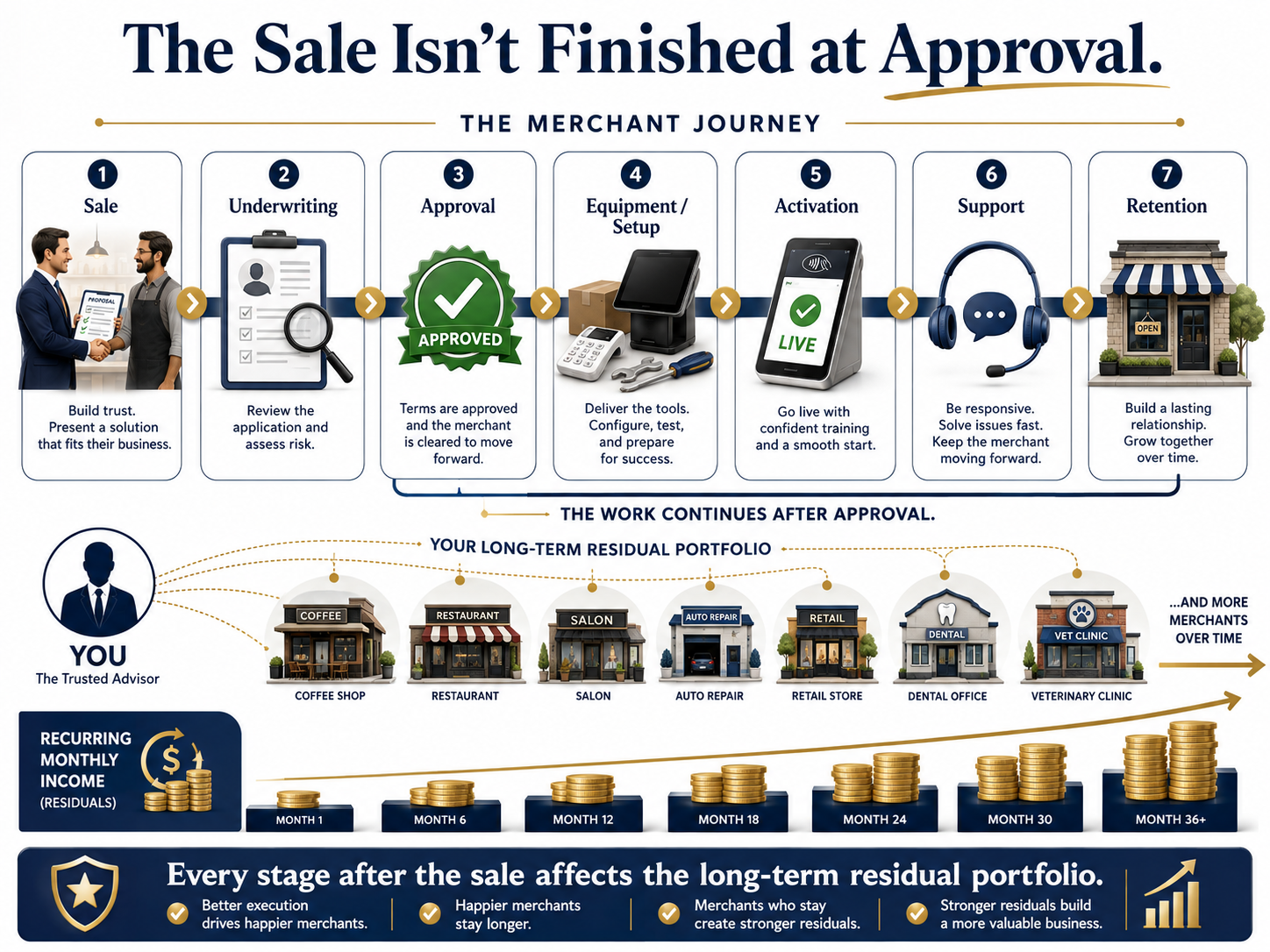
8. Test the Merchant Support Before You Trust the Recruiting Pitch
This is one of the areas I care about most because poor backend support has cost me time, energy and merchants over the years.
You can be an incredible salesperson and still lose accounts because the company behind you doesn't perform.
A merchant gets approved and then waits too long for equipment. Underwriting comes back several days later asking for documents that could have been requested upfront. The system isn't configured properly. Nobody answers when the merchant has a serious issue. Support sends the business through an endless call-center loop while the salesperson is left trying to save the relationship.
When that happens, the merchant doesn't care whose department made the mistake.
You brought them the company.
Your reputation is attached to the experience.
This is also one reason I explained in Merchant Services Agent vs. ISO that I prefer allowing a strong ISO to handle the backend heavy lifting while I focus on sales. But that model only works if the ISO is actually great at the backend.
Before putting serious production through an organization, find out how merchant support works. Learn who handles escalations. Understand what happens during installations. Ask existing agents what happens after the recruiting process is over and something actually goes wrong.
I will happily give an upstream organization its share of the economics if that company is genuinely providing infrastructure that allows me to close more merchants, retain more merchants and spend more of my time selling.
That's a fair trade.
9. Evaluate the Technology You're Actually Going to Sell
A compensation plan can be excellent and still leave you with products that are difficult to sell.
That matters.
Merchant services has changed dramatically. Some businesses still need nothing more than a simple terminal with fair pricing and dependable funding. Other businesses are evaluating complete commerce systems involving POS software, online ordering, appointments, inventory, customer management, loyalty, employee tools, ecommerce, reporting and automation.
A good agent program should give you products that make sense for the merchants you're targeting.
If you specialize in restaurants, does the organization have competitive restaurant technology? If you sell contractors, do you have invoicing and mobile payment solutions that make sense for their workflow? If you target retail businesses, can you provide inventory and ecommerce capabilities when needed?
Don't choose a program because somebody shows you a wall full of product logos.
Ask whether those products actually allow you to solve the problems your target merchants have.
This is where understanding how credit card processing works and learning modern commerce technology makes you a stronger agent. You're no longer evaluating the company only as a salesperson.
You're evaluating whether the tools they're giving you can create satisfied, long-term merchants.
10. Compare the Training Based on What It Teaches—Not How Much of It Exists
Every company says it has training.
The question is what the training actually teaches.
A library containing 200 videos isn't automatically better than a focused program containing the 40 things you genuinely need to know. Training should help you understand both the industry and the practical job of acquiring merchants.
I want a new agent to understand payment processing, pricing, merchant statements, compensation, agreements, products, prospecting, discovery, presentations, objections, follow-up and portfolio building.
Then the company-specific training should teach the agent how that particular organization's products, systems, underwriting and support procedures work.
Those are two different layers of education.
One teaches you the merchant services industry.
The other teaches you how to operate inside a particular company.
That's why I strongly believe independent education should come first. If the only merchant-services knowledge you possess came from the company currently recruiting you, you don't have much context for evaluating whether its compensation, products or contract are competitive.
You can start building that independent foundation through How to Learn Merchant Services Before You Choose a Company.
11. Understand the Underwriting and Onboarding Experience
Underwriting doesn't sound exciting in a recruiting presentation, but it becomes very important the moment you start selling.
You can work hard to acquire a merchant and still lose the deal during onboarding.
I've experienced situations where merchants provided everything requested, only for additional verification questions to appear days later. By that point I may have already moved on to the next market, while the merchant is wondering why the company I recommended can't get the account finished.
That creates friction.
A good underwriting department still needs to protect the organization from fraud and risk. I am not suggesting that every account should simply be approved because an agent sold it.
What I want is competence and communication.
How quickly are normal accounts reviewed? Are document requirements clear? Can agents get answers when something unusual happens? Are merchants left sitting in limbo? Does the company have solutions for different business types, or does every account become a battle?
The easier legitimate merchants are to board correctly, the easier it becomes for agents to create momentum.
That matters especially for new salespeople. Early wins help agents build confidence. A strong sale followed by a terrible onboarding experience does the opposite.
12. Ask Whether the Program Helps You Build the Business You Actually Want
This is the final comparison because it forces you to step back from all the individual features.
What are you actually trying to build?
Maybe you want a small portfolio of 40 or 50 strong merchants producing recurring income. Maybe you want to become a high-volume salesperson. Maybe you want to specialize in restaurants. Maybe you want to build a national agent organization. Maybe you're starting part-time and want to eventually make merchant services your full-time business.
Those goals can require different relationships.
A new salesperson may value training and support more heavily. An experienced agent may care more about economics, residual rights and technology. Someone building a large team needs an organization capable of supporting agents underneath them. Someone who wants to sell rather than manage backend infrastructure may prefer a strong ISO partner instead of trying to become registered themselves.
This is why I don't believe asking "What is the best merchant services agent program?" is enough.
The better question is:
"What is the best merchant services agent program for the business I'm trying to build?"
That's also why I still believe merchant services sales is worth considering in 2026, but only when someone approaches it as a real business rather than chasing an opportunity advertisement.
My View on a Good 50% Merchant Services Residual Split
Because agents get so distracted by percentages, I want to be very clear about my position.
I think a clean 50% residual split can be an excellent arrangement.
If the company gives me strong underlying costs, transparent reporting, vested residual rights, good technology, reliable merchant support, competent underwriting and infrastructure that allows me to focus on selling, I'm perfectly comfortable with my upstream partner making money alongside me.
They should make money.
They're providing the infrastructure.
The question is whether we're both being compensated fairly for the value we create.
If my relationship grows and production justifies moving to 55% or 60%, that's obviously worth discussing. But I'm not going to reject a genuinely strong opportunity because someone else waves a larger percentage in front of me.
I'd rather build 100 well-supported merchants at a clean 50% than constantly jump between companies chasing another five or ten percentage points while destroying momentum.
The portfolio is the goal.
The split is one component of the portfolio economics.
What I Would Never Choose an Agent Program Based On
I wouldn't choose a merchant services company because it had the biggest recruiting presentation, the loudest social-media presence or the highest percentage printed on a landing page.
I also wouldn't choose based solely on an upfront bonus, free equipment or a recruiter telling me the company has "lifetime residuals."
All of those things can be valuable.
None of them is enough by itself.
I want to know whether the economics are good, the agreement is fair, the residual rights are clear, the technology is competitive, the merchants are supported and the organization can actually execute once I start putting business through it.
That's the complete relationship.
How I Would Compare Two Merchant Services Agent Programs
If I had two potential partners in front of me today, I would price the same hypothetical merchant through both organizations and look at the actual economics.
If Company A offered a clean 50% split while Company B offered 60%, I would calculate what each one actually paid after its underlying costs. Then I would compare vesting, residual-survival language, merchant support, product options, underwriting, training and agreement restrictions.
I would also speak with active agents who have been there long enough to experience more than the onboarding honeymoon.
How quickly do merchants get boarded? Are residual reports accurate? Does support answer? Does underwriting communicate? Does the company change compensation unexpectedly? Do agents actually receive the support that was promised during recruiting?
I'd rather spend an extra week doing due diligence before sending business through a company than spend the next three years regretting an agreement I signed too quickly.
Want to Learn Enough to Compare Merchant Services Companies Yourself?
This is exactly the problem I created Merchant Service University to solve.
If you don't yet understand what a Schedule A is, how residuals are calculated, what vesting means, how processing works or what an ISO actually does, it's extremely difficult to evaluate one agent program against another.
You end up relying on the recruiter to explain why their company is the best.
I'd rather teach you enough to ask better questions.
Inside Merchant Service University, the core education covers merchant-services fundamentals, payment processing, pricing, merchant statements, residual income, modern commerce technology, merchant sales, prospecting and the larger business model.
The education is free, and there is no obligation to join one particular merchant-services company because you completed it.
Start Merchant Service University Free
https://merchantserviceuniversity.com
Learn the industry first. Understand what matters. Then compare your options.
Get educated before you get recruited.
Frequently Asked Questions About Merchant Services Agent Programs
What is a merchant services agent program?
A merchant services agent program is a business relationship that allows independent sales agents or sales organizations to acquire merchants for payment-processing and commerce solutions. Compensation, products, support, residual rights, training and contractual terms vary between programs.
What should I look for in a merchant services agent program?
I would evaluate the residual economics, Schedule A, vesting, lifetime-residual language, portfolio rights, agent agreement, upfront compensation, merchant support, technology, training, underwriting and whether the program fits the business you're trying to build.
Is a 50% merchant services residual split good?
A clean 50% residual split can be a strong arrangement when the underlying costs are competitive, residual rights are protected and the ISO provides valuable infrastructure and support. The percentage should never be evaluated without understanding what the split is calculated from.
Is a 60% residual split always better than a 50% split?
No. A 60% split calculated from a weaker net-revenue base can pay less than a 50% split calculated from stronger underlying economics. Compare actual dollar outcomes rather than percentages alone.
What is a Schedule A in a merchant services agent program?
A Schedule A generally outlines important economic terms and underlying costs associated with the processing relationship. These costs can influence the eligible revenue from which an agent's residual share is calculated.
What does vesting mean in a merchant services agent agreement?
Vesting relates to an agent's contractual rights to ongoing residual compensation. The conditions vary by agreement, so agents should determine when residuals vest and what happens to payments if production stops or the relationship ends.
Are lifetime residuals really lifetime?
That depends on the agreement. Agents should determine whether continued payments depend on production, active status, termination provisions or other contractual conditions rather than relying only on the phrase "lifetime residuals."
Should I choose the agent program with the highest residual split?
I wouldn't. The residual percentage is only one part of the economics. Underlying costs, vesting, portfolio rights, support, technology, merchant retention, upfront compensation and contractual terms can all influence the value of the relationship.
Does merchant support matter when choosing an agent program?
Absolutely. Poor underwriting, onboarding or merchant support can cause accounts to cancel, which directly affects an agent's residual portfolio. Backend operational quality should be treated as part of the compensation equation.
Where can I learn how to compare merchant services agent programs?
You can learn merchant-services fundamentals free through Merchant Service University. Understanding payments, residuals, pricing, statements, agreements and industry structure makes it much easier to evaluate agent programs independently.
Final Takeaway: Choose the Relationship, Not the Recruiting Pitch
A merchant services agent program can influence years of your career.
The right relationship can give you the infrastructure, technology, support and compensation structure to focus on acquiring merchants and building a valuable recurring-revenue portfolio.
The wrong relationship can make every part of the business harder.
That's why I wouldn't choose a company based on one number.
A clean 50% split with strong underlying economics can be better than a 60% split with expensive costs. A great compensation plan can be destroyed by poor support. Strong technology can be undermined by a bad agreement. "Lifetime residuals" don't mean much if the contract allows them to disappear under conditions you never understood.
Look at the whole relationship.
Understand the money.
Understand the agreement.
Understand the technology.
Understand the support.
Understand what happens when things go wrong.
Then decide whether that organization helps you build the business you actually want.
If you don't understand enough yet to make that comparison, don't rush the decision.
Get educated first.
About Joe Wagner
Joe Wagner has spent more than 16 years in merchant services and payment-processing sales, acquiring merchants, building recurring-revenue portfolios and developing sales organizations.
His focus today is helping agents understand the merchant-services industry before making long-term decisions about compensation, agreements, technology and partners.
If you're new to the industry, begin with the Merchant Services Sales Beginner's Guide, then read What I Wish I Knew Before Becoming a Merchant Services Agent. Learn how merchant services agents get paid, understand whether merchant services sales is worth it in 2026, learn the difference between a merchant services agent and an ISO, understand how credit card processing works, and review how to learn merchant services before choosing a company.
You can also browse the Merchant Sales Training Blog, explore additional Merchant Sales Resources, or begin learning free through Merchant Service University.
Free education. No obligation. Get educated before you get recruited.